
The Hero with a Thousand Faces: Complete Chapter-by-Chapter Summary

Welcome to the world of *The Hero with a Thousand Faces*. Imagine a little princess who loses her golden ball into a deep well. A frog appears, offering to retrieve it, but only if she agrees to share her bed and table. She laughs it off, thinking the frog is beneath her. Yet, that simple mistake is the "Call to Adventure"—a ripple from a suppressed desire that pulls us out of our comfort zone and into an unknown world.
This frog represents the power we often reject within ourselves. It looks ugly, but it holds the key to transformation. Whether it's a frog in a fairy tale or a terrifying monster in mythology, these figures signal that our old life is ending and a new journey is beginning. Think of the Buddha, who left his palace of luxury to seek enlightenment, or the tragic King Minos, who refused this call and ended up trapped in a deadly labyrinth.
The story isn't about avoiding the call; it's about embracing the change. When we resist, we build our own prison. But when we step forward, even with fear, we find guides—wise women, mysterious elders, or protective spirits—who help us navigate the darkness. They are the first allies in this great adventure, showing us that the path to a new life begins with taking that very first, uncertain step into the unknown.

Look at this image. On the left, we see the rigid, cold architecture of modern society—concrete blocks, circuit boards, a world built on logic and efficiency. But on the right, behind shattered glass, lies a swirling, ancient cosmos with roots reaching deep into the earth. This visual perfectly captures the central crisis we face today: the loss of our mythic instincts.
We have never been more connected. We possess science that reaches the stars and media that touches every corner of the globe. Yet, paradoxically, we have lost the map for our own souls. We have replaced the stories that once gave us meaning with data that tells us nothing about who we truly are.
The slide reminds us of a profound truth: a people without myths are like a person who cannot dream. Without these stories, we lose our creativity, and eventually, we wither. Myths aren't just relics of the past or dead cultures; they are the vital spiritual guides we desperately need right now. They provide the depth and the mystery that a purely rational world simply cannot offer.
When we strip away the myths that connect us to the deeper layers of existence, we fracture our own reality. We are left staring at a world that is technically advanced but spiritually barren. The image of the broken glass suggests that without these guiding narratives, our modern structures are fragile, ready to shatter under the weight of an empty existence. We need to reclaim the power of the myth to heal this divide and find our way back to a whole, integrated life.

Today's slide reveals a profound mirror of the human soul: the isomorphism between dreams and myths. As the text reminds us, myths aren't just primitive history; they are psychological analyses written in poetry and symbols. Think of it this way: a myth is a collective dream, a story our ancestors told to make sense of the chaos they saw in the stars and the sea. But a dream? That is your private myth, a unique narrative unfolding in your own mind.
Both rely on the same secret language of the unconscious. They use symbols to guide us past the surface of our daily lives, urging us to touch the untapped potential deep within our spirits. Whether you are navigating the labyrinth of a nightmare or decoding an ancient legend, you are essentially doing the same thing: bridging the gap between who you are and who you could be. This is the shared architecture of the human experience, connecting the personal and the universal in a single, illuminating vision.
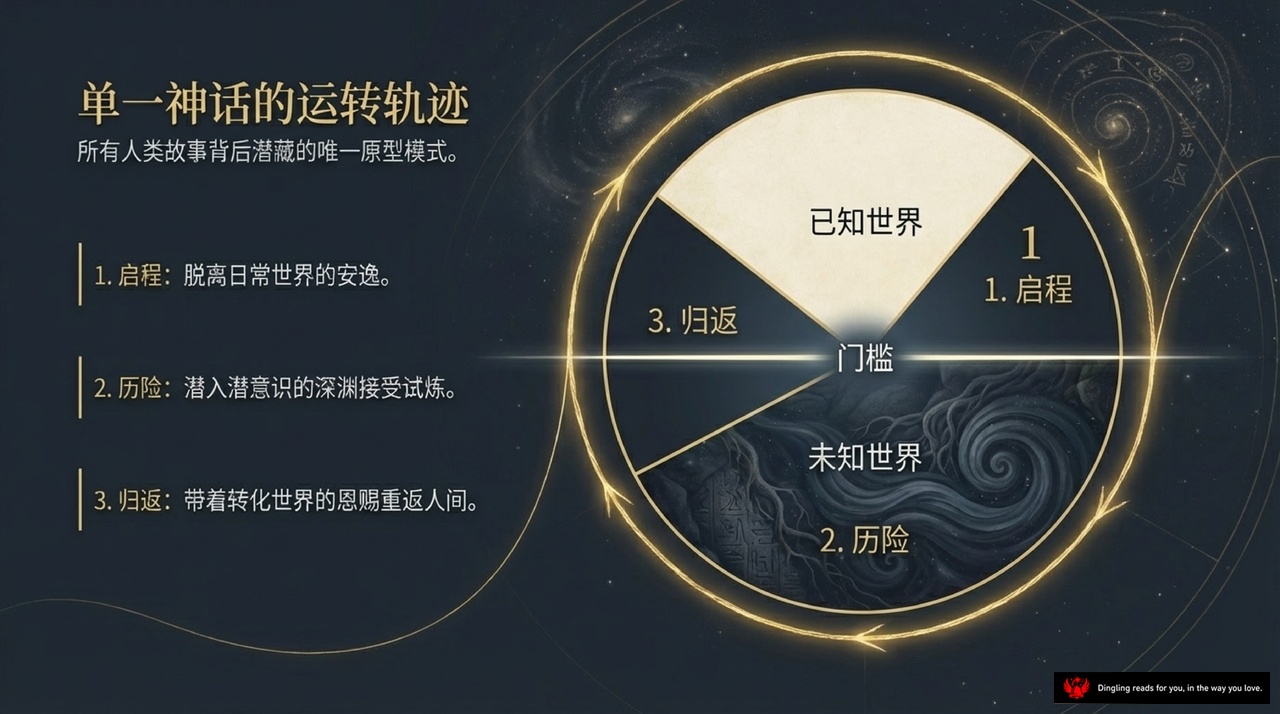
Have you ever wondered why every great story in human history—from ancient myths to modern blockbusters—follows the exact same path? It's not a coincidence. As we see on this slide, there is a single, universal trajectory behind all human stories. This is the Hero's Journey: a three-act cycle of Departure, Initiation, and Return.
First, we have the Departure. This is the moment the hero leaves the comfort of their known world. It's the call to adventure that pushes them out of their daily routine and into the unknown. Next comes the Initiation. Here, the hero dives into the depths of the unconscious, facing trials and transforming into something new. Finally, we have the Return. The hero doesn't just go back to where they started; they come back with a gift—a transformed perspective that can heal and renew the world they left behind.
This cycle isn't just about fiction; it's the blueprint for our own lives. We all leave our safe zones, face the terrifying unknown, and eventually return with wisdom that changes everything. This is the eternal rhythm of the soul.
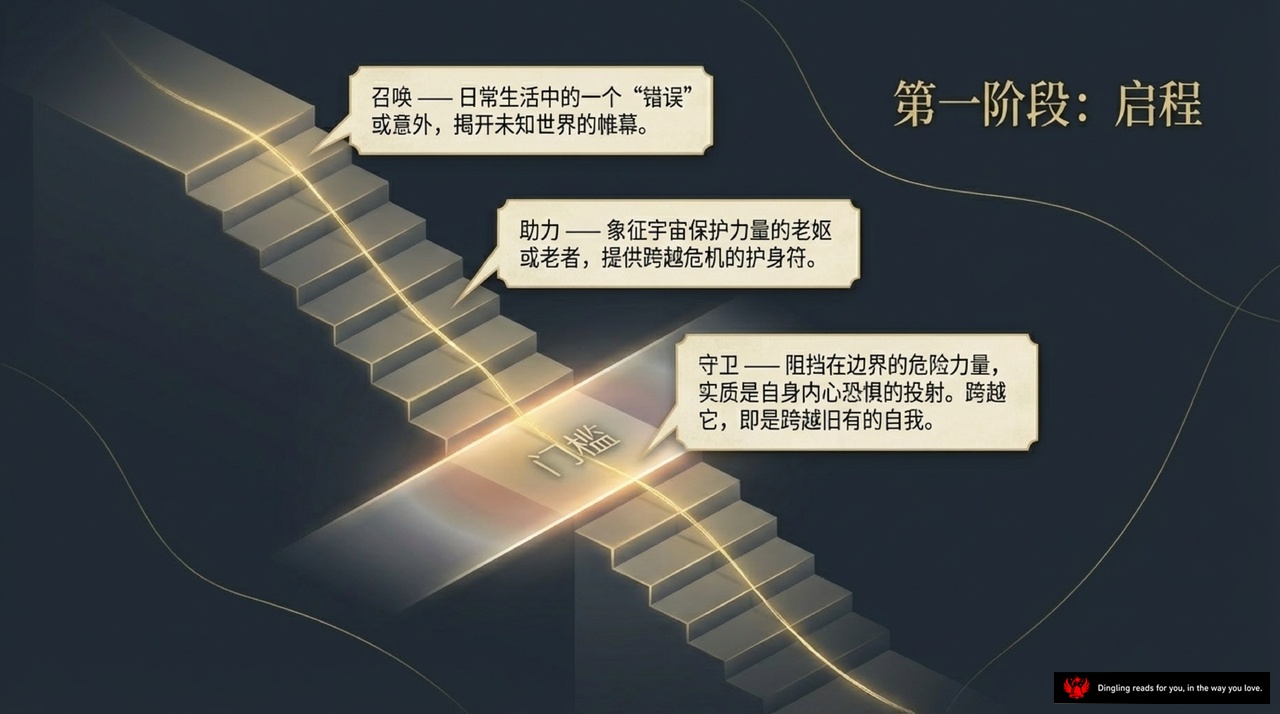
Let's talk about the "Threshold"—that critical moment where the hero steps from the known world into the unknown. Think of it as the edge of your comfort zone. In myths, these guardians are often terrifying figures: man-eating demons with eyes on their feet, the water father who brings disaster, or Pan, the god who fills travelers with inexplicable fear. But here's the twist: they aren't just obstacles to defeat. They are a protective boundary, a necessary filter.
Crossing this threshold isn't about brute force; it's about a fundamental shift in your identity. It represents the end of who you were and the terrifying beginning of who you could become. You face a choice: either get destroyed by the unknown or be reborn.
Look at the merchant leader from Benares who lost everything because he trusted a fake guide and threw away his water in the desert. Contrast that with the Five-Blade Prince, who faced a monster that could stick weapons to his skin. Instead of fighting, he tapped into his inner wisdom and courage, terrifying the monster into submission. Or consider the myth of the "Whale's Belly"—being swallowed whole. It's a powerful symbol of the womb, a place of death that leads to new life. To emerge from there, you must let go of your ego completely. As the hero moves through this dark gateway, they aren't just surviving; they are transforming, breaking through the limits of their old self to enter a realm where nothing is quite as it seems.
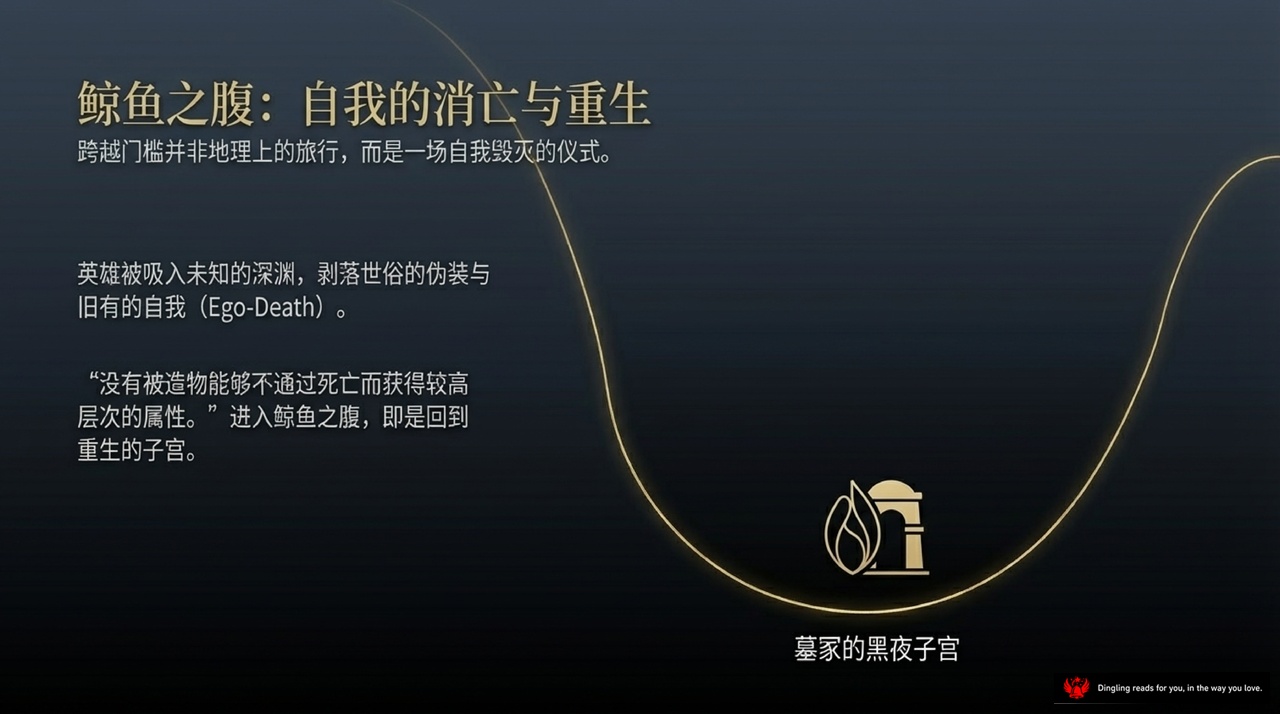
Welcome back. Today, we dive deep into the most profound and terrifying metaphor in mythology: the Belly of the Whale.
In the classic story of Jonah, the prophet is swallowed by the sea monster, only to emerge reborn. But this isn't just a literal journey; it represents a spiritual death and resurrection. As the slide suggests, crossing this threshold is not a physical trip, but a ritual of self-destruction. The hero is sucked into the unknown abyss, shedding all worldly masks and the old self we cling to. This is what we call "Ego-Death."
The text reminds us of a powerful truth: no being can gain higher attributes without passing through death. Entering the whale's belly is like returning to a womb—a dark, silent place where the old identity dissolves so something new can be born. This is why the slide calls it the "black womb of the tomb." It is a necessary sacrifice. We must destroy our limited, fearful selves to access a state of eternal reality. Without this internal death, there is no true rebirth.

Welcome to the second stage of the hero's journey: the Adventure. Think of this not as a simple trek, but as a peeling away of layers within the labyrinth of your own subconscious. The slide outlines three critical encounters that define this phase.
First, you face the "Clashing Rocks." This isn't just a physical barrier; it represents the collision of opposing forces in your life. You must navigate through these dualities to dissolve your obsession with the sensory world, realizing that the rigid boundaries you cling to are illusions.
Next, you encounter the Goddess. This figure embodies the infinite transformation and love of life itself. Meeting her is the ultimate test of your capacity to embrace the full spectrum of existence, from the terrifying to the nurturing. She holds the key to the "Ultimate Grace," but only if you are willing to surrender your ego.
Finally, you must confront your Father. This is the most profound challenge: breaking the idolatry of authority and facing the terrifying father figure within. By doing so, you achieve reconciliation with the will of the universe. As the myth shows, only by passing these thresholds—dissolving opposition, embracing the divine mother, and forgiving the father—can the hero truly transform and carry the gift back to the world.

The sacred coin has two sides: illusion and reality. In our inner world, gods and monsters are just projections of the mysteries we haven't yet solved. On the left, we see the fear of the self. When we cling tightly to our ego, the universe's power twists into a devouring monster—a tyrant that threatens to swallow us whole. This is the "Man-Eating Father" or the "Fox Spirit," the terrifying shadow of our own rigidity. But on the right lies the acceptance of the self. When a hero lets go of obsession and opens their heart, that same terrifying monster transforms into a benevolent father or a cosmic mother, granting wisdom and life. This balance is the true hero's journey: moving from the darkness of fear into the light of integration, realizing that the divine and the monster are actually the same force, waiting to be understood.
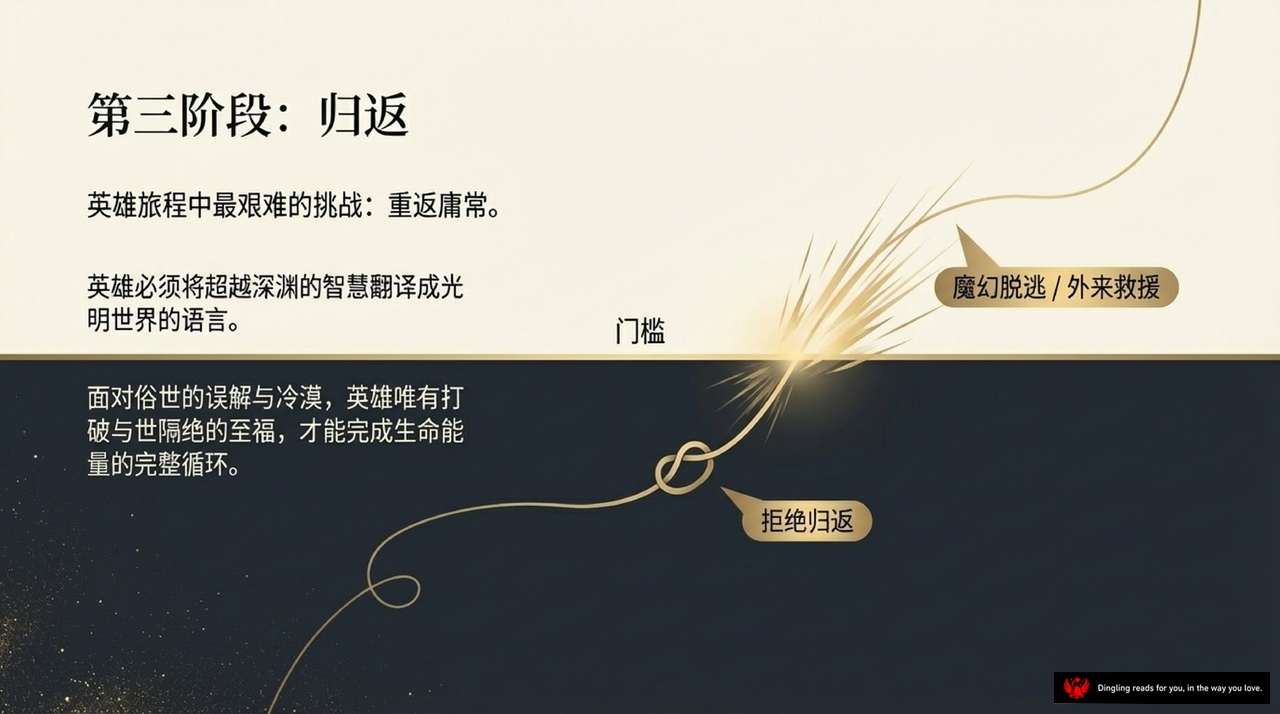
The third and final stage of the Hero's Journey is often the most overlooked, yet it presents the hardest challenge of all: the Return. It's not enough to conquer the unknown; the true test is bringing that wisdom back to a world that may not be ready to receive it. As the slide illustrates, the hero must cross the threshold back into the mundane, translating the profound insights gained in the depths of the unconscious into a language the ordinary world can understand.
But this return isn't always smooth. The slide highlights a critical fork in the road: the temptation to reject the return. Just like the Azaman Prince or the Princess Budur, who were trapped by their refusal to accept their destiny, many heroes find themselves unable to reintegrate. They might choose a magical escape or rely on external rescue, avoiding the pain of re-entering society. However, true transformation requires breaking through the isolation of the divine realm and facing the misunderstandings and coldness of the everyday world.
The hero must complete the full cycle of life energy. This means taking the power they gained—whether it's a magical token like the ring connecting two worlds, or a deeper spiritual awakening—and using it to heal the broken community. It's about realizing that the divine and the mundane are not separate; the "godly realm" was always a deeper layer of our own reality. Only by successfully navigating this final threshold can the hero achieve true wholeness, turning their personal liberation into a gift for everyone else.

True heroes don't run from the messy reality we live in, nor do they get lost in the clouds of pure spirituality. They are the masters of two worlds, moving effortlessly between the mundane and the divine. Think of it like a golden figure-eight: one loop is the material world, filled with our everyday struggles and ordinary lives; the other is the realm of spirit and myth, where eternal laws and sacred revelations live. The real hero dances between these two, seeing the eternal pattern within the chaos of the secular world. As the text beautifully puts it, the dancer of the universe doesn't stand heavily on the ground; instead, they leap lightly and joyfully from one world to the other. This balance allows us to embrace the common struggles of humanity while holding onto the higher truths that guide us. It's not about choosing one side over the other, but about integrating both to find a path that is both grounded and transcendent.
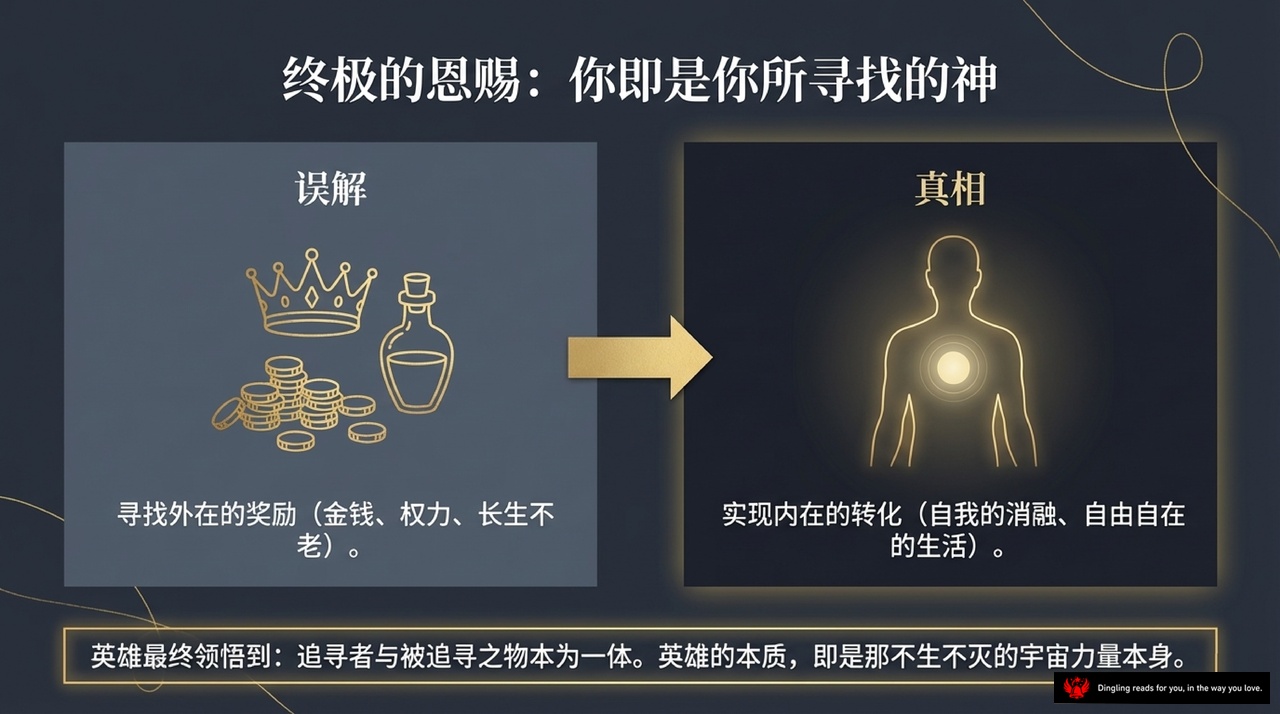
So, here is the ultimate twist: the greatest gift you can ever receive isn't something you find outside yourself. It's the realization that you are the god you've been searching for all along.
Look at the slide. On the left, we see the "misunderstanding." For centuries, we've been chasing external rewards—crown, gold, immortality. We think the divine is out there, something to be acquired or conquered. But the arrow points us to the truth on the right: the "reality." The true gift is an internal transformation. It's about the dissolution of the ego and the emergence of a life lived in total freedom.
Think about the hero's journey we've just discussed. In the end, the hero realizes that the seeker and the sought are one and the same. You don't find the divine; you discover that the divine is the very essence of your own being. That eternal, unchanging cosmic power isn't a distant deity sitting on a throne; it's the force pulsing right here in your chest.
This is the moment of awakening. It means stepping away from the illusion that we are separate, small things fighting for scraps of power or wealth. Instead, we recognize our own infinite nature. When you make this shift, you stop running from the darkness because you realize you are the light all along. You become the source of your own life, free from the need to prove yourself or hold onto anything. That is the ultimate grace: realizing that you were never lost, and you never needed to go anywhere to find the divine. You were already home.
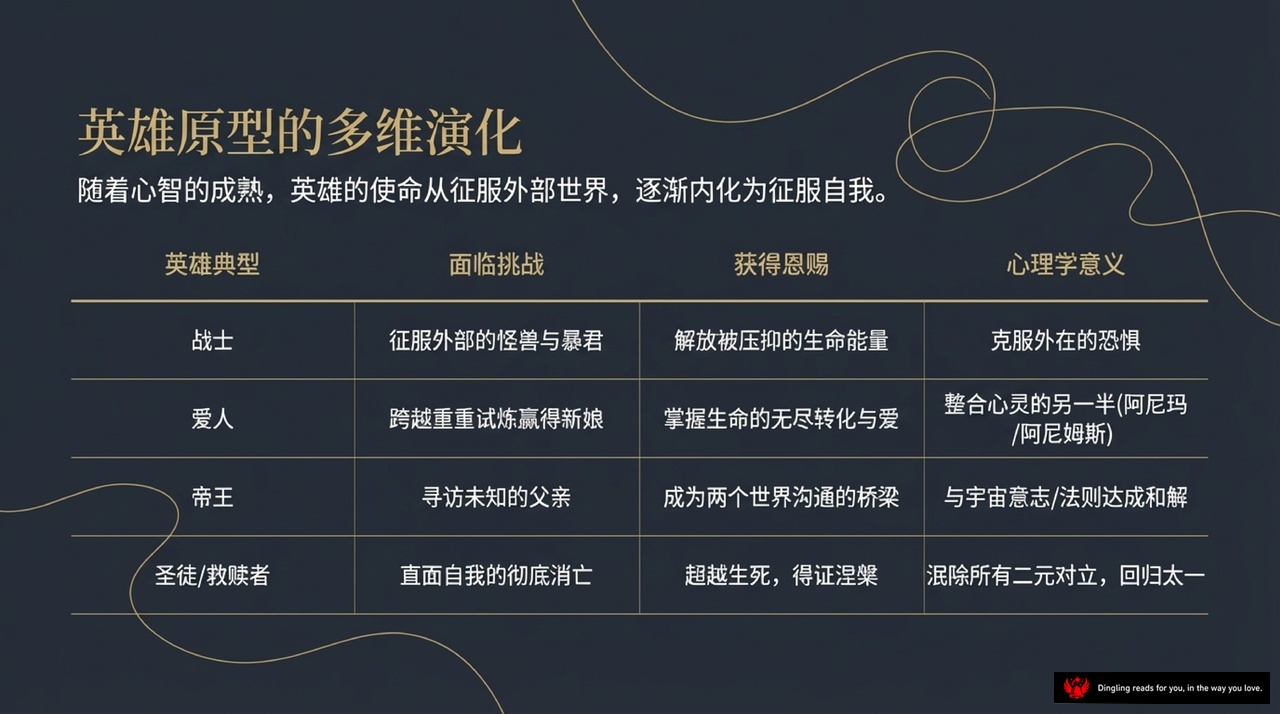
As we mature, the hero's journey undergoes a profound transformation. The mission shifts from conquering the external world to conquering the self. This slide breaks down four distinct archetypes that represent this evolution.
First, we have the **Warrior**. Their challenge is to slay external monsters and tyrants, liberating suppressed life energy. Psychologically, this represents overcoming the fear of the outside world.
Next is the **Lover**. Instead of fighting monsters, they face the challenge of winning a bride through great trials. Their reward is mastering the endless transformation of life and love. This mirrors the psychological integration of the soul's other half, often symbolized by figures like Anima or Animus.
Then comes the **King or Emperor**. Their quest is to seek an unknown father figure. By becoming a bridge between two worlds, they achieve reconciliation with the cosmic will or universal laws.
Finally, we reach the **Saint or Redeemer**. This is the ultimate stage. The challenge is facing the total dissolution of the self. The reward is transcending life and death to attain nirvana. Psychologically, this means dissolving all dualities and returning to the state of Oneness.
This progression shows that true heroism isn't just about external victories; it's an inward journey toward wholeness and unity.

The universe isn't just a static place; it breathes. Think of it as a grand, cosmic rhythm where the smallest spark in your mind mirrors the vast expansion of the cosmos itself.
Look at this cycle: everything begins from the void, flowing out into a complex, diverse world. But it doesn't stay there forever. Just like you, every being eventually returns to that formless source, dissolving back into the beginning.
Your life—your birth, your struggles, and your eventual death—isn't a random accident. It is a perfect, conscious microcosm of this universal cycle. We are simply the universe experiencing itself, descending from the infinite to live a human life, and then rising back up. This isn't just a theory; it's the fundamental truth of existence.
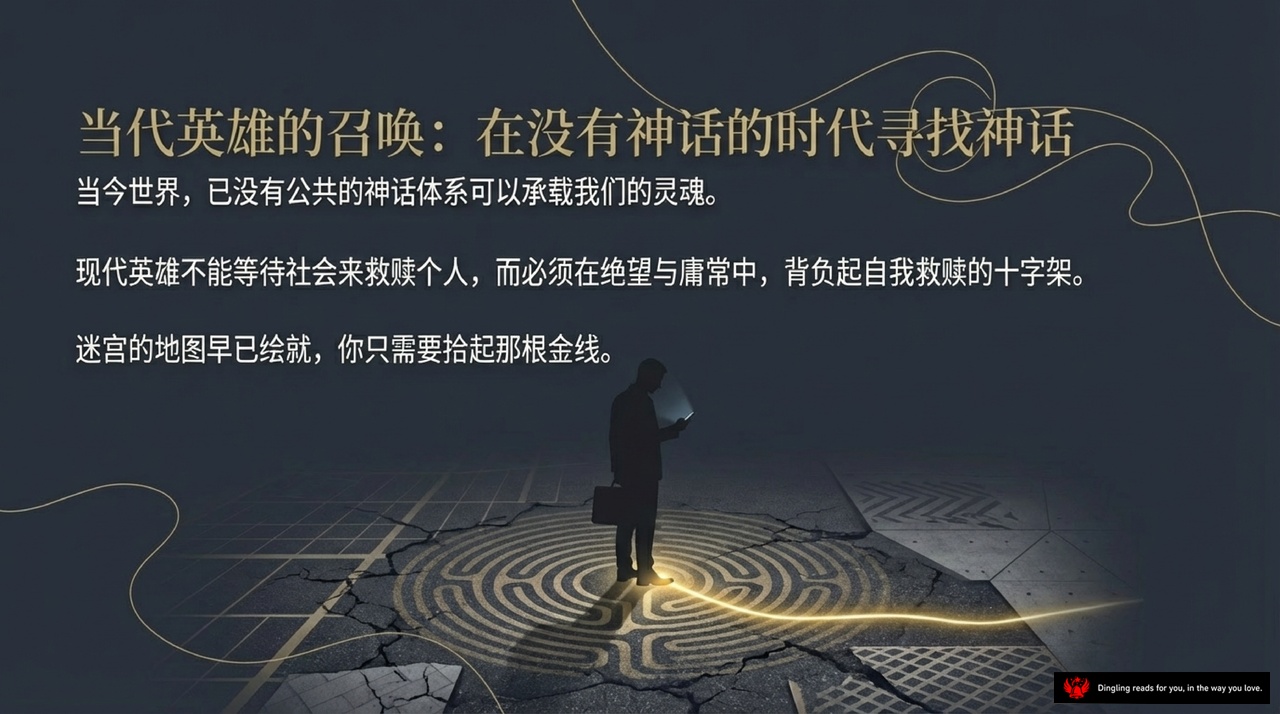
In today's world, we've lost the shared myths that once gave our souls a home. We no longer have a public story to hold us up. So, what does this mean for us? It means the modern hero can't wait for society to save them. Instead, we must carry our own cross of self-redemption, walking through the very despair and ordinariness of our daily lives.
Look at the image before us. We see a lone figure standing in a cracked, fragmented landscape, holding a glowing thread. This isn't just a maze; it's a map that was already drawn long ago. The path exists, but it's invisible until we choose to lift that golden thread. This is the call of the contemporary hero: not to find a new path, but to see the old one clearly and walk it.
When we reject this call, when we refuse to step into the unknown, we trap ourselves in a meaningless loop. We become like the mythical King Minos, who refused to sacrifice his bull, only to find his life turning into a death maze of his own making. Or like Daphne, who ran so hard from Apollo's call that she turned into a tree, losing her freedom forever. Refusing the call is just refusing to grow. It seals us off in a barren desert where no exit is possible.
But there is hope. Even when we refuse, a turn is always coming. In myths, a supernatural protector often steps in—whether it's a spider woman giving feathers to the Navajo twins, a wise old woman lifting a desperate man to the sun, or a fairy godmother guiding us out of the labyrinth. These figures remind us that we are never truly alone. They are the bridge between our trapped reality and the possibility of transformation.
The journey doesn't end when we cross the threshold into the unknown. The hardest part is the return. Bringing that spiritual wisdom back into our broken, ordinary world is incredibly difficult. Many heroes fail here, unable to translate their deep truths into language the world understands. But those who succeed—like the prince Azaman, who returned with a ring connecting two worlds—show us the way. They prove that even when the world feels like a chaotic maze, we can still find the thread. We can lift it, follow it, and bring the light back to ourselves and everyone around us.

The hero's journey is the eternal map of human consciousness maturing. We dive into the darkness of the subconscious to find light, then return to our mundane world to transform it. When the magic of myth peels away, the banality of everyday life becomes a new, heavy obstacle. The question is: Do you have the courage to embark on your own hero's journey? Are you ready to face the great dragon deep within your heart?
This slide captures the core truth: growth requires stepping into the unknown. Just as the frog in the fairy tale represents the rejected parts of ourselves that hold the key to transformation, we must confront our own inner shadows. The dragon isn't just a monster; it's the ultimate test of our willingness to evolve beyond our comfort zone. True maturity happens when we stop running from our fears and instead embrace them as the very path to wisdom. Your journey starts the moment you decide to look inward, even when it feels terrifying.