
The House of Morgan: Complete Chapter-by-Chapter Summary

Welcome to the epic story of one of America's most powerful families. This isn't just about money; it's about the very architecture of modern finance. The image you see here sets the stage: a grand, imposing building with towering columns, representing the "House of Morgan," and behind it, the chaotic, handwritten ledgers of a volatile market. This is the world Ron Chernow takes us into with his book, *The House of Morgan*.
It begins in the 19th century, with George Peabody, a Baltimore merchant who traveled to London to save American bonds from default. He didn't just save the day; he outmaneuvered British bankers and became the primary link between American states and European capital. But the real legend belongs to his protégé, Junius Morgan. When the French government needed emergency funding during the Franco-Prussian War, while other giants like Barings and Rothschild hesitated, Junius stepped in. He organized a syndicate, even using homing pigeons and balloons to pass messages, to secure a massive loan. His success made him a titan of London finance, complete with a luxury estate and a life of high society.
But the true architect of the empire was Junius's son, Pierpont Morgan. He inherited a legacy of strict discipline and a hunger for dominance. Pierpont didn't just follow in his father's footsteps; he expanded them. He took over the family's London business, eventually moving the center of power to New York, specifically to the famous address at 23 Wall Street. From this headquarters, he transformed the chaotic, failing railroad industry into a controlled system. He bought up bankrupt lines, merged them, and created a monopoly that controlled one-sixth of all American railroads. He was so powerful that he could single-handedly stop a war between two major railroads, settling disputes from his private yacht, the *Savannah*.
Pierpont's influence was so absolute that he became the de facto central bank of the United States. When the economy crashed in 1893, or when the government faced a gold shortage in 1895, it was Pierpont Morgan who stepped in to stabilize the nation, often at great personal cost and with little official recognition. He was a man of immense contradictions: a ruthless business strategist who was also a passionate philanthropist and an avid collector of art, buying masterpieces to elevate American culture to the level of Europe.
As the 20th century began, his son, J.P. Morgan Jr., took the helm. He faced new challenges, from the sinking of the Titanic to the intense scrutiny of government hearings that exposed the sheer scale of his financial power. But the story of the House of Morgan is far from over. It evolved through decades of crisis, from the Great Depression to World War II, and eventually split into the modern giants we know today: J.P. Morgan, Morgan Stanley, and Morgan Stanley's sibling, Morgan Grenfell. This is the history of a dynasty that shaped the world, built on ambition, resilience, and the relentless pursuit of power.

Welcome to the transformation of capital, a century and a half of financial evolution driven by one family. This timeline maps the metamorphosis of the Morgan empire, starting with the roots of trust in 1838. During this Baronial Age, capital moved from London to America based strictly on personal character, led by figures like George Peabody and Junius Morgan.
As we move forward to 1890, we enter the Age of Monopolies under J. Pierpont Morgan. Here, the bank acts as America's unofficial central bank and corporate architect, solidifying the sovereign bank era. The timeline then shifts to 1913, marking the Diplomatic Age where Jack Morgan becomes the figurehead. In this Shadow Government phase, the family finances World Wars and acts as state proxies, wielding immense influence behind the scenes.
Finally, the era fractures in 1933, ushering in the Casino Age. By 1990, we see the legacy of Morgan Stanley and J.P. Morgan & Co. In this final stage, deregulation, hostile takeovers, and global commoditized capital define a new reality. The family's unified grip on finance dissolves, transforming from a single dynasty into competing global powerhouses.

When Character Was Capital, the foundational philosophy forged by Peabody and Junius Morgan, relied on an unwritten code where bankers didn't solicit business but waited to be asked, demanding exclusive loyalty and offering absolute guarantees. This approach wasn't just tradition; it was an economic necessity born from capital shortages in the US and information asymmetry in London, positioning the banker as the essential bridge between the two worlds. In an era with no SEC and limited financial data, European investors bought American state and railroad bonds based solely on the personal reputation of George Peabody and Junius Morgan, trusting that if a railroad defaulted, the banker would step in to manage it. This deep personal trust replaced complex regulations, allowing the Morgan family to build an empire where character itself became the most valuable currency available.

The visual you see here perfectly captures the dual nature of J.P. Morgan's legacy: the architect of the "Financial Sovereign" era. At the center of this golden solar system is Jupiter himself, J.P. Morgan, who didn't just finance companies; he fundamentally reorganized the American economy.
Let's look at how he did this. On the left, we see the "Railroads," or the Voting Trust. Morgan pioneered this mechanism to wrest control away from reckless railroad barons, stabilizing ruinous price wars and protecting European bondholders. It was about replacing chaotic competition with orderly, banker-managed monopolies.
To the right, we see the rise of "Industrial Monopolies." Morgan reorganized fragmented industries into behemoths, culminating in the creation of U.S. Steel, the world's first billion-dollar corporation. This was the era of "Morganization," where he believed that only through such consolidation could stability be achieved.
Finally, at the bottom, we see "The Federal Backstop." Morgan rescued the U.S. Gold Standard in 1895 and personally halted the Panic of 1907 by locking prominent bankers in his private library until a bailout was secured. He effectively became the nation's de facto central bank, stepping in whenever the system threatened to collapse.
In short, J.P. Morgan believed that by creating a controlled financial order, he could bring stability to a volatile nation. He wasn't just a banker; he was the ultimate stabilizer of the American economy.
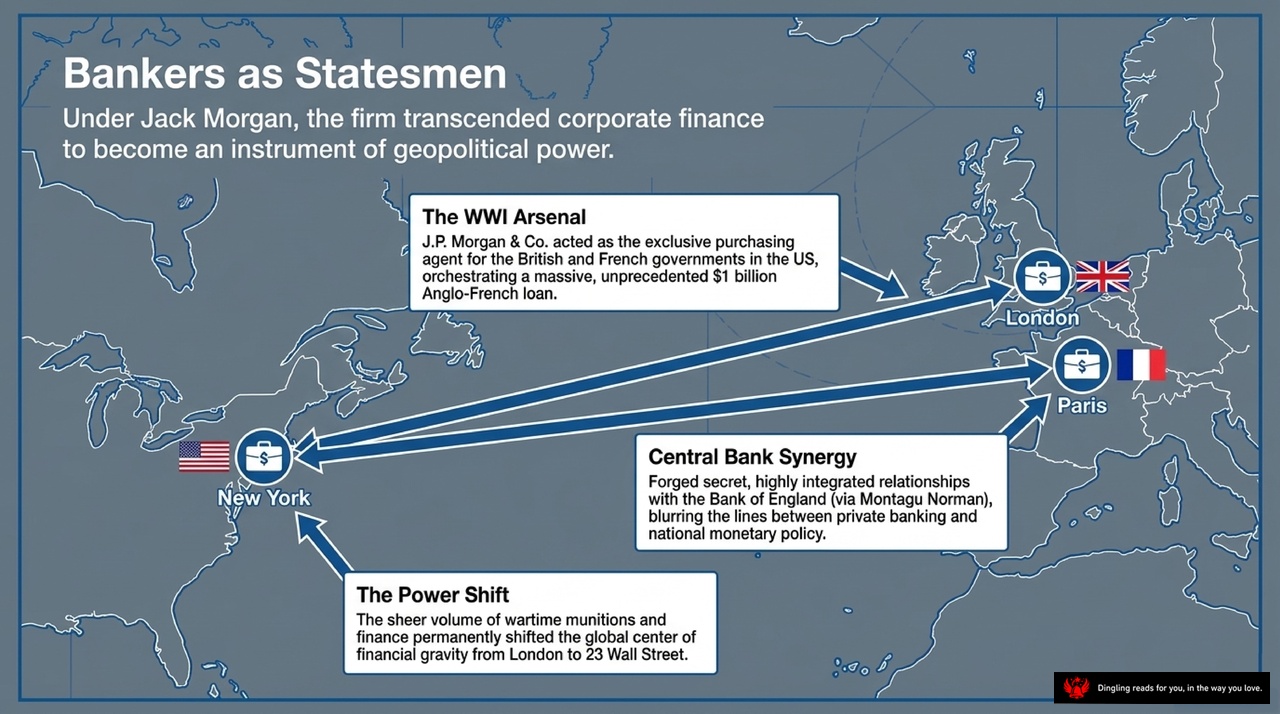
Under Jack Morgan's leadership, J.P. Morgan & Co. transcended traditional corporate finance to become a true instrument of geopolitical power. Look at this map: it illustrates how the firm orchestrated a massive, unprecedented $1 billion Anglo-French loan during World War I, acting as the exclusive purchasing agent for both British and French governments. This wasn't just business; it was the "WWI Arsenal," effectively arming the Allies while shifting the global center of financial gravity permanently from London to 23 Wall Street.
This shift created a unique "Central Bank Synergy." The firm forged secret, highly integrated relationships with the Bank of England, blurring the lines between private banking and national monetary policy. By managing the sheer volume of wartime munitions and finance, Morgan didn't just lend money; he dictated terms. The result was a permanent power shift, establishing New York as the new world capital of finance. In this era, bankers were no longer just merchants of capital; they were statesmen, wielding influence that rivaled any government.

The image you see here captures the dramatic fracture of the Morgan Empire, a moment where government intervention physically shattered what was once the ultimate Money Trust. The central focus is the Glass-Steagall Act of 1933, depicted as a massive hammer striking the foundation of "The House of Morgan." This legislation didn't just tweak the rules; it fundamentally divided the financial world by separating commercial banking from investment banking.
As a result of this split, the monolithic empire fractured into distinct pieces. On the left, we see J.P. Morgan & Co. retaining its core identity as a commercial bank, holding onto massive deposits, trust business, and blue-chip corporate lending. On the right, the investment arm was spun off as Morgan Stanley, inheriting the prestigious underwriting business but starting with just $7.5 million in capital. Another piece, Morgan Grenfell, was left to operate independently in London, gradually losing the immense advantage of its transatlantic umbilical cord.
This division was the direct result of a powerful catalyst: public outrage over the Great Depression and the shocking revelations of the Pecora Hearings. These events led the Roosevelt administration to dismantle the old system, forcing the family to choose sides. Ultimately, the era of the unified, all-encompassing Morgan empire came to an end, replaced by a competitive landscape where the once-invincible House of Morgan had to rebuild itself in two separate, and now rival, forms.

From Polite Underwriter to Aggressive Predator: How Morgan Stanley adapted to survive a commoditized, post-war landscape.
On the left, we see the legacy of "The Polite Underwriter." Back in the 1950s, J.P. Morgan operated as the ultimate Syndicate King. It wasn't about selling to the masses; it was a pure wholesale game for the elite. Figures like Perry Hall ran the show, demanding that position as the sole lead manager on those prestigious tombstone ads. Their power didn't come from low prices or marketing; it relied entirely on institutional prestige and historical loyalty. In that era, you didn't compete on cost; you competed on pedigree.
But look at the right side: The M&A Machine. The landscape shifted dramatically between the 1970s and 1980s. As underwriting revenues stagnated, Morgan built a formidable Mergers & Acquisitions department to fight for survival. They shattered the old gentleman's code by engaging in aggressive, hostile takeovers. This was the era of the "eat what you kill" mentality. They adopted a hyper-competitive, meritocratic culture where results mattered far more than traditional pedigree or family names.
This slide captures the great transformation of the financial world. We moved from a club of polite, exclusive bankers who valued tradition above all, to a ruthless predator machine that valued aggression and profit above everything else. This shift didn't just change how Morgan worked; it fundamentally rewrote the rules of Wall Street, turning the industry from a gentleman's game into a high-stakes battlefield where only the most aggressive survived.

The Death of Noblesse Oblige. As finance grew complex and transactional, the unwritten gentleman's code eroded under modern pressures.
Look at this timeline of breaches. First, in 1938, we see the Whitney Embezzlement. Richard Whitney, an aristocratic broker for Morgan, was caught embezzling. The image clearly shows a broken shield labeled "Breach." Morgan partners secretly tried to cover it up to protect their class, exposing the dark side of clubby loyalties.
Then, in 1964, the Texas Gulf Sulphur Case. A Morgan partner inadvertently sparked a massive insider trading scandal regarding a Canadian ore strike. This marked the SEC's severe crackdown on the cozy, informal sharing of corporate secrets. Notice the gavel and the "Insider Trading" stamp in the graphic.
Finally, in the 1970s, the Adrian Antoniu Affair. A Morgan Stanley M&A banker was caught leaking takeover targets to conspirators. This definitively proved that institutional prestige could no longer guarantee individual integrity. The lock icon labeled "Corruption" illustrates this final breakdown.
These three events—embezzlement, insider trading, and corruption—mark the end of an era where being a member of the club was enough. Trust was no longer enough; rules and regulations had to replace old-fashioned honor.

Imagine a world where the rules of power flipped completely upside down. For over a century, the story of American finance was written by the banks, but by 1980, the script had changed entirely. Look at this seesaw: in 1900, the Bank side was heavy, representing the "Baronial Era" where bankers dictated strategy and sat on corporate boards. But by 1980, the Corporation side had soared, marking the arrival of the "Casino Era."
This shift wasn't just a minor adjustment; it was a fundamental inversion of power from Wall Street to Corporate America. In the old days, corporations were capital-starved and financially immature, relying exclusively on the bank's reputation to sell bonds. But as companies grew, they generated immense internal cash flows and built strong credit ratings. Suddenly, they didn't need the banks anymore. The rise of commercial paper allowed corporations to bypass banks entirely, forcing financial institutions into cutthroat competitive bidding, often through Dutch auctions.
The result was a permanent end to the exclusive, lifelong relationships that once defined the industry. In the old Baronial Era, bankers held exclusive loyalty with their clients. In this new Casino Era, corporate treasurers forced banks to fight for every dollar, turning the financial system into a marketplace where the master had become nothing more than a vendor.

The slide before you maps the dramatic transformation of banking from a club for the elite to a high-speed global machine. We see three distinct eras: The Baronial, The Diplomatic, and finally, The Casino.
In the early 1900s, banking was about "Personal Character & Trust." As the text describes, this was the era of the "Baronial" banker like J.P. Morgan himself, who acted as a "State Proxy" during wartime. His power wasn't built on spreadsheets, but on "Patriotism & Discretion." He was the "Master" of the client dynamic, stabilizing economies through sheer personal will and moral authority, often acting as a private central bank.
But as we move to the 1970s and 80s, the paradigm shifts completely. The "Casino Era" replaces honor with "Information & Capital Speed." The banker is no longer a master or a statesman, but a "Vendor." The market structure explodes from stable sovereign loans into "Hostile M&A & Eurodollars." The ethical code hardens into a brutal "Eat what you kill" mentality.
This slide captures the exact moment the "Gentleman's Club" of Wall Street died. The era of the quiet, private partner giving advice to kings and presidents ended. In its place rose a new world where bankers became aggressive deal-makers, driving hostile takeovers and leveraging debt to the limit. The slide illustrates how the core currency of finance changed from the banker's reputation to the velocity of money, fundamentally altering the nature of power and risk in the modern world.

Reclaiming the Throne via Debt. This slide illustrates how Wall Street returned to owning companies to combat shrinking margins through Leveraged Buyouts, or LBOs. Unlike the Pierpont Morgan era, which sought industrial stability through monopolies, the LBO era relied on dismantling assets and cutting costs to service massive debt loads.
The process starts with The Bridge Loan. Here, the bank risks its own capital to provide immediate, massive funding to buy a target company. Next comes The Junk Bond. The bank issues high-yield debt to the public to refinance that bridge loan, earning massive underwriting fees in the process. Finally, we reach The Equity Stake. The bank takes an ownership stake in the acquired company, regaining the board control they enjoyed in Pierpont Morgan's era.
This cycle allowed banks to leverage their balance sheets, effectively using debt to buy back the very companies they were supposed to just lend to. It was a high-risk, high-reward strategy that defined the financial landscape for decades, prioritizing short-term returns and operational efficiency over long-term stability.

Picture: Capital Without Borders. Geographical constraints dissolved into a 24-hour global trading machine. The map highlights New York, London, Tokyo, and Latin America, connected by glowing lines. Three key boxes: "The Two Londons," "The Petrodollar Boom," and "The Loss of the Mystique."
Manuscript:
"In the 1970s, the race to recycle OPEC wealth led to massive, reckless sovereign lending to Latin America, prioritizing pure transaction volume over rigorous risk assessment."
"Capital became a pure commodity. Success was no longer dictated by historical pedigree or a Wall Street address, but by the size of the balance sheet and the speed of the trading floor."
"The quiet, clubby Gentleman's City of Morgan Grenfell was overrun by a second City—a ruthless, meritocratic arena dominated by American banks chasing Eurodollars."
Script:
Welcome to the era of Capital Without Borders. Look at this map. The old world order is gone. Geographical constraints have completely dissolved, replaced by a relentless, 24-hour global trading machine. The lines connecting New York, London, Tokyo, and Latin America aren't just data; they are the veins of a new financial superorganism.
First, notice the transformation in London. The traditional, quiet, clubby Gentleman's City—once the domain of Morgan Grenfell and old money—was overrun by a second City. This new arena was ruthless and meritocratic, dominated by American banks aggressively chasing Eurodollars. It wasn't about who you knew; it was about who could move capital fastest.
Then, look at the driver of this boom: The Petrodollar Boom. In the 1970s, the race to recycle OPEC wealth led to massive, reckless sovereign lending to Latin America. The focus shifted entirely to pure transaction volume, completely prioritizing speed over rigorous risk assessment. Money was no longer scarce or mysterious; it was a fluid resource to be deployed anywhere, instantly.
Finally, consider the profound cultural shift: The Loss of the Mystique. In this new world, capital became a pure commodity. Success was no longer dictated by historical pedigree or a prestigious Wall Street address. Instead, it was defined by the sheer size of the balance sheet and the speed of the trading floor. The old guard was out; the new era was all about volume and velocity.

Look at this slide: "The Dispersal of Power." It tells a stark truth about the modern financial world: the architecture of finance has simply outgrown the need for a single sovereign banker. We've moved from an era where one man could dictate the economy to a fragmented, democratic system.
First, consider the democratization of capital. Financial power is no longer hoarded in a mahogany library. It is deeply fragmented among institutional investors, pension funds, commercial banks, and global markets. No single bank can corner the market anymore.
Second, we see the rise of institutional identity over personal authority. The days of a single bearded patriarch dictating national policy from a private room are gone forever. We don't need a hero to save us; we have a complex, hyper-efficient system.
Finally, we face the end of the Gentlemen's Club. Modern finance is heavily regulated and relentlessly transactional. Loyalty has a price, and information moves instantly across the globe. The exclusive, old-world charm of the past has been replaced by a reality where power is dispersed, and no single figure holds the keys to the kingdom.

Jack Morgan's maxim remains the central tension of Wall Street today: "First-class business in a first-class way." This simple phrase captures the relentless struggle every financial institution faces—balancing the pressure for quarterly profits with the long-term need for integrity and trust. Despite the transformation from bespoke merchant banking to global financial supermarkets, this core tension hasn't changed. The House of Morgan proved that while capital can be commoditized, true credibility cannot be engineered; it must be built, guarded, and endured. In an era where speed and scale often overshadow substance, this principle reminds us that lasting success isn't about outsmarting the market, but about earning its trust through consistent, principled action.

In this final chapter, we witness the transformation of the House of Morgan from a private dynasty into a global machine. As the summary on your screen suggests, the history of the Morgan family is the history of modern finance itself. We see how capital evolved from a personal currency, anchored by the character and gentleman's codes of the 19th century, into a highly regulated, fiercely competitive, and commoditized global system.
The story is one of outgrowing the past. The Morgan dynasty built the architecture of the modern corporate world, only to see that very architecture eventually outgrow the need for sovereign bankers. By the 1980s, the old guard was gone. The rigid partnership structure gave way to public ownership, and the exclusive "gentleman's club" atmosphere was replaced by aggressive market competition. The once-hallowed walls of Wall Street 23 were abandoned, and the moral compass that guided the family for generations was traded for short-term profits.
So, as we close this book, we are left with a profound question for our own time. In an era where capital moves at the speed of light and algorithms have replaced the handshake, have we engineered a financial system that is infinitely more efficient, yet fundamentally devoid of the character that once held it together? The era of the sovereign banker is over, but the question of what kind of financial world we have built remains unanswered.