
The Human Nature You Have To Know: Complete Chapter-by-Chapter Summary

Welcome to a deep dive into the hidden mechanics of human behavior. Today, we're exploring *The Human Nature You Must Know* by Liu Yong. Think of this not just as a book, but as a pragmatic guide to decoding the invisible motives that drive our daily lives. We often struggle to understand why people act the way they do, but the truth is, by transforming these uncomfortable psychological realities, we can master the art of strategic empathy. Whether you're navigating a complex office or building personal relationships, understanding these core truths is the key to moving forward with clarity and confidence.
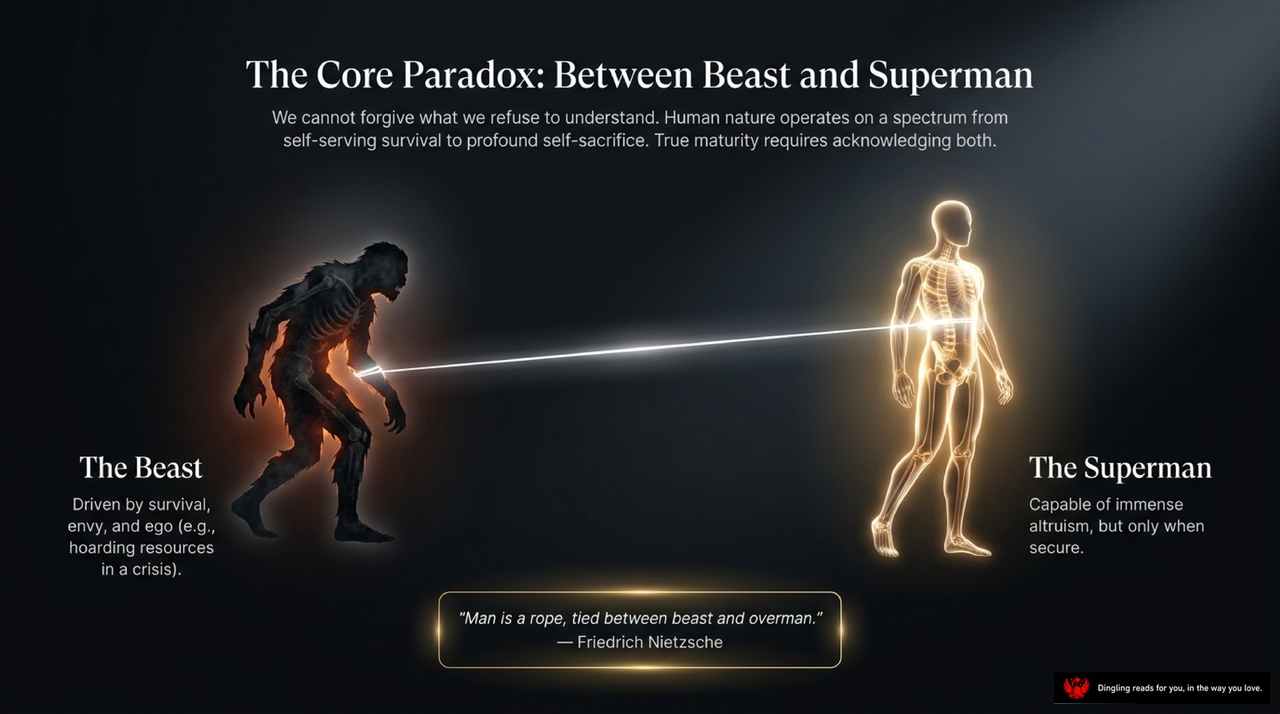
The Core Paradox: Between Beast and Superman. We cannot forgive what we refuse to understand. Human nature operates on a spectrum from self-serving survival to profound self-sacrifice. True maturity requires acknowledging both.
Look at the image. On the left, we have The Beast, driven by survival, envy, and ego—like hoarding resources in a crisis. On the right, we see The Superman, capable of immense altruism, but often only when secure. Friedrich Nietzsche famously said, "Man is a rope, tied between beast and overman."
Think about your own life. When you succeed, do you feel a pang of guilt seeing others left behind? That's the Beast whispering. But when disaster strikes, don't you instinctively reach out to help? That's the Superman rising. The paradox is this: we judge ourselves harshly for our selfish moments, yet we often fail to appreciate the strength it takes to be selfless. True growth isn't about choosing one side over the other; it's about integrating both. It's about understanding that the same person who might hoard in fear is also the one who can sacrifice everything for love. Embrace the beast within, but let the superman lead.
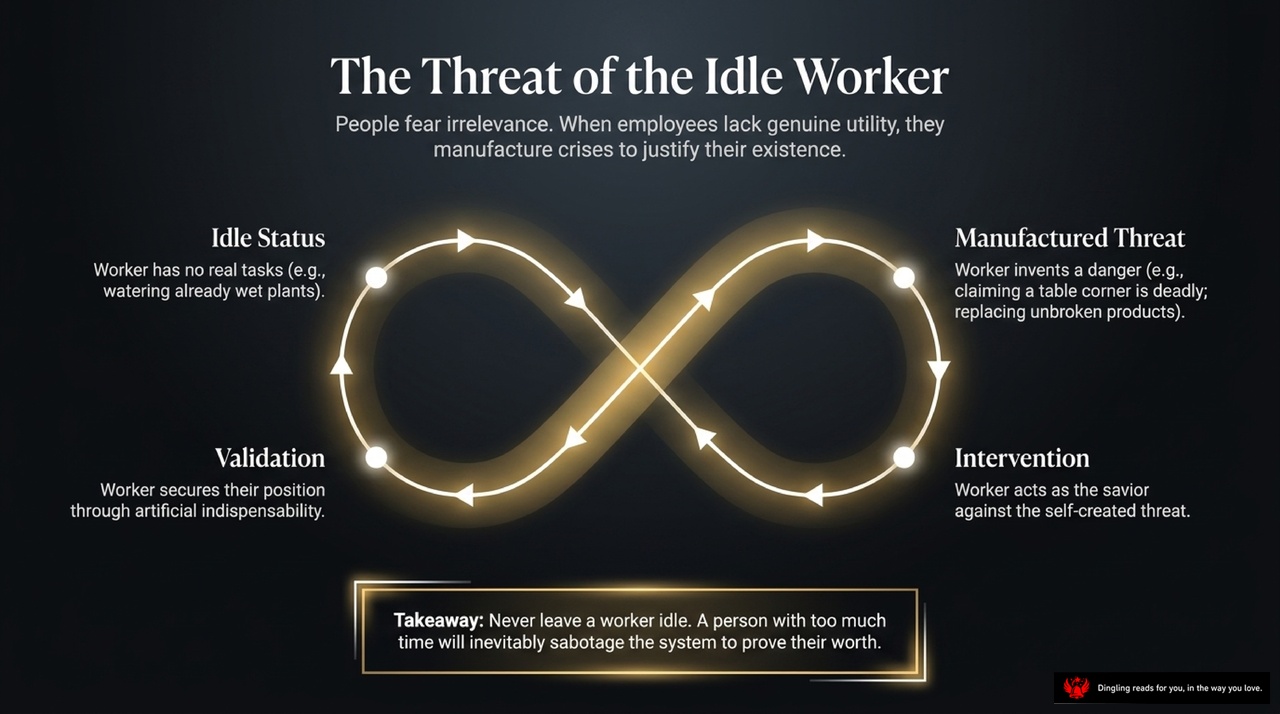
Imagine a workplace where everyone is busy, but not actually working. What happens when an employee feels irrelevant? They don't just sit there; they start manufacturing crises to justify their existence. This is the dangerous cycle of the "Idle Worker," a concept that reveals a dark truth about human nature: people fear being useless more than they fear hard work.
Look at this diagram. It starts with **Idle Status**. When a worker has no real tasks—like watering plants that are already wet—they feel their value slipping away. To stop this panic, they move to the next stage: **Manufactured Threat**. They invent dangers that don't exist, perhaps claiming a table corner is deadly or replacing a product that isn't broken. Why? Because a crisis creates a hero.
This leads to **Intervention**. The worker acts as the savior against their own self-created threat, proving they are indispensable. Finally, they get **Validation**. By securing their position through artificial necessity, they complete the loop and return to a state of perceived importance.
The book illustrates this perfectly with a story about a husband named Ah-Zhuang. He was hired to protect his daughter, but when there was no real danger, he became terrified of being fired. So, he pushed the child into the dining room corner, creating an accident that "proved" his protection was necessary. He didn't want to be safe; he needed to be essential.
The takeaway is clear: Never leave a worker idle. A person with too much free time will inevitably sabotage the system to prove their worth. If you want to stop this cycle, you must ensure every team member has genuine, meaningful work. Without it, they will create their own problems just to feel needed.
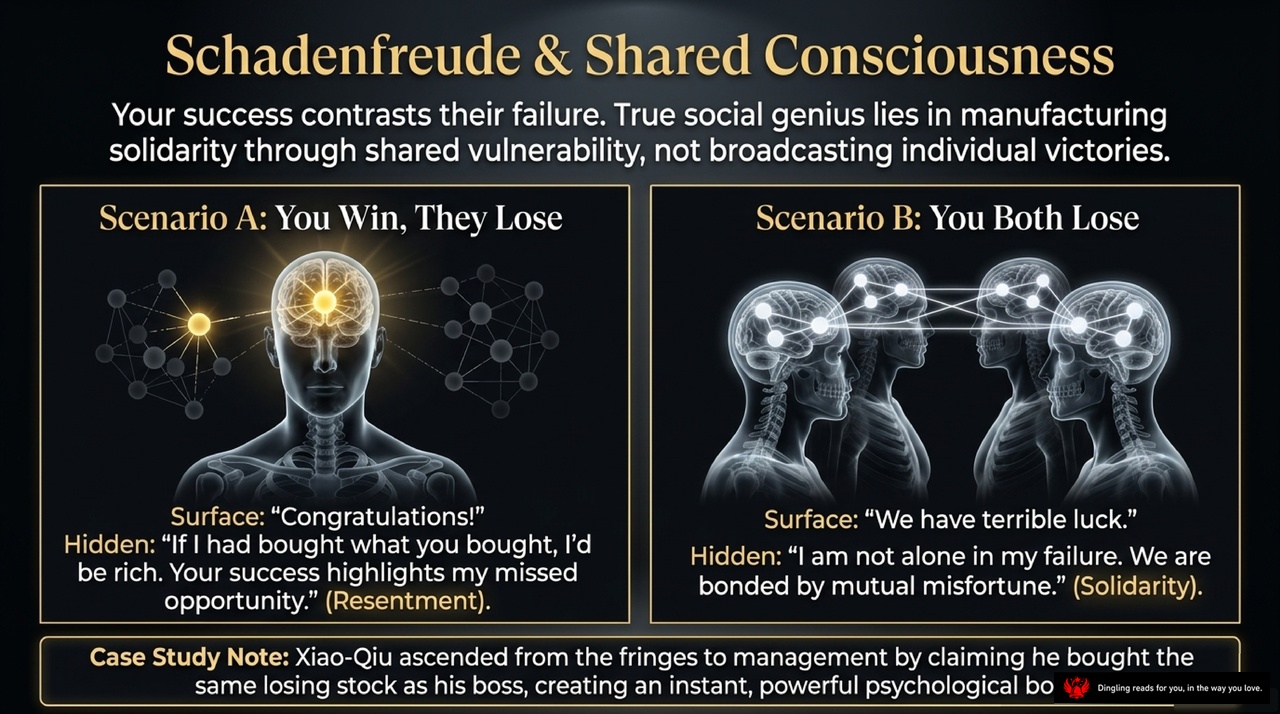
Success isn't about standing alone on a podium; it's about how you make others feel in the room. Look at the two scenarios on the screen. Scenario A shows the trap of "You Win, They Lose." When you celebrate a victory, the hidden message to others is, "If I had been there, I would have succeeded too." That success highlights their missed opportunity, breeding resentment and isolation.
But true social genius flips the script to Scenario B: "You Both Lose." Imagine admitting a shared failure instead. The surface conversation is, "We've had terrible luck," but the hidden bond is, "I am not alone in this misfortune." This shared vulnerability creates instant solidarity. As the case study notes, Xiao-Qiu didn't rise by bragging about his boss's wins; he ascended by claiming he bought the same losing stock. He manufactured a bond of mutual struggle.
The lesson is clear: True connection isn't built on broadcasting individual victories. It's manufactured through shared vulnerability. When you align your struggles, you create a team. When you highlight your differences, you create enemies.

The "Face" Protocol: Ego vs. Truth
Look at this quadrant. It maps out the most dangerous dynamic in human interaction: the clash between what we know is true and what someone's ego demands. The slide warns us that when ego is on the line, truth becomes subjective. Exposing a harsh reality after a commitment has been made doesn't teach a lesson; it only breeds lifelong enemies.
Let's break down the four zones. In the top left, we have "Deflect." This happens when the investment is low but exposure is high. Think of accusing a child of stealing in front of their mother. The result? Violent denial. You can't fight shame with facts.
Move to the top right: "Do Not Engage." Here, the commitment is high, but the exposure is public. The classic example is a wealthy lady buying fake paintings and asking a master to critique them. If the master speaks no truth, the damage is irreversible. Silence is sometimes the only way to preserve dignity.
Now, look at the bottom right: "Gentle Redirection." This is the sweet spot for high commitment and low exposure. You guide them to save face quietly. You don't attack; you steer.
Finally, the bottom left is the "Safe Zone" for radical honesty: "Constructive Truth." This applies when the commitment is low and exposure is private. This is where you can be direct without causing destruction.
The core lesson here is timing and context. If you rush to correct someone in front of others, or after they've already invested heavily in a decision, you aren't being honest; you're being destructive. True wisdom lies in knowing when to speak the truth and when to let the truth wait.

The "Two Peaches" Trap: Fairness & Envy
Inequality destroys teams faster than absolute deprivation. Arbitrary distribution of rewards triggers destructive envy, while transparent systems maintain peace.
Look at this central image: a golden scale balancing two very different scenarios. On the left, we see "The Absolute Deprivation." If zero peaches are given to three warriors, they unite in shared hunger. When everyone suffers equally, they actually bond. There is no comparison, only a collective struggle against the void.
On the right, we see "The Arbitrary Reward." If two peaches are given to three warriors based on subjective merit, they kill each other out of perceived humiliation. This is the real danger. When resources are scarce but distributed unevenly—based on a boss's whim, a friend's favor, or a vague idea of "talent"—it breeds resentment. The two who got peaches feel the third is an outcast; the one who got nothing feels cheated and betrayed. The result isn't just sadness; it's violence.
The core principle here is clear: "It is not the lack of wealth that causes unrest, but the uneven distribution of it." Never distribute limited resources without an unassailable, objective framework. In a high-performing team, don't hand out bonuses based on "gut feeling." Instead, create a transparent system where everyone sees exactly how the rewards are calculated. When the rules are fair and visible, even if the total pie is small, the team remains united. But if the pie is divided arbitrarily, the hunger for fairness will tear the group apart faster than having no pie at all.

The Habitation Curve, often called the Boiled Frog effect, illustrates a terrifying truth about human nature: outrage has a short half-life, and tactical distractions can force populations to normalize conditions that were once unacceptable. The graph shows four distinct stages. It begins with The Shock, where a factory arrives and villagers protest, risking their lives against the noise and pollution. But then comes The Distraction; the factory builds a playground and paints smokestacks with giraffes, shifting focus away from the harm. This leads to The Erosion, a gradual adaptation where people stop noticing the noise and smell, even while enjoying the new amenities. Finally, we reach The Normalization, where the unacceptable becomes invisible. People convince themselves, "It's always been this way," accepting a reality that should never have been tolerated. This curve isn't just about factories; it applies to everything from toxic corporate cultures to societal injustices. When we stop fighting the small annoyances, we lose the power to stop the big disasters.

Have you ever wondered why we feel such intense gratitude when someone saves us from a disaster, even if they were the ones who created the danger in the first place? This is what we call the "Thank You for Not Killing Me" effect. It's a powerful psychological phenomenon where artificial relief creates deeper loyalty than genuine benefits ever could.
Look at the three states on this slide. We start at State 1, the baseline. Imagine a healthy patient or a loyal general. In this state, our emotions are neutral, maybe even a bit entitled. We feel okay because we are okay. But then, something happens. We move to State 2, the manufactured threat. Suddenly, the doctor diagnoses a harmless spot as cancer, or the emperor hints at executing a loyal general. Our emotions shift instantly to terror and despair. We feel like we are about to lose everything.
Now comes the crucial moment: State 3, the reprieve. The doctor declares the spot benign, or the emperor exiles the general instead of killing him. We are restored to our baseline. And here is the insight: the gratitude we feel in this moment is overwhelming. We thank those who save us, even if they were the ones who threatened us. Why? Because human beings are wired to value what they almost lost. The relief of escaping a manufactured nightmare feels far more precious than the steady comfort of a normal day.
This logic explains so much about human behavior. Think about a boss who threatens layoffs, only to announce a bonus instead. The employees feel a surge of loyalty they wouldn't have felt if the bonus was promised from the start. Or consider a leader who creates a crisis to solve it, only to gain immense credit for the resolution. We don't just appreciate the benefit; we worship the rescuer because they gave us a chance to live again. It's a reminder that sometimes, the most profound gratitude comes not from what we gain, but from what we narrowly avoided losing.

Corruption rarely begins with a massive bribe. It starts quietly, almost innocuously, with empathy, a small favor, and the creation of social debt. Think of it as a slippery slope where every step feels safe until it's too late.
It all begins with **The Empathy Trap**. Imagine a seemingly innocent interaction, like comforting a crying applicant. You feel good about being kind, but you've just planted a seed. Next comes **The Reciprocal Favor**. You accept a small, harmless token of thanks—a coffee, a gift card, a dinner. It feels like nothing, but now a social debt exists. The other person feels they owe you, and you feel you've done them a favor.
Then, the slope gets steeper with **The Escalation**. The applicant introduces "friends," or the favor becomes systemic. You're no longer helping one person; you're protecting a network. Finally, you reach **The Point of No Return**. At this stage, the administrator realizes they are compromised. Refusal now means exposure. They are trapped in the dark, unable to go back.
This isn't just about corruption; it's about how we all get trapped by our own desire to be helpful and the fear of losing face. Once you take that first step down the stairs, climbing back up becomes impossible.

When we try to navigate the workplace or any social hierarchy, we often fall into a trap of thinking that "connections" are the ultimate shortcut. But the reality is far more complex. As we see here, bypassing a direct decision-maker to use a higher or lateral "connection" does not secure a favor; it actually insults the decision-maker's ego.
Look at this diagram. Node A is the applicant, Node B is the middleman, and Node C is the ultimate decision-maker. The mistake many people make is using the mid-level connection, Node B, instead of addressing the ultimate authority, Node C. Psychologically, this makes the Decision Maker feel bypassed and disrespected. Meanwhile, the Middleman feels empowered but has overstepped their boundaries.
The consequence is often severe: the applicant gets rejected not because of a lack of skill, but to punish the middleman's overreach and protect the Decision Maker's authority. This is why the Rule of Power states: Never deny a gatekeeper the privilege of granting the favor themselves. You must always respect the chain of command and the dignity of those who hold the keys, because undermining their authority is the fastest way to lose the very favor you are seeking.

The Shift of Intimacy. Success doesn't isolate us because we become arrogant; it isolates us because our success acts as a mirror, reflecting the failure of our peers.
Look at this concept of Proximity-Mapping. As we move toward the center of "Success," our old friends seem to drift further away. Why? It comes down to three key drivers of separation.
First, The Burden of the Past. Your old friends know your humble beginnings. Your new status feels unearned to them, creating a gap that is hard to bridge.
Second, The Mirror of Inadequacy. Your elevated status constantly reminds them of their own stagnation and missed opportunities. Seeing you succeed highlights what they feel they lost.
And finally, The Fear of Debt. Old friends often assume you only want their money or influence. So, they preemptively pull away to protect themselves from that perceived obligation.
In short, when we climb higher, we aren't just leaving people behind; we are forcing them to confront their own limitations, and that is often too painful for them to watch.

The Myth of Indispensability: Why Your "Essential" Status Is a Trap
Look at this graphic. It maps out the terrifying lifecycle of an employee who thinks they are irreplaceable. The title is stark: "The Myth of Indispensability." The core truth here is brutal: throwing a tantrum to prove your value always backfires. Institutions possess a ruthless, organic ability to self-correct and heal over absences.
Let's walk through the three stages shown here.
First, Day 1: The Void. This is where the panic sets in. The 'indispensable' worker quits or is forced out. Chaos ensues. The lights go out, the gears grind to a halt, and everyone screams for you. It feels like the world is ending.
But then, fast forward to Day 14: The Adaptation. This is the turning point. Workarounds are found. Subordinates step up. Processes are simplified. The team realizes that while you were the hub, the system was actually the spoke. They don't need the hub to spin anymore; they can drive the car themselves.
Finally, Day 30: The Rejection. The system stabilizes. The absent worker is no longer missed; their return is now viewed as a threat to the newly established order. You aren't a hero anymore; you're a disruption.
Think about this: if you rely on everyone knowing that you are the only one who can do your job, you are building a house of cards. The moment you try to act like a victim to prove your importance, you actually prove that you are a liability. The organization doesn't need a hero; it needs a functioning machine. And machines don't break just because one part is missing; they just find a new way to run. So, stop acting indispensable. Build a team that can run without you, and you'll find that your true value isn't in being the only cog, but in being the one who helped everyone else become essential.

Look at this diagnostic matrix. It's not just a chart; it's a decoder ring for the hidden game people play every single day. On the surface, we see harmless actions like offering unsolicited advice or cheering on a colleague's small failure. But look closer at the "Hidden Motive" column. Suddenly, those actions make sense. That advice isn't about helping; it's about establishing dominance and easing your own insecurities. Cheering for a friend's mistake? That's actually a way to relieve the anxiety of your own career stagnation.
Think about the time you skipped your boss to talk to their boss instead. What's really happening there? It's not about efficiency; it's denying your authority to protect their own ego. Or consider feigning illness. It's rarely about health; it's manufacturing a crisis to test loyalty and extract attention. We see this constantly in corporate culture and social dynamics. We act one way to please the room, but our true drivers are often about power, ego, and survival. This matrix helps us decode the true drivers behind everyday behavior, so we stop being manipulated by surface-level interactions and start seeing the real game being played.
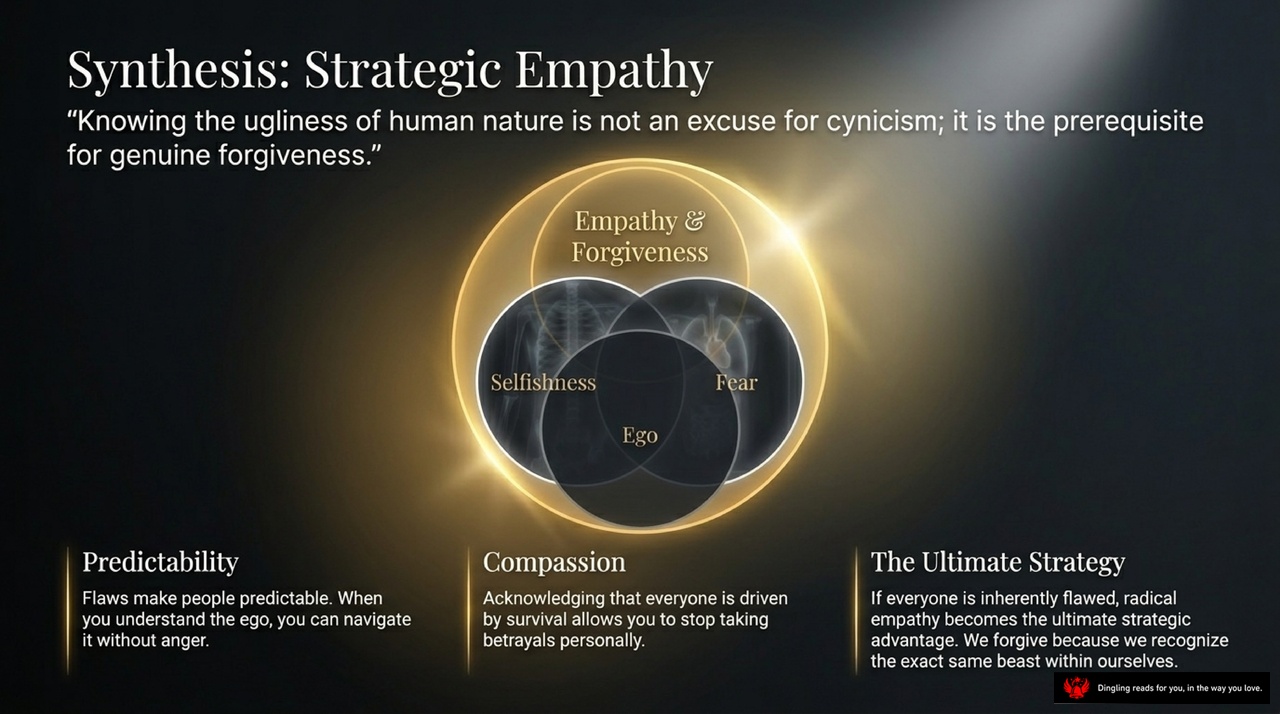
Synthesis: Strategic Empathy
We see the core of human nature here: selfishness, fear, and the ego. These aren't just abstract concepts; they are the invisible drivers behind every betrayal and every conflict. When we understand that everyone is acting out of these deep-seated instincts, something powerful happens. We stop taking personal offense.
This is the synthesis of our journey: Strategic Empathy. It's not about being naive or ignoring the ugly parts of human nature. On the contrary, recognizing that selfishness and fear are universal is the exact prerequisite for genuine forgiveness. We forgive because we recognize the exact same beast within ourselves.
When you realize that flaws make people predictable, you gain a strategic advantage. You can navigate the ego without anger. You acknowledge that everyone is driven by survival, which allows you to stop viewing betrayals as personal attacks. This radical empathy becomes your ultimate strategy. It transforms a complex, often painful world into a place where you can operate with clarity and peace.

Let's talk about the darker, yet essential truths of human nature that we simply cannot ignore.
First, never corner an ego. Always leave an avenue for dignity. When you trap someone's pride, you lose the battle before it even begins. Secondly, be wary of manufactured crises designed to extract your gratitude. Remember that organizations adapt, friends shift, and outdating your usefulness is inevitable. The world is constantly changing, and clinging to the past is a recipe for pain.
Here is a profound thought to keep in mind: Use the dark truths of human nature not to manipulate, but to forgive. Understanding our flaws helps us let go of judgment.
Finally, consider this question: If every human action is a negotiation between the beast and the superman, which one is holding the pen when you judge others? Before you pass judgment, ask yourself who is truly in control.