
The Idiot: Complete Chapter-by-Chapter Summary
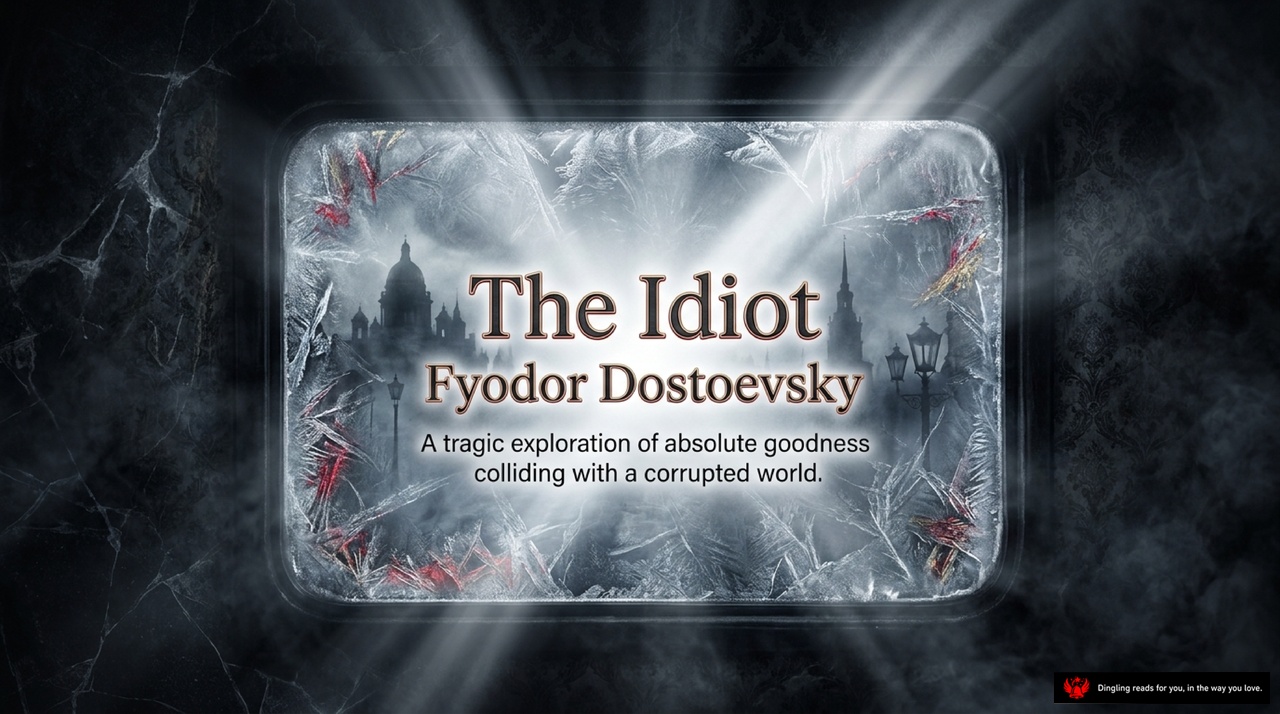
Welcome to our deep dive into Fyodor Dostoevsky's masterpiece, *The Idiot*. This image sets the perfect tone: a tragic exploration of absolute goodness colliding with a corrupted world.
Imagine Prince Myshkin, a man of pure, almost unbearable goodness, arriving in a foggy, melting-snow St. Petersburg. He's just returned from Switzerland, broken and penniless, seeking refuge with a distant relative. But even before he steps foot in the General's house, his innocence begins to clash with the harsh reality around him. He's not just a guest; he's a living contradiction. While others see him as a beggar or a fool, Myshkin sees the spiritual depth in everyone, even the servants. He talks about the cruelty of execution not out of fear, but out of a profound understanding of human suffering, which surprisingly wins the respect of those he meets.
As he navigates this new world, he encounters Nastasya Filippovna—a woman trapped by her past, selling her soul for money and dignity. He also meets Prince Rukavishnikov, a man who, like Myshkin, feels he's been wronged, yet reacts with violence rather than peace. Myshkin tries to bring light into their darkness, offering forgiveness and understanding, but the world he enters is built on deception, greed, and manipulation.
In this novel, Dostoevsky asks a terrifying question: What happens when someone who is perfectly good is thrown into a world that has lost its way? Myshkin's journey is a testament to the idea that true goodness is rare, fragile, and often tragic. It's a story about how one man's refusal to compromise can shake the foundations of an entire society. Join us as we uncover the layers of this haunting tale and see how Myshkin's "idiocy"—his inability to play the game of social survival—becomes his greatest strength and his ultimate curse.

The Mock Execution and The Neurological Storm. These aren't just titles; they are the twin pillars holding up Fyodor Dostoevsky's entire literary legacy.
First, look at the top section: The Mock Execution of 1849. Dostoevsky was arrested for radical intellectual activities and faced a firing squad. His death sentence was commuted to Siberian exile mere seconds before execution. This proximity to death forged his unparalleled obsession with mortality and the fleeting value of every second of life. Imagine standing in front of a firing squad, knowing you will die in the next minute. That isn't just a story; it's a psychological earthquake that rewires your brain. It forces you to confront the absolute absurdity of life.
Now, look at the bottom section: The Neurological Storm. Plagued by severe epilepsy, Dostoevsky experienced seizures that offered moments of profound, transcendent clarity immediately followed by devastating physical and mental ruin. This duality became the biological blueprint for his protagonist. He didn't just write about mental illness; he lived it. The terrifying darkness of the seizure was the only time he felt truly alive, a paradoxical enlightenment born from destruction.
These two experiences—the near-death experience and the neurological storm—explain why his characters are so intense, so flawed, and so deeply human. They are not just literary devices; they are the scars of a man who stared into the abyss and wrote back.

Prince Myshkin's return to Russia is a story of pure innocence crashing into a world of corruption. He arrives on a freezing November morning, dressed in a thin foreign cloak completely unsuited for the Russian winter, carrying nothing but a small bundle. It's a stark contrast to the society he's entering.
Just weeks after his return, Prince Myshkin finds himself at the center of a dramatic storm at Nastasia Filippovna's birthday party. The atmosphere is thick with tension as everyone waits for her to decide her future. Prince Myshkin, acting on a sudden impulse, stands up and tells her the simple, devastating truth: "Do not marry."
In that moment, he becomes the catalyst for everything that follows. He takes the responsibility of her choice, effectively ending her engagement to Gania. But this act of kindness doesn't bring peace. Instead, it triggers a chain of tragic events. It leads to a confrontation with Rogozin, a man driven by obsession and jealousy, who sees himself as the only one worthy of Nastasia. The innocent mind of the Prince, which he hoped would heal Nastasia, instead becomes the spark that ignites a fire of violence.
The story ends in tragedy. Nastasia, overwhelmed by the chaos and the weight of her choices, takes her own life. Prince Myshkin, who sought to save her, is left to grapple with the devastating consequences of his own good intentions. His journey from a hopeful arrival to a witness of this profound loss illustrates the painful complexity of human nature and the unintended consequences of trying to fix broken lives.

Look at this silhouette. It's a map of a man's soul, broken and beautiful. We see three distinct forces at war inside him: The Mind, The Nervous System, and The Heart.
First, look at the mind. It is described as free of vanity and social artifice. This man possesses an uncanny ability to read the true emotions of others, stripped of their masks. He sees the world as it really is, which is terrifying in a society built on lies.
Then, look at the spine. That's the nervous system. It is afflicted by epilepsy, what the text calls the "sacred disease." This condition grants him flashes of supreme spiritual harmony, moments of pure clarity, but it leaves him vulnerable to sudden, complete physical collapse. He lives on the edge between divine insight and total darkness.
Finally, look at the heart. This is his tragic flaw. It practices unconditional, indiscriminate compassion. He embodies absolute Agape, or selfless love. But the text warns us: this proves dangerous in a world that operates on ego and transactional desire. His love is too pure for a world that only knows how to trade.
This isn't just a medical profile; it's a prophecy. A man who sees too clearly, suffers too much, and loves too purely in a world that demands he be selfish. That is the dangerous, beautiful tragedy of this character.

In the world of Dostoevsky's *The Idiot*, we often see how two opposing forces collide, creating a dramatic tension that drives the story forward. On one side, you have Prince Myshkin, representing pure pity, spiritual healing, and redemption. He embodies the ideal of Agape, offering a light that is so pure that Nastasya Filipovna feels unworthy of it, driven by her deep-seated guilt. On the other side stands Parfyon Rogozhin, the embodiment of Eros. He offers a different kind of pull—consuming, violent passion, and a desire for earthly destruction. For Nastasya, this isn't just about love; it satisfies a subconscious, self-destructive urge for punishment.
This slide captures the tragic core of her character: she feels permanently soiled by her past abuse and unlovable. Because she cannot accept the pure light of Myshkin's forgiveness, she is inevitably drawn to Rogozhin's dark, fiery intensity. It is a heartbreaking choice between being saved by a saint or consumed by a demon, and in her world, the path of destruction feels more familiar than the path of salvation.

Look at this slide. We see money burning in a fireplace, labeled "Weaponized Trauma" and "The Ultimate Refusal." This captures the most explosive moment in Nastasya Filippovna's story.
Earlier in the novel, we learn that Nastasya has been abused and commodified by wealthy aristocrats since childhood. She was treated as a passive trophy, a commodity to be traded around like a piece of jewelry. This trauma didn't break her; instead, she weaponized it. She decided that if she was going to be a victim, she would be the one to decide the terms of her own destruction.
This leads us to that shocking act of self-destructive pride. In the climax of her life, she stands before a room full of men—her former suitors, her family, and Prince Myshkin. She holds a bundle of 100,000 rubles, the money she was forced to sell her soul for. Instead of accepting it or letting her father take it, she throws it into the fire.
By burning that money, she publicly rejects the transactional nature of St. Petersburg society. She is saying that she refuses to be bought, even by the people who claim to love her. She asserts her agency through this shocking act, declaring that her worth cannot be measured in rubles.
But this "Beauty as Rebellion" comes at a terrible cost. Her pride is so absolute, her refusal to be a victim so fierce, that it isolates her completely. She pushes away the only man who truly loves her without conditions, Prince Myshkin, and drives the man she was forced to marry, Rogozhin, into a corner of despair. In her attempt to reclaim her freedom, she inadvertently sets the stage for her own tragic end. It is a powerful, heartbreaking testament to the fact that sometimes, the most rebellious act is to choose your own fate, even when that fate is destruction.

Parfyon Rogozhin: The Dark Obsession. Look at this knife, wrapped in dark silk, resting on a scarred wooden table. It's not just a weapon; it's the physical manifestation of a soul consumed by obsession. Rogozhin's love for Nastasya is possessive, violent, and utterly indistinguishable from hatred. He doesn't want to save her; he wants to own her, to destroy her, and in doing so, destroy himself.
This slide highlights two critical themes. First, Earthly Passion. Rogozhin is driven by a madness that borders on insanity. He believes Nastasya loves him, yet he interprets her actions through a lens of paranoia. When she chooses the Duke, Rogozhin feels betrayed, not heartbroken. His reaction isn't grief; it's a sudden, explosive shift to violence. He sees her choice as an insult to his very existence, proving that his love was always a twisted form of control.
Second, The Loss of Faith. Rogozhin embodies the spiritual decay of the modern Russian soul. He desperately wants to believe in Myshkin's light—the idea of innocence and redemption—but he is trapped by his own destructive desires and paranoia. He looks at the crucifix, the symbol of Christ, and instead of seeing hope, he sees a mockery. The painting in his home, showing a tortured and swollen Christ, reflects his internal reality: a world where faith has crumbled, leaving only raw, unfiltered cruelty. He knows deep down that his path leads to ruin, yet he cannot stop. He is a man who has lost his way, trapped in a cycle of jealousy and rage, ultimately proving that when you trade faith for obsession, there is no escape.

Look at this diagnostic comparison of desire's anatomy. We see three distinct paths to tragedy, defined by their primary motives. Prince Myshkin is driven by Agape, pure pity and spiritual healing. His ultimate goal is to save others, but the result is an unintended destruction of himself and everyone around him. He tries to be good, yet his goodness becomes a weapon that breaks people.
Contrast him with Parfyon Rogozhin, whose motive is Eros and obsession. His goal is complete possession, not love, but ownership. This leads directly to murder and madness. It's a brutal, violent spiral where desire consumes the self entirely.
Then we have Gavril Ivanovich, fueled by vanity and greed. His goal is simply social status. He wants to climb the ladder, to be someone important. But his tragic result is profound humiliation and mediocrity. He gains nothing but the hollow weight of his own pretense.
These three characters show us that the anatomy of desire isn't always about passion. Sometimes, the most dangerous force is the desperate need to be loved by others, to possess them, or to be seen as someone you're not. And in every case, the cost is total ruin.

Look at this cross-section of a grand, yet suffocating house. It perfectly captures the central conflict of Dostoevsky's *The Idiot*: the terrifying gap between inner reality and social performance.
On the left, we see "The Sickness of the Ordinary." This refers to characters like Ganya, who are smart enough to know they are mediocre, yet too vain to accept it. Instead of being content, they engage in desperate acts just to appear original or superior. They are trapped in a cycle of self-deception, constantly trying to climb out of the "sickness" of their own ordinariness.
On the right, we see "The Aristocratic Spectators." This represents the Yepanchin family, who view Prince Myshkin with a complex mix of genuine affection and cold, aristocratic condescension. They admire his purity but treat it like a curiosity. Aglaya, in particular, mocks him as the "Poor Knight"—a figure of absurd, pure idealism that she believes is utterly unsuited for high society. She sees his goodness as a weakness, failing to understand that his moral integrity is actually his greatest strength.
This image illustrates the tragedy of the novel: Myshkin, the true nobleman, is constantly judged and manipulated by a society that values appearance over truth, and performance over genuine humanity. He is the only one who sees people as they are, while everyone else is just playing a role in this elaborate, crumbling house.

Look at this stark brick wall. It's not just a wall; it's the physical manifestation of a broken world. This image captures the essence of Ippolit, an 18-year-old dying of consumption, staring into the void. He represents the absolute edge of godless, rational despair. For Ippolit, life isn't a gift to be enjoyed; it's a cruel joke. He resents nature's mockery, watching healthy people waste their time while he counts down the seconds of his own brief existence. His philosophy is cold and logical, yet it fails him when faced with the ultimate reality of death. His failed public suicide attempt serves as a grim exhibition of the impotence of purely rational, nihilistic philosophy. No matter how hard he tries to logically dismantle life, the human instinct for survival, however fragile, always wins. This is the tragic rebellion of youth—a battle of reason against the very biology that refuses to let him go.

Imagine a world where the relentless pursuit of wealth and material progress comes at a terrible cost to our very soul. This is the haunting vision presented by Lebedev, a Russian intellectual who saw the 19th century not as an age of enlightenment, but as a descent into spiritual darkness. He famously equated the frantic expansion of railways—the symbol of industrialization and accumulating wealth—with the biblical "Star of Wormwood," a force that poisons the waters of humanity.
As we see in this striking image, the scale tips heavily. On one side, we have the steam train, chugging forward with the force of a machine, representing the era's obsession with money and status. On the other side, the well of life is cracked and dry, symbolizing the "Lost Water of Life." Lebedev argued that while our pockets were getting fuller, the unifying spiritual ties that once bound us together were eroding into nothingness. The rush for materialism lacked any moral foundation.
This wasn't just about economics; it was about a fundamental shift in human values. People began to measure their worth by their bank accounts rather than their character or their connection to others. The result was a society that was richer than ever, yet felt increasingly hollow and isolated. Lebedev's apocalyptic warning remains chillingly relevant today, reminding us that when we prioritize the accumulation of things over the cultivation of our spirits, we risk poisoning the very essence of what it means to be human.
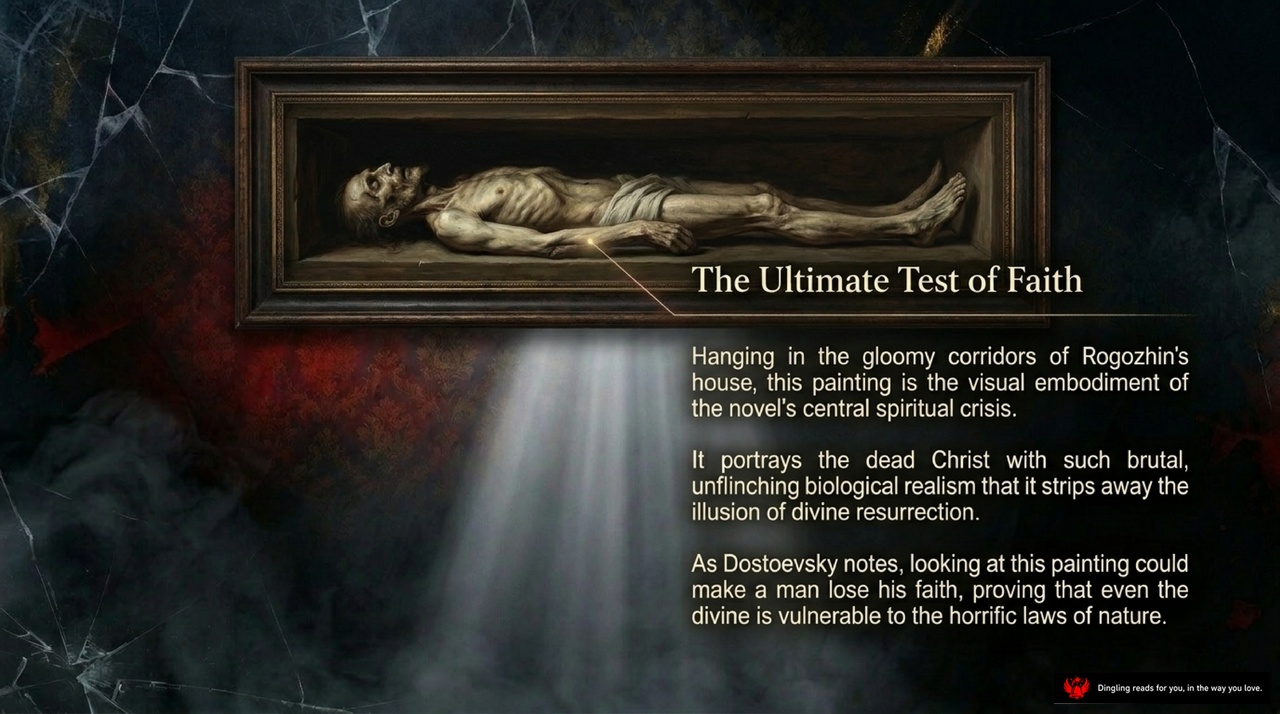
Imagine the most brutal test of faith humanity can face. This isn't just a painting; it's a psychological weapon hanging in the gloomy corridors of Rogozhin's house. It depicts the dead Christ, stripped of all divine illusion, rendered with such brutal biological realism that the body looks less like a savior and more like a victim of nature's horrific laws.
Dostoevsky understood that this image could shatter a man's soul. By staring into this unflinching, rotting reality, one is forced to confront the terrifying possibility that even the divine is vulnerable to decay. It is the ultimate test of faith: can you believe in resurrection when your eyes see only death? This visual embodiment of the novel's central spiritual crisis challenges us to question whether our faith can survive the shock of absolute, undeniable mortality.
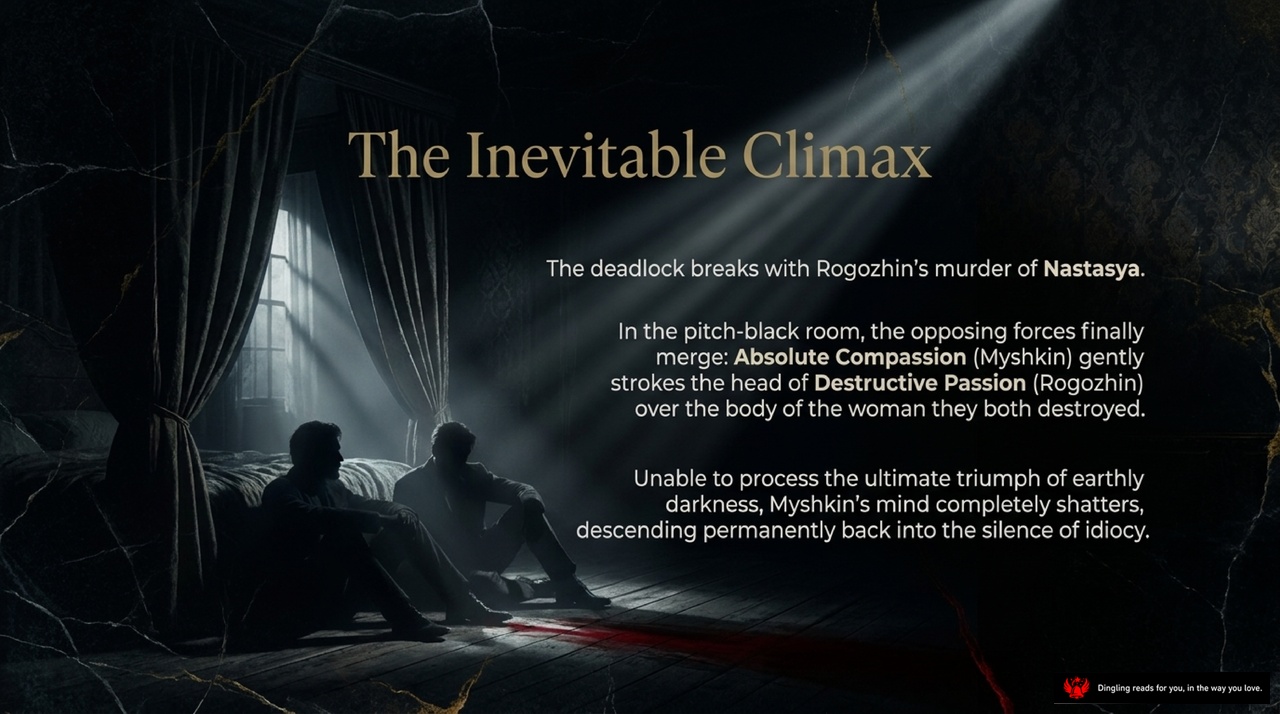
The Inevitable Climax. In the pitch-black room, the opposing forces finally merge: Absolute Compassion (Myshkin) gently strokes the head of Destructive Passion (Rogozhin) over the body of the woman they both destroyed. Unable to process the ultimate triumph of earthly darkness, Myshkin's mind completely shatters, descending permanently back into the silence of idiocy.
This is the moment the deadlock breaks with Rogozhin's murder of Nastasya. It is a collision of the most tragic kind: the man who chose to live through love, and the man who chose to live through destruction, standing face-to-face over a lifeless body. Rogozhin, driven by a twisted logic of "giving" what he loved to the man he envied, has taken the ultimate step. He has killed the woman, believing he has saved her soul by freeing her from Nastasya's torment. But in doing so, he has become the very monster he feared.
And here stands Prince Myshkin. He does not run. He does not scream. Instead, in this absolute darkness, he performs an act of impossible grace. He touches the head of the murderer. He offers forgiveness to the man who just committed the worst act imaginable. It is a moment where two opposing forces—one representing the destructive power of the human heart, and the other representing the redemptive power of unconditional love—finally collide and merge.
But this union does not bring salvation. It brings a devastating collapse. Myshkin cannot comprehend this victory of earthly darkness. He cannot reconcile the idea that his compassion has somehow validated the murder. The weight of this truth is too heavy for his mind. It shatters completely. He descends, not into enlightenment, but back into the silence of his "idiocy," a permanent retreat from the world he once tried to save. The climax is not a triumph of good over evil, but a tragedy where the very act of forgiving destroys the forgiver.

Why the Ideal Fails. Look at this shattered glass. It represents the tragic collision of pure goodness with a broken world. In *The Brothers Karamazov*, Dostoevsky stages a grand, almost brutal experiment: he drops a perfectly beautiful, selfless soul—Prince Myshkin—into a deeply flawed, modern society. And what happens? The ideal fails. Not because the ideal is weak, but because the world is too rigid to hold it.
In a world governed by ego, materialism, and damaged pride, absolute pity cannot function as a cure. Instead, it acts as a highly disruptive, chaotic, and ultimately fatal force. Think about it: when you try to save someone with pure love in a society built on transaction and pride, you don't heal them; you destroy the very fabric that holds them together, and in the process, you destroy the savior and those he attempts to save. The shattering glass isn't just damage; it's the inevitable result of trying to force a spiritual truth into a system that only understands power and money. That is the harsh, beautiful lesson Dostoevsky leaves us with.

The destruction of Prince Myshkin serves as a tragic mirror for our own society, revealing how a world driven by vanity, materialism, and destructive passion simply cannot sustain unconditional compassion. When the perfectly good man is destroyed by the very world he inhabits, we are forced to ask a haunting question: is the flaw in the man, or is it in the world itself? This isn't just about one character's failure; it's about the fundamental incompatibility between true goodness and a society that thrives on selfishness. If the world demands cruelty to survive, then the tragedy lies not in the hero's inability to fight back, but in the system's refusal to allow goodness to exist at all.