
The Imperial Presidency: Complete Chapter-by-Chapter Summary
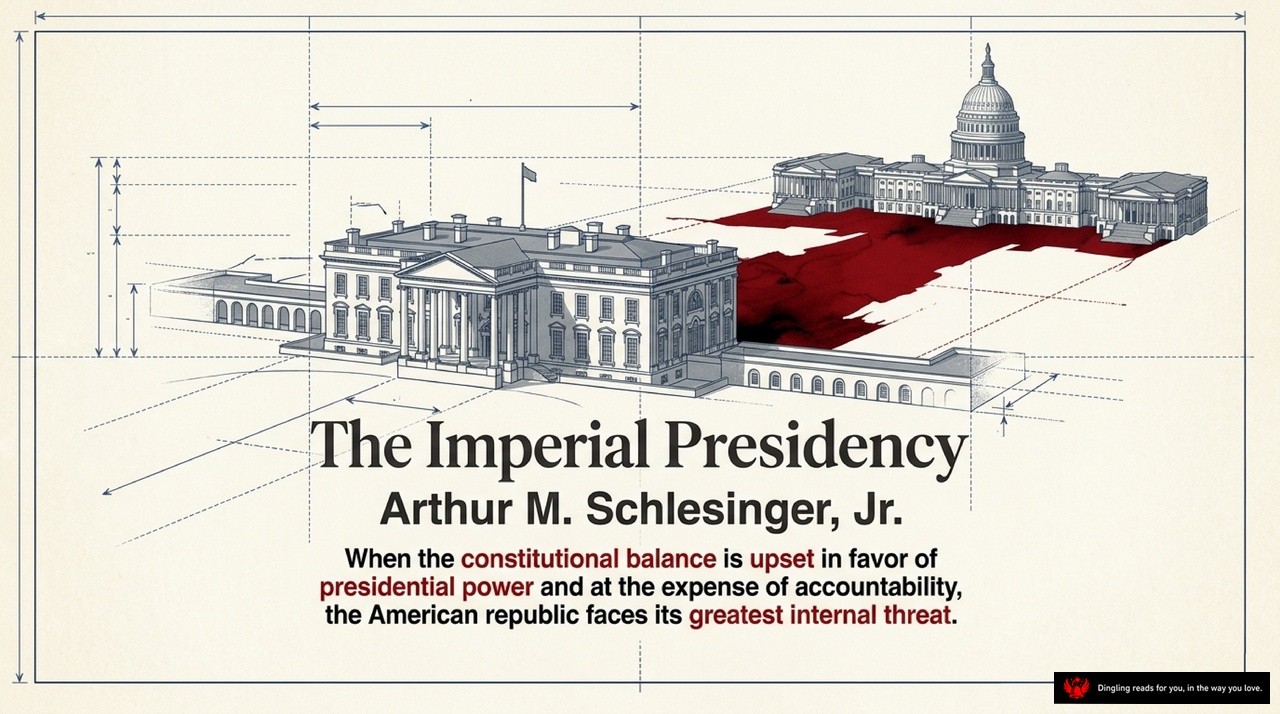
Welcome to our deep dive into *The Imperial Presidency* by Arthur M. Schlesinger, Jr. Today, we are looking at the cover, which sets a powerful tone for the entire book. You see the White House and the Capitol Building, but notice the striking red stain connecting them—it symbolizes the dangerous flow of power from the executive branch into the legislative heart of our nation.
The subtitle on this page captures the core argument perfectly: "When the constitutional balance is upset in favor of presidential power and at the expense of accountability, the American republic faces its greatest internal threat." This isn't just about history; it is a warning about the delicate equilibrium between the President and Congress. The founders deliberately designed a system where war powers were shared, refusing to give the President the unilateral authority that a British King once held. They wanted to prevent any single person from monopolizing the decision to go to war.
However, as Schlesinger argues, this balance is fragile. When the scales tip too far toward the executive, democracy suffers. The red area in this illustration represents that critical shift—where the President acts without sufficient oversight, bypassing the checks and balances intended to protect us. This book explores how that balance was slowly eroded over centuries, turning a system of shared responsibility into what we now call the "Imperial Presidency."

Imagine a simple seesaw, where the left side represents the Constitutional Presidency and the right side represents the Imperial Presidency. In the early days of our nation, this balance was delicate but functional. The Constitutional model worked because it relied on friction—shared decisions and a healthy tension between branches. It was about balancing energy with checks.
But look at the right side of that scale. The Imperial Presidency is defined by a dangerous equation: Power is greater than Accountability. Here, the executive branch captures vital national decisions, shielding them behind secrecy and divorcing them from any real congressional oversight. This isn't just about having more power; it's about hoarding it so tightly that the other side of the scale, the people's representatives, can't even see what's happening.
This shift didn't happen overnight. It began with the Founders' fear of war. They deliberately gave Congress the power to declare war, refusing to let the President act like a king. They wanted friction, not a one-person show. But over time, that balance tipped. Presidents began to argue that diplomacy and emergency situations required speed and secrecy that Congress simply couldn't provide. They claimed the "sole organ" of foreign policy belonged to them alone.
As the 20th century rolled on, especially during the Cold War, the scale tipped even further. The need for rapid, secret decision-making regarding nuclear weapons and global conflicts made the long, deliberative process of Congress seem too slow. Presidents started using executive agreements instead of treaties, bypassing the Senate entirely. They built a system where they could commit the nation to wars or massive military deployments without ever asking for permission.
The result is the imbalance you see on the right: a presidency that operates in a vacuum, insulated from the very branch designed to check its power. When power exceeds accountability, democracy loses its grip on foreign policy. The seesaw tips, and suddenly, the nation is being steered by a single individual, far removed from the public will. That is the defining characteristic of the Imperial Presidency.

The Founders didn't just write a constitution; they drew a blueprint for survival. And at the heart of that design was a simple, radical idea: no single person should ever hold the power to make war. Look at this slide. On the left, you see Congress holding the keys: the power of the purse, the authority to declare war, and the power to raise armies. On the right, you see the President, titled Commander in Chief, but with a critical caveat—he can only direct war when authorized. This wasn't an accident; it was a deliberate mechanism to preclude the exercise of arbitrary power.
Alexander Hamilton, one of the architects of this system, was famously skeptical of human virtue. He warned that we cannot trust the interests of our nation to the sole disposal of a President. That's why the Framers split the difference. They gave the President the ability to defend the country against sudden attacks, but they strictly reserved the decision to start a full-scale war for the legislative branch. It was a system built on checks and balances, designed to ensure that the heavy burden of war was never shouldered by one man alone.
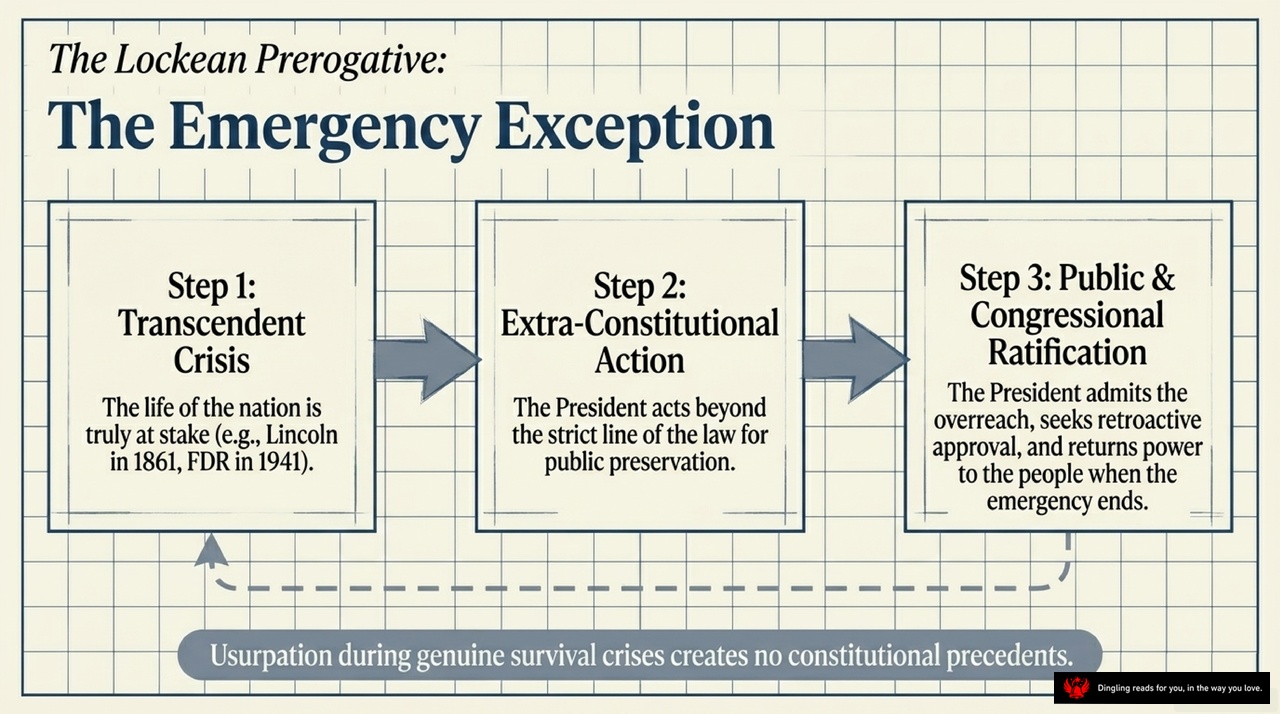
Step 1: Transcendent Crisis. Imagine a moment where the very survival of the nation hangs in the balance. The text highlights Lincoln in 1861 and FDR in 1941 as prime examples. This is the trigger for the first step: a situation so dire that normal rules seem to break down.
Step 2: Extra-Constitutional Action. Once that crisis hits, the President moves beyond the strict line of the law. The slide notes that the President acts for public preservation, taking steps that might technically be unconstitutional under normal circumstances. It's about doing what is necessary to keep the country alive when the clock is ticking.
Step 3: Public & Congressional Ratification. But here is the crucial catch. The slide explains that this overreach isn't the end of the story. The President must admit the breach, seek retroactive approval from Congress, and return power to the people once the emergency ends. The bottom line is clear: usurpation during genuine survival crises creates no constitutional precedents. If the emergency is real, the temporary expansion of power is forgivable, but it cannot become a permanent rule. This cycle defines the Lockean Prerogative, balancing emergency necessity with long-term democratic accountability.

The slide before us captures a pivotal shift in American history: the transformation of the President's war powers from a temporary emergency measure into an inherent right. Look at the table contrasting "Emergency Power" against "Inherent Power." Under emergency power, actions are seen as temporary exceptions that admit an extra-legal status and seek retroactive ratification from Congress. They leave no permanent mark. But under inherent power, the narrative flips completely. It becomes routine authority claiming a constitutional right, bypassing Congress entirely, and hardening into permanent institutional power.
This slide highlights the core argument of our chapter: the Cold War shifted the baseline. Presidents like Truman in Korea and LBJ in Vietnam transformed those temporary emergency measures into an inherent presidential right to wage war. This was a dangerous evolution. Instead of waiting for a clear crisis to act, the presidency began to claim it could act unilaterally as a matter of course. The table shows how this shift allowed the executive branch to bypass the legislative branch, turning what was once a shared constitutional duty into a solitary domain for the President. This shift fundamentally altered the balance of power, moving us away from the founders' intent of a shared war power toward a system where the President could essentially decide to go to war on his own authority.

Look at this chart: "Mechanism I: War Power Abdication." It maps a dangerous slide down the ladder of American democracy, driven by two forces: presidential rapacity and congressional pusillanimity.
It starts high up with the "Constitutional Mandate." Originally, Congress held the keys, declaring both perfect and imperfect wars. But the first step down is "The Cold War Consensus." Faced with the threat of perpetual crisis, Congress began to defer to the executive branch. They stopped asking the hard questions and let the President take the lead.
That leads us to the final, red zone: "Unilateral Combat." Here, Presidents commit troops globally without explicit authorization. This isn't just about reacting to emergencies anymore; it's about acting first and asking questions later. The chart shows us that this entire erosion of power wasn't an accident. It was driven equally by the President's insatiable desire for power and Congress's failure to stand up and protect its constitutional authority.

Imagine the government as an iceberg. What you see above the water—the press briefings, the official speeches, the sanitized reports—is just the tip. That's "Public Knowledge." But beneath the surface lies the massive, hidden mass of "Executive Reality": classified actions, covert operations, and night-and-cloud diplomacy. This is the core of what we call Mechanism II: The Secrecy System.
The slide highlights something critical on the right: The Illusion of Expertise. It's the dangerous belief that only the executive possesses the information necessary to govern. This belief isolates the President and shields folly from democratic review. When the administration controls the flow of information, it creates a bubble where the public is left guessing about the real stakes of war and peace.
We've seen this play out repeatedly. From the secret treaties in the 19th century to the hidden commitments in Southeast Asia during the Cold War, presidents have consistently used secrecy to bypass Congress. They argue that diplomacy requires speed and confidentiality, but in practice, it often becomes a tool to avoid accountability. When Congress is kept in the dark, it cannot effectively check the war powers granted to the executive. The result is a system where the President operates with near-absolute autonomy, making life-or-death decisions without the consent of the people's representatives. Restoring the balance requires more than just laws; it requires a fundamental shift in how we view the relationship between secrecy and democracy.
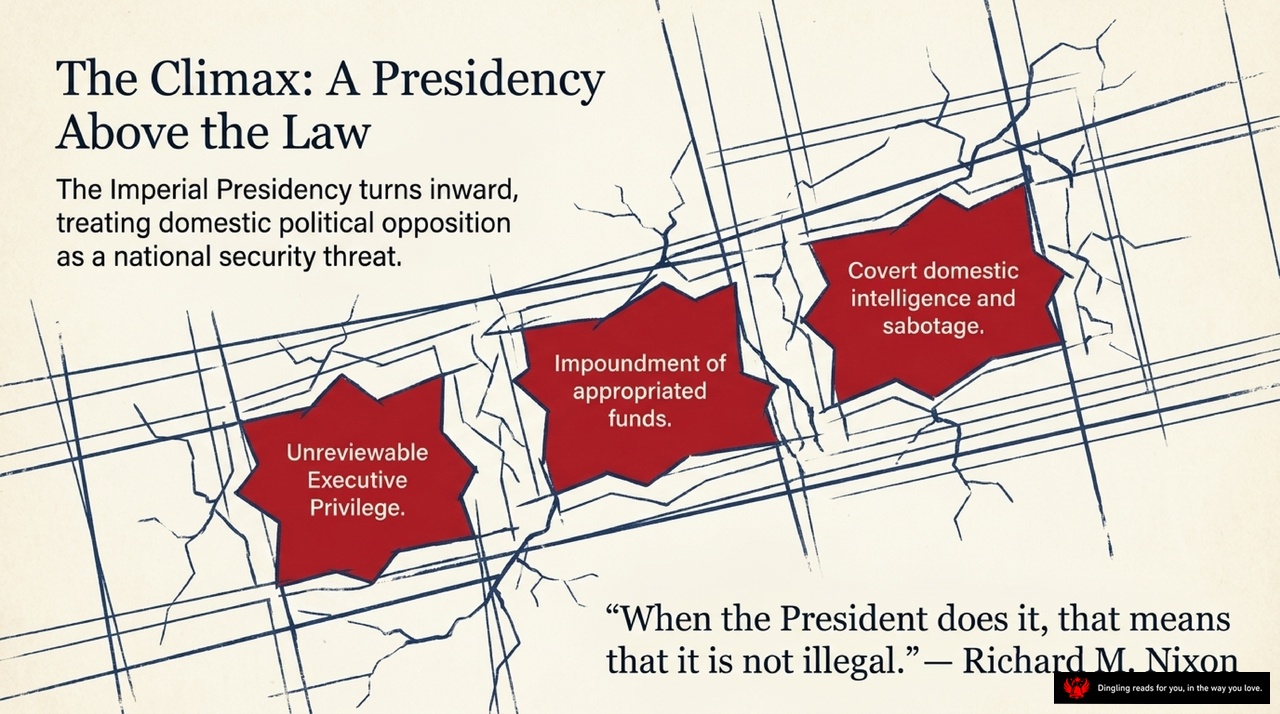
Welcome to the climax of our journey into the Imperial Presidency. Today's slide captures the terrifying moment when the American presidency stopped being a servant of the law and started acting as a ruler above it. Look at those red zones on the map; they represent the critical shifts that define this era. We see "Unreviewable Executive Privilege" and the "Impoundment of appropriated funds." These aren't just bureaucratic terms; they are the tools that allowed a president to ignore Congress, withhold money, and hide secrets from the very people elected to oversee the government.
But the most chilling element here is the final red zone: "Covert domestic intelligence and sabotage." This signals a dangerous turn inward, where political opposition at home is no longer just a disagreement—it is framed as a national security threat. This mindset treats domestic critics as enemies to be neutralized, effectively turning the country against itself.
This slide also features a quote from Richard M. Nixon himself: "When the President does it, that means that it is not illegal." This isn't just a soundbite; it is the core philosophy of the Imperial Presidency. It suggests that the law is not a boundary for the President, but a suggestion that can be discarded whenever the officeholder decides. When this logic takes hold, the separation of powers collapses, and we are left with a system where one man's word is the only law that matters.

The Resurgence: Post-9/11 & The War on Terror
Look at this diagram. It illustrates a dangerous cycle known as "The Mechanism of Resurgence." It shows how international crises, like the rise of Al-Qaeda, don't just happen in a vacuum; they actively trigger a feedback loop that empowers the presidency.
First, we see "Chronic International Crisis." When the world feels threatened, the public demands immediate action. This creates a "Demand for Secrecy & Dispatch," pushing the government to bypass normal legal processes, like the USA Patriot Act, in the name of speed.
Next, this urgency leads to a "Suspension of Accountability." We see examples like Guantanamo Bay and the detention of unlawful enemy combatants. These actions happen outside the usual checks and balances.
As these gears turn, the result is a resurgent Imperial Presidency. The text at the bottom makes it clear: international crises reliably resurrect the power of the president, once again straining the separation of powers to the breaking point. In short, every time the world gets scared, the system is designed to hand more unchecked power to the executive branch.

Let's talk about the illusion of empire. When we look at history, traditional empires like Rome and Britain operated on a simple, brutal logic: they expanded their territory, ruled dependent states, and held direct political control over their subjects. Their power was territorial and absolute.
But the American Empire is different. As we see on this slide, it exerts vast military power but strangely lacks direct political control. Instead of ruling lands, the U.S. often becomes the prisoner of dependent states. Think about the tragic example of South Vietnam, where American forces were trapped in a conflict they couldn't truly win or control. While historic empires were driven by a desire for land, the American version is driven by a messianic ideology—a belief that it is its divine mission to spread freedom and democracy everywhere.
This creates a dangerous dynamic. The slide reminds us of a hard truth: superhuman military power cannot solve everything. No amount of firepower can fix the problems of a society you don't actually govern. Furthermore, these imperial aspirations actively undermine our own pluralistic and democratic ideals. By trying to act like an empire, we risk losing the very values that make America unique. We must remember that having the power to rule is not the same as having the wisdom to govern.

The slide clearly argues that trying to fix our political system by tweaking the Constitution is a false cure. It shows us crossing out the parliamentary system, term limits, and other structural changes, pointing out that importing these features often leads to unintended consequences and instability. The core message is that structure is often just an alibi for policy failure. The real problem isn't the machinery of the 1787 Constitution itself, but rather the political will of the people and Congress.
History teaches us that when we focus too much on changing the rules rather than improving our political culture, we invite chaos. Whether it's imposing term limits or shifting to a parliamentary model, these structural panaceas fail because they ignore the human element of governance. The true failure lies not in the branches of government, but in the lack of courage and responsibility from those who hold power. To restore balance, we must stop looking for quick structural fixes and instead focus on rebuilding the political will that drives our democracy forward.

Look at this slide: "The Antidote: Secularizing the Presidency." The image shows a royal crown being crushed into a voting box, symbolizing a powerful shift in how we view our leader. The text outlines three critical steps to fix our political system.
First, we must demystify the office. The President is a politician, not a demigod or sovereign. We need to strip away the myth of presidential infallibility. For too long, we have treated the White House like a monarchy, expecting perfection from a human being. But history shows us that even our greatest leaders make mistakes.
Second, we need to abandon the idea that the President is always right. This illusion has allowed power to expand unchecked. When the President is seen as above reproach, accountability disappears.
Finally, we must cultivate a little serious disrespect for the office. This doesn't mean disrespecting the Constitution or the people, but rather refusing to blindly follow orders. We need to ensure brutal reality-checking and genuine accountability. Only by treating the President as a fallible public servant can we restore the balance of power that the Founders intended.

Look at this diagram: The Engine of Accountability. It shows three interlocking gears driving our democracy. On the left, we have a Transparent Executive, one who adheres to the principle of disclosure. On the right, an Assertive Congress that reclaims the power of the purse and war-making. And at the bottom, an Alert Citizenry that demands consent and rejects the illusion of executive supremacy.
These three gears must turn together. As the text reminds us, the true defense against tyranny is not efficiency, but the deliberate friction of shared decisions. When the executive hides information or acts unilaterally, that friction disappears, and the system stalls. When Congress stays silent or the public remains unaware, the gears grind to a halt.
We've seen history prove this point. From the founding fathers who insisted on congressional control over war, to the challenges of the Cold War and Vietnam, the balance has constantly tipped toward the president. But the diagram is clear: without a transparent leader, an active legislature, and an engaged citizenry, we lose our freedom. True democracy requires all three parts to work in sync, constantly checking and balancing each other to prevent any single branch from dominating the others.
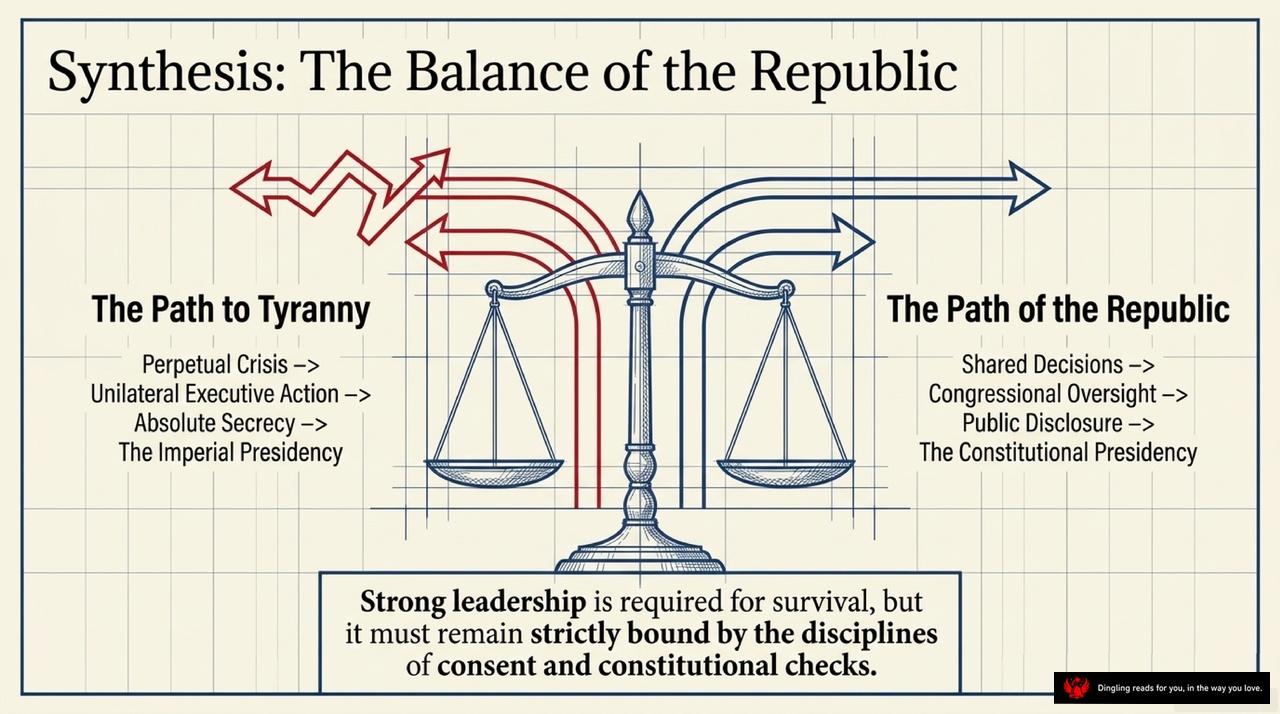
Synthesis: The Balance of the Republic. Look at this scale. It perfectly captures the central tension that has defined American history for over two centuries. On one side, we see the path to tyranny: a spiral fueled by perpetual crisis, unilateral executive action, absolute secrecy, and the rise of the imperial presidency. On the other, the path of the republic: shared decisions, congressional oversight, public disclosure, and a constitutional presidency.
The founders knew that strong leadership is required for survival, but it must remain strictly bound by the disciplines of consent and constitutional checks. They designed a system where war powers are shared, not monopolized. They rejected the idea of a king-like commander-in-chief who could declare war at will. Instead, they envisioned a balance where the President acts as the executor of the law, while Congress holds the ultimate authority to start a war and control the purse strings.
But as we've seen, this delicate balance is fragile. History shows us that when leaders face existential threats or internal crises, the temptation to bypass Congress grows. From the secret treaties of the early republic to the unilateral deployments in Korea and Vietnam, the executive branch has repeatedly stretched its power. And when combined with a culture of secrecy, where information is hoarded to protect the administration rather than to inform the public, the scales tip dangerously.
The lesson is clear. Democracy cannot survive if the executive branch operates in the dark. We need transparency, we need checks and balances, and we need a president who respects the role of the legislature. Without these, we risk sliding down the path to tyranny, leaving the republic behind.

So, we've reached our final stop. This slide asks us to step back and reflect on what we've just explored. The Constitution of 1787 did give us the machinery to balance executive energy with democratic accountability, but here's the hard truth: that machinery isn't self-executing. It doesn't just work on its own. It requires an assertive Congress, a transparent executive, and an engaged public to prevent the slide into imperialism.
Think about it this way: if the ultimate safeguard against arbitrary power relies not on parchment, but on the political will of the people, are we prepared to be the vigilant citizens this Constitution demands? We've seen how power can quietly shift, how secrecy can replace transparency, and how the "imperial presidency" can take root when we stop watching. The system is designed to work, but it only works if we keep pushing against it, staying informed, and refusing to let the scales tip too far in one direction. The choice, ultimately, belongs to us.