
The Information: Complete Chapter-by-Chapter Summary
Welcome to our deep dive into James Gleick's masterpiece, *The Information*. Today's slide sets the stage for a journey that transforms how we see the universe itself. Look at the imagery behind us: on the left, we see the rough, ancient texture of parchment and tree rings, representing humanity's long history of trying to capture meaning. On the right, sleek, glowing data streams and geometric blueprints symbolize the modern digital age. This visual contrast perfectly captures Gleick's central thesis: information has evolved from a vague, human concept into the fundamental, quantifiable building block of reality.
The book promises a sweeping exploration of how we went from oral traditions to the digital age. Gleick argues that information isn't just about facts or messages; it is the very fabric of the cosmos. As the subtitle suggests, we are looking at a history, a theory, and a flood. We will trace the path from the "talking drums" of Africa and the first printed dictionaries to the abstract logic of DNA and the quantum nature of the universe. Prepare yourself, because this story reveals that the universe itself might just be a giant computer, processing bits of information. Let's begin.
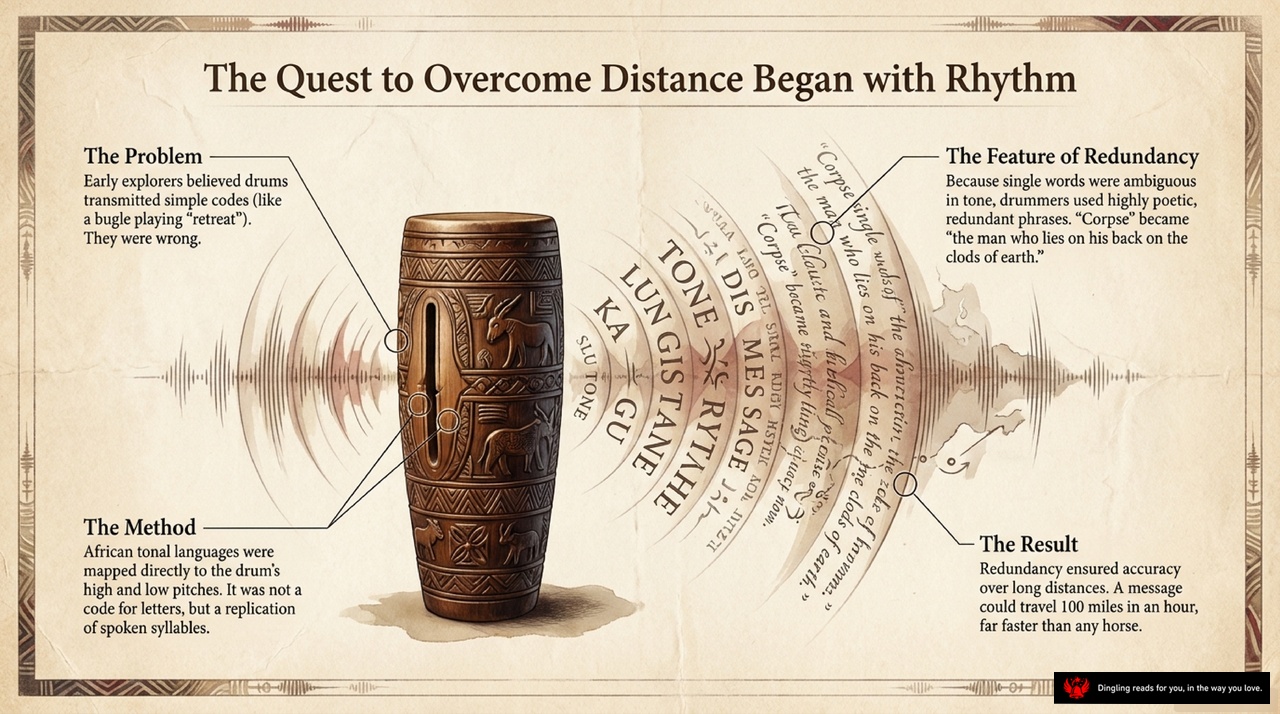
Have you ever tried to send a message across a vast distance and found that a simple word like "corpse" is too vague? In the African savannah, early explorers thought drums were just playing simple codes like a bugle, but they were wrong. The secret lay in rhythm and redundancy. Because spoken words in African tonal languages carry subtle meanings that change with pitch, a drum—limited to just high and low tones—couldn't simply say "corpse." Instead, drummers used poetic, redundant phrases. They didn't just say "corpse"; they described "the man who lies on his back on the clods of earth." This extra detail wasn't wasted space; it was the safety net that ensured accuracy. By mapping the complex tones of spoken syllables onto the drum's limited pitches, they created a system where a message could travel over 100 miles in an hour—far faster than any horse could run. This ancient wisdom taught us that when signals are noisy or limited, adding redundancy is the smartest way to overcome distance and guarantee your message arrives exactly as intended.

Imagine a world where calculation was a slow, error-prone game of human pencil and paper. In the early 19th century, Charles Babbage saw a different path. He envisioned machines that could generate complex mathematical tables automatically, freeing humanity from the drudgery of manual arithmetic. His difference engine relied on a clever mathematical trick called the method of finite differences, turning complex functions into simple, repetitive additions that gears and levers could handle effortlessly.
But building such a machine was no small feat. Babbage had to solve the problem of precision, designing thousands of parts that needed to be accurate to the micrometer. When funding dried up and the project stalled, Babbage didn't give up. He dreamed bigger, shifting his focus to the Analytical Engine. This wasn't just a calculator; it was a universal computer. It featured a "store" for memory, a "mill" for processing, and most importantly, a control mechanism using punch cards—inspired by Jacquard looms—to store instructions. This was the birth of the concept of a stored-program computer.
The story didn't end with Babbage alone. Ada Lovelace, the visionary daughter of the poet Lord Byron, recognized the profound potential of this machine. She realized that if the machine could process numbers, it could process anything that could be expressed numerically—music, graphics, even text. She wrote the first algorithm intended for a machine, earning her the title of the world's first programmer. Although their Analytical Engine was never built in their time, their ideas laid the exact groundwork for the digital revolution that would follow centuries later.
Then came the telegraph, which fundamentally rewrote our understanding of space and time. Samuel Morse's code transformed dots and dashes into letters, allowing information to travel at the speed of light across vast distances. For the first time, "instant" became a reality. This shift didn't just connect cities; it connected the globe, creating the concept of global simultaneity. It forced humanity to adopt standardized time zones and gave birth to a unique, concise writing style known as "telegraphic prose," where every word counted.
However, as the network expanded, so did the need for security and efficiency. Codewords and early encryption methods emerged to protect sensitive data, while the sheer volume of communication demanded smarter ways to compress information. These challenges—from the mechanical logic of Babbage's engines to the electrical pulses of the telegraph—were the essential stepping stones that eventually led to the birth of modern computing and the information age we live in today.

In the early 19th century, Charles Babbage dreamed of a machine that could do the math for us, freeing humanity from the tedium and error of manual calculation. His Difference Engine wasn't just a calculator; it was the first proof that abstract logic could be built out of gears and levers. By breaking down complex functions into simple, repeating additions, Babbage showed that a machine could handle the logic of numbers with mechanical precision.
But Babbage's vision went even further with his Analytical Engine. This wasn't just a number chucker; it was a general-purpose computer. Its genius lay in separating data from instructions, using punch cards—inspired by Jacquard looms—to program the machine. This was the birth of the "stored program" concept. Even more revolutionary was Ada Lovelace, who saw that these machines could process anything that could be coded, not just numbers. She envisioned them handling music, images, and even text, effectively predicting the essence of modern computing long before the first transistor existed.
Later, Samuel Morse solved a different problem: how to send language over wires. He realized that not all letters are created equal. By analyzing letter frequency in newspapers, he designed a compression algorithm where common letters like 'E' got short codes, while rare ones like 'Z' got longer sequences. This created a system remarkably close to mathematical optimization, drastically reducing the physical energy needed to transmit human language.
These breakthroughs—from mechanical logic to digital programming, and from manual calculation to compressed digital signals—laid the foundation for everything that came next. They proved that information could be quantified, compressed, and transmitted across vast distances, transforming how we think, communicate, and even perceive the universe itself.

Today's slide explores the birth of Information Theory, a field that fundamentally changed how we understand the universe. It all started in the 1920s and 30s, when engineers like Nyquist and Hartley began trying to measure the limits of communication. They asked simple but profound questions: How fast can a channel transmit data? How much information is actually in a signal? Hartley realized that information isn't about the meaning of a word, but about the number of choices available—like picking a letter from a 26-letter alphabet versus a binary 0 or 1.
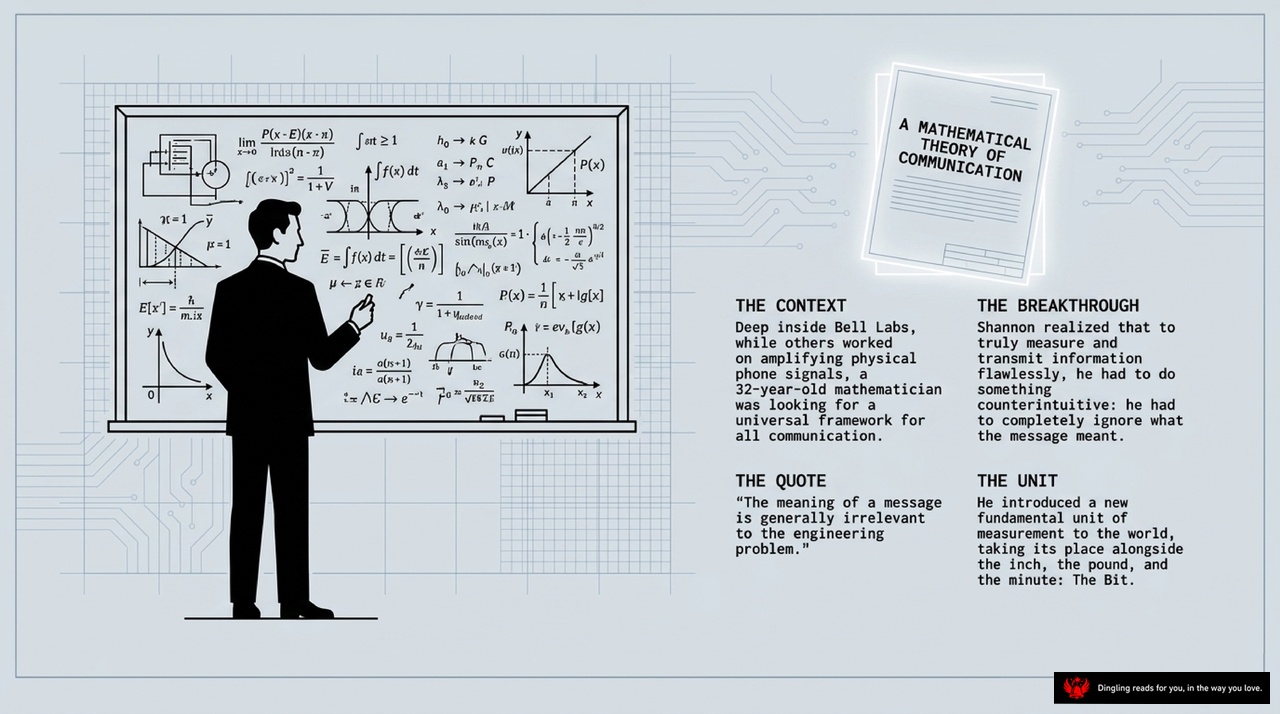
Then came Claude Shannon in 1948. He took these engineering ideas and built a complete mathematical framework. His famous definition stripped away the emotional weight of "meaning" to focus on the core problem: How do we accurately copy a message from one point to another, even when noise interferes? He introduced the concept of the "bit" and "entropy," treating information as a quantifiable physical quantity, just like mass or energy.
This shift was revolutionary. Before Shannon, information was vague. After him, it became a science. He showed that as long as we send data faster than the channel's capacity, we can make errors virtually disappear. This insight didn't just fix phone lines; it laid the groundwork for everything from DNA sequencing to modern computer compression. It proved that information is a universal language, governed by the same laws across biology, physics, and technology.
In this final chapter, we confront the paradox of our modern age: the Babel Library. Jorge Luis Borges imagined a library containing every possible book, a perfect metaphor for today's digital overload. Just like Wikipedia, which now holds more text than all printed encyclopedias combined, we live in an infinite archive where truth and nonsense sit side by side. The sheer volume of data—from social media feeds to global databases—has created a crisis of choice. We are drowning in information but starving for knowledge.
To survive this flood, we need better filters. Think of search engines not just as tools, but as the modern "Maxwell's Demon," sorting chaos into order. But here lies the crucial distinction that Shannon's original theory left behind: he brilliantly quantified *information* as uncertainty, measured in bits, yet he intentionally set aside *meaning*. He solved how to transmit the signal, but not what the signal actually says.
Today, we face the cost of that separation. We can download a perfect copy of a book, but if we don't understand its meaning, it's just noise. As we move forward, the challenge shifts from simply accumulating data to curating wisdom. We must learn to filter the raw data into actionable knowledge, bridging the gap between the mathematical transmission of bits and the human need for meaning. Without this shift, we remain trapped in Borges' endless library, unable to find the one story that truly matters.

Welcome to the final chapter of our journey into the nature of information. Today's slide asks a profound question: How do we separate raw information from the meaning we desperately seek?
Look at the diagram. We see Shannon's classic communication model: the Information Source, the Transmitter, the Channel, the Receiver, and finally, the Destination. But notice the lightning bolt beneath the channel—the Noise Source. This represents uncertainty, static, and errors. Shannon's revolutionary insight was that to overcome this noise, we must stop worrying about the semantic meaning of a message. Instead, we treat messages purely as sequences of symbols chosen from a finite set of probabilities. By focusing on predictability rather than meaning, we can mathematically calculate exactly how much redundancy to add to perfectly overcome any interference.
This brings us to the core tension of the modern age: the separation of information from meaning. Shannon stripped meaning away to make information a quantifiable, calculable object, just like Newton did with physics. But this creates a paradox. As we saw in our previous chapters, information is everywhere—from the DNA in our cells to the code running your phone. Yet, as we approach the limits of storage and bandwidth, we are drowning in data. We have the tools to transmit every possible fact, but we are losing the ability to find what matters.
The slide captures this dilemma perfectly. We have built a "Babel Library" where every possible book exists, yet finding the one that holds true meaning is increasingly difficult. Information is the raw material—the bits, the symbols, the noise-resistant signals. Meaning, however, is the structure we impose on that chaos to create knowledge and understanding. As we move forward, we must ask ourselves: in a world saturated with noise and data, how do we rebuild the bridge back to meaning?

Imagine a scale balancing two worlds: on one side, the heavy, predictable weight of "High Predictability," represented by a string of repeating 'T's. As the slide explains, if you know the next letter is definitely a 'T', receiving it gives you zero new information. It's pure redundancy, a system with no surprises.
On the other side, we have "High Entropy." Picture a coin flipping—Heads or Tails. The outcome is uncertain, and that uncertainty *is* the information. The slide perfectly captures this with a string like "HTTHHT." The more surprising and unpredictable a message is, the more information it actually contains.
This visual ties directly to Claude Shannon's groundbreaking insight: information is fundamentally the measure of surprise. It's order extracted from disorder. A single bit is nothing more than the resolution of that single, uncertain coin flip. In a world flooded with data, remember this: true value isn't found in what you already expect, but in the moments that catch you off guard.
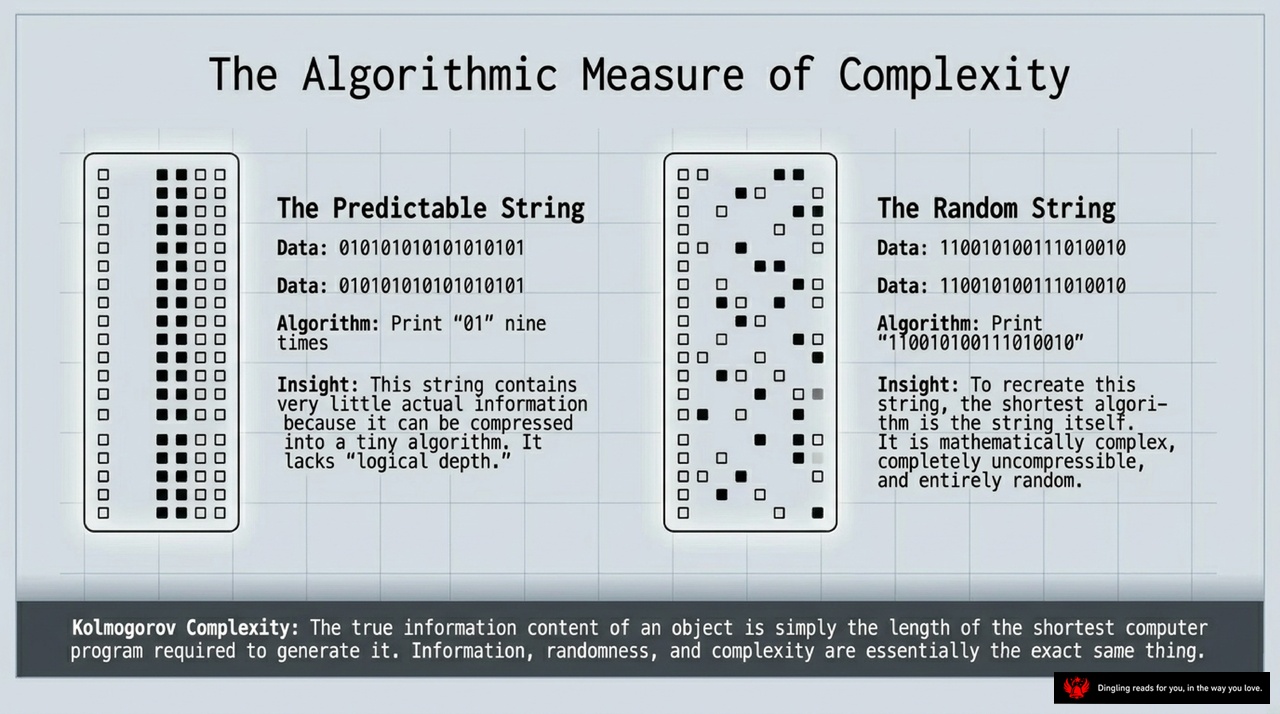
Imagine a string of zeros and ones that looks perfectly orderly, repeating the same pattern over and over. It feels simple, right? But now look at a string that looks like pure chaos, with no repeating pattern at all. Intuitively, we might think the messy one is more complex. But here is where our intuition gets tricked.
This slide introduces Kolmogorov Complexity, a radical idea that flips our understanding of information on its head. It tells us that true complexity isn't about how hard it looks, but how hard it is to explain.
Look at the predictable string on the left. It's just "01" repeated nine times. To recreate this, you don't need to write out every single digit. You just need a tiny instruction: "Print '01' nine times." Because the algorithm to generate it is so short, this string has very low complexity. It lacks logical depth; it's highly compressible.
Now look at the random string on the right. It looks like noise, but that's exactly why it's so complex. There is no pattern to exploit. The shortest possible algorithm to recreate this string is the string itself. You cannot compress it any further. In fact, true randomness and maximum complexity are the same thing.
This leads us to the core definition at the bottom: Kolmogorov Complexity is simply the length of the shortest computer program required to generate an object. If you can describe something with a few lines of code, it's simple. If the only way to describe it is to write out the data itself, it is maximally complex.
So, the universe of information is a bit of a paradox. The most predictable things are the simplest, while the most random things are the most complex. Information, randomness, and complexity are essentially the exact same thing.

Imagine a world where the universe isn't made of atoms, but of bits. This is the radical idea proposed by physicist John Wheeler: "It from bit." In this view, matter, energy, and even space-time itself are just the byproducts of information processing. Every particle, every star, and every thought is ultimately a choice between two states—a 0 or a 1.
This concept is deeply rooted in quantum mechanics. Unlike classical bits, which are either here or there, quantum bits, or qubits, can exist in a superposition of both states at once. This allows for a storage and processing power that defies our everyday intuition. Furthermore, quantum entanglement reveals a strange connection where particles separated by vast distances remain instantaneously linked, suggesting that information might be the fundamental fabric holding the cosmos together.
But this shift in perspective doesn't just change physics; it redefines reality itself. If information is primary, then the physical world we perceive is merely an interface or a simulation of that underlying data. Even the most mysterious phenomena, like black holes, are now understood through the lens of information conservation. When matter falls into a black hole, its information isn't lost; it's transformed, preserved within the radiation emitted by the event horizon.
This leads us to a profound conclusion: information and matter aren't separate entities. They are two sides of the same coin. As we explore the frontiers of quantum computing and cosmology, we are discovering that the universe operates on the same logical principles as our computers. We are not just observers of the universe; we are participants in a grand, cosmic computation where the flow of information is the true engine of existence.

For centuries, we've viewed the universe through the lens of matter and energy—stars, planets, and forces. But a profound paradigm shift has occurred, one that redefines the very fabric of reality. As the slide illustrates, we are no longer just observing particles interacting; we are seeing them exchange bits, flipping quantum states, and processing data on a cosmic scale.
This is the core of John Archibald Wheeler's famous oracle: "It from Bit." Wheeler argued that every particle, every force field, and even the space-time continuum itself derives its function and very existence from binary choices. The universe isn't just a container for information; it *is* information.
Imagine the cosmos as a colossal quantum computer. It is calculating its own destiny with a staggering speed of $10^{120}$ operations per second. In this view, the swirling vortex of binary code you see on the right isn't just a metaphor—it's the fundamental substrate of reality. The distinction between the physical and the digital has collapsed. We are living inside a computation, and understanding that the universe is built on bits is the key to unlocking the deepest mysteries of physics.

Imagine the universe not as a collection of matter and energy, but as a vast, intricate network of data. This slide illustrates a profound shift in our understanding of reality: the idea that information is the fundamental substrate of everything. At the very center lies "The Bit," the basic unit of information, acting as the core around which three major disciplines orbit.
First, we have Physics. This is the mechanics of bits. It explores how quantum entanglement, thermodynamics, and entropy operate, even tackling the mysterious black hole information paradox. It suggests that the laws of physics are essentially the rules governing how bits behave.
Moving outward, we find Biology. Here, we see the replication of bits. DNA sequences are nothing more than long strings of coded bits, storing the instructions for life. Genetic evolution and cellular communication are all processes of copying, transmitting, and processing this biological data.
Finally, at the outermost layer, is Computer Science. This is the engineering of bits. It encompasses algorithms, networks, artificial intelligence, and the telecommunications pioneered by Shannon. It is the field where we actively manipulate these bits to build tools and solve problems.
The bottom text on this slide captures the ultimate realization of the 20th century: Computer science, biology, and physics are no longer separate disciplines. They are all, fundamentally, Information Sciences. Whether we are decoding the stars, understanding our own DNA, or building an AI, we are all just working with the same fundamental building block: the bit.

Imagine standing in Borges' Library of Babel, an infinite maze where every possible book exists—containing every truth, every lie, and every meaningless variation imaginable. We have effectively built this library ourselves. When all information is preserved, finding the actual truth becomes agonizing. This is the paradox of plenty: the durability of data means we suffer from an inability to forget. We are surrounded by a sea of bits, leading directly to information fatigue, anxiety, and a loss of autonomy.
In a system where data is infinite, memory becomes cheap. Yet, ironically, it is forgetting and ignoring that now require precious cognitive energy and computational work. We are drowning in the noise of the Library of Babel, struggling to navigate the flood of information without a clear path to meaning.
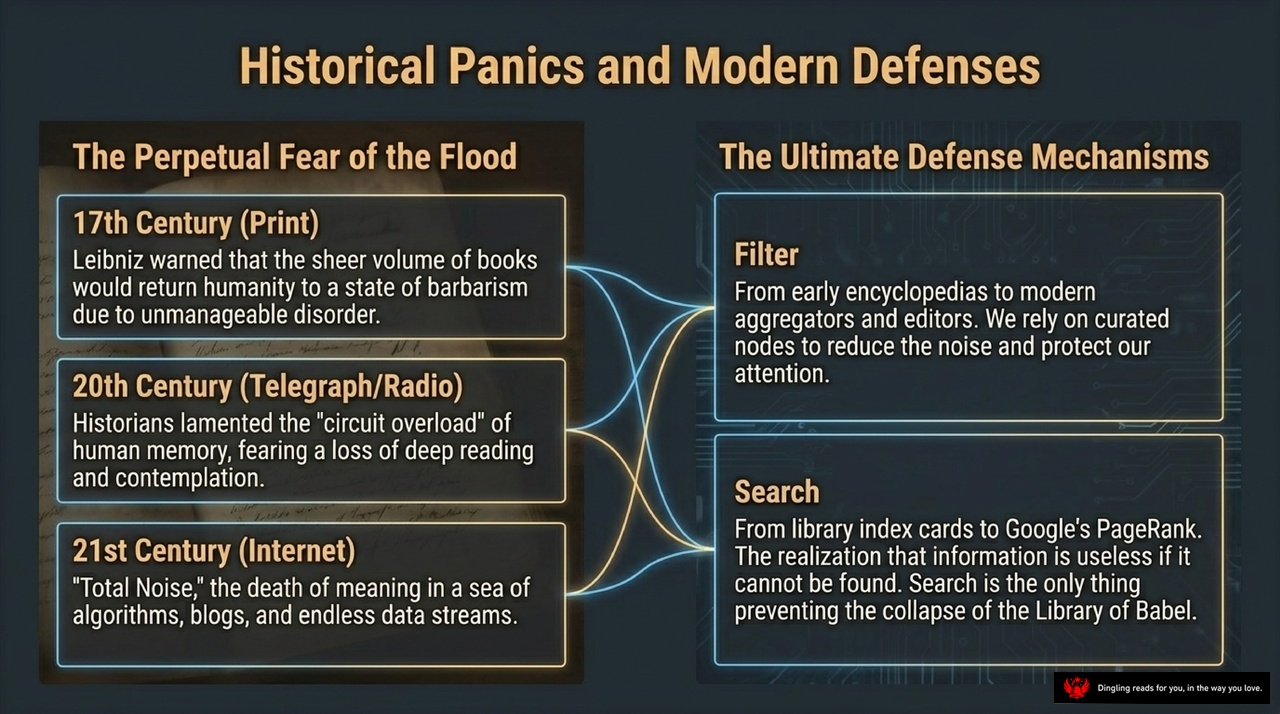
Have you ever felt completely overwhelmed by the sheer volume of information available today? We're living in a version of Borges' "Library of Babel," where every possible book exists, yet finding the one that actually matters feels impossible. This slide breaks down how humanity has faced this "flood" of data and built defenses to survive.
On the left, we see the history of our panic. In the 17th century, when the printing press exploded, Leibniz feared that the sheer volume of books would return us to barbarism through unmanageable disorder. By the 20th century, with the telegraph and radio, historians worried about "circuit overload," fearing our memories couldn't handle the noise and we'd lose the ability for deep contemplation. Now, in the 21st century, we face "Total Noise"—a sea of algorithms and endless data streams where meaning seems to die.
But we haven't just panicked; we've engineered defenses. The slide highlights two ultimate mechanisms: Filters and Search. First, we rely on **Filters**. From early encyclopedias to modern aggregators and editors, we use curated nodes to reduce noise and protect our attention. We don't read everything; we trust trusted sources to do the heavy lifting. Second, we rely on **Search**. Think from library index cards all the way to Google's PageRank. The hard truth is that information is useless if it cannot be found. Search is the only thing preventing the collapse of the Library of Babel, allowing us to navigate the chaos and find the signal we need.

Imagine the universe not as a chaotic void, but as a vast, self-aware computer. As the slide suggests, we started with simple signals—beating wood in the jungle, then carving ink into paper, and eventually coding our thoughts into electrical pulses and pure mathematics. In doing so, we uncovered a profound truth: we aren't just passive observers of reality; we are active nodes in a colossal cosmic network of information. Everything that exists is, at its core, a manifestation of bits.
If the universe is calculating its own destiny, and we are the algorithms it uses to understand itself, what message are you writing into the code? The answer lies in how we process information. From the rhythmic drumming of West Africa to the binary logic of modern chips, we've always been balancing efficiency with accuracy, fighting against noise and ambiguity to make sense of the chaos. As we move forward, remember that every choice you make, every idea you share, adds a line to the universal program. What will your contribution be?