
The Innovator's DNA: Complete Chapter-by-Chapter Summary
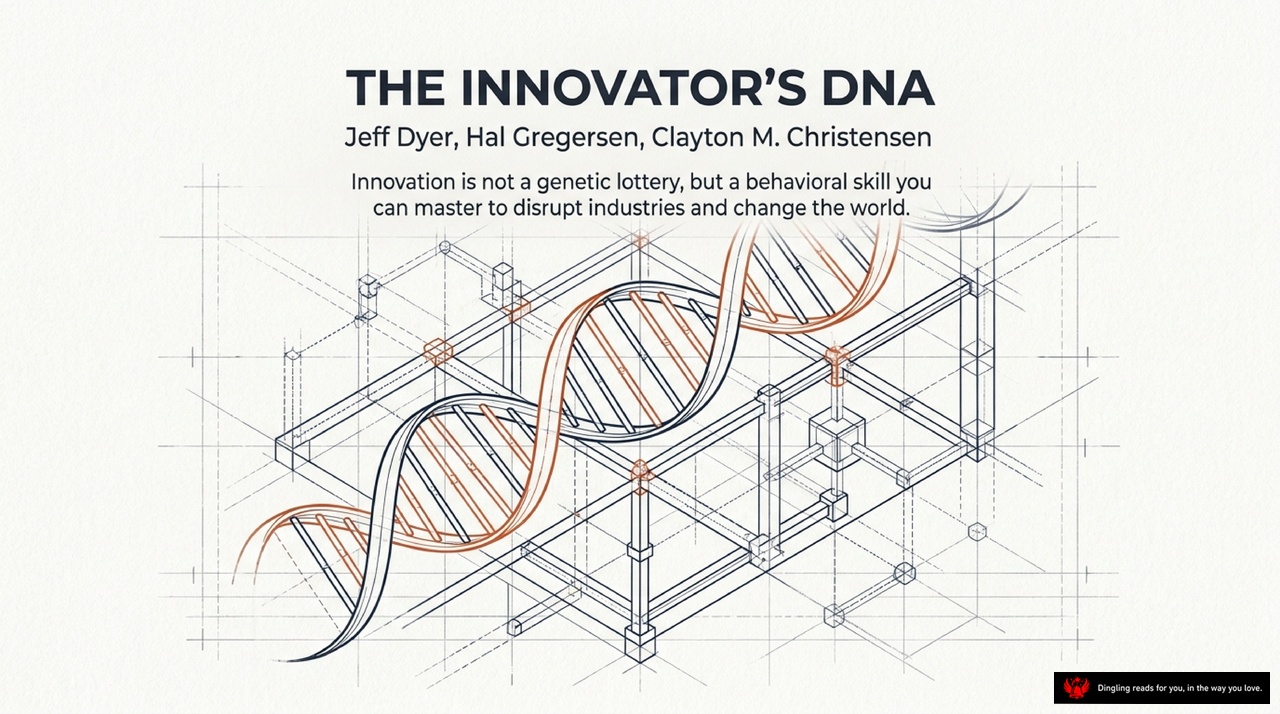
Welcome to today's session on *The Innovator's DNA*. You're looking at the cover, where the title "The Innovator's DNA" is set against a visual of a DNA double helix intertwined with architectural blueprints. This imagery perfectly captures the book's central thesis: innovation isn't a genetic lottery reserved for a few lucky geniuses. Instead, as the text on the slide states, it is a behavioral skill you can master to disrupt industries and change the world.
For years, we've been told that traits like those of Steve Jobs or Jeff Bezos are innate talents—something you're either born with or not. But this book flips that narrative on its head. It argues that the "innovator's gene" is actually a set of five discoverable skills that anyone can learn. Whether you're a student, an entrepreneur, or a corporate leader, you have the potential to edit your own DNA and unlock your creative potential. This isn't about waiting for inspiration to strike; it's about actively practicing a specific set of behaviors that separate the innovators from the rest.
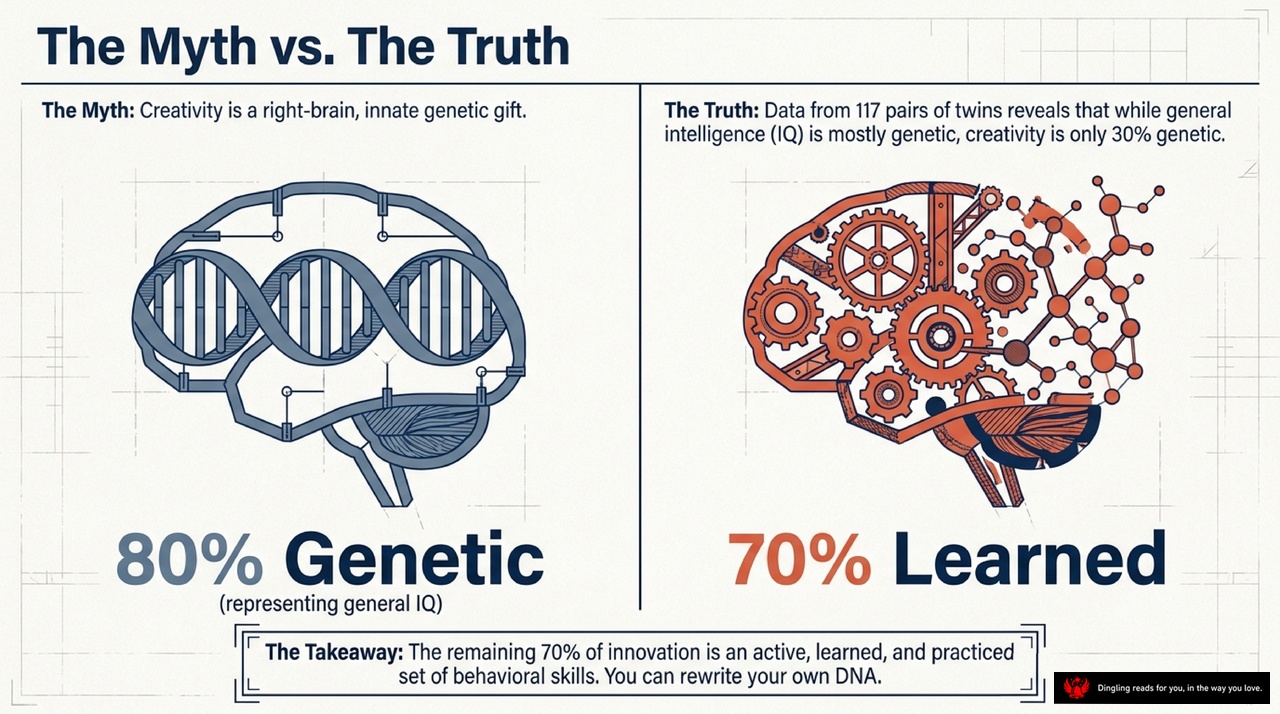
The myth says creativity is a magical gift you're born with, something only right-brained geniuses like Steve Jobs or Bezos possess. But the truth is much more empowering: your DNA isn't fixed. Research from 117 pairs of twins shows that while general IQ is about 80% genetic, creativity is only 30% genetic. That means a massive 70% of your innovative power is learned.
Look at the split in this slide. On the left, we see the old belief that 80% of your potential is locked in your genes. On the right, the reality shifts to 70% learned. This isn't just a number; it's a game-changer. It means innovation isn't a random spark you hope for; it's an active, practiced set of behavioral skills. You can literally rewrite your own DNA through deliberate practice. The remaining 70% of innovation comes from asking questions, observing details, connecting ideas, and experimenting. So, stop waiting for a lightning bolt. Start building the skills that turn anyone into a creator.

The slide we see here perfectly captures the fundamental tension every leader faces: the Executive Paradox. Most companies are built to execute existing models, not to discover new ones. Business schools train us to be excellent executors, but disruptive growth demands a different breed of person entirely: the Discoverer.
On the left, we have the Executor. Their goal is to optimize the status quo. They rely on delivery skills—analyzing, planning, and enforcing discipline. Their output is incremental growth and operational efficiency. This is the engine that keeps the lights on, but it doesn't create the future.
On the right stands the Innovator. Their goal is to disrupt the status quo. They rely on discovery skills—associating, questioning, observing, networking, and experimenting. Their output isn't just efficiency; it's breakthrough ideas and entirely new markets.
The insight at the bottom is crucial: great companies balance both. However, if you want to find that next big thing, you can't rely on the delivery team. Disruptive ideas only come from discovery. You need to stop just executing and start exploring.
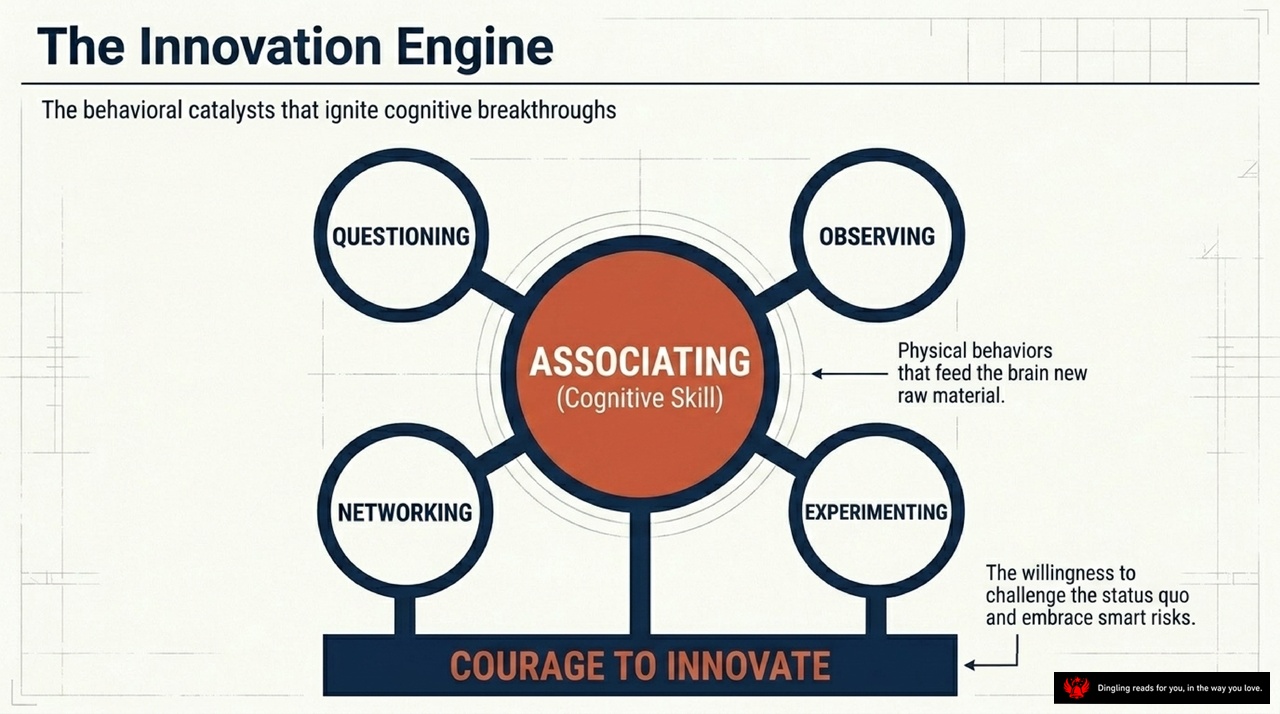
Innovation isn't just for geniuses; it's a machine we can build, and it runs on five key behaviors. Think of it as an engine where **Associating** is the core cognitive skill in the center, fueled by four physical behaviors: **Questioning**, **Observing**, **Networking**, and **Experimenting**. These actions feed your brain fresh raw material, allowing you to connect dots that others miss. But here's the catch: this whole system only ignites if you have the **Courage to Innovate**. Without the willingness to challenge the status quo and embrace smart risks, none of these skills matter.
Consider how this works in practice. **Questioning** breaks the mold—like asking, "Why does a computer need a fan?" **Observing** reveals hidden needs, such as noticing a family huddled on a motorcycle in the rain, which sparked a new car concept. **Networking** connects disparate worlds, like linking traditional medicine with modern health trends. And **Experimenting** turns ideas into reality, whether by dissecting a product or testing a new service online.
The magic happens when these behaviors combine. When you actively question, observe, and connect, you unlock what Steve Jobs called "connecting things." But remember, the engine won't start without courage. It's about daring to be wrong, to try the unfamiliar, and to believe that you can change the game. That courage is the fuel that turns a good idea into a breakthrough.
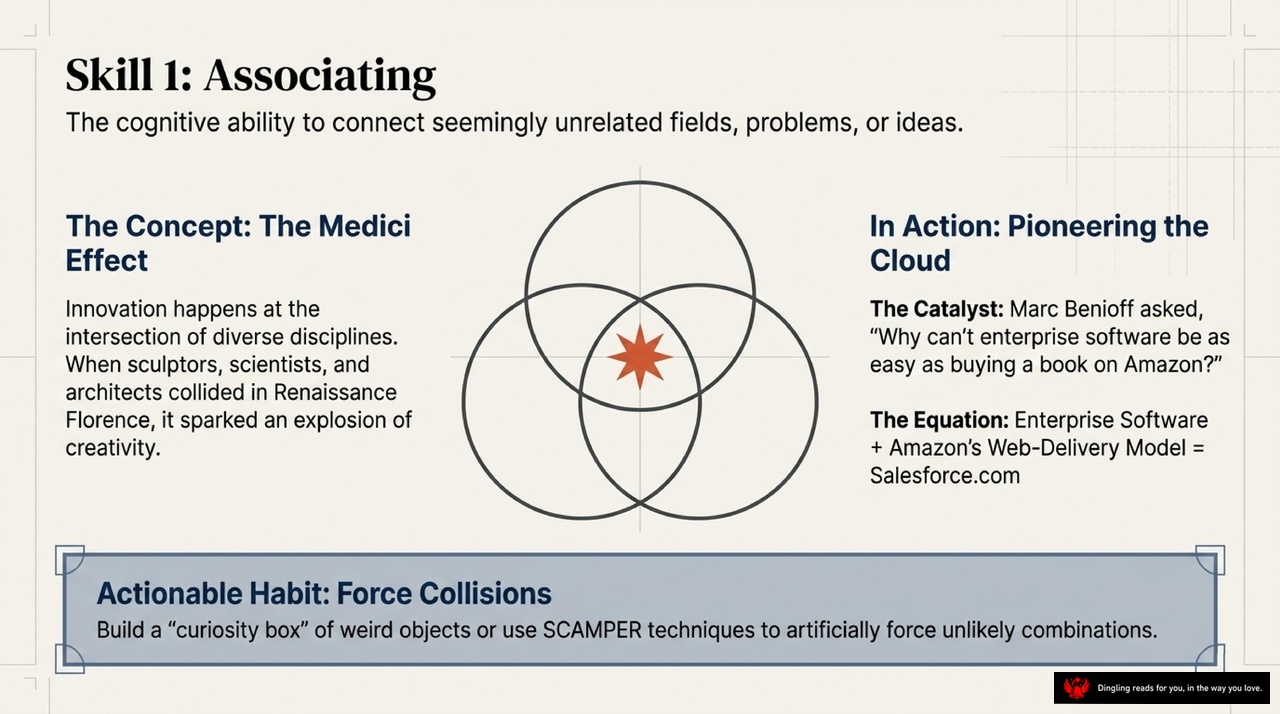
So, how do we actually *build* this associating muscle? The book suggests five practical tricks to force your brain into making unlikely connections.
First, try the "Force Collision" method. It sounds chaotic, but it works. Take two completely unrelated things—like a flower tea and an iPad—and force them together. Maybe you create an AR app that shows how the tea grows, or a reusable packaging that doubles as a toy. Don't worry if it feels silly at first; the goal is just to try.
Second, role-play. Imagine you are the CEO of a totally different company, like Virgin or Apple, and ask yourself: "How would they solve my problem?" This instantly breaks your own company's blind spots.
Third, use analogies. Think of something familiar and map it to your challenge. If you're building an online course, don't just think of education; think of a personal trainer at a gym. Suddenly, the pricing model changes from "per class" to "pay per workout."
Fourth, build a "Curiosity Box." Collect weird objects like a spring, a model plane, or an old pocket watch. When you're stuck, pull one out randomly and brainstorm how it could inspire your current project. Physical objects often trigger ideas that abstract words can't.
Finally, use the SCAMPER technique. It's a structured checklist: Substitute, Combine, Adapt, Magnify, Put to other uses, Eliminate, and Reverse. For example, combine a power bank with a hand warmer, or reverse the order of a product's assembly.
By mixing these five approaches, you stop waiting for inspiration and start engineering it.
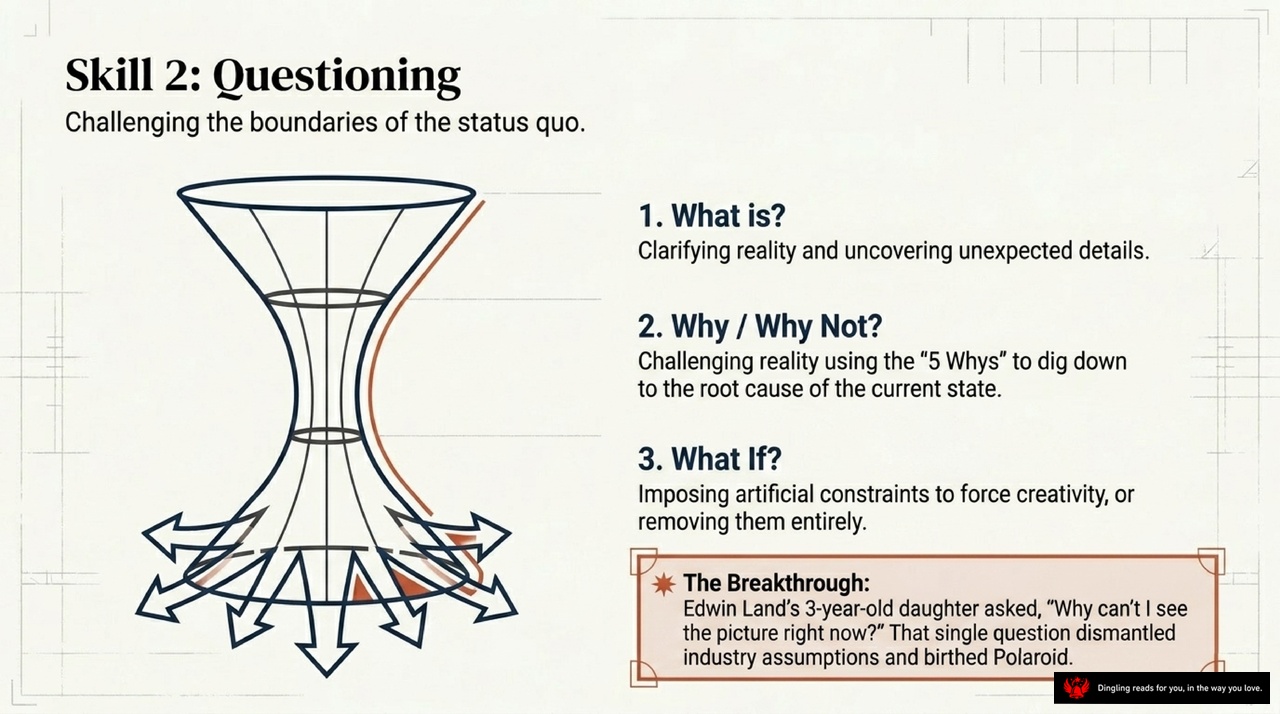
Skill 2: Questioning. This slide isn't just about asking questions; it's about challenging the boundaries of the status quo. Think of it as a funnel that forces us to break out of the narrow path we're currently on.
On the left, you see this visual metaphor. The top represents our current reality, but as we move down, the arrows fan out. That expansion is where the magic happens. It's where we stop accepting things as they are and start exploring new possibilities.
Let's break down the three key question types on the right. First, "What is?" This is about clarifying reality and uncovering unexpected details. Before we can innovate, we need to truly understand the current state.
Next is "Why / Why Not?" This is where we dig deep. The slide mentions the "5 Whys" technique. It's not just about asking once; it's about peeling back the layers to find the root cause of why things are the way they are, or why they *aren't* the way we want them to be.
Then we have "What If?" This is the ultimate creativity booster. It involves imposing artificial constraints to force new ideas, or removing constraints entirely to see what's possible.
Finally, look at the breakthrough story at the bottom. It's about Edwin Land and his three-year-old daughter. She asked a simple, powerful question: "Why can't I see the picture right now?" That single question dismantled an entire industry's assumption that you had to wait for photos to develop. It led directly to the invention of Polaroid.
So, remember this: questioning isn't passive. It's an active tool to disrupt the status quo and birth new ideas.
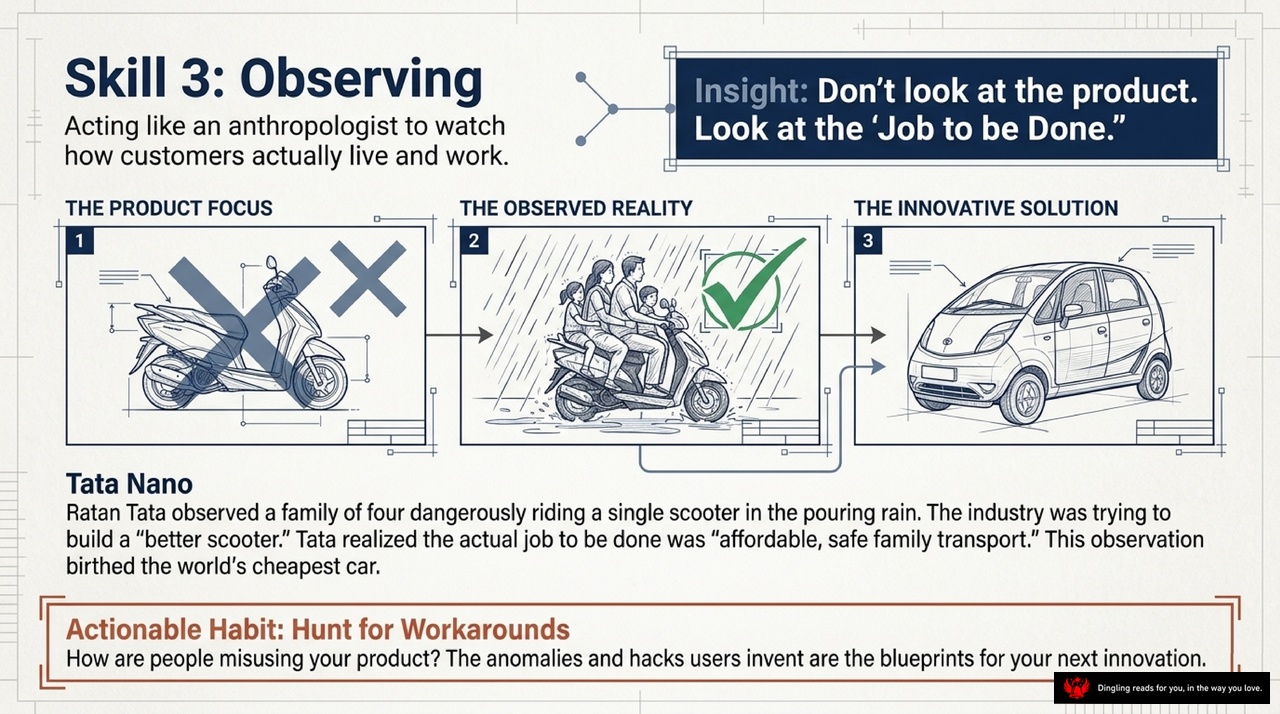
Skill 3 is all about observing. But here's the real insight: don't just look at the product. Look at the "Job to be Done." Think of it like acting as an anthropologist, watching how customers actually live and work in the wild, not just how they use your brochure.
Take the Tata Nano story. The industry was obsessed with building a "better scooter"—they were fixated on the product itself. But Ratan Tata saw something completely different. He observed a family of four dangerously riding a single scooter in pouring rain. That was the observed reality. They weren't just riding a scooter; they needed affordable, safe family transport.
So, instead of tweaking the scooter, the innovative solution was to build the world's cheapest car. This shift from product focus to understanding the underlying need is everything.
Here's your actionable habit: Hunt for Workarounds. How are people misusing your product? The anomalies and hacks users invent are the blueprints for your next innovation. When you see people struggling or finding creative, messy solutions, that's your signal to step in and build the real tool they actually need.
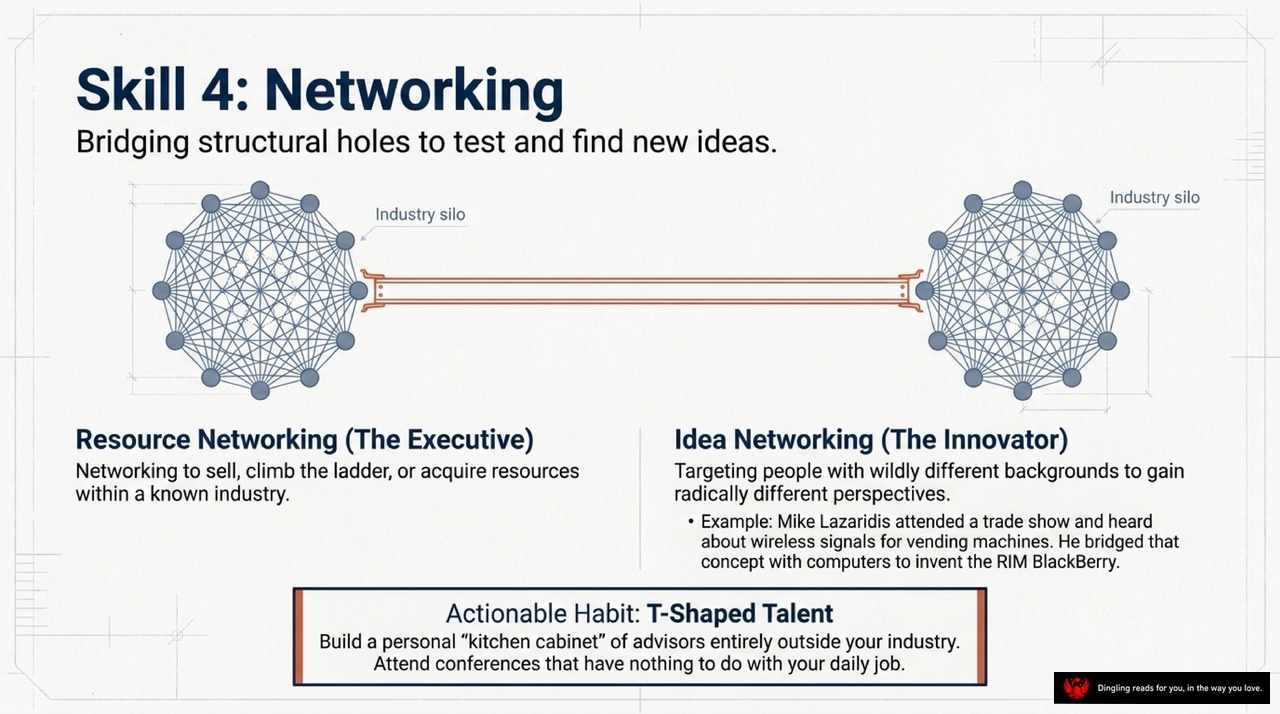
Networking isn't just about collecting business cards; it's about bridging the gaps between isolated worlds. Think of your industry as a tight-knit circle, or a "silo," where everyone knows everyone else, but nothing new enters. True innovation happens when you build a bridge to a completely different circle.
The slide distinguishes two types of networking. First, there's Resource Networking, which is what executives often do. It's about selling yourself, climbing the ladder, or grabbing resources within your own industry. It's safe, but it rarely sparks breakthrough ideas because you're just hearing the same things over and over.
Then, there's Idea Networking, the superpower of innovators. This means targeting people with wildly different backgrounds to gain radically different perspectives. Look at Mike Lazaridis, the founder of BlackBerry. He didn't just talk to computer engineers; he attended a trade show for vending machines. He heard about wireless signals there and bridged that concept with computing, inventing the BlackBerry. That's the magic of crossing structural holes.
To master this, you need to build a "T-Shaped Talent" profile. Deepen your expertise in your own field, but also cultivate a personal "kitchen cabinet" of advisors entirely outside your industry. Attend conferences that have nothing to do with your daily job. By constantly connecting these disparate dots, you stop waiting for inspiration and start creating it.
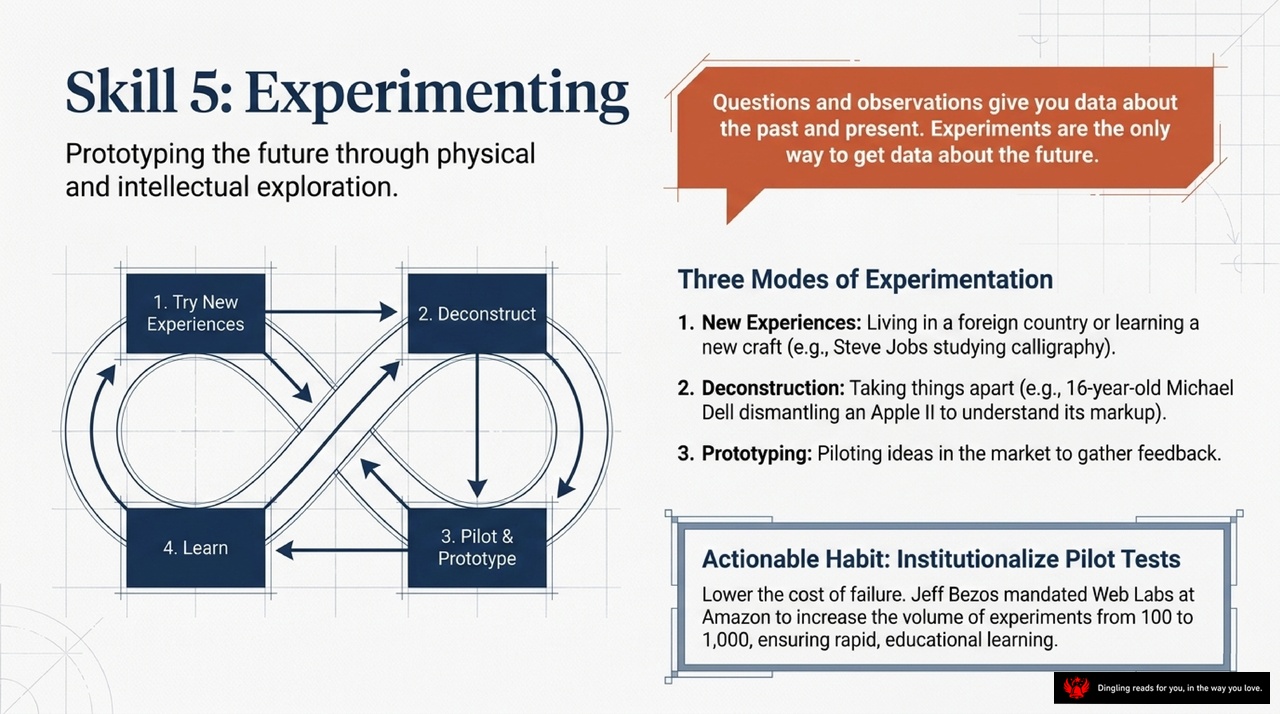
Skill 5 is all about experimenting—essentially, prototyping the future through both physical and intellectual exploration. Think of it this way: questions and observations give you data about the past and present, but experiments are the only way to actually get data about the future.
We break experimentation down into three distinct modes. First, try new experiences. This could mean living in a foreign country or learning a completely new craft, like Steve Jobs studying calligraphy. Second, deconstruct. This is about taking things apart to understand how they work, just like a 16-year-old Michael Dell dismantling an Apple II to understand its markup. And third, prototyping. This is piloting your ideas in the real market to gather real-world feedback.
To make this stick, you need to institutionalize pilot tests. The goal is to lower the cost of failure. Look at Jeff Bezos at Amazon; he mandated that his Web Labs increase the volume of experiments from just 100 to 1,000. By doing this, he ensured rapid, educational learning, turning failure into a stepping stone rather than a dead end.

Innovation is often mistaken as the sole domain of R&D departments, but visionary leaders like Steve Jobs and Jeff Bezos insist it is a core responsibility for every single employee. At Apple, the famous "Think Different" campaign wasn't just an ad for customers; it was a rallying cry for the team, reminding everyone that their mission is to leave a mark on the universe. Similarly, Procter & Gamble's CEO A.G. Lafley expanded the definition of innovation from just the 8,000 scientists to the entire workforce of 100,000. He didn't just talk about it; he acted on it. When an employee suggested a new hair care product for a specific demographic, P&G brought it to life, proving that frontline ideas can drive massive success.
To make this happen, truly innovative companies back their people with real resources. Think of Google's famous "20% rule," which allowed engineers to spend one day a week on their own passion projects. That freedom gave birth to Gmail and Google News. Whether it's 3M's 15% rule or Atlassian's "FedEx Day," these policies send a clear message: we believe in your ability to create, and we are willing to invest in your ideas.
But how do you measure if this culture is real? It's simple. If you ask 100 random employees two questions—"Does your organization expect you to innovate?" and "Is innovation part of your performance metrics?"—in a true innovator, over 70% will say yes. In these companies, innovation isn't a perk for a few; it's a daily job for everyone.
However, pouring resources into the wrong projects is a waste. Many companies still funnel most of their budget into incremental improvements, like tweaking an existing product. True innovators flip the script. They deliberately shift resources toward disruptive projects that aim to create entirely new markets or platforms. This might mean building a completely new business unit, like Amazon's cloud computing division, to break free from the constraints of the old model.
Finally, these companies embrace "calculated risk." They don't fear failure; they respect it. Jeff Bezos famously said that if you're not willing to make mistakes, you're not willing to take the necessary risks to win. The goal isn't to avoid errors, but to fail fast and learn quickly. By creating small, autonomous teams and encouraging smart experimentation, these organizations turn the fear of failure into the fuel for breakthrough success.
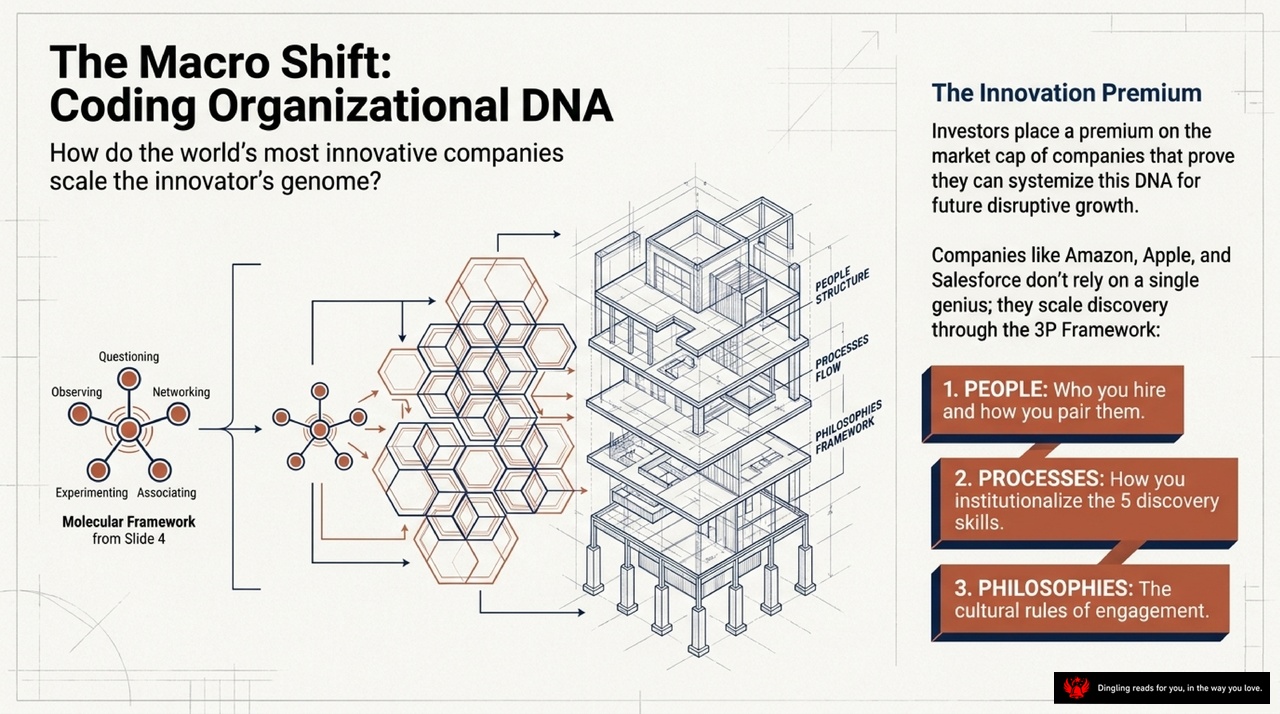
The Macro Shift: Coding Organizational DNA. How do the world's most innovative companies scale the innovator's genome?
Let's look at how top-tier investors actually evaluate success. They don't just look at past reputation or patent counts; they place a premium on the market cap of companies that prove they can systemize innovation for future growth. That's what we call the "Innovation Premium."
Companies like Amazon, Apple, and Salesforce don't rely on a single genius. Instead, they scale discovery through a specific framework we call the 3P Framework: People, Processes, and Philosophies.
First, **People**: This is about who you hire and how you pair them. You need leaders with a high "Discovery Quotient" who are obsessed with asking, observing, and experimenting.
Second, **Processes**: This is how you institutionalize the five discovery skills. Think of it as building the operating system for innovation. For example, Amazon embeds the "Five Whys" into daily operations to solve root causes, while Apple uses "If... what if?" scenarios to spark breakthrough ideas like the iPad. They turn individual habits into company-wide routines.
Third, **Philosophies**: These are the cultural rules of engagement. It's about defining innovation as everyone's job, not just the R&D department's. Leaders like Jeff Bezos champion "calculated risk," teaching teams that failure is a necessary cost of learning. This creates a culture where bold ideas can survive and thrive.
By aligning these three pillars, these companies successfully code their organizational DNA, ensuring that innovation isn't a lucky accident, but a repeatable, scalable engine for disruption.
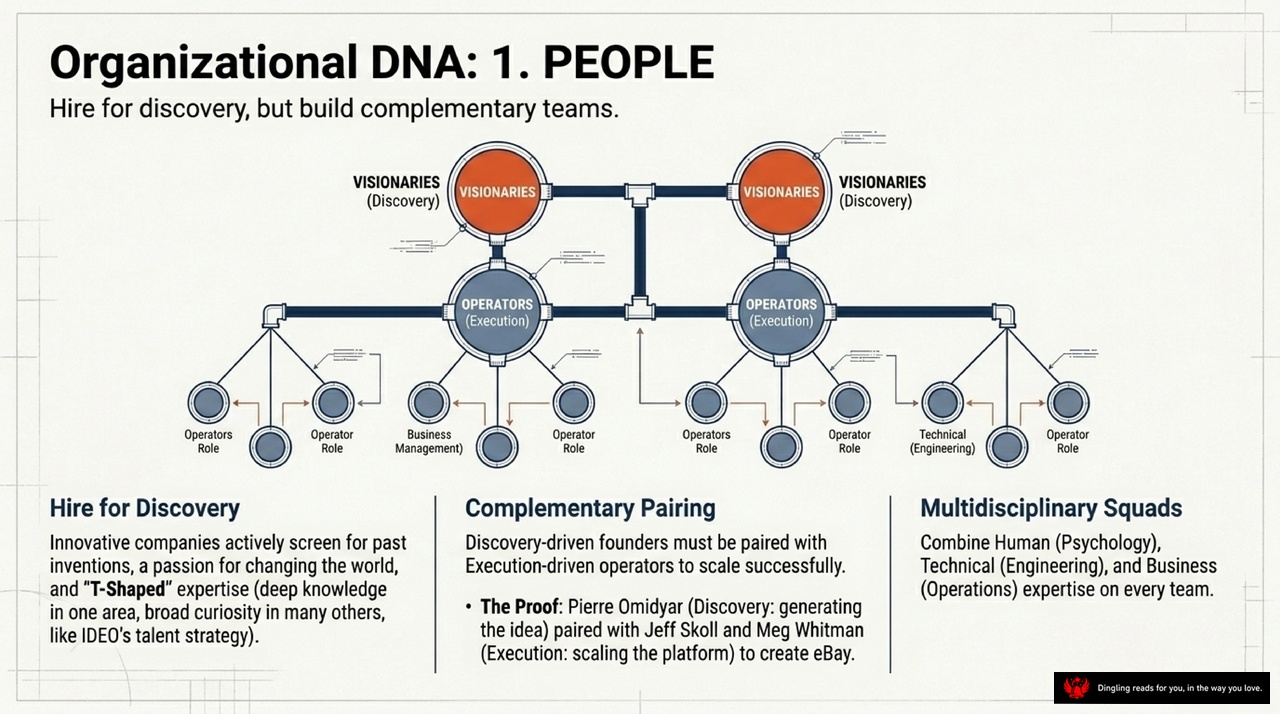
Organizational DNA starts with people, and specifically, how we build our teams. The slide highlights a critical insight: hire for discovery, but build complementary teams. This means your visionaries—the ones driving discovery—must be paired with operators who excel at execution. Without this balance, you either have great ideas that never launch, or a well-oiled machine that can't innovate.
Look at the structure here. We need multidisciplinary squads that combine human psychology, technical engineering, and business operations on every team. Think of the proof provided: Pierre Omidyar, the discovery-driven founder of eBay, was perfectly paired with Jeff Skoll and Meg Whitman, the execution-driven operators who scaled the platform. That synergy is what turns a concept into a global empire.
Innovative companies actively screen for T-shaped expertise—deep knowledge in one area with broad curiosity in many others. They don't just hire for past inventions or a passion for changing the world; they build diverse teams where these skills intersect. By combining human, technical, and business experts, you create a unit capable of both seeing the future and building it. This complementary pairing is the foundation of sustainable innovation.

Organizational DNA: 2. Processes. Think of your company not as a static building, but as a living pipeline where specific behaviors are hard-coded into the very systems that run your business. Today's slide breaks down exactly how to institutionalize those behaviors into four critical areas: Questioning, Observing, Networking, and Experimenting.
Let's look at how top innovators have built these habits into their DNA. First, institutionalizing Questioning. Look at Toyota's famous "5 Whys" methodology. It's not just a suggestion; it's deployed right on the factory floor to root out systemic issues. By forcing everyone to ask "why" five times, they turn curiosity into a mandatory part of their problem-solving process.
Next, we have Observing. This is about seeing what others ignore. Companies like P&G and Google have cracked this by creating unique employee exchange programs. They immerse talent in entirely different corporate cultures, forcing them to observe new workflows and gain fresh perspectives that stay home with them. It's about breaking your own blind spots by living in someone else's world.
Then, we move to Networking. This isn't about collecting business cards; it's about forcing cross-departmental collaboration. Google's internal innovation challenges are a perfect example. They create structures that force people from different silos to work together, ensuring that ideas don't get stuck in one department but flow across the entire organization.
Finally, institutionalizing Experimenting. This is where Amazon leads the pack with their A/B testing web labs. Their philosophy is simple but powerful: reducing the cost of experiments exponentially increases the volume of innovation. By making failure cheap and fast, they encourage everyone to test, learn, and iterate without fear.
The takeaway here is clear: innovation doesn't happen by accident. It happens when you build systems that force Questioning, Observing, Networking, and Experimenting to become the daily rhythm of your company.

Today, we're looking at the cultural bedrock that protects disruptive ideas: Organizational DNA, specifically the "Philosophies" layer. Think of this as the foundation holding up the entire structure of an innovative company.
First, innovation isn't just for R&D labs; it's everyone's job. At Google, engineers spend 20% of their time on personal projects that birthed Gmail. Atlassian even has "FedEx Days," forcing teams to ship a new idea in just 24 hours. This mindset shifts innovation from a department to a daily habit for every employee.
Second, companies must allocate resources to disruptive portfolios, not just safe, incremental upgrades. Think of Google's famous 70-20-10 rule: 70% on core business, 20% on adjacent growth, and 10% on moonshots. This ensures you're building the future while keeping the lights on today.
Third, keep teams small and autonomous. Amazon's "Two-Pizza Rule" limits teams to no more than six or seven people—enough to be fed by two pizzas. This prevents bureaucratic bloat, ensures speed, and makes it easy for anyone to take ownership and move fast.
Finally, embrace smart risk-taking. It's not about blind gambling; it's about celebrating "good failure." IDEO champions the mantra, "Fail often to succeed sooner." When you treat mistakes as cheap, educational experiments rather than career-ending disasters, your team gains the courage to explore truly bold, transformative ideas.
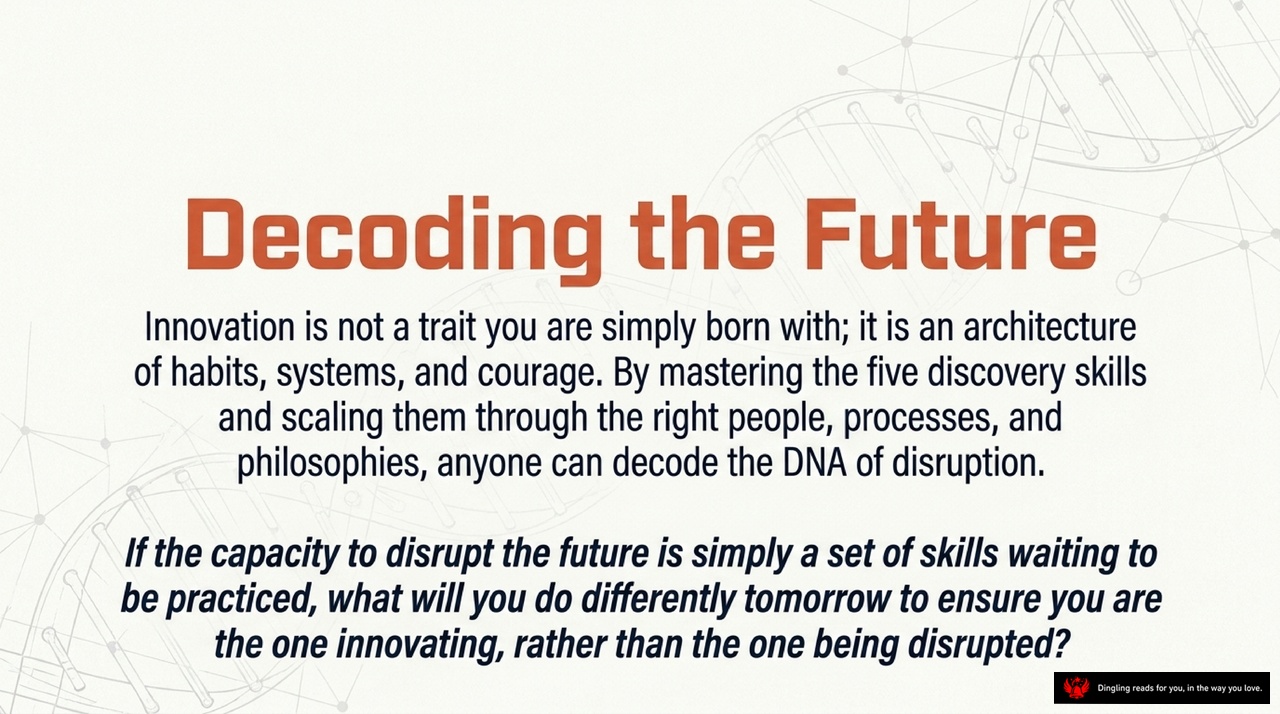
Innovation isn't a magical gift you're born with; it's an architecture built on habits, systems, and the courage to question the status quo. As we've explored, mastering five discovery skills—asking, observing, connecting, networking, and experimenting—allows anyone to decode the DNA of disruption. But here's the critical takeaway: these skills don't work in isolation. They function as a powerful, interconnected system. When you combine them, you unlock a multiplier effect that transforms ordinary ideas into breakthrough innovations.
Think of it this way: asking sharp questions guides your observations; those observations fuel your connections across different fields; networking with diverse thinkers expands your pool of insights; and finally, experimenting validates whether your new ideas actually work. This is how companies like Amazon and Apple operate. They don't just wait for inspiration; they create an environment where these skills reinforce each other. For instance, Amazon's culture encourages employees to ask "why" constantly, observe customer behaviors deeply, and rapidly test prototypes. This cycle of discovery creates a self-sustaining engine for innovation.
So, what does this mean for you? It means you don't need to be a genius to innovate. You just need to practice these skills deliberately and connect them intentionally. Start by asking better questions, paying closer attention to the world around you, seeking out diverse perspectives, and being brave enough to test your ideas. By integrating these five skills into your daily routine, you position yourself not as someone who gets disrupted, but as the one driving the future. The future isn't something that happens to you; it's something you build, one discovery at a time.