
The Innovator’s Solution: Complete Chapter-by-Chapter Summary
Welcome to the Innovator's Solution, where Clayton M. Christensen and Michael E. Raynor offer a predictable blueprint for creating and sustaining successful disruptive growth. In a world where 95% of Fortune 500 companies fail to grow above inflation, this book cuts through the noise to reveal how mature enterprises can escape stagnation and how startups can topple giants. It's not about luck or magic; it's about understanding the hidden forces that drive innovation. We will explore the core models of disruption, from targeting zero-consumption markets to mastering the dynamics of value chains. Whether you're leading a legacy business or launching a new venture, this framework provides the strategic clarity needed to navigate uncertainty, avoid the traps of commoditization, and build a sustainable engine for future growth. Let's dive into the principles that separate the innovators from the imitators.

The slide reveals a harsh reality that many Fortune 500 companies face: the predictable failure of corporate growth. It highlights a "Stall Point," where 95% of these giants hit a wall between 1955 and 1995, while only a tiny 4% managed to restart growth beyond GDP levels.
This isn't just a random crisis; it's a trap. Look at the case study on the right: AT&T's $50 billion death spiral. After the 1984 breakup, the pressure for massive, immediate growth forced AT&T into forced acquisitions like NCR and McCaw Cellular. The result? Blind capital chasing scale led to value destruction.
This is the "growth trap" described in the book. When a company stalls, the market punishes it brutally—often wiping out over 75% of its value. Managers feel immense pressure to restart growth quickly, but history shows it's incredibly hard. The data shows that without a new, disruptive approach, simply trying harder at the old business model rarely works.
The core lesson here is that growth isn't about doing more of what you're already doing. It's about finding a new foothold, often in a "zero-consumption" market or the low-end of the industry, where established giants are too focused on their high-end customers to compete. If you ignore this shift and just keep pouring money into scaling up without a new strategy, you risk ending up exactly where AT&T did: trapped in a spiral of declining value.
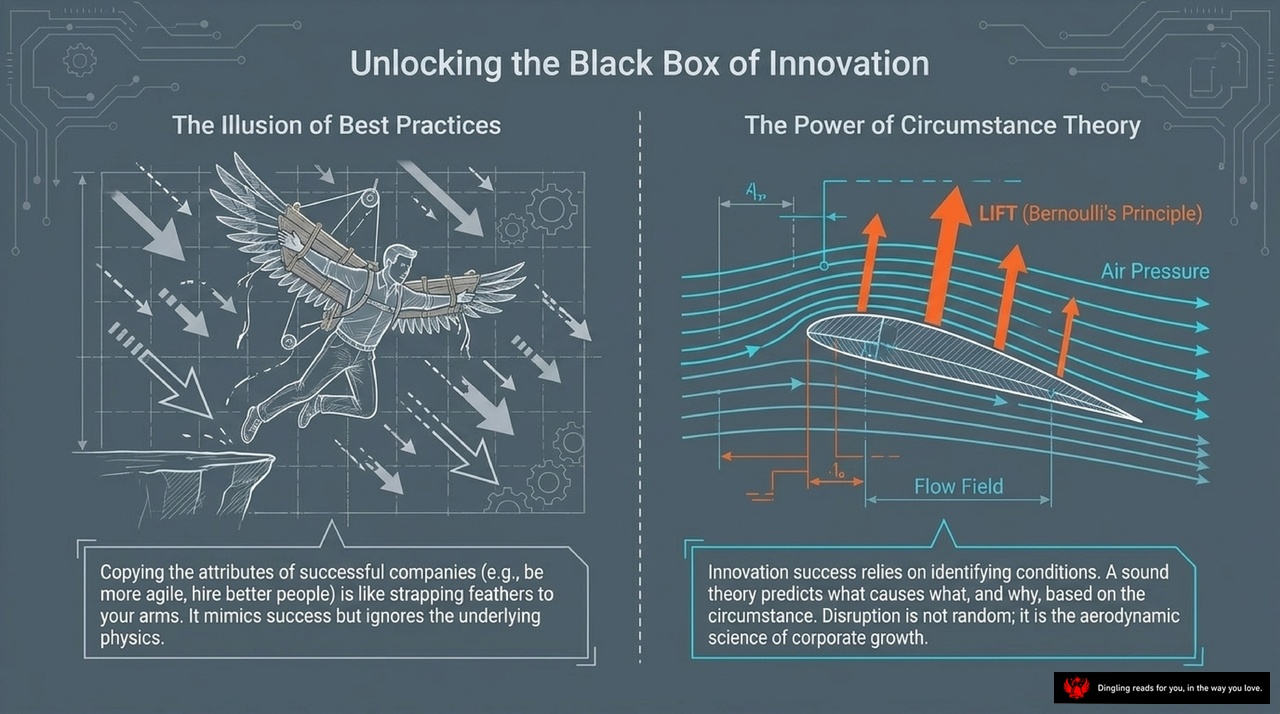
The illusion of "best practices" is a trap that kills innovation. We often think success is a copy-paste job: if a company is agile, hires better people, or has a flat structure, we should just copy those attributes. But this is like the early pioneers of flight who strapped feathers to their arms and jumped off cliffs. They mimicked the *look* of a bird but ignored the underlying physics. Without understanding the aerodynamic principles, they just crashed.
True innovation isn't about copying the attributes of successful companies; it's about understanding the circumstances that made them successful. Think of a wing generating lift through Bernoulli's principle. It's not magic; it's the result of specific air pressure dynamics within a flow field. Innovation success relies on identifying these conditions. A sound theory predicts what causes what and why based on the circumstance. Disruption is not random; it is the aerodynamic science of corporate growth.
If you don't build a theory that explains the underlying mechanics, you're just guessing. You might copy the feathers, but you won't fly. To unlock the black box of innovation, we must stop looking for universal recipes and start mastering the science of context. Only then can we predict growth and stop failing.
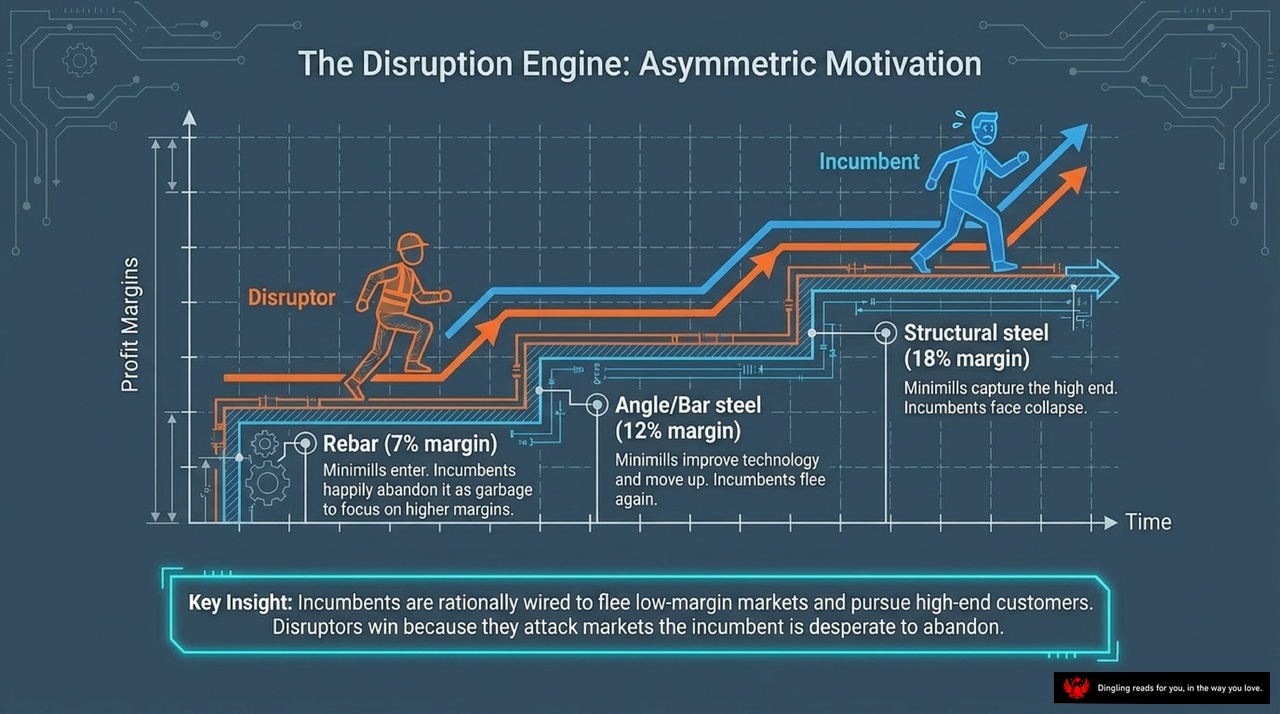
Today's slide visualizes a powerful concept: the Disruption Engine driven by Asymmetric Motivation. Look at the graph. The orange line represents the Disruptor, while the blue line tracks the Incumbent. You'll notice they don't just compete head-on; they play a game of musical chairs across different market segments over time.
The story starts at the bottom left with Rebar, where margins are only 7%. Here, the Disruptor enters. The Incumbent, rational and focused on higher profits, happily abandons this low-margin segment as "garbage" to focus on better opportunities. This is the first advantage: the disruptor takes the ground the incumbent is desperate to leave.
As the timeline moves forward, the Disruptor improves its technology and moves up to Angle/Bar steel, capturing a 12% margin. By the time the Incumbent tries to catch up, the Disruptor has already fled to the next tier. Finally, the Disruptor reaches Structural steel with an 18% margin. Now, the tables have turned. The Incumbent, now chasing high-end customers and trapped in a high-cost structure, faces collapse as the Disruptor captures the high end.
The key insight at the bottom sums it all up: Incumbents are wired to flee low-margin markets and pursue high-end customers. Disruptors win because they attack exactly the markets the incumbent is desperate to abandon. It's not about being better at everything; it's about being where the competition refuses to go.

Look at this graph visualizing the two distinct vectors of disruption. We are looking at a timeline where product performance evolves over time, creating a "Mainstream Market" plateau. But here is the critical insight: disruption doesn't just happen along one path. It splits into two very different directions.
First, we have Vector 1: Low-End Disruption. This strategy is rooted in the current value network. It targets customers who are actually over-served by the mainstream market. These are clients who have a product that is "good enough" but are tired of paying for features they don't need. The key here is a low-overhead business model. Think of companies like Minimills or Dell. They don't try to out-innovate the giants on high performance; instead, they strip away the cost, offering a simpler, cheaper solution that still does the job. This allows them to eat away at the margins of the established players from the bottom up.
Then, we have Vector 2: New-Market Disruption. This is where things get even more interesting because it creates a completely new value network. Instead of fighting for existing customers, this vector targets non-consumption. These are people who previously lacked the money or the skill to use the product at all. They aren't in the market yet. Classic examples include the early days of Sony transistor radios or personal computers. These innovations didn't try to beat the vacuum tube radios or mainframes on performance; they offered something simple and accessible that turned non-users into users.
So, the lesson from this slide is clear: to beat the strongest competitors, you don't necessarily need to outperform them in the same arena. You can either undercut them by removing unnecessary costs for the over-served, or you can expand the market entirely by creating new demand where there was none before. It's about choosing the right vector for your specific opportunity.

Welcome to Chapter 5, where we tackle a critical decision every growing company faces: keep it in-house or outsource it?
Too often, leaders fall into the trap of blindly copying past successes. Just look at IBM in the 80s; they outsourced their microprocessors to Intel and operating systems to Microsoft, thinking they were smart. Instead, they shrank their own potential while empowering those very partners to become giants. The lesson is clear: there is no single "best practice." The right choice depends entirely on the market context.
Think of it this way: when a product is "not good enough," you need to build it yourself. You need a tightly integrated, symbiotic architecture where every component is custom-designed to maximize performance and reliability. This is essential when you are competing in an imperfect market where the customer demands the absolute best.
However, once your product becomes "too good," you've entered the trap of over-service. The customer doesn't need all that extra performance; they just want the job done. At this point, you should outsource. You shift to a modular architecture where components are standardized and can be bought from different suppliers. This allows you to respond quickly to changing needs without reinventing the wheel every time.
History proves this cycle repeats itself. In the early days of computing, giants like IBM and DEC dominated because they controlled the entire stack. But as performance surpassed what users actually needed, modular companies like Microsoft and Intel stepped in, offering flexible, lower-cost solutions that the integrated giants couldn't match.
The danger lies in getting the timing wrong. If you stay integrated too long after performance becomes excessive, you lose to the agile modular competitors. Conversely, if you modularize too early while the market still craves peak performance, you fail to deliver what customers need.
Consider the DSL internet market in the 90s. Local competitors tried to use modular strategies to break in, but they failed miserably because the underlying technology was still in a "not good enough" phase. The interfaces were too complex and dependent on the incumbent's proprietary systems. Only when the technology matured did modular approaches succeed.
So, how do you decide? Ask yourself: Is the market currently suffering from a performance gap, or has our product become a commodity with too many features? If it's the former, integrate and control the value chain. If it's the latter, open up your architecture and let the market do the work for you.
This dynamic shift between integration and modularity is the heartbeat of product architecture. Mastering this rhythm allows you to stay ahead of the curve, ensuring that your business model evolves in lockstep with the changing demands of your customers.

The slide clearly contrasts two approaches to market segmentation: the traditional, flawed method based on demographics and the modern, effective method centered on "Jobs to be Done." On the left, we see age, zip codes, and income brackets crossed out with a big red X, labeled "The Flaw." This represents the old trap of attribute-based segmentation, which creates a one-size-fits-none illusion. It assumes that knowing who a customer is—like their age or income—tells you why they buy. But it doesn't.
On the right, under "The Fix," we see a traveler waiting in an airport lounge, focused on a task. This visual perfectly captures the core insight: customers don't hire products; they hire them to do specific jobs. As the case study notes, RIM's BlackBerry didn't compete against laptops. Instead, it competed against reading the Wall Street Journal, staring blankly at a phone, or wasting time in a waiting room. The job was to help people be productive in small snippets of wasted time.
The lesson here is profound for any business leader. If you segment your market by demographics, you'll build products that no one truly needs. But if you segment by the task the customer is trying to accomplish, you unlock real growth. By understanding the specific job a customer is hiring your product to do, you can design solutions that actually matter, moving beyond generic features to genuine value.

Targeting the Zero-Consumption Market is all about finding growth where the giants are blind. Look at the center of this diagram: Zero-Consumption. This isn't just about selling to people who have no money; it's about serving customers who simply don't exist yet.
Let's break down the four key dynamics driving this strategy. First, we have The Barrier. These are the people who want to accomplish a task but lack the money or technical skills to use existing mainstream products. Because the alternative is literally nothing, they are incredibly eager for a simple, low-cost solution.
Next is The Benchmark. Unlike mainstream buyers who compare new products against high-end competitors, these zero-consumption customers compare a disruptive product against having nothing at all. This lowers the bar for performance, allowing you to succeed with a "good enough" product that traditional players would ignore.
Then comes The Hurdle. Because the alternative is zero, these customers are easily delighted. They don't demand the full feature set of a flagship product; they just need something that works for their specific context. This makes it much easier to gain traction early on.
Finally, we have The Ecosystem. This is where the real magic happens. By serving this new segment, you aren't just selling a product; you are using it in entirely new channels and environments, creating a new value network from the ground up. This allows you to grow independently, away from the intense competition of the mainstream market, until you are strong enough to challenge the status quo.
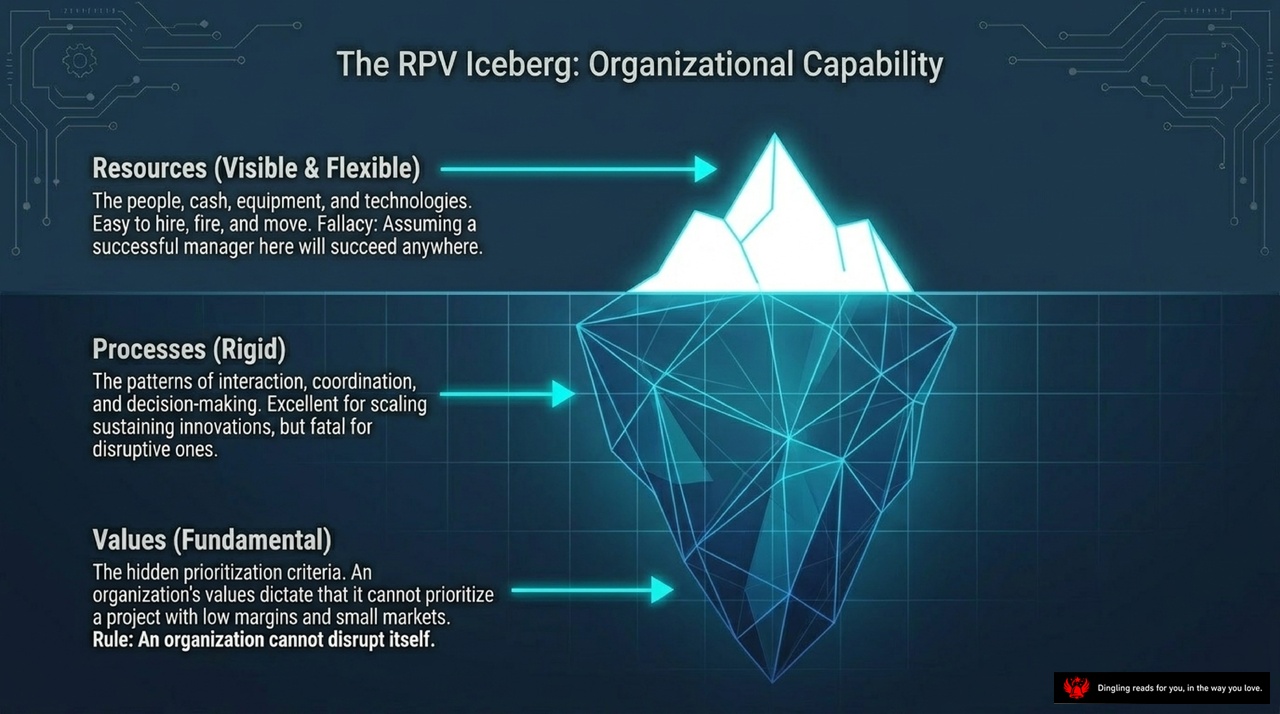
The RPV Iceberg isn't just a diagram; it's the hidden engine that determines whether your company thrives or stalls. Look at the tip of the iceberg: **Resources**. These are your people, cash, and tech. Easy to hire, easy to fire. But here's the trap: assuming a great manager will succeed anywhere. They won't. If your organization's DNA is rigid, even the best talent will fail.
Now, dive deeper into the water. You hit **Processes**. These are your patterns of interaction and decision-making. They are excellent for scaling what you already do, but they are fatal for anything new. If your company's history is built on one way of doing things, that history actively blocks the new paths you need to take.
But the deepest, most dangerous layer is at the bottom: **Values**. This is your hidden prioritization criteria. Your values dictate that you simply cannot prioritize a project with low margins or small markets, no matter how promising it is. As the slide warns: an organization cannot disrupt itself.
If your values are built for stability and high margins, you will never choose the risky, low-margin path that disruptors take. To grow, you don't just need new ideas; you need a new organization with a new set of values that makes the impossible look like the obvious choice.

So, how do we actually build a machine that can consistently churn out these disruptive growth opportunities? It's not about hoping for the best; it's about engineering a specific engine. Think of it as building a dedicated R&D lab that operates under completely different rules than your main factory.
The first step is timing. You have to start building this engine while your core business is still thriving. If you wait until your main revenue is flatlining, the pressure to deliver immediate results will kill the new venture before it can breathe. You need to invest in this future growth now, creating a runway that lasts for years.
Second, you need the right leader at the helm. This isn't about your best COO or CFO. You need a CEO, or a leader with equivalent authority, who is personally obsessed with this new business. Why? Because in the early days, there are no established processes yet. The middle management in your main company will instinctively filter out these risky, low-margin ideas because they don't fit the existing playbook. Only a top-level leader has the power to override those ingrained values and protect the new venture.
Third, you need a small, agile team. Don't try to scale this up immediately. A small team can move fast, make mistakes, and pivot without the bureaucracy of a giant corporation. They need to focus on collecting and validating those "zero-consumption" ideas—those opportunities that everyone else is ignoring.
Finally, you must train your entire organization to spot these opportunities. Your salespeople, engineers, and marketers need to learn the difference between a "continuing innovation" and a "disruptive one." They need to know how to use the "three test stones" to filter ideas. If a salesperson sees a customer asking for a cheaper, simpler version of your product, they shouldn't just say no. They should recognize that as a potential disruption and flag it immediately.
By combining a timely start, a powerful champion, a small team, and a trained workforce, you create a self-sustaining engine. This ensures that when the market shifts, you don't just react—you're already ready to strike.

Think about the most common reason why brilliant companies eventually stagnate. It's often not a lack of talent, but a fundamental misunderstanding of how strategy actually evolves. Look at this graphic: we start with a chaotic tangle of ideas, which eventually crystallizes into a single, clear direction. This visual perfectly captures the shift from Phase 1, Emergent Strategy, to Phase 2, Deliberate Strategy.
In the beginning, things are messy. We are in a state of high uncertainty, often what the book calls a "zero-consumption market." Here, the goal isn't to hit arbitrary revenue targets. Instead, capital must be used to test hypotheses and pivot rapidly. The winning formula hasn't been found yet. This is where learning happens. You fail fast to learn what works.
But once you find that winning formula and the market becomes clear, you must transition. You move into Phase 2: Deliberate Strategy. Now, the action shifts to top-down execution. Resources are strictly allocated to scale the proven model efficiently. This is where you build a dominant position.
However, there is a critical danger highlighted right here on the slide: applying Deliberate Strategy too early kills disruption. If you try to force a rigid plan before you've actually learned what works, you suffocate the very innovation that could save your company. The key is to stay in the messy phase of learning until you have enough evidence to draw a straight line forward. Only then do you commit to the arrow.

The Capital Matrix is a powerful visual tool that separates "Good Money" from "Bad Money," and understanding this distinction is the single most critical factor in whether a disruptive business survives or dies. Look at the top-left quadrant: Good Money. This capital is defined by a high patience for growth but low patience for profit. It forces early, small-scale profitability. This is the golden ticket for disruptive innovators because it proves the model works in a low-end or new market without demanding immediate massive scale. It allows you to stay in the niche, refine your product, and grow organically without the pressure to please the stock market today.
Now, look at the bottom-right quadrant: Bad Money. This is the death spiral catalyst. It demands massive, immediate revenue to move the needle for a large corporation. This pressure forces innovators to abandon small, disruptive markets and cram their products into crowded, mainstream markets where they can't compete on price or performance. This is exactly what happens when capital loses its patience for growth and demands instant returns. You stop innovating to survive, and you become a commodity. The lesson here is clear: to build a lasting disruptive company, you must structure your capital matrix to favor patient growth over immediate profit. If you do the opposite, you will inevitably be forced into the trap of bad money, and your disruption will fail.
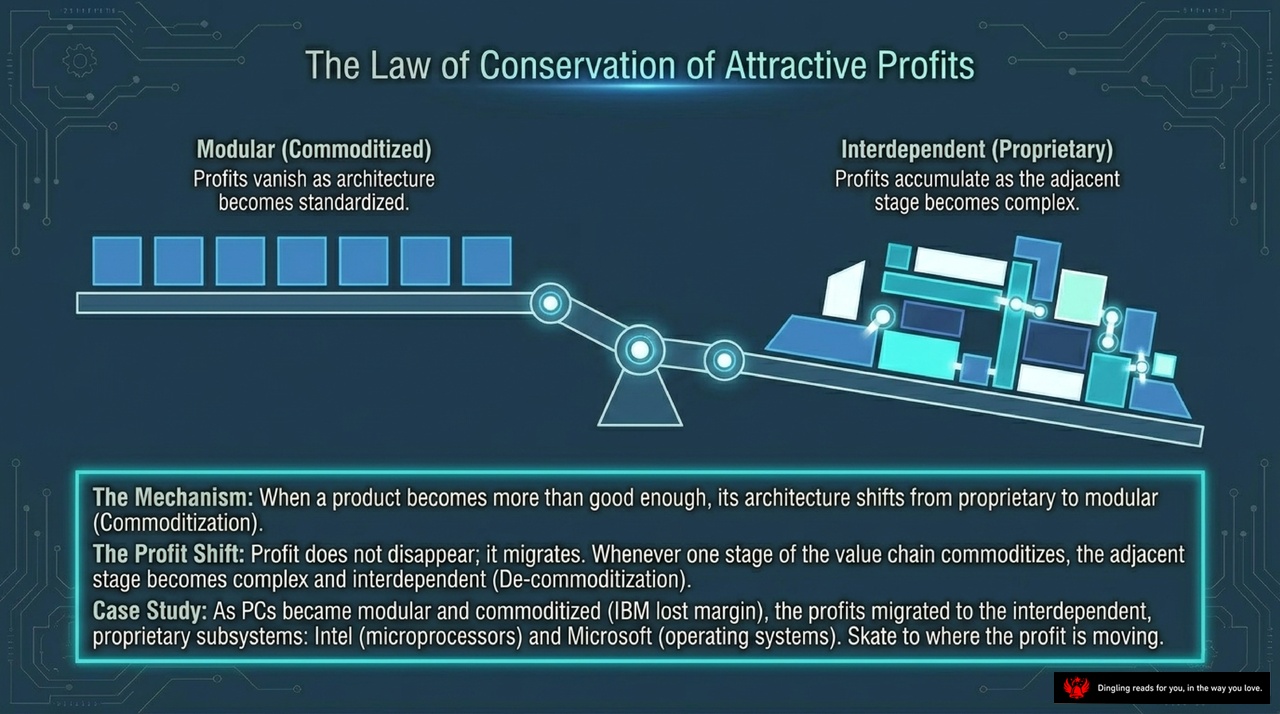
So, where exactly is the money hiding in your business? It's not where you think it is.
Look at this seesaw. On the left, we have modular, commoditized products. Think of it like a row of identical blue blocks. As soon as a product becomes standardized and "good enough," the profits vanish. The architecture flattens, and the margins evaporate.
But watch the right side of the seesaw. When profits disappear from one stage, they don't just vanish into thin air. They migrate. The Law of Conservation of Attractive Profits tells us that whenever one stage commoditizes, the adjacent stage becomes complex and interdependent. That's where the new wealth is created.
Take the PC industry as a case study. When IBM's mainframes became modular and commoditized, they lost their margin. But the profits didn't disappear; they shifted to the proprietary subsystems: Intel with their microprocessors and Microsoft with their operating systems. Those companies built complex, interdependent architectures right where the money moved.
The lesson is clear: don't just chase the product. You have to skate to where the profit is moving. When your product becomes too good and too standard, stop trying to defend it. Instead, look for the next stage in the value chain that is becoming complex. That is where the next wave of high-margin growth lives.

So, how do we actually build this "Disruptive Growth Engine" without it just being a fancy diagram on a wall? The book gives us a clear, four-step blueprint that turns unpredictable innovation into a predictable process.
First, you have to **Start Early**. Don't wait until your core business is struggling and you're desperate for a miracle. Launch your growth initiatives while you're still healthy. This avoids the trap of needing massive, immediate scale, which is usually a death sentence for new ideas.
Next, you need **Executive Shielding**. You must appoint a senior leader—ideally at the CEO level—to personally protect this new unit. Their job is to shield the disruptive team from the mother ship's rigid resource allocation processes. Without this high-level sponsorship, the new venture will starve.
Then, create a **Dedicated Shaping Team**. This isn't just a normal project group; it's an expert, standalone team that uses disruption theory, not past data, to turn raw ideas into viable business models. They need the freedom to think differently from the rest of the company.
Finally, you must **Train the Frontlines**. This is where the magic happens operationally. You need to educate your sales and engineering teams to actively identify non-consumers and asymmetrical opportunities. They become the eyes and ears, feeding raw materials into the engine that the rest of the company might have missed.
When these four gears turn together, you stop guessing and start building a machine for continuous, repeatable growth.

Are you building an engine for disruptive growth, or are your best people currently polishing the brass on a sinking ship? That is the critical question we face today.
To answer it, we must look at the blueprint for true disruption. It starts with targeting non-consumption or over-served markets, not just trying to fight head-on with established giants. You need to solve a specific Job to be Done, understanding that customers buy to accomplish tasks, not just to own products. When you identify these overlooked opportunities, the next step is to spin out an autonomous unit. This is essential to bypass rigid corporate values and the slow-moving processes of your legacy business.
But even with the right strategy and structure, you cannot ignore the role of capital. You must ensure your funding is patient for growth but impatient for profit. This balance forces the business to find a sustainable model quickly without waiting for the main business to catch up. Finally, you must be willing to skate to where profits will eventually conserve, anticipating where value will shift in the value chain before your competitors do.
If you fail to execute this blueprint, you risk becoming the next company that lost its way. Don't just maintain the status quo; build an engine that drives irreversible, disruptive growth.