
The Innovators: Complete Chapter-by-Chapter Summary

Welcome to today's session on *The Innovators* by Walter Isaacson. As we open this chapter, we're reminded that the digital revolution wasn't forged by solitary geniuses in isolated garages, but by collaborative networks operating at the vibrant intersection of the humanities and the sciences. This book explores how creativity and logic, often seen as opposites, actually fuel each other to build the modern world. From Ada Lovelace's visionary blend of poetry and science to the teamwork behind the internet and personal computing, we see a pattern: true innovation thrives when diverse minds connect. Whether it's the hardware revolution or the rise of the web, history shows us that the most transformative breakthroughs come not from lone heroes, but from communities where ideas flow freely across disciplines. Let's dive into the stories of the people who shaped our digital reality.
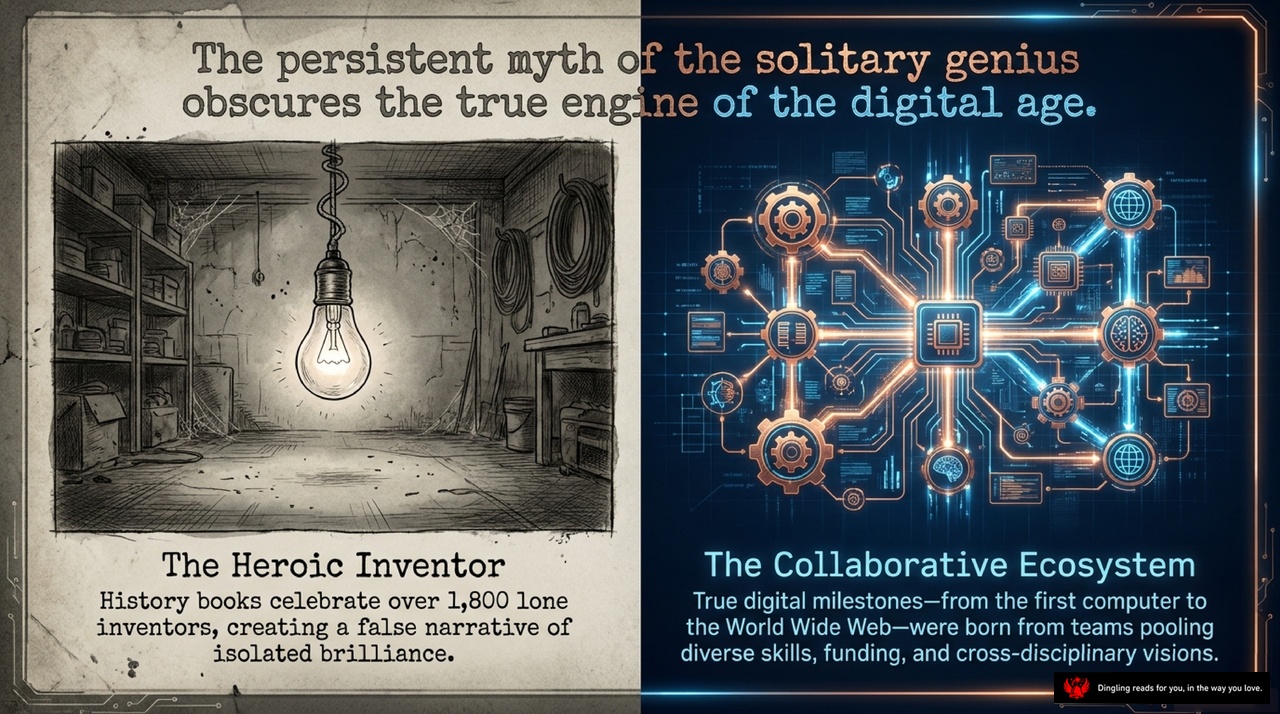
The persistent myth of the solitary genius obscures the true engine of the digital age. Look at the left side of this slide: history books have long celebrated over 1,800 lone inventors, painting a false narrative of isolated brilliance. They tell us of the "Heroic Inventor," the solitary figure in a dimly lit room, sparking an idea all alone. But this is a story we've been told, not the reality.
On the right, we see the true engine of our modern world: The Collaborative Ecosystem. True digital milestones—from the first computer to the World Wide Web—were never born from isolated minds. They were born from teams pooling diverse skills, funding, and cross-disciplinary visions.
Think about the early days of computing. It wasn't just one person. Ada Lovelace, for instance, didn't work alone; she collaborated with Charles Babbage, blending his mechanical logic with her own poetic vision for what machines could do. Later, the creation of the transistor wasn't a solo act; it was a tight-knit team at Bell Labs where theory met experiment. And the internet? That was the result of engineers, scientists, and visionaries working together across the globe.
The lesson is clear: the digital revolution wasn't driven by lone geniuses, but by ecosystems of collaboration. The future belongs not to the solitary thinker, but to those who know how to build, connect, and thrive within a community of innovators.

Imagine a world where a Victorian countess didn't just write poetry, but saw the blueprint of the future hidden in simple punch cards. This slide captures that exact moment: the birth of the digital revolution, sparked not by a modern engineer, but by Ada Lovelace's revolutionary insight.
On the left, we see the Analytical Engine, the mechanical brain of the 19th century. Ada realized that just as a Jacquard loom weaves intricate flowers and leaves by following punched cards, this machine could weave algebraic patterns. She championed "Poetical Science"—the daring marriage of rebellious imagination and rigorous mathematics. She understood that computers weren't just number crunchers; they were creative partners capable of composing music or processing text.
Fast forward to the right side of the image, where that 19th-century vision transforms into today's high-tech reality. The glowing circuit board represents the ultimate breakthrough: by observing those old mechanical looms, Ada foresaw that Charles Babbage's Analytical Engine could process far more than just numbers. Her idea that machines could manipulate symbols and logic laid the foundation for everything we use today. From the code running your phone to the algorithms shaping our world, it all traces back to her realization that the future of computing was written in poetry, not just math.

Let's talk about the culture that actually powered the personal computer revolution. It wasn't just about code; it was about a radical shift in how we interact with technology and each other.
Look at the two distinct models on the right side of our slide. The first is the "Hierarchical & Tense" approach. This was the traditional path, seen in places like Bell Labs, where theoretical physics met experimental tinkering under a demanding visionary. It was top-down, structured, and often tense. While effective for foundational breakthroughs like the transistor, this model kept innovation somewhat contained within strict boundaries.
But the second model, labeled "Flat & Open," tells a completely different story. This is the DNA of the modern tech industry. Think of the "Traitorous Eight" leaving Shockley's lab or the open cubicles at Intel. These environments fostered a culture of shared equity and uncredited intellectual cross-pollination. Instead of silos, ideas flowed freely between engineers, designers, and theorists.
This open, flat structure is what allowed the internet to explode. It's the same spirit that birthed the World Wide Web and open-source software. When barriers to entry disappear, innovation accelerates. We move from a world where a few geniuses build in isolation to a global community where anyone can contribute.
So, while the hardware was forged by brilliant minds, the real revolution happened when those minds stopped working alone and started collaborating openly. That shift from hierarchy to openness is what truly defined the digital age.

The ENIAC project was born out of desperation. In 1942, the U.S. Army needed to calculate artillery firing tables faster than ever before. Enter John Mauchly and J. Presper Eckert, a power couple of science and engineering. Mauchly dreamed the big picture; Eckert built the reality. Together, they engineered a beast of a machine: the ENIAC. It was massive—100 feet long, weighing 30 tons, and packed with 17,468 vacuum tubes. It wasn't just fast; it was revolutionary, performing 5,000 additions per second, a hundred times faster than anything before it. When it debuted in 1946, the world watched as it solved complex problems in mere seconds, proving that electronics could truly power the future.
But here's the twist: the story of ENIAC isn't just about Mauchly and Eckert. It's a story of collaboration and credit. While they built the machine, another pioneer, John Vincent Atanasoff, had actually conceived the core ideas years earlier. When patent disputes erupted, the courts eventually ruled that Atanasoff's contribution was the foundation. This moment teaches us a vital lesson about innovation: it rarely happens in a vacuum. Great breakthroughs are often the result of multiple minds colliding, where one person's idea sparks another's invention.
Looking back at the entire journey of the digital revolution, from Ada Lovelace's early visions to the transistor, the integrated circuit, and now the internet, we see a pattern. Innovation isn't the work of a lone genius sitting in a tower. It's a symphony of diverse talents. Think of the teams at Bell Labs or Intel, where theorists, engineers, and managers worked side by side. Or consider the open-source movement, where thousands of volunteers collaborate without a central boss. Whether it's government funding, private enterprise, or community-driven projects, the most powerful results come from combining different strengths.
So, what does this mean for us today? The future belongs to those who understand that technology is not a replacement for humanity, but an extension of it. Just as Ada Lovelace saw the potential for machines to be creative partners rather than cold calculators, we must embrace this "poetic science." We need to blend our human intuition, empathy, and creativity with the raw power of machine logic. The next wave of innovation won't come from just smarter algorithms; it will come from people who can bridge the gap between the technical and the human, turning cold code into something that truly serves and inspires us.

Today's slide reveals the two distinct philosophies that fractured and ultimately defined our entire software industry: the Hacker Ethic versus Proprietary Ecosystems. On the left, we see the open-source model, often called the Decentralized Bazaar. Think of it as a community code where information wants to be free. Icons like Linus Torvalds and Richard Stallman built this on the belief that code belongs to everyone. It's a place of crowdsourced tinkering, where continuous, collaborative innovation thrives without walls.
On the right stands the opposing force: Proprietary Ecosystems, or the Closed model. This is the Centralized Cathedral approach championed by icons like Bill Gates and Steve Jobs. Here, software is treated as a valuable, patentable product requiring strict quality control. It's a highly polished, profitable, walled garden designed to protect intellectual property and maintain a monopoly.
The image perfectly captures this fundamental divide. One side is a sprawling, organic network of community contributions, while the other is a rigid, hierarchical structure built on exclusivity. These two philosophies didn't just coexist; they competed, clashed, and shaped every decision in the tech world we live in today.

Decentralized networks survive because they distribute responsibility across every node. Look at the contrast here. The top model shows a "Hub and Spoke" system, which is centralized. It has a single central hub connected to all the outer nodes. But notice the red "X" over that hub. That represents a central failure point. If the hub goes down, the entire network dies. Every connection relies on that one single point.
Now, look at the bottom model. This is a "Distributed Grid," or a decentralized network. There is no single hub. Instead, we have a mesh of interconnected nodes. Even if one node fails, marked by that red "X," the network doesn't collapse. Why? Because there is no single point of failure. Data packets automatically reroute through redundant paths to reach their destination.
This resilience comes from breaking messages into smaller packets and allowing them to independently route themselves through a decentralized web. By doing this, the ARPANET became indestructible. It wasn't just about connecting computers; collaboration was built directly into the protocol itself. This shift from a fragile, centralized structure to a robust, distributed grid is what allowed the internet to survive and grow, turning a fragile experiment into a global infrastructure that no single entity could ever shut down.

Interactive interfaces didn't just make computers faster; they fundamentally changed what it means to be human. As the slide illustrates, we moved from using computers as remote calculators to treating them as extensions of our own minds. This transformation rests on two pivotal moments. On the left, we see "The Mother of All Demos" from 1968. Douglas Engelbart didn't just show us a new gadget; he unveiled the mouse, hypertext, and networked collaboration all at once. He treated the computer as a convivial tool, proving that with the right input, we could multiply our collective intelligence.
On the right, the vision shifts to the Xerox PARC era. Alan Kay pushed for interfaces that were intuitive and graphical, arguing that computers should feel like personal mediums for creativity—much like a musical instrument. This philosophy of "Augmented Thought" is the key takeaway. The flow from input to processing and finally to an expanded mind shows that technology's greatest power isn't replacing us, but enhancing our ability to think, create, and collaborate.

Look at this split-screen comparison. On the left, we see a walled garden with guards and a barrier labeled "AOL / CompuServe / Closed Networks." This represents the proprietary approach of the early internet. These curated, dial-up ecosystems wanted to control everything. They charged access fees, locked users inside their specific spaces, and decided what content was allowed. It was a business model built on exclusivity and restriction.
But on the right, the scene transforms completely. We see an open, blue grid with documents flying freely, connected by glowing lines. This is "The Open Web." The text at the top summarizes the pivotal shift: "The World Wide Web succeeded by demanding open standards over walled gardens."
This success wasn't an accident; it was a deliberate choice by Tim Berners-Lee. As the slide explains in "The Berners-Lee Synthesis," he didn't just build a network; he released the underlying protocols—URL, HTTP, and HTML—into the public domain for free. By doing this, he allowed anyone, anywhere, to link to anything. He chose openness over control.
This decision to democratize the technology is what truly defeated the "closed networks" on the left. While the old guard tried to keep users trapped behind paywalls, Berners-Lee's vision created a platform where everyone could participate. This open architecture is the exact reason the internet exploded from a niche academic tool into the global infrastructure we use today. It proves that when you remove the barriers and embrace collaboration, innovation happens at a speed no monopoly can match.

The greatest repository of human knowledge was built on a foundation of radical trust, and this slide perfectly illustrates the pivotal moment when that trust transformed the digital landscape. On the left, we see the failure of Nupedia. Early attempts at digital encyclopedias collapsed because they relied on a rigid, top-down hierarchy of expert gatekeepers. They tried to replicate the old world's authority in a new medium, but it simply didn't work.
On the right, the success of Wikis tells a different story. Jimmy Wales and Ward Cunningham embraced what we call the Bazaar model. By making editing instantaneous and open to anyone, the network rapidly self-corrected and scaled organically. Instead of waiting for an expert to approve every fact, the system trusted the crowd.
Look at the center of the image. Anonymous Users pour their contributions into a funnel, but it's not a chaotic mess. It's guided by Community Consensus and Radical Transparency. Every edit is visible, every change is debated, and the truth emerges from the friction of public discussion. This collective wisdom filters out the noise, leaving behind a refined, reliable Wikipedia Article at the bottom.
This visual captures the essence of the modern web: it's not about who knows the most, but about how we collaborate to find the truth together.

Imagine a world where the internet isn't just a chaotic web of links, but a democratic voting booth for quality. That's exactly how Google conquered the chaos. Instead of just counting how many times a word appears on a page, the Brin & Page insight revolutionized search by treating every link as a vote.
Look at this diagram. It visualizes the "Collaborative Metric." Here, we see Node A, labeled "Low Authority," receiving votes from three other nodes. Meanwhile, Node B, glowing brightly as "High Authority," receives a massive vote from a highly trusted source. The core logic is simple yet powerful: a link from one site to another counts as a vote, but a vote from an already highly-trusted site carries significantly more weight.
This is the genius behind the engine. It's fundamentally powered by human collaboration encoded as data. By evaluating the relationships between pages rather than just word frequency, search algorithms can distinguish between a spammy page with many weak links and a true authority backed by strong endorsements. It's a brilliant system where the collective intelligence of the web determines what you see first, turning the entire internet into a self-correcting, quality-assured network.

The future of technology isn't just about building smarter machines; it's about deciding whether to replace us or to amplify us. This slide captures that fundamental philosophical divide. On the left, we have Artificial Intelligence, the path of replacement. Pioneered by giants like Alan Turing and John von Neumann, this vision treats the machine as an independent, intelligent entity—a separate actor in the story. The goal here is autonomy: creating machines that can replicate human thought and act on their own, much like the original Turing Test suggested. It's a vision of the machine as a sovereign being.
But look to the right. That's the path of Intelligence Augmentation, championed by J.C.R. Licklider and Douglas Engelbart. This approach views the machine not as a rival, but as an exoskeleton for the human mind. The goal isn't to think for us, but to handle the complex data so we can focus on what we do best: creative leaps. Here, the machine is a partner, a symbiotic extension of our own capabilities.
The history of computing has been a tug-of-war between these two forces. Yet, as we move forward, the most powerful innovations won't come from choosing one side over the other. The real breakthrough lies in merging them—using the machine's raw processing power to unlock human potential, creating a future where technology doesn't just replace us, but elevates us.
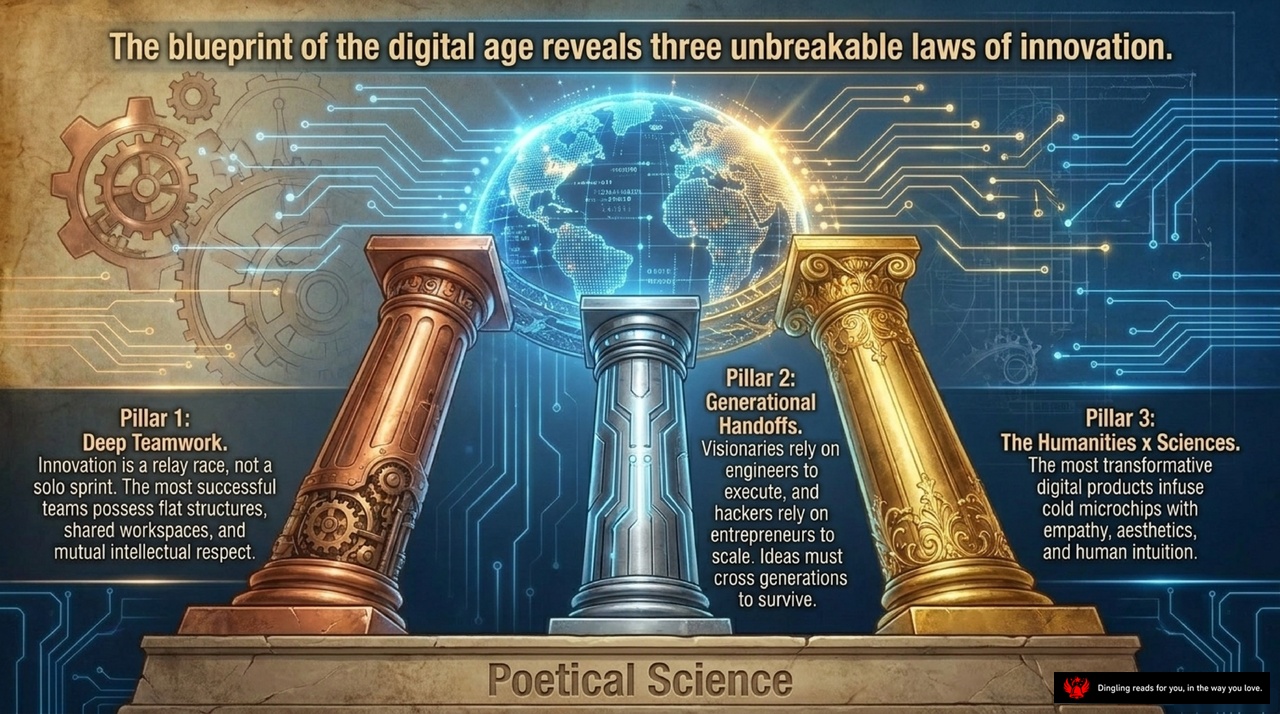
The blueprint of the digital age rests on three unbreakable pillars, and today we're diving straight into the foundation of our modern world: Deep Teamwork. Look at the first pillar on the left. It tells us that innovation isn't a solo sprint; it's a relay race. The most successful teams don't just share a workspace; they build flat structures where everyone respects each other's intellect. Think about the history of tech. When did we see real breakthroughs? Not when one genius worked in isolation, but when diverse minds collided. Take the team at Bell Labs that invented the transistor. They weren't just a group of engineers; they were a mix of theorists, experimentalists, and skeptics who debated until the end. Or look at Intel's "constructive confrontation" culture, where no one was too senior to challenge an idea. This deep teamwork is the engine that turns individual sparks into a roaring fire. Without it, even the brightest ideas stay stuck in the lab. So, remember this: if you want to build the future, stop trying to be a superhero and start building a team that believes in you as much as you believe in them.

Innovation doesn't happen when machines take our place; it thrives when we work together. As we look at this image of a human hand reaching out to touch a glowing digital core, we see the essence of the digital revolution: a deep, collaborative symbiosis between human creativity and machine power.
While machines have mastered the cold science of computation—handling everything from complex calculations to vast data storage—they cannot replicate the warm poetry of human collaboration. They can execute logic, but they cannot offer intuition, empathy, or the spark of imagination that drives true breakthroughs.
The history of technology is a story of this partnership. From Ada Lovelace's vision of "poetic science" to the collaborative teams at Bell Labs that invented the transistor, and from the open-source spirit of the internet to the modern era of AI, progress has always come from blending human insight with mechanical efficiency. The future belongs not to those who try to replace us, but to those who know how to cultivate this unique human touch, guiding machines to do what they do best while we focus on what only we can do.