


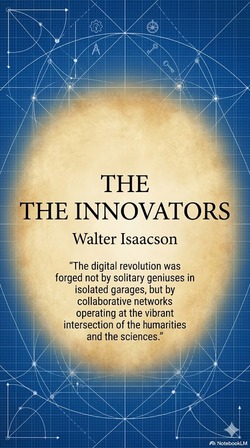
This book proves that transformative innovation comes from diverse teams collaborating, not isolated geniuses working alone.
Your Review
This book proves that transformative innovation comes from diverse teams collaborating, not isolated geniuses working alone.

Isaacson beautifully explains how diverse teams drove the digital revolution. He details how Ada Lovelace merged poetry with math to envision the Analytical Engine, showing that her collaboration with Babbage was essential. The story of the transistor team at Bell Labs further illustrates this, where Shockley, Bardeen, and Brattain combined theory, quantum insight, and hands-on experimentation to succeed. Shockley's later failure as a dictator contrasts sharply with their early harmony, proving that psychological safety and cross-disciplinary skills are the real engines of breakthroughs, not individual brilliance alone.

This book shatters the lone genius myth by showing how real innovation needs diverse teams instead of isolated superstars.

This book shatters the lone genius myth about tech innovation.

Isaacson brilliantly reframes the digital revolution as a messy, iterative process driven by diverse teams rather than isolated superstars. He traces the arc from Ada Lovelace's 'poetic science' to the collaborative dynamics at Bell Labs where Shockley, Bardeen, and Brattain solved problems no single person could crack alone. The book effectively debunks the romantic myth of the solitary inventor by showing how cross-disciplinary collaboration—from Turing building on Lovelace to Shannon merging math with circuits—actually fueled every major breakthrough. While it covers a lot of ground, the focus on psychological safety and open systems makes the complex history feel accessible and deeply relevant for understanding why modern innovation thrives in inclusive environments rather than exclusive garages. This perspective shift is crucial for anyone interested in tech history or building effective teams today.

Isaacson proves the digital revolution relied on diverse teams blending art with science rather than isolated geniuses working alone to build lasting technology.

Isaacson brilliantly traces the digital revolution from Ada Lovelace to Tim Berners-Lee, proving that transformative breakthroughs emerge not from isolated geniuses working in isolation, but from diverse teams blending technical rigor with human creativity across disciplines like poetry and math, which creates a more hopeful and nuanced framework for understanding how we actually foster real progress in our own lives and workplaces today.


Isaacson debunks the lone genius myth perfectly.

The book explains how open systems like Wikipedia and Linux accelerate innovation by allowing diverse voices to collaborate freely without strict control from top leaders.

Isaacson argues that innovation requires diverse teams blending art and science, using Ada Lovelace as an early example of poetic science merging math with imagination to define computing.

I found the section on Intel very inspiring because it shows how balanced leadership from three different personalities turned a risky microprocessor idea into a dominant industry.

Some parts felt dry and repetitive without enough emotional connection to the people described.

This book shatters the lone genius myth.

Tim Berners-Lee refusing to patent the web shows how open collaboration created a global platform instead of a proprietary product for one company.

Smooth writing; easy to finish in short sessions.

The book details how Bell Labs created the transistor through a trio of experts with complementary skills rather than a single genius working alone in isolation.

This book really made me rethink the lone genius myth. Isaacson shows how teamwork drives real progress.

The partnership between Bill Gates and Paul Allen illustrates perfectly how combining a visionary with a detail-oriented coder created the software industry.

This book really changed how I see innovation, moving me away from thinking of Steve Jobs as a solo visionary. Instead, Isaacson shows that every breakthrough, from Ada Lovelace's early algorithms to the transistor team at Bell Labs, relied on diverse skills and open collaboration. I was struck by how he details the specific roles of engineers, designers, and theorists who often get erased by the 'lone genius' narrative. For instance, the story of how Bardeen and Brattain solved the transistor problem while Shockley failed highlights that teamwork beats ego. It also made me realize that modern tech success, like the internet's open protocols or Apple's design, depends on balancing different strengths rather than waiting for one magical person. The examples of the Homebrew Computer Club and Wikipedia further prove that sharing ideas freely drives progress faster than closed systems. Ultimately, this isn't just history; it's a practical guide for building better teams today, reminding us that true innovation thrives when we stop worshipping individual stars and start valuing the collective effort behind every great idea.

Good read about teamwork but felt too focused on history.