
The Institutional Logic of Chinese Governance: Complete Chapter-by-Chapter Summary
Welcome to our exploration of the institutional logic of governance in China. This session is rooted in the insightful research of Zhou Xueguang from Stanford University’s Department of Sociology. We’ll dive into the organizational mechanisms, inherent contradictions, and on-the-ground bureaucratic behaviors that underpin China’s vast state governance system. From how central policies translate to local action to the tensions between top-down directives and real-world realities, we’ll unpack the complex dynamics that keep this model functioning. Let’s begin our journey into understanding these layered processes.

Let’s dive into the core paradox that shapes how China is governed—this constant pull between centralization and effectiveness.
First, think about the unified system. For a country as big and diverse as China, the central state has a non-negotiable need: to maintain supreme, unchallenged authority over its vast territories, varied populations, and local resources. Without that, the risk of fragmentation is real—like a puzzle falling apart if you don’t hold the pieces together.
Then there’s effective governance. Local governments are on the front lines, dealing with real, day-to-day problems. They need flexibility to adjust policies to their unique contexts, autonomy to make quick decisions, and the space to solve issues that matter to their communities—whether it’s a farmer needing better irrigation in a rural village or a small business struggling with red tape in a bustling town. If they don’t have that, they can’t keep things stable on the ground.
The paradox hits when these two needs clash. When the center tightens its grip to reinforce the unified system, it strips local governments of the tools they need to act effectively—like cutting off a mechanic’s wrench when they’re trying to fix a car. But when the center decentralizes to let locals fix crises, it runs the risk of losing control—like letting the car drive without a steering wheel. It’s a delicate balance that’s been a part of China’s governance DNA for decades—always shifting, never fully resolved, but always at the heart of how the country navigates its challenges. This tension isn’t temporary; it’s a permanent, systemic struggle that defines every layer of governance from Beijing down to the smallest village.

Let’s dive into how China’s government bridges the governance gap—the constant tension between centralization and local realities. The state relies on three recurring institutional coping mechanisms to navigate this tricky balance.
First up is Administrative Subcontracting, the bureaucratic mechanism. Picture the central government setting a big-picture target, like reducing carbon emissions by a specific percentage. Instead of micromanaging every step, it lets local governments figure out the nitty-gritty of how to hit that goal—whether by shutting down outdated factories or investing in solar farms. This balances the center’s need for unified decision-making with the flexibility local areas need to adapt to their unique situations.
Next, Ritualized Indoctrination, the symbolic mechanism. Even when local execution strays from central policy, regular political rituals—like mandatory meetings, training sessions, or public ceremonies—reinforce ultimate loyalty to the central authority. These aren’t just empty formalities; they help keep ideological unity intact across different levels of government.
And when routine bureaucracy fails or local deviation goes too far, there’s Campaign-Style Governance, the corrective mechanism. The center launches intense, top-down mobilizations—think of a nationwide push to crack down on unsafe mines or clean up polluted rivers. These campaigns temporarily shift focus from regular work to fix the problem, reasserting control and forcing immediate compliance.
Together, these three mechanisms help the state manage the constant push and pull between central control and local needs, keeping the system functioning even when the two seem at odds. They’re not one-time fixes but recurring tools the government uses to keep things on track.

Let’s talk about how power actually operates in China’s bureaucracy—because it’s not as straightforward as “central government calls all the shots and local governments just follow.” The slide here lays out the core idea: authority isn’t absolute; it’s negotiated through three key control rights in an incomplete contract. Let’s break that down.
First up, target setting. Central or higher-level governments hold absolute power here—they define the big-picture metrics, like GDP growth or emission reduction goals. But local governments? They don’t have formal power to set these targets, so they quietly adapt them to fit their local realities. Think of it like a corporate HQ setting a sales target for a regional office, but the regional team adjusts the plan to account for their market’s unique challenges (like a smaller customer base or tougher competition).
Next, inspection and acceptance. Central uses unpredictable spot checks to keep lower levels under pressure. But local governments are always one step ahead—they’re constantly prepping, hiding, or managing information to pass those inspections. It’s a bit like a student cramming for a surprise quiz, but on a government scale: they’ll tidy up records, shift resources around, or even downplay issues to make sure they meet the central standards.
Then there’s incentive allocation. Central doesn’t micromanage this part; they delegate it to middle-level governments. But local governments have the practical power here—middle layers design specific rewards or punishments for frontline workers. So even if central sets the overarching rules, local gets to decide how to motivate the people actually doing the work (like bonuses for hitting pollution cuts or penalties for missing targets).
The book calls this administrative subcontracting. For example, in environmental policy, central sets emission targets and does inspections, but local governments handle the day-to-day incentives for their teams. This distribution of control rights is why you see local governments both following central orders and bending them a little—they’re balancing the need to meet top-down goals with the messy reality of their own regions.
So, authority isn’t a one-way street. It’s a dance between central and local, each holding different pieces of the control puzzle. This back-and-forth shapes how policies get made, executed, and sometimes even bent to fit local needs.

Let’s take a deep dive into FS, a small agricultural town in northern China, where two local stories—road building and village elections—unpack the messy, human side of governance.
First, the "Village-to-Village" road initiative. On paper, it was a game-changer: connecting remote villages to markets, making life easier. But the funding model was broken. The government only supplied cement for each kilometer (worth about $7k), but the total cost per km hit $24k—villages had to cover the rest. Most were already drowning in debt from failed 80s and 90s township enterprises. Take Shangpo and Xiapo: Shangpo had a 20-year village leader with some collective income, so they raised funds (including donations) and built 4.5km, ending up $90k in debt. Xiapo, with no savings and a rotating leadership, scraped together $4k to build 1.5km—still $30k in the red. After the roads opened, debt collectors swarmed leaders’ homes: one had to hide during New Year, another’s house was packed with people demanding money.
Then there are the village elections, four rounds from 2000 to 2008. 2000: the town government called the shots, picking candidates who’d help collect taxes and enforce family planning. 2003: villagers revolted—tired of heavy taxes and corruption, they voted for leaders who promised to push back against the town. 2006: elections got fairer—strict procedures, no more proxy voting for dozens of people, high turnout. Villagers even cited election rules to challenge officials! By 2008, power shifted to elected village heads, not appointed party secretaries.
These stories show how top-down policies clash with local realities. The road project had good intentions but left villages in debt. Elections, once a formality, became a real voice for villagers. It’s a reminder that governance isn’t just about policies—it’s about how they land with real people, with real stakes.

Let’s talk about a common dilemma for grassroots officials: you’re stuck between a top-down mandate that clashes with your local reality and the pressure to follow orders. How do you survive this? Today, we’re breaking down their strategic playbook for navigating these tight spots.
First strategy: Formal Negotiation, also called the Signal Game. When there’s ambiguity in information or rules, officials use official channels—like detailed reports, data analysis, or formal requests—to plead for target adjustments. For instance, if a county’s pollution reduction goal is unrealistic because of aging industrial infrastructure, the local team might submit a comprehensive report showing technical challenges, giving them legitimate cover to ask for a revised target. This works best when there’s room to justify exceptions within the system.
Second: Informal Negotiation, which leans on social capital. Think personal networks, hometown ties, or even casual private dinners. If formal rules are too rigid—say, an inspection that would shut down a local business critical to the community—officials might reach out to a former colleague or someone with shared connections to soften the approach. This is often used to protect special local interests or avoid taking blame for issues beyond their control.
Third: The Quasi-Exit, or passive resistance. When negotiation isn’t an option—like during a high-stakes campaign where no flexibility is allowed—officials outwardly accept the mandate but covertly adjust execution. They might delay implementation, tweak details to fit local needs, or even distort how they report results—all without openly defying the order.
These strategies aren’t about being uncooperative; they’re about bridging the gap between centralized mandates and the messy, real-world needs of local communities. They show the quiet, constant negotiation that keeps the system running when one-size-fits-all rules fall short.

Let’s talk about Institutional Collusion—this is when different levels of local government secretly team up to deceive their higher-ups. It’s a common pattern, but why does it happen? Let’s break it down.
First, there’s the Flaw of One Size Fits All. National policies are often rigid, one-size-fits-all, and don’t account for local differences. Take a federal mandate for a new energy efficiency standard: a big city might handle it easily, but a small rural town with limited funds and older infrastructure can’t meet the requirement without shutting down local businesses. So local officials have to bend the rules a little to keep things running.
Next, Shared Vulnerability. Suppose the state sets a strict target for reducing homelessness. If the county (which is supposed to inspect) and the town (being inspected) both fail to hit that target, they’re both going to face penalties from the state. Their fates are tied—so they have every reason to team up and hide the real numbers.
Then there’s The Strategy they use during top-down inspections. They put on a Potemkin display: hide bad data, temporarily enforce rules they usually ignore, and make everything look perfect. Once the inspectors leave, though, it’s back to business as usual.
But here’s a key insight: this isn’t just corruption. It’s a rational, institutionalized survival mechanism for local governance. These officials aren’t just being sneaky—they’re navigating a system that often sets them up to fail if they follow the rules to the letter. It’s their way of keeping their communities afloat while also keeping their jobs. It’s a tricky balance, but it’s how many local governments deal with the pressure from above.

Let’s paint a picture: You’re a local government official, and your desk is piled high with mandates from different central ministries. One says “boost GDP this quarter”; another demands “clean up the river by next month”; a third warns “no social unrest during the festival”—and you’ve got way less staff and money than you need to do any of it well. That’s the reality for grassroots governments in China: stuck at the bottom of a massive administrative funnel, drowning in conflicting orders.
So how do they handle it? They use what we call the “muddling through” strategy. Since resources are tight, they can’t tackle all goals at once. Instead, they play a constant game of priority shuffle: when an inspection team is on its way, they drop everything to focus on that one task. For example, one week they’re all in on economic development, then suddenly switch to environmental prep because the inspectors are arriving.
But this approach has a big downside. It turns governance into a chaotic cycle of firefighting. Policies get done in quick, superficial bursts—like painting over a crack instead of fixing the foundation—rather than through steady, long-term work.
Why does this happen? The book breaks down three conflicting pressures local officials face: First, they have to hit hard targets from above (or risk their jobs). Second, they need to keep good relationships with other departments to get anything done. Third, the incentives are often messed up—sometimes faking data is easier than meeting an unrealistic goal. So they end up “patchwork coping”: shifting resources, adjusting priorities, and sometimes bending rules just to keep up.
It’s not that they don’t care about doing a good job—it’s that the system pushes them into these reactive, short-term patterns. And the result? A lot of busy work, but not much real, sustainable progress. Local governments become trapped in a cycle where they’re always putting out fires instead of building something that lasts.

Let’s dive into the Inverse Soft Budget Constraint—this concept helps us see how China’s local governance works in a way that’s different from traditional economic models.
In standard economics, a soft budget constraint means the state bails out failing enterprises. But in China’s governance logic, this dynamic is flipped. Let’s unpack the mechanism behind this.
First, there are unfunded mandates: the central government often orders large local projects—think rural infrastructure or modernization initiatives—but doesn’t provide enough funding to cover the full costs. Then, performance pressure: local officials’ promotions depend entirely on delivering visible, short-term wins. They can’t afford to fall short, since their careers hang on these results.
So what’s their move? Downward extraction. Local governments can’t legally declare bankruptcy, so they break their budget constraints by pushing the burden downward—forcing debt onto lower administrative levels, villages, and local businesses.
The key issue here? Responsibility and reward are separated. The official gets promoted for finishing the project, but the local communities end up stuck with the debt. It’s a cycle where short-term career gains for officials translate into long-term financial strain for those at the bottom.
This isn’t just an abstract idea—it’s a real pattern playing out across China, from small villages to local enterprises. It highlights how the pressure to perform can lead to unintended consequences, shifting the cost of growth onto the most vulnerable parts of society.

Let’s break down how a well-meaning state policy turns into a grassroots financial crisis—using the village road project as our example. First up: The Mandate. The state rolls out the Village-to-Village Road initiative, a noble goal to modernize rural areas and boost farmers’ access to markets. Sounds great, right? But here’s The Squeeze: the township shoves the task onto village leaders but only gives a tiny fraction of the needed funds. For every kilometer of road, the government might cover $10,000 worth of cement, but the actual cost is $34,000—so the village has to fill the gap.
Then comes The Debt Creation. Desperate to meet the target, leaders turn to local social networks: they buy materials on credit (since banks won’t lend to already-indebted villages), take high-interest loans from friends, and even force villagers to work for free. No choice—they have to get the road done.
The Aftermath? The roads get built, higher-ups claim political success and win awards. But the village is left with crippling, unpayable debt. Take Shangpo Village: they ended up $90,000 in red, selling off collective assets like school buildings just to make partial payments. Every Spring Festival, debt collectors camp out at the village chief’s house. The trust between the state and rural communities? Completely shattered. What started as a promise of progress turned into a nightmare of debt and broken faith. That’s the anatomy of this crisis.

Ever wondered why village elections in China can feel like a messy tug-of-war between competing forces? Let’s break down the three key logics colliding here—each with its own agenda, all fighting for control.
First up is the State’s logic. Think of it as the national government’s playbook: they see elections as a way to legitimize their system, crack down on local corruption, and keep things fair by the book. So they push hard for strict procedural rules—like ensuring every vote counts and candidates follow the process to the letter.
Then there’s the local bureaucracy—your town or county officials, stuck in the middle like middle managers between corporate HQ and the frontline team. Their biggest fear? If villagers elect their own leaders, those leaders won’t listen to orders from above. So they might try to control who runs, or even manipulate the candidate pool to keep things stable (and protect their own jobs, of course).
And finally, the villagers themselves. Their logic is rooted in what matters most to them: family ties, local clans, and their own economic interests. They don’t care as much about the state’s big-picture goals—they want someone who’ll stand up for their land, their money, and their way of life against outside meddling.
These three logics don’t just coexist—they clash head-on. Elections aren’t just a democratic exercise; they’re a battleground where state control, bureaucratic risk-aversion, and local survival all negotiate for power. Take FS Town, for example: early on, local officials tried to handpick candidates who’d do their bidding, but villagers started pushing back, using election rules to vote for people who actually represented their needs. Over time, the balance shifted—villagers learned to play the game, and officials had to back off to avoid chaos. It’s a vivid example of how these three forces interact, shape outcomes, and keep the system in constant flux.

Let’s start with a question from our slide today: If the Chinese state’s deep organizational control strictly prevents formal, independent interest groups from forming, then how does societal resistance even happen? The answer lies in what we call unorganized collective action.
Think about this: When formal channels to organize are blocked, people facing the same institutional pressures often act in identical, simultaneous ways—without any coordinated leadership. Take the examples from the slide: widespread passive resistance to tax collection. Imagine a new tax policy hitting thousands of farmers across a region. None meet to plan, but each decides on their own to hold back payment because they all feel the burden is unfair. Or spontaneous mass incidents triggered by a localized grievance—like a factory dumping toxic waste into a village’s water supply. Suddenly, villagers from all parts show up to protest, not because someone told them to, but because they share the same anger and fear for their health.
Why does this happen? The institutional cause, as our slide points out, is the state’s highly uniform, one-size-fits-all policies. When the state rolls out policies across vast populations without local adaptation, it creates uniform grievances. Millions face the same problem, so they react the same way—no leader needed.
This form of resistance is fascinating: no headquarters, no spokesperson, no formal plan. Yet it can still have a powerful impact. It’s a response shaped directly by the state’s control mechanisms: blocking formal groups pushes resistance into this unorganized, diffuse form.
Next time you hear about a mass incident in this context, remember: it’s not just a random crowd. It’s the result of a system where uniform policies meet blocked channels, leading people to act together without even trying to organize. This is how societal resistance finds its voice when formal paths are closed.

Let’s take a look at this pendulum model—it’s a sharp way to unpack the cycles of Chinese governance.
First up: Centralization. When the state needs to tighten its grip, it consolidates power to lock in ideological unity and hold onto territorial control. Think of recent moves like Beijing’s crackdown on tech giants or reinforced oversight in Xinjiang—these are classic centralization plays to keep everyone aligned.
But here’s the tradeoff: too much centralization leads to Rigidity & Paralysis. Local governments lose the autonomy to solve on-the-ground problems. Imagine a village needing to adjust irrigation policies for its dry soil, but it can’t because every call has to wait for top-level approval. Stuck in red tape, issues like crop failures or community unrest fester.
So grassroots officials adapt with Coping & Deviation. They use informal tricks—colluding with other departments to bypass rules, patching together unapproved solutions, or making off-the-books deals—to keep things moving. It’s their survival hack when the system is too inflexible.
Over time, these workarounds spiral into Decentralization & Chaos. When regions ignore central rules—say, cutting environmental corners to boost GDP or misusing funds—the center’s authority frays. Local crises pop up, from pollution scandals to economic bubbles, threatening the system’s stability.
That’s when we swing back to Centralization. The center launches campaign-style crackdowns: sending inspectors, rolling out new regulations, or purging officials who strayed too far. It’s a cycle that repeats, driven by the tension between keeping the country unified and letting local areas adapt.
This pendulum isn’t just theory—it’s played out across China’s history, from imperial dynasties to modern times. Understanding this loop helps us see why policy shifts feel so dramatic, and how the state balances control with the need for flexibility.

Let’s dive into "The Price of Scale" today. First off, a common misconception: China’s state isn’t some monolithic block. It’s actually a highly adaptive, deeply fragmented matrix of organizations all navigating their own survival.
Now, here’s the paradox: the very mechanisms that let the state govern a continent-sized population—administrative subcontracting, institutional collusion, campaign-style mobilization—are exactly the ones that spark its biggest internal crises. Think about it: when you pass tasks down layer by layer, local officials might team up to cut corners or hide problems instead of sticking strictly to the plan. And those big, urgent campaigns? They get quick results, but they also throw normal operations off balance and create unforeseen issues.
So how does this system keep going? It survives by constantly absorbing the friction between central ideals and local realities. The central government has grand goals, but local places have their own unique challenges—different resources, different needs. The system doesn’t break because it’s always adjusting, always finding ways to let those two sides coexist without falling apart. That’s the quiet magic (and the hidden cost) of governing at this scale. It’s a delicate dance between unity and flexibility, and every step comes with a price.
Let’s start with a scenario you might know: imagine a huge national coffee chain. HQ sets strict rules—every store must serve the same drink sizes, follow the exact same cleaning schedule, hit the same sales targets. But local managers? They’ve got to deal with real-world problems: a store in a small town might need to adjust hours because customers don’t come late, or a city location might have to cut corners on cleaning to keep up with rush hour. If they don’t, they get in trouble. So they find workarounds—maybe fudge sales numbers a little, or collude with other managers to share resources.
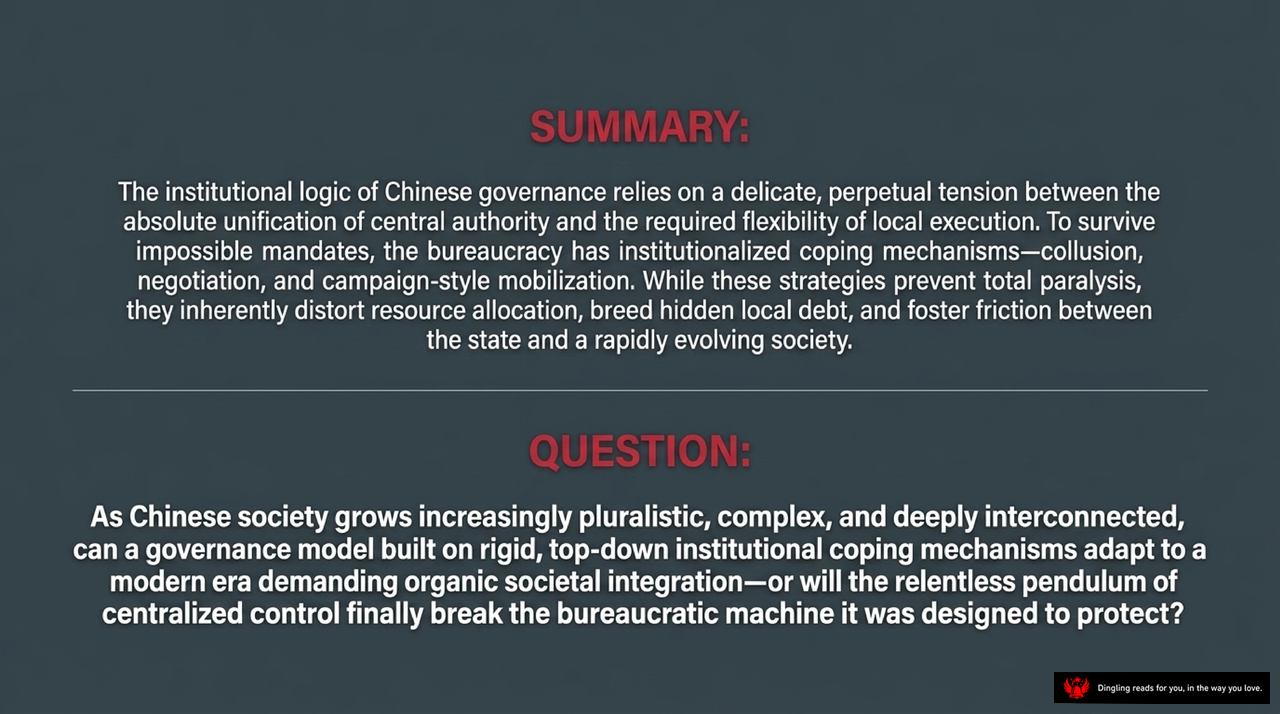
That’s a lot like what’s happening in China’s governance, according to the book we’re discussing. The core tension here is between the central government’s need for absolute unification (think HQ’s strict rules) and local governments’ need for flexibility to get things done (the store managers’ workarounds). To survive those impossible top-down mandates, local bureaucrats have developed go-to coping mechanisms: they collude with each other to hide problems from higher-ups, negotiate behind the scenes to adjust policies, or launch big campaign-style pushes to meet short-term goals.
These tricks keep the system from grinding to a halt, but they come with big costs. They mess up how resources are allocated—money might go to projects that look good on paper instead of what communities actually need. They create hidden local debt, like a store manager taking out loans to hit sales targets without telling HQ. And they build friction between the government and society—people get frustrated when policies don’t fit their lives, or when they see officials cutting corners.
Now, here’s the big question: As China’s society gets more diverse, complex, and connected—like a chain that’s grown into hundreds of different neighborhoods—can this governance model adapt? Can a system built on rigid, top-down coping mechanisms shift to something more organic, where local needs and central goals work together? Or will that constant back-and-forth between central control and local flexibility eventually break the bureaucratic machine it was supposed to protect? It’s a question that’s not just about China’s future—it’s about how any large, centralized system can balance order and adaptability.