
The Intelligent Investor: Complete Chapter-by-Chapter Summary

Welcome to today’s session on *The Intelligent Investor* by Benjamin Graham. This iconic book offers a timeless framework for achieving financial goals through rational analysis, disciplined behavior, and the continuous pursuit of intrinsic value. Whether you’re new to investing or looking to refine your approach, this guide lays the foundation for smart, long-term wealth building. Let’s dive in and explore how you can become an intelligent investor.

Let’s be clear: there’s a fundamental divide between investing and speculating—and confusing the two can cost you everything.
On the left, you’ve got The Investor. This person doesn’t chase hot tips or try to time the market. Instead, they dig deep. They analyze the underlying business, understand its value, and build wealth slowly and steadily over time. Their mindset? They see market dips not as disasters, but as chances to buy something solid at a discount. It’s about patience, discipline, and long-term thinking.
Now flip to the right: The Speculator. This is where things get dangerous. Here, the focus isn’t on value—it’s on price. The speculator watches charts, guesses what the crowd will do next, and treats the market like a casino. They’re chasing quick wins, driven by emotion and the promise of rapid, uncalculated gains. No analysis, no safety net—just risk.
The note at the bottom isn’t just a warning—it’s a lifeline. Ignoring this distinction is the fastest way to lose your money. Risk and speculation go hand in hand, but smart investing? That’s about control, not chance.

Imagine you own a piece of a private business, and your partner is someone named Mr. Market. Every single day, he calls you up and tells you what he thinks your stake is worth. Sometimes he’s in a manic, euphoric mood, offering to buy out your share at a sky-high price. Other days, he’s in a deep, irrational depression, offering to sell you his share for pennies on the dollar.
Look at this chart. The jagged white line represents Mr. Market’s quotes—pure human emotion. It swings wildly from exuberance to panic. But notice the smooth, steady gold line. That is the intrinsic value of the company itself. That is reality. Mr. Market’s price is not reality; it’s just noise.
Here’s the key insight: Mr. Market is your servant, not your master. His daily quotes do not dictate the true value of your business. You are free to ignore him entirely. But more importantly, you can turn his instability into your advantage. When he’s depressed and offering cheap shares, that’s your time to buy. When he’s euphoric and trying to sell you out, that’s your time to buy even more.
So, don’t let Mr. Market dictate your actions. Use him. Let his manic swings work for you, not against you. That is the investor’s mindset.

Slide 3: Choose Your Path: The Investor Diagnostic.
Let’s be honest—most investors don’t start with a strategy. They start with a fear. Fear of missing out, fear of losing money, fear of making the wrong call. But here’s the hard truth: investment returns aren’t about how much risk you take. They’re about how much intelligent effort you’re willing to put in.
This slide breaks it down into two clear paths: The Defensive Investor and The Aggressive, or Enterprising, Investor.
If you’re the Defensive Investor, your goal isn’t to outperform the market—it’s to avoid serious mistakes and stay out of the daily grind of decision-making. You want peace of mind. That means minimal time and effort, relying on automated systems and strict formulas. Your psychology? You seek calm, and market drops unsettle you. Your strategy? A diversified portfolio of high-grade stocks and bonds—safe, steady, and predictable.
Now, flip that around. The Aggressive Investor thrives on opportunity. Their goal is better-than-average returns—not through luck, but through rigorous, independent valuation. This path demands substantial time and effort. You’re doing deep research, analyzing businesses continuously, and thinking like an owner. Your psychology? You’re independent, contrarian, and actually energized by market pessimism. Your strategy? Bargain hunting, special situations, and acquiring undervalued assets—taking calculated risks where others see danger.
So, which path fits you? Are you chasing security, or are you chasing alpha? The answer shapes everything—from your portfolio to your peace of mind.
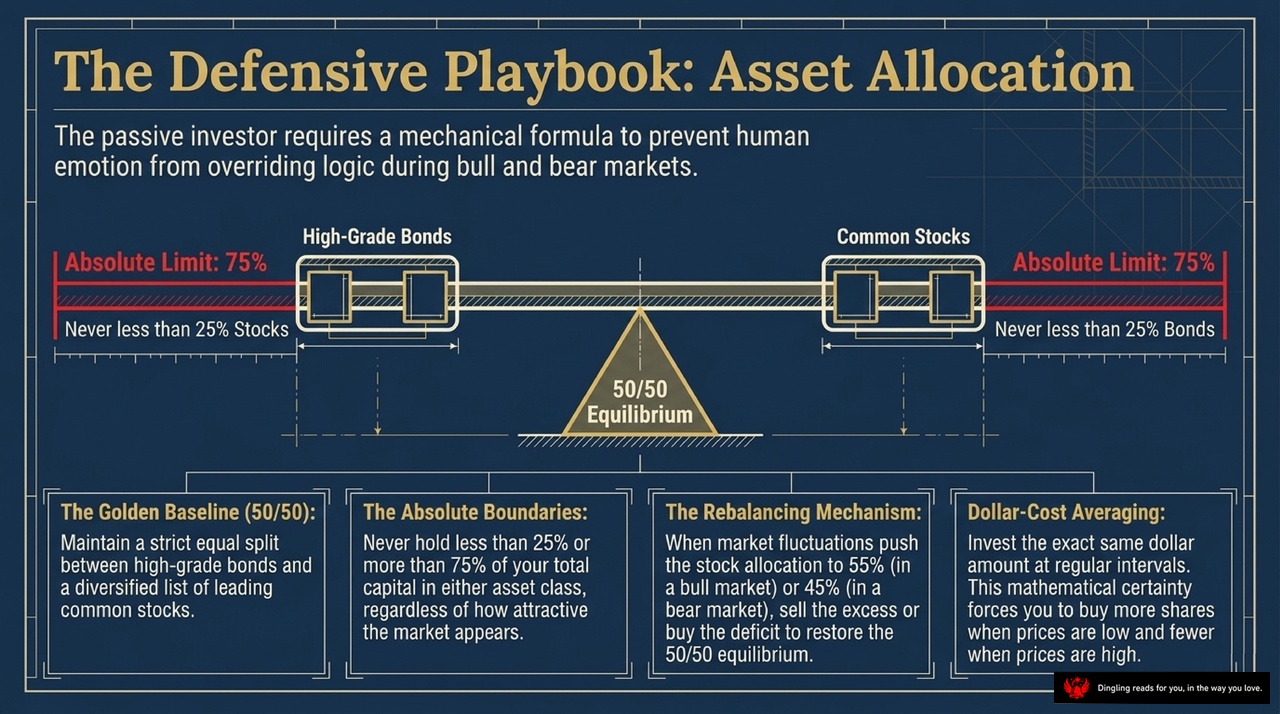
Imagine you're building a fortress for your money—not to win every battle, but to survive the worst ones and come out stronger on the other side. That’s what this slide is all about: The Defensive Playbook. It’s not about chasing the next hot stock or timing the market. It’s about discipline, balance, and staying calm when everyone else is panicking.
At the heart of it lies the 50/50 equilibrium—a simple, mechanical split between high-grade bonds and common stocks. Think of it as your financial seesaw: if stocks go up too much, you trim them; if they crash, you let bonds hold steady. But here’s the key rule: never let either side dip below 25% or climb above 75%. These aren’t suggestions—they’re absolute boundaries. Why? Because human emotion loves to override logic during bull and bear markets. We buy high when things are booming and sell low when fear takes over. This system removes that temptation entirely.
When the market swings—say, stocks surge to 55% of your portfolio—you don’t cheer. You rebalance. Sell the excess, buy back bonds, and restore that golden 50/50 balance. And when prices drop? You do the opposite: buy more shares at a discount. That’s dollar-cost averaging in action—not just a strategy, but a mathematical certainty that forces you to buy low and sell high, automatically, without emotion.
This isn’t about being rich. It’s about being consistent. It’s about having a playbook that works even when you’re tired, distracted, or scared. And that, my friend, is the real power of passive investing.

Building a truly defensive portfolio isn't about chasing hot tips or picking the trendiest tech stocks. It's about the art of exclusion. Think of it like a funnel. You start with hundreds of companies, and through four strict filters, you narrow it down to the few that have survived the toughest economic storms.
First, we look at **Diversification**. You don't want all your eggs in one basket. We want a portfolio that holds between 10 and 30 distinct individual stocks. This ensures that if one sector tanks, the rest of your portfolio can hold steady.
Next, we apply a filter for **Size and Prominence**. We are looking for the giants of their industry—companies that are large, dominant, and conservatively financed. In our system, we typically look for companies with assets or sales exceeding $50 million. We want the leaders, not the struggling startups.
Once we have the big players, we check their **Dividend Record**. This is the ultimate stress test. We only keep companies that have a proven history of paying dividends for at least 20 years. If a company can keep paying shareholders through two recessions, it’s likely to keep paying through the next one.
Finally, we enforce strict **Valuation Limits**. Even a great company is a bad investment if you pay too much for it. We set a hard cap on the purchase price. We generally won't buy a stock if it trades for more than 25 times its average earnings over the past seven years, or 20 times its earnings from the last 12 months. By following these four filters, we filter out the noise and leave only the safest, most reliable investments.
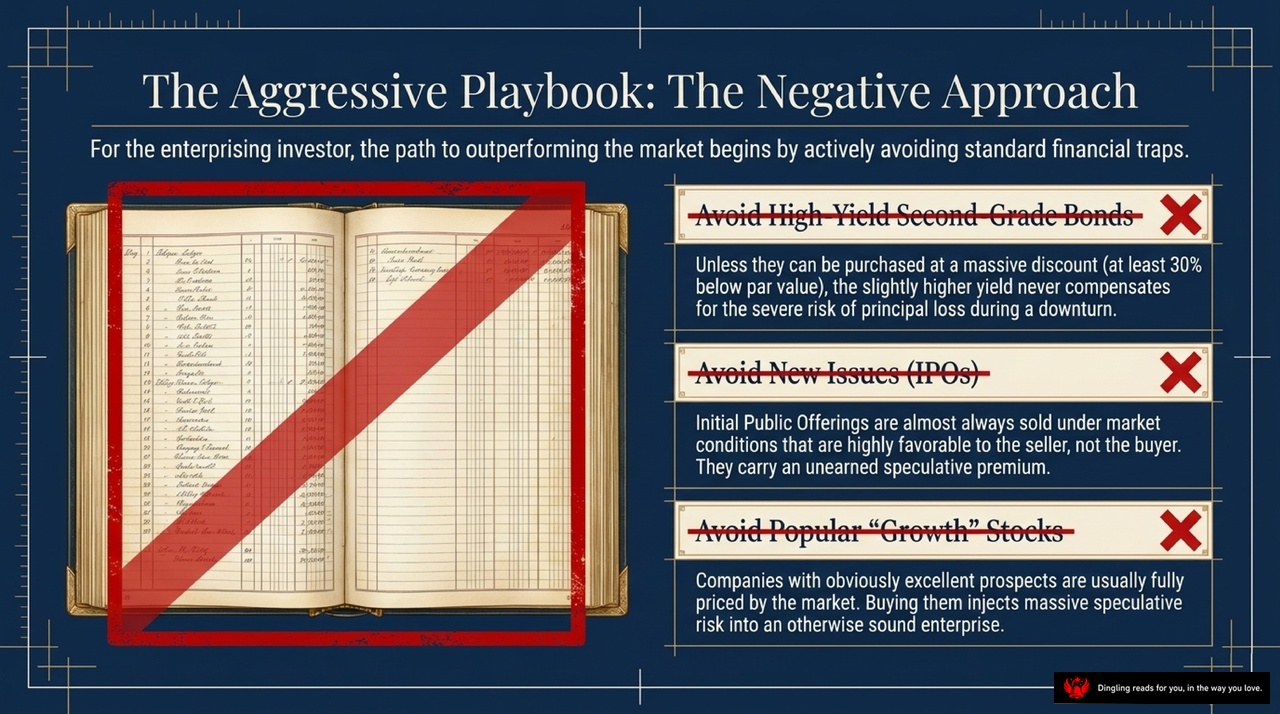
Alright, let's dive into this slide.
The image presents a concept called "The Aggressive Playbook: The Negative Approach." This is specifically designed for the enterprising investor who wants to outperform the market. The core philosophy here is simple but powerful: instead of chasing every opportunity, the path to success begins by actively avoiding standard financial traps.
The slide highlights three specific areas to avoid. First, it warns against High Yield Second-Grade Bonds. The logic is that unless these bonds can be purchased at a massive discount—at least 30% below par value—the slightly higher yield never compensates for the severe risk of principal loss during a downturn.
Second, the playbook advises avoiding New Issues, or IPOs. The reasoning is that initial public offerings are almost always sold under market conditions that are highly favorable to the seller, not the buyer. They carry an unearned speculative premium.
Finally, the slide suggests avoiding Popular "Growth" Stocks. Companies with obviously excellent prospects are usually fully priced by the market. Buying them injects massive speculative risk into an otherwise sound enterprise.
So, in essence, this slide is about discipline. It tells us that to beat the market, we shouldn't just be looking for the next big thing; we need to know what to stay away from.
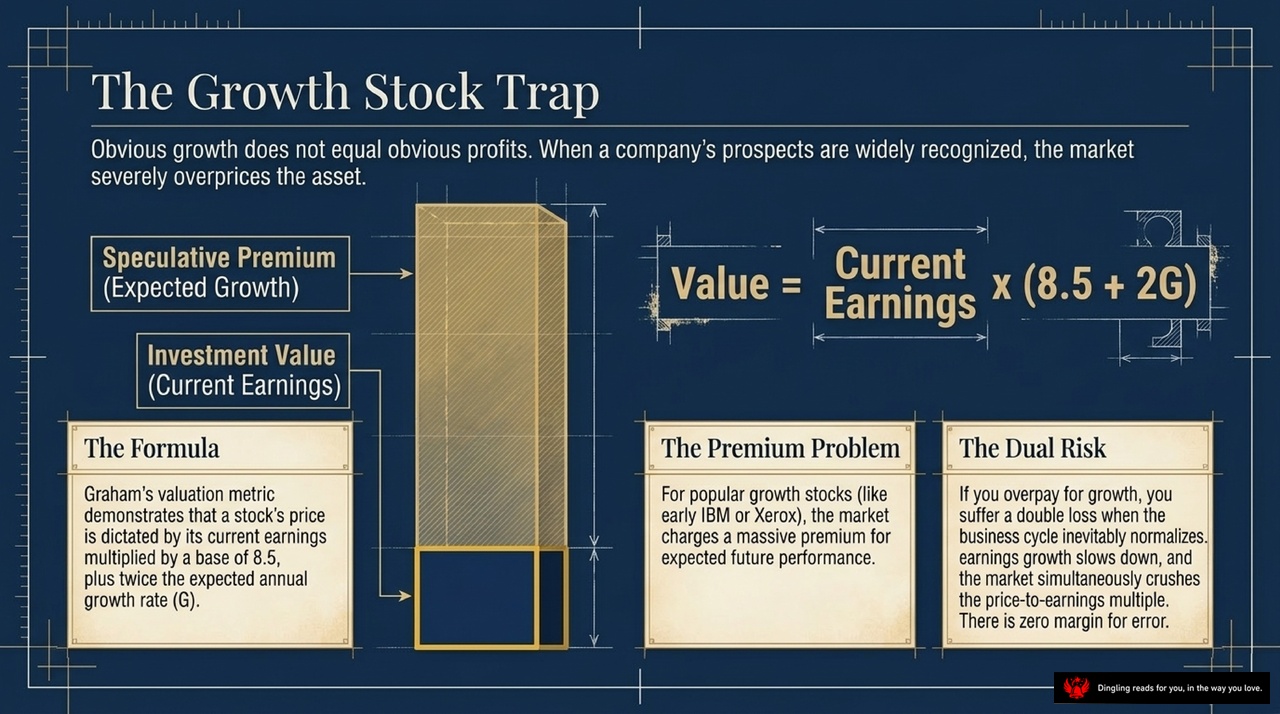
So, let’s talk about the Growth Stock Trap—because here’s the thing: just because a company looks like it’s on fire with growth doesn’t mean it’s actually worth what everyone’s paying for.
The slide shows a formula: Value equals Current Earnings times (8.5 plus twice the expected annual growth rate). That’s Graham’s way of putting a price tag on a stock—not just what it’s making today, but what you expect it to make tomorrow. But here’s the catch: when growth becomes obvious—like with early IBM or Xerox—the market gets greedy. It starts pricing in all that future success, adding a “Speculative Premium” on top of the actual Investment Value.
That premium? That’s where the trap lives. You’re paying for growth you haven’t seen yet—and if that growth slows down, or if the market cools off, you’re left holding a stock that’s now overpriced and underperforming. It’s a double whammy: you lose on the earnings, and you lose on the multiple. There’s no room for error.
So remember this: obvious growth isn’t always a good thing. Sometimes, it’s just a sign that everyone’s already priced in the upside—and that’s when the real risk starts.
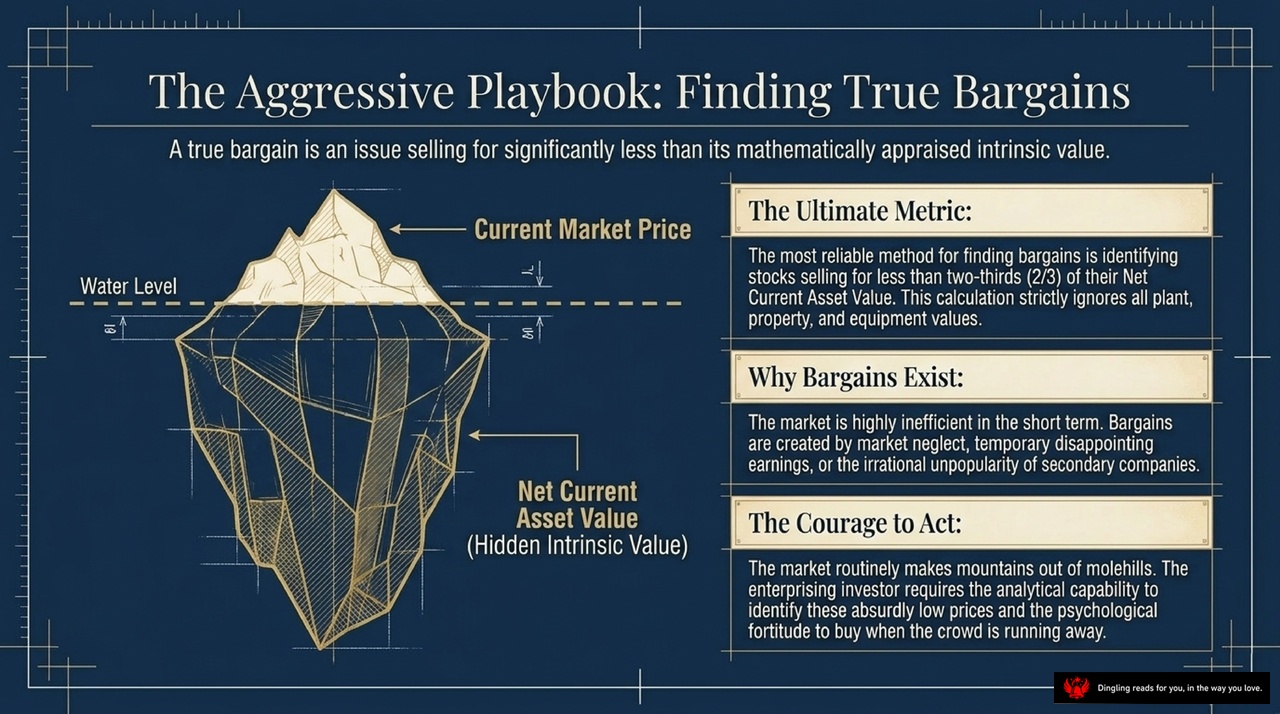
Slide 8: The Aggressive Playbook – Finding True Bargains
Let’s dive into the core of smart investing: how to spot a real bargain, not just a cheap stock. A true bargain isn’t just about low price—it’s about buying something for significantly less than its mathematically appraised intrinsic value. Think of it like an iceberg. What you see above the water is the current market price—what everyone’s paying today. But the real value? That’s hidden beneath the surface.
In this aggressive playbook, we’re looking for stocks trading at less than two-thirds of their Net Current Asset Value. Why ignore plant, property, and equipment? Because those are often overvalued or hard to liquidate. We want to focus on what’s actually cash or cash-equivalent on the balance sheet.
So why do bargains exist? The market is notoriously inefficient in the short term. Sometimes, a company gets ignored. Maybe earnings dipped temporarily, or the whole sector is out of favor. These are the moments when opportunity hides in plain sight.
But here’s the kicker: spotting a bargain is only half the battle. The other half? Having the courage to act. Markets often exaggerate fear and panic. They turn molehills into mountains. The savvy investor doesn’t follow the crowd—they analyze the numbers, identify absurdly low prices, and have the fortitude to buy when everyone else is running away.
This isn’t about gambling. It’s about discipline, clarity, and conviction.
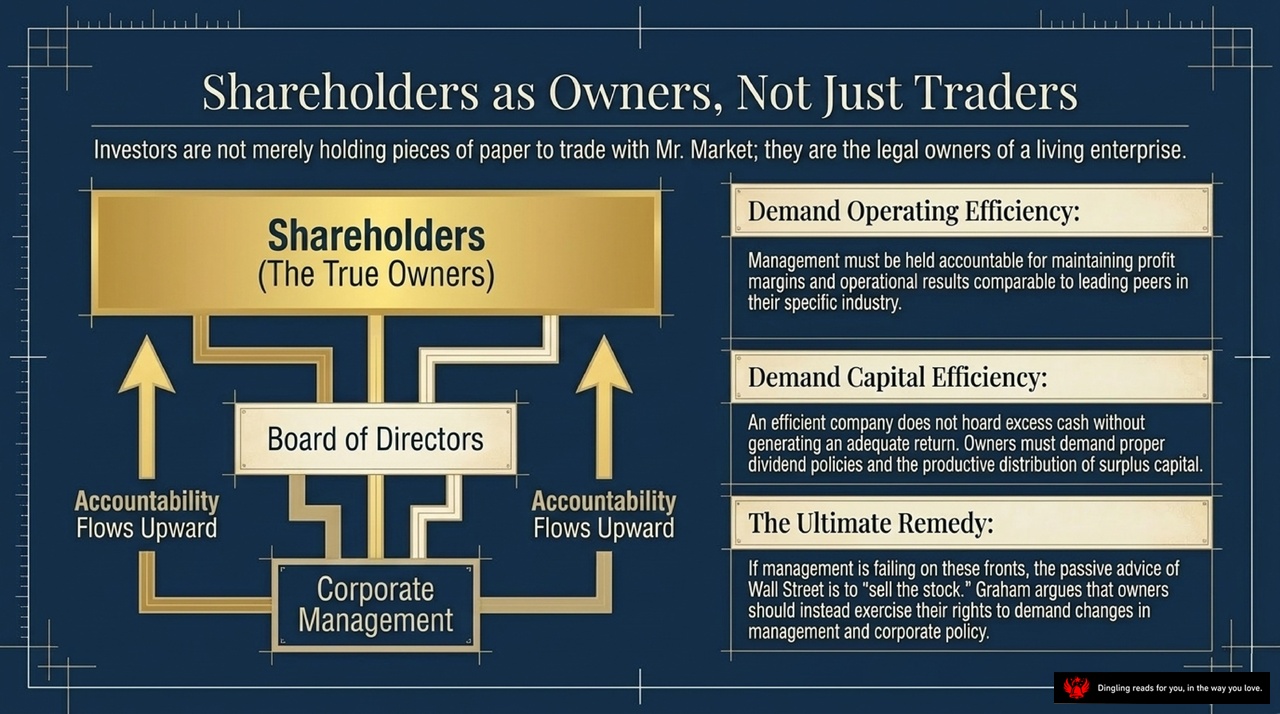
Let’s be clear: when you own shares in a company, you’re not just holding a piece of paper to flip for profit. You’re the legal owner of a real, living business. That changes everything.
As shown here, shareholders sit at the top—not as passive traders, but as true owners. And that ownership comes with power. It means you have a right to demand that management run the company efficiently—both operationally and financially.
Look at the arrows: accountability flows upward. That’s not just a diagram. It’s a principle. Management doesn’t get to hoard cash or ignore performance. They must deliver results comparable to their peers. If they don’t, you have the right to ask: “Why are we sitting on this money? Where’s the return?”
And if things go wrong? Wall Street’s default answer is “sell the stock.” But Benjamin Graham saw deeper. He believed owners shouldn’t just exit—they should act. They should push for change in how the company is run, how capital is allocated, and how value is created.
This isn’t theory. It’s the foundation of responsible investing. When you think like an owner, you stop chasing short-term gains and start demanding long-term discipline. And that’s what separates smart investors from speculators.
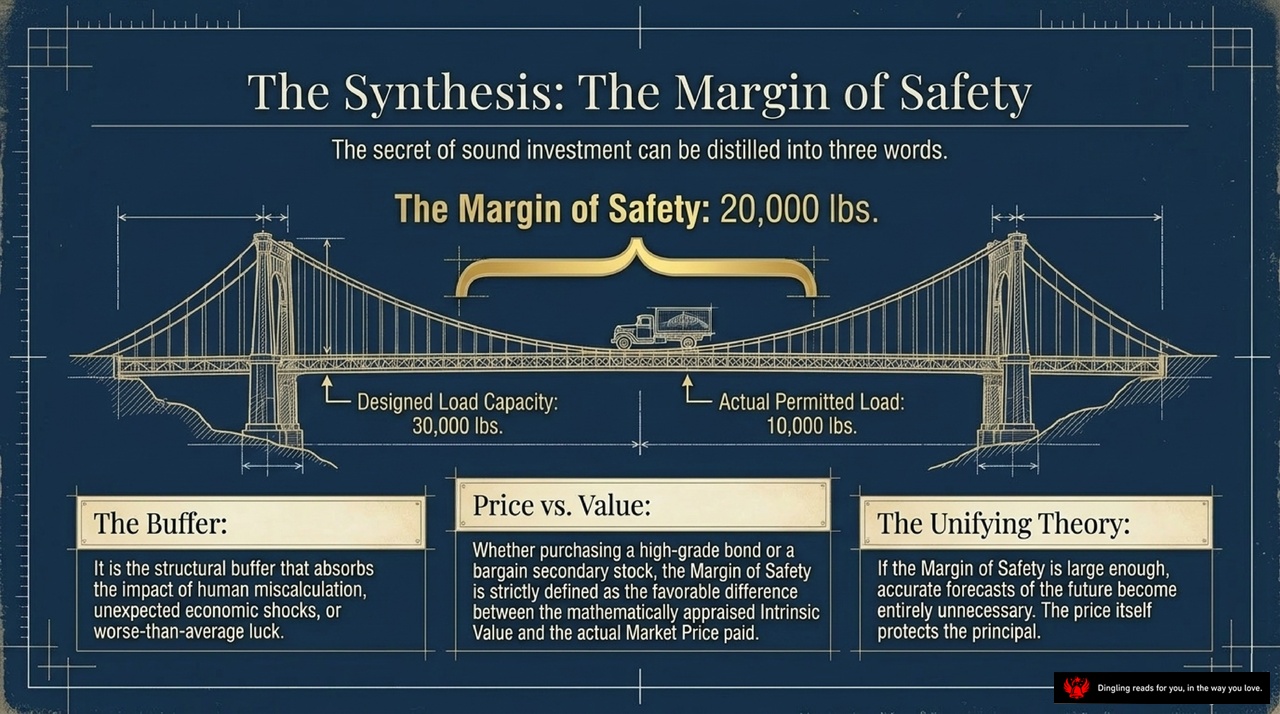
Today, we’re pulling everything together with one powerful concept: The Margin of Safety. Think of it like the extra space on a bridge—your bridge can hold 30,000 pounds, but you only drive on it with a 10,000-pound truck. That 20,000-pound gap? That’s your safety buffer. In investing, this buffer protects you when things don’t go as planned. Whether it’s a sudden market drop, a miscalculated forecast, or just bad luck—the Margin of Safety absorbs the shock. It’s the difference between what something is truly worth—its intrinsic value—and what you actually pay for it. And here’s the beauty: if you build that buffer big enough, you don’t even need to be a crystal ball. The price itself becomes your shield. That’s the unifying theory: when you buy with a wide margin of safety, you’re not betting on the future—you’re protecting your capital.
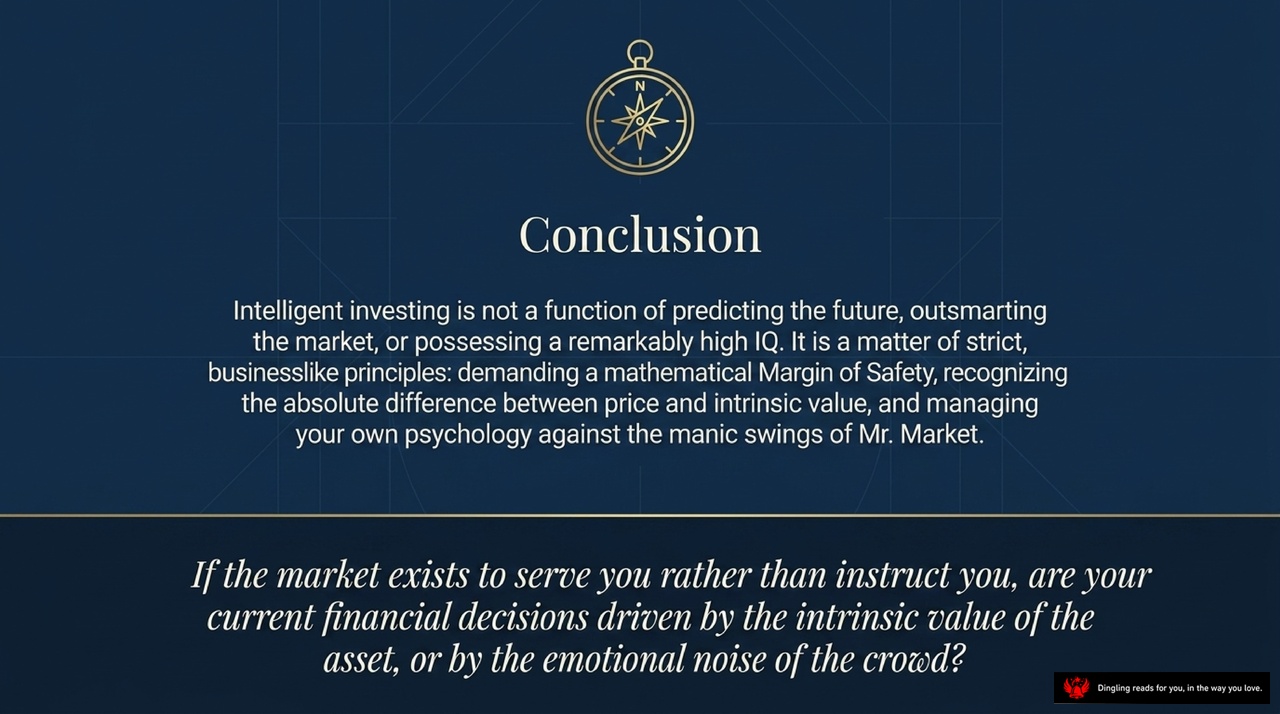
So, we’ve reached the conclusion.
Intelligent investing isn’t about predicting the future, outsmarting the market, or having a high IQ. It’s about sticking to solid, businesslike principles.
First, always demand a mathematical Margin of Safety. That’s your buffer—your protection against being wrong.
Second, understand the absolute difference between price and intrinsic value. Don’t buy just because the market says it’s hot. Buy because the asset is worth more than what you’re paying for it.
Third, manage your own psychology. Mr. Market will swing wildly with emotion—greed, fear, panic—but you don’t have to follow. Stay calm. Stay disciplined.
And remember this: the market exists to serve you, not to instruct you. So ask yourself—are your financial decisions driven by the true value of the asset, or by the emotional noise of the crowd?
That’s the core of intelligent investing.