
The Interpretation of Dreams: Complete Chapter-by-Chapter Summary
Welcome to the fascinating world of *The Interpretation of Dreams* by Sigmund Freud. Tonight, we step into the mind of the father of psychoanalysis to uncover one of the most revolutionary ideas in psychology: the secret language of sleep.
Freud challenged the ancient belief that dreams were messages from gods or random electrical noise. Instead, he proposed a bold, foundational theory: dreams are the disguised fulfillment of repressed wishes. Think of it as your mind's way of getting what it wants, even when you're asleep. But because these desires are often forbidden or too uncomfortable to face while awake, the mind wears a mask. It transforms raw, hidden wishes into strange, surreal stories—what we call the "dream work."
In this book, Freud uses a powerful method called free association, asking patients to let their thoughts flow without judgment, like removing the guard of reason. Through this, he reveals that even the most bizarre or painful dreams are actually clever compromises. They allow us to satisfy deep, unconscious desires—like a child wishing to see a loved one again, or an adult trying to escape guilt—while keeping our conscious mind asleep and safe. So, the next time you wake up confused by a strange dream, remember: it's not nonsense. It's your inner self speaking a coded language, revealing the true desires you keep hidden from the world.
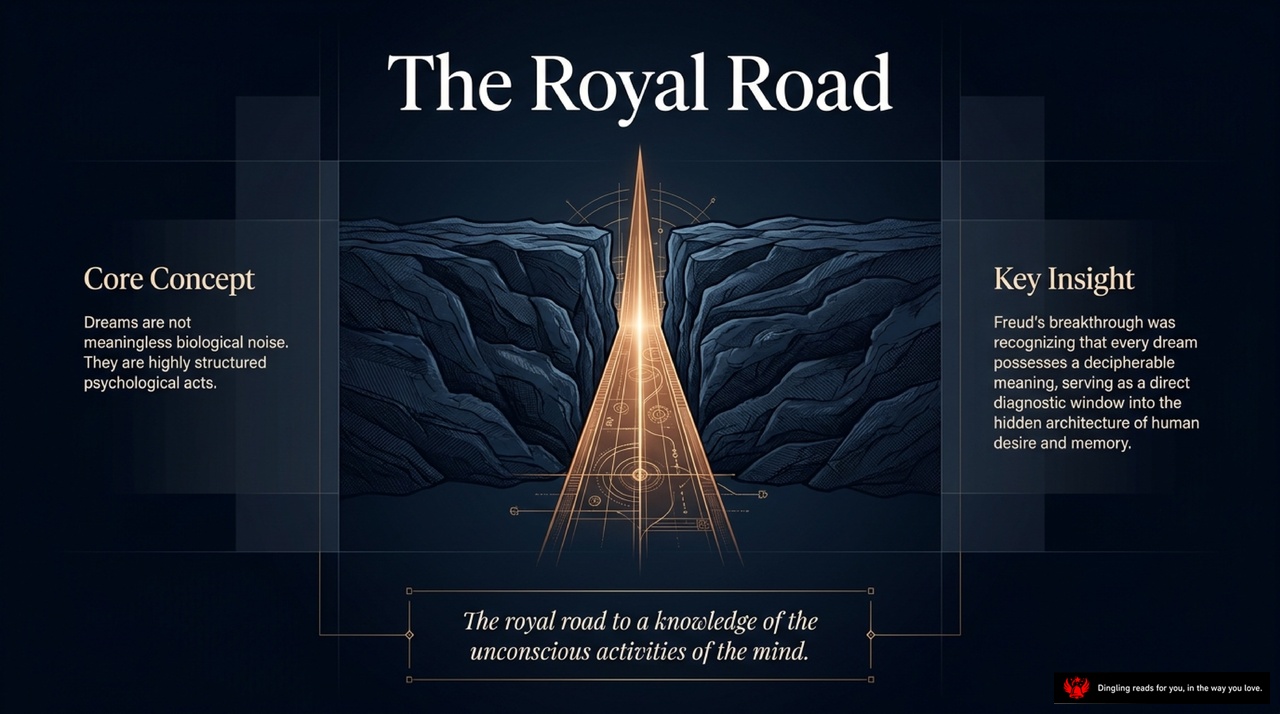
Imagine a bridge stretching across a chasm of darkness, a golden path illuminating the hidden architecture of the human mind. This is "The Royal Road," the direct route to understanding the unconscious activities that drive us.
The core concept here is revolutionary: dreams are not meaningless biological noise or random static. They are highly structured psychological acts. As we see in the image, every dream possesses a decipherable meaning, serving as a direct diagnostic window into our deepest desires and memories.
Sigmund Freud's breakthrough was realizing that the dream is essentially the fulfillment of a wish. Even the most terrifying or painful dreams are not exceptions; they are cleverly disguised. Think of it this way: if your conscious mind is a strict bouncer at a club, your unconscious is the party happening behind the door. When the bouncer gets tired in the morning, the party spills out, but it's wearing a mask. A nightmare about being chased might actually be a disguised wish to escape a stressful situation in your waking life. A dream about losing teeth often symbolizes anxiety about losing power or control, rather than a literal prediction of dental issues.
So, when you look at your dreams, stop dismissing them as nonsense. Instead, treat them as a coded message from your own psyche. The Royal Road invites you to decode these messages, to look past the surface story of the dream and find the hidden wish that is truly driving the narrative. It's not about predicting the future; it's about understanding the past and the present forces that shape your reality. By walking this road, you transform your sleep from a mystery into a mirror, revealing the parts of yourself that you often try to hide.
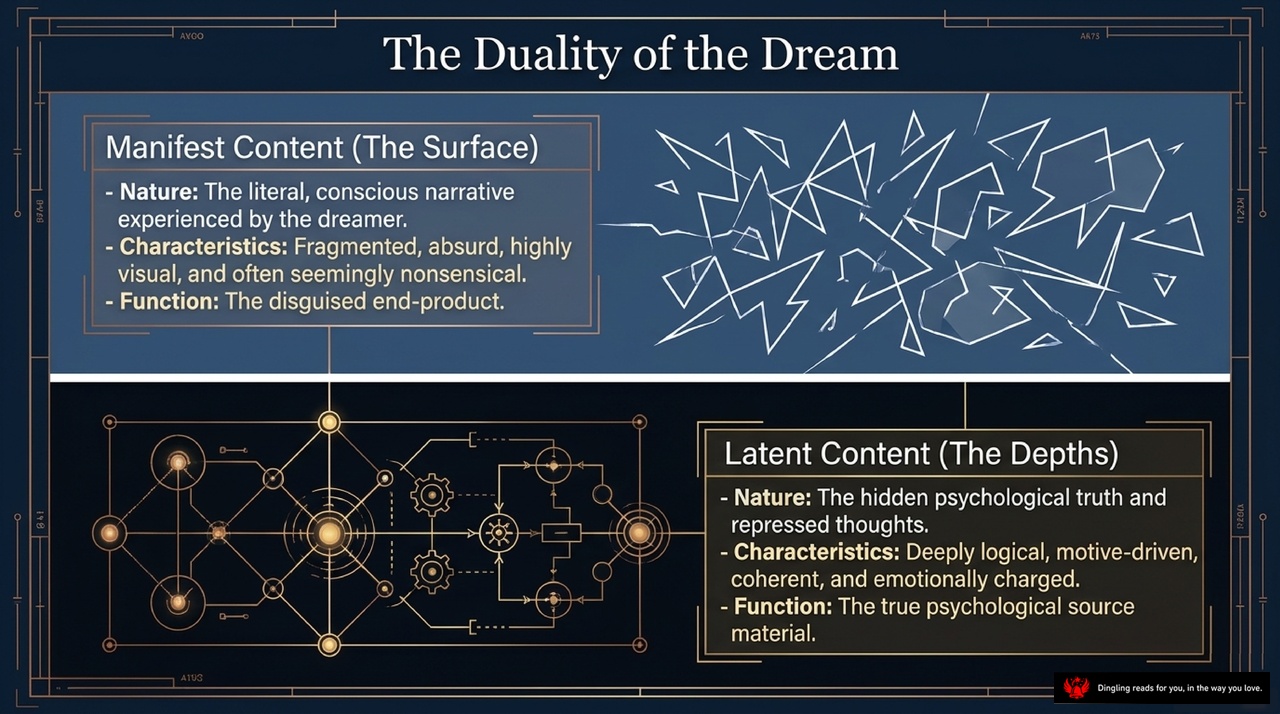
The Duality of the Dream. Think of your mind not as a single room, but as a two-story house with very different vibes on each level.
On the top floor, we have the **Manifest Content**. This is the "surface" story—the literal, often chaotic narrative you remember when you wake up. It's fragmented, absurd, and full of weird visuals. It feels nonsensical, like a movie with the plot cut out. But don't be fooled; this isn't just random noise. It's the disguised end-product, the final output your mind puts out to hide the real message.
But if you look deeper, down into the **Latent Content**, that's where the real action happens. This is the "depths"—the hidden psychological truths and repressed thoughts you try your hardest to ignore. Unlike the messy surface above, this layer is deeply logical, motive-driven, and emotionally charged. It's the true source material, the raw truth that your conscious mind is trying to keep at bay.
So, when you analyze a dream, you aren't just decoding a random story. You are peeling back the layers of the Manifest Content to find the coherent, powerful truth hiding in the Latent Content. It's the difference between what you see and what actually drives you.
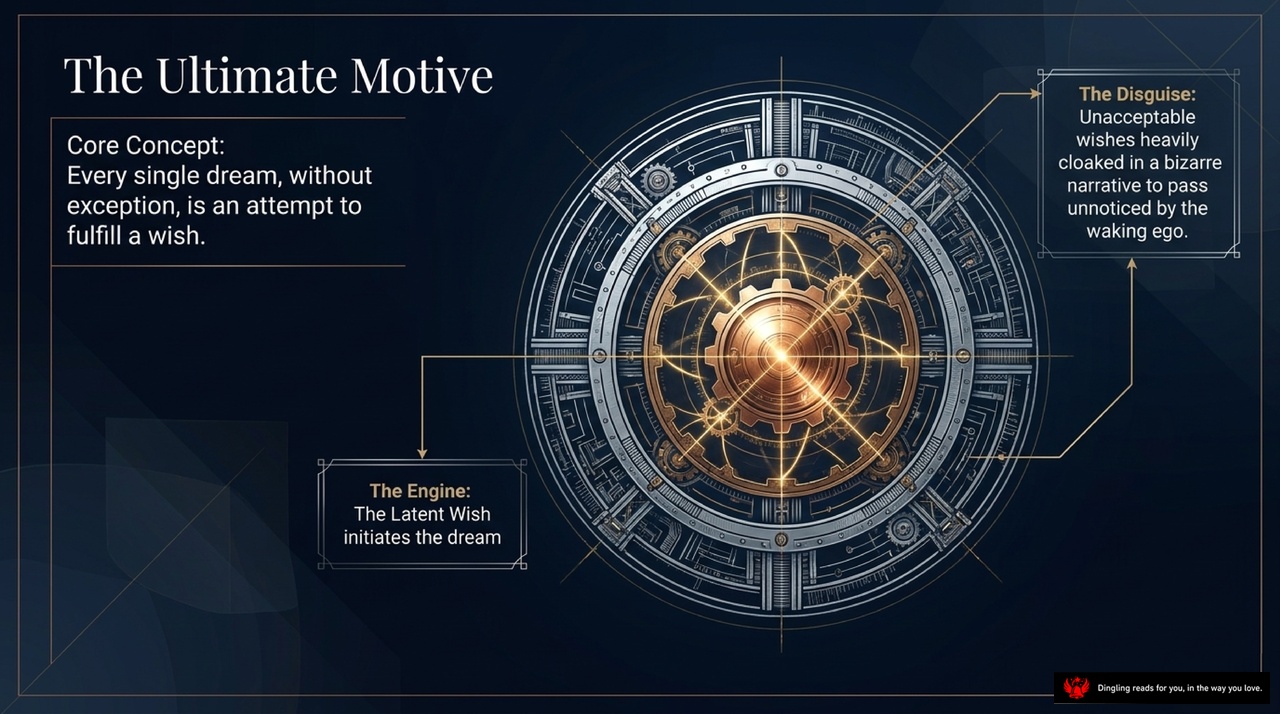
The Ultimate Motive: Every single dream, without exception, is an attempt to fulfill a wish.
Think of your mind as a sophisticated, high-tech engine running in the background while you sleep. This isn't random static; it's a precise mechanism designed to get one thing done: satisfying a desire.
Let's break down how this "dream machine" works. First, there's the engine itself: the latent wish. This is the core drive, the hidden desire that kicks the whole process off. But here's the catch—sometimes our conscious mind, or what we call the "waking ego," isn't ready to accept these wishes. Maybe they're too embarrassing, too dangerous, or simply unacceptable.
So, what happens? The dream activates a disguise. It takes that raw, unacceptable wish and cloaks it in a bizarre, often confusing narrative. It's like putting on a heavy mask so the waking part of your brain doesn't notice the truth. You might dream something terrible or chaotic, but deep down, you're actually trying to achieve something you can't admit to yourself while awake.
Whether it's a child dreaming they climbed a mountain they couldn't reach, or an adult dreaming of a scenario that seems like a nightmare, the logic remains the same. The dream is a clever, creative solution to keep you asleep while still granting your deepest desires. It's the ultimate motive at work: fulfilling the wish, no matter the disguise.
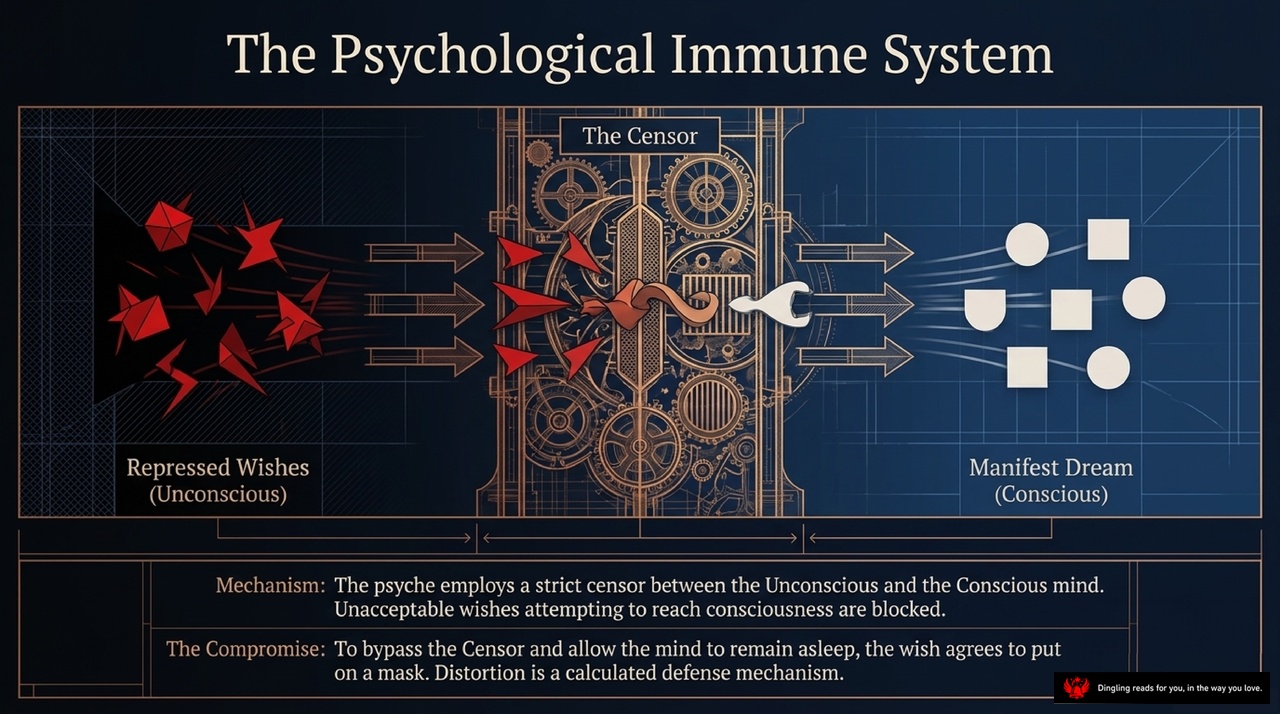
The Psychological Immune System isn't just a metaphor; it's the engine behind every dream you've ever had. Look at this diagram: on the left, we have "Repressed Wishes"—the raw, often unacceptable desires bubbling up from our unconscious. But they can't just burst into the light of day. That's where "The Censor" comes in. Visualized here as a complex, mechanical gatekeeper, the Censor is the psyche's strict security system. Its job is simple but ruthless: block any unacceptable wish from reaching our conscious mind. If a desire is too dangerous, too immoral, or simply too embarrassing, the Censor stops it cold.
So, how do we get our wishes fulfilled at all? The answer is "The Compromise." As the slide explains, the unconscious wish doesn't give up; it just puts on a mask. It agrees to distort itself, to twist the truth, just enough to slip past the Censor's guard. This calculated defense mechanism allows the wish to manifest as a "Manifest Dream"—the confusing, symbolic, and often bizarre imagery we see on the right side of the screen. These aren't random nonsense; they are cleverly disguised versions of our deepest desires. Whether it's a dream about falling, losing teeth, or meeting a stranger, every element is a piece of this compromise, a way for our mind to satisfy a repressed wish without waking us up to face the reality of it.
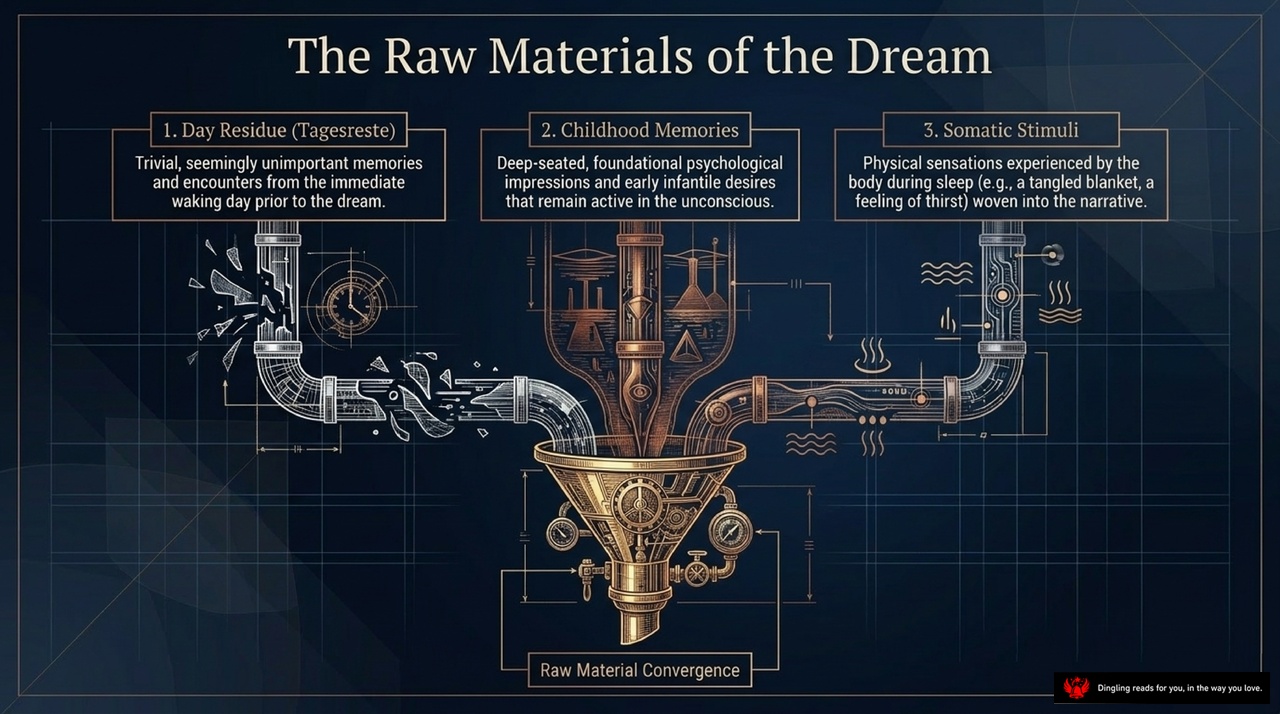
Imagine your mind as a sophisticated, steampunk-style factory, churning out dreams by night. This slide, "The Raw Materials of the Dream," perfectly captures that industrial process. We see three distinct pipelines feeding into a central funnel labeled "Raw Material Convergence." Let's break down what's flowing through each channel.
First, on the left, we have "Day Residue," or *Tagesreste*. Think of this as the factory's immediate intake. It's not grand events, but the trivial, seemingly unimportant encounters from the waking day prior to sleep. These are the loose threads your mind grabs onto, the immediate impressions that haven't had time to fade.
Moving to the center, we see the deepest input: "Childhood Memories." This pipeline taps into the foundational, psychological impressions and early infantile desires that remain active in the unconscious. Even if you think you've forgotten them, these deep-seated impressions are the heavy, structural beams supporting your dream architecture. They are the old blueprints resurfacing to mix with today's news.
Finally, on the right, we have "Somatic Stimuli." This represents the physical sensations experienced by your body during sleep. Maybe you felt a tangled blanket, a sudden drop in temperature, or a feeling of thirst. The mind weaves these physical realities into the narrative, turning a bodily sensation into a story element.
All these streams—today's trivialities, your childhood past, and your body's physical state—merge in that central funnel. This convergence is crucial because it proves that a dream is never random. Every dream is a composite of these specific raw materials, filtered through your unconscious needs. Understanding these three inputs is the first step to decoding the strange logic of your sleep.
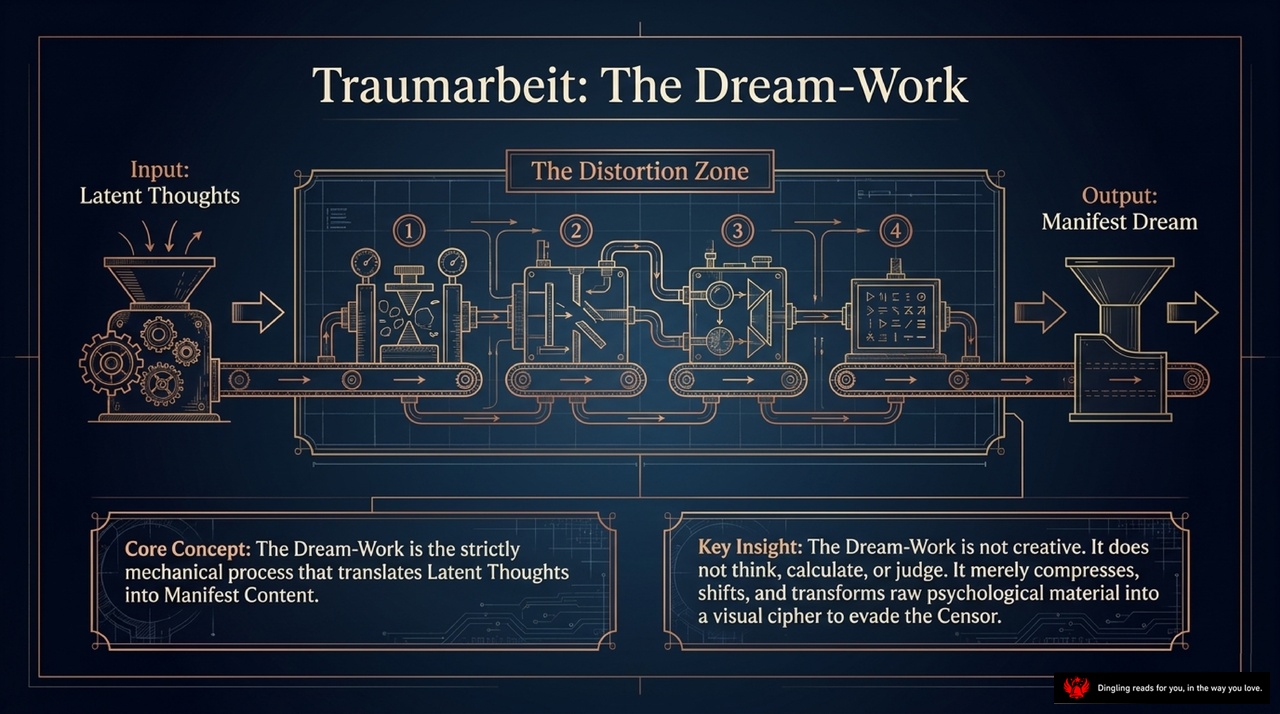
Traumarbeit: The Dream-Work. Think of your mind not as a chaotic mess, but as a highly efficient factory. Tonight, we're looking at the blueprint of that factory: the mechanical process that takes raw, hidden thoughts and churns them into the bizarre stories we call dreams.
On the left, we have our **Input: Latent Thoughts**. These are the raw materials—your repressed desires, childhood memories, and unresolved conflicts—waiting to be processed. They enter the system like ore into a crusher.
Then comes the heart of the operation: **The Distortion Zone**. This isn't a place of creativity or logic; it's a strict, industrial assembly line. As the text reminds us, the Dream-Work is "not creative." It doesn't judge, calculate, or imagine new things. Instead, it mechanically compresses, shifts, and transforms your raw psychological material. It's a ruthless editor, taking complex, often disturbing truths and reshaping them into a visual cipher.
Finally, on the right, we get the **Output: Manifest Dream**. This is the finished product—the strange, illogical narrative you remember upon waking. Its sole purpose? To evade the internal censor. By disguising the truth behind symbols and absurdity, the Dream-Work allows you to sleep peacefully without your conscious mind interrupting your rest.
So, next time you wake up confused by a nightmare or a surreal story, remember: it wasn't random. It was a carefully engineered translation, turning your deepest, most forbidden wishes into a safe, visual code.

Today's slide breaks down the first phase of how our minds distort reality: Condensation and Displacement. Think of Condensation as the ultimate mental compression algorithm. Just like the diagram shows, multiple latent thoughts, people, or places get fused into a single composite image. One dream object carries multiple meanings at once—what we call overdetermination. It's our brain's way of cramming a lifetime of associations into a single, efficient visual.
Then there's Displacement, which is all about shifting the emotional weight. The slide illustrates this perfectly: a highly significant, charged latent thought transfers its emotional intensity onto a completely trivial manifest object. It's a psychological sleight of hand. Instead of confronting a scary or taboo truth, our mind attaches the anxiety to something harmless, like a random number or a minor detail, allowing us to successfully evade the internal censor. Together, these mechanisms explain why dreams feel so fragmented and why the most important parts of our emotional life are often hidden behind the most insignificant symbols.

Mechanisms of Distortion: Phase II. Look at this slide. On the left, we have "Visual Representation." The text explains that the unconscious mind simply cannot handle abstract logic or contradictions. It's like a machine that forces complex thoughts into concrete, pictorial symbols and dramatic actions. That's why a dream about a house or a key isn't just random; it's the mind's way of translating abstract ideas into something it can actually "see" and process.
On the right, we see "Secondary Revision." This is the final polish. Imagine the mind as a craftsman working just as you wake up. It sees the fragmented, absurd narrative of the dream and tries to patch the gaps, applying a deceptive veneer of logical coherence. It smooths out the rough edges so the story makes sense, even if the underlying truth is completely distorted.
So, what's the takeaway? Your dreams aren't just chaotic static. They are a two-step process: first, the unconscious translates abstract feelings into visual images, and second, your conscious mind tries to make those images into a logical story before you fully wake up. This "Secondary Revision" is what often tricks you into thinking the dream makes sense, when in reality, it's just a carefully constructed lie to hide the true, often disturbing, wishes underneath.

Imagine your mind not as a blank slate, but as a complex, multi-layered city built on a topographical blueprint. This structure reveals how we experience reality. At the very surface lies the Conscious, or Cs. This is your surface perception system—the narrow window of what you are aware of right now. It's the top floor where you live your daily life, making decisions and reacting to the present moment.
But beneath this surface lies a vast, hidden infrastructure. Directly underneath the conscious layer is the Preconscious, or Pcs. Think of this as a mental waiting room. It's not inaccessible, but it requires a little effort to reach. This is where your accessible memories and thoughts reside, waiting to be brought into your conscious awareness through focus or association. It's the organized library of your mind, ready to serve your current thoughts.
However, guarding the deepest levels of your psyche are the Censor Barriers. These are the strict security checkpoints that filter what can move up or down. Below the first barrier lies the Unconscious, or Ucs. This is the deepest engine room of your mind. It is the most mysterious and powerful part of all. Here, logic and time have no place. It is inaccessible to your conscious view, driven entirely by primitive instincts, repressed wishes, and the pursuit of pleasure. It's a chaotic, powerful force that runs the show, even when you're asleep.
Understanding this blueprint is crucial because it explains why our dreams often feel so strange and disjointed. The conscious mind tries to impose order, but the unconscious engine room below is churning with raw, unfiltered desires. The barriers between them create the friction that shapes our dreams, turning hidden wishes into the bizarre narratives we experience when we close our eyes.

In our waking lives, our psychic energy flows forward seamlessly: we take in sensory information, store it in memory, and translate it into physical action. It's a straightforward, linear path from perception to movement. But what happens when that forward motion is blocked? This is where the fascinating phenomenon of regression comes in, and it explains exactly why we dream.
Imagine a scenario where your body is paralyzed—like during REM sleep. You cannot move, you cannot act, and that physical release is cut off. Because this forward channel is blocked, the psychic energy doesn't just vanish; it flows backward. Instead of moving from memory to action, it regresses from the motor system back into the memory system, and finally, it floods into the sensory system.
This backward flow transforms abstract thoughts and memories into vivid, hallucinatory images. That's why dreams feel so real. Your brain is essentially taking your internal thoughts and projecting them outward as a sensory experience, creating a "hallucinatory reality" because your body can't act them out. So, while your waking life is a forward march from thought to action, your dream life is a reverse journey where blocked energy creates a second, internal world of sight and sound.
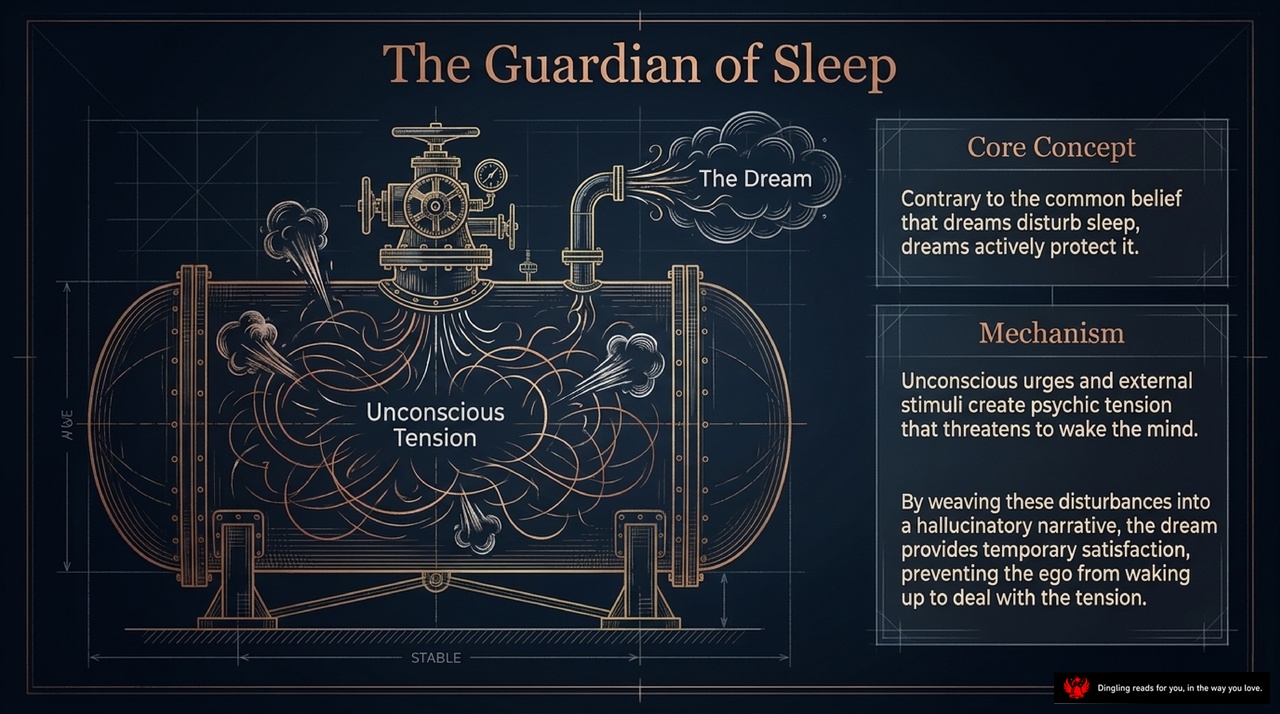
Think of your mind as a high-pressure boiler, constantly fed by unconscious urges and external stimuli that threaten to wake you up. Without a safety valve, this psychic tension would blow the lid off your sleep, forcing you to confront reality. But here's the twist: dreams act as that very Guardian of Sleep. Instead of being a nuisance, they are the ultimate maintenance crew, actively protecting your rest.
The mechanism is brilliant in its deception. When the pressure gets too high, the dream doesn't let you wake up to deal with it. Instead, it weaves these disturbing impulses into a hallucinatory narrative, providing temporary satisfaction. It tricks your ego into believing the tension is resolved, preventing you from waking up to face the real work. By turning anxiety into a story, the dream keeps the pressure stable, allowing you to drift back into a peaceful slumber.

Good morning, everyone. Today, we're diving deep into the most fascinating, and perhaps most disturbing, aspect of dreams: The Paradox of the Nightmare.
Look at this diagram. We have the "Censor membrane" from previous slides acting as a strict gatekeeper, trying to keep our raw, forbidden desires out of our conscious mind. But what happens when the pressure becomes too great? Freud identifies two distinct scenarios where this defense fails, leading us into the nightmare.
First, we have Scenario A: The Failure of Disguise. This happens when a repressed wish is so intensely forbidden that its disguise completely slips. The raw emergence of this thought triggers massive anxiety in the conscious ego. The mind panics, and the only way to stop this thought is to abruptly wake the dreamer up. That's why you wake up in a cold sweat during a terrifying dream; your brain is screaming, "Stop this thought!"
Then, we have Scenario B: The Punishment Wish. This is where it gets even more complex. Here, the dream successfully functions, but it fulfills a masochistic wish. Instead of a happy ending, the dream satisfies the internalized, punishing desires of the superego. It demands guilt and retribution. In these dreams, the nightmare isn't just an intrusion; it's a fulfillment of a hidden desire to be punished for our flaws or sins.
So, the paradox is clear: even our most horrific nightmares are not random chaos. They are the distorted, disguised fulfillment of a wish—either the wish to escape unbearable anxiety by waking up, or the wish to satisfy a deep-seated need for self-punishment. The nightmare is still a dream, just one that wears a mask of terror.

Imagine your mind as a complex, steampunk machine, where gears and cogs twist together to form a tangled, chaotic cloud labeled "The Manifest Dream." But beneath this messy surface lies a simple, golden thread leading down to "The Latent Wish." This slide, "Decoding the Cipher," illustrates the very heart of psychoanalysis: the analyst's task is to dismantle the dream-work.
Instead of reading your dreams as coherent stories, we break them into fragments. Think of it as taking apart a clock to find the original time. You use free association, tracing these threads backward past the censorship, untangling the original repressed wish at the core. It is an act of working backward from the symptom to the source.
In my own analysis of the Irma dream, I found that every bizarre detail—the angry colleague, the failed treatment, even the mocking doctor—was actually a carefully constructed defense mechanism. My unconscious wasn't creating chaos; it was building a fortress to protect me from guilt. By dismantling this dream-work, I realized the dream wasn't a random jumble of brain cells. It was a disguised wish fulfillment. The dream worked backward, taking my repressed desire to prove my innocence and wrapping it in layers of anxiety and blame. So, when you look at that tangled cloud, remember: it's not a mystery to be solved by guessing symbols. It's a puzzle designed by your own mind to satisfy a deep, hidden need. By tracing the threads back to the source, you stop seeing a nightmare and start seeing a message from your true self.

Freud's framework reveals that our minds are vast, hidden landscapes where forgotten memories and repressed desires continually seek expression, constructing elaborate nocturnal dramas just to keep us asleep. If our dreams are the ultimate guardians of our deepest, most forbidden desires, what is your waking mind still trying to hide from you?