
The Leadership Pipeline: Complete Chapter-by-Chapter Summary
Welcome to the Leadership Pipeline. Imagine a grand, spiraling staircase illuminated by golden light, stretching upward into the future. This isn't just an architectural blueprint; it's the map for building a leadership-powered company.
Today, we are introducing the comprehensive framework by Ram Charan, Stephen Drotter, and James Noel. Think of this as the essential guide to diagnosing, building, and sustaining your organization's leadership engine from the ground up.
The core idea is simple yet profound: moving from an individual contributor to a CEO isn't a straight line. It's a series of six critical transitions. Each step requires a fundamental shift in skills, time management, and—most importantly—mindset. You can't skip these stages, and you certainly can't learn them in a single workshop.
As we climb this pipeline, you'll discover exactly what it takes to move from managing yourself to managing others, then to managing managers, and all the way up to the C-suite. This model helps you identify where your leaders are stuck, prevents costly gaps in your talent pipeline, and ensures that your most valuable asset—your people—are growing at the right pace. Let's begin the climb.
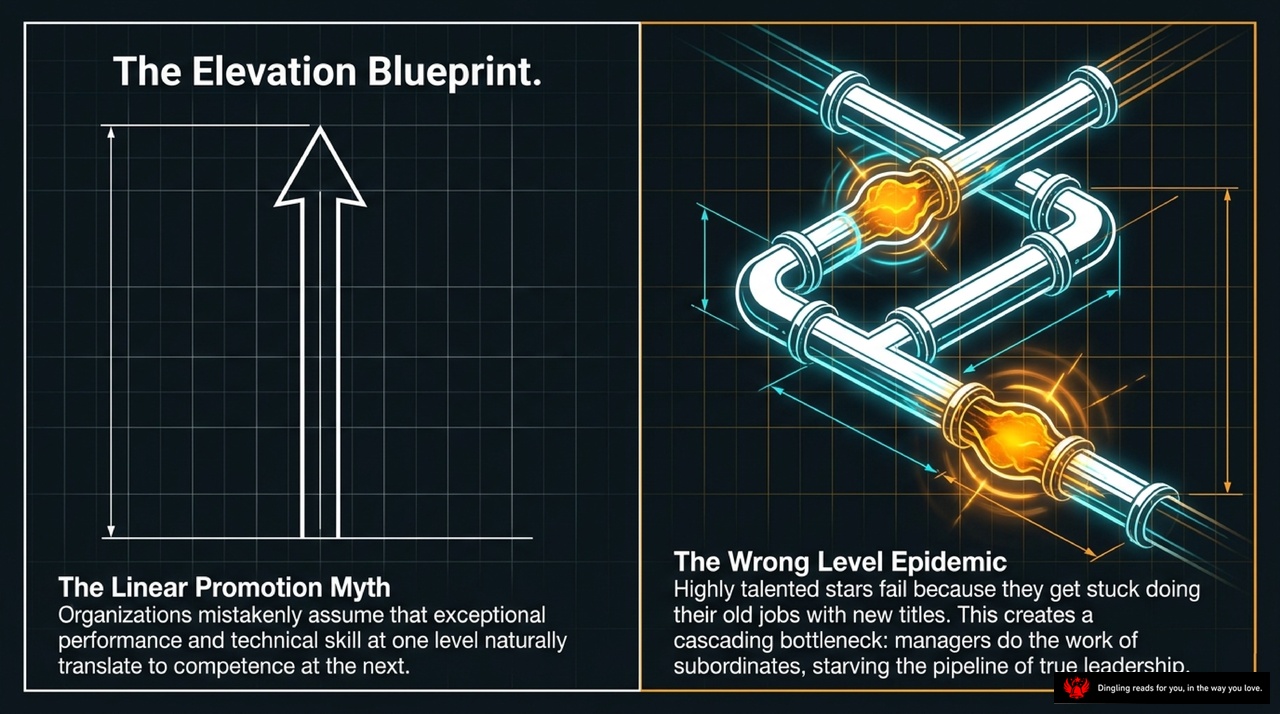
The Elevation Blueprint on the left shows a simple arrow pointing up, but the reality of corporate growth is far more complex than that. As the text "The Linear Promotion Myth" warns, organizations often make a costly mistake: they assume that being a top performer in one role automatically makes you a leader in the next. This is a trap. Just because you were great at coding or selling doesn't mean you know how to build a team.
On the right, we see "The Wrong Level Epidemic" visualized as pipes clogged with glowing bottlenecks. This illustrates a critical failure in many companies: highly talented stars get stuck doing their old jobs with new titles. They are promoted to manager, but they never learn to manage. Instead of delegating, they micromanage, creating a cascading bottleneck where managers end up doing the work of their subordinates. This starves the pipeline of true leadership, leaving the organization with a few brilliant individuals who are actually choking the very growth they were meant to drive. To succeed, leaders must stop climbing the ladder the wrong way and instead invest in the specific skills required for each new level of the leadership ladder.

Imagine your career as a complex machine, where three distinct gears must mesh perfectly for you to climb the corporate ladder. This slide outlines "The Elevation Blueprint," the essential framework for moving from a successful individual contributor to a true leader.
First, look at the blue gear on the left: **Leadership Skills**. This represents "what you do." As you ascend, you must acquire entirely new capabilities required for the next level. Crucially, this means you have to abandon the technical tasks that brought you past success. You can't keep doing the work that made you a star employee; you must learn to do the work of a leader.
Next, consider the white gear on the top right: **Time Application**. This is about "how you work." Your time allocation needs a complete reallocation. You must shift your hours away from personal execution and delegate those tasks. Instead, you need to invest your time in coaching your team, planning for the future, and providing strategic oversight. Your time is no longer about doing; it's about enabling others to do.
Finally, examine the yellow gear at the bottom: **Work Values**. This is "what you believe is important," and the text warns this is the hardest shift. You must fundamentally change your core beliefs about what constitutes real work and where value is actually generated. If your values don't shift, your skills and time management won't matter.
In short, to elevate, you must change your skills, reallocate your time, and most importantly, transform your underlying values.

Look at this "Elevation Blueprint." It visualizes the six critical stages every leader must navigate to climb from an individual contributor to the CEO. Think of your career not as a straight line, but as a series of sharp 90-degree turns. Each turn requires a fundamental reconstruction of your skills, how you spend your time, and the very values that drive your work.
Starting at the bottom, Stage 1 is the shift from Managing Self to Managing Others. This is where most new managers stumble. They are promoted because they were great individual contributors, but they fail because they try to do everyone's job instead of empowering their team. Next, Stage 2 moves you from Managing Others to Managing Managers. Here, your focus shifts from doing the work yourself to hiring, coaching, and developing the leaders who will do the work.
As you ascend to Stage 3, you transition from Managing Managers to Managing Functional Departments. Now, you're no longer just looking at your own team; you're taking a strategic view of an entire function, like sales or manufacturing, and balancing it against the company's broader goals. Stage 4 is the leap to Business Unit General Manager. This is where you take full ownership of a business unit, managing the P&L and balancing short-term profits with long-term growth.
Stage 5 takes you from Business Manager to Group Manager. At this level, your job isn't to run the business yourself anymore; it's to manage the managers who run the businesses. You are allocating resources and setting strategy for the whole group. Finally, Stage 6 is the ultimate elevation: from Group Manager to Enterprise Manager, the CEO. This isn't just about managing more people; it's about managing the entire organization, the board, and the external world, making the high-stakes decisions that define the company's future. The blueprint is clear: to succeed at the next level, you must completely reinvent how you lead.

Today's slide outlines the "Elevation Blueprint," a critical roadmap for leaders at two distinct stages of their career. On the left, we see the path for the First-Line Manager. The core shift here is moving from personal technical output to team output. This means finding satisfaction in the success of others rather than relying on personal heroics. The danger? Competing directly with your subordinates or fixing their mistakes instead of coaching them. If you stay in the weeds, you'll never scale your team.
On the right, the blueprint shifts to the Director level. The transformation here is moving from coaching individuals to coaching coaches. Your key value becomes holding first-line managers accountable for their managerial work, not their technical tasks. The danger is bypassing your direct reports to manage the frontline yourself, which destroys the authority of the manager layer and creates a bottleneck.
In short, as you move up the ladder, your focus must expand outward. You stop doing the work and start building the people who do the work. If you try to do the job of the person below you, you will fail at the job you are actually hired to do.

Passage 3: To Functional Manager. Imagine your career as a series of ladders, where climbing to the next rung requires more than just doing the same job better; it demands a fundamental shift in how you think and operate. Today, we're focusing on that critical transition from managing individuals to managing an entire function, a leap that often separates successful leaders from those who hit a ceiling.
The core challenge here is undeniable: you must now evaluate and manage disciplines you have never personally executed. Think about it—moving from a specialist role where you control the details to a functional role where you oversee diverse teams requires a massive skill shift. You can no longer rely on your own expertise; you must master cross-functional communication and resource negotiation. It's about stepping out of your comfort zone and learning to lead people who operate differently than you do.
But the most profound change is the value shift. This is where many leaders stumble. You must stop thinking like a bureaucrat protecting the turf of a single department and start thinking like a true business person. Your focus needs to expand from defending your specific silo to valuing the overarching corporate strategy. If you cling to departmental goals at the expense of the company's broader success, you will fail. The graphic on your screen illustrates this perfectly: those cages labeled Silo 1, Silo 2, and Silo 3 represent the old way of working in isolation. The arrow pointing right represents the breakthrough you need to make—breaking out of those silos to drive value for the entire organization.
This transition is the third stage in the leadership ladder, and it's pivotal. Without mastering this shift from a narrow functional view to a broad business perspective, you cannot effectively support the business units you are meant to serve. It requires courage to let go of your old identity as a doer and embrace your new role as a strategic enabler. Are you ready to stop defending your territory and start driving the company's strategy?
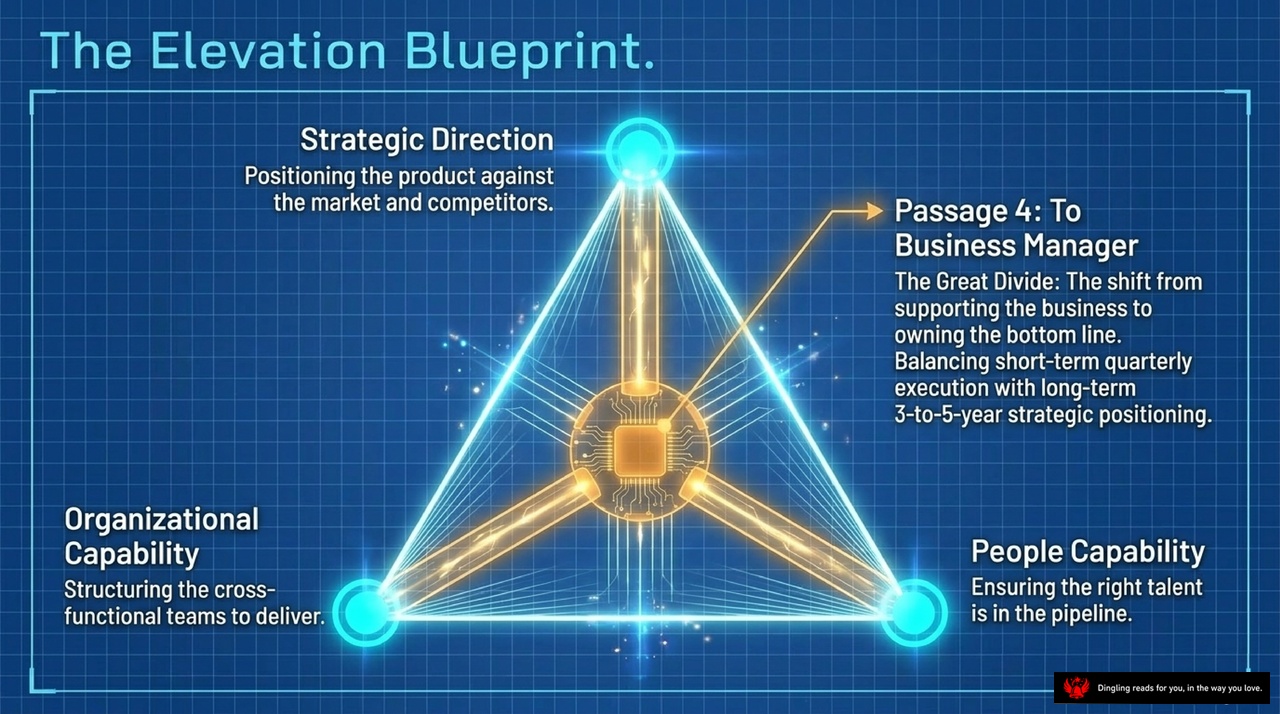
The Elevation Blueprint isn't just a diagram; it's the master key to unlocking your career's next level. As we've explored, moving from a manager to a business leader requires balancing three critical pillars: Strategic Direction, People Capability, and Organizational Capability. Think of it as a high-tech circuit board where every connection counts.
On the top, Strategic Direction is about positioning your product against the market. It's the shift from simply supporting the business to actually owning the bottom line. This means you can't just focus on short-term quarterly execution; you have to master the art of balancing immediate results with a 3-to-5-year strategic vision. Without this long-term view, you risk losing your competitive edge.
But strategy is nothing without the right people. That's where People Capability comes in. It's about ensuring the right talent is always in your pipeline. You need leaders who aren't just skilled in their craft, but who have the mindset to drive the entire organization forward.
Finally, you need Organizational Capability. This is the engine that makes it all work. It's about structuring cross-functional teams to deliver. You have to break down silos and create a flow where information and resources move freely across departments. When these three elements align—clear strategy, top-tier talent, and a connected organization—you stop managing tasks and start leading an enterprise. This blueprint transforms how you operate, turning complex challenges into a clear path for sustainable growth.
Welcome back to our deep dive into the Leadership Pipeline. Today, we are zooming out to look at the big picture: The Elevation Blueprint.
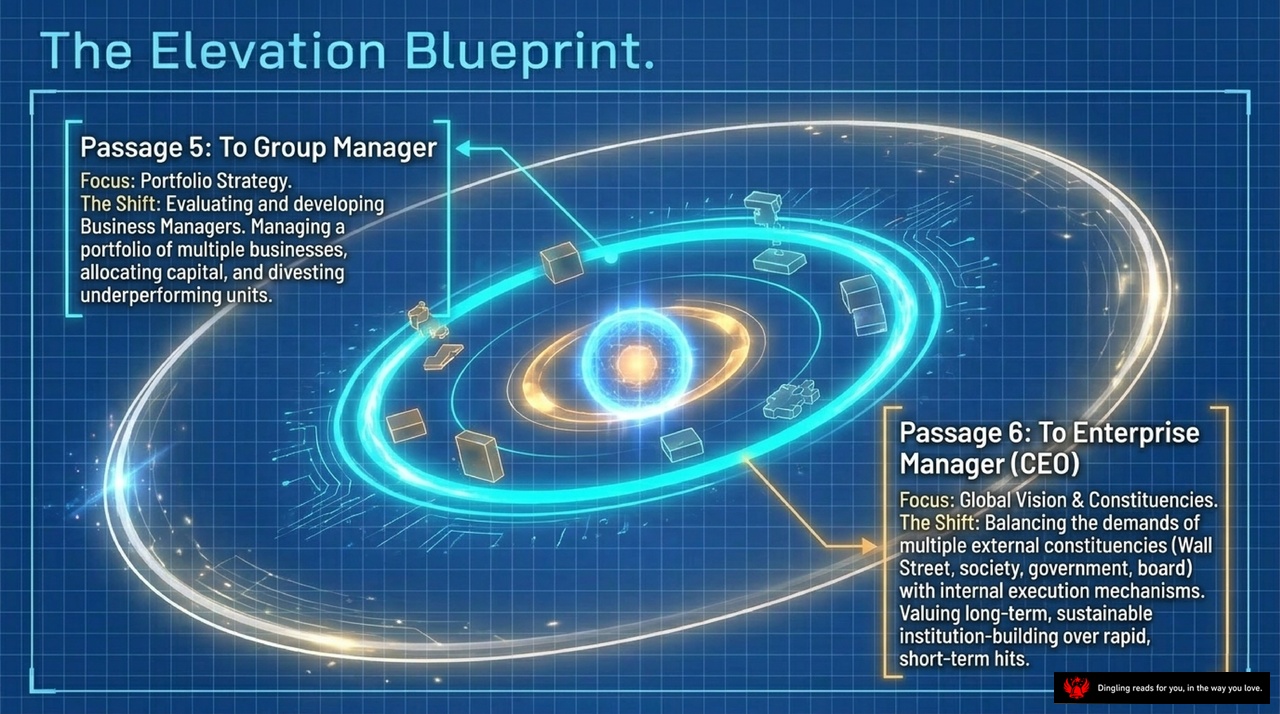
Imagine your career not as a straight ladder, but as a series of concentric rings, each representing a distinct stage of leadership. As you move outward, your focus shifts from managing yourself to managing the entire enterprise.
On the left, we see Passage 5: To Group Manager. This is the pivotal moment where you stop being the hero of your own business unit and become the architect of the portfolio. Your focus shifts entirely to Portfolio Strategy. The real shift here isn't about doing things better; it's about evaluating and developing the Business Managers who run those units. You are no longer responsible for the daily operations of a single business; your job is to manage a portfolio of multiple businesses, allocate capital where it matters most, and have the courage to divest underperforming units. It's a move from tactical execution to strategic oversight.
Now, look at the outer ring on the right: Passage 6: To Enterprise Manager, or the CEO. This is the ultimate elevation. Here, the focus expands to Global Vision and Constituencies. The challenge becomes balancing the demands of multiple external forces—Wall Street, society, government, and the board—while keeping internal execution mechanisms running smoothly. You can't just chase quick wins anymore. The shift here is about valuing long-term, sustainable institution-building over rapid, short-term hits. You are no longer managing a business; you are building the institution itself.
This blueprint shows us that true leadership growth isn't just about climbing higher; it's about fundamentally changing how you think, what you prioritize, and who you serve.

Let's talk about the "Alternate Branch"—the path for highly specialized experts like General Counsels or Chief Technology Officers. Think of it as a parallel pipeline that runs alongside the traditional management track. But here's the critical shift: as you move up this functional path, you must stop asking, "Can we do this?" and start asking, "Should we do this to create a competitive advantage?" It's a move from pure technical execution to strategic commercial thinking.
The danger to avoid on this path is becoming just an errand runner or an administrative aide for the CEO. If you stay there, you lose your edge as an independent strategic partner. Your real value lies in driving enterprise-wide innovation and shaping the company's future from a unique expert perspective, rather than just executing orders.
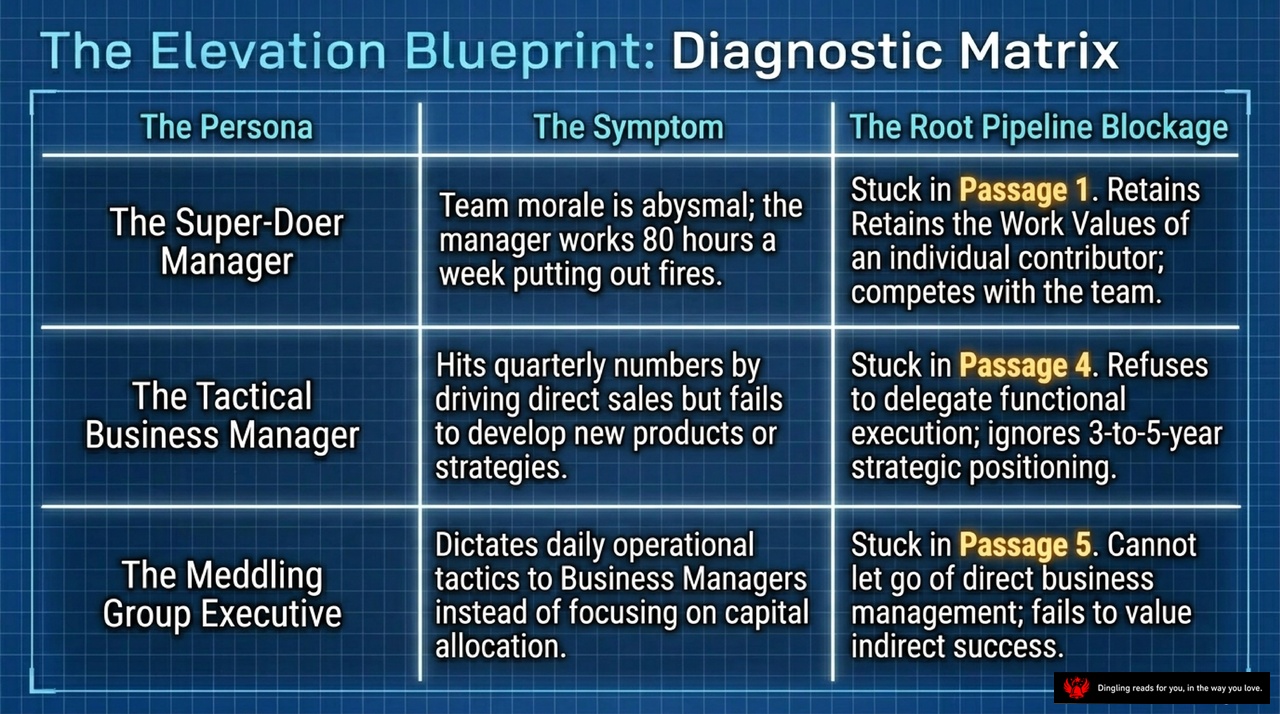
The Elevation Blueprint: Diagnostic Matrix isn't just a chart; it's a reality check for leaders who are stuck in the wrong lane. Look at "The Super-Doer Manager." This persona is burning out because they're trapped in Passage 1, still operating as an individual contributor. They're putting out fires 80 hours a week, which kills team morale, because they compete with their team instead of empowering them. Then, we have "The Tactical Business Manager." They hit quarterly numbers by driving direct sales, but they fail to develop new strategies because they're stuck in Passage 4. They refuse to delegate functional execution and ignore the 3-to-5-year strategic positioning needed for true growth. Finally, there's "The Meddling Group Executive." This leader dictates daily operational tactics instead of focusing on capital allocation. They're stuck in Passage 5, unable to let go of direct business management and failing to value indirect success. These blockages aren't just personal habits; they are systemic failures that halt the entire leadership pipeline. To elevate your organization, you must diagnose where these leaders are stuck and guide them to the next passage.
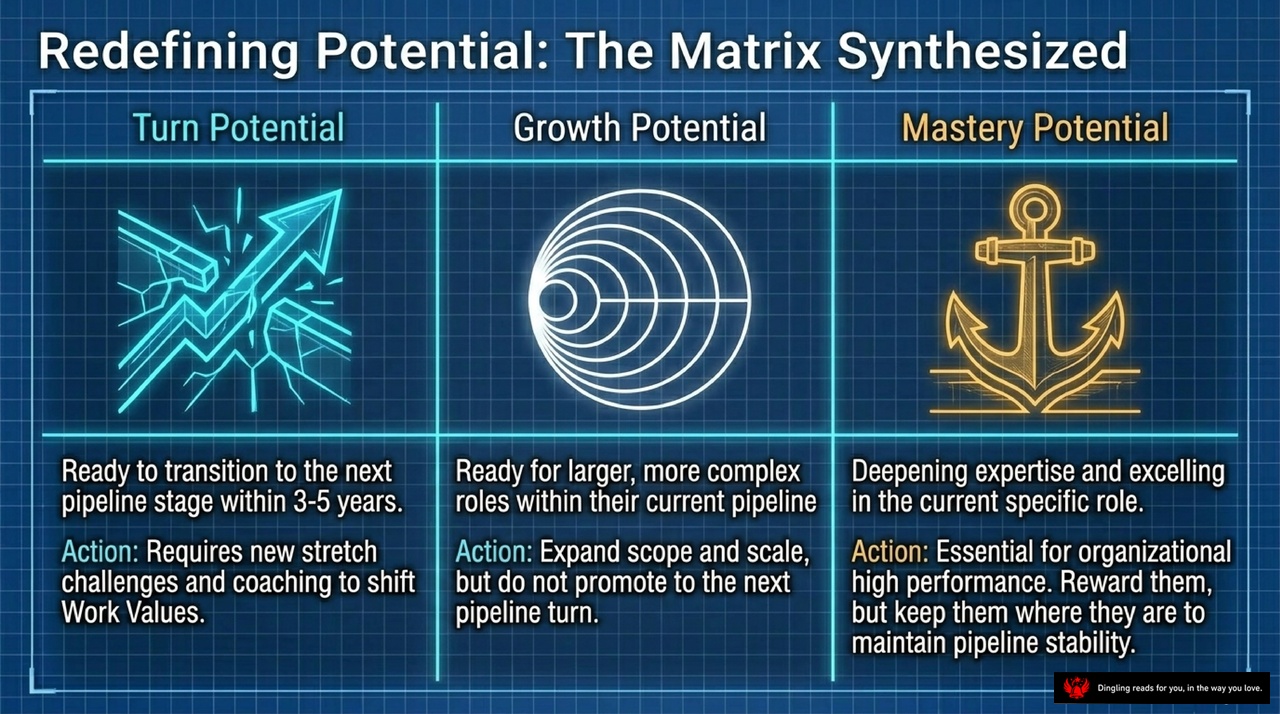
Let's talk about the "Matrix Synthesized"—a visual blueprint for redefining what potential actually looks like in a high-performing organization. This slide breaks down talent into three distinct categories based on where they sit in the leadership pipeline: Turn Potential, Growth Potential, and Mastery Potential.
First, look at the left column: Turn Potential. These are the leaders ready to transition to the next pipeline stage within the next three to five years. The graphic shows an arrow breaking through barriers, symbolizing the need for change. To unlock this potential, these leaders require new stretch challenges and coaching specifically designed to shift their work values. They are on the verge of a major leap, but they need the right push to move from their current role to the next level of responsibility.
In the center, we see Growth Potential. Represented by expanding concentric circles, these leaders are ready for larger, more complex roles within their current pipeline. They aren't ready to jump to the next major stage yet, but they are primed for expansion. The action here is clear: expand their scope and scale. However, it's crucial to hold them back from promoting them to the next pipeline turn prematurely. Let them grow deep within their current domain before pushing them outward.
Finally, on the right, is Mastery Potential. Illustrated by an anchor, these leaders represent stability and deep expertise. They are excelling in their current specific role and deepening their mastery. While they are essential for organizational high performance, the strategy here is different. You should reward them generously, but you must keep them where they are. Moving them to a new role might actually dilute their value. Their job is to maintain pipeline stability and set the standard for excellence in their current function.
So, the key takeaway is that not every high performer needs a promotion. Some need a shift in mindset, some need more scope, and some need to stay put to anchor the organization. Understanding which category a leader falls into is the first step to building a resilient leadership pipeline.

Imagine your career not as a straight line, but as a blueprint with seven distinct phases. This slide, "The Elevation Blueprint," visualizes the critical shift from being a high-performing individual contributor to a fully effective leader. Notice the circle divided into seven wedges: Operational, Customer, Leadership, Management, Relationships, Social Responsibility, and Personal Expertise.
When you get promoted, you instantly create a "Performance Gap." A new leader often starts by filling only the first two wedges—Operational and Personal Expertise. They are great at doing the work themselves, but they haven't yet mastered the other five areas like managing people, building relationships, or taking social responsibility. This is why many new leaders struggle; they are trying to do the job of the next level with the skills of their current level.
True pipeline development isn't about hoping things work out. It's about using targeted coaching to fill those empty wedges. By addressing the gaps in Management, Relationships, and Leadership, you shift the leader from partial output to Full Performance. It's about transforming how you work, not just what you do, ensuring you are equipped to succeed at every stage of your elevation.
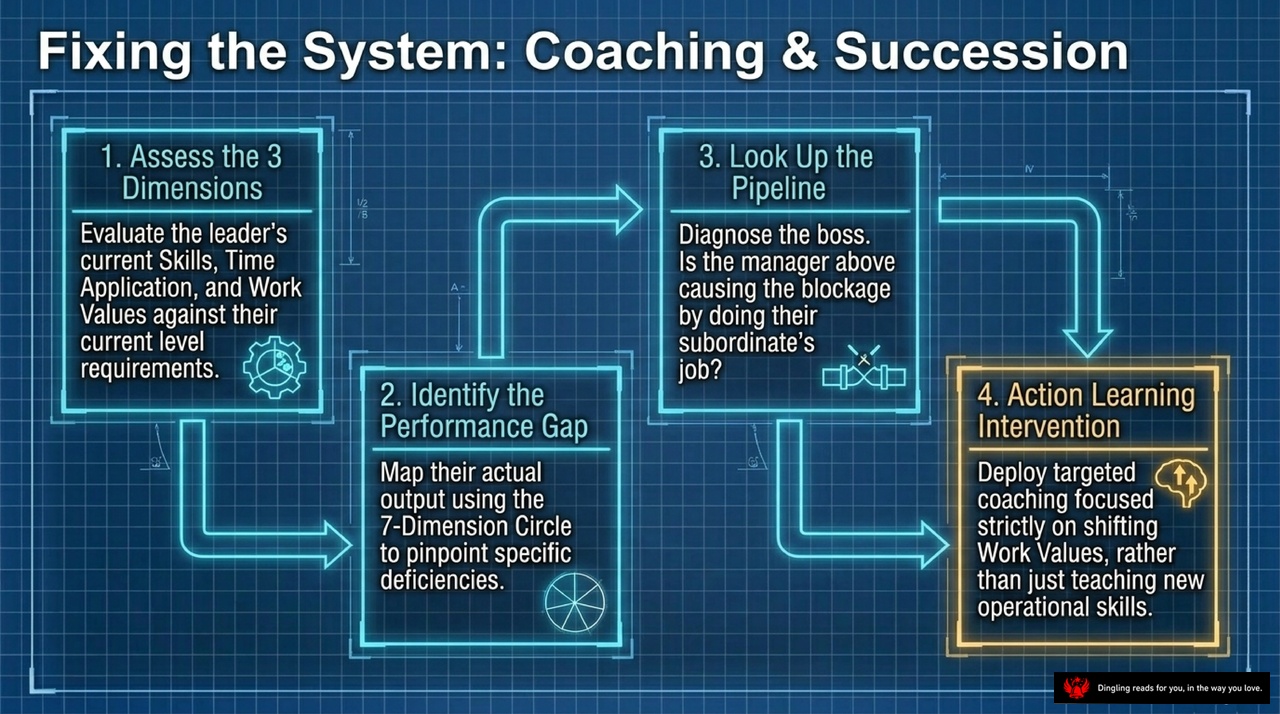
Fixing the System: Coaching & Success. This slide outlines a four-step diagnostic framework to identify why leaders are stuck and how to unblock them.
First, we assess the three dimensions: skills, time application, and work values. We evaluate the leader's current output against the requirements of their specific level. Next, we identify the performance gap. Instead of just looking at skills, we map their actual time usage using the 7-Dimension Circle to pinpoint exactly where they are wasting time on tasks that don't belong at their level.
Then, we look up the pipeline. This is a crucial step. We diagnose the boss above. Is the manager causing a blockage by doing their subordinate's job? Often, a leader's inability to grow is directly caused by their boss micromanaging or taking over critical responsibilities. Finally, we move to action learning intervention. Once we've identified the root cause, we deploy targeted coaching. The focus isn't just teaching new operational skills; it's strictly on shifting work values and helping the leader stop doing the work of the next level up. By fixing the system above and below, we enable the leader to finally succeed in their current role.
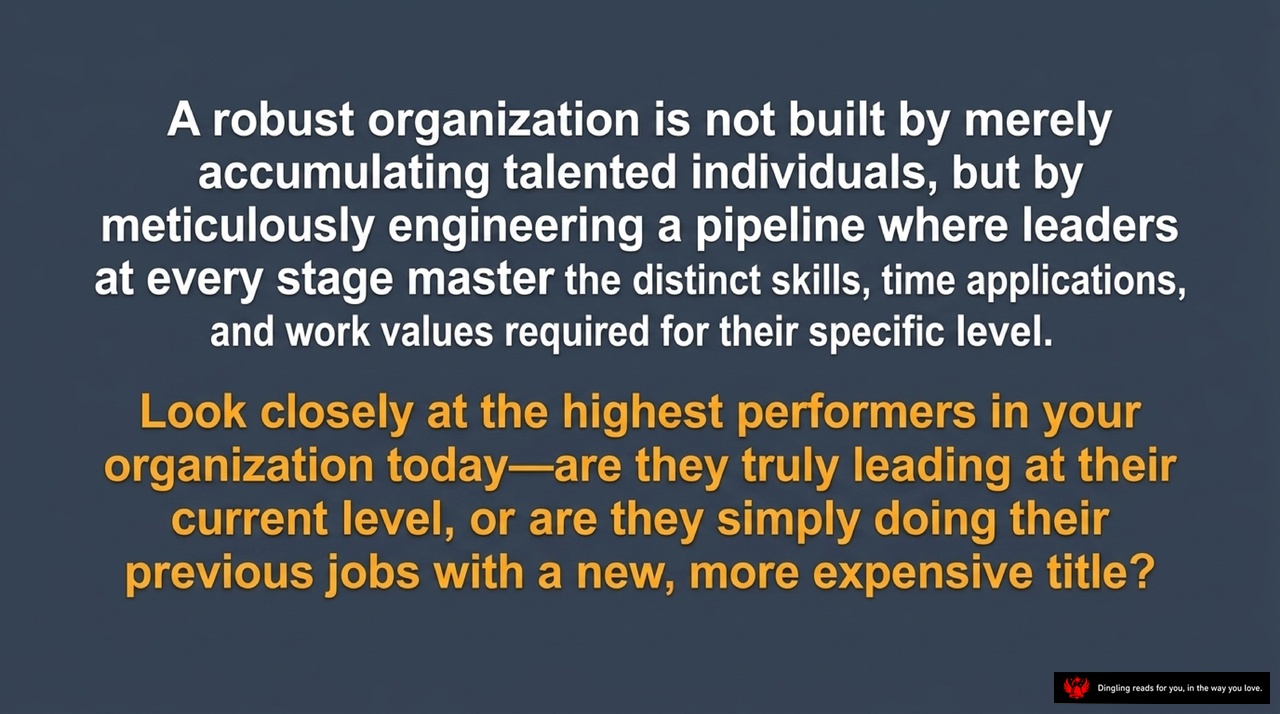
Let's be brutally honest: a robust organization isn't built by merely accumulating talented individuals. You can hire the smartest people in the world, but without a deliberate system, they will just burn out or leave. The real secret lies in meticulously engineering a pipeline where leaders at every stage master the distinct skills, time applications, and work values required for their specific level.
Think about the highest performers in your organization today. Look closely at them. Are they truly leading at their current level, or are they simply doing their previous jobs with a new, more expensive title? This is the most dangerous trap a company can fall into. We often promote a brilliant individual contributor to a management role, expecting them to suddenly manage people the way they managed tasks. But that doesn't work.
To build a resilient company, you must stop rewarding the past and start engineering the future. You need to ensure that every leader understands that their success is no longer defined by their own output, but by the success of the team they lead. If you skip these critical developmental stages, you aren't building a leadership pipeline; you're just creating a revolving door of failed managers.