
The Life and Times of Su Tungpo: Complete Chapter-by-Chapter Summary

Welcome to our journey into the life of one of history's most captivating figures: Su Dongpo. Set against the timeless backdrop of ink-wash mountains, we explore the story of an incorrigible optimist, poet, and statesman who transformed political exile into immortal art.
Su Dongpo's life wasn't just about surviving; it was about thriving despite relentless adversity. As the book reveals, he faced repeated political exiles, yet instead of crumbling, he turned his hardships into masterpieces. Whether composing poetry while exiled to remote islands or painting bamboo in solitude, his spirit remained unbreakable.
He was a man of profound contradictions—part scholar, part farmer, part rebel, yet always deeply compassionate. His ability to find joy in the simplest moments, from a rainy day to a quiet night with friends, made him a true master of life.
This is the story of how one man turned suffering into wisdom, and how his legacy continues to inspire us all. Let's dive into the life of Su Dongpo.

The Uncontainable Breadth of an Incorrigible Optimist. Look at Su Shi. He wasn't just a poet; he was a man of infinite contradictions, a true Renaissance figure in ancient China. As the slide beautifully illustrates, his life was a kaleidoscope of roles. He was a statesman, the Emperor's secretary, yet also a fearless critic of corrupt regimes. He was a bon vivant, brewing experimental wines and cooking legendary pork stews, but he was also a friend of the people, an engineer who built dams and established orphanages and hospitals. He was a mystic, practicing yogic breathwork and Daoist alchemy, and an artist, a master calligrapher who founded the Literati style of painting.
Su Shi didn't fit into any single box. He could be the most serious philosopher or the most playful prankster. As he famously wrote, "Up, I can keep company with the Jade Emperor; down, I can keep company with the beggars. I see no bad person in the world." This mindset defined his resilience. When he was exiled to the most remote islands, he didn't complain; he adapted, he farmed, he painted, and he found joy in the simplest things. From the bustling capital to the desolate frontier, Su Shi remained an incorrigible optimist, proving that your circumstances don't have to define your spirit.

Imagine a wild swan stepping onto a field of slushy snow. It leaves a print, then takes flight, soaring away without a care for which direction the wind takes it. This isn't just a poetic image; it's the core philosophy of Su Dongpo, a lesson on how to live with grace in an unpredictable world.
Su Dongpo understood that while we leave accidental footprints on the earth—whether through our policies, our art, or our relationships—we must not be bound by them. True freedom, he believed, comes from accepting that our worldly impact is temporary. Even when he was exiled to the remote, harsh islands of Hainan, facing a life of hardship and isolation, he maintained an absolute inner freedom. He cared not whether he went east or west; his spirit remained unshackled.
This insight wasn't just about escaping political persecution. It was about a deeper truth: that true grace requires us to let go of the fear of fate. When Su Dongpo faced the "accidental footprints" of his life—from the betrayal of his friends to the loss of his wife and the death of his son—he never let the storm dictate his inner peace. He taught us that we can walk through the slush, leave our mark, and then fly away, unburdened by the weight of our past or the uncertainty of our future.

The Clash of Eras: Humanity versus Ideology. This slide perfectly captures the defining conflict of Su Dongpo's life: a battle between human nature and rigid ideology. On the left, we see Su Dongpo, the ultimate pragmatist. His core belief is simple yet powerful: the people are the root of the state. He valued human nature above all else, advocating for leniency and compassion in punishment to protect the innocent. His governance style was flexible and grounded in common sense, always rejecting absolute theories in favor of practical relief for farmers.
On the right stands Wang Anshi, the ideological reformer. His philosophy was built on systematic state capitalism, a top-down approach that prioritized theory over reality. His famous "Three Don't-Cares" doctrine declared that Heaven's will is inadequate to fear, people's opinions are inadequate to follow, and ancestors' rules are inadequate to use. This rigid, theoretical approach forced farmers into state loans and punished them even during good harvest years if they couldn't repay.
This clash wasn't just about policy; it was about the soul of governance. Su Dongpo fought tirelessly against this system, believing that true leadership must serve the common people, while Wang Anshi believed in reshaping society through forceful, centralized control. This ideological rift ultimately tore Su Dongpo's career apart, sending him into exile, but it also cemented his legacy as the defender of humanity against the tyranny of abstract ideology.

Picture shows three hanging parchment notes tied together by a chaotic scribble of black ink, symbolizing the tangled web of political persecution. The first note, "Exhibit A," highlights Su Dongpo's "Green Wheat" metaphor, where he mocks greedy politicians as crows fighting over rotting meat while true scholars soar like swans. The second note, "Exhibit B," details his fable of the Owl and the Phoenix, portraying corrupt officials as owls usurping the rightful place of the absent Emperor, the Phoenix. The final note, "The Verdict," reveals the grim outcome: arrested in Huzhou, interrogated at Crow Terrace Prison, and saved from execution only by the Empress Dowager's intervention.
Let's dive into the 1079 Poetry Trial, a dark chapter in Su Dongpo's life where his words became his downfall. His famous "Green Wheat" poem wasn't just art; it was political treason in the eyes of the new regime. By comparing greedy officials to crows scavenging rotting meat, and himself to a high-flying swan, he was essentially calling out the entire administration for corruption. Similarly, his fable about the Owl and the Phoenix was a thinly veiled attack on the corrupt censor who had usurped the Emperor's authority. These weren't abstract metaphors; they were direct challenges to the powerful.
The result was swift and brutal. In 1079, Su Dongpo was arrested in Huzhou by the Imperial Guards and dragged to the infamous Crow Terrace Prison for interrogation. The charges were based entirely on his poetry, twisted out of context to prove disloyalty. He faced the death penalty, a fate reserved for high treason. However, his life was spared at the last minute, not by the Emperor, but by the Empress Dowager and loyal friends who intervened on his behalf. This trial marked a turning point, pushing Su Dongpo from the center of power into the wilderness, where his greatest literary masterpieces would eventually be born.

Look at this graph. It captures the ultimate paradox of Su Dongpo's life: as his political status and material wealth plummeted into the mud, his spiritual freedom and artistic mastery soared into the heavens.
The black line represents his fall from an Imperial Magistrate to an impoverished outcast living in malarial tropics. He was stripped of power, forced from the capital to the remote, dangerous island of Hainan. Yet, the red line tells the opposite story. As he lost everything worldly, he soared from a constrained bureaucrat into a fully realized philosopher.
This is the key takeaway: the destruction of his political ego was the exact requirement for the birth of his transcendent genius. It was only when he stopped trying to please the court that he could finally write immortal masterpieces. In his darkest hours, he created the *Red Cliff Odes* and the *Ballad of the Western Lake*, works that touch the soul of humanity even today. His exile didn't break him; it unlocked him. He found that while the world could take his office and his home, it could never take his joy or his ability to see the moon clearly.

Welcome back to the story of Su Dongpo. Today, we step into a pivotal chapter of his life: his rebirth on the Eastern Slope, or as he called it, Dongpo.
After being stripped of his official salary and forced into exile, Su Dongpo didn't just survive; he transformed. The image on the screen captures this profound shift in three key ways.
First, look at **The Land**. No longer a high-ranking official, he literally tilled the soil. He built a dam and planted wheat, turning his survival into an act of dignity. This wasn't just farming; it was reclaiming his agency.
Second, notice **The Snow Hall**. This structure represents his new community. He painted the walls himself with winter landscapes, creating a sanctuary where he hosted wandering monks, poor scholars, and local farmers. It was a place of connection, bridging the gap between the exiled scholar and the common people.
Finally, consider **The New Name**. He adopted the moniker 'Dongpo' after his farmland, shedding the identity of a disgraced official. In doing so, he embraced a simpler joy: listening to a neighbor's wooden clogs on the dirt path and watching the rain.
This transition from a political figure to a farmer and a friend is what made Su Dongpo truly timeless. He found freedom not by escaping the world, but by diving deep into it, finding peace in the soil and the simple rhythms of daily life.

Imagine drifting on the Yangtze River under the moonlight, where the water whispers a timeless philosophy of resilience. This is the essence of Dongpo's "Red Cliff Odes," born from his profound insight while floating at night. He realized that our grief over life's brevity stems from fixating on what changes. But if we shift our perspective to see what remains constant—the unchanging rhythm of the universe—both we and the world become eternal. In this cosmic view, the fleeting worries of daily life dissolve into insignificance.
Dongpo taught us that our truest treasures aren't material possessions or fleeting fame, but the simple, inexhaustible gifts of nature: the clear breeze sweeping over the river and the bright moon rising above the mountains. These are freely given by the Creator, available to everyone, and never running out. While others mourn the passage of time, Dongpo invites us to embrace the eternal present, finding peace not in controlling the flow of life, but in aligning our hearts with the enduring beauty of the world around us.

The Three Pillars of a Resilient Soul
Imagine a man who cares deeply for the suffering of the world yet remains spiritually untouched by his own worldly losses. This is the essence of the "True Dongpo," a definition perfectly captured where Confucianism, Buddhism, and Daoism converge.
On the left, we see Confucianism, representing The Duty. It is about active engagement with the world—fighting famine, reforming prisons, and building infrastructure like the West Lake causeway. It's the drive to make a tangible difference.
On the right, Buddhism stands for The Detachment. It teaches us to recognize the illusion of the material world and break the habits of sensory attachment to achieve mental tranquility. It's the inner peace that comes from letting go.
At the bottom, Daoism offers The Harmony. It's about simplifying life, flowing with nature, and seeking internal alchemy and longevity. It's the wisdom of going with the flow.
But it is the intersection of all three that creates true resilience. When you combine the duty to serve, the detachment from material loss, and the harmony with nature, you get a soul that can endure anything. Just like Su Dongpo, who faced exile and tragedy but never lost his spirit, because he lived this balanced life.

Imagine a world where the pursuit of immortality isn't about chasing magical pills or secret formulas, but is found in the quiet art of cooking a pot of stewed pork. This slide beautifully captures the dual nature of Su Dongpo's life: the esoteric and the earthly. On one side, he was deeply fascinated by Daoist magic, breathing techniques, and the elusive elixir of life, seeking to survive entirely on sunshine. Yet, on the other side, he grounded these lofty spiritual ideals into practical, everyday wisdom. Instead of relying on magic, he distilled his longevity secrets into four simple, practical rules: no business is wealth, early sleep is wealth, walking is your carriage, and late eating is meat. By turning the abstract concept of immortality into the tangible pleasure of Dongpo Pork—slowly stewing cheap, unwanted meat until it is perfect—Su Dongpo showed us that true wisdom lies not in escaping the world, but in mastering it through simplicity and mindfulness.

Look at this slide. On the left, we see the rigid, mathematical skeleton of a cow, labeled with fixed proportions and specific anatomy. On the right, we have bamboo—fluid, organic, and free from any fixed shape. The text contrasts these two concepts: "Constant Form" versus "Constant Principle."
This image perfectly captures Su Dongpo's revolutionary artistic philosophy. While traditional craftsmen and painters focused on the "Constant Form"—copying the exact measurements of a cow or a building—Su Dongpo argued for something deeper. He believed true art requires capturing the "Constant Principle."
Just like bamboo or flowing water, nature doesn't follow a rigid blueprint, but it possesses an inner logic and rhythm. Su Dongpo taught that a painter must understand the inner nature of the bamboo so thoroughly that the brush moves with the spontaneous, living rhythm of nature itself. He didn't want to draw a static picture of a plant; he wanted to capture the spirit and movement behind it. This shift from copying the external shell to expressing the internal essence was the core of his "Theory of Constant Principle," transforming Chinese painting from mere illustration into a profound expression of life.
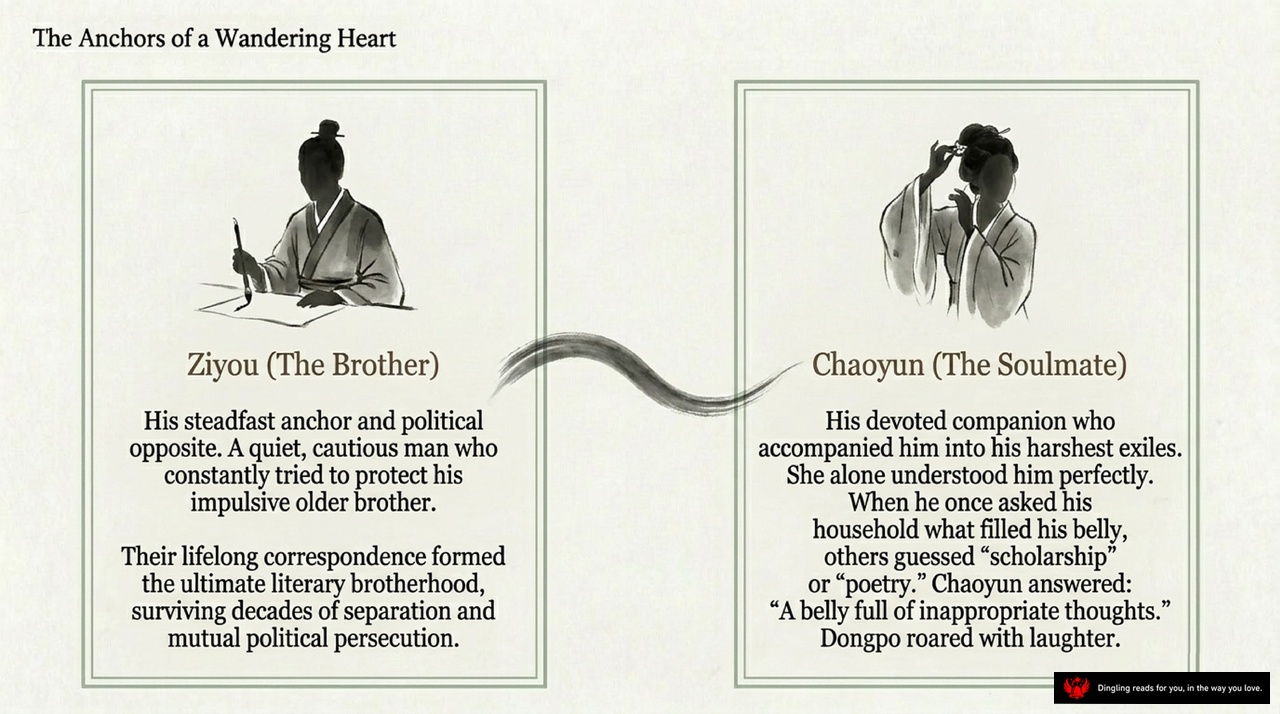
The Anchors of a Wandering Heart. Today, we explore the two figures who held Su Dongpo steady during his life's storms: Ziyou, his brother, and Chaoyun, his soulmate.
On the left, we see Ziyou, described as the steadfast anchor and political opposite. He was a quiet, cautious man who constantly tried to protect his impulsive older brother. Their lifelong correspondence formed the ultimate literary brotherhood, surviving decades of separation and mutual political persecution. It was Ziyou who stood by Dongpo when the world turned against him, a silent guardian in a chaotic era.
On the right, we see Chaoyun, Dongpo's devoted companion who accompanied him into his harshest exiles. She alone understood him perfectly. The slide shares a famous story where Dongpo asked his household what filled his belly. While others guessed "scholarship" or "poetry," Chaoyun answered with a laugh: "A belly full of inappropriate thoughts." That moment captures their unique bond—a shared humor and deep understanding that transcended words.
Together, Ziyou and Chaoyun represent the emotional core of Dongpo's journey. One was the brother who protected his legacy through letters and loyalty; the other was the soulmate who shared his laughter and sorrow, even when he was far from home. Without these two anchors, Dongpo's wandering heart might have drifted aimlessly.

Look at this palm tree standing firm against the swirling winds. This image captures the essence of Su Shi's final chapter: The Edge of the World. At sixty-two years old, Su Shi was exiled to Hainan Island, a malarial, tropical frontier that was considered a death sentence for a northern scholar. There was no medicine, terrible food, and lethal humidity. Yet, this was where he found his ultimate triumph.
Su Shi realized that absolute loss equals absolute freedom. Stripped of all status, he wandered the island in a peasant's rain hat with his dog, "Black Muzzle." Instead of despairing, he chatted with illiterate farmers, gathered oysters, and swapped ghost stories. In this harsh environment, he discovered a profound truth: all places are the same if the mind is at peace. His journey to the edge of the world became his greatest liberation, proving that true freedom comes not from where you are, but from how you choose to see it.

The Final Rest isn't just a title; it's the ultimate lesson on how to face the end of life. Picture this: after years of exile and finally being pardoned, the 64-year-old poet Dongpo returns north, only to fall fatally ill. As he lay dying, his closest friend urged him to focus his mind on the afterlife and the Buddhist Pure Land to secure his soul's safe passage. But Dongpo refused. Instead of clinging anxiously to life or forcing his entry into the next, he whispered his final, ultimate Daoist truth: "To force it is wrong." He opted instead to fade naturally into the great rhythm of the universe. This moment captures the essence of his life's journey—finding peace not by controlling fate, but by trusting the flow. It reminds us that true freedom comes from letting go, even when our hearts are heavy.

Su Dongpo didn't build an empire of stone or gold; he left behind something far more enduring: a legacy of unyielding joy. As the slide beautifully captures, he proved that when the material world strips you of everything, the invincible human spirit can still find infinity in a river's breeze and a mountain's moon. Life is full of inevitable storms that sweep away our carefully built plans, yet it is in those moments of loss that we truly discover what matters. So, when the wind blows and the snow falls, what footprints will you choose to leave behind?