
The Little Book of Behavioral Investing: Complete Chapter-by-Chapter Summary
Welcome to *The Little Book of Behavioral Investing* by James Montier. This isn't just about charts or numbers; it's about the one variable you can't control but must master: your own brain.
Imagine your mind as a battlefield where two forces are constantly at war. On one side, you have your rational, long-term plan. On the other, your primal instincts—fear, greed, and the urge to act on every impulse. The book's core message is simple yet profound: your brain is actually your greatest financial enemy. Without discipline, your emotions will hijack your decisions, turning you into a victim of market volatility rather than a master of it.
But here's the good news: you can outsmart your own brain. By understanding these psychological traps—like why you panic during a crash or why you chase hot trends—you can build a strategy that protects you from your worst impulses. It's about creating rules in advance, so when the market gets chaotic, you don't have to rely on a momentary reaction. Instead, you execute a plan you've already won.
This book will guide you through the hidden forces driving investor behavior, showing you how to turn your psychological weaknesses into your strongest competitive advantage. Let's dive in and learn how to take control of your financial destiny.
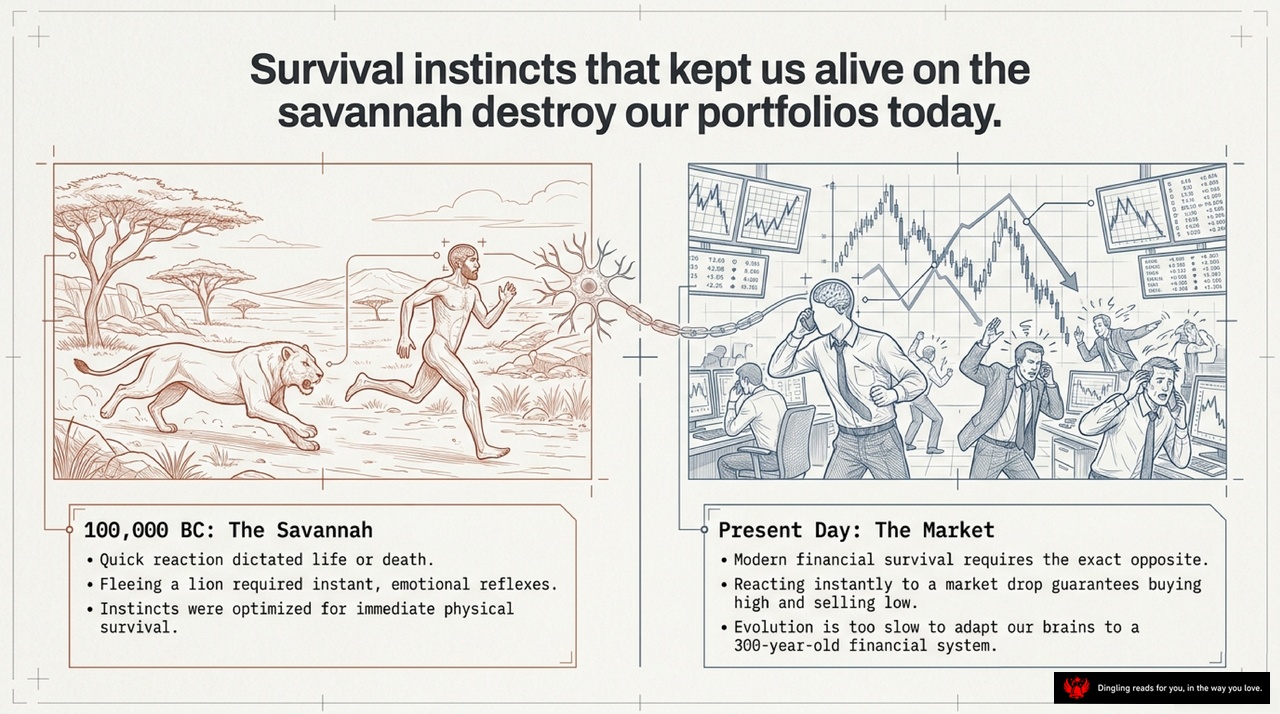
Imagine you are running for your life on the savannah, with a lion closing in behind you. In that moment, your brain is wired for one thing: immediate survival. You don't think; you react. You flee instantly, driven by raw emotion and instinct. This was the perfect strategy 100,000 years ago. But today, that same ancient survival mechanism is actively destroying your portfolio.
Look at the contrast. On the left, we see that primal fear in the savannah, where quick reflexes dictated life or death. On the right, we see the modern trading floor. Instead of a lion, we have crashing stock charts and flashing red numbers. Instead of running away from a predator, we are frantically reacting to market drops. The problem is, our brains haven't evolved fast enough to adapt to a financial system that has only been around for 300 years.
When the market tanks, our "fight or flight" instinct kicks in, screaming at us to sell immediately. We buy high out of panic and sell low out of fear, guaranteeing the worst possible outcome. Evolution optimized us for physical survival, not for navigating complex, long-term investment strategies. To build wealth today, you have to consciously override these hardwired instincts and act in the exact opposite direction of your fear.

Today's slide reveals the invisible war happening inside your brain every time you make an investment decision. It all comes down to the battle between two systems: System X and System C.
On the left, we have System X, which the slide calls "Dr. McCoy." This is your emotional, fast, and effortless brain. It's the default setting that processes information based on what feels familiar or close at hand. While it's quick, it's highly flawed in modern finance because it's driven by impulse rather than logic.
On the right is System C, labeled "Mr. Spock." This is your logical, slow, and deliberate side. It requires immense effort to engage but handles problems accurately. The challenge is that System C gets easily fatigued. In today's noisy market, we constantly default to the easier path of System X, leading to the very errors we try to avoid.
The slide also highlights a critical diagnostic tool: The Cognitive Reflection Test. It shows that even among 600 professional investors, 60% failed to answer basic logic questions correctly. This proves that relying on our gut feeling—System X—is a dangerous habit. To succeed, you must consciously override your emotional instincts and force yourself to engage the slower, more accurate System C.

Today's slide tackles a critical psychological trap known as the "Empathy Gap." As the chart illustrates, we operate in two distinct states: a "Cold State" of rational planning and a "Hot State" of market panic. The massive gap between these two lines represents our inability to predict how we will behave when emotions take over.
Think about it: when you are calm, you might plan to bring water to the gym. But 61% of people think they'll make it without it, only to regret it 92% of the time after they've actually sweated through the workout. That is the empathy gap in action—we cannot simulate the intensity of a panic market from our calm, rational desk.
Because we can't predict our future behavior, we need a prescription: Pre-Commitment. The slide highlights John Templeton's rule, which is a perfect example of this. Instead of trying to make a brave decision when the market crashes, you create a "Wish List" of great companies during calm times. You then place standing buy orders at 40% below current prices. When the panic sets in and your terrified "System X" tries to stop you, the system executes the trade automatically. This bypasses emotion entirely, allowing you to buy at the bottom without hesitation.
The key takeaway is simple: you must make your rational decisions today, while you are calm, so that your future self doesn't have to fight against their own fear.

We often think that more data and better stories make us smarter investors, but the chart on this slide tells a different story. Look at the curve labeled "Confidence"—it shoots upward as we add more information, while "Accuracy" stays stubbornly flat. This is the core of what we call the Narrative Fallacy.
In the real world, we prefer a good story over cold, hard base-rate facts. Take IPOs, for example. They come with dazzling narratives about disrupting the world and capturing global markets, which often leads to massive oversubscription. Yet, the data shows these companies frequently suffer catastrophic cash flow drops of 55% within five years. We remain hooked because the story overrides the logic.
This isn't just about finance; it's about how our brains work. Consider the horse racing experiments mentioned here. When handicappers were given just five variables, their accuracy was modest, but their confidence was low. When you dumped 40 variables on them, their accuracy didn't improve a bit, yet their confidence surged from 17% to 30%. We are tricked into feeling more certain simply because we have more information to weave into a story.
So, how do we break free? The answer lies in shifting from the X system, which loves stories and quick conclusions, to the C system, which relies on facts and rigorous analysis. Instead of chasing the next compelling narrative, you must anchor your decisions in verifiable data. Ask yourself: does this story hold up against the cold reality of numbers? By prioritizing accuracy over confidence, you stop being a victim of your own imagination and start making decisions that actually work.
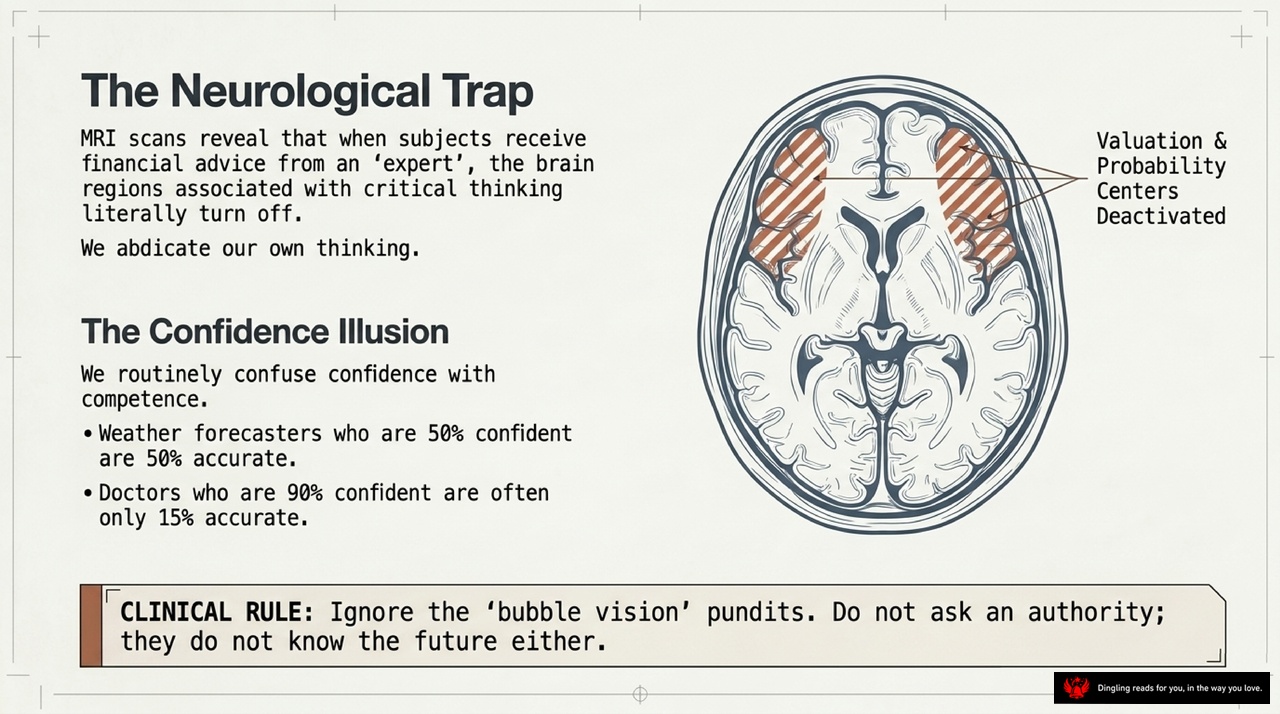
Look at this brain scan on the right. Notice those two highlighted areas? That's the "Neurological Trap" in action. When we hear an "expert" give financial advice, our brain literally shuts down the very regions responsible for critical thinking and probability assessment. We don't just disagree; we abdicate our own minds. We become passive receivers of their narrative.
This connects directly to what we call the "Confidence Illusion." We routinely mistake confidence for competence. Think about weather forecasters: when they are 50% confident, they are right 50% of the time. But look at doctors: when they claim 90% confidence, they are often only right 15% of the time. Our brains trick us into believing that an expert's swagger guarantees accuracy.
This is why you need to follow our clinical rule at the bottom: Ignore the "bubble vision" pundits. Do not ask an authority for the future, because they don't know it either. If their brain lights up less when they speak, and their confidence doesn't match their track record, why would you trust them? The smartest move is to stop looking for a crystal ball and start building your own rules, because no amount of expert noise can replace your own disciplined thinking.

Have you ever made a decision based purely on how things turned out, rather than how you got there? Imagine a 21 Blackjack player holding a 17 and insisting on hitting, only to bust and win anyway. It sounds absurd, yet it's the daily reality of the stock market. We constantly fall into the trap of **outcome bias**, judging our decisions by their results instead of the logic behind them.
If a doctor performs a risky surgery with an 8% failure rate but the patient survives, we praise the doctor. If the same surgery fails, we condemn them—even though their decision quality was identical. In investing, this distortion is dangerous. Fund managers often chase popular stocks just to align with the crowd, ignoring their own flawed logic, simply because the short-term result looks good. This leads to a cycle where we ignore bad processes that happen to yield good results, and stick to bad processes that happen to yield bad results.
The antidote is shifting from **outcome accountability** to **process accountability**. Focus entirely on the inputs: Did you gather the right data? Was your valuation logical? Did you follow your rules? A brilliant process doesn't guarantee a win every time, but a terrible process guarantees long-term failure. As the saying goes, the only thing you can truly control is your decision-making process. So, stop obsessing over yesterday's price movement and start rigorously auditing your strategy. Build a system that works, and trust it enough to let it play out over time, regardless of the noise.

Today's slide highlights a critical concept: the "Disposition Effect." This is the psychological trap where investors sell their winners too early and hold onto their losers far too long. As you can see in the chart, we tend to sell profitable stocks at a rate of 15%, which is significantly higher than the 1.7 times lower rate at which we sell our losing positions. This behavior directly contradicts the math of investing. By cutting our winners short, we lock in gains that could have compounded further. Conversely, by clinging to losers—often for over 124 days compared to just 102 days for winners—we drag down our overall portfolio performance. The data shows that the stocks we sell for profits outperform the ones we stubbornly hold by 3.4% annually. To break this cycle, we need to adopt a "process-based" mindset. Instead of asking, "How did this trade perform?", we must ask, "Was my decision-making process sound?" If the logic was correct at the time, we should stick with it, regardless of the short-term result. This shift from focusing on outcomes to focusing on the process is the key to overcoming our natural bias and building a truly resilient investment strategy.
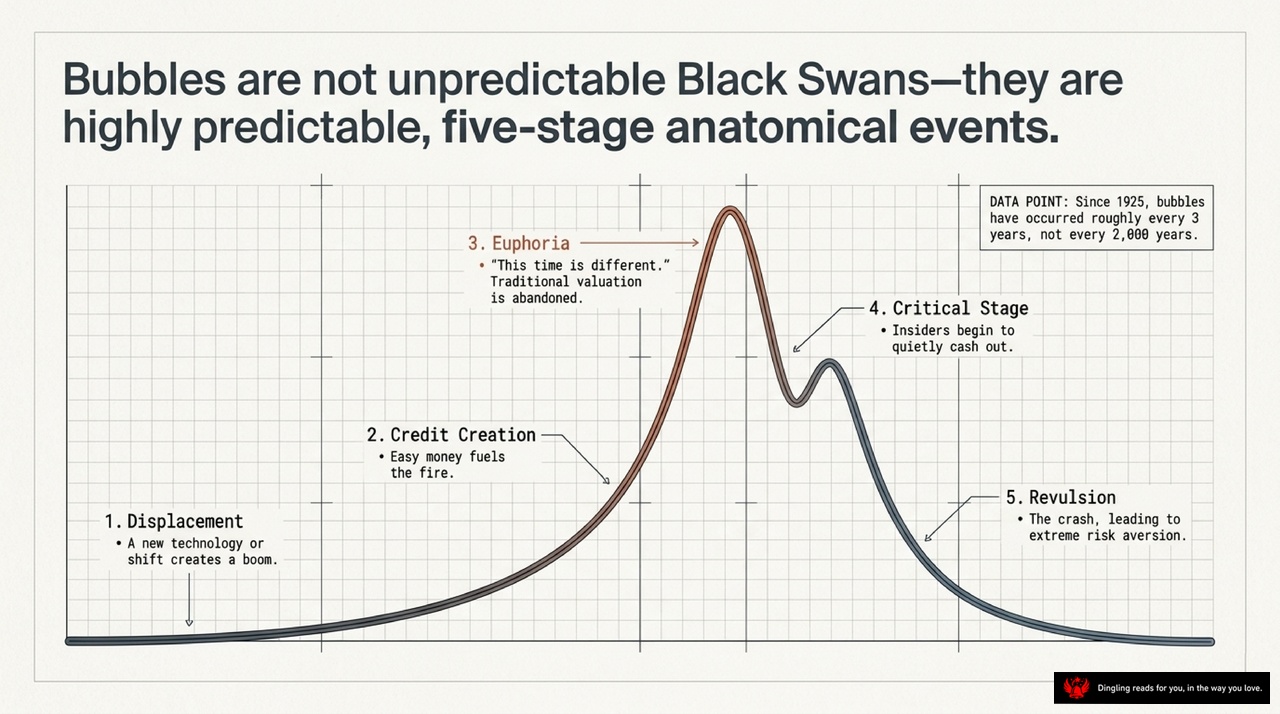
Bubbles are not unpredictable Black Swans—they are highly predictable, five-stage anatomical events. As this chart illustrates, since 1925, bubbles have occurred roughly every three years, not every two thousand. This regularity is the key to navigating market cycles.
The cycle begins with **Displacement**, where a new technology or shift creates an initial boom. This is quickly followed by **Credit Creation**, where easy money fuels the fire, expanding the trend. Then comes the peak of **Euphoria**, marked by the dangerous mantra, "This time is different," as traditional valuation standards are completely abandoned.
However, the turning point often lies in the **Critical Stage**. Here, insiders begin to quietly cash out, sensing the peak is near. Finally, the market crashes into **Revulsion**, leading to extreme risk aversion and a sharp decline.
Understanding this five-stage anatomy allows you to see that what feels like a chaotic "Black Swan" is actually a structured, repeatable pattern. By recognizing which stage the market is currently in, you can anticipate the shift from euphoria to critical stage, giving you the opportunity to act with discipline rather than panic.
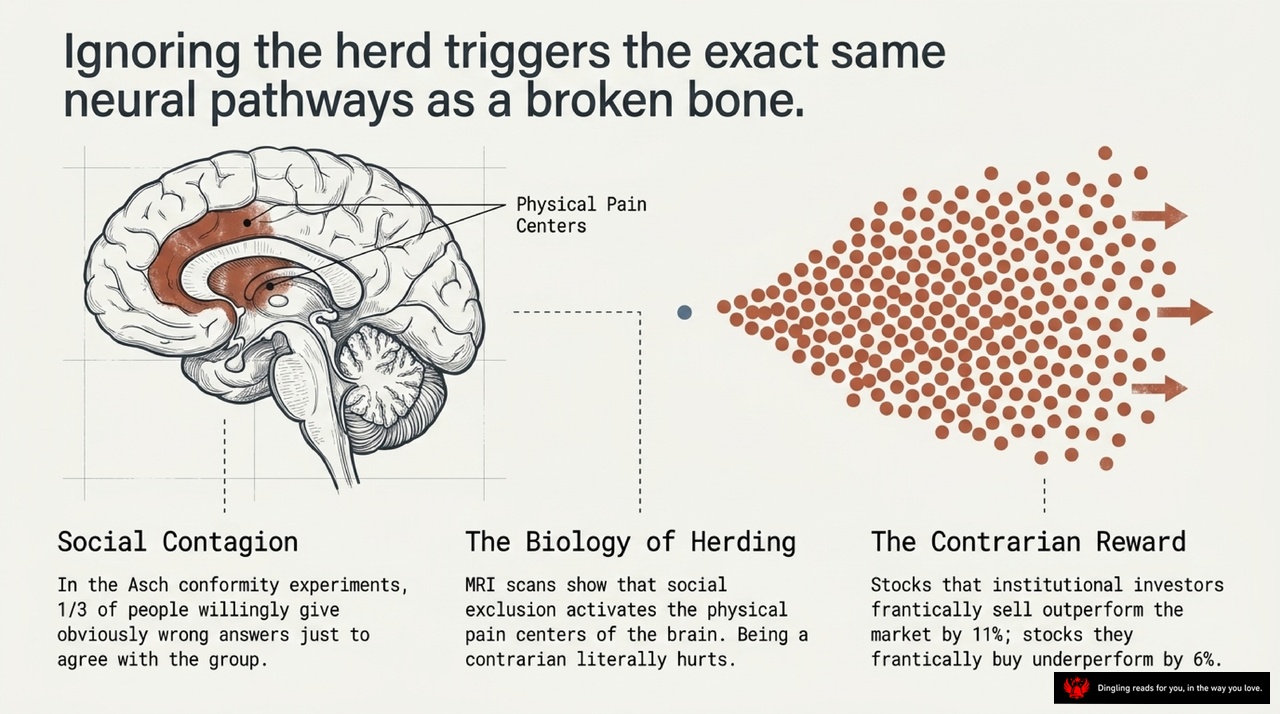
Imagine this: your brain doesn't just feel pain when your bone breaks. When you get ignored by a group, or when you go against the crowd, the exact same neural pathways light up. It's as if social rejection physically hurts you. This is the biology of herding. In classic conformity experiments, one-third of people will knowingly give the wrong answer just to fit in with the group. It's a powerful social contagion.
But here's the counterintuitive part: this very pain is what drives the market. When investors feel the sting of being different, they panic and sell. Yet, this "contrarian reward" is where the real money is made. History shows that stocks which institutional investors frantically sell often outperform the market by 11%. Conversely, the stocks everyone frantically buys tend to underperform by 6%.
The lesson is clear: ignoring the herd triggers the same pain as a broken bone, but following the herd guarantees you'll lose. To succeed, you must be willing to endure that social pain. You have to buy when others are terrified and sell when everyone is euphoric. It's not just a strategy; it's a mental workout that requires you to feel the discomfort of being alone while the world rushes in the opposite direction.

We hold onto our losers hoping for a rebound, and sell our winners out of fear. This slide captures one of the most painful yet universal truths in investing: the Disposition Effect. Look at this scale in the center. On the left, we have losses with a 2.5x impact, while gains on the right only feel like a 1x impact. This is Loss Aversion in action. Psychologically, the pain of losing twice the money feels just as bad as the joy of gaining it, but it actually hits us much harder—roughly 2 to 2.5 times more intensely.
Because of this, we act irrationally. We sell our winning stocks 1.7 times faster than our losing ones. Why? Because selling a winner feels like securing a win, whereas holding a loser feels like admitting a loss is still happening. The result? We keep the underperformers that drag down our portfolio while cutting our winners short. The data is clear: the winning stocks we sold out of fear end up outperforming the losers we stubbornly held by 3.4% annually.
Think about a PGA golfer trying to putt for a birdie versus just saving a par. The fear of dropping a shot makes them play worse, just like we play worse with our money when we are afraid of losing. To fix this, you must reframe your mindset. Instead of focusing on the pain of the loss, focus on the process of the recovery. Remember, markets are cyclical. What looks like a permanent loss today is often just a temporary dip in a long-term trend. Stop trying to time the bottom, and start trusting your original thesis. If the fundamentals haven't changed, the market will eventually correct, and your patience will be rewarded.
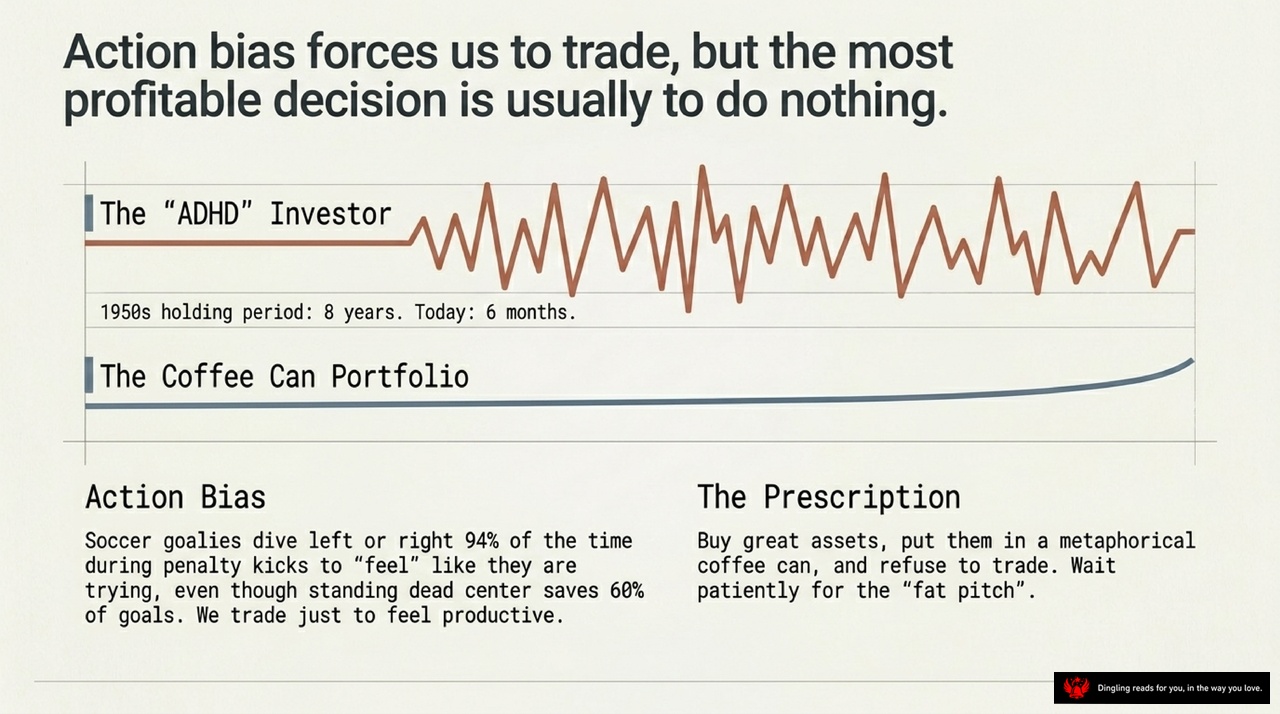
Action bias tricks us into thinking we need to trade constantly just to feel productive, but the smartest move is often doing absolutely nothing. Look at the chart here: the "ADHD Investor" line is all over the place, jumping wildly from left to right. That's because in the 1950s, people held stocks for eight years, but today, we average just six months. We trade not because the math demands it, but because we can't stand still.
Think about soccer goalies. In 94% of penalty kicks, they dive left or right just to feel like they are trying, even though staying dead center would actually save them 60% more goals. We do the same thing with our portfolios. We buy and sell to feel busy, ignoring the fact that the most profitable decision is usually patience.
The solution is simple: buy great assets and put them in a metaphorical coffee can. Once you put them in, you refuse to trade. You wait patiently for that "fat pitch"—the perfect opportunity to strike again. Stop forcing action where none is needed and let your money compound quietly while the rest of the market chases noise.
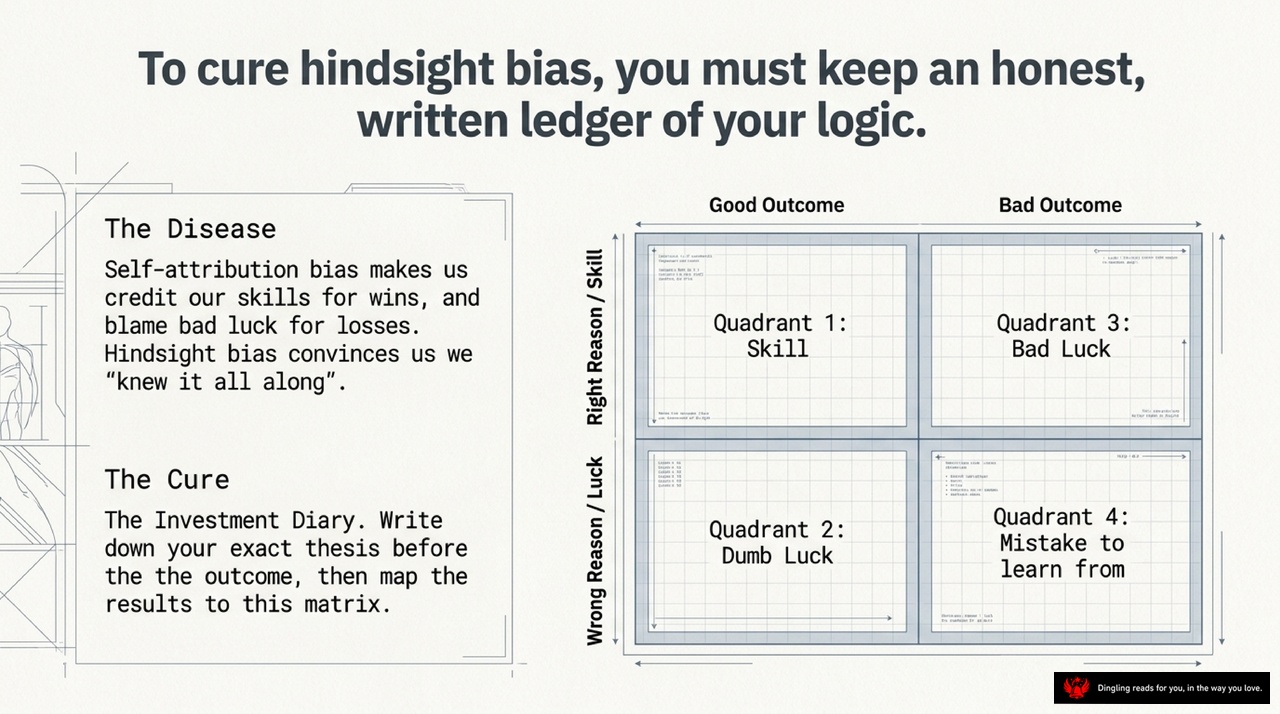
To cure hindsight bias, you must keep an honest, written ledger of your logic.
Here is the core problem: we suffer from two powerful psychological diseases. First, self-attribution bias makes us credit our skills for wins and blame bad luck for losses. Second, hindsight bias convinces us we "knew it all along" once the outcome is revealed. This combination creates a dangerous illusion of competence that prevents us from learning.
The cure is simple but requires discipline: The Investment Diary. Before you make a move, write down your exact thesis and the logic behind it. Then, after the outcome is known, map the result to this matrix. Look at the four quadrants: Did a good outcome come from skill, or was it just dumb luck? Did a bad outcome stem from bad luck, or was it a mistake you must learn from?
By forcing yourself to separate your reasoning from the result, you stop the lie of "I knew it all along." You build a database of truth, allowing you to distinguish between actual ability and random chance, ensuring that your future decisions are based on reality, not memory.

You cannot manage returns or control risks. You can only control your process. This slide breaks down the four quadrants of investing outcomes based on whether your process is sound or flawed, and whether the market outcome is good or bad.
Look at the top left: Good Process leading to a Good Outcome. This is what we call "Deserved Success," and it is the only goal that truly matters. It's the result of disciplined execution meeting favorable market conditions.
Now look at the top right: Good Process leading to a Bad Outcome. This is labeled a "Bad Break." Here, you did everything right, but the math was against you temporarily. The key takeaway, as the slide notes, is to keep executing the process. Math will eventually work in your favor if you stay the course.
Conversely, the bottom left quadrant shows a Bad Process leading to a Good Outcome. This is the most dangerous trap known as "Dumb Luck." You got lucky, perhaps due to market timing or random chance, but you reinforced terrible habits that will eventually destroy your portfolio. That is why we must avoid this quadrant at all costs.
Finally, the bottom right represents a Bad Process leading to a Bad Outcome. The slide calls this "Poetic Justice." It's the expectation for anyone who takes the easy way out.
The clinical rule at the bottom is clear: Reward the process, not the outcome. If you focus on your decision-making and execution, the results will follow.

Knowledge doesn't equal action. Understanding your behavioral biases is meaningless unless you build an investment process designed to actively defend against them. Now that you know your own brain is wired to destroy your wealth, what structural rules will you put in place tomorrow to protect yourself from yourself?
The truth is, knowing about your biases is just the first step; the real battle happens when you stop relying on your gut and start relying on a rigid system. We are biologically programmed to make emotional decisions, especially when fear or greed takes over. Without a pre-defined set of rules—like strict stop-loss limits or a disciplined rebalancing schedule—you will inevitably fall into the trap of holding onto losers too long or selling winners too early.
Think of your investment strategy as an autopilot. When the market gets chaotic and your emotions start screaming, you need that autopilot to take the wheel. It's not about predicting the future; it's about creating a framework that forces you to act rationally even when you feel irrational. By establishing these structural rules now, in calm times, you ensure that your future self isn't forced to make desperate, costly decisions during a crisis. The only way to truly master your brain is to build a cage around it with the discipline of a well-crafted plan.