
The Little Book That Builds Wealth: Complete Chapter-by-Chapter Summary

Welcome to our deep dive into *The Little Book That Builds Wealth* by Pat Dorsey. Today, we're setting the stage for everything we'll learn about constructing lasting generational wealth.
The cover of this book promises to reveal something powerful: the structural competitive advantages that protect high returns and build long-term generational wealth. Think of this not just as reading, but as learning the blueprint for success. Just as an architect uses a plan to build a skyscraper, you need a clear framework to build a portfolio that withstands the storms of the market.
We are about to explore the concept of the "economic moat"—the invisible walls that separate truly great companies from the rest. While many investors chase short-term trends or rely on flashy management, the real secret lies in understanding what allows a business to thrive for decades, even when conditions change.
In the chapters ahead, we will break down exactly how to identify these advantages. We'll look at the four key sources of a moat: intangible assets like brands and patents, high switching costs that lock in customers, network effects that create a self-reinforcing cycle, and cost advantages that make you cheaper than everyone else. We'll also learn how to spot false moats—those temporary advantages that vanish overnight—and understand how to value a company based on the cash it will generate in the future, not just its current stock price.
This isn't about guessing; it's about rigorous analysis. By the end of this series, you'll have the tools to see past the noise of the market and focus on the few companies capable of delivering the kind of consistent, compounding returns that turn a modest portfolio into a fortune. Let's get started.

The core philosophy of investing isn't about chasing the next hot trend; it's about defying the relentless pull of mean reversion. Look at this chart: on the left, we have the threat. Capital naturally seeks high returns, and when a company makes money, competitors swarm in like vultures, destroying margins and driving returns down to the industry average. Without protection, every company eventually becomes a commodity, and its value evaporates.
But there is a defense. This is the Economic Moat. It's a structural business characteristic that acts as a fortress, keeping competitors at bay and securing long-term cash flows. Companies with a wide moat, like the blue line at the top, can maintain high returns on invested capital for decades. They create generational wealth because they don't have to constantly fight for survival. In contrast, companies with no moat, represented by the red line, see their returns plummet quickly as competition erodes their advantage.
The real question for investors is simple: Does this business have a moat? If it does, it can defy gravity and keep creating value long after the competition has faded. If it doesn't, you're just betting on a machine that will break down the moment someone else builds a better one.
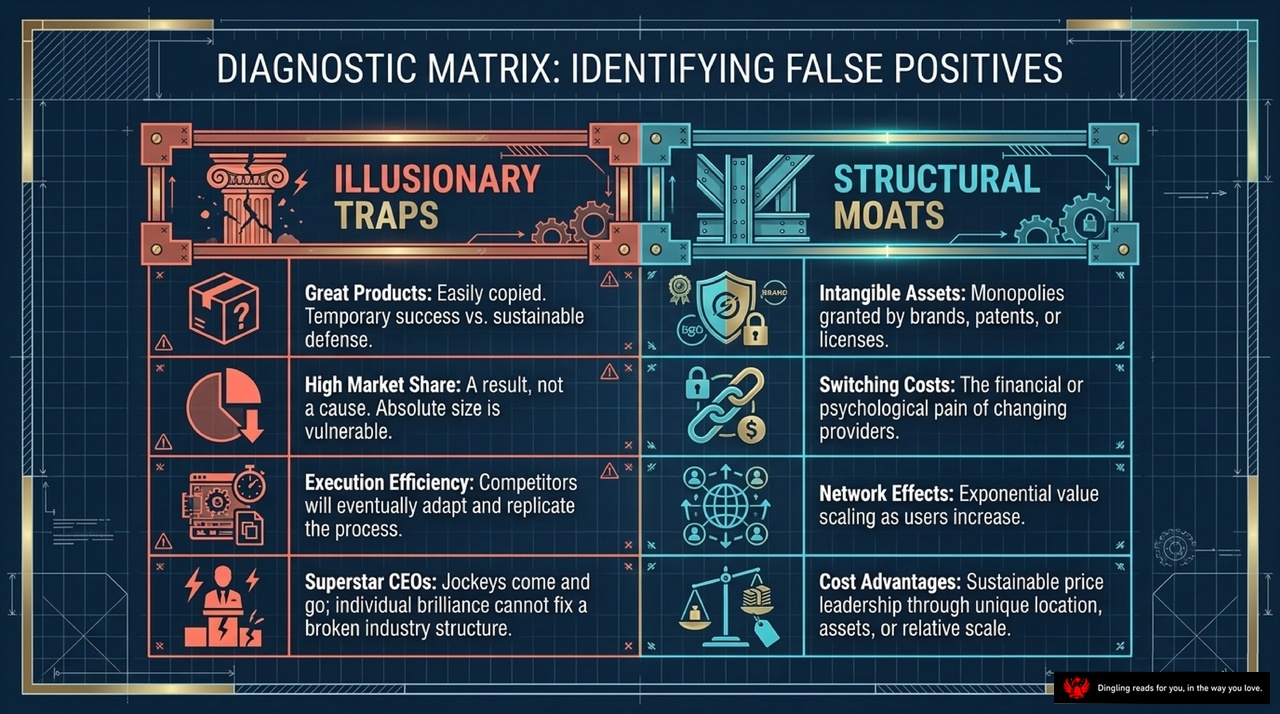
Welcome back. Today, we're diving into the "Diagnostic Matrix" to separate the wheat from the chaff in your investment portfolio. Think of this as a battlefield map: on the left, you have "Illusionary Traps"—the red flags that look like gold but are actually quicksand—and on the right, the "Structural Moats" that actually protect your returns.
Let's start with the traps. Many investors get fooled by "Great Products." Sure, a killer product can sell like hotcakes, but if it's easily copied, that success is temporary, not sustainable. Then there's "High Market Share." Just because a company is big doesn't mean it's safe; history is full of giants that got crushed because their size wasn't a real barrier. You also see "Execution Efficiency" and "Superstar CEOs" listed here. Great management and efficient operations are important, but competitors will eventually copy the playbook, and even the best CEO can't fix a broken industry structure. These are all fleeting advantages.
Now, look at the blue side: the real moats. First, "Intangible Assets." This includes brands, patents, and licenses that grant you a monopoly or the power to charge premium prices. Next, "Switching Costs." This is the financial or psychological pain customers feel when trying to leave you. If they hate the hassle of switching, they stay, and you win. Then we have "Network Effects," where your product gets more valuable the more people use it, creating a self-reinforcing cycle that new competitors can't break. Finally, "Cost Advantages." This isn't just about being cheap; it's about having a sustainable edge through unique location, assets, or scale that competitors simply cannot match.
The key takeaway here is simple: don't bet on the jockey, bet on the horse. Ignore the temporary hype of a popular product or a famous CEO. Instead, focus on these four structural pillars. If you can identify these true moats, you aren't just buying a stock; you're buying a fortress that can withstand the inevitable storms of competition.
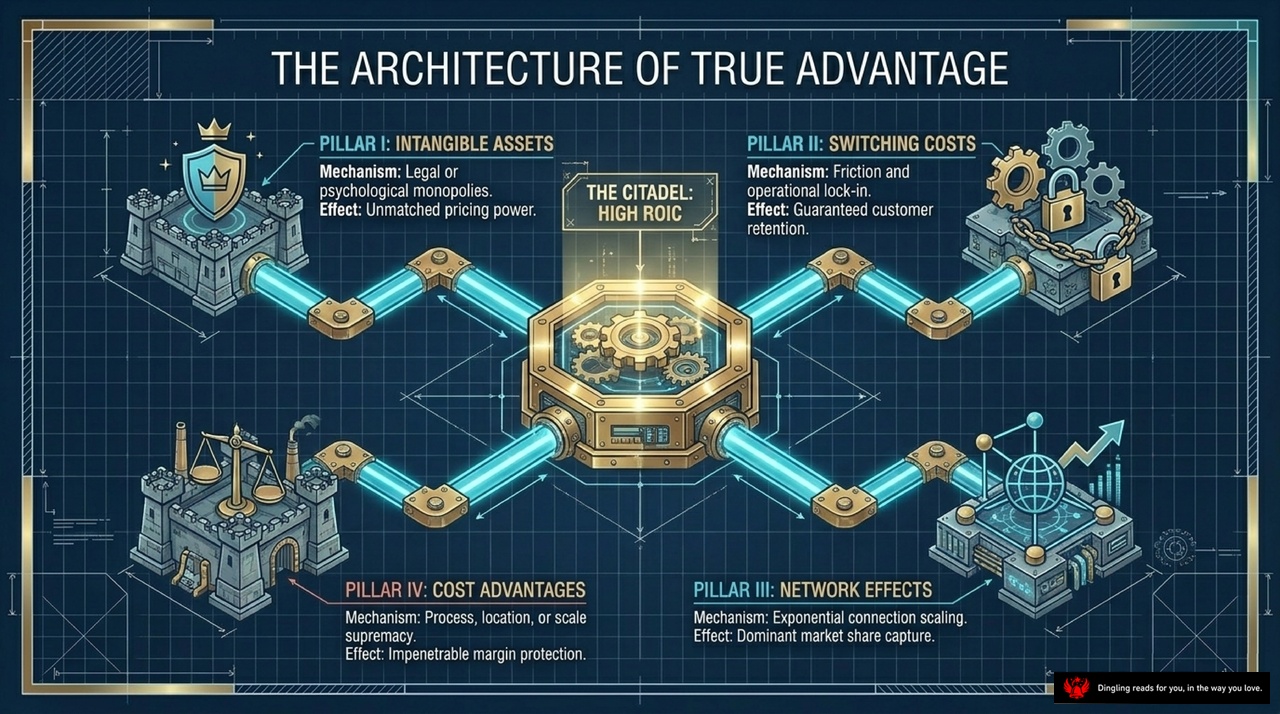
The Architecture of True Advantage isn't just a metaphor; it's the blueprint for building an unassailable fortress. At the center sits The Citadel, driven by high ROIC, but it relies on four critical pillars to stay standing.
First, look at Pillar I: Intangible Assets. This is your moat's shield, built from legal monopolies or psychological power. It gives you unmatched pricing power, allowing you to charge more than competitors simply because you can.
Next, Pillar II: Switching Costs. This is the operational lock-in that traps your customers. By creating friction and making it painful to leave, you guarantee retention. Your clients stay not because they have to, but because the cost of moving elsewhere is too high.
Then, Pillar III: Network Effects. This is the engine of exponential growth. As more users join, the product becomes more valuable for everyone else, creating a self-reinforcing cycle that captures dominant market share. It's the classic "rich get richer" dynamic.
Finally, Pillar IV: Cost Advantages. This pillar protects your margins from below. Whether through superior processes, prime locations, or massive scale, you operate cheaper than anyone else, making it nearly impossible for rivals to compete on price.
When these four pillars align, they create an impenetrable defense. You aren't just surviving the competition; you are structurally designed to thrive in it, securing long-term dominance and predictable cash flows.

The strongest moats aren't always the ones you can see with your eyes. In fact, the most durable competitive advantages often come from the things that are intangible: brands, patents, and regulatory licenses. Let's break down how these invisible assets build an unassailable fortress.
First, consider **Brands**. Here is the golden rule: popularity does not equal profitability. A brand is only a true moat if it grants pricing power or significantly reduces search costs for the consumer. Think about Tiffany & Co. They charge a massive premium for an exact diamond simply because of that iconic blue box. The value isn't in the stone; it's in the brand. However, be careful not to confuse fame with a moat. Sony is a household name, yet consumers rarely pay extra for the Sony logo on a DVD player; they care about specs and price. That's a difference between a famous name and a powerful brand.
Next, look at **Patents**. These legal monopolies can be incredibly lucrative, but they are subject to expiration and relentless legal siege. Relying on a single patent is a dangerous game. True defense requires a diverse portfolio and an ongoing track record of innovation. Companies like 3M and Merck succeed not because they hold one patent, but because they constantly replace old ones with new breakthroughs, ensuring their moat never dries up.
Finally, there are **Regulatory Licenses**. These government-granted oligopolies can restrict competition entirely. Think of the "NIMBY" effect—Not In My Backyard. Landfills and stone quarries face almost zero new local competition due to zoning laws. Once a company secures the right to operate in a specific location, they effectively have a monopoly. Similarly, industries like bond rating agencies or slot machine manufacturers face such high barriers to entry that they can operate with near-total control over pricing and competition.
So, remember this: while these assets are intangible, their impact on pricing power and market access is very real. But always ask yourself: is this advantage permanent, or just a temporary shield against today's competition?
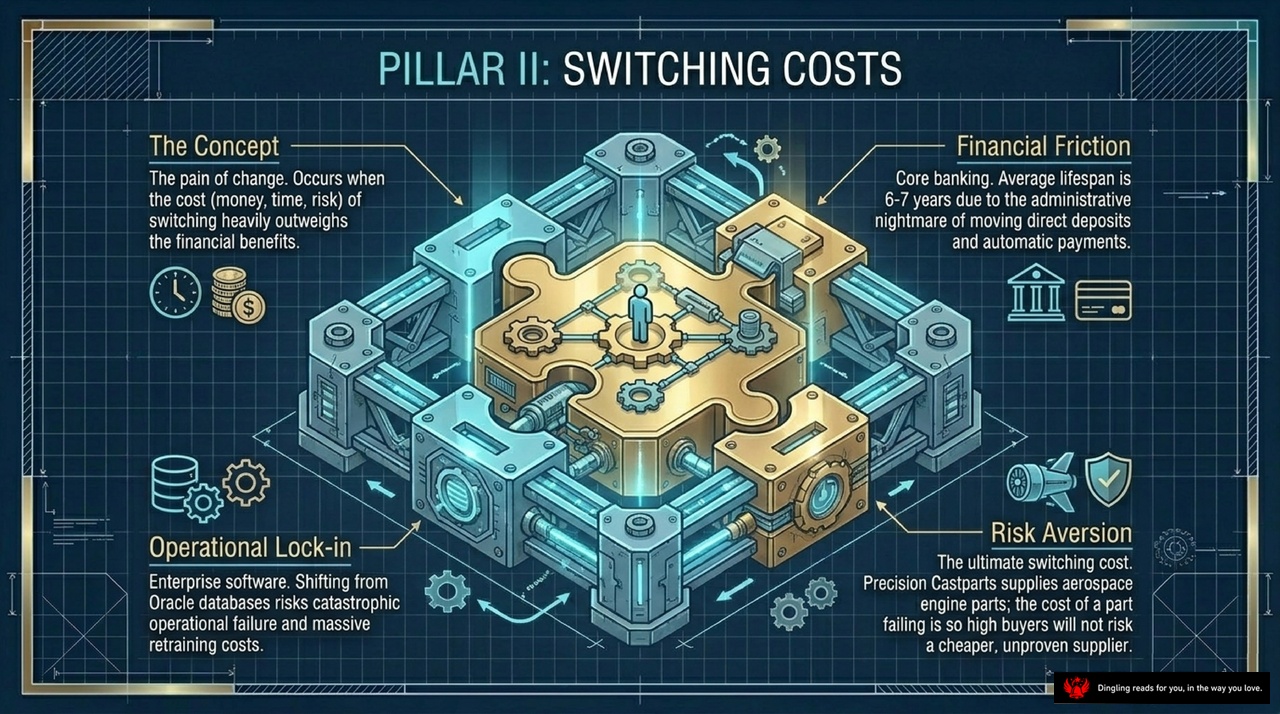
Welcome back to our deep dive into Economic Moats. Today, we are focusing on a critical concept that often trips up investors: Switching Costs. As you can see on the slide, this is Pillar II of our framework.
Let's break down what this actually means. The core concept is simple yet powerful: it's the "pain of change." It occurs when the cost of switching providers—whether that's money, time, or risk—heavily outweighs the financial benefits you might get from moving to a competitor. When this happens, customers stay put, not because they love the current company, but because leaving simply hurts too much.
Think about the banking sector. This is a classic example of financial friction. The average lifespan of a customer at a bank is 6 to 7 years. Why? Because moving accounts is a nightmare. You have to re-enter all your data, adjust direct deposits, and set up automatic payments. Imagine the risk of your paycheck getting delayed or a bill getting missed because of a transfer error. That administrative headache and the fear of financial disruption create a massive barrier. Banks know this, which is why they can quietly lower interest rates or add fees, and customers often just accept it rather than bother switching.
This isn't just about banks. Look at enterprise software. If a company is running on Oracle databases, shifting to a new system risks catastrophic operational failure. They would need to migrate massive amounts of data and retrain their entire workforce. The cost and risk here are so high that no cheaper competitor can easily steal their market share.
Even in the world of software for everyday users, this principle holds true. Take Intuit's QuickBooks or TurboTax. Small business owners and individuals put their entire financial history into these tools. Moving to a competitor means spending hours migrating and checking data for errors. The risk of making a mistake that leads to a tax penalty or payroll delay is too great. So, users stick with Intuit, allowing the company to maintain high capital returns for years.
Finally, consider the ultimate form of switching cost: risk aversion. In industries like aerospace, precision parts suppliers might be cheaper, but if a part fails, the consequences are disastrous. Buyers simply won't risk it. They prefer to pay a premium to a proven supplier rather than gamble with an unproven, cheaper option.
So, when you analyze a company, ask yourself: How painful is it for a customer to leave? If the answer is "very painful," you've likely found a strong moat built on switching costs.
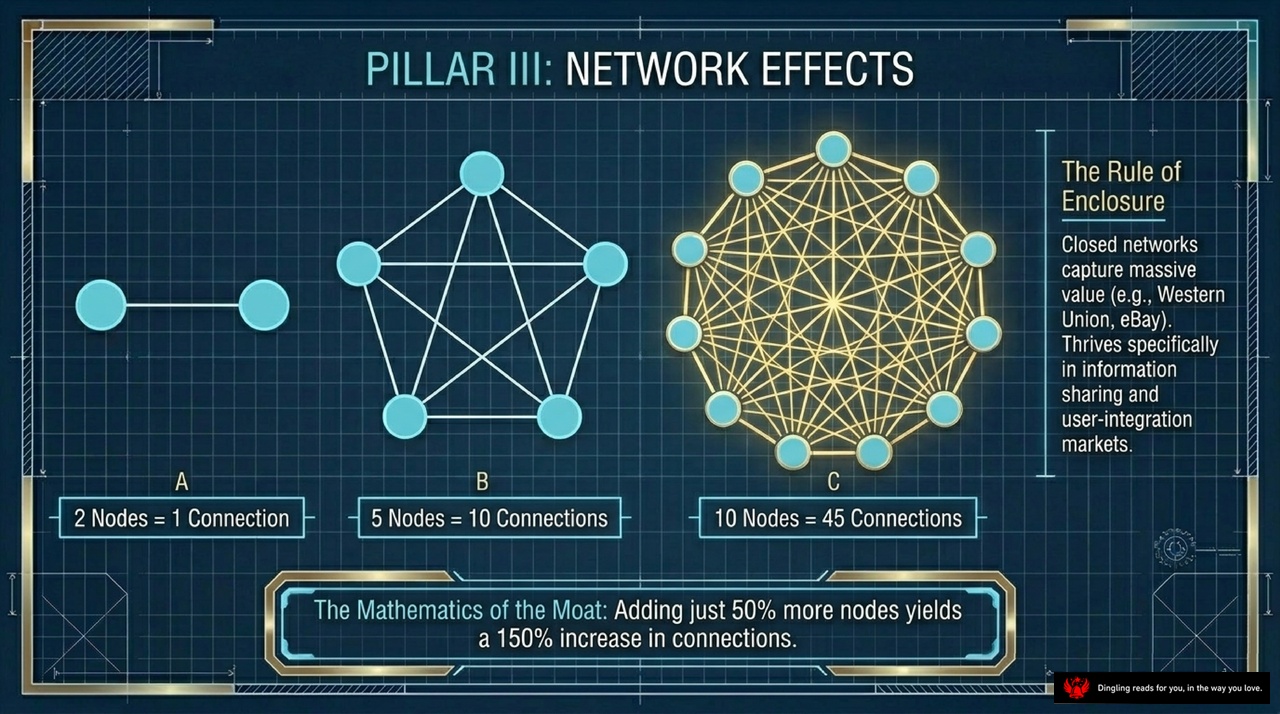
Let's talk about why some networks become unstoppable giants while others fade into obscurity. Look at the evolution on this slide. We start with just two nodes creating a single connection. Move to five nodes, and suddenly we have ten connections. By the time we reach ten nodes, the network explodes into 45 connections. This is the "Mathematics of the Moat." Adding just 50% more nodes yields a 150% increase in connections. This explosive growth is the engine behind Network Effects, our third pillar of a true economic moat.
When a network becomes closed, it captures massive value. Think of Western Union or eBay. As more users join, the platform becomes exponentially more valuable for everyone else. Merchants flock because there are more buyers; buyers stay because there are more merchants. This creates a self-reinforcing cycle that is incredibly hard for competitors to break. Unlike a brand or a patent, which can lose its edge, a robust network effect creates a structural advantage that grows stronger over time. It thrives specifically in markets where information sharing and user integration are key. So, when you see a company where user growth directly fuels product value, you are looking at one of the most durable moats in the entire market.

Today's slide breaks down the fourth and final pillar of a moat: Cost Advantages. As you can see, this isn't just about being cheap; it's about building a layered defense that competitors struggle to penetrate.
At the very top, we have the shallowest defense: Process Advantages. This relies on cheaper operational methods, like early Dell or Southwest Airlines. While effective, it's highly vulnerable because competitors can replicate these efficiencies over time.
Moving down to Level 2, we find Location Advantages. This is about proximity to heavy, low-value resources. Think cement or garbage collection—things that are too expensive to transport far. This creates localized monopolies that are much harder to copy than a simple business process.
Level 3 takes us deeper into Unique Assets. Here, you have access to world-class, cheap raw materials driven by geographic luck. A perfect example is Aracruz Cellulose in Brazil, where eucalyptus grows in just seven years compared to twenty elsewhere. That natural advantage is incredibly difficult for rivals to match.
Finally, at the base, we have the deepest defense: Scale. This is about absolute dominance in fixed-cost distribution networks. Once a company like UPS recovers its fixed costs, sending extra packages becomes incredibly profitable, creating a barrier that new entrants cannot cross without losing money.
The key takeaway is that true cost advantages come from this stack—process, location, unique assets, and scale—working together to create a moat that is wide, deep, and hard to cross.
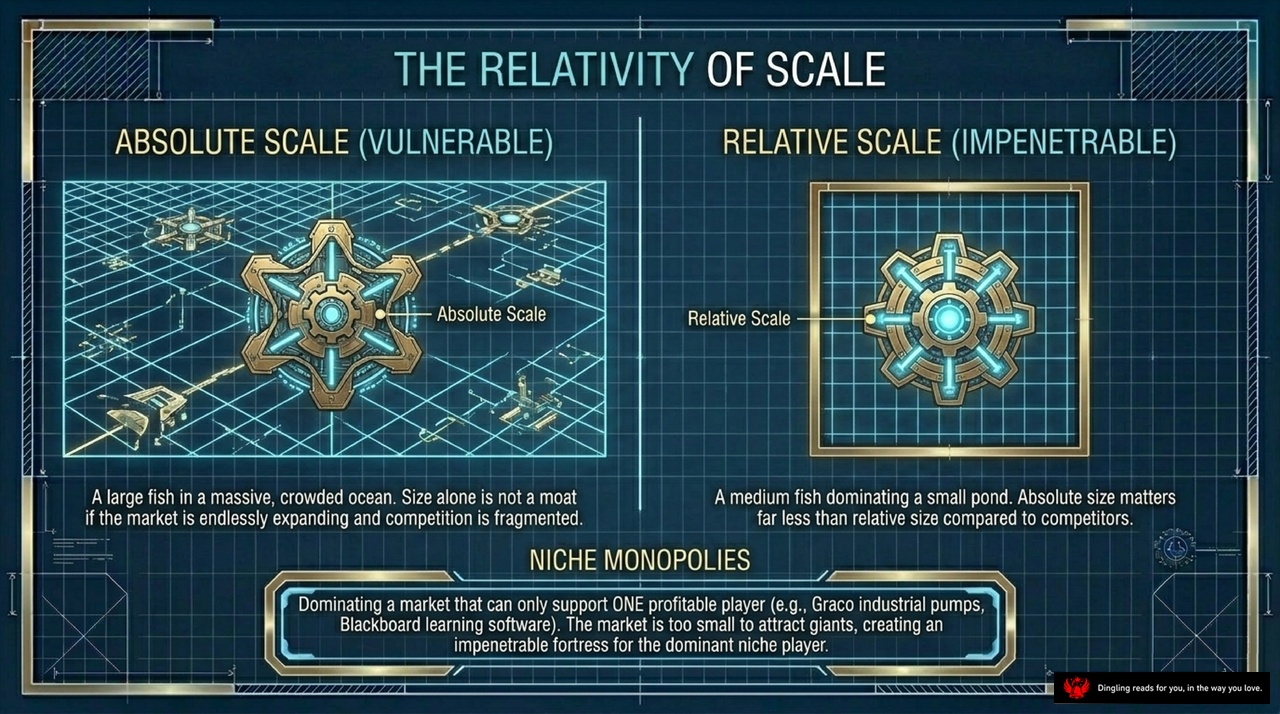
Look at this slide titled "The Relativity of Scale." It breaks down a crucial concept for building a durable moat: the difference between being a big fish in a crowded ocean versus a medium fish dominating a small pond.
On the left, we see "Absolute Scale," which the text labels as vulnerable. It describes a large fish swimming in a massive, crowded ocean. Just because you are big doesn't mean you are safe if the market is endlessly expanding and competition is fragmented. Size alone isn't a moat; it's often just a target.
On the right, we have "Relative Scale," which is described as impenetrable. Here, a medium fish dominates a small pond. In this scenario, your absolute size matters far less than your relative size compared to your competitors. If you are the only player in a niche that can only support one profitable business, you create an impenetrable fortress.
The slide highlights this with the concept of "Niche Monopolies." Think of companies like Graco industrial pumps or Blackboard learning software. These are markets too small to attract giants. By dominating a niche where no other competitor can survive, you secure a stable, high-return environment that large, inefficient corporations simply cannot replicate.
So, the lesson here is clear: don't just chase massive scale in a saturated market. Instead, look for the small pond where you can be the undisputed king. That relative dominance is often a stronger, more sustainable moat than being a giant in a chaotic sea.

The Siege: Recognizing Moat Erosion. Imagine your competitive advantage as a fortress, but even the strongest walls can crumble if you don't spot the cracks early. Today, we're looking at three specific threats that silently destroy value.
First, look at Blip 1: Technological Obsolescence. This is the ultimate game-changer. It happens when a superior paradigm completely replaces your core offering. Think Kodak. They owned the film market, a massive moat, but digital imaging rendered their entire business model obsolete. Their moat didn't just narrow; it vanished entirely.
Next, Blip 2: Industry Structure Shifts. This isn't about your product; it's about your customers. When buyer power consolidates, suppliers lose their leverage. Retailers like Walmart or Target can crush supplier margins simply by demanding lower prices. Once you lose pricing power, your economic moat evaporates, no matter how good your product used to be.
Finally, Blip 3: Value-Destroying Growth. This is a trap many managers fall into. It happens when you waste capital chasing growth in industries where you have no structural advantage. Remember Microsoft in the 90s? They burned billions on European cable TV networks where they possessed zero competitive edge. That wasn't growth; it was a slow-motion suicide of their capital efficiency.
So, how do you defend against these? You must constantly monitor these three vectors. If your technology is becoming a legacy product, if your customers are becoming dictators, or if you're pouring money into non-core businesses, your moat is under siege. Don't wait for the fortress to fall. Spot the erosion now, reallocate your resources, and stay ahead of the curve.
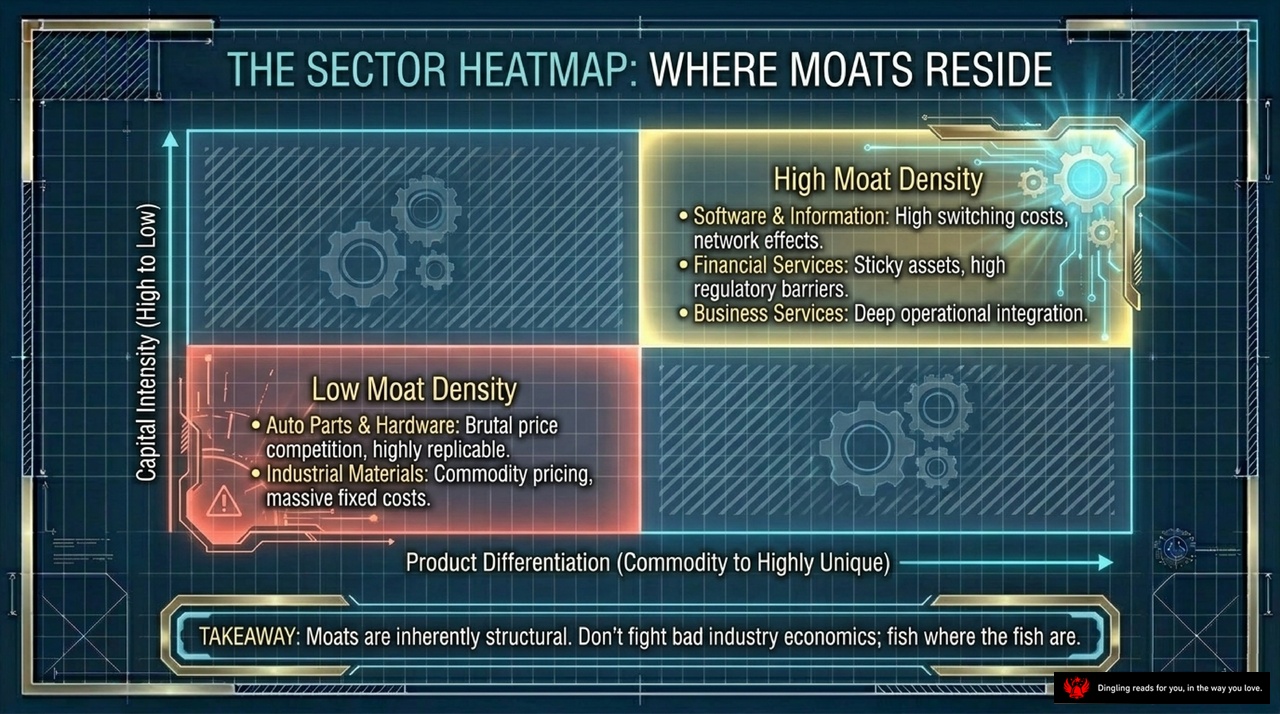
Look at this sector heatmap. It visually maps out exactly where true economic moats live, separating high-density opportunities from low-moat traps. On the vertical axis, we see Capital Intensity, and on the horizontal, Product Differentiation.
Notice the top-right quadrant labeled "High Moat Density." This is the sweet spot for investors. Industries like Software & Information thrive here because of high switching costs and network effects. Financial Services dominate due to sticky assets and regulatory barriers, while Business Services win through deep operational integration. These sectors offer structural advantages that are incredibly hard for competitors to replicate.
Conversely, look at the red zone at the bottom-left, marked "Low Moat Density." Here, industries like Auto Parts & Hardware face brutal price competition and highly replicable products. Industrial Materials suffer from commodity pricing and massive fixed costs. In these sectors, product differentiation is low, and capital intensity is high, making it nearly impossible to build a lasting competitive edge.
The key takeaway at the bottom is clear: Moats are inherently structural. Don't fight bad industry economics. Instead, fish where the fish are. Your job as an investor is to identify sectors where the business model itself creates a fortress, rather than trying to force a moat into an industry where none can exist.

Imagine you are looking at a complex map of the investment world, and today we are zooming in on the most critical distinction: The Jockey versus the Horse. As the slide illustrates, we are comparing Management Quality against the strength of a business's "Moat."
On the top left, we see "The Futile Struggle." This is the trap of the Jockey. It represents a brilliant manager trying to save a fundamentally broken business. No matter how talented the CEO is, if the economics are bad, their efforts are like Sisyphus pushing a boulder uphill. The reputation might stay intact for a while, but the risk is immense, and the effort is grueling. This is why you should avoid betting on superstar CEOs to rescue moatless companies.
On the bottom left is the "Value Trap." Here, you have a poor manager and no moat. It's a bad business with bad management. This is the easiest company to avoid, and the one that destroys the most capital over time.
Now, look at the bottom right quadrant. This is where the real wealth is created: "The Wealth Engine." Here, structural advantage supersedes individual brilliance. A wide moat generates more wealth with less friction. It doesn't matter who is driving the car; the car itself is a high-performance machine that creates value automatically.
Finally, the top right quadrant shows the "Ideal" scenario: a Superstar Manager combined with a Wide Moat. While this is the best case, the slide notes it is rare and expensive. Often, the marginal gain from hiring a superstar manager to drive an already great engine is simply not worth the high cost.
The central thesis at the bottom of the slide drives it all home: Management rarely creates a moat from scratch. Instead of obsessing over the driver, focus on the horse. Invest in the structural business advantages that create long-term moats, not just the temporary performance of a charismatic CEO.
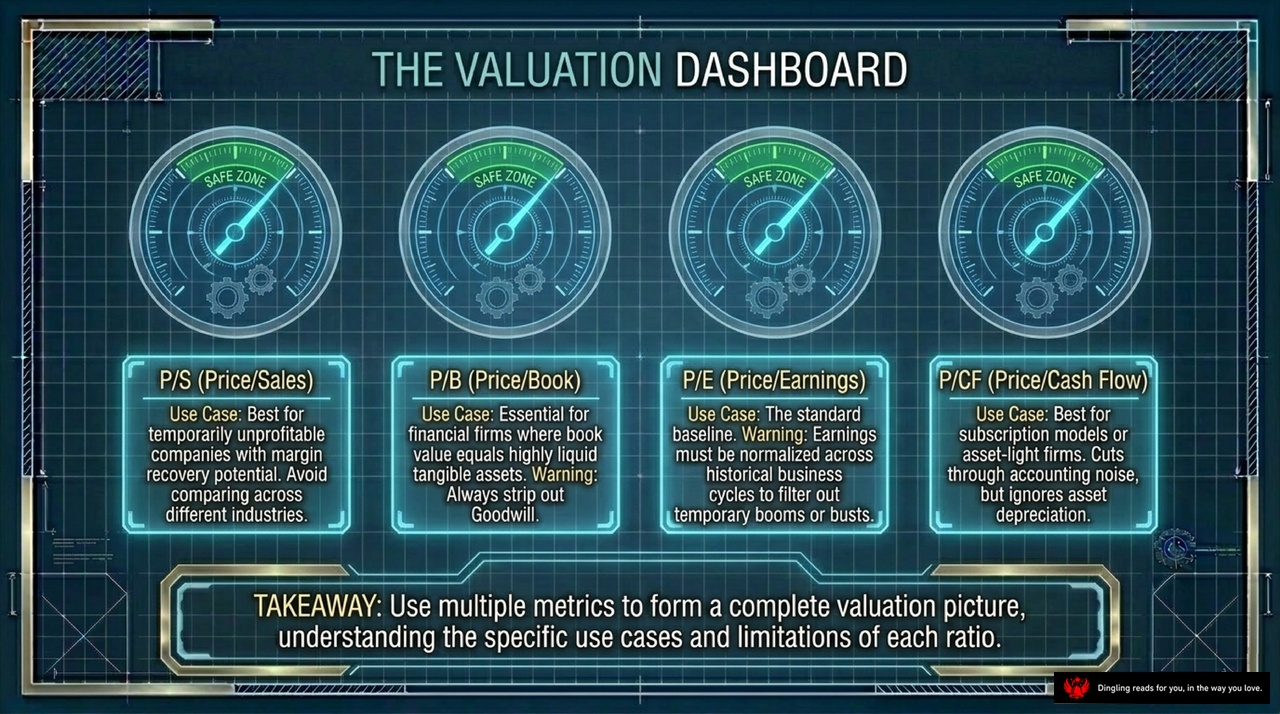
Imagine your investment portfolio as a high-tech cockpit, where every decision relies on a precise dashboard. Today, we're looking at "The Valuation Dashboard," a critical tool that helps you navigate the complex landscape of stock prices.
This dashboard features four key gauges, each representing a different metric to measure a company's worth. First, we have P/S, or Price-to-Sales. Think of this as your go-to metric for companies that might be temporarily unprofitable but have strong sales growth. It's perfect for spotting businesses with margin recovery potential, though you should avoid comparing it across different industries since profit structures vary wildly.
Next is P/B, or Price-to-Book. This is essential for financial firms like banks and insurers, where the book value of tangible assets closely matches their market value. However, a crucial warning: always strip out goodwill from the book value. Goodwill is often an accounting artifact that doesn't reflect real, liquid assets, and keeping it can distort your valuation.
Then we have the standard baseline, P/E, or Price-to-Earnings. This is the most common metric, but it comes with a caveat. Earnings can be noisy, so you must normalize them across historical business cycles to filter out temporary booms or busts. This ensures you aren't buying a stock just because it had a great year, or selling one because it had a bad one.
Finally, we have P/CF, or Price-to-Cash Flow. This metric is best for subscription models or asset-light firms where accounting noise can be misleading. It cuts through the clutter, but remember, it ignores asset depreciation, so use it carefully for heavy asset industries.
The key takeaway here is simple but powerful: never rely on just one number. Use multiple metrics to form a complete valuation picture. Understand the specific use cases and limitations of each ratio. By mastering this dashboard, you move from guessing to calculating, turning uncertainty into a clear, actionable investment strategy.

The disciplined investor's operating system isn't just a checklist; it's a continuous, self-correcting cycle designed to capture long-term value. Let's walk through this loop, starting with **Identify**. You begin by filtering for companies with a solid 10-year history of high Return on Invested Capital, specifically looking for those exceeding 15%. This historical data is your first filter, separating the contenders from the non-starters.
Once identified, you must **Diagnose**. Here, you don't just accept the high returns at face value; you prove they are structural, not lucky. You locate the specific source of that advantage—whether it's intangible assets like brands, high switching costs that lock in customers, powerful network effects, or genuine cost advantages. This step ensures the moat is real and wide.
Next, you move to **Value**. This is where you determine the business's intrinsic worth by assessing growth potential, risk, that capital return, and the longevity of the moat. You are essentially answering: how much cash will this machine generate over the next decade, and how certain are we that it will?
Finally, you **Execute** with a strict margin of safety. You wait patiently until the market price drops below your calculated intrinsic value. You only sell when the original thesis breaks or the moat erodes. This disciplined cycle repeats, ensuring you are always buying great businesses at fair prices and selling them when the logic changes, securing your place in the market for the long haul.
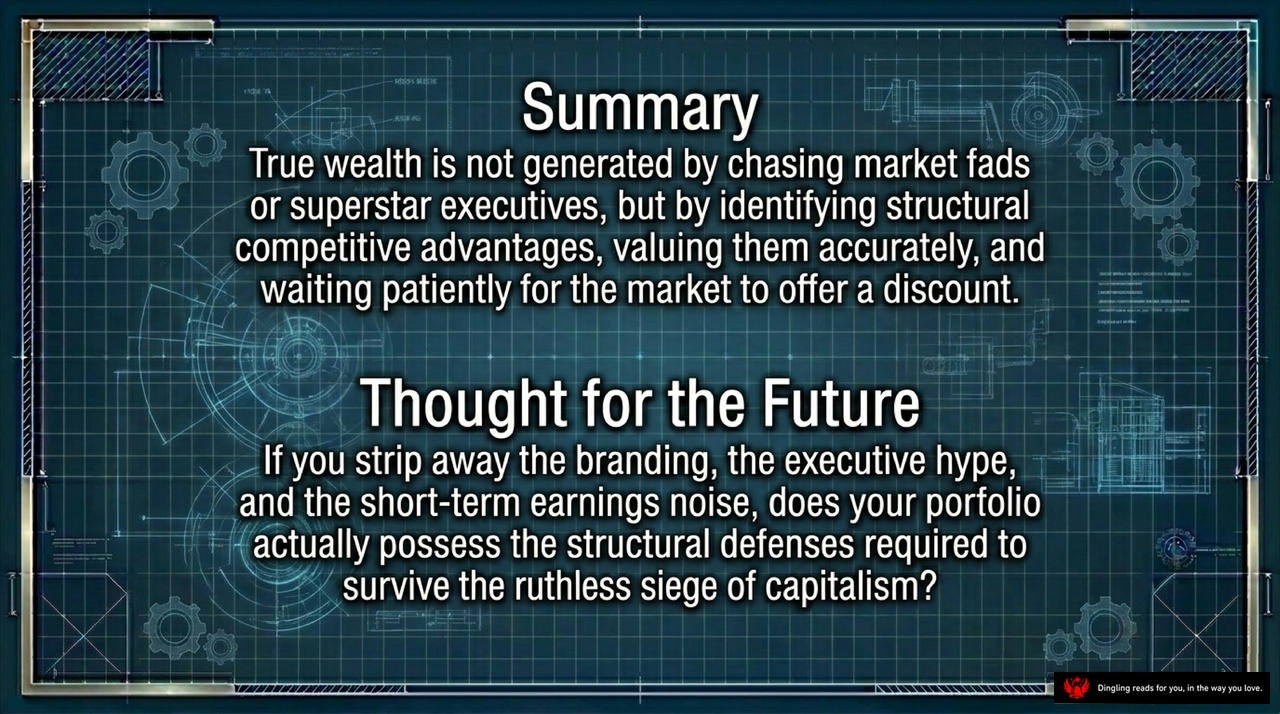
Let's close out our journey into economic moats with a powerful summary. True wealth isn't generated by chasing fleeting market fads or blindly worshipping superstar executives. Instead, it comes from identifying deep structural competitive advantages, valuing them accurately, and then exercising the patience to wait for the market to offer a discount.
As we look to the future, I want you to ask yourself a critical question: If you strip away the flashy branding, the hype surrounding the CEO, and the noise of short-term earnings, does your portfolio actually possess the structural defenses required to survive the ruthless siege of capitalism? Don't just look at the surface; dig deep to ensure your investments can truly endure.