
The Looming Tower: Complete Chapter-by-Chapter Summary

Welcome to today's session on *The Looming Tower* by Lawrence Wright. This book traces the intertwining paths of ideology, organization, and wealth that built a global tragedy. We begin by looking at the two central figures whose lives would eventually collide and reshape the modern world. On one side stands Sayyid Qutb, an Egyptian intellectual whose journey from faith crisis to radicalism set the ideological blueprint for modern jihadism. On the other is Osama bin Laden, whose personal evolution from a devout, conservative Saudi youth into a global terrorist leader mirrors the very tensions Qutb identified. Their stories are not just biographies; they are the warning signs of a coming storm, driven by a deep rejection of Western modernity and a desperate quest to rebuild the Islamic world on purely religious terms.

Look at this blueprint. It doesn't just show three men; it reveals the exact machinery that built the modern terror we know today. We are looking at three distinct pillars: The Spark, The Engine, and The Fuel.
On the left, we have Sayyid Qutb, labeled as "The Spark" or Ideology. He provided the theoretical framework that defined the modern world as a spiritual wasteland demanding destruction. Without his radical ideas, there is no blueprint to follow.
In the center stands Ayman al-Zawahiri, "The Engine" of Organization. His role was the transformation of that abstract theory into ruthless, underground militant action. He built the structure that made the ideology a living, fighting force.
And on the right, we see Osama bin Laden, "The Fuel" of Resources. His power came from the convergence of royal-adjacent wealth, puritanical fervor, and global construction logistics. He provided the money and the logistical backbone that kept the movement running.
These three disparate lives didn't just happen in parallel; they forged the architecture of modern terror together. Ideology gave the vision, organization gave the muscle, and resources gave the fuel. It is a perfect, terrifying equation.

FILE 01: The Ideologue. This slide introduces Sayyid Qutb, a man whose quiet life in Egypt would explode into a fire that reshaped modern extremism. He wasn't always a radical; he started as a mild-mannered bureaucrat and literary critic who loved Western culture. But his worldview shattered in 1948 after the Arab defeat in the war against Israel. That humiliation, combined with America's support for Zionism, turned his admiration into a burning hatred.
Look at this powerful quote on the right. Qutb didn't just dislike Westerners; he despised them without exception. From the English and French to the Dutch and, finally, the Americans. In his mind, the entire West was a corrupt, materialistic force that had enslaved the soul of Islam. He saw the modern world not as a place of progress, but as a spiritual desert where the pursuit of money and pleasure had completely replaced faith.
This slide marks the beginning of his transformation. Qutb realized that gradual reform wouldn't work. He believed the only path to redemption was to destroy the modern system entirely and return to a pure, original Islam. His ideas provided the blueprint for the coming decades, turning a frustrated intellectual into the ideological father of the global jihadist movement.

The slide contrasts two realities of post-war America: the booming economy and vibrant culture versus what Sayyid Qutb saw as a spiritual wasteland. While the U.S. celebrated prosperity, high social trust, and the integration of immigrants, Qutb interpreted this through a harsh filter. He viewed rampant materialism as prioritizing money over the soul and described jazz music as merely animalistic. He also pointed to deep sexual immorality, citing the Kinsey Report as proof of American depravity. For Qutb, America's freedom didn't open his mind; instead, it calcified his disgust for Western modernity, convincing him that the West was a land where the soul had no value.

True Islam demands complete submission to Sharia law, the absolute unity of state and religion, and a deep spiritual harmony. Yet, the modern world has drifted into what Qutb called *Jahiliyya*—a state of modern ignorance defined by secularism, democracy, and the dangerous worship of science and materialism. This slide captures the core conflict: there is no room for compromise. The separation of church and state, which the West embraces, is seen here not as progress, but as a betrayal of God's law that leads to societal decay. Qutb argued that these modern values—rationalism and individualism—have corrupted the soul, turning humanity into slaves of desire and greed. To restore true Islam, one must reject this false order entirely. The path forward requires destroying these modern structures to rebuild a society where faith governs every aspect of life, from law to government. Only by refusing to compromise with a world that prioritizes profit over piety can the spirit of Islam be truly revived.

Gamal Abdel Nasser and Sayyid Qutb represent two opposing visions for Egypt's future. Nasser, backed by the Egyptian military and state apparatus, aimed for Pan-Arab socialism and rapid secular modernization. In contrast, Sayyid Qutb, drawing power from the underground Muslim Brotherhood, sought a pure, uncompromising Islamic theocracy. Their paths diverged sharply in 1954. After a failed Brotherhood assassination attempt on Nasser, the regime responded with brutal force. Qutb was arrested, subjected to torture, and the movement was aggressively suppressed. This violent clash between the secular state and the fundamentalist vision would set the stage for decades of ideological warfare, ultimately shaping the trajectory of global extremism.

Forged in the Crucible of the Egyptian Prison: The Al-Qaeda Incubator
This slide maps the terrifying transformation of a man, showing how the Egyptian prison system didn't just punish a prisoner—it manufactured a revolutionary icon. Look at the four stages. It starts with **Brutalization**. Qutb wasn't just jailed; he was broken. He endured horrific physical breakdowns, beatings, and even attacks by dogs in the prison hospital. This wasn't just pain; it was a psychological dismantling designed to destroy his spirit.
But that pain led directly to **Revelation**. While being tortured, Qutb witnessed fellow Brotherhood members murdered by guards. In that moment of agony, he made a radical conclusion: the state apparatus itself was no longer Muslim. The government had become an enemy of faith. This is the pivotal shift from a political prisoner to a theological enemy of the state.
From that realization came **Takfir**. This is the modern concept of excommunication. Qutb formulated the idea that any Muslim serving a secular state is effectively an apostate. He created the theological loophole that justifies not just criticizing the government, but killing fellow Muslims who serve it. This logic turns the entire population into potential targets.
Finally, we reach **Martyrdom**. In 1966, Qutb refused a pardon, stating, "They will kill me, and my words will have more power." He was hanged, but his sacrifice became a weapon. His ideas, born in that crucible of suffering, provided the blueprint for future generations. This isn't just history; it's the origin story of the ideology that would later reshape the Middle East and the world.

FILE 02: The Organizer. Meet Ayman al-Zawahiri, the brilliant, aristocratic surgeon who weaponized ideology into a highly disciplined, underground militant framework. Unlike Osama bin Laden, who sought wealth and global fame, Zawahiri was a man of pure, rigid doctrine. He saw himself not as a rebel, but as a restorer of a lost order.
Look at the symbol on the left: a crossed dagger and pen. That was his life's mission. He believed that to save Islam, you had to first destroy the modern world as he knew it. His defining moment came inside a courtroom cage. Even while facing execution, he shouted with terrifying conviction: "We are not regretful; we are not regretful for what we have done for our religion."
This wasn't just a statement of defiance; it was the core of his entire worldview. Zawahiri rejected compromise. He hated the political Islam of the Muslim Brotherhood, viewing their gradual approach as a betrayal. To him, there was no middle ground. You either built a pure Islamic state overnight or you failed. This uncompromising drive, born from his time in Egyptian prisons and sharpened by the Soviet-Afghan war, eventually fused with Bin Laden's resources to create the most lethal engine in history. He didn't just want to fight; he wanted to redefine the very rules of the battlefield.

The slide we're looking at breaks down the terrifyingly complex story of Ayman al-Zawahiri. It's titled "The Paradox of the Aristocratic Extremist," and that label hits home immediately because his background was the exact opposite of what you'd expect from a terrorist.
Look at the left side, "The Pedigree." Zawahiri wasn't born into poverty or the slums. He was born into elite Egyptian aristocracy in Maadi. His grandfather was the President of Cairo University, and his great-uncle was the Grand Imam of Al-Azhar. He was a brilliant medical student and surgeon. This isn't the profile of a marginalized rebel; this is the profile of a high-functioning member of the establishment.
But then, look at the right side, "The Secret Life." This is where the paradox explodes. Despite this elite upbringing, he was deeply pious and utterly disgusted by secular authority. The contrast is stark. While he was studying to be a doctor, he formed his first underground militant cell at age 15 in 1966—the very same year his idol, Sayyid Qutb, was hanged.
The bottom line of this slide drives the entire narrative: Radicalization was not born of poverty or marginalization, but of elite ambition fused with intense religious fervor. This is the crucial takeaway. The most dangerous extremists often don't come from the streets; they come from the top. They are the sons of professors and imams who decide that the world they inherited is fundamentally broken, and they possess the education, resources, and social standing to destroy it from the inside out. Zawahiri's story proves that the most effective revolutionaries are often the most privileged ones.

The escalation of Egyptian radicalism wasn't a sudden explosion; it was a carefully calculated four-step strategy that unfolded over decades. Let's break down this timeline.
It all began with Step 1: Campus Takeovers. President Sadat initially tolerated Islamic groups just to counter the rising leftist influence, but this backfired. Radical cells rapidly dominated university campuses, turning academic spaces into recruitment grounds for extremism.
Next came Step 2: Underground Fragmentation. Hardline cells broke away from the mainstream Muslim Brotherhood. They were no longer interested in gradual reform; they sought immediate, violent overthrow of the state. This shift marked the transition from political opposition to revolutionary intent.
Then, Step 3: Military Infiltration. This is where things got dangerous. Zawahiri's Jihad group successfully recruited active Egyptian military officers, including high-ranking figures like tank commander Essam al-Qamari. These officers were given access to stockpile weapons, embedding the radical movement directly into the state's security apparatus.
Finally, Step 4: The Ultimate Strike in October 1981. The assassination of President Anwar Sadat during a military parade by rogue military elements aligned with the Jihad movement. This wasn't just an act of revenge; it was the culmination of years of planning, proving that the state had been hijacked from within. This event fundamentally altered the Middle East, paving the way for the global rise of jihadist terrorism we see today.

The Factory of Extremism and Betrayal. This slide maps the tragic transformation of Ayman al-Zawahiri, illustrating how state violence forged one of the world's most feared terrorists.
It begins with **The Arrest**. Following the assassination of Anwar Sadat, Zawahiri was swept up in a massive state crackdown. He wasn't just a political prisoner; he was a target of a regime desperate to crush dissent.
But the real horror happened at **The Breaking Point**. Here, the image shows him subjected to horrific torture by Egyptian intelligence. Under extreme physical duress, he was forced to reveal the location of his closest ally, Essam al-Qamari. This act of betrayal shattered him. As the graphic warns, "Torture is a cruel treadmill... it breaks the spirit and destroys the soul." The trauma wasn't just physical; it was a psychological lobotomy that replaced his moderate inclinations with a desire for vengeance.
This led directly to **The Transformation**. The profound shame of his betrayal and the trauma of the torture stripped away his previous identity. The clinical planner became a hardened, vengeance-driven extremist. He no longer sought reform; he sought total destruction of the secular regime that had tortured him. This prison experience was the factory where a moderate thinker was manufactured into a mastermind of global jihad, proving that state-sponsored violence often creates the very monsters it tries to destroy.

FILE 03: The Financier. Look at this blueprint-style illustration of construction cranes and rising skyscrapers. It perfectly captures the essence of what we're discussing today: the fusion of boundless royal-adjacent wealth, unparalleled logistical mastery, and austere puritanical devotion. This is the story of Osama bin Laden and the resource fuel that powered his empire.
The slide highlights a crucial point: if you want to prove you are a man, you inherit the family business. For bin Laden, this wasn't just about money; it was about legacy and power. His father, Mohammed bin Laden, was a master builder who started as a humble dockworker in Jeddah. He rose to become one of the world's largest construction contractors, building roads, palaces, and even the massive expansion of the Prophet's Mosque. He built the nation's infrastructure, literally shaping the Saudi landscape, all while maintaining a deep, almost fanatical devotion to Islam. He lived simply, refused to show off his wealth, and treated his workers with a respect rare among the ultra-rich.
But tragedy struck when Mohammed died in a plane crash. The family business, which had grown into a global conglomerate, was left to his sons. Young Osama, only 17 at the time, took over a significant share. Unlike his father, who was content with building physical structures, Osama had a different vision. He saw the construction industry not just as a business, but as a vehicle for a larger ideological mission. He used the family's immense resources—billions of dollars in cash and assets—to fund a very different kind of construction: the construction of a global jihadist network.
He didn't need to ask for funding from governments or donors. His own family provided the capital. This financial independence was his greatest strategic advantage. While other groups struggled for money or relied on foreign states, bin Laden could operate autonomously. He could fund training camps in Afghanistan, buy weapons, and support fighters anywhere in the world without answering to anyone. The resources his family accumulated through decades of building the Middle East became the fuel for a revolution that would shake the entire globe.
So, when we look at this image of cranes lifting steel into the sky, we see more than just construction. We see the foundation of a movement. The same discipline, the same logistical precision, and the same absolute devotion to a cause that his father used to build roads and mosques, Osama redirected toward a far more dangerous objective. He inherited the empire his father built, but he intended to use its power to tear down the existing world order. This is the story of how a wealthy Saudi heir turned the tools of modern capitalism into weapons of global jihad.
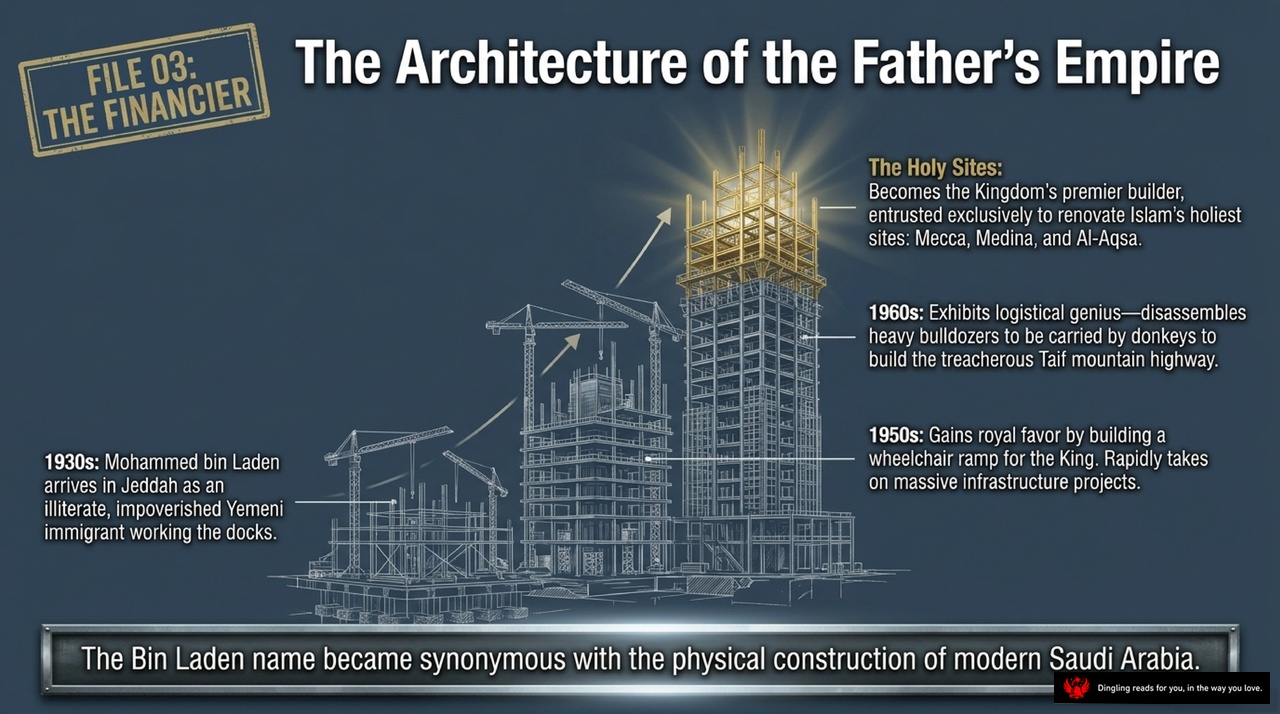
Look at this timeline. It shows the rise of Mohammed bin Laden from a poor Yemeni immigrant working the docks in the 1930s to the architect of modern Saudi Arabia. By the 1950s, he was gaining royal favor by building a wheelchair ramp for the King, which opened the floodgates for massive infrastructure projects. In the 1960s, he displayed true logistical genius by disassembling heavy bulldozers and having donkeys carry them to build the treacherous Taif mountain highway. Eventually, he became the Kingdom's premier builder, entrusted exclusively with renovating Islam's holiest sites: Mecca, Medina, and Al-Aqsa. This visual story proves that the Bin Laden name became synonymous with the physical construction of modern Saudi Arabia.

Today's slide captures the fascinating, almost contradictory duality of Osama bin Laden's upbringing. On one side, we see "The Material World": he was born into immense wealth, the son of a legendary Saudi financier who built an empire from nothing. He grew up in a sprawling family of 54 children, inheriting access to the highest echelons of Saudi society. Yet, look at the other side: "The Ascetic World." Despite this opulent background, Osama was driven by a desperate need to emulate his strict, legendary father. He constantly sought out hardship to prove his worth, rejecting the very luxury he was born into.
He was shy and deeply devout, practicing an austerity that shocked many. He fasted twice a week and woke up at 1 AM for prayer, long before the sun rose. He violently rejected Western culture, even forcing his driver to turn off secular Egyptian music, viewing it as a corruption of the soul. This tension between vast privilege and strict puritanism defined his early life. While his father believed wealth was a tool to serve God, Osama internalized the message that true faith required self-denial. He didn't just want to be rich; he wanted to be the ultimate believer, someone who could withstand the temptations of the material world while leading others out of what he saw as a spiritual decline. This unique blend of immense resources and rigid, almost obsessive piety created the foundation for his future ideology: a man with the means to change the world, fueled by a conviction that the world itself was morally bankrupt.
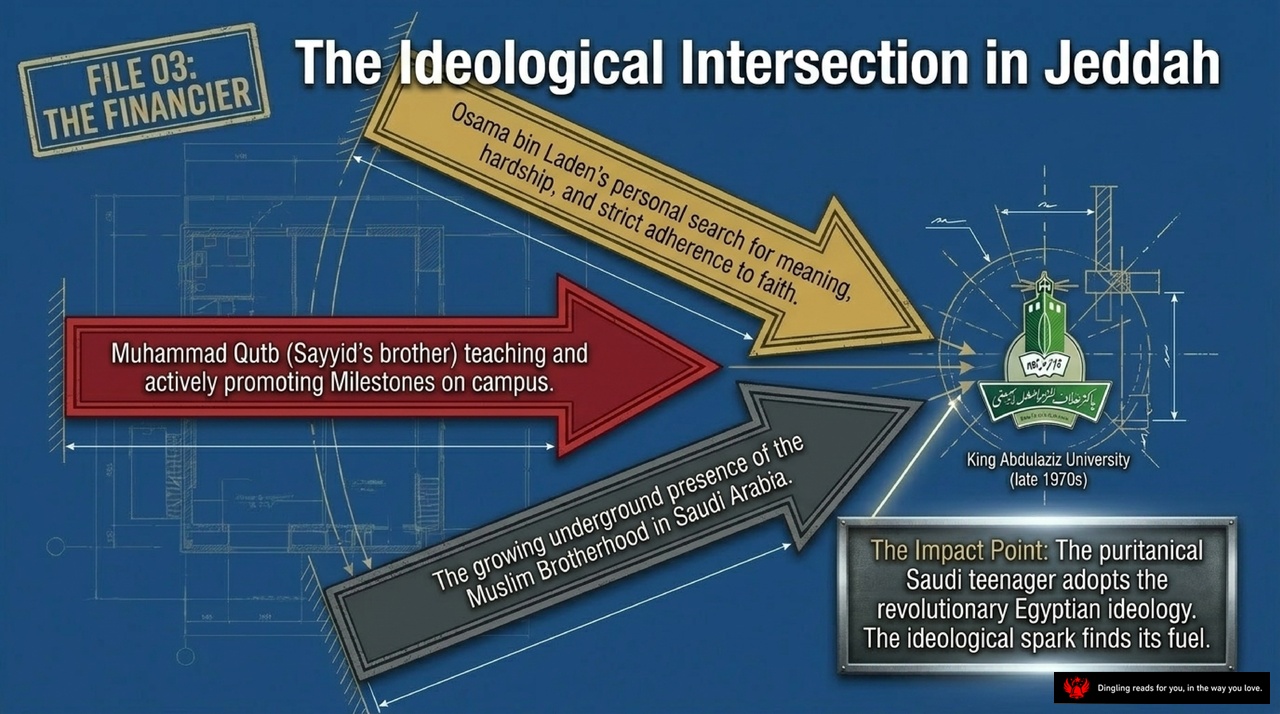
FILE 03: The Financier. Welcome to Jeddah in the late 1970s, where the ideological map of the future was being redrawn. Look at these three converging forces. First, you have the intellectual engine: Muhammad Qutb actively promoting his brother's radical ideas right on campus. Second, the personal spark: Osama bin Laden's own journey through hardship and a strict, uncompromising adherence to faith. And third, the hidden network: the growing underground presence of the Muslim Brotherhood throughout Saudi Arabia.
These arrows all point to one critical destination: King Abdulaziz University. Here, a puritanical Saudi teenager absorbs revolutionary Egyptian ideology. This is the impact point. The ideological spark finds its fuel. In this specific intersection, the seeds of a global movement are planted, transforming a young man's personal search for meaning into a structured, militant vision for the Islamic world.

FILE 03: The Financier. Today, we map the ideological ecosystem that fueled the modern terror network. Think of it as a machine with three distinct parts: the spark, the engine, and the fuel.
First, the Spark. This is Sayyid Qutb. His primary motivation was a deep-seated spiritual purity and a burning anti-Western disgust. The catalyst for his radicalization was a severe culture shock during his time in the United States. He saw what he called a spiritual wasteland, where money and flesh ruled over the soul. His core contribution? He provided the theological justification for terror, specifically the concept of Takfir, or declaring others apostates. This idea gave the movement a moral reason to use violence.
Next, the Engine. This is Ayman al-Zawahiri. While Qutb provided the theory, Zawahiri built the machinery. His motivation was the violent overthrow of the secular Egyptian state. The catalyst for his path was the state-sponsored torture he endured in Egyptian prisons. That trauma didn't break him; it hardened him. His core contribution was creating the underground militant cell structure and establishing a ruthless operational capability. He turned abstract ideas into a functioning army.
Finally, the Fuel. This is Osama bin Laden. Without him, the movement might have lacked the resources to survive. His primary motivation was the defense of Muslim lands and the emulation of his father's legacy. The catalyst was his exposure to Qutb's brother at the university, which planted the initial seed. But his true power lies in his core contribution: boundless funding, construction logistics, and global reach. He paid for the bombs, built the training camps, and connected the dots across the world.
Together, these three elements created a perfect storm. Qutb gave them the "why," Zawahiri gave them the "how," and bin Laden gave them the "with what." This is the ecosystem that changed history.

FILE 03: The Financier. This map illustrates the pivotal moment in history where the Afghan frontier became the crucible for global jihad. It all started in 1979 with the Soviet invasion of Afghanistan, an event that acted as a massive catalyst, shifting the focus of radical Islam from overthrowing internal states to launching a global holy war.
Look at these convergence points. From Egypt, the ruthless militant underground, led by figures like Zawahiri, merged with the vast logistical wealth of Saudi Arabia right on the border of Pakistan. This wasn't just a meeting of minds; it was a merger of ideology and capital. Zawahiri arrived as a doctor treating refugees, using the war as a training ground for his militants. Meanwhile, Bin Laden utilized his family's massive construction empire to build roads, camps, and heavily fund the fighters.
The result was a powerful new force. The Egyptian fighters provided the tactical experience and the will to fight, while the Saudi money provided the fuel and the infrastructure. This alliance on the Afghan border created the perfect storm, transforming a regional conflict into a global threat that would reshape the world for decades to come.

The Weaponization of Humiliation isn't just a phrase; it's the tragic engine that drove the modern era of terror. Look at this cycle: Humiliation leads to Radicalization, which inevitably fuels Violent Retaliation. It wasn't about poverty; it was about the crushing weight of shame.
Consider the 1948 and 1967 Arab military defeats. When Israel's victories humiliated leaders like Qutb and Zawahiri, it proved that secular nationalism had failed, pushing them toward religious absolutes. This profound sense of defeat became the fundamental catalyst for terror.
Then, look at the geopolitical imbalance. The West's perceived cultural and military humiliation of the Islamic world drove Bin Laden to fund a global pushback. He felt the entire world had turned against them.
Finally, consider state torture. The physical humiliation and forced betrayals inside Egyptian prisons stripped Zawahiri of his humanity, leaving only vengeance. The pain of the prison cell didn't just break him; it forged a weapon out of his soul.
Across all three tracks—military defeat, geopolitical imbalance, and state torture—humiliation was the fuel. It transformed ordinary men into radicals and radicals into the architects of violence, creating a cycle where revenge became the only language left.

The blueprint of global terror isn't something that just happened by accident; it was a meticulously constructed machine built over decades. Look at this diagram: it shows how four distinct pieces fit together to create the perfect storm.
First, ideology provided the moral loophole. This concept, known as Takfir, allowed extremists to kill indiscriminately, declaring anyone who wasn't with them as an enemy of God. Second, prison torture played a dark but crucial role. It forged ruthless, disciplined men who were willing to execute violence without hesitation. Third, Saudi construction logistics and oil wealth built the physical infrastructure required to export this terror globally, providing the money and resources to operate anywhere. And finally, these elements combined to create a mechanism that wasn't spontaneous at all.
As the text reminds us, Al-Qaeda was not a sudden anomaly; it was a carefully engineered system. From the ideological justifications to the brutal training in prisons, and backed by massive financial resources, every part was designed to make the impossible possible. This was the calculated construction of modern global terror.

The foundations of modern global terror were not laid in caves, but in the hallowed halls of American universities and the opulent palaces of Saudi Arabia. This slide captures a pivotal truth: the architecture of today's extremism was built on the fatal intersection of three forces—Qutb's unyielding ideology, Zawahiri's militant organization, and Bin Laden's vast logistical wealth.
Consider Qutb, who transformed from a liberal Egyptian intellectual into a radical icon after witnessing what he saw as the moral decay of the West. His writings provided the theological blueprint, declaring a war against the "materialist" West. Then, take Zawahiri, whose time in Egyptian prisons didn't break him; instead, it forged a ruthless revolutionary who believed that brutal crackdowns by secular states were the very fuel needed to ignite a new generation of martyrs. Finally, there is Bin Laden. While others debated theology, he provided the muscle. His immense wealth funded the training camps, the weapons, and the networks that turned abstract hatred into actionable violence.
The slide poses a haunting question: if extremist movements are forged as much by the brutal crackdowns of secular states as they are by radical theology, how can modern societies dismantle the ideology without inadvertently fueling its next generation? The legacy of the Tower is not just about the buildings that fell, but about the ideas that survived, nurtured in the very spaces we thought were safe.