
The Lucifer Effect: Complete Chapter-by-Chapter Summary

Welcome to our journey into the darkest corners of the human mind. Today, we explore *The Lucifer Effect* by Philip Zimbardo. Look at the image before us: on the left, a radiant angel; on the right, a menacing demon. This visual split captures the book's core truth—evil isn't born in monsters; it lives in ordinary people. The title, *The Lucifer Effect*, refers to the moment an angel falls, challenging authority to rule in hell. Zimbardo asks a terrifying question: How do good people turn bad? The answer lies not in character flaws, but in the invisible power of situations and systems. When we strip away our names and identities, as prisoners in a simulation, or when we wear uniforms that grant unchecked power, our morality can shatter in an instant. This book reveals that the line between hero and villain is thinner than we think, and understanding this is the only way to resist the forces that push us toward darkness.

On the left, we see a rotting apple crossed out with a giant red X, labeled "The Dispositional Fallacy." This represents the "Bad Apple" myth—the idea that evil comes from a few broken individuals, whether it's bad genetics, poor parenting, or a twisted personality. We love this story because it lets us feel safe. It tells us that we are good, and only those rare, pathological monsters are evil. It creates a false boundary between "us" and "them."
But look at the right side. That is "The Reality." Instead of a single bad apple, we see a rotting wooden barrel surrounded by many healthy apples. This is the "Bad Barrel" model. It shifts the blame from the individual to the system. The rot isn't in the fruit; it's in the barrel. The text reminds us that systemic and situational forces actively corrupt human behavior, overriding our individual morals.
History proves this again and again. From the Stanford Prison Experiment to Abu Ghraib, we've seen that ordinary, decent people don't need to be "evil" to commit evil acts. They just need to be placed in the right barrel. When a system creates an enemy, strips away anonymity, and diffuses responsibility, it turns a crowd of good people into a machine of cruelty. The lesson is clear: don't look for the bad apple. Look at the barrel. Because if you fix the barrel, you save the apples.

Welcome to the second slide, where we visualize the core engine driving human behavior: The Architecture of Behavior.
Look at this diagram. It illustrates a powerful truth: you are not an isolated island of personality. Your actions are the result of a complex interplay between three distinct forces.
First, we have **The Person**. This is the core—the individual's biological templates, personality traits, and personal morality. We often mistake this for the sole driver of behavior, assuming that a "good person" will always do good things. But as we've seen, this is a dangerous oversimplification.
Then, there is **The Situation**. This represents the immediate context: the environment you're in, the peer pressure around you, the roles you're forced to play, and the immediate rewards or punishments you face. Think of it as the stage set. A kind actor can suddenly become cruel if the script demands it.
Finally, and perhaps most critically, is **The System**. This is the invisible hand behind the scene. It encompasses the political, economic, historical, and administrative structures that legally and culturally define the situation. The system creates the rules, allocates the power, and sets the stage. It's the difference between a chaotic playground and a military drill; the system dictates what is possible.
The lesson here is profound: while we focus on who we are, it is often the system and the situation that decide what we do. When these forces align to dehumanize others or reward cruelty, even the most decent among us can be pushed toward the dark side. Understanding this architecture is the first step to resisting it.

On this slide, we see the stark transformation of ordinary college students into figures of authority and submission. At the top, under "Baseline," you see normal, healthy students with no history of pathology. But then, a red line labeled "Catalyst" appears, representing the arbitrary assignment to "Guard" or "Prisoner" roles. This is the turning point. Below, under "Result," we see the terrifying outcome: six days to madness. The experiment was terminated prematurely because the roles entirely consumed the individuals.
This visual perfectly captures the core lesson of the Stanford Prison Experiment. It illustrates how quickly a specific situation can override a person's inherent character. These weren't evil people from the start; they were just regular students placed in a system that demanded cruelty and obedience. The system created a hierarchy, stripped away their identities, and provided unlimited power to the guards while imposing total helplessness on the prisoners. Within days, the guards began to abuse their power, inventing cruel rules and dehumanizing the prisoners, while the prisoners became passive, depressed, and compliant.
The slide drives home a critical truth: evil isn't always the work of monsters. Often, it is the work of ordinary people trapped in a flawed system. When the environment removes accountability and amplifies power, even the kindest individuals can be pushed into doing terrible things. This graphic reminds us that we must always question the structures we live in, because as we saw here, the power of the situation is far stronger than we often give it credit for.

The slide we're looking at captures a chilling truth about how evil operates: it's not always the work of monsters, but often the result of a powerful, unfeeling system. The title, "The Power of the System," sets the stage for what happened at Abu Ghraib. As the red box warns, those atrocities weren't just rogue soldiers acting on their own; they were the product of administrative evil.
Look at the flow from the top down. Politicians at the very top redefined "torture" to bypass the Geneva Conventions, creating a legal gray zone. Below them, military leadership demanded "actionable intelligence" and actively removed oversight, pressuring soldiers to do whatever it took. At the bottom, behind the bars, soldiers acted out "soft torture" under extreme psychological pressure, but crucially, they did so with an implicit systemic approval. The system gave them the permission to break the rules.
This graphic illustrates a fundamental shift in how we understand evil. It moves away from blaming individual character flaws and instead points to the environment. When a system creates a culture where rules are flexible, enemies are dehumanized, and power is unchecked, ordinary people can be pushed to do extraordinary things they never thought they would. The system doesn't just influence us; in the right conditions, it can completely reshape our behavior, turning a soldier into an abuser without them ever having to change who they are at their core.

The slide outlines the "Three Pillars of Compliance," a framework for understanding how ordinary people get swept up in evil. Let's break down these three psychological forces.
First, we have Asch and Conformity. In his famous experiment, participants were asked to judge simple line lengths, but they were surrounded by actors giving the wrong answer. The core finding was profound: our desperate need to belong can make us deny objective reality just to fit in. We sacrifice truth for social acceptance.
Next is Milgram and Obedience. Here, ordinary citizens were instructed by a lab-coated authority to deliver what they believed were lethal electric shocks to a stranger. The result was shocking: 65% of them went all the way to the maximum voltage. This reveals the terrifying power of authority—when rules and commands override our conscience, even decent people can become instruments of cruelty.
Finally, we have Zimbardo and the power of Roles and Rules. This refers to the Stanford Prison Experiment, where the situation itself, supported by institutional structures, caused people to rapidly adopt the masks they were wearing. Whether you are a guard or a prisoner, the system shapes your behavior more than your personality ever could.
Together, these three pillars show us that evil isn't just about bad apples; it's about the barrel—the environment, the authority, and the pressure to conform—that turns good people into doers of bad deeds.

The slide outlines a chilling roadmap to evil, detailing four psychological mechanisms that transform ordinary people into perpetrators of atrocity. It starts with **Anonymity**, where uniforms, masks, or darkness hide our individual identities. When we lose our personal faces, we lose our personal accountability. This leads directly to the second stage: **Deindividuation**, often called the "Carnival Effect." Here, self-awareness fades, and primal impulses take over. We stop thinking as individuals and start acting as a faceless mob.
Once stripped of identity, the next step is **Dehumanization**. This is the act of labeling the "other"—whether it's an enemy, a prisoner, or a minority group—as nothing more than an object or an animal. When we strip someone of their humanity, we make it easier to hurt them without guilt. Finally, this process culminates in **Moral Disengagement**. This is the cognitive ability to commit horrific actions without feeling personal remorse. We convince ourselves that our actions are necessary, justified, or not our fault.
Together, these four steps explain how good people can be pushed into darkness. It's not about being born evil; it's about how specific situations and systems can systematically remove our moral brakes. Understanding this path is the first step to preventing it.

Look at this powerful contrast. On the left, we see a human mind filled with the things that make us human: our names, our families, our hopes, and our fears. These are the anchors of our identity. But look at the right side. That's what happens when labels are weaponized. Words like "Enemy," "Cockroach," "Collateral Damage," and "Target" don't just describe us; they strip away our humanity and turn us into objects to be destroyed.
This slide captures the terrifying concept of the "Hostile Imagination." As the text explains, systemic propaganda alters the very architecture of our brains. By using dehumanizing language, perpetrators in tragedies like the Holocaust or the Rwandan Genocide stopped seeing people as neighbors or family. Instead, they viewed murder not as a crime, but as pest control. When you label someone a "cockroach," you convince yourself that killing them is a necessary act of sanitation, not an act of evil. This is how ordinary people become capable of unthinkable cruelty. It's not about being born bad; it's about how we are taught to see each other.

The slide we see here carries a heavy but necessary truth: "The Evil of Inaction." It reminds us that the ultimate enabler of systemic evil isn't always the active perpetrator, but the passive bystander who sees the abuse, understands it's wrong, and chooses silence.
This concept is powerfully illustrated by the "Good Samaritan Experiment." When theology students were placed under severe time pressure, 90% of them completely ignored a visibly suffering person on their way to deliver a sermon about compassion. It's a chilling reminder that even those trained in love can become complicit in indifference when the situation gets tough.
But the story of heroism shows us that inaction isn't inevitable. We've seen how individuals like Joe Darby, a reservist at Abu Ghraib, chose to break the silence despite the risk to his career and safety. Or Debbie Layton, who exposed the deadly cult of Jonestown before the tragedy unfolded. These heroes didn't just see the abuse; they took a stand.
The lesson here is clear: resisting the pressure to stay silent is an active choice. It requires courage to speak up when others choose to look away. True heroism isn't about being perfect; it's about refusing to let evil go unchecked, even when it's easier to just stay quiet.

Good evening, everyone. Today, we arrive at the ultimate synthesis of everything we've discussed: The Lucifer Effect.
Look at this scale on your screen. On one side, you have a human heart, glowing and fragile. On the other, a heavy stack of weights labeled "Systemic Pressure," "Situational Forces," and "Ideology." The scale is tipping heavily toward the weights. This visual tells us a profound truth: Human malleability is absolute.
We are not born purely good or purely evil. The line between the two is highly permeable, easily crossed under the right conditions. As the text reminds us, ordinary humans are simply the product of our biological templates interacting with immense systemic and situational pressures.
Think about this: we often believe that our character alone dictates our actions—that we are inherently good or bad. But history and psychology show us that when the rules collapse, when the environment twists, even the most decent people can be pushed into doing terrible things. The "Lucifer Effect" isn't about a few monsters; it's about how systems and situations can transform ordinary people into agents of evil.
So, the next time you look at someone making a bad choice, don't just blame their personality. Look at the scale. Look at the weight of the system around them. Because in the end, we are all capable of sliding from good to evil if the pressure becomes too great.

To resist the pull of a toxic environment, we must move from passive survival to active resistance. The first line of defense is your mindset. You have to admit your mistakes quickly, neutralizing that uncomfortable feeling before it traps you in denial. You must maintain situational mindfulness, constantly turning off your "autopilot" and questioning the familiar contexts around you.
Never allow a group to diffuse your individual accountability. You must take personal responsibility for your actions, refusing to hide behind the crowd. When facing authority, evaluate the source: respect just leadership but actively rebel against unjust commands. Assert your unique identity by rejecting anonymity; insist on names and eye contact to keep yourself human. Be wary of aporones—those who actively attack authority—and always evaluate the authority you are told to follow. Finally, remember that true freedom isn't found in a shield, but in the courage to stand apart when the system demands you conform.

Strategies for Resistance: Action. This slide isn't just a list; it's your survival toolkit against the invisible forces that twist ordinary people into agents of harm. We've spent time understanding how systems and situations can hijack our morality, but now it's time to move from awareness to action.
First, look at the torch on the left. It represents the light of independent thought you must keep burning. Point number six, "Value Independence," tells us to choose personal integrity over the comfort of group acceptance. It's easier to go along with the crowd, but true resistance starts with the courage to stand apart when the group is wrong.
Next, watch out for "Framed Information." Number seven warns us to deconstruct political slogans and propaganda. Evil often hides behind clever language, so you must learn to see past the spin and question the narrative being sold to you.
Then, balance your time perspective. Don't sacrifice your future consequences for the sake of present compliance, as number eight advises. Short-term obedience might feel safe, but it often leads to long-term regret and complicity.
Number nine is about protecting liberty: never sacrifice basic human rights for the illusion of security. We often trade our freedom for a false sense of safety, but that trade is always a bad deal.
Finally, number ten urges us to oppose unjust systems. Be the whistleblower. Evil relies on your silence, so speaking up is the only way to break the cycle. Remember, you don't need to be a superhero to make a difference; you just need to refuse to be part of the problem.
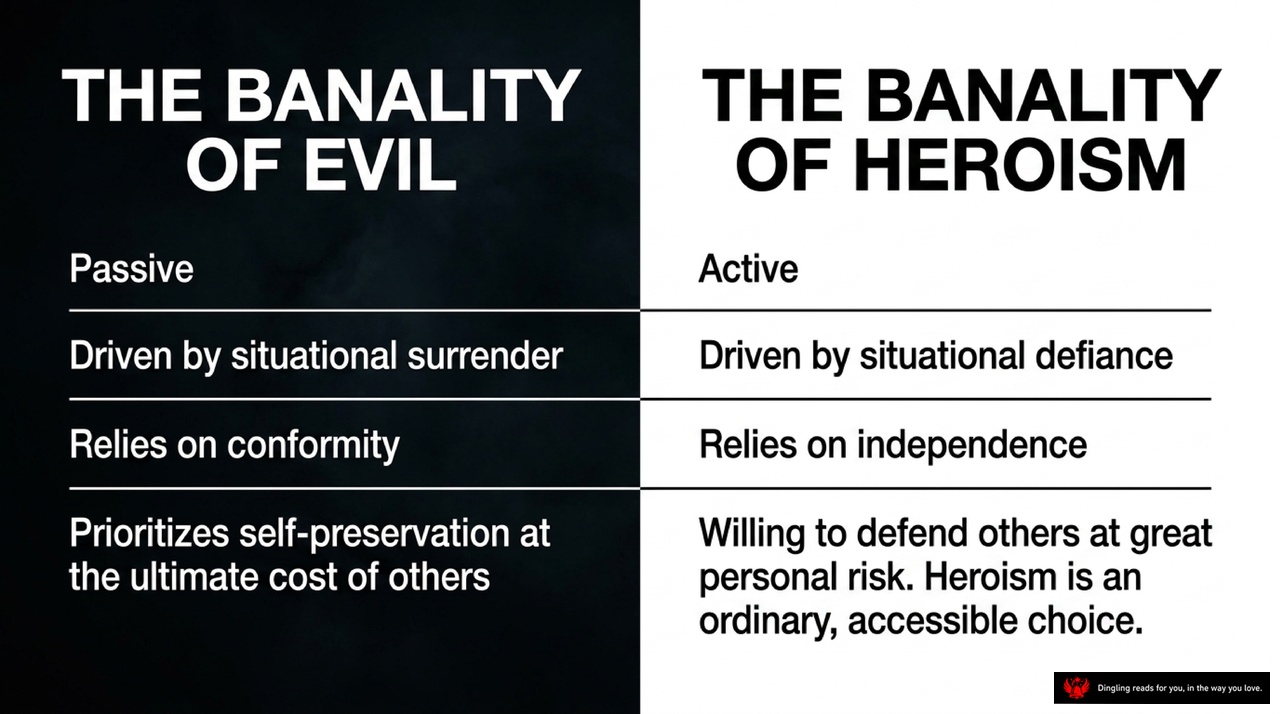
Look at this slide. It presents a powerful mirror to our modern world: on the left, the banality of evil, and on the right, the banality of heroism.
The contrast is stark. Evil is passive; it is driven by situational surrender and relies on conformity. It prioritizes self-preservation, often at the ultimate cost of others. Think about the Stanford Prison Experiment or the Abu Ghraib scandal. In those moments, ordinary people didn't wake up as monsters. Instead, they succumbed to the pressure of the system. They let the situation dictate their actions, hiding behind the crowd and choosing safety over morality. They became the "banality of evil"—not because they were inherently wicked, but because they chose to surrender to the context.
But look at the other side. Heroism is active. It is driven by situational defiance. It relies on independence, not the safety of the group. True heroism is willing to defend others at great personal risk. It requires the courage to stand alone when everyone else is standing still. The slide reminds us that heroism isn't a superpower reserved for a few; it is an ordinary, accessible choice. It is the decision to break the cycle of conformity and refuse to let the situation dictate your soul. While the banality of evil whispers, "just go along," the banality of heroism demands, "stand up." Which side of the mirror will you choose?
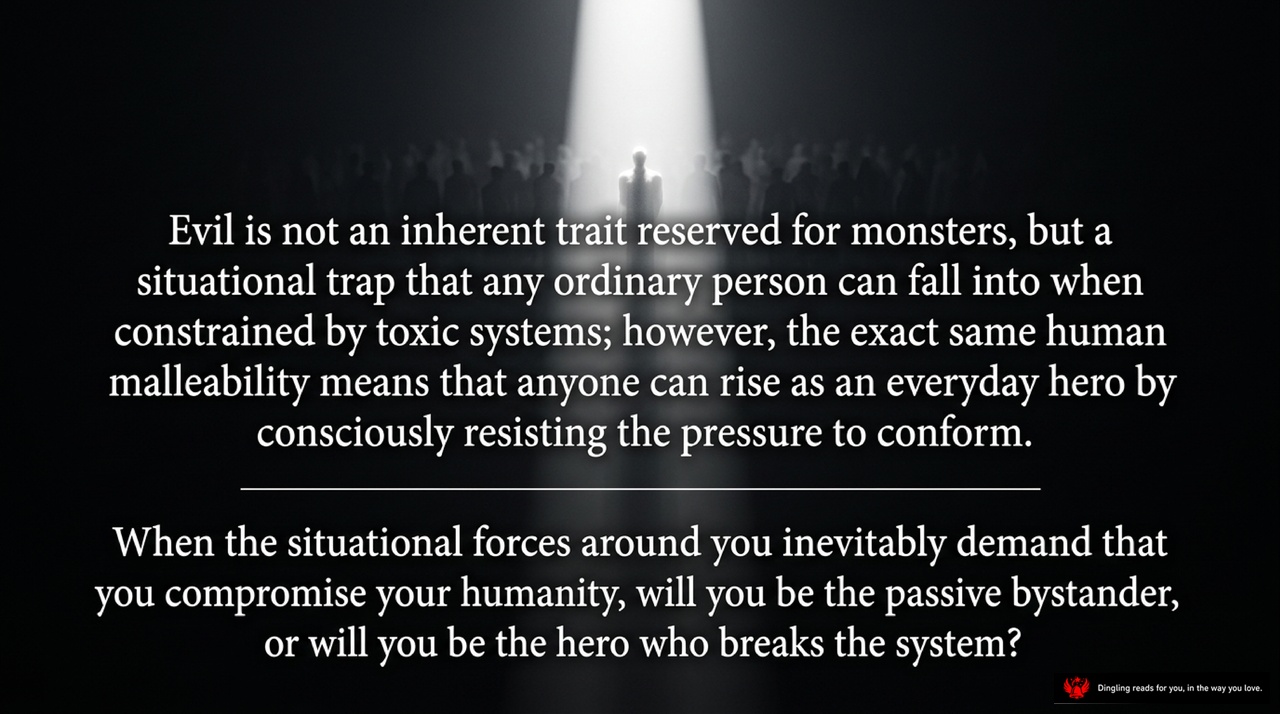
Evil isn't the exclusive domain of monsters; it's a trap that ordinary people fall into when squeezed by toxic systems. As we've seen, from the Stanford Prison Experiment to Abu Ghraib, the same human malleability that lets us become villains also allows anyone to rise as a hero by consciously resisting the pressure to conform. The image of that single figure standing in the spotlight against a crowd reminds us that when situational forces demand you compromise your humanity, you have a choice: be a passive bystander or the one who breaks the system.
Consider Joe Darby at Abu Ghraib. He was just a reservist, initially laughing at the abuse photos, but his moral alarm eventually rang. He chose to leak evidence, risking his career and safety to stop the torture. Or look at Irena Sendler, who risked her own life in the Holocaust to smuggle hundreds of Jewish children to safety, refusing to reveal their hiding spots even under torture. These aren't superhuman acts; they are the result of rejecting the system's script. They prove that while systems can turn good people into monsters, individual courage can also dismantle those very systems. The question remains: when the pressure mounts, will you stand in the shadows, or step into the light?