
The Lychees of Chang'an: Complete Chapter-by-Chapter Summary

Welcome to today's reading session. Let's dive into a story that starts with a simple fruit but spirals into a nightmare of bureaucracy and human cost. The book is *The Lychees of Chang'an* by Ma Boyong.
Imagine a low-ranking official, Li Shande, who has finally managed to buy a small home in Chang'an. He's fifty-two years old, tired, and drowning in debt, yet he's just found a tiny bit of happiness with his family. But his life takes a terrifying turn when he is suddenly appointed as the "Lychee Envoy." His mission? To defy nature, geography, and a ruthless bureaucracy to deliver fresh lychees 5,000 miles to the Emperor's consort—or die trying. It sounds like a fairy tale, but in this story, it's a death sentence for anyone who tries to make it work.

Meet Li Shandé, a mid-level government official with one major flaw: he trusts numbers more than people. He's a 9th-grade official, a lowly rank with no political capital, but he's a master of mathematics and accounting. In fact, he only trusts what he can calculate.
But here's the problem: Li Shandé is vulnerable. He recently bought a house in Chang'an to settle down with his family, but he's now drowning in a crushing 200-guan loan from a local temple. Every month, his tiny salary just isn't enough to cover the interest. He's desperate.
This desperation becomes his trap. His superiors see this and manipulate him. They offer him a "prestigious" temporary assignment that sounds like a golden ticket: a special mission to deliver fresh lychees to the Emperor. It sounds like a sure way to get a bonus and pay off his mortgage. But Li Shandé, desperate for money, easily falls for it. He doesn't realize he's walking into a doomsday scenario. The mission is impossible, the logistics are a nightmare, and he's the only one holding the bag. He's the expendable project manager, pushed into a corner by the system he serves.

Look at this diagram: "The Bureaucratic Hot-Potato." It perfectly captures the absurd reality of Tang Dynasty administration. In a rigid hierarchy, impossible tasks simply flow to the bottom.
The story shows how a decree for "Lychee Wine"—a task easily handled by the Imperial Dietary Office—got rejected and kicked down the chain. The Imperial Treasury said no. The Palace Market Envoy refused. Even the Lingnan Assembly Envoy rejected it. Why? Because they all knew the biological limit of the fruit. Fresh lychees rot in days over 5,000 miles.
But here's the final hack. The Shanglin Office Director, Li Shande, gets drunk and uses a yellow correction slip to alter the decree from "Lychee Wine" to "Fresh Lychees" right as the Emperor signs it. Suddenly, the impossible becomes the order. The Court of National Agricultural forces it upon the Shanglin Office.
It's a classic case of bureaucratic buck-passing until the very last person in line is forced to solve an impossible problem.

Imagine a graph where the vertical axis represents "Quality" and the horizontal axis represents "Time." On this chart, a steep green line starts high on Day 1, but it crashes downward with alarming speed. By Day 2, the aroma dissipates. By Day 3, the taste sours. And by Day 4, the fruit has completely rotted. This is the biological limit of a fresh lychee—a timeline of just three days before it becomes inedible.
Now, look at the black bar stretching across the bottom of this graph. It represents the geographic reality: the 5,000 li journey from Lingnan to Chang'an. Even at the maximum transit speed of a horse relay—roughly 300 li per day—it takes over 15 days to cover that distance.
Here lies the impossible gap. The biological limit is 3 days, but the geographic reality demands 15 days. The fruit rots long before it can reach the destination. This isn't just a math problem; it's a death sentence for anyone trying to deliver fresh lychees across the empire.

Success isn't just about working harder; it's about hacking the system. In this pivotal moment, Li Shande stops trying to change the laws of nature and instead focuses on optimizing the margins. He breaks the impossible mandate into two actionable variables: Success equals Delay Decay plus Increase Speed. To delay decay, he experiments with preservation technology, like the branch-planting method he just discovered. To increase speed, he maps and tests multiple transit routes, calculating every mile to shave off precious time. But even with the perfect formula, he needs fuel. This is where the funding hack comes in. Because the Imperial Treasury refuses to fund his experiments, Li leverages his only asset: his title. He issues tax-free five-district transit passes to a Persian merchant in exchange for 1,500 guan in venture capital to fund his A/B tests. It's a brilliant trade-off, swapping official privileges for the capital needed to save his family.

Imagine a system where nature and engineering dance together to conquer time. This isn't just about moving fruit; it's about rewriting the rules of decay. By combining local wisdom with imperial power, Li Shande created a multi-layered preservation shield. First, the fruit itself is protected by a "Salt Wash and Bamboo Shield," washing away pests and wrapping them in a breathable weave to prevent bruising. But the real magic happens in transit. The "Dual-Layer Urn" acts as a mobile climate control, using cold river water to keep the temperature stable. Even smarter is the "Doshu Method"—instead of picking the fruit, entire branches are sawed off and planted directly into the urn, allowing the tree to keep growing and nourishing the fruit during the journey. Finally, an "Ice Relay" ensures that once the payload crosses the Yangtze River, the urns are packed with imperial winter ice. This brilliant, iterative engineering delayed decay from a mere 3 days to a full 11 days, turning an impossible mission into a reality.

Look at this data table. It tells the story of Li Shande's desperate gamble to deliver fresh lychees to Chang'an. He didn't just send one team; he launched four simultaneous test relays to find the absolute limit of courier speed.
The results were brutal. Route 1, Route 2, and Route 3 all failed miserably. They were blocked by slow ferry crossings, treacherous rapids, and crisscrossing waterways. Their average speed was nowhere near enough. But look at the fourth column: The Master Route. By combining the Meiguan Pass with an overland journey to Shangzhou and using fresh horses every 30 li, Li Shande achieved a staggering 500 li per day. This was the only path to success.
This table proves that Li Shande's genius wasn't just in logistics, but in optimization. He realized that cutting through the terrain bottlenecks was the only way to beat time. Without this hybrid strategy, the lychees would have rotted before they even reached the capital. The maximum speed achieved was 500 li per day—a record that would remain unmatched for centuries.

The Power of the Silver Token. In this scene, we see the stark contrast between rigid bureaucracy and absolute authority. On the left, the bureaucracy represents a wall of red tape. When Li Shande tries to requisition resources through standard channels—like the Six Ministries—they simply ignore him. They refuse to spend their budgets on a temporary envoy's project, proving that "process is a rule meant only for the weak."
But look at the right side. This is the power of the Silver Token. Li hands the credit to the ruthless Prime Minister Yang Guozhong in return for a blank silver token. This token bypasses all legal frameworks, allowing instant requisitioning anywhere. It breaks through the bureaucratic deadlock that would otherwise crush him. While standard protocol fails, political brute force becomes the only solution. Li Shande's perfect 11-day logistical plan requires 153 post stations, thousands of fresh horses, and ice from local state reserves. Without this token, he is powerless; with it, he can command the entire empire. This is the moment where the system's rules are suspended by a single, powerful symbol of authority.
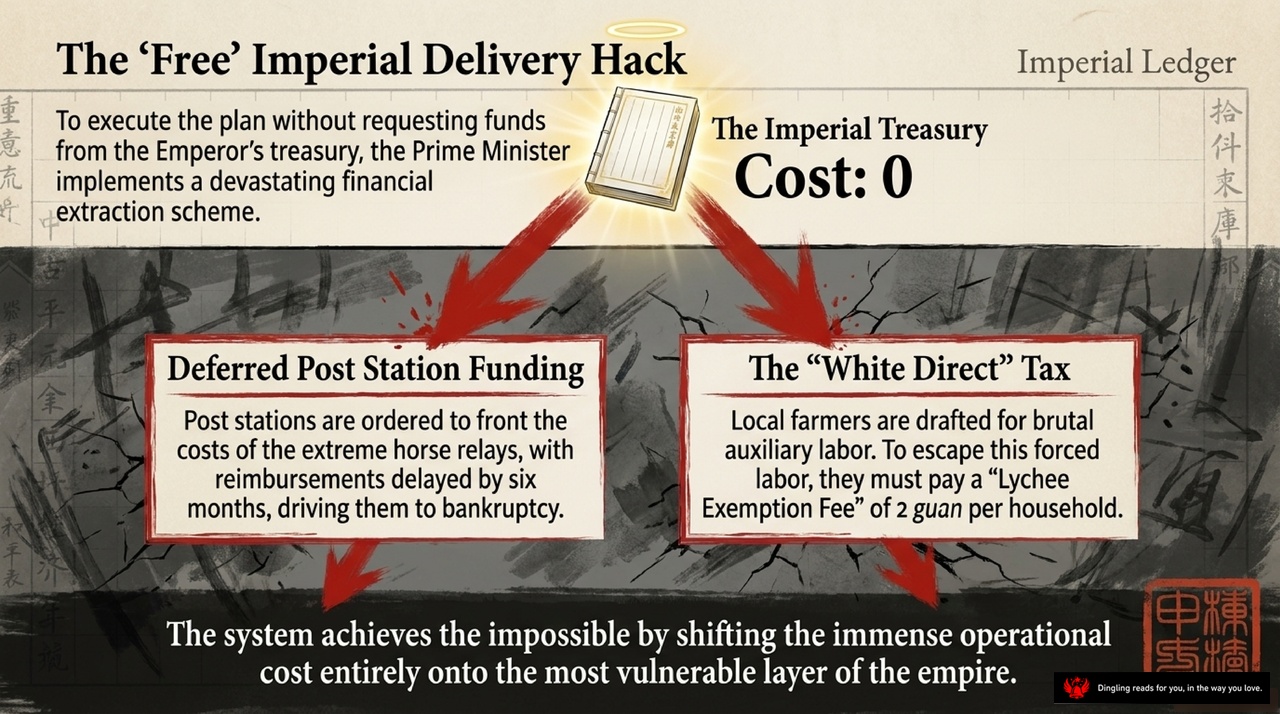
Look at this slide, titled "The 'Free' Imperial Delivery Hack." It reveals the brutal, invisible cost behind the Emperor's desire for fresh lychees. The chart shows that the Imperial Treasury's cost is zero, but this "free" meal was paid for entirely by the empire's most vulnerable people.
The system achieved this impossibility through two devastating extraction schemes. First, we have "Deferred Post Station Funding." The post stations were forced to front the massive costs of the extreme horse relays, with reimbursements delayed by six months. This cash flow gap drove the stations straight to bankruptcy. Second, there is "The 'White Direct' Tax." Local farmers were drafted for brutal auxiliary labor. To escape this forced labor, they had to pay a "Lychee Exemption Fee" of 2 guan per household.
In essence, the Prime Minister implemented a financial extraction scheme that shifted the immense operational cost entirely onto the shoulders of the common people. The Emperor enjoyed his fresh fruit, the treasury spent nothing, and the people paid everything.
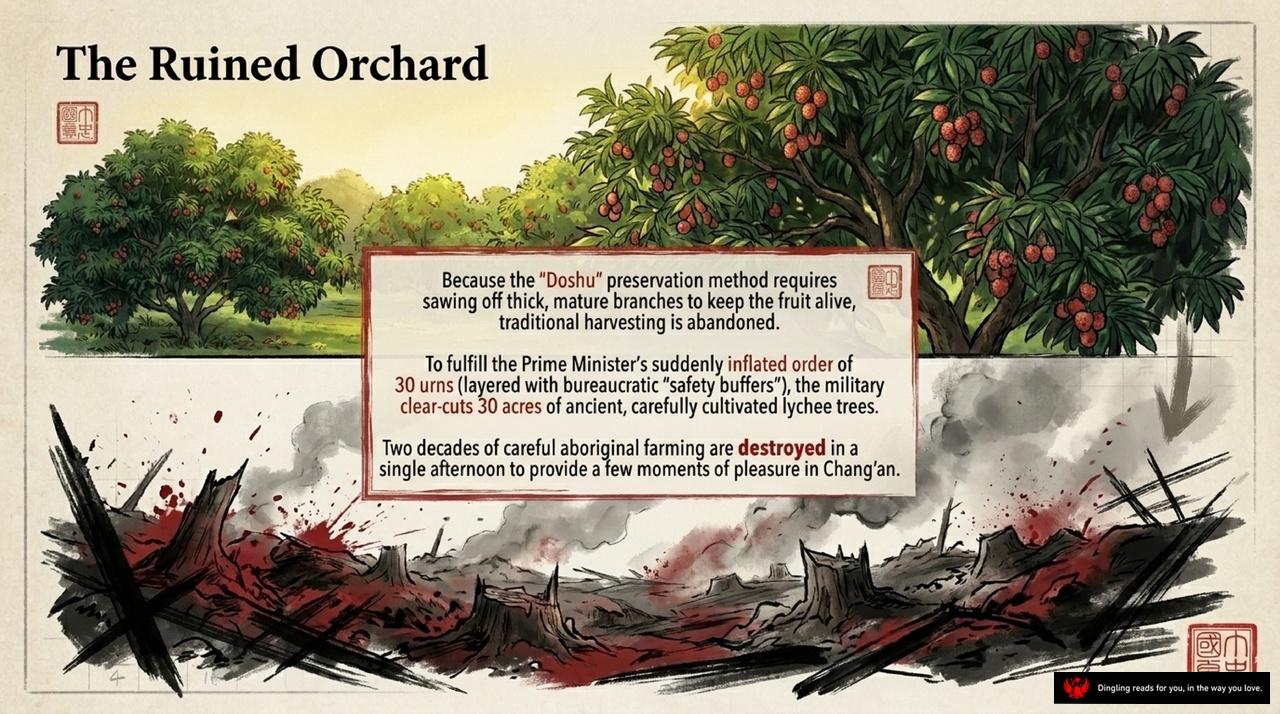
Look at this haunting scene: "The Ruined Orchard." Above, we see a lush, thriving lychee tree, heavy with fruit, representing decades of careful, indigenous farming. But look at the bottom—chopped stumps, smoke rising, and a landscape scarred by destruction. This isn't just a picture; it's the tragic climax of Li Shande's story.
To understand why this happened, we have to look at the absurd logic of the court. The "Doshu" preservation method required sacrificing mature branches to keep the fruit alive, which already meant abandoning traditional harvesting. But the real tragedy was the Prime Minister's sudden, inflated order. He demanded 30 urns of lychees, layered with bureaucratic "safety buffers." In the world of imperial bureaucracy, if you ask for three, the local officials feel pressured to deliver ten. If you ask for ten, they feel compelled to send fifty.
So, to fulfill this impossible, bloated order, the military didn't just harvest; they clear-cut 30 acres of ancient, carefully cultivated lychee trees. Two decades of patient, aboriginal farming were destroyed in a single afternoon. The goal? To provide just a few fleeting moments of pleasure in Chang'an for the Empress. It is a brutal reminder of how human impulse, when unchecked by reason, can turn a living landscape into a grave.

Look at this stark contrast. On the left, we have "The Deliverable": just two small jars of semi-fresh lychees and one smile from Consort Yang. It sounds almost trivial, right? But look at the right side. That is "The True Cost."
This isn't just a delivery; it's a catastrophe. Ecologically, thirty acres of prime orchards were destroyed. Economically, the Huangcao Post Station went bankrupt, forcing surrounding villages to flee the brutal "Lychee Tax." And for humanity? The cost was literal death. Couriers were trampled, horses died from exhaustion, and in one horrific case, a slave was eaten by a tiger. Finally, there's the cost to integrity: Li Shande betrayed the merchant who funded him and the farmer who trusted him.
In the pursuit of a fleeting moment of pleasure for the emperor, an entire ecosystem and countless lives were sacrificed. This is the ledger of blood.

Speaking Truth to Absolute Power.
Li Shande had done the impossible. He had figured out how to transport fresh lychees from the deep south to the capital in just eleven days, a feat previously thought to be physically impossible. For this extraordinary achievement, the court offered him promotion and wealth. But Li Shande refused. Instead of taking the reward, he presented the Ledger of Blood to the Prime Minister, exposing the true cost of this imperial indulgence.
He argued that the world's wealth has a fixed sum. If the treasury isn't paying for the lychees, where does the money come from? It is wrung from the post stations, the orchards, and the local farmers. By taking from the people to serve the top, the court claims it costs not a single coin. Li Shande saw the terrible reality: entire villages had been emptied, trees destroyed, and countless lives lost in the rush to satisfy a single moment of pleasure.
For his defiance, Li was beaten, stripped of his rank, and exiled with his family to the deep south of Lingnan. Yet, even in his downfall, he stood as a moral compass, reminding us that true leadership isn't about serving the whims of power, but protecting the dignity of the people.

The Fall of the System
Look at this split world. On the left, a quiet, peaceful life: a farmer picking lychees under a tree, a simple house, and a future that seems safe. But on the right, the capital is burning. The city is engulfed in flames, smoke billowing into the sky, and the walls are cracking. This is the moment the entire system collapses.
Just one year after Li Shande secured his home and was given this impossible mission to deliver fresh lychees, the An Lushan Rebellion erupted. The Tang Dynasty's military, hollowed out by corruption and a bureaucracy that prioritized trivial luxuries over logistics, completely collapsed. Chang'an fell. The Emperor fled, and the Prime Minister and Consort Yang were executed by their own mutinying guards.
While the world burned, Li Shande, exiled to the remote south and stripped of his status, found his true survival strategy. He was expelled from the very system that destroyed everyone else. Now, safely farming lychees with his family in the south, he survived the apocalypse precisely because he was outside the crumbling walls. The system that once promised him a home and a career had turned into a furnace, but his rejection of it became his only path to life.

The final chapter of Li Shande's story isn't a triumph of logistics; it's a tragedy of humanity. Look at this lychee on the paper—it represents the impossible demand of a system that demands the impossible. While the delivery of the Chang'an Lychees was indeed a logistical miracle, engineered through rigorous data analysis and supply-chain optimization, it was driven by the relentless whim of absolute power. This forced success at a catastrophic human and ecological cost—a systemic rot that foreshadowed the collapse of an entire dynasty. When a system demands the impossible, and achieving it requires sacrificing your humanity, is it a greater victory to succeed within the system, or to fail and keep your soul?