
Buffett: The Making of an American Capitalist: Complete Chapter-by-Chapter Summary
Welcome to the story of an American legend. Today, we begin with the title of our book, *The Making of an American Capitalist* by Roger Lowenstein. This isn't just a biography; it is a visual synthesis of Warren Buffett's lifelong evolution. We see his journey from a numbers-obsessed Omaha boy into the world's most disciplined investor.
It all started in 1930 in Omaha. From the moment he was born, small and premature, Warren had an insatiable hunger for numbers. He counted license plates, calculated letter frequencies in newspapers, and even memorized city populations. But his fascination quickly turned to money. By age five, he was selling gum and lemonade. By six, he made his first profit by reselling soda cans at the lake. His father, a stockbroker, fueled this fire by taking him to the New York Stock Exchange at age ten, sparking a lifelong obsession.
Warren wasn't just a kid counting coins; he was a visionary. He dreamed of getting rich by thirty-five, a goal he stated with absolute certainty, not arrogance. He collected golf balls, sold racehorse tips, and even ran a newspaper route in Washington that earned him more than many full-time jobs. Despite a turbulent home life with his volatile mother, he found his footing. When he turned twenty, he discovered his true mentor, Benjamin Graham, whose book *The Intelligent Investor* felt like finding God. Graham taught him that the market is a voting machine, not a weighing machine, and that investors must focus on intrinsic value and the "margin of safety."
This early education in Omaha laid the foundation for everything that followed. Warren learned that investing was about patience and understanding the true value of a business, not chasing quick profits. He built his first partnership, studied under Graham at Columbia, and eventually returned home to start his own firm. The seeds planted in that small Midwestern city would eventually grow into a global empire, proving that discipline and a clear vision could change the world.
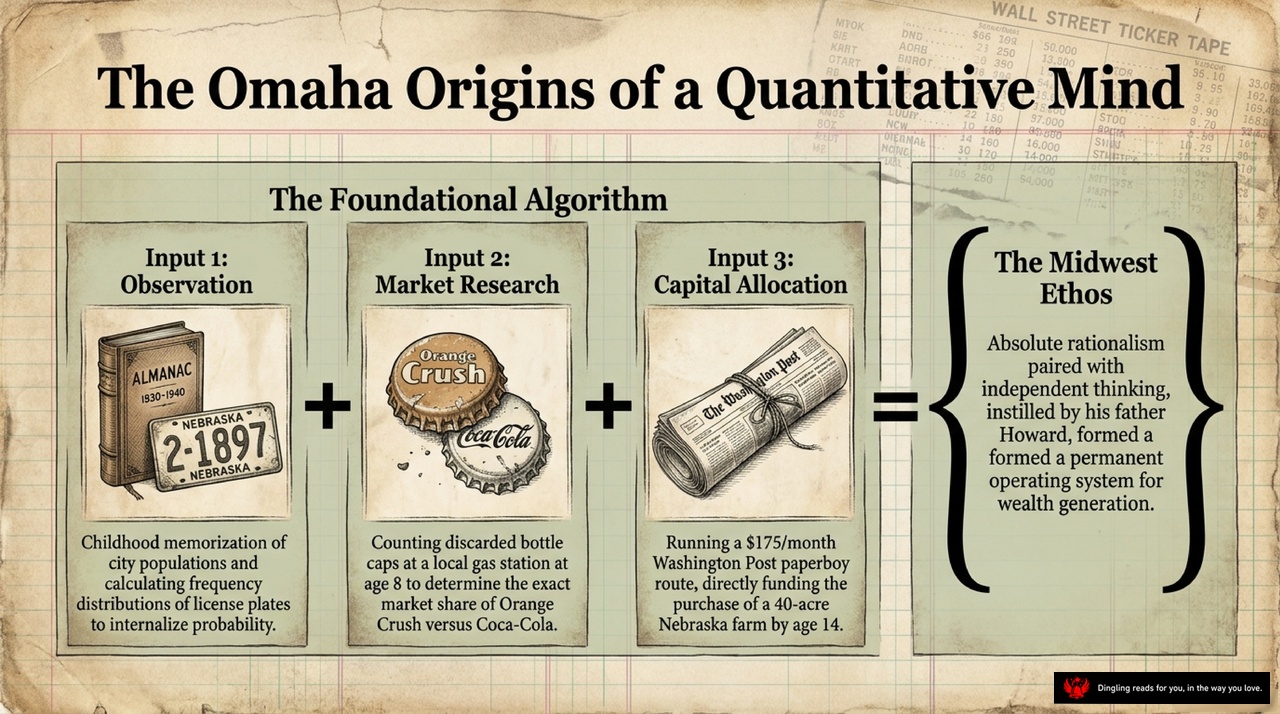
Welcome back to our book club. Today, we're diving into the very foundation of Warren Buffett's success, looking back at his childhood in Omaha. The slide you see right now breaks down what he calls "The Foundational Algorithm"—the three inputs that built his quantitative mind.
First, we have Observation. As a child, Warren didn't just play; he analyzed. He memorized city populations and even calculated the frequency of license plates on passing cars, essentially internalizing probability long before anyone else understood statistics.
Next is Market Research. Even at the age of eight, he was conducting real business intelligence. He counted discarded Orange Crush and Coca-Cola bottle caps at a local gas station to determine which brand held the market share. He wasn't just guessing; he was gathering data.
The third input is Capital Allocation. By age 14, Warren had already run a newspaper route that earned him $175 a month. He used that capital to purchase a 40-acre farm in Nebraska, proving he knew how to deploy money early and often.
When you combine these three inputs—Observation, Market Research, and Capital Allocation—you get what the slide calls "The Midwest Ethos." It's a unique blend of absolute rationalism paired with independent thinking, instilled by his father, Howard. This wasn't just about making money; it was about forming a permanent operating system for wealth generation. While other kids were just playing, Warren was building the mental framework that would eventually make him the greatest investor of our time.
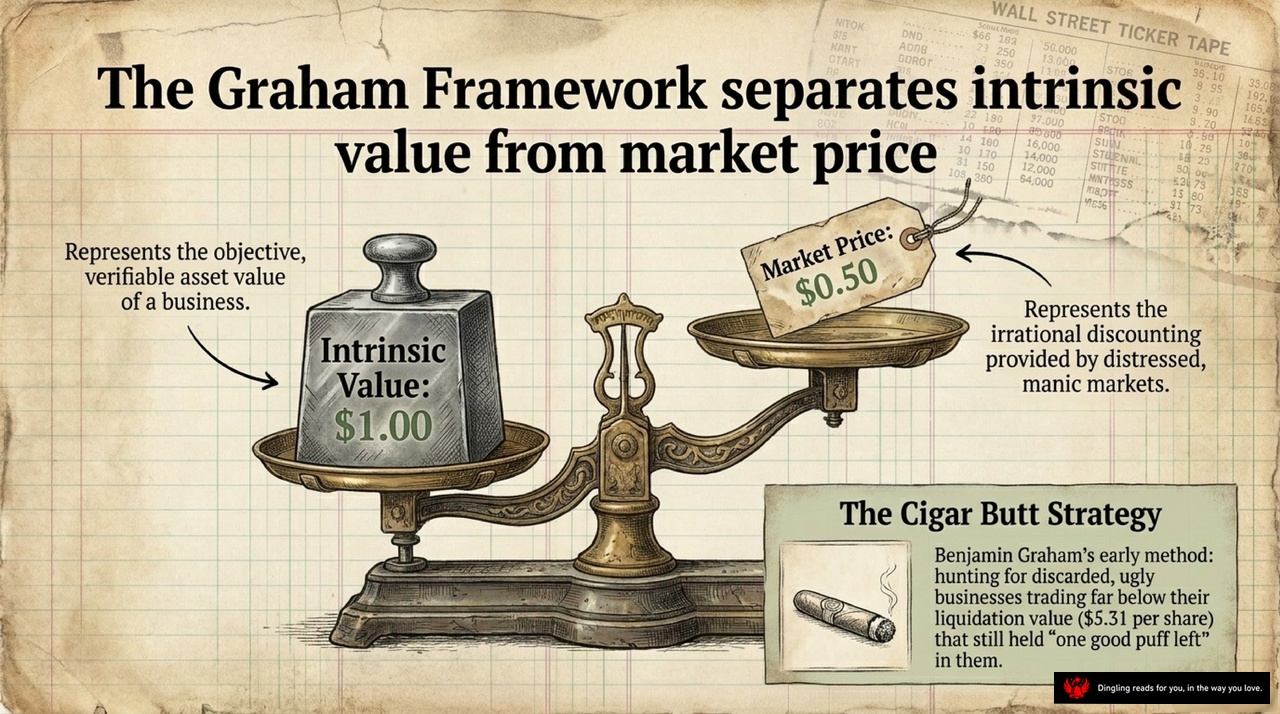
The image illustrates a fundamental shift in Warren Buffett's investment philosophy: moving from hunting for discarded assets to investing in businesses with durable value. As the scale shows, the Graham Framework separates "Intrinsic Value"—the objective worth of a business—from the often irrational "Market Price." While the early "Cigar Butt Strategy" focused on finding ugly companies trading far below their liquidation value, Buffett evolved to recognize that true value often lies in intangible assets like brand strength.
This evolution is perfectly captured by his iconic acquisition of Coca-Cola. When the stock price fell 25% after the 1987 crash, Buffett saw not a broken company, but a fortress. He viewed Coca-Cola not as a volatile stock, but as a bond with no face value, backed by a global brand moater that was four times larger than Pepsi's. He famously stated that even if someone offered him 100 billion dollars, no one could dislodge Coca-Cola's market leadership. This mindset allowed him to ignore the market's panic and buy a 7% stake for over 10 billion dollars, which eventually grew into a 37.5 billion dollar asset. By focusing on the enduring power of a brand rather than short-term price fluctuations, Buffett proved that the best investments are often the ones the market is too afraid to touch.

Mr. Market is a manic-depressive partner, not a guiding oracle. Look at this chart: it perfectly captures the emotional rollercoaster of the stock market. On the red curve, you see Mr. Market's mood swings. When he's in a state of euphoria and greed, he demands a premium for your business, often pushing prices far above reality. At those peaks, the smart investor ignores his noise or sells. But when panic and fear take over, Mr. Market becomes irrational, offering businesses at steep discounts. That is the moment the true value investor steps in to buy.
Notice the green line labeled "The Value Investor." Unlike Mr. Market, who is driven by emotion, the value investor remains steady and rational. This visualizes a core insight: the market exists strictly to serve the investor with opportunities, never to inform the investor of a business's true worth. When everyone else is fearful, you should be greedy. When everyone is greedy, you should be fearful. This graph reminds us that the market is a voting machine in the short term, but a weighing machine in the long term. Your job is to weigh the business, not to get caught up in the market's temporary emotions.
In the late 1980s, Wall Street was swept up in a fever pitch for Leveraged Buyouts, a trend driven by cheap debt and aggressive speculation. It was in this chaotic environment that Warren Buffett faced one of the most critical tests of his career: the crisis at Salomon Brothers. By 1990, the firm's culture had become toxic, marked by reckless trading and a complete disregard for rules. The situation deteriorated until the government suspended Salomon's ability to auction government bonds, effectively cutting off its lifeblood and threatening immediate bankruptcy.
At this point of existential danger, Buffett stepped in as Chairman. He didn't just offer money; he offered a moral reckoning. He demanded a complete overhaul of the company's culture, famously introducing the "Newspaper Test" to every employee: "Would you be ashamed if your actions were printed on the front page of tomorrow's local paper?" This simple principle of integrity became the new foundation for Salomon.
Under Buffett's leadership, the firm survived the crisis, paying a $290 million fine but avoiding criminal charges. However, the cost was high. Salomon lost hundreds of employees, and the old guard was purged. Yet, the company emerged stronger, more ethical, and financially stable. This rescue operation wasn't just about saving a business; it was a powerful demonstration of Buffett's core belief that trust and character are the ultimate currencies in investing. While the rest of Wall Street chased short-term gains and complex derivatives, Buffett proved that true value lies in building institutions that are honest, reliable, and built to last forever.
Imagine a world where the smartest money managers aren't chasing the next hot trend, but are instead building unshakeable empires on the backs of trusted brands. This is exactly where Warren Buffett found himself in the 1990s. While the rest of Wall Street was obsessed with high-leverage deals and risky financial engineering, Buffett was quietly consolidating his position on what truly matters: durable competitive advantages.
Look at the chart on your screen. It captures a pivotal moment in his strategy: the shift from hunting for cheap assets to acquiring whole businesses with massive moats. We see this clearly in his acquisition of Gillette. At a time when everyone else was looking at short-term trading opportunities, Buffett recognized Gillette's global dominance in the razor market. He didn't just buy a stock; he bought a monopoly with pricing power that competitors couldn't touch. Similarly, his stake in Wells Fargo during the banking crisis wasn't about speculation; it was a bet on the bank's low-cost structure and long-term resilience. Even his controversial convertible bonds with companies like American Airlines and International Paper were calculated moves to protect his massive capital base during turbulent times.
But perhaps the most defining chapter of this era was his rescue of Salomon Brothers. As the chart illustrates, Buffett's influence went beyond just picking stocks; it became about saving institutions from collapse. When Salomon faced a regulatory crisis that threatened to wipe out the firm, Buffett stepped in not as a speculator, but as a guardian of the system. He made the difficult decision to slash executive bonuses and restructure the entire culture, proving that true value comes from integrity and long-term thinking, not quick profits.
The lesson here is profound. While the market was distracted by complex derivatives and leveraged buyouts, Buffett was doubling down on the basics: buying wonderful companies at fair prices and holding them forever. His portfolio of Coca-Cola, Gillette, and his insurance float turned into a money-printing machine, generating returns that no high-frequency trading algorithm could ever match. This era cemented his legacy not just as a great investor, but as a steward of American capitalism who proved that patience and principle are the most powerful forces in finance.

Imagine a world where investing isn't about chasing the next hot trend, but about understanding the very nature of value itself. Today, we look at the "Investment Evolution Matrix," a framework that perfectly captures Warren Buffett's journey from a novice to a legend.
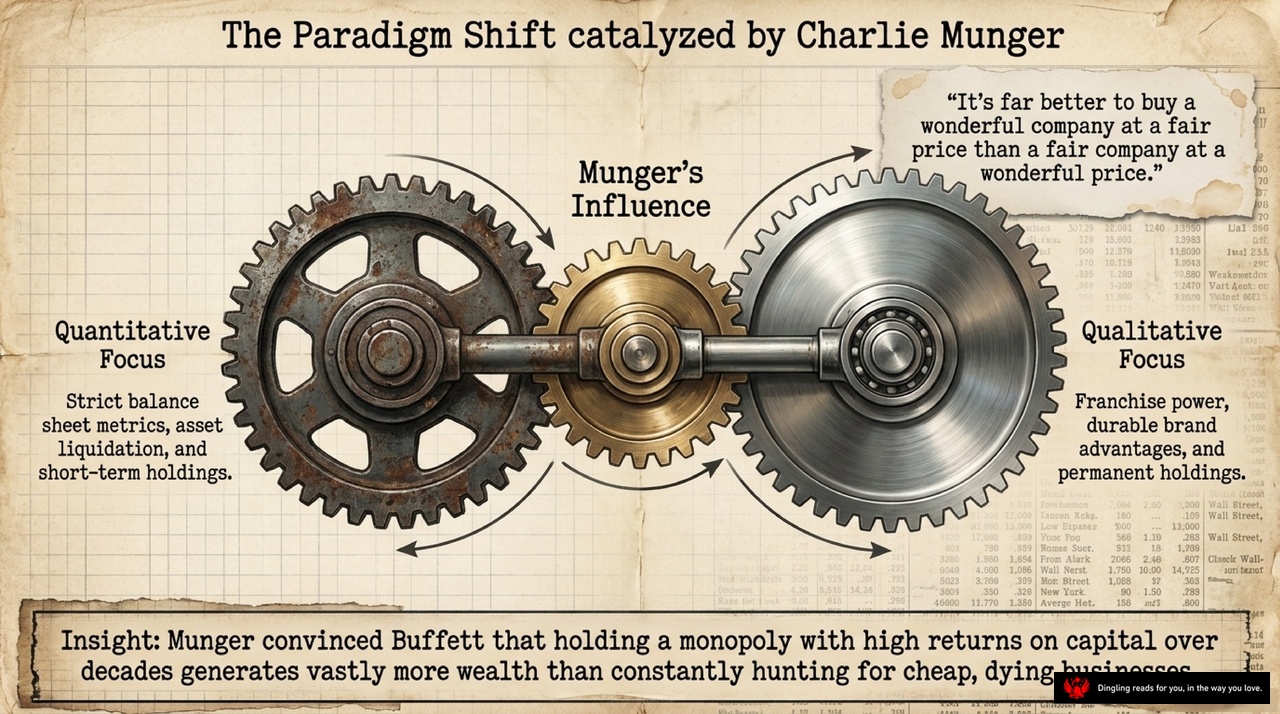
On the left, we see the "Cigar Butts" of the early era. Think of these as distressed, ugly, dying industries. The target profile here is companies that are practically bankrupt, offering no hope for the future. The primary metric is purely quantitative: you only buy if the price is strictly below the liquidation value. You are essentially buying a broken factory for less than the scrap metal it's worth. The holding period is short-to-medium; you buy it, you fix it or liquidate it, and you sell the moment the price corrects. A classic example is Dempster Mill, a failing windmill manufacturer that was liquidated for parts. This was the "smoke-filled room" approach of the past—buying what was left behind because it was cheap.
Now, look to the right. This represents the "Great Franchises" of the mature era. The target profile shifts dramatically to dominant consumer monopolies with real pricing power. Think of brands like American Express or Disney—companies that own the market. Here, the primary metric becomes qualitative. You aren't just looking at numbers; you are analyzing Return on Capital, brand strength, and management quality. The holding period? Simple: Forever. You buy these companies because they generate cash flow indefinitely, requiring no constant maintenance.
The evolution is clear. Buffett moved from hunting for "cigar butts"—companies so broken they were free for the taking—to acquiring "great franchises"—companies so strong they could print money. He realized that while a bargain price on a dying business is a great deal, owning a thriving monopoly with a moat is a superior strategy. This shift from quantitative discounts to qualitative dominance is the key to understanding how Buffett built the empire we know today.

Imagine a self-sustaining money machine where the fuel is free. This is the power of insurance float, and it serves as the zero-cost engine for compounding at the heart of Berkshire Hathaway's success. As the diagram illustrates, the process begins with inflow: policyholders pay upfront premiums to entities like National Indemnity and GEICO. This creates a reservoir of cash that Berkshire holds but does not yet own, waiting to pay future claims.
Here is the magic step: because disciplined underwriting ensures that premium intake matches future claims, this float acts as an infinite, zero-interest loan. Instead of paying interest to a bank, Berkshire uses this capital to power corporate acquisitions and invest in high-yield equities. Buffett allocates this cost-free float into these compounding assets, generating profits that remain entirely with Berkshire. Eventually, claims are paid out, but the engine keeps turning, fueling the next cycle of growth without any interest expense. It is a brilliant loop where money works for you, not against you.

Imagine your business as a toll bridge. If you control the only path to your customers, you don't just collect a fee; you own the flow itself. This is what we call "Pricing Power," and it's the ultimate moat. As the slide illustrates, a true toll bridge allows an owner to raise prices during inflation without losing traffic. Think of it like a global brand monopoly, such as Coca-Cola, which can sell billions of servings with a guaranteed profit because consumers have no other choice.
But how do you build this bridge? It starts with a deep "moat" of consumer habit and high barriers to entry. In the past, a local media monopoly acted like a fortress, controlling the only road to the audience. Today, that looks like a global brand that has become the default choice for everyone. The key takeaway is simple: a business is only a toll bridge if it can continuously raise prices without risking its market share or needing massive capital to stay competitive. When you find that bridge, you stop chasing growth and start collecting the toll.
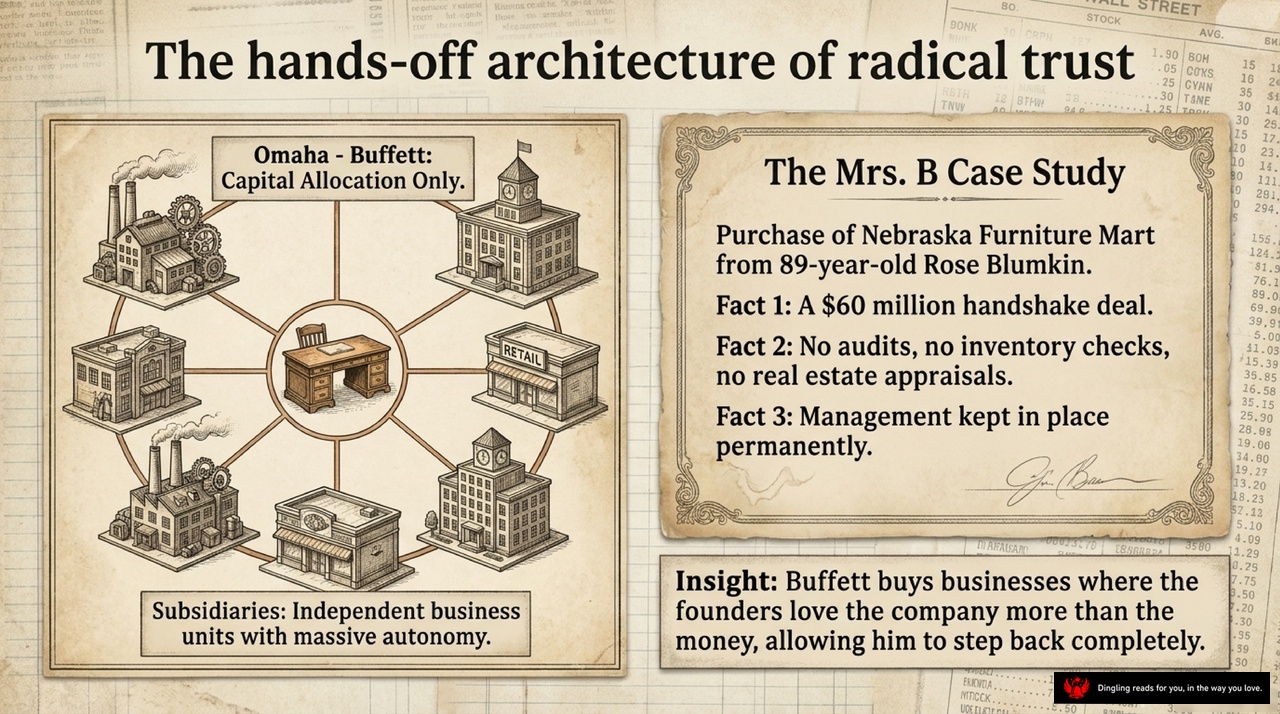
Look at this diagram illustrating the "hands-off architecture of radical trust." On the left, you see Omaha, where Buffett's role is strictly limited to capital allocation. He doesn't micromanage the factories or the retail stores; instead, he connects them all to a central hub of independent subsidiaries. Each of these business units operates with massive autonomy, running their own show while Buffett simply provides the fuel.
This structure was tested perfectly in the "Mrs. B Case Study" on the right. Think about this: Buffett purchased the Nebraska Furniture Mart from an 89-year-old founder, Rose Blumkin, for a staggering $60 million handshake deal. Here is the radical part—there were no audits, no inventory checks, and absolutely no real estate appraisals. He trusted her completely. Furthermore, he didn't replace her management team; he kept her in place permanently.
The insight here is profound. Buffett buys businesses where the founders love the company more than the money. Because the founder cares so deeply about the business's soul, they naturally run it with integrity. This allows Buffett to step back completely. He knows that if he tries to interfere, he would destroy the very culture that makes the business valuable. By buying businesses run by people he trusts and then letting them be, he creates a self-sustaining empire that requires no constant supervision.
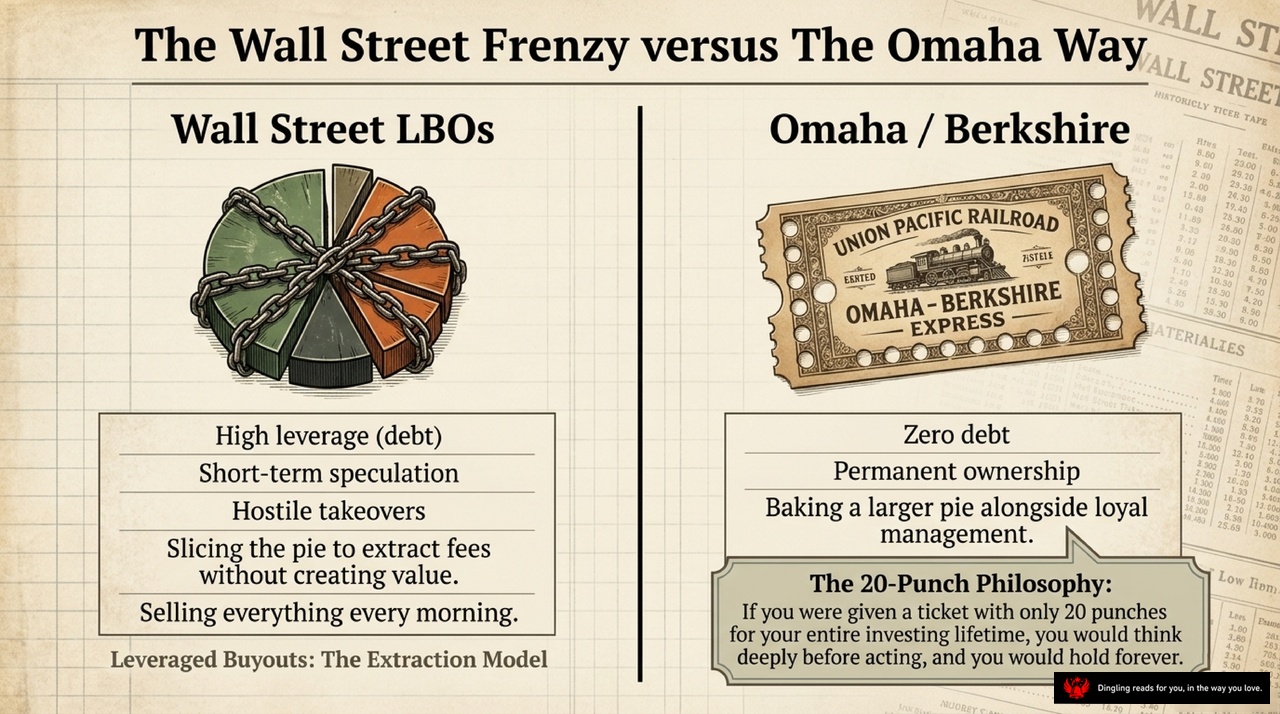
Look at this slide comparing the Wall Street frenzy to the Omaha way. On the left, we see Wall Street LBOs depicted as a pie chart bound by heavy chains. This visual perfectly captures the "Extraction Model." It's all about high leverage, short-term speculation, and hostile takeovers. The logic here is simple but ruthless: slice the pie to extract fees without creating any real value, and essentially sell everything every morning. It's a game of financial engineering where the goal is just to take money from the company, often leaving it worse off in the process.
Now, look to the right. That's the Omaha or Berkshire approach, symbolized by a vintage ticket for the "Omaha-Berkshire Express." This represents permanent ownership and zero debt. Instead of slicing the pie, the goal is to bake a larger one alongside loyal management. This is about building long-term partnerships and creating genuine value. The slide highlights a crucial concept called the "20-Punch Philosophy." Imagine you only had 20 punches for your entire investing lifetime; you would think deeply before acting and hold onto your assets forever. This stands in stark contrast to the frantic trading on the other side. It's about patience, trust, and staying the course, proving that the smartest move isn't always the fastest one.

Imagine you were handed a ticket with only twenty punches for your entire lifetime. Every punch represents one investment opportunity, and once they're gone, they're gone forever. How would you spend them? This thought experiment, featured on our slide, cuts straight to the heart of Warren Buffett's greatest lesson: wealth isn't about how smart you are or how many secrets you know; it's about the power of psychological consistency.
Buffett's unparalleled compounding wasn't built on secret algorithms or insider trading. It was the triumph of character over intellect. By maintaining absolute psychological independence, refusing to play games he didn't understand, and holding onto exceptional assets forever, he transformed Midwestern stoicism into the ultimate financial moat. While the market swings wildly, chasing the next hot trend, Buffett remains anchored. He doesn't try to predict the future or time the market. Instead, he focuses on what he can control: his own discipline.
This mindset allows him to do something almost impossible for most investors: wait. Whether it's sitting through a market crash to buy quality assets at a bargain or holding a brand like Coca-Cola for decades without panic, consistency is his superpower. It's not about making a million dollars in a day; it's about making a little bit of money every day, consistently, for decades. So, if you only had twenty chances in your life, would you waste them on fleeting trends, or would you use them to build something that lasts? That is the choice that defines true wealth.