
The Man in the High Castle: Complete Chapter-by-Chapter Summary

Welcome to our deep dive into Philip K. Dick's masterpiece, *The Man in the High Castle*. Tonight, we aren't just reading a story about an alternate history where the Axis powers won World War II; we are stepping into a world built on the ashes of our own, where reality itself is a fragile construct.
As the slide suggests, this book is a philosophical deconstruction of reality and authenticity. Imagine a world where the United States is split: the West Coast is a Japanese colony, and the East Coast is a Nazi stronghold. In this dystopia, history has rewritten itself. Germany and Japan aren't just occupying territories; they are reshaping the very fabric of society, culture, and human identity.
But here is where it gets truly mind-bending. The narrative is woven through the metaphysical paths of the I Ching, the ancient Book of Changes. In this world, the future isn't just something that happens; it's something that can be predicted, and perhaps even influenced, through divination. Characters constantly consult the I Ching to decide their next move, treating the universe as a puzzle with answers waiting to be revealed.
At the heart of this story lies a haunting question: What is real? Is the world we see the true world, or is it merely a fiction we've been told? The book challenges us to question our own reality, asking if our lives are as fixed and certain as we believe them to be. It's a thrilling, terrifying, and ultimately profound exploration of what it means to be human in a world that refuses to make sense.
So, let's turn the page and step into the shadows of the High Castle, where the line between truth and illusion is dangerously thin.

Look at this map. We aren't looking at the United States as you know it anymore. We are staring into a fractured future where the nation has been conquered and carved up by foreign empires. The screen is split into three distinct zones, each representing a terrifying new reality.
On the left, in the Pacific, lies the Pacific States of America. This isn't the land of the free anymore; it is now governed by the Japanese Empire. It's a society built on rigid protocol and trade missions, a place where ordinary Americans are forced to live in silence, revering pre-war artifacts as if they were museum pieces rather than their own heritage.
In the center, stretching across the continent, is the Rocky Mountain States. This is the neutral, desolate buffer zone. It's a wasteland where outcasts, fugitives, and ordinary people who can't fit into either empire try to live unnoticed. It's the only place left that feels vaguely like a refuge, though it's nothing more than a desperate holding pattern.
And then, dominating the eastern half of the country, is the Greater German Reich. This is an expansionist, hyper-technological superpower that has extended its grip all the way into space. It is embroiled in ruthless internal power struggles following the death of Martin Bormann. This is where the future belongs for the Nazis, a dark, red territory where technology meets tyranny.
This map illustrates the geopolitical divide of a conquered nation. It shows a world where the American dream has been shattered, replaced by a cold, calculated partition between an Eastern Nazi superpower and a Western Japanese empire, with the heart of America left in the shadows in between.
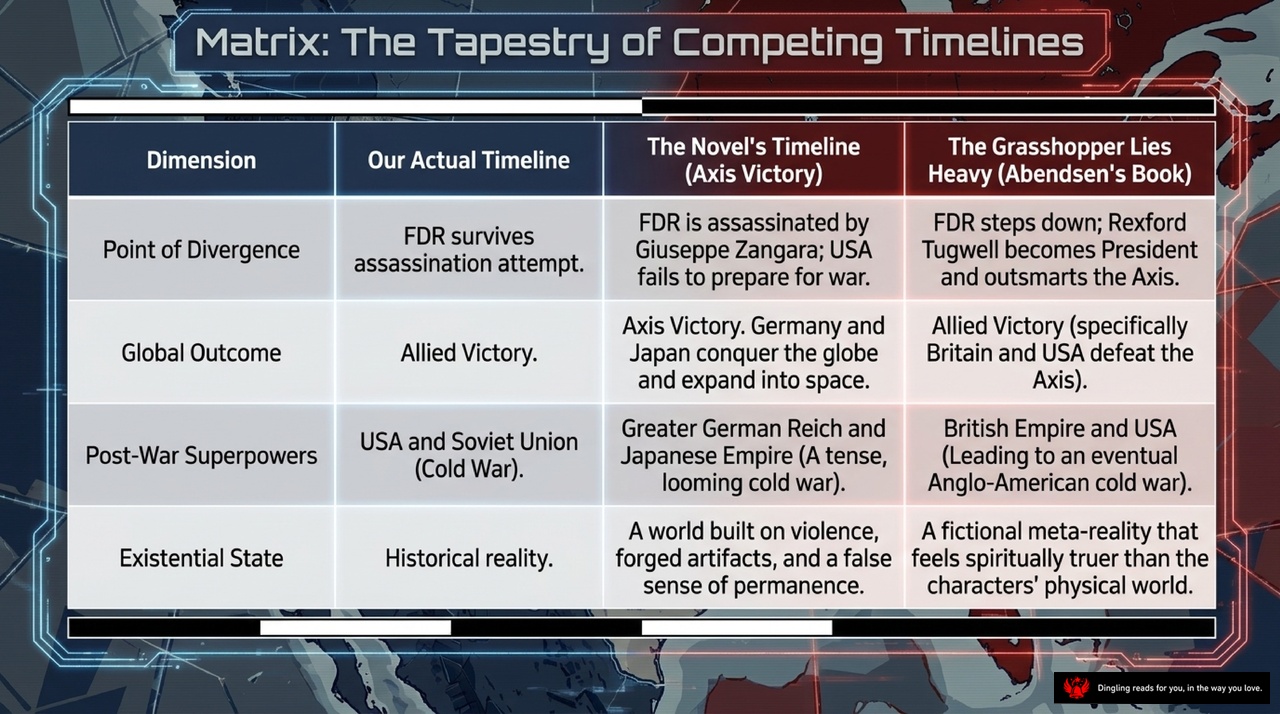
Welcome back to our deep dive into *The Grasshopper Lies Heavy*. Today, we are unpacking the very heart of the novel's unique structure: the "Matrix of Competing Timelines."
As you can see on this slide, we are comparing three distinct realities. First, our actual timeline where FDR survives, leading to Allied victory. Then, the timeline of the novel itself, *The Grasshopper Lies Heavy*, where FDR is assassinated, the Axis wins, and a Greater German Reich dominates the globe. But there is a third, fascinating dimension: the timeline presented in the book *The Grasshopper Lies Heavy*—which is actually a fictional meta-reality where the Allies win.
This comparison reveals the novel's core argument. In the novel's world, the Axis powers conquer everything, expanding into space, creating a tense cold war between the German and Japanese empires. It is a world built on violence and forged artifacts, yet it feels disturbingly permanent. In contrast, the world described in *The Grasshopper Lies Heavy*—the one we are reading—is an Allied victory. Here, Britain and the USA defeat the Axis, leading to a different kind of cold war between the British Empire and the USA.
But why does this matter? The slide points out that while our actual history is just a historical reality, the fictional world of *The Grasshopper Lies Heavy* feels spiritually truer to the characters. It suggests that the "Axis Victory" world in the novel is a false sense of permanence, whereas the "Allied Victory" world, though fictional, represents a more authentic human experience.
This matrix isn't just a chart; it's the philosophical engine of the story. It forces us to ask: Which world is the real one? And why does the world where the bad guys win feel so much more real to the people living in it? This tension drives every character's journey, from the jeweler Frank to the shopkeeper Robert, as they navigate these conflicting realities. We will explore how this "tapestry" shapes their choices in the coming chapters.

Welcome back to our deep dive into the Axis World. Today, we're unpacking a pivotal moment where our three main characters—Robert Childan, Frank Frink, and Juliana Frink—find themselves at a crossroads, each grappling with the terrifying new reality of a world where the Axis powers have won.
Let's start with Robert Childan. You remember his anxiety over the fake Confederate pistols? That nightmare isn't over. A former customer, a Jewish man named Frank, has been arrested for fraud and is now being handed over to the German consulate to face execution. Childan, who has spent his life seeking validation from his Japanese superiors, is finally forced to confront the brutal truth of his own moral cowardice. He realizes that by choosing the "easier path" of silence, he has become complicit in a system that destroys innocent people. He's trapped between two evils, and the silence feels louder than ever.
Meanwhile, our Jewish fugitive, Frank Frink, has hit rock bottom. After his failed jewelry venture, he's been arrested and sentenced to death by the Nazis. But just as hope seems lost, a twist of fate—thanks to a bureaucratic mix-up involving a released prisoner—sends him back to his workshop. It's a miraculous reprieve, but Frank knows the war isn't over for him. He's still a hunted man, still running, still trying to find meaning in a world that wants him dead.
Then we have Juliana, the former judo instructor. Her journey takes her from the safety of the buffer zone to the heart of the action in Denver. There, she's not just a bystander; she's a witness to the horror. She sees the true colors of the "fascist" Italian driver she thought was just a romantic fantasy. He's actually a SS assassin sent to kill the author of the forbidden book, *The Locusts*. The tension snaps when she realizes the truth. In a moment of desperate courage, she turns the tables, slashing his throat with a razor and fleeing into the night. She's no longer just surviving; she's fighting back.
But the most profound moment on this page belongs to Juliana's final confrontation with the author, Hawthorne Abendson. She tracks him down to warn him that the world he described in his book—the one where Germany and Japan lose—is actually the real future. When she reveals this, Abendson doesn't run. He doesn't hide. Instead, he stands firm, declaring that fear cannot dictate his life. He has already written the truth, and he is ready to face the consequences.
This scene is a powerful reminder that in the face of overwhelming darkness, the choice to speak the truth, even when it's dangerous, is the only way to preserve our humanity. As Juliana leaves that house, feeling a strange sense of rebirth, we are left with a question: In a world where the winners are the monsters, what does it mean to be a human being? That's the challenge we all face.

In a conquered America, the victors obsess over pre-war artifacts, believing that value is built on a shared delusion: a fake object plus a fabricated history equals perceived cultural value. This is the "Axis Delusion," where Robert Childan's antique trade thrives on selling forged Civil War posters and fake Mickey Mouse watches, convincing buyers that history is real simply because they believe it is.
But there is a different path. The Edfrank Revelation offers a powerful alternative: a new object plus authentic human creation equals real spiritual value, or what we call "Wu." This isn't about what something was in the past, but what it means in the present. Consider Frank Frink's original, formless silver jewelry. Created without any historical precedent, these pieces have no age to prove their worth. Yet, because they are imbued with inner truth and human intent, they possess a profound, undeniable spiritual value.
The contrast is stark. One side clings to the illusion of historicity, trading in lies and nostalgia. The other embraces the reality of 'Wu,' finding true worth in the raw, unadorned expression of the human spirit. It is a choice between a museum of fakes and a workshop of truth.

Welcome back to our journey through the novel. Today, we focus on the pivotal moment where the Edfrank pin finds its true purpose. This slide maps out the entire lifecycle of this mysterious artifact, from its humble beginnings to its ultimate awakening.
Let's start at the beginning with **Creation in the Workshop**. This is where Frank Frink, a Jewish fugitive fleeing the chaos of the Pacific Alliance, channels his deep anxiety and lost creativity into crafting an original, formless silver pin. It's not just jewelry; it possesses 'Wu'—an inexplicable, authentic life force born from his struggle to survive.
Next, we move to **Distribution at the Antique Shop**. Here, Robert Childan reluctantly takes the pin on consignment. Initially, he views it as worthless because it lacks traditional historicity. He doesn't understand its spiritual weight, seeing it only as a piece of metal without a story.
Then comes the crucial **Validation by the Aristocrat**. Enter Paul Kasoura, an educated Japanese elite. He recognizes the spiritual weight of the pin immediately. By suggesting it has the authority of true art, he terrifies Childan and validates the pin's hidden power. This moment shifts the pin from a commodity to a sacred object.
Finally, we reach **Awakening in the Official's Park**. Mr. Tagomi, a high-ranking official, purchases the pin. But the real magic happens when he holds it in the park. The artifact's 'Wu' acts as a metaphysical anchor, briefly transporting him out of his rigid timeline and into our actual reality. It's a profound reminder that art can bridge the gap between worlds and touch the very soul of the observer.

The Metaphysical Engine: Consulting the Oracle. In this world, characters don't rely on free will; they surrender their agency to the I Ching, believing it taps into the synchronicity of the universe. Let's break down how this ancient system functions as a predictive tool.
First, we have the Cast. You manipulate 49 yarrow stalks or use three coins to generate a numeric value, creating the foundation for the reading. Next comes the Lines. Even numbers generate a Yin line, representing broken, passive, and dark energy, while odd numbers create a Yang line, symbolizing solid, active, and light forces.
From these lines, we build the Hexagram. Six lines are constructed from the bottom up to form one of the 64 possible hexagrams, representing the precise spiritual state of the moment. Finally, we look at the Changing Lines. A 6 or 9 indicates a state in flux, pointing to a second, future hexagram that guides the character's next action. It's a dynamic process where the present state evolves into a future state, revealing the path forward through the chaos.

Divining the Paths: The Oracle in Action. This slide breaks down how the I Ching guides our three main characters through their darkest moments.
First, Frank Frink. He's facing Hexagram 15, Modesty. After losing his job and fearing the blacklist, the oracle tells him: "The low will be raised, the high will be brought down." It's a call to pivot. Instead of fighting the system, he's encouraged to start his own jewelry business and create authentic art.
Next is Mr. Tagomi. He's under Hexagram 47, Oppression. As an undercover spy, he's sensing the looming threat of the SS and internal betrayals. The guidance warns of a heavy burden and deviation from the Tao. To protect his guests, Tagomi is forced into an unnatural act of violence, killing two men. It's a moment where duty demands a terrible sacrifice.
Finally, Juliana Frink. She consults Hexagram 44, Coming to Meet, regarding her ex-husband Frank. The oracle reveals that the maiden she seeks is powerful and unpredictable. The guidance is clear: one should not marry such a maiden. Juliana is an unpredictable force destined to unravel the Nazi assassin's plot on her own terms.
Together, these hexagrams show that when we face oppression or uncertainty, the path forward isn't always linear. Sometimes, we must pivot, sometimes sacrifice, and sometimes, we must trust our own unpredictable power to change the course of history.

Look at this split screen. On the left, we see a misty, historical Japan with rickshaws and traditional architecture, where a figure sits alone on a bench holding a glowing silver pin. On the right, it's the brutal reality of 1940s America under Nazi occupation: a chaotic highway under an elevated freeway, and a stern white police officer staring back at us. This image captures the exact moment Tagomi's world fractures.
Traumatized by the violence he has committed and horrified by the Nazi regime's atrocities, Tagomi retreats to a park bench. Clutching the Edfrank silver pin, he tries to find answers through meditation. But the object's intense authenticity acts as a metaphysical wedge. Suddenly, his perception is ripped out of the Axis timeline. For a terrifying moment, he sees a monstrous structure in the sky—the Embarcadero freeway—and encounters an arrogant white police officer. It is a jarring projection into our actual, historical reality. In this split second, the illusion of his alternate world cracks, revealing the true, terrifying history that has been erased from his mind.
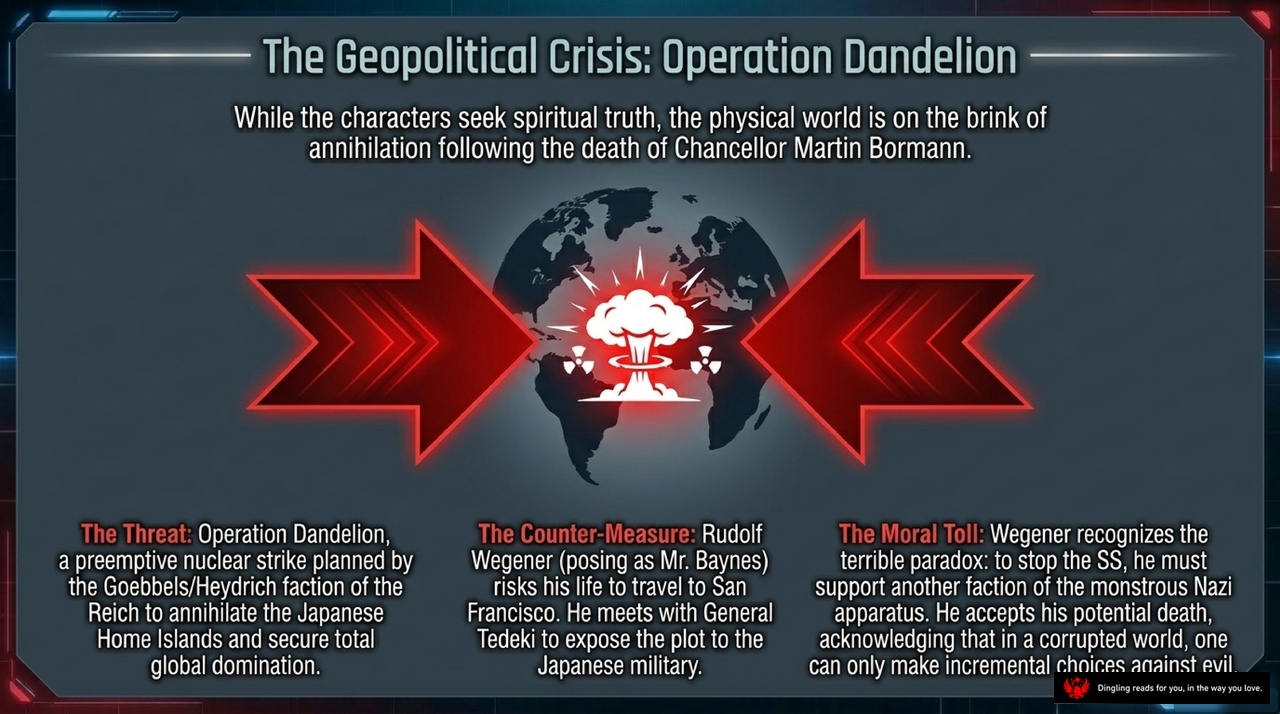
Look at this dramatic setup: Operation Dandelion. While the characters are chasing spiritual truths, the physical world is teetering on the brink of total annihilation after Chancellor Martin Bormann's death. The stakes couldn't be higher.
We see two massive red arrows converging on a nuclear explosion over the globe. This is the threat: a preemptive strike planned by the Goebbels and Heydrich faction to annihilate Japan and secure global domination. But there is a counter-measure. Rudolf Wegener, posing as Mr. Baynes, risks everything to travel to San Francisco. He meets with General Tedeki to expose the plot to the Japanese military.
This brings us to the moral toll. Wegener faces a terrible paradox: to stop the SS, he must actually support another faction of the monstrous Nazi apparatus. He accepts his potential death, acknowledging that in a corrupted world, one can only make incremental choices against evil. It's a grim reality where stopping the greater evil might require complicity with a lesser one.
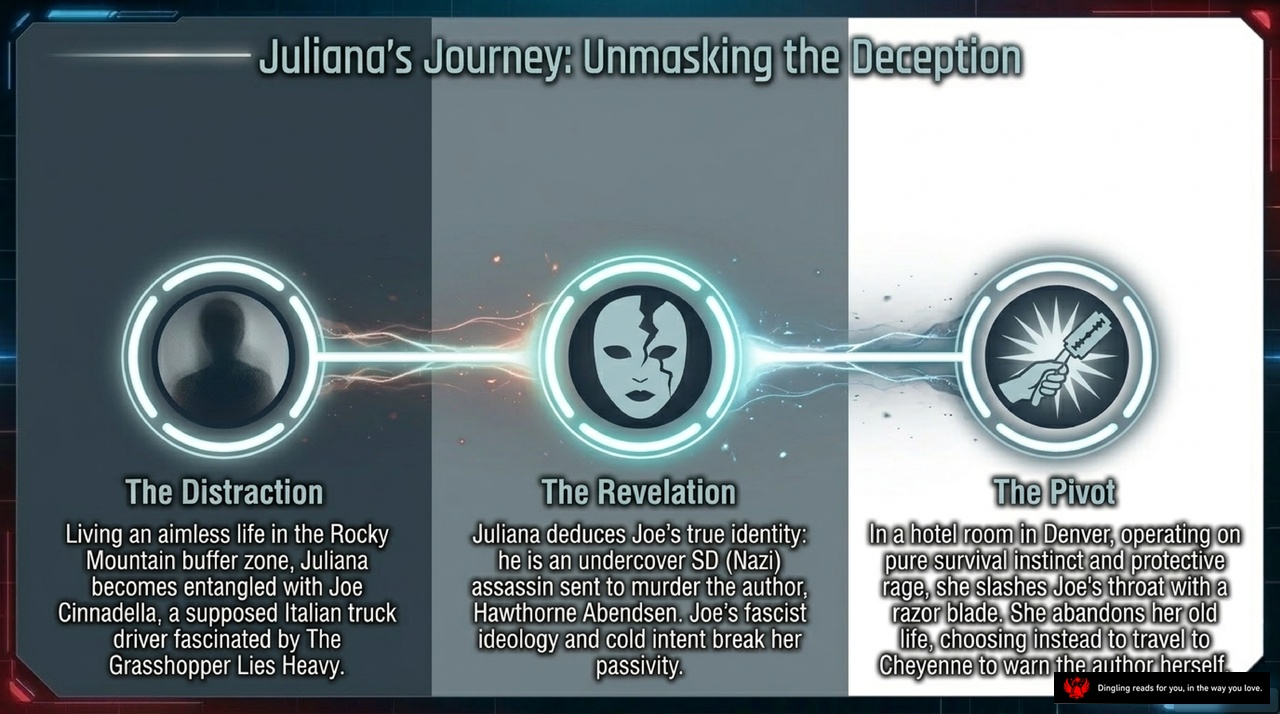
Juliana's Journey: Unmasking the Deception. This slide breaks down her life-changing arc into three critical phases. First, The Distraction. Juliana is living an aimless life in the Rocky Mountain buffer zone, entangled with Joe Cinnadella, a supposed Italian truck driver fascinated by Hawthorne's book, *The Grasshopper Lies Heavy*. But this connection is a trap. Second, The Revelation. Juliana deduces Joe's true identity: he is an undercover SD assassin sent to murder the author, Hawthorne Abendsen. Joe's fascist ideology and cold intent shatter her passivity, forcing her to see the truth. Finally, The Pivot. In a hotel room in Denver, operating on pure survival instinct and protective rage, she slashes Joe's throat with a razor blade. She abandons her old life, choosing instead to travel to Cheyenne to warn the author herself. This is the moment she stops being a bystander and becomes the hero of her own story.

The Tapestry of Realities: The Nested Worlds. Philip K. Dick constructs a maze of overlapping truths, proving that reality is subjective and fragile. Look at this diagram. We live in "Our Reality," where the Allies won and the Cold War began. But inside the novel, the characters inhabit "The Novel's Reality," a nightmare where the Axis powers conquered and America fell. Yet, there is a third layer: The Meta-Reality. This is the world of *The Grasshopper Lies Heavy*. In this book, the Allies actually win, but in a way that feels structurally different from our own history. To the characters trapped in the Nazi nightmare, this fictional world feels infinitely more real and morally true than the dystopia they live in. It forces us to ask: which version of the truth is actually the one we should be living in?

Juliana arrives at the High Castle—which is just a normal house—and forces Hawthorne Abendsen to consult the I Ching regarding why it wrote The Grasshopper Lies Heavy. The Oracle casts Hexagram 61: Chung Fu (Inner Truth). The devastating, liberating revelation: Germany and Japan did lose the war. The terrifying Axis world the characters endure is an illusion, a false reality masking the truth. Through authentic creation (the book), the oracle has communicated the ultimate metaphysical reality.
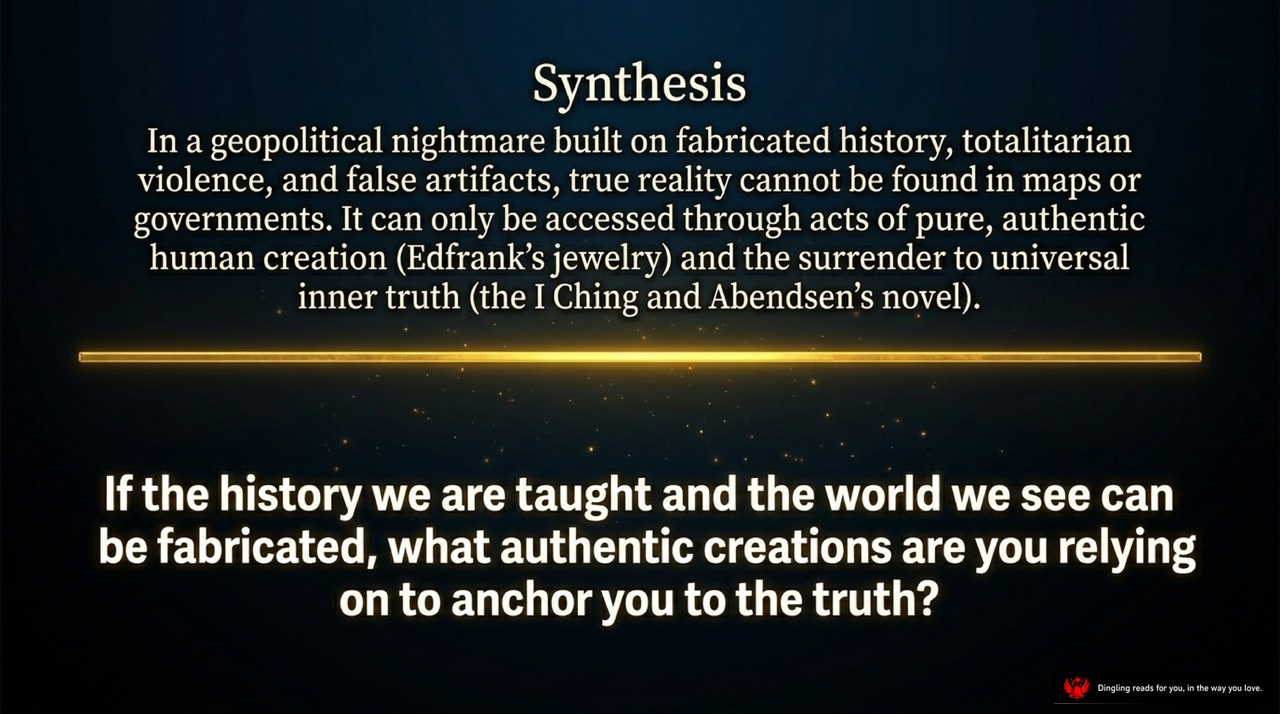
In a world where history is a lie and governments are puppets, where do we find the truth? Today, we arrive at the synthesis of our journey. The slide reminds us that in a geopolitical nightmare built on fabricated history and false artifacts, reality cannot be found in maps or state decrees. Instead, true reality is accessed through two powerful anchors: acts of pure, authentic human creation, like Ed Frank's jewelry, and the surrender to universal inner truth, found in the I Ching and Abendsen's novel.
Think about this: if the history we are taught and the world we see can be fabricated, what authentic creations are you relying on to anchor you to the truth? For Frank, it was the act of making jewelry with his own hands, refusing to let the system erase his identity. For Abendsen, it was the courage to write a forbidden book that revealed the terrifying possibility of a different future, trusting the inner truth over the official narrative.
So, I leave you with this question: When the world around you feels fake or manipulated, what is your personal "Ed Frank's jewelry"? What authentic creation, whether it's an idea, a piece of art, or a personal value, do you hold onto to stay grounded in reality? That is the only map that truly matters.