
The Man Who Solved the Market: Complete Chapter-by-Chapter Summary
Ever curious about the genius who cracked Wall Street’s market code? Today we’re exploring “The Man Who Solved the Market”—based on Gregory Zuckerman’s book. This is the story of a secretive mathematician who pioneered algorithmic trading, wiped human emotion from investing, and built the most successful money-making machine in Wall Street history. Let’s dive into how he turned math into market magic.
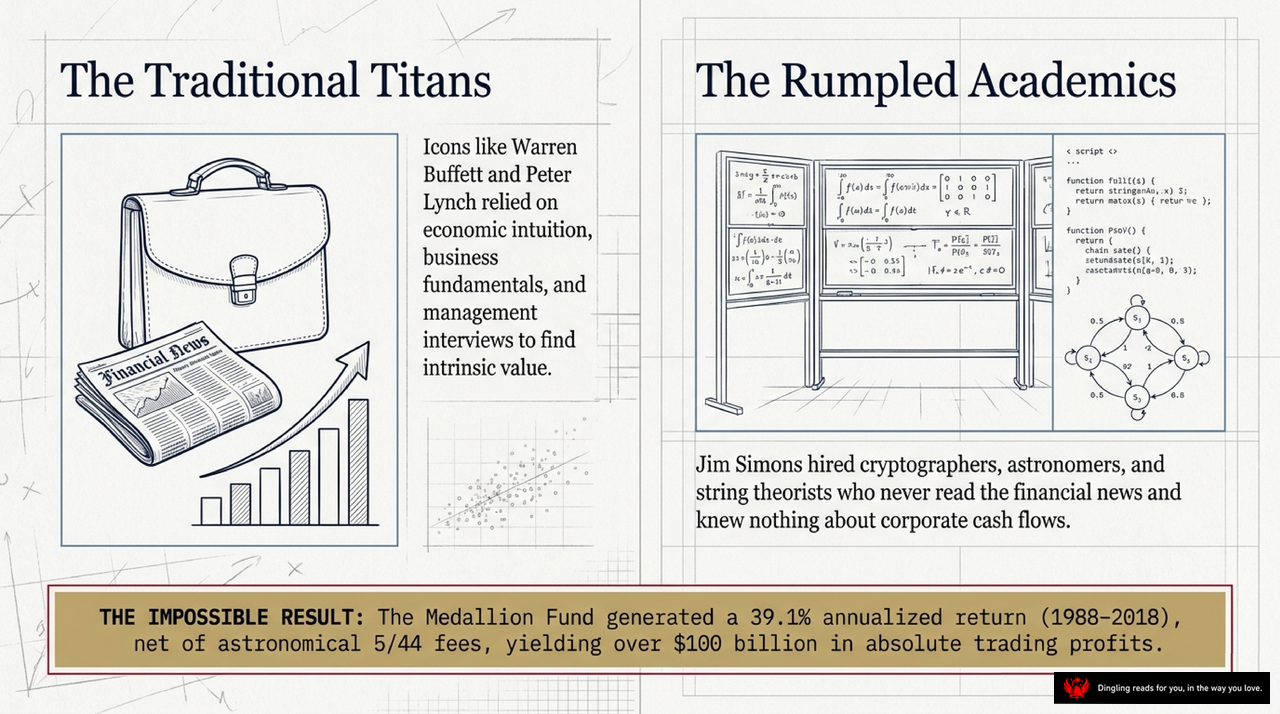
Let’s take a minute to compare two totally opposite approaches to investing—they’re like night and day.
On one side, we have the Traditional Titans: legends like Warren Buffett and Peter Lynch. These guys built their legacies on old-school strategies: trusting their economic intuition, digging into business fundamentals (think balance sheets, earnings, all that good stuff), and even sitting down with company managers to get the inside scoop. Their goal? Find a company’s intrinsic value—what it’s really worth—and buy when the price is undervalued.
Now flip to the other side: The Rumbled Academics, led by Jim Simons. Simons didn’t hire Wall Street pros or finance gurus. Instead, he brought in cryptographers (code-crackers), astronomers (star-studiers), and string theorists (theoretical physicists who work on the universe’s basic rules). These folks didn’t read financial news, and most had no clue about corporate cash flows. Sounds wild, right?
But here’s the jaw-dropper: Simons’ Medallion Fund pulled off the impossible. From 1988 to 2018, it delivered an annualized return of 39.1%—and that’s after paying the fund’s astronomical 5/44 fees (5% management fee plus 44% of profits). Over those 30 years, it raked in more than $100 billion in absolute trading profits. That’s not just impressive—it’s historic.
So what’s the takeaway? Sometimes, the most unexpected teams and out-of-the-box approaches can deliver the most extraordinary results. The traditional way works, but Simons proved that thinking way beyond finance can lead to something truly game-changing.
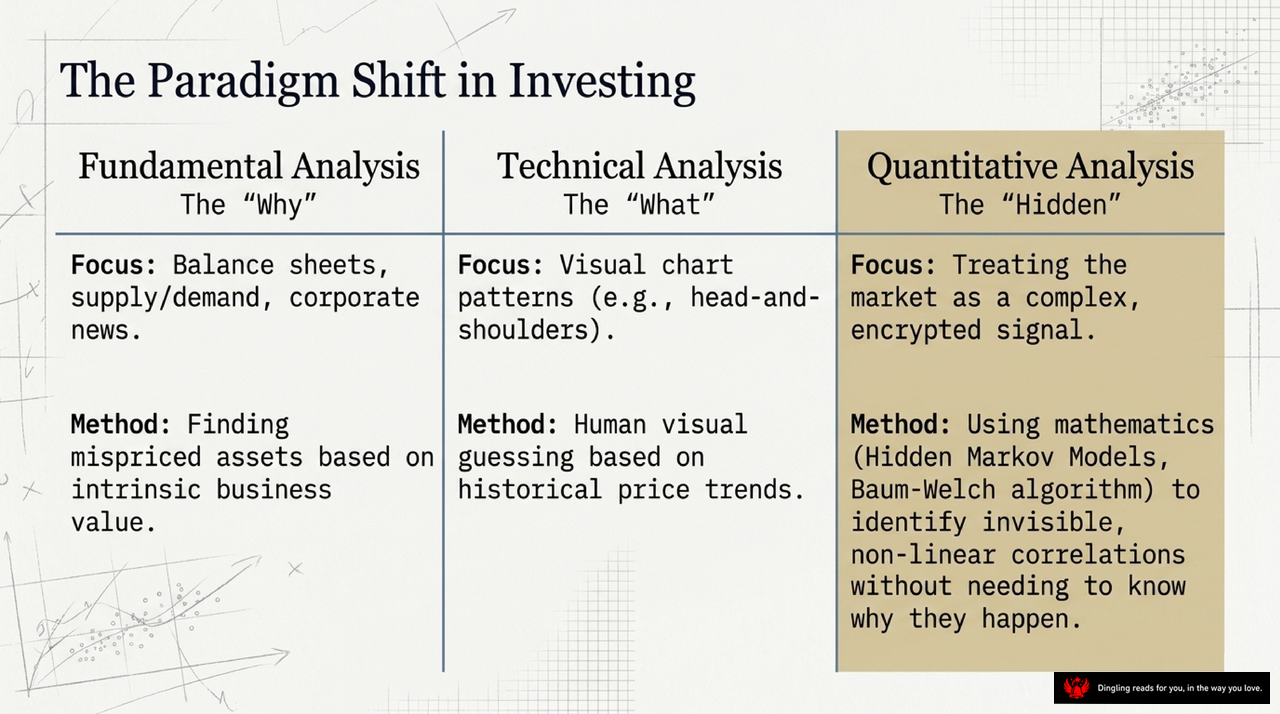
Let’s dive into the paradigm shift in investing—because how we analyze markets has come a long way. On this slide, we’ve got three core approaches: Fundamental, Technical, and Quantitative Analysis. Let’s break each down like we’re chatting over coffee.
First, Fundamental Analysis—the “Why” of investing. This is the classic approach: you dig into balance sheets, supply and demand trends, corporate news. The goal? Find mispriced assets by figuring out a company’s intrinsic value. Like, if a company’s earnings are booming but its stock price is stuck, a fundamental analyst might call it undervalued. It’s all about understanding the “why” behind a stock’s worth.
Next up: Technical Analysis—the “What”. This one’s all about visual chart patterns, think head-and-shoulders or support levels. Traders here use historical price trends to guess what’s next. It’s less about the business itself and more about what the charts are “telling” them. But let’s be real: it’s often human intuition—guessing based on what they see in the data.
Now, the game-changer: Quantitative Analysis—the “Hidden”. This is where Jim Simons made his name. Quants don’t care about balance sheets or chart patterns. Instead, they treat the market like a complex, encrypted signal. They use math tools—Hidden Markov Models, the Baum-Welch algorithm—to spot invisible, non-linear correlations. And here’s the kicker: they don’t need to know why those correlations exist. They just need to know they work. Simons’ Medallion Fund used this approach to crush the market for years, proving that the hidden patterns are where the real money is.
So from asking “why” to looking at “what” to finding the “hidden”—this shift has turned investing from an art into a science. And Simons? He didn’t just follow the trend; he created it, showing that sometimes the best way to beat the market is to let the numbers do the talking.
Imagine it’s August 2007. James Simons is in Boston, burying his mother, when his phone rings with bad news: his Medallion Fund—once the golden child of quant investing—is bleeding cash. The entire quant world is crashing; traders call it the “quant earthquake.” Back at Renaissance’s Long Island office, chaos reigns. His top lieutenants, Peter Brown and Bob Mercer, are at war: Brown wants to stick to the models, even double down, while Simons is terrified margin calls will force banks to liquidate their positions.
Somehow, they survived. By year’s end, Medallion was up 86%—a miracle when most quants were licking their wounds. Then came 2008: the financial crisis that took down Lehman Brothers and crushed the S&P 500 by 38%. Medallion? It soared 82%. Simons was summoned to Congress, where he supported more hedge fund transparency and even higher taxes on his own kind.
By 2010, at 72, Simons retired. He handed the reins to Brown and Mercer, then dived into philanthropy. He poured millions into autism research (after his son Nick died in a diving accident) and fought to fix public school math education—arguing we should reward great teachers instead of bashing bad ones to keep talent in classrooms.
But trouble loomed. Mercer, a quiet genius who loved building model trains and held extreme conservative views, started funneling millions into Republican causes—including Donald Trump’s 2016 campaign. This split Renaissance: some employees were appalled, others defended his right to his beliefs. When Mercer’s politics threatened the firm’s reputation (protests at his home, clients pulling out), Simons had to act. He asked Mercer to step down as co-CEO. Mercer agreed, though he was hurt.
Today, Renaissance is still a powerhouse. Medallion Fund—closed to outsiders—delivered 45% returns in 2018, while the S&P 500 fell 6%. Quant investing now handles a third of all market trades, but it’s not perfect: most funds don’t outperform traditional ones, and areas like distressed debt still need human judgment.
Simons, in his 80s, is still busy. He’s a top Democratic donor, fights for science funding, and his foundation is one of America’s biggest backers of basic research. After decades beating the market, he’s now chasing problems that matter more than profits—proving that even the most brilliant quant can find purpose beyond the numbers. And Renaissance? It’s still showing the world that with the right data, models, and a little human sense when it counts, you can beat the odds—again and again.
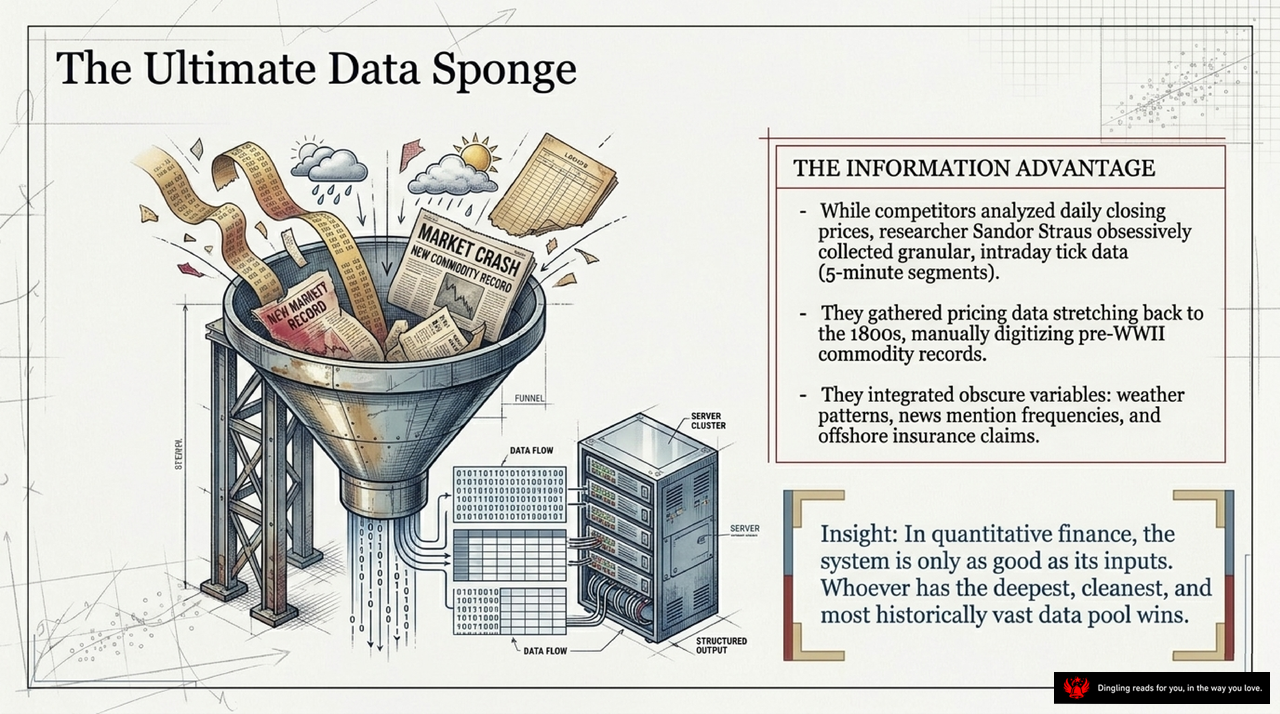
Ever wonder what separates the best quantitative finance firms from the rest? It’s not just their fancy algorithms—it’s how they treat data. Today, we’re diving into what it means to be the ultimate data sponge.
First, let’s talk about granularity. While most competitors stuck to analyzing daily closing prices, researchers like Sandor Strauss were obsessed with intraday tick data—breaking the day into 5-minute segments. Think of it this way: if daily closes are like reading the first and last page of a book, 5-minute data is devouring every chapter, every paragraph. It captures the tiny, fleeting market movements others miss—movements that add up to big returns over time.
Then there’s historical depth. These teams didn’t stop at recent data; they dug all the way back to the 1800s, manually digitizing pre-WWII commodity records. That’s hours of painstaking, unglamorous work, but it gives them a context no one else has. When a market pattern repeats, they can say, “Hey, we’ve seen this before—back in 1927, and here’s how it played out.” That historical perspective is invaluable.
And let’s not forget the obscure variables: weather patterns (directly impacting crop prices), news mention frequencies (gauge market sentiment), even offshore insurance claims (hint at global supply chain disruptions). These aren’t typical financial metrics, but they’re gold for finding hidden signals others overlook.
The insight here is simple but powerful: in quantitative finance, your system is only as good as its inputs. Whoever has the deepest, cleanest, and most historically vast data pool wins. It’s not about being smarter—it’s about being more thorough. This rigor is why top funds outperform consistently: they don’t just react to trends; they predict them using every possible piece of information. That’s the secret to turning data into dollars.
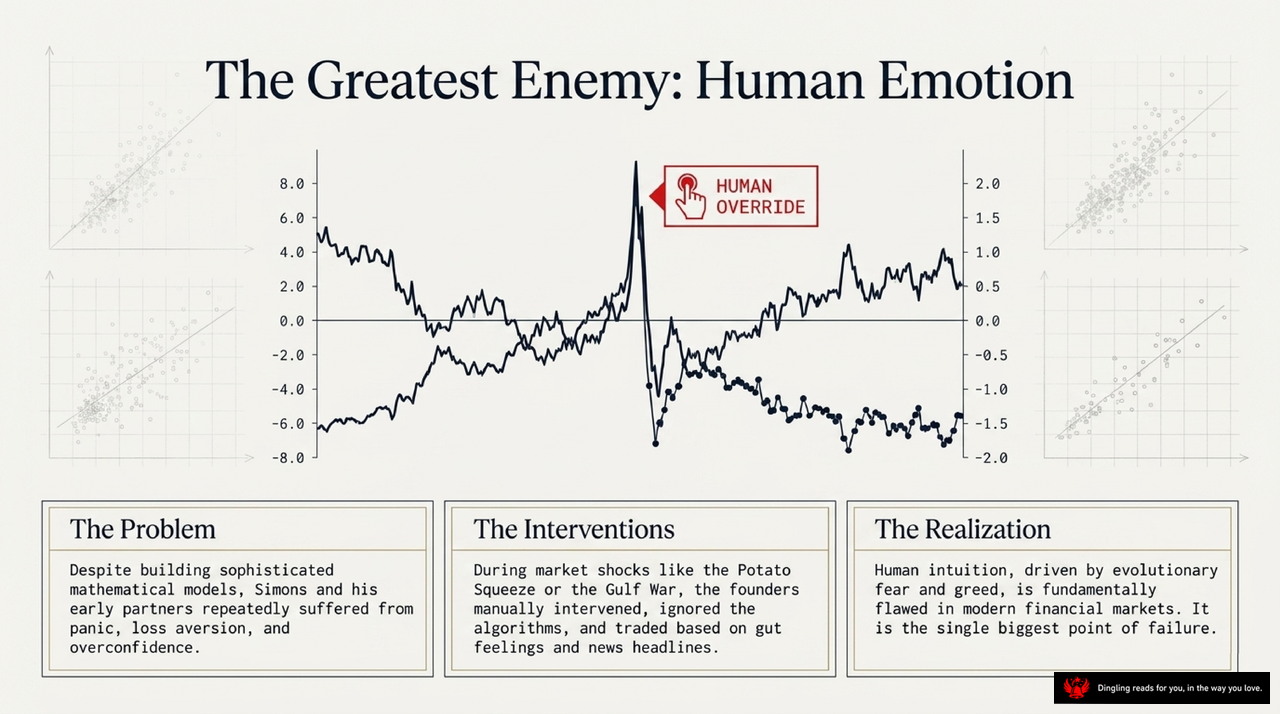
Let’s dive into a truth every investor—from newbies to pros—grapples with: the greatest enemy in finance isn’t a volatile market or a complex algorithm. It’s human emotion. That’s the core of this slide: The Greatest Enemy: Human Emotion.
Even Jim Simons, who later built some of the world’s most powerful quantitative models, didn’t escape this early on. His team had sophisticated math on their side, but they still fell prey to panic when markets tanked, clung to losing trades because they hated admitting mistakes (loss aversion), and got overconfident after a few wins. These aren’t just rookie blunders—they’re wired into our DNA.
When market shocks hit, like the Potato Squeeze or the Gulf War, they’d toss their algorithms out the window. They’d manually intervene, ignore the data-driven rules they’d built, and trade based on gut feelings or the latest news headlines. We’ve all felt that urge: a breaking story pops up, and suddenly we’re clicking “sell” before we think.
But here’s the key realization they had: human intuition—fueled by ancient instincts of fear and greed—just doesn’t work in modern financial markets. It’s the single biggest point of failure. Our brains evolved to react to immediate dangers, not to navigate the fast-paced, complex world of stocks and futures.
This was a game-changer for Simons. It pushed him to double down on systems that could take the human element out of trading. Because he learned the hard way: no matter how smart you are, your emotions will always find a way to mess things up if you let them. The best models aren’t just about math—they’re about taming the chaos inside us.
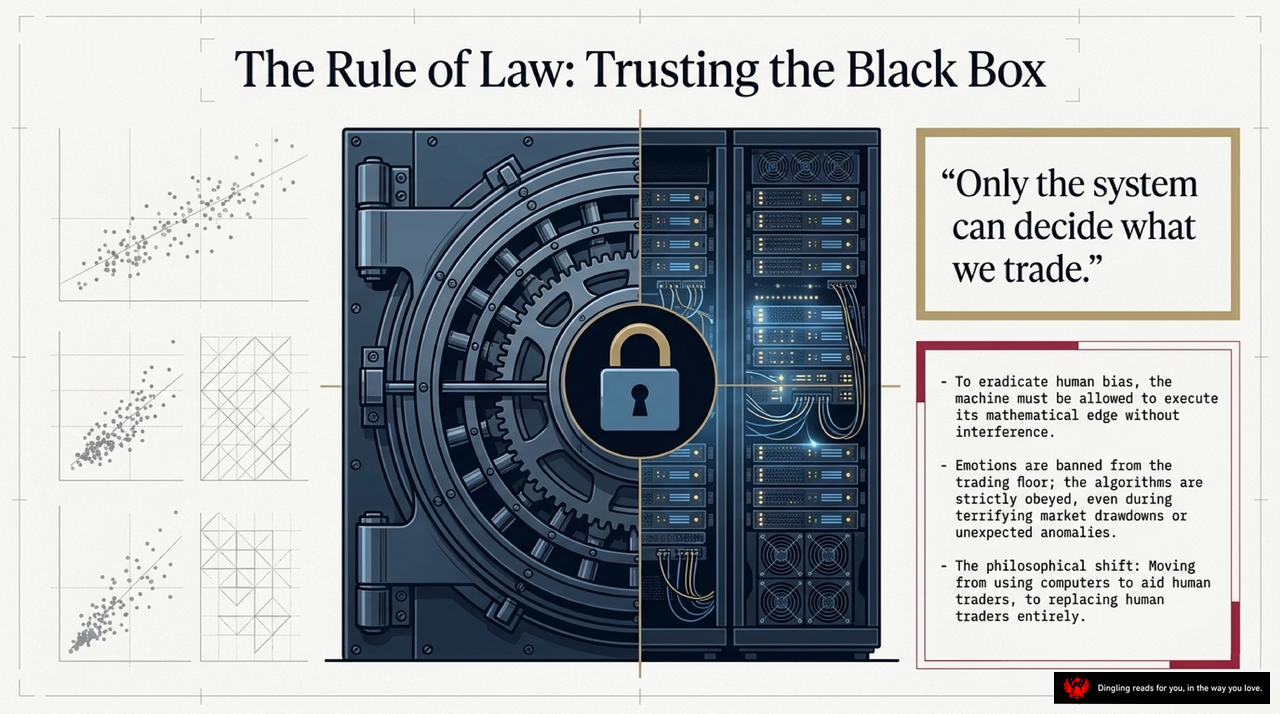
Alright, let’s dive into "The Rule of Law: Trusting the Black Box"—a core principle that defined Renaissance Technologies’ success.
You’ve probably noticed the quote here: “Only the system can decide what we trade.” This wasn’t just a catchphrase; it was a non-negotiable rule. Why? Because human bias is the silent killer of consistent returns. Think about it—when the market is in chaos, or when you’re riding a winning streak, your gut instinct can lead you to make reckless choices. So the team made a bold call: the machine must execute its mathematical edge without any human interference. No second-guessing, no overriding the model, even if it feels wrong in the moment.
Emotions? They’re completely banned from the trading floor. Algorithms are strictly obeyed, even during terrifying market drawdowns or unexpected anomalies. Remember the 1987 crash or the 1998 Long-Term Capital Management meltdown? Renaissance stuck to their system through it all, and that’s how they avoided the worst of those disasters.
This marked a huge philosophical shift. It wasn’t just about using computers to help human traders anymore—it was about replacing them entirely. The data showed machines could process more information, spot patterns humans missed, and act faster than any trader. Trusting the black box meant letting go of control, but it paid off. Renaissance’s models turned market noise into predictable signals, proving that when you let the numbers do the talking, you cut through the chaos and focus on what works.
That’s the power of trusting the system: it turns emotion-driven guesswork into disciplined, data-backed decisions. And that’s why Renaissance became one of the most successful hedge funds in history.
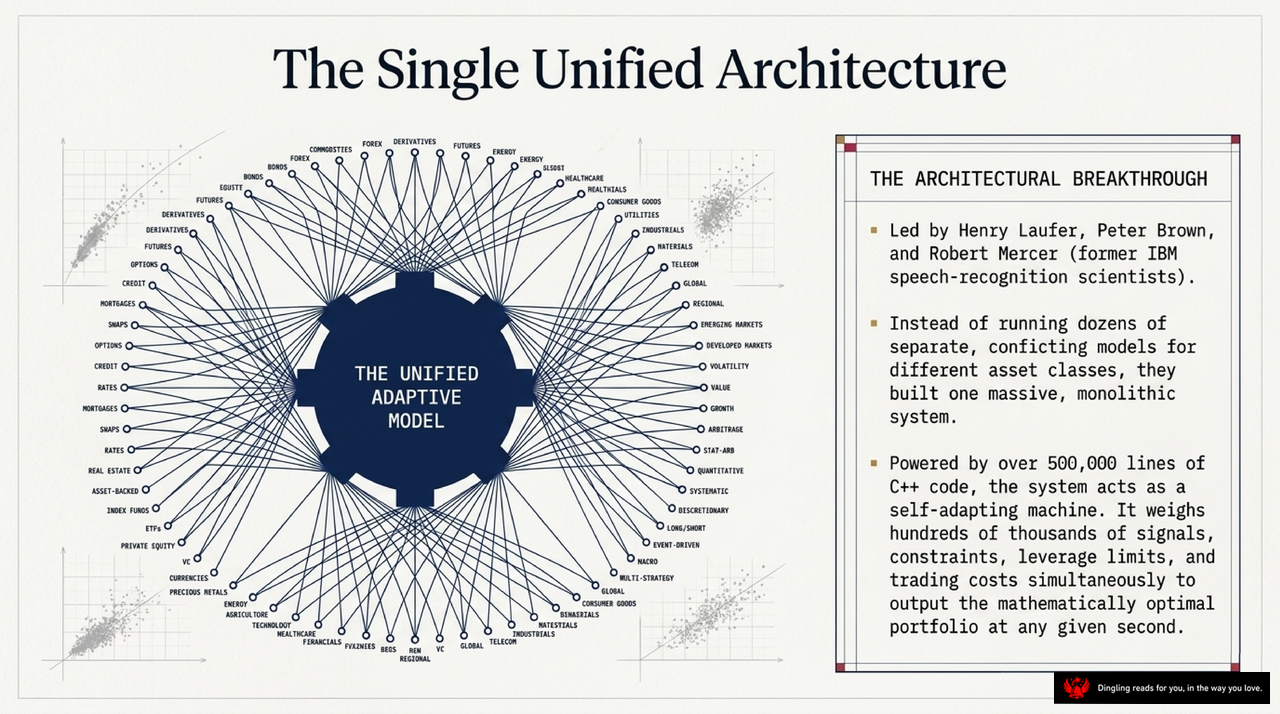
Let’s dive into the architectural breakthrough that set Renaissance Technologies apart: the Single Unified Architecture. This wasn’t just an incremental tweak—it was a revolution in how quantitative trading systems are built.
Spearheading this effort were three key figures: Henry Laufer, Peter Brown, and Robert Mercer, all former IBM speech recognition scientists. Their expertise in processing messy, unstructured data from human speech gave them a unique edge in solving financial problems.
Before this, most quant firms relied on separate, often conflicting models for different asset classes—stocks, bonds, futures, commodities. These siloed systems couldn’t communicate with each other, leading to inconsistent and suboptimal decisions. Renaissance’s team flipped the script: instead of many small models, they built one massive, monolithic system that covered every asset class under one roof.
This system was a marvel of engineering. With over 500,000 lines of C++ code, it functioned as a self-adapting machine. At any given second, it crunches hundreds of thousands of signals—price trends, market volatility, economic indicators—along with critical constraints like leverage limits and trading costs. All of this happens in real time to generate the mathematically optimal portfolio for that exact moment.
The impact? Renaissance could make faster, more consistent decisions than any human trader or siloed model. This unified architecture became the backbone of their success, allowing them to outperform the market year after year.
This wasn’t just a technical win; it was a paradigm shift. It proved that unifying data and decision-making could unlock levels of performance once thought impossible in quantitative finance. And it’s a big reason why Renaissance remains one of the most successful hedge funds in history.
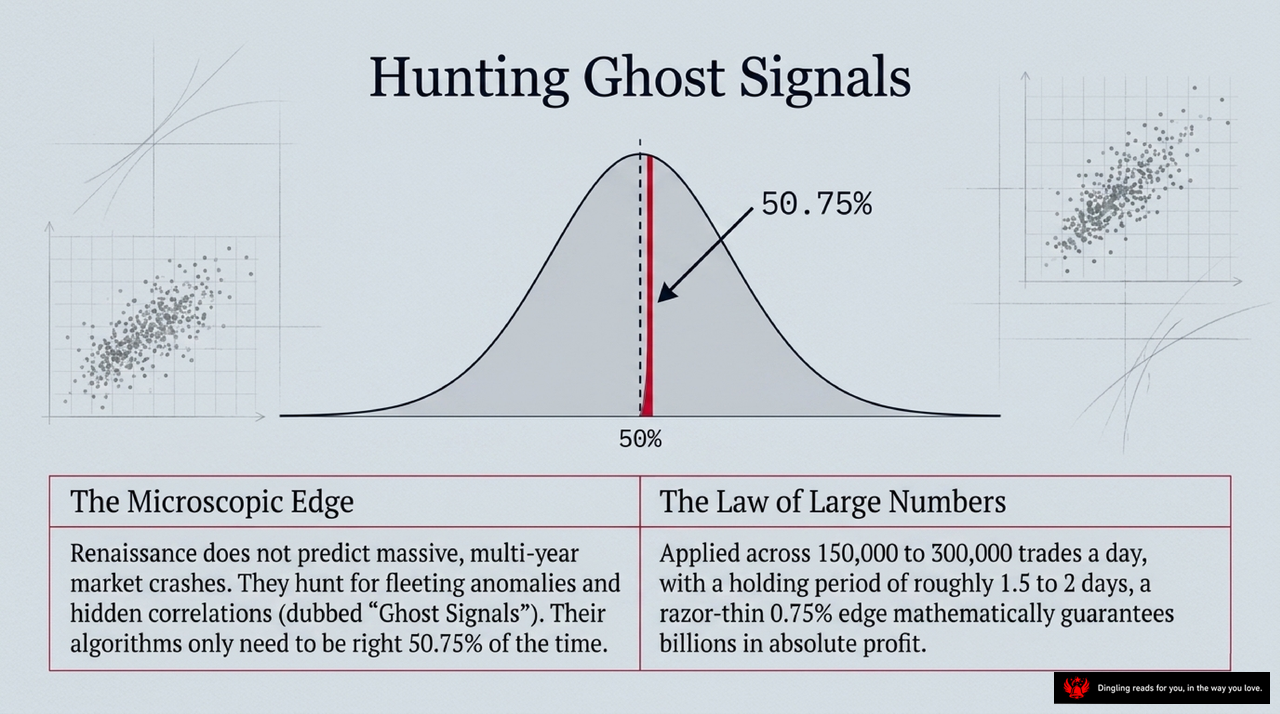
Let’s dive into how Renaissance Technologies hunts those elusive “Ghost Signals”—the tiny, hidden market anomalies most investors overlook.
First off, they’re not trying to predict massive crashes or multi-year trends. Instead, their focus is on fleeting inefficiencies and hidden correlations in the market. And here’s a surprising fact: their algorithms only need to be right 50.75% of the time. That’s barely more than a coin flip, but that’s all they need.
Why? Because of the Law of Large Numbers. Renaissance executes between 150,000 to 300,000 trades every day, with an average holding period of just 1.5 to 2 days. Even a razor-thin 0.75% edge on each trade adds up to billions in absolute profit when scaled that much. It’s like flipping a coin that lands heads 50.75% of the time—do it hundreds of thousands of times, and you’re guaranteed to come out ahead.
These “Ghost Signals” are the little blips others miss: a split-second price difference between similar assets, or a pattern that repeats just enough to be statistically meaningful. Renaissance’s math whizzes and data scientists sift through mountains of data to find these signals, then let automated systems act without human emotion getting in the way.
So even though each trade gives a tiny win, multiplying by hundreds of thousands turns it into something amazing. That’s their secret: small edges, huge volume, and complete trust in the numbers—no guesswork, no gut feelings, just data and math doing the heavy lifting.
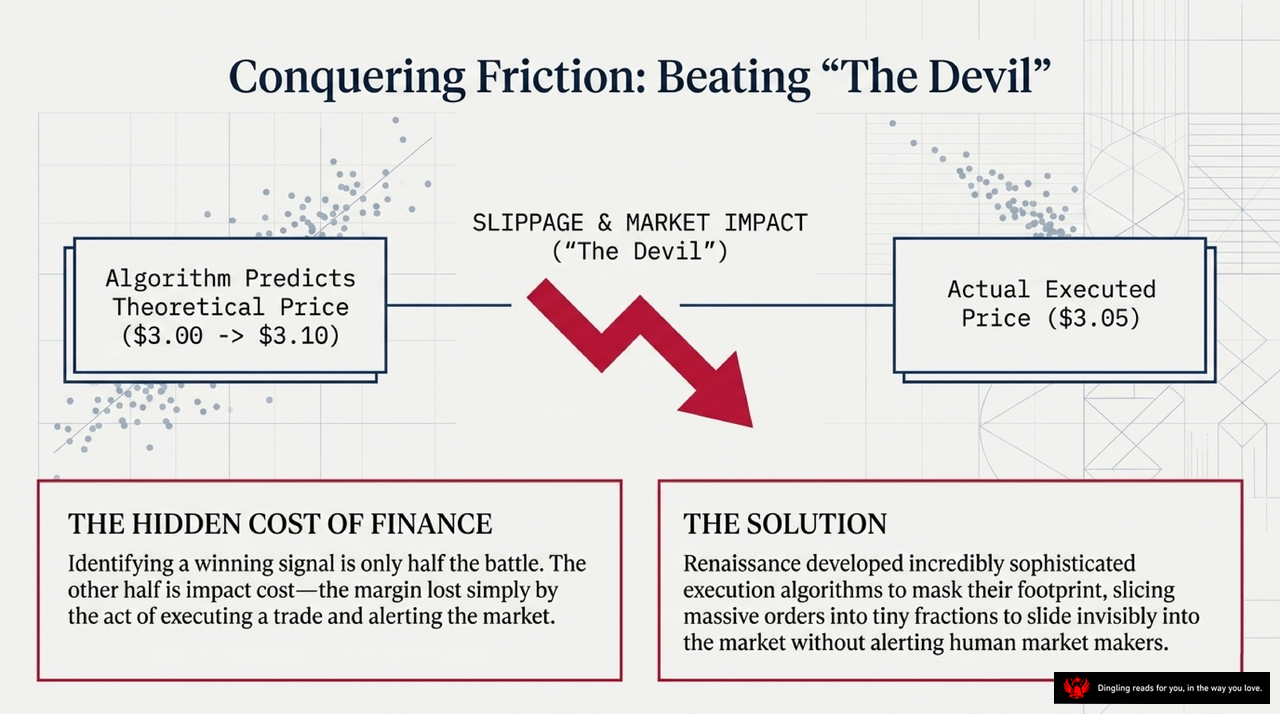
Let’s dive into conquering friction—beating what we call "the devil" in trading. So what exactly is this devil? It’s slippage and market impact. Picture this: your algorithm crunches the numbers and predicts a theoretical price range, say from $3.00 to $3.10. But when you actually hit "execute," you end up with an average price of $3.05. That gap between what you expected and what you got? That’s the devil eating into your profits.
This is the hidden cost of finance. A lot of traders think finding a winning signal is the whole fight, but it’s only half. The other half is impact cost—the money you lose just by executing the trade because it alerts the market. Think about it: if you place a huge order, market makers notice and immediately adjust prices against you. Suddenly, that great signal isn’t so great anymore.
So how did Renaissance beat this devil? They built incredibly smart execution algorithms. The secret? Masking their footprint. Instead of dumping a massive order all at once, they sliced it into tiny, almost imperceptible fractions. These small pieces slip into the market without human market makers catching on. It’s like breaking a boulder into grains of sand—you can move it without anyone noticing.
This was a game-changer. It meant Renaissance could execute large trades without moving the market against them. No more letting the devil of friction steal their profits. Their focus on execution algorithms was just as critical as their predictive models. Because even the best signal in the world is useless if you can’t get in and out at a good price.
So remember: trading isn’t just about finding the right opportunity—it’s about executing it in a way that doesn’t tip off the market. That’s how you beat the devil.
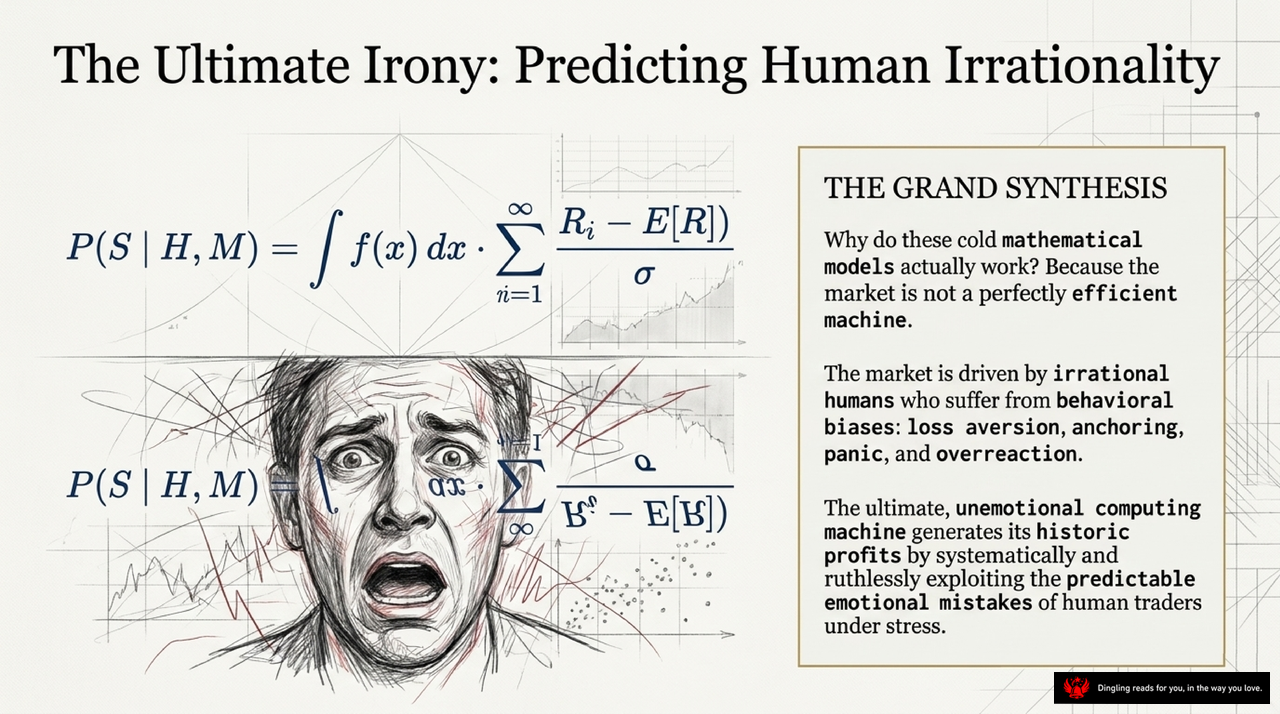
The Ultimate Irony: Predicting Human Irrationality—isn’t that a fascinating twist? We like to think we’re logical when it comes to money, but let’s be real: our emotions often take over. And here’s the secret: those cold, unfeeling math models work precisely because of our irrationality.
Why? Because the market isn’t the perfectly efficient machine textbooks talk about. It’s driven by people—people who hold onto losing stocks way too long (loss aversion), fixate on a past price like it’s set in stone (anchoring), panic sell at the first sign of trouble, or overreact to a single headline. These are predictable, repeated mistakes we make when under stress.
That’s where the unemotional machines shine. Firms like Renaissance Technologies use algorithms to spot these patterns of human error. They don’t get scared, greedy, or attached—they just crunch the numbers. Their systems systematically exploit those emotional missteps, turning our own flaws into their profit.
Simon used to say his fund made money off traders who thought they were too smart to fail—those who trusted their gut over data. The models don’t need to understand why we mess up; they just need to know we’ll keep doing it. So next time you feel that impulsive urge to trade, remember: there’s a machine out there counting on that very impulse. It’s the ultimate irony—using math to predict the one thing we think is unpredictable: human emotion.
Let’s dive into the 2007 quant quake—this was a defining moment for Renaissance Technologies. Imagine August 2007: the Dow plummets 281 points out of nowhere, and every quantitative fund is bleeding money left and right. Jim Simons was at his mother’s funeral in Boston when he got the call—both the Medallion Fund and RIEF were taking heavy hits.
Back at the office, chaos reigned. Bob Mercer and Peter Brown clashed hard: Brown wanted to stick to the system, maybe even double down, while Simons was terrified of margin calls forcing banks to dump their positions. Researchers pulled all-nighters, wondering if their models were finally broken. The sales chief, Dwyer, had a Crohn’s flare-up from the stress, and the company cafeteria was eerily quiet—no one was talking.
But Renaissance didn’t crumble. By mid-August, the selling pressure eased, and they started turning a profit again. Some employees grumbled that Simons’ intervention cost extra gains, but he stood firm. That year, Medallion still delivered an 86% return—absolutely unheard of during such market turmoil.
This event hammered home a key lesson: never trust your model blindly. They ramped up risk management, ensuring the system could pull back when volatility spiked. When the 2008 financial crisis hit? Medallion soared 82% while the rest of the market crashed.
Simons once said, “All models have flaws, but some work.” This quake wasn’t the end—it was a wake-up call that even the best systems need human judgment, and adaptability is everything in finance. Renaissance emerged stronger, solidifying their status as the gold standard in quantitative investing.
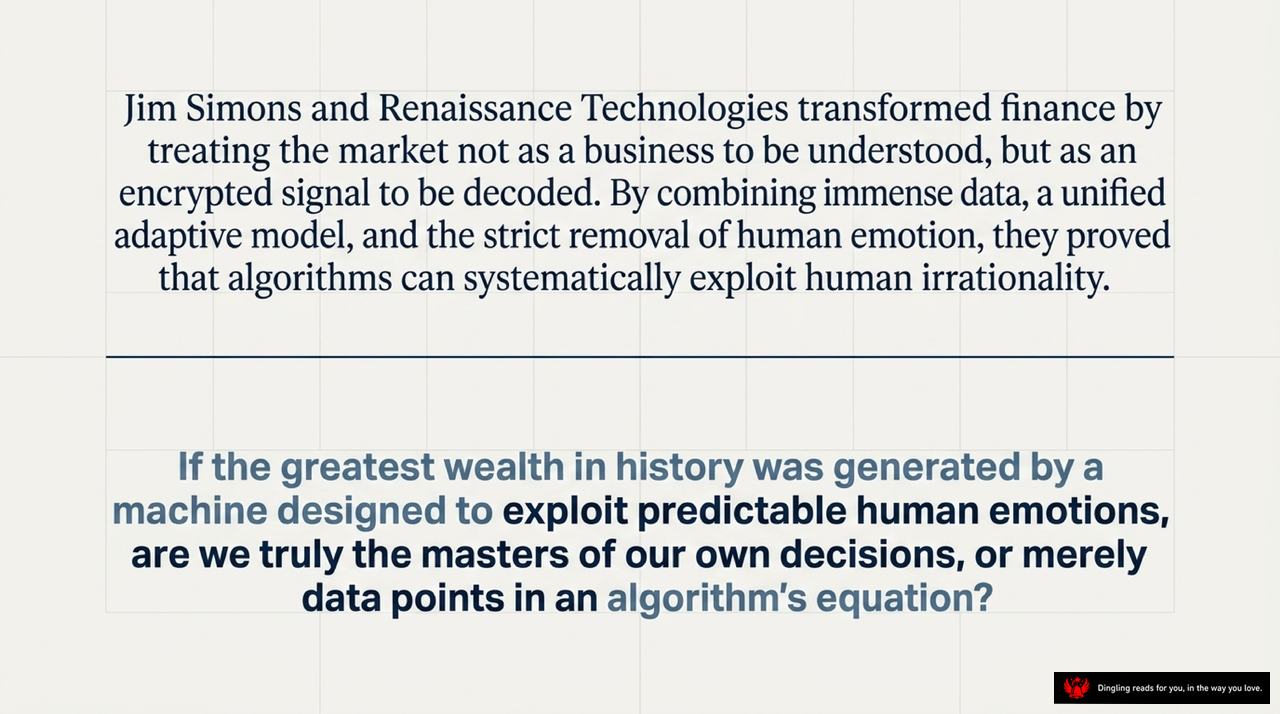
Let’s take a step back and think about how Jim Simons and Renaissance Technologies turned finance on its head. Instead of approaching the market like traditional investors—poring over business plans or trying to outguess other traders—they saw it as something entirely different: an encrypted signal, just waiting to be decoded.
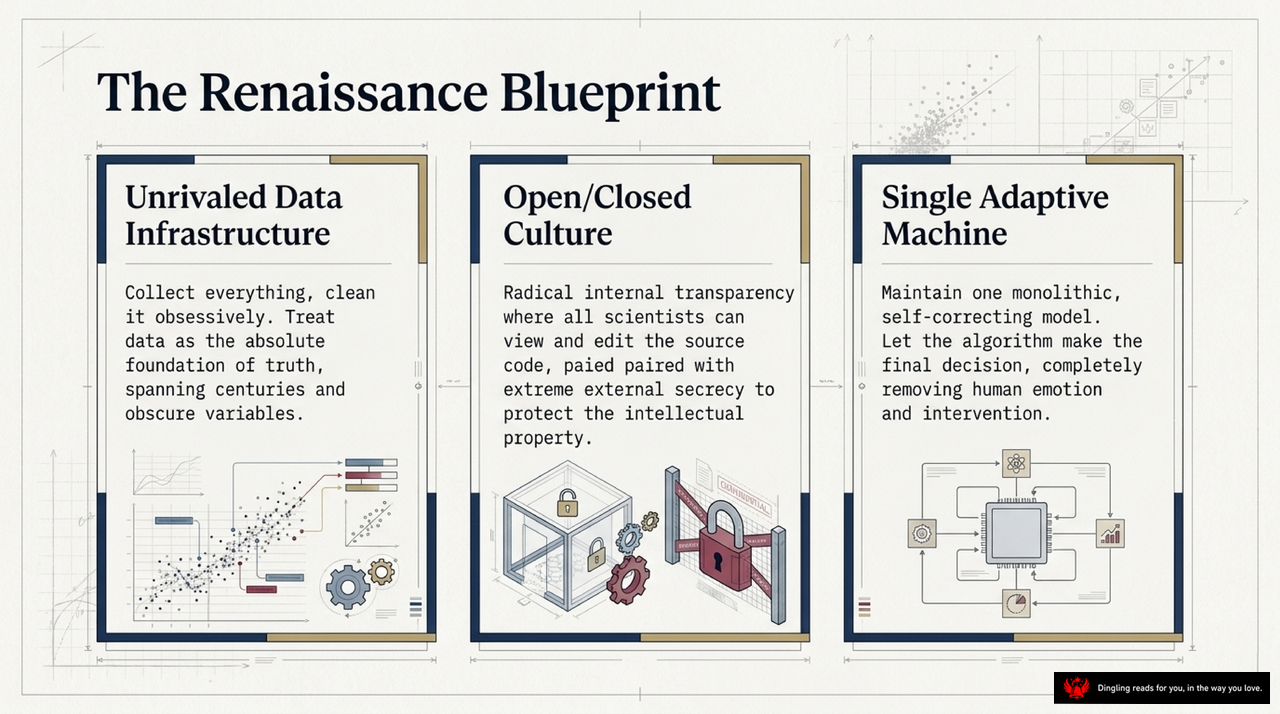
How did they pull this off? Three core pieces came together. First, they amassed mountains of data—years of price movements, tiny fluctuations, and trends most people overlooked. Second, they built a unified, adaptive model that could learn and evolve as the market changed. And third, they did something radical: they cut human emotion out of the equation entirely. No gut feelings, no panic selling, no greedy overreach—just cold, calculated algorithms.
The result? They proved that these algorithms could systematically exploit human irrationality. Let’s be real—we humans are predictable. We get greedy when prices rise, scared when they fall, and we repeat the same mistakes over and over. Renaissance’s models picked up on those patterns and turned them into massive profits.
But this success leaves us with a big question, one you see on the slide here: If the greatest wealth in history was generated by a machine designed to exploit our predictable emotions—are we truly the masters of our own decisions? Or are we just data points in an algorithm’s equation?
It’s a heavy thought. Because if our emotions are so consistent that a machine can make billions off them, what does that say about our control over our financial choices? Renaissance’s story isn’t just about money—it’s about understanding human nature, and how technology is reshaping the way we interact with the world around us. And it makes you wonder: where do we go from here?