
The Martian: Complete Chapter-by-Chapter Summary

Welcome to the story of *The Martian* by Andy Weir. Set against the stark, rust-colored landscape of Mars, this isn't just a sci-fi adventure; it's a masterclass in human resilience and extreme problem-solving. The narrative follows 687 sols, or Martian days, as protagonist Mark Watney fights for survival after a catastrophic dust storm leaves him stranded alone on the red planet. While his crew believes he's dead, Watney turns despair into data, transforming a hopeless situation into a calculated mission of survival. From growing potatoes in a habitat to engineering a rocket from scrap, his journey is a thrilling testament to the power of the human mind.
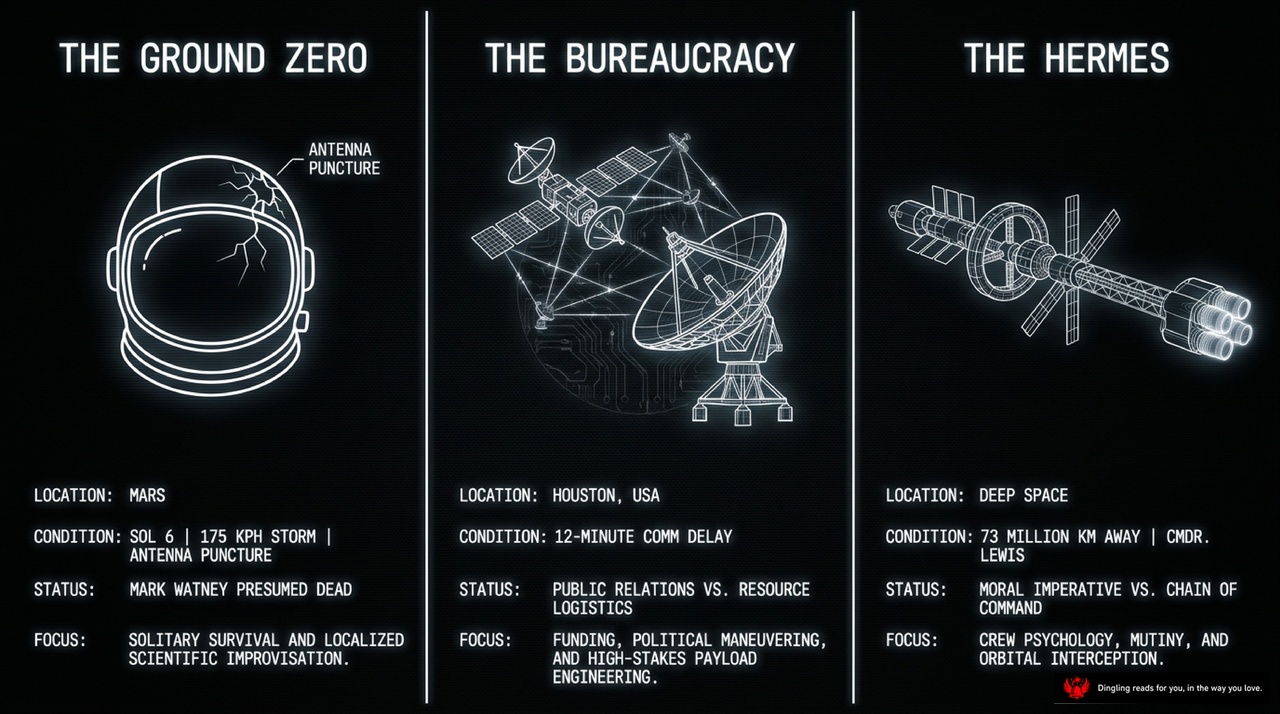
This slide breaks down the story of *The Martian* into three distinct worlds operating in real-time: The Ground Zero on Mars, The Bureaucracy back in Houston, and The Hermes crew deep in space.
On the left, we see Mark Watney's reality. He's alone on Mars, dealing with a 175 KPH dust storm and a punctured suit. His focus is purely on solitary survival and figuring out how to fix things with limited resources. In the middle, we have the Earth side—the Bureaucracy. This is Houston, where the team is stuck behind a 12-minute communication delay. Their battle isn't against the elements, but against public relations, logistics, and political maneuvering. They're trying to balance the cost of saving one man against the mission's original goals. On the right, we have The Hermes, the rescue ship. They are 73 million kilometers away, piloted by Commander Lewis. Their crisis is moral and technical: do they follow the chain of command and leave, or do they take a huge risk to save their teammate? They are fighting crew psychology and the possibility of mutiny.
The core tension here is the disconnect between these three zones. Mark is dying slowly in the silence of space, while the people on Earth are arguing over the budget and the optics of his rescue, and the rescue crew is hesitating to turn the ship around. It's a perfect setup for the high-stakes engineering and leadership challenges that drive the rest of the story.

Biological engineering bought NASA 500 extra Sols, fundamentally shifting the timeline from immediate starvation to long-term rescue logistics.
Look at this graph. On the left, you see the "Initial Supply"—a steep red line dropping to zero by Sol 400. That was the grim reality: with a daily requirement of 1,500 calories, the existing food would run out in less than a year, leaving Mark facing certain death. But then, watch the green line rise. This is the "Potato Harvest." By cultivating just 92 square meters of Martian soil using vacuum-dried feces, Earth bacteria, and local regolith, Mark created a new survival margin extending all the way to Sol 900.
This wasn't just farming; it was a lifeline. With a yield of 770 calories per kilogram of potatoes, this single hypothesis expanded his survival window by nearly 500 days. It transformed the mission from a desperate race against starvation into a manageable wait for long-term rescue logistics. It was the moment biology became the ultimate engineering solution.

Here is the spoken-word script for Slide 3, tailored for an American audience with a natural, engaging narrative style.
**Slide 3 Script:**
So, let's talk about the real-life "Mission Impossible" moment that almost wiped out Mark Watney. Look at this flowchart on the left—it breaks down how he turned rocket fuel into water. The source is MDV Hydrazine, a toxic chemical he found in his damaged spacecraft. By dripping it over an Iridium catalyst, he splits it into hydrogen and nitrogen. Then, he burns that hydrogen with oxygen to create the water he desperately needs. The goal? To produce 40 liters of water per cubic meter of soil across his entire farm.
But here's the catch: this process is incredibly dangerous. The right side of the screen shows the "Margin of Error." If the hydrogen isn't burned completely, it builds up in the habitat. At 64% concentration, a single static spark would trigger the "Hindenburg Effect"—instantly vaporizing the entire facility. Mark knew this risk better than anyone. He had to perform this reaction in a sealed, oxygen-rich environment, using a makeshift torch and precise timing to ensure every drop of hydrogen was consumed. It was a gamble with his life, but without that water, his potato farm would have died, and so would he. This moment defined his transition from a victim of circumstance to an engineer fighting for survival.

After four months of drifting in space, the crew of Hermes is finally reunited with their families, sharing joyous video calls and emails. But that happy atmosphere shatters instantly when Johnsen receives a voice message from back on Earth: "Mark Watney is alive." The silence that follows is heavy with shock, followed by a chaotic mix of laughter, tears, and overwhelming guilt. They realize the weight of their decision to leave him behind; they didn't just abandon a teammate, they abandoned a promise. Now, their mission shifts from a simple return home to a desperate race to save him.
Back on Mars, Mark's life has settled into a strange new normal. He's receiving emails, joking with NASA about his "colonization," and even teaching himself Morse code just in case. But peace is short-lived. A minor sandstorm tears through his airlock, blowing it off and leaving him trapped in a leaking suit. With his farm destroyed and his food supply cut in half, Mark faces a terrifying reality: he only has enough supplies to last until Sol 600, but the resupply ship won't arrive until Sol 856. He's staring down a 250-day food gap that seems impossible to bridge.
The situation is critical. When Mark reports this dire shortage to Earth, NASA realizes they have less than 50 days to manufacture a rescue ship. Their initial plan, "Iris," fails spectacularly when the cargo of protein blocks melts into a dangerous sludge during launch, causing the ship to crash. Just as hope fades, a breakthrough comes from an unexpected source: China's space agency offers a powerful booster, the Titan, to help deliver the supplies. In a moment of crisis, NASA agrees, prioritizing Mark's life over any political considerations. But there's still a bigger risk lurking. The Hermes crew, led by Vogler, discovers a secret trajectory designed by an engineer named Bunnel—a "Bunnel Maneuver" that could allow them to return to Mars, but it requires defying direct orders and risks everyone's lives. As the clock ticks down, both Mark and the crew are preparing for the ultimate test of survival and courage.
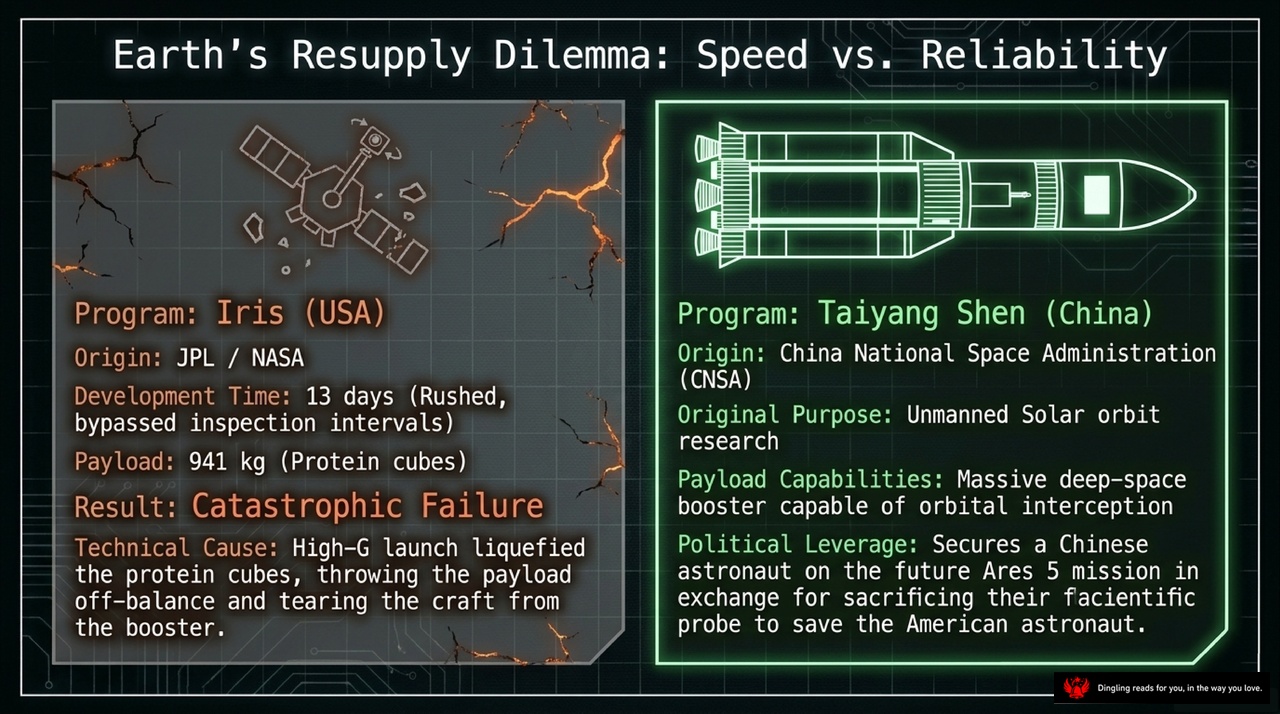
Earth's Resupply Dilemma: Speed vs. Reliability. On the left, we see the Iris program from NASA's JPL. Rushed into development in just 13 days, this mission skipped critical safety inspections and carried 941 kilograms of protein cubes. But the result? A catastrophic failure. The high-G launch liquefied the payload, throwing the craft off balance and tearing it from the booster. It was a textbook case of prioritizing speed over reliability.
On the right, look at the Taiyang Shen program from China's CNSA. Originally designed for unmanned solar orbit research, this vehicle is a massive deep-space booster capable of orbital interception. Its payload capabilities are far superior, but the story here isn't just about engineering—it's about leverage. In this scenario, Taiyang Shen secures a spot for a Chinese astronaut on the future Ares 5 mission, but the price is steep: they sacrifice their scientific probe to save the American astronaut. This trade highlights a harsh reality of space exploration: sometimes, survival comes at the cost of scientific progress.
While the US rushed and failed, China leveraged its heavy-lift capability to offer a lifeline. It's a stark reminder that in the vacuum of space, there is no room for error, and every decision carries a heavy political and human weight.

Look at this "Mutiny Decision Tree." It captures the most pivotal moment in the story, the moment where protocol clashes with morality.
On the left, we have the "Obey Chain of Command" path. This is the safe, logical choice. If they follow orders, Hermes returns home safely, and five astronauts survive. But the consequence is tragic: one astronaut, Watney, dies alone on Mars. Protocol is upheld, but at a terrible human cost.
On the right, we see the "Moral Imperative," which leads to mutiny. This path is chaotic and dangerous. Sysadmin Johanssen hacks the system to disable the remote override, forcing the crew to extend their mission by 533 days. The stakes skyrocket: they risk six lives and a multi-billion-dollar asset just to save one. Protocol is destroyed.
But here is the critical takeaway highlighted in the orange box: Commander Lewis's definitive choice prioritizes crew cohesion and life over institutional directives. It's a stark reminder that sometimes, doing the right thing means breaking the rules. In the end, the crew chooses to stay, proving that their bond as a team is stronger than any mission order.

Look at this "Risk Tolerance Matrix." It perfectly captures the central conflict of the entire mission: the clash between Earth's bureaucracy and the reality of survival in space.
On the left, we have Teddy Sanders, the NASA Director. His mindset is purely institutional. His primary goal isn't saving a person; it's protecting NASA's public relations, funding, and the future of the Ares programs. To him, losing one person—like Watney—is an acceptable casualty if it means saving the other five. He operates within a strict, risk-averse bureaucracy.
On the right stands Commander Melissa Lewis of the Hermes. Her philosophy is starkly different: "Leave No Man Behind," regardless of the career or institutional cost. For her, the math is absolute: zero casualties. Either all six survive, or all six perish together. This mindset drives her to what Earth views as intentional mutiny and hacking of federal systems.
This matrix illustrates the tragic irony of the mission. Earth wants to minimize risk to preserve the program, while the crew in space knows that true survival requires taking massive risks. It's the moment where protocol meets human necessity, setting the stage for everything that follows.

Look at this blueprint. It's the master plan for turning a massive, multi-stage orbital vehicle into a makeshift, convertible rocket. The goal? To bridge the gap between the Hermes flyby speed of 5.8 km/s and the MAV's initial capability of just 4.1 km/s from low Mars orbit. To make that jump, they need to shed a staggering 5,000 kg of mass.
So, what gets cut? The nose cone is removed and replaced with a simple hab canvas. Those five acceleration chairs go. The life support, air ducts, and heaters are stripped out—meaning Watney will have to rely on his EVA suit for protection. Even Engine 1 is sacrificed, leaving the vehicle relying on a single booster. This isn't just about weight; it's about a desperate gamble to convert a complex machine into a one-way ticket home. Every removed component brings them closer to survival, but also closer to the edge.

The Intercept Gap. It's a terrifyingly precise moment where math meets human error. As you see, the Hermes spacecraft and the MAV are converging, but they're missing by a staggering 68 kilometers. That's not just a glitch; that's a life-or-death miscalculation. With a relative velocity of 11 meters per second, the tether limit is only 5 meters per second. There is no time to react.
But look closer at the bottom. This is the genius solution that saves the day: The Air-Lock Bomb Schematic. It's a functional cross-section of Vogel's Sugar/LOX bomb. The equation is simple yet powerful: Sugar plus pure oxygen equals 16.7 million Joules of energy. The action is brutal but necessary—blow the inner air-lock door to vent atmospheric pressure into the vacuum. The escaping gas generates the exact reverse thrust needed to decelerate Hermes instantly.
This isn't just a diagram; it's the difference between drifting apart forever and a final, desperate handshake. It turns a catastrophic failure into a controlled correction. In the silence of space, a simple chemical reaction becomes the bridge that pulls two ships back together. That is the power of engineering under pressure.

Look at this diagram. At the center, we see "Survival." It's not a lucky break or a matter of brute force. It's the result of rigidly applying a specific loop: Problem, Hypothesis, Execution, and Margin of Error.
Watterson didn't just survive; he engineered his way out of death by treating every deadly variable with scientific precision. He broke down his survival into four distinct disciplines. In Biology and Botany, he wasn't just planting potatoes; he was calculating the exact caloric burn versus the soil microbial yield to ensure his farm was actually productive. In Chemistry, he took extreme risks to control exothermic hydrazine reactions, effectively manufacturing water from thin air to keep his systems running.
Then there was Astrophysics and Orbital Mechanics. He wasn't just driving a rover; he was calculating Earth-gravity assists and intercept trajectories to navigate thousands of kilometers across a hostile landscape. Finally, in Engineering, he was bypassing hardware limitations, stripping mass from the MAV, and even hacking systems to create a makeshift torch or patch a broken helmet.
This slide captures the essence of the mission: survival was achieved by treating the impossible as a solvable equation. By applying this rigorous "Problem to Margin of Error" framework to every single challenge, from growing food in a vacuum to navigating a global storm, he turned a certain death into a calculated victory.

Through 687 sols, Mark Watney and humanity proved that the ultimate weapon against the hostile indifference of the universe is rational, calculated science. Every lethal variable was dismantled by the scientific method. But when a global society expends billions of dollars, overrides international politics, and risks six lives to save one... is the true triumph found in our mathematical brilliance, or in our irrational, defiant humanity?