
The Master Algorithm: Complete Chapter-by-Chapter Summary

Welcome to the first chapter of our journey into the future of intelligence. Today, we're diving into Pedro Domingos's masterpiece, *The Master Algorithm*. Look at that intricate web of connections in the background—it's a visual representation of the very thing we're discussing: the ultimate learning machine that promises to remake our world.
In a traditional computer program, humans write the rules, and the machine follows them blindly. But machine learning flips this logic on its head. Instead of humans coding the rules, we feed the machine data and desired outcomes, and it figures out the rules for us. It's like the difference between a farmer planting seeds and watching crops grow versus trying to engineer every single plant by hand. Machine learning is the seed; data is the soil; and the resulting program is the harvest.
The power here is staggering. Algorithms can now write other algorithms, tackling tasks that are too complex for human logic, like self-driving cars or recognizing handwritten notes. The rule is simple: more data leads to better insights, and these algorithms can tame complexity that would otherwise overwhelm us. From Google's ad targeting to Netflix's recommendations, machine learning has already become the top predator in the information ecosystem, turning raw data into actionable knowledge.
But we are just at the beginning. While current algorithms are powerful, they still have limits. The real question driving this revolution is whether we can discover a single, universal algorithm capable of solving any problem. If we do, the impact could be as profound as the industrial revolution, potentially ushering in a new stage for human evolution. So, let's explore how this works, where the challenges lie, and what the future holds for us all.

The Automation of Automation is a concept that flips the entire script on how we build software. Look at the diagram on the left: Traditional Programming. Here, humans act as the architects. We spend years writing rigid rules and feeding data into a computer, which then dutifully spits out answers. It's a linear, top-down approach where the programmer must anticipate every single scenario. But as the slide notes, this creates a "Complexity Monster." The moment the world gets too messy for us to define every rule, this system crumbles.
Now, look at the shift to the right: Machine Learning. This is where the paradigm changes completely. Instead of humans coding the rules, we feed the computer data and the desired outcome, and let it figure out the rules itself. The computer becomes the architect. It learns from examples, just like a child learning to recognize a cat without being told the definition of a cat. This allows machines to master tasks that are too complex for humans to describe with code, from driving cars to identifying handwriting. As the text explains, machine learning is essentially an inverse operation. While traditional programming is like squaring a number to get a result, machine learning is the square root—working backward from the result to discover the underlying logic. This shift transforms automation from a static, hand-coded process into a self-generating one, allowing us to tame complexity and unlock capabilities we previously thought were impossible.

Imagine a single, all-powerful algorithm capable of learning anything, given enough data. This is the "Holy Grail" of artificial intelligence—the ultimate unified theory of knowledge. Just as physicists spent centuries searching for the Standard Model to explain all the laws of physics, AI researchers are hunting for this "Master Algorithm" to discover every scientific law, read any text, and predict any outcome.
This slide presents the ultimate hypothesis: if one algorithm can truly learn everything, it represents the final piece of the puzzle. But what does this look like in practice? Think of it like a farmer planting seeds. Data is the soil, and the learning algorithm is the seed. When you plant the right seed in rich soil, you don't just get a plant; you get a crop that can handle complex, unpredictable environments.
However, finding this single algorithm isn't easy. We are currently facing a crisis of complexity. Our world is too messy for one simple rule to cover everything. That's why we've had to develop different "schools" of thought to tackle different parts of the problem. We have the symbolic approach, which uses logic and rules, like a strict engineer. We have the connectionist approach, which mimics the human brain's neural networks, learning from patterns rather than rules. We have the evolutionary approach, which uses natural selection to evolve better solutions over time. We also have the Bayesian approach, which deals with uncertainty and probability, and the analogical approach, which learns by comparing new situations to old ones.
The Master Algorithm isn't just one of these methods; it's a fusion of all five. It needs the logic of the symbolists, the flexibility of the connectionists, the adaptability of the evolutionists, the reasoning of the Bayesians, and the pattern recognition of the analogists. Only by combining all these pieces can we hope to build a system that is truly universal. This isn't just about building better chatbots or smarter search engines; it's about unlocking the next stage of human evolution. If we succeed, we could design new medicines, create entirely new materials, and even engineer our own biology. The journey to the Master Algorithm is the journey to understanding everything.

Welcome back. Today, we're diving into the very first map of the machine learning landscape. Imagine the entire field of AI not as a single monolith, but as a battlefield divided into five distinct factions. This slide, "Mapping the Territory of the Five Tribes," perfectly captures that reality.
As the text explains, the landscape of machine learning is divided into five distinct factions. Each tribe draws inspiration from a different scientific discipline, possesses its own master algorithm, and holds a unique philosophy on how machines understand the world.
Let's take a look at who these tribes are. At the top, we have **The Symbolists**. They are the logicians, viewing the world as a system of symbols and rules that can be manipulated through deduction.
To their right, you see **The Connectionists**. Inspired by the human brain, they believe intelligence emerges from networks of interconnected neurons, much like the biological circuits in our own heads.
Moving down, we have **The Evolutionaries**. These are the naturalists who mimic the process of natural selection. They don't hand-code solutions; instead, they let algorithms evolve and mutate over time, just like species adapting to their environment.
On the left, we find **The Bayesians**. They are the probabilists, masters of uncertainty. They don't look for absolute truths but rather calculate the likelihood of different outcomes based on evidence.
And finally, at the bottom left, **The Analogizers**. They are the pattern matchers who rely on similarity. If two things look alike, they assume they behave alike, using this principle to solve new problems.
Each of these five tribes holds a piece of the puzzle. While they approach the problem of intelligence from different angles, together they form the complete picture of how we are teaching machines to learn.
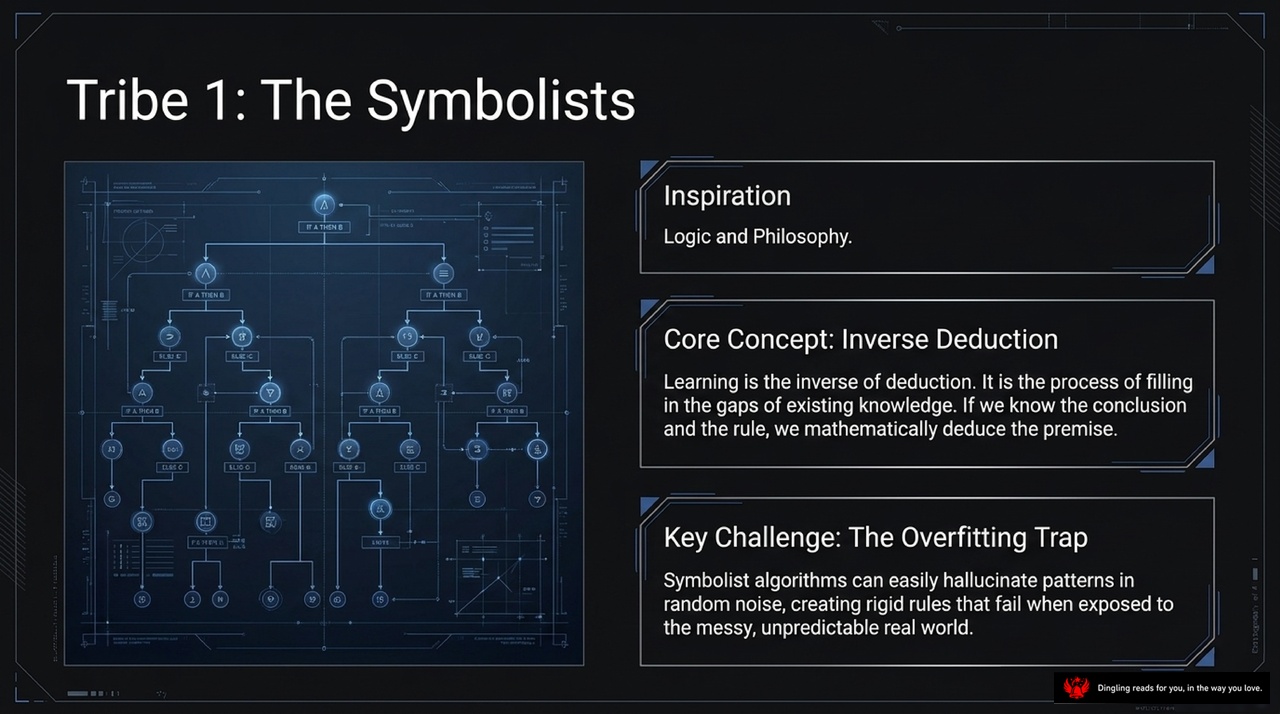
Tribe 1: The Symbolists. Think of this group as the architects of pure logic, drawing their inspiration directly from the ancient fields of logic and philosophy. Their entire approach rests on a powerful concept called Inverse Deduction. While traditional thinking moves from rules to conclusions, Symbolist learning works backward: it starts with a known conclusion and a set of rules, then mathematically deduces the hidden premises that must have caused them. It's like solving a mystery by knowing the outcome and working back to find the culprit.
However, this rigid pursuit of perfect rules comes with a dangerous Key Challenge: The Overfitting Trap. Because Symbolist algorithms strive to find perfect, rigid patterns, they are prone to hallucinating structure out of random noise. They might create complex rulebooks that work flawlessly in a clean lab environment but completely shatter when exposed to the messy, unpredictable reality of the real world. In short, they are brilliant at following the map, but often fail when the terrain changes.

Tribe 2: The Connectionists. If you've ever wondered how a computer "learns" to recognize a cat or translate a sentence, the answer lies here: it's not about following rigid rules, but about mimicking the brain itself. This school of thought draws its inspiration directly from neuroscience and physics, treating intelligence as something that emerges from the physical connections between neurons.
The core concept driving this revolution is backpropagation. Imagine the brain as a massive network of simulated neurons. When the network makes a mistake, backpropagation acts like a reverse-engineering tool, sending error signals backward through the layers. It then adjusts the "synaptic weights"—the strength of the connections between neurons—just slightly, to minimize that error. It's a process of trial and error on a colossal scale, where the network slowly tunes itself until it gets it right.
However, there's a massive hurdle here: the credit assignment problem. In a network with millions of hidden layers, it's incredibly difficult to pinpoint exactly which single neuron is responsible for a specific error and how much its weight needs to change. It's like trying to find the one specific gear that's causing a car to stall by checking every single gear in the engine. Despite this challenge, this approach of reverse-engineering the brain has become the dominant force in modern AI, powering everything from image recognition to autonomous driving. It's the closest we've come to unlocking the secret code of human intelligence.

Tribe 3: The Evolutionaries. This isn't just about biology; it's about how we build intelligence by mimicking nature's most powerful engine: evolution.
Our inspiration comes directly from genetics and evolutionary biology. The core concept here is Genetic Programming. Think of it as simulating natural selection inside a computer. Instead of humans writing every line of code, algorithms mate via crossover and mutate, with only the fittest surviving to pass their code to the next generation. It's like a digital breeding ground where the best solutions get to reproduce.
But this approach faces a key challenge: The Explore-Exploit Dilemma. It's a constant balancing act. You need to find the perfect balance between exploiting a known good solution and exploring unknown mutations without getting permanently trapped in a local optimum. If you only stick with what works, you miss out on breakthroughs. But if you explore too much, you waste time on dead ends. Evolution solves this naturally, and now, so can our machines.

Tribe 4: The Bayesians. This isn't just about math; it's about how we actually think in an uncertain world. As the slide highlights, the core concept here is Bayesian Inference. Learning, from this perspective, is simply the systematic updating of our beliefs every time we encounter new evidence. It's about precisely calculating the probability of a hypothesis being true given the real-world data we observe. Think of it as a dynamic mental model that constantly recalibrates itself.
However, there's a massive hurdle on the path to mastering this. The slide points out a "Key Challenge": The Computational Explosion. Handling the vast, interacting uncertainty of the real world isn't easy. To do it correctly, you often need to calculate an exponentially growing number of probabilities. If we tried to compute every possibility at once, the system would crash. This is the bottleneck that defines the Bayesians: they have the perfect logic for reasoning under uncertainty, but the math is too heavy for a computer to handle directly. That's why this tribe is so fascinating—they are constantly searching for ways to approximate these perfect calculations, making the impossible, computationally possible.

Tribe 5: The Analogizers. Think of the most natural way humans learn: we don't memorize every rule; instead, we look at what's similar. If two situations share a few key traits, we assume they share the rest. This is the core of the Analogizers, powered by a concept called Support Vector Machines. Imagine trying to draw a line between two groups of dots. The algorithm doesn't just pick any line; it finds the "widest" possible gap between them, maximizing the safety margin. The dots closest to this line are the "support vectors," and they are the only ones that truly matter; everything else gets ignored. This approach is incredibly robust because it focuses on the most critical examples rather than getting distracted by noise.
But there's a catch, known as the Curse of Dimensionality. As we add more attributes to our data, the space expands so rapidly that everything starts to look equally distant. It's like trying to find your neighbor in a city with millions of dimensions; suddenly, everyone is a stranger. This overwhelms the system, hiding the true similarities we rely on. To fix this, we must find the right balance—filtering out irrelevant data so the algorithm can see the meaningful patterns clearly. By mastering these analogies and managing dimensions, we turn raw data into intelligent understanding, bridging the gap between what we know and what we can discover.

Today's slide maps out the "Diagnostic Matrix of Machine Learning," a framework that categorizes the five distinct schools of thought driving our industry. Think of this not just as a chart, but as the DNA of modern intelligence.
At the top, we have the **Symbolists**. Rooted in logic and philosophy, they rely on inverse deduction. Their core mission is simple yet profound: filling gaps in our existing knowledge through rigorous reasoning. Next, we move to the **Connectionists**, inspired by neuroscience. They don't use rules; they mimic the brain. Through backpropagation, they constantly adjust synaptic weights, learning by trial and error rather than explicit instruction.
Then, we see the **Evolutionaries**, who borrow from genetics and biology. Their master algorithm is genetic programming, operating on the principle of "survival of the fittest code." They evolve solutions over generations, letting the best programs survive. Following them are the **Bayesians**, grounded in statistics. They treat learning as updating probabilistic beliefs, using Bayesian inference to refine their understanding as new evidence arrives.
Finally, at the bottom, are the **Analogizers**, inspired by psychology. They don't calculate; they compare. Using Support Vector Machines, they extrapolate from similarity—essentially asking, "What is this new thing most like?" to make a decision.
Together, these five tribes represent the full spectrum of how machines learn: from logical deduction to biological evolution, from statistical inference to pattern matching. Understanding where your specific problem fits in this matrix is the first step toward building the ultimate algorithm.

Imagine the elephant in the room isn't just a metaphor, but a blueprint for the future of AI. This slide, "The Blind Men and the AI Elephant," perfectly illustrates why we can't build a true Master Algorithm by looking at just one perspective. Just like the ancient parable where five blind men touch different parts of an elephant and each thinks they know the whole truth, today's AI specialists are only seeing a fraction of the puzzle.
The red box shows the Connectionists, who see the trunk like a snake, focusing on neural networks. The blue box highlights the Symbolists viewing the tusk as a spear, relying on logic and rules. The green box represents the Evolutionaries seeing the leg as a tree, using natural selection. Meanwhile, the Bayesians and Analogizers on the right see the ear and tail, focusing on probability and similarity.
Each tribe has solved a crucial piece of the puzzle, but none possess the complete picture. To build a true Master Algorithm capable of solving complex problems like curing cancer, we must synthesize all five perspectives into a single unified entity. We need the logic of the Symbolists, the adaptability of the Connectionists, the efficiency of the Evolutionaries, the reasoning of the Bayesians, and the pattern recognition of the Analogists. Only by combining these five distinct views can we finally see the whole elephant and unlock the potential of the ultimate algorithm.

The Architecture of the Master Learner isn't just a fancy diagram; it's the blueprint for how intelligence actually works. Think of it as a high-tech control room where three critical systems operate in perfect harmony.
First, on the left, we have **Optimization**, or the Search Algorithm. This is the engine of discovery. It's the method we use to sift through millions of possibilities to find the single best model. Whether it's merging evolutionary genetic search with connectionist gradient descent, this system is constantly asking, "What's the highest-scoring solution out there?" It's the relentless drive to improve.
On the right, we have **Evaluation**, the Scoring Function. This is the judge. Without a metric to judge how well a model fits reality, we wouldn't know if we're getting closer to the truth. It might use Bayesian posterior probability or Analogizer margins to score the performance. It's the feedback loop that tells the optimizer when it's on the right track.
And right in the center, anchoring the whole process, is **Representation**, the Formal Language. This is the vocabulary of the machine. It's the specific language—the logic, the networks, the symbols—that the algorithm uses to describe the world. It's the bridge between raw data and meaningful understanding.
When these three components lock together, you get the Master Learner. The Representation defines the world, the Evaluation judges the truth, and the Optimization finds the best path forward. It's a self-correcting loop that allows machines to not just process information, but to truly learn from it.

So, we've walked through the five great schools of thought—symbolic logic, connectionism, evolution, Bayesian probability, and analogy. Each one holds a piece of the puzzle, but none of them can solve the world's most complex problems alone. That's where the real magic happens: unification.
Today, we're looking at that unification in action. The slide you see here is the blueprint for **Markov Logic Networks**. Think of it as the ultimate hybrid. On the left, we have **Symbolist Logic**, which gives us the rigid, structural certainty of rules—what we call "the rules." On the right, we have **Bayesian Probability**, which brings the flexibility to handle uncertainty and noise—what we call "the weights."
When you combine these two, you get a powerful new tool. Instead of choosing between strict logic and fuzzy probability, Markov Logic Networks allow us to do both at once. They create a universal learner that can hold vast databases of human knowledge while gracefully handling the messy, uncertain nature of real-world data. It's the bridge we've been looking for, merging the best of the symbolic and the probabilistic worlds into one cohesive framework.

Imagine a world where technology doesn't just execute commands, but actively evolves to solve problems we haven't even defined yet. This slide captures the vision of that future: a world built entirely on machine learning.
Look at the first pillar: Curing Disease. Here, machine learning acts as a master architect for biology. Instead of guessing which treatment works, algorithms map the entire metabolic network of your cells. They tailor distinct therapies for individual cancer cells based on vast biological data, effectively turning medicine from a one-size-fits-all approach into a highly personalized science.
Next, we have Digital Avatars. Think of these not as robots, but as 360-degree digital mirrors of yourself. These algorithms serve as your personal proxies, filtering the noise of the modern world, negotiating on your behalf, and intelligently guiding your choices. They become the interface through which you interact with reality.
Finally, notice this upward curve labeled The Phase Transition. This isn't a warning of a destructive singularity; it represents an evolutionary leap. We are moving from an era where humans manually discover scientific truths to one where the process of discovery itself becomes automated. Machine learning is the engine that will unlock the next stage of human progress, transforming how we cure diseases, how we interact with the world, and how we fundamentally understand reality.

Machine learning is doing something far more profound than just automating our physical labor; it is automating discovery itself. By uniting the five distinct tribes of AI—symbolic, connectionist, evolutionary, Bayesian, and analogical—into a single Master Algorithm, we are essentially building a mirror that reflects the entirety of human knowledge and biological evolution.
Imagine a world where a single algorithm can learn to cure diseases, navigate the complexities of our daily lives, and even predict the future. This raises a profound question: Are we writing the final lines of computer code, or are we simply teaching the universe how to understand itself? The potential here is limitless. We are moving from a era of rigid rules to one of autonomous discovery, where the machine doesn't just execute instructions but learns the underlying logic of reality. This shift represents the next great leap in human capability, promising a future where technology doesn't just serve us, but helps us comprehend the very fabric of existence.