
The McKinsey Way: Complete Chapter-by-Chapter Summary

Welcome to *The McKinsey Way* by Ethan M. Rasiel. Set against the backdrop of towering glass skyscrapers, this book offers an insider's look into the elite problem-solving methodologies of the world's most prestigious strategic consulting firm. Founded in 1923, McKinsey has built an unstoppable reputation, serving the majority of the Fortune 100 and influencing governments globally. Its power comes not just from its 4,500 professionals across 75 offices, but from a culture that demands excellence and a unique language of its own. Whether you are a manager, a consultant, or a newcomer, this guide reveals how to tackle complex business challenges with the same rigor and clarity that defines the McKinsey legacy.

Today's slide, titled "The Solution," outlines the three foundational pillars that make the McKinsey approach so powerful. Think of these three columns as the structural supports for every complex business problem you face.
First, look at the left pillar: "Fact-Based." The text emphasizes that facts bridge the credibility gap. In the real world, intuition often fails, especially when dealing with senior leadership who may not share your background. As the book notes, "facts are friendly." They don't lie, and they are the only way to compensate for a lack of gut instinct. You must fear nothing but the absence of data.
Moving to the center, we see "Rigidly Structured." This is about order. When chaos hits, you need a framework to make it navigable. The core principle here is MECE—Mutually Exclusive, Collectively Exhaustive. It forces you to break down complex business environments into clear, actionable components without leaving anything out or overlapping. It's the difference between guessing and having a precise map.
Finally, on the right, is "Hypothesis-Driven." This is your compass. Before you even start the deep dive, you need an initial hypothesis to guide your research. It provides a testable roadmap. If your hypothesis is wrong, proving it wrong is actually progress because it points you toward the right answer.
Together, these three elements—facts, structure, and hypothesis—form the engine that drives effective problem-solving. Without any one of them, the entire solution risks collapsing.

Imagine you are trying to organize a chaotic room or solve a complex business problem. How do you ensure you haven't missed anything, yet you aren't listing the same thing twice? This is exactly where the MECE Principle comes in, a cornerstone of McKinsey's thinking framework. As you see on the slide, MECE stands for Mutually Exclusive and Collectively Exhaustive.
Let's break this down. "Mutually Exclusive" means your components must be entirely independent and distinct. Think of it like sorting shapes into bins: a triangle never belongs in the same category as a circle. There are no overlaps; every item has only one home. This clarity prevents confusion and ensures that your analysis is precise.
However, independence isn't enough. You also need to be "Collectively Exhaustive." This asks a simple but critical question: Does the sum of your components cover the entire problem? Are there any gaps? Using our shape analogy again, if you only sort into circles and squares, you've missed the triangles and hexagons. Your analysis would be incomplete.
In practice, the Rule of Thumb on your slide suggests aiming for 2 to 5 top-level items. Why? Because too many categories clutter your insight, while too few might hide the truth. Always utilize an "Other Issues" category as a safety net. This ensures you stay exhaustive without getting lost in trivial details. By applying this filter, you transform a messy problem into a structured, solvable puzzle, ensuring you have covered every angle without redundancy.

Mapping the Issue Tree isn't just about drawing a diagram; it's about building a roadmap from a hunch to a proven answer. Think of it as a three-layer engine. It starts with **The Initial Hypothesis**. This is your compass, derived from digesting industry facts to structure the top-level drivers. But remember, this hypothesis is a guide, not the final destination. If the facts prove you wrong, you adjust to the facts—never force the data to fit your framework.
Next, we move to **Key Drivers**. These are the 2 to 3 actionable, MECE-compliant solutions that actually move the needle, like changing your sales structure or cutting unit costs. From there, the tree branches out into **Testable Questions**. These are the specific, data-driven inquiries required to prove or disprove your drivers.
This entire process flows through three distinct layers: First, hypothesis formation; second, defining those critical MECE drivers; and third, data collection and testing. By mapping your issue tree this way, you stop guessing and start validating, turning a vague problem into a clear, executable path forward.

Imagine your consulting team as a baseball squad. You don't want them chasing every fly ball or trying to hit a home run on every at-bat. Instead, you want them to focus on hitting singles—consistent, reliable base hits. This is the essence of "Hit Singles." In a complex business environment, the goal isn't to be a superstar who hits once and vanishes, but to be a reliable contributor who manages expectations and executes simple tasks flawlessly.
But there's a danger zone you must avoid at all costs: "Don't Boil the Ocean." This quadrant represents the trap of trying to analyze everything. Many consultants get stuck here, gathering endless facts and data, trying to prove their hypothesis with perfect precision. The reality is, you only need enough evidence to prove or disprove your main idea. Once you have that, stop. Don't keep digging for marginal returns that add no value.
The most effective approach is to work smarter, not harder. Gather just the facts you need to move forward, then stop when the cost of analysis outweighs the benefit. By focusing on hitting singles and refusing to boil the ocean, you ensure your team stays productive, delivers real results, and avoids getting lost in the noise of unnecessary complexity.
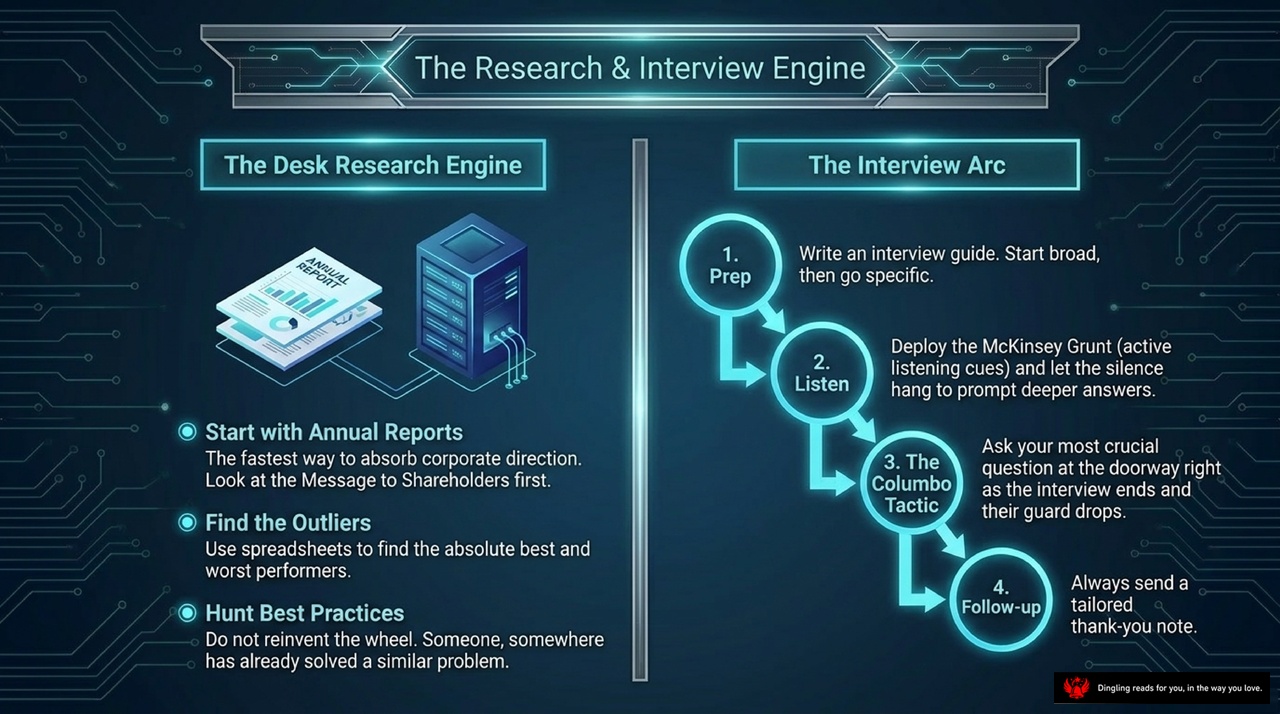
On the left, we see the "Desk Research Engine." Think of this as your pre-work homework before you ever step into a client's office. The fastest way to grasp a company's direction? Start with their annual report, specifically the Message to Shareholders. Once you have that, use spreadsheets to find the outliers—the absolute best and worst performers in their data. This helps you identify where the real problems or opportunities lie. Finally, hunt for best practices. Don't reinvent the wheel; if someone else has already solved a similar problem, learn from them.
On the right is "The Interview Arc," your roadmap for talking to people. It starts with Prep: write an interview guide that starts broad and gets specific. Next is Listen. Deploy the "McKinsey Grunt"—use active listening cues and don't be afraid to let silence hang. That pause often prompts the deepest answers. Then comes The Columbo Tactic: ask your most crucial question right at the doorway as the interview ends, just when their guard drops. And finally, always follow up with a tailored thank-you note. Master these steps, and you'll turn every conversation into a strategic advantage.
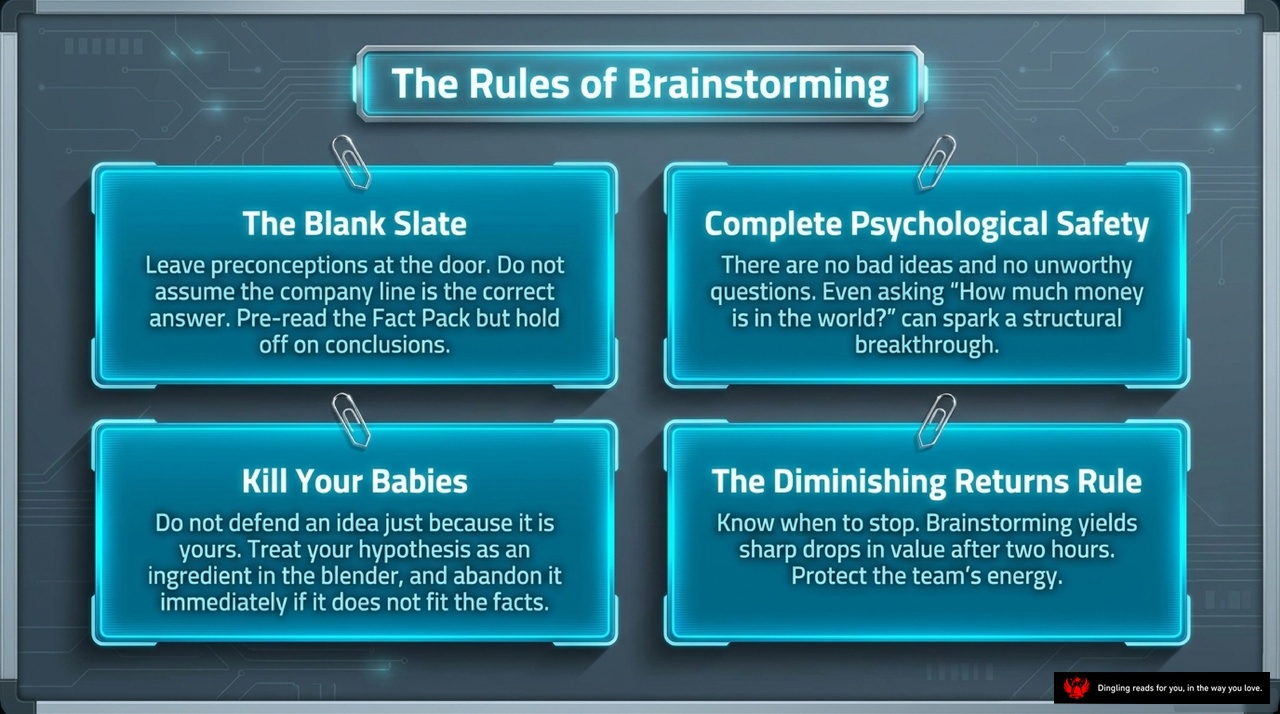
Welcome back. Today, we're diving into the heart of how McKinsey turns chaotic thinking into breakthrough solutions. It all starts with one powerful session: the brainstorm. But before you grab your markers, there's a crucial rule to remember: preparation is non-negotiable. You can't generate magic in a vacuum. The team needs to pre-read the "Fact Pack" to ensure everyone is grounded in the same reality before the creativity begins.
Once everyone is ready, the first golden rule kicks in: The Blank Slate. This means leaving all preconceptions at the door. We aren't here to defend the company line or validate old assumptions. We are here to see the problem fresh. This is where complete psychological safety becomes essential. In this room, there are no bad ideas and no unworthy questions. In fact, asking seemingly absurd questions, like "How much money is in the world?", can spark a structural breakthrough that no one else would have considered.
However, there's a catch. We must be willing to "Kill Your Babies." This is the hardest part for most of us. You must not defend an idea just because it's yours. Treat your hypothesis like an ingredient in a blender. If the facts don't fit, abandon it immediately. Don't cling to your ego; let the data dictate the path.
Finally, we have The Diminishing Returns Rule. Know when to stop. Research shows that brainstorming yields sharp drops in value after about two hours. Pushing too long just burns the team's energy without adding value. So, respect the clock. Protect the team's energy, capture the best ideas, and then move on. It's about quality over quantity.
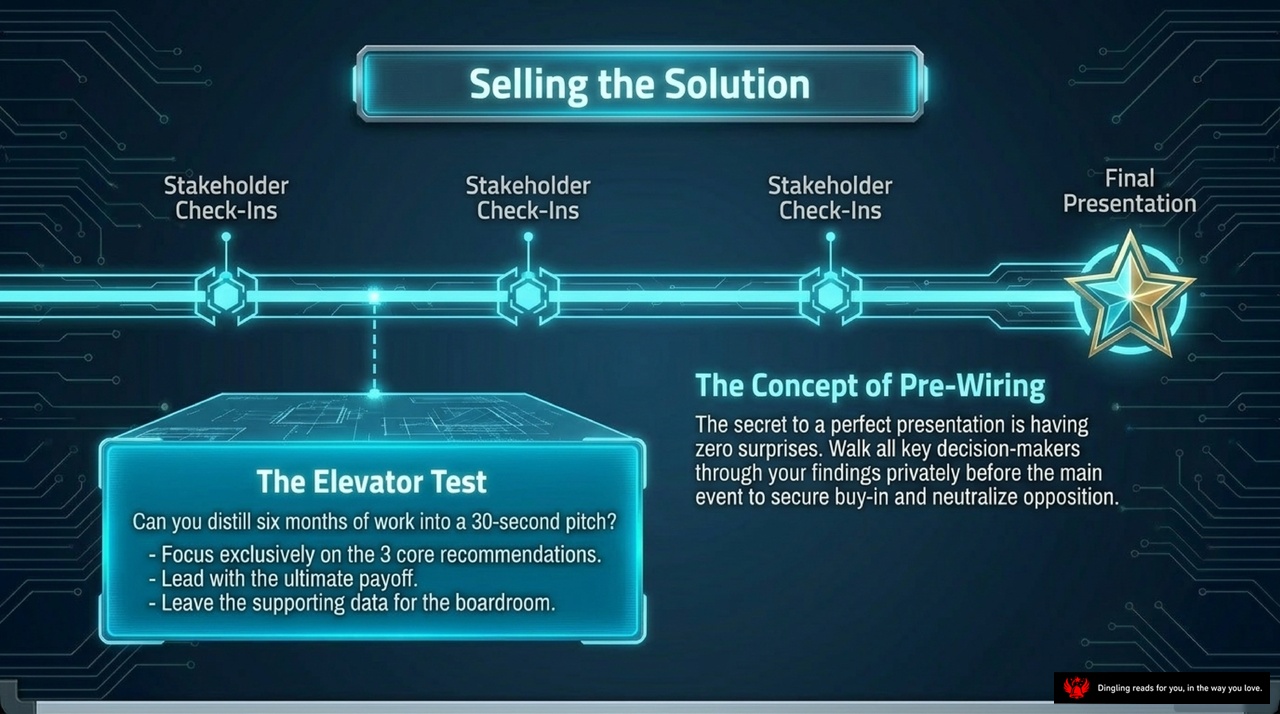
When you've done all the heavy lifting—six months of deep dives, data crunching, and strategic modeling—your job isn't to present every detail. It's to sell the solution. Think of your presentation as the final checkpoint on a journey that started long before you walked into the boardroom.
To get there, you need a roadmap. Imagine a timeline leading from your initial "Stakeholder Check-Ins" all the way to the "Final Presentation." Those check-ins aren't just polite nods; they are your safety net. This is where you practice the concept of "Pre-Wiring." The secret to a perfect presentation is having zero surprises. Before you ever stand in front of the big group, you walk all key decision-makers through your findings privately. You secure their buy-in early and neutralize any opposition before it can derail you in the main event.
But before you even approach those stakeholders, you must pass "The Elevator Test." Can you distill six months of work into a 30-second pitch? If you can't, you're not ready. Your pitch must focus exclusively on the three core recommendations, lead with the ultimate payoff, and leave the heavy supporting data for the boardroom. You are selling the solution, not the process. By the time you hit that final star on the timeline, your audience should already feel like they've made the decision.

Look at this chart. It's a classic example of how McKinsey turns complex data into a single, undeniable truth. Notice the title right at the top: "Accessories drive 75% of profit loss." That is the message line. It doesn't just describe the data; it explicitly states the takeaway. In the world of high-stakes consulting, a chart that fails to tell a story is just decoration.
Now, look at the structure itself. This is a waterfall chart. It visually illustrates the cumulative quantitative flow—the exact path from the starting baseline, through positive and negative inputs, all the way to the final total. You can see the sales baseline, a positive driver, and then two negative drivers that drag the value down. It makes the impact of those negative drivers impossible to ignore.
But why is it so effective? First, it keeps it simple. The rule is one message per chart, using strictly black, white, and one accent color. Absolutely no 3D effects or distracting graphics. This minimalist approach ensures your audience focuses on the logic, not the design. Second, credibility is non-negotiable. Notice the source citation at the bottom: "Source: Annual Sales Report." Always citing your data source instantly resolves any credibility questions before they even arise.
In business, whether you're presenting to a CEO or analyzing your own team's performance, the goal is the same. You need to strip away the noise, anchor your insights in hard facts, and present the narrative so clearly that the decision becomes obvious. This isn't just about making pretty slides; it's about mastering the anatomy of persuasion.

The Human Element isn't just about strategy; it's about navigating the complex social and operational landscape of high-stakes consulting. Let's break down the two critical sides of this coin: managing client dynamics and ensuring your own survival as a consultant.
On the left, we look at Client Dynamics. First, you must align objectives. If the client refuses to implement your solution, no amount of brilliance matters. Turn their goals into yours. Next, you need enterprise-wide buy-in. Rigorous implementation requires tailored communication that flows from the boardroom executives all the way down to the shop floor workers. Finally, manage liabilities by isolating uncooperative team members and building strong alliances with internal champions.
On the right, we focus on Consultant Survival. You cannot navigate the corporate jungle alone; find a mentor and hitch your wagon to a senior star. Your assistant is your lifeline—treat administrative staff with profound respect because they hold the keys to logistics, scheduling, and your daily survival. Never forget the PTM protocol when traveling: always have your Passport, Tickets, and Money ready. And most importantly, protect your sanity. Take one full day off per week and set strict boundaries to separate work from home life. Without these human elements, even the best strategy will fail.
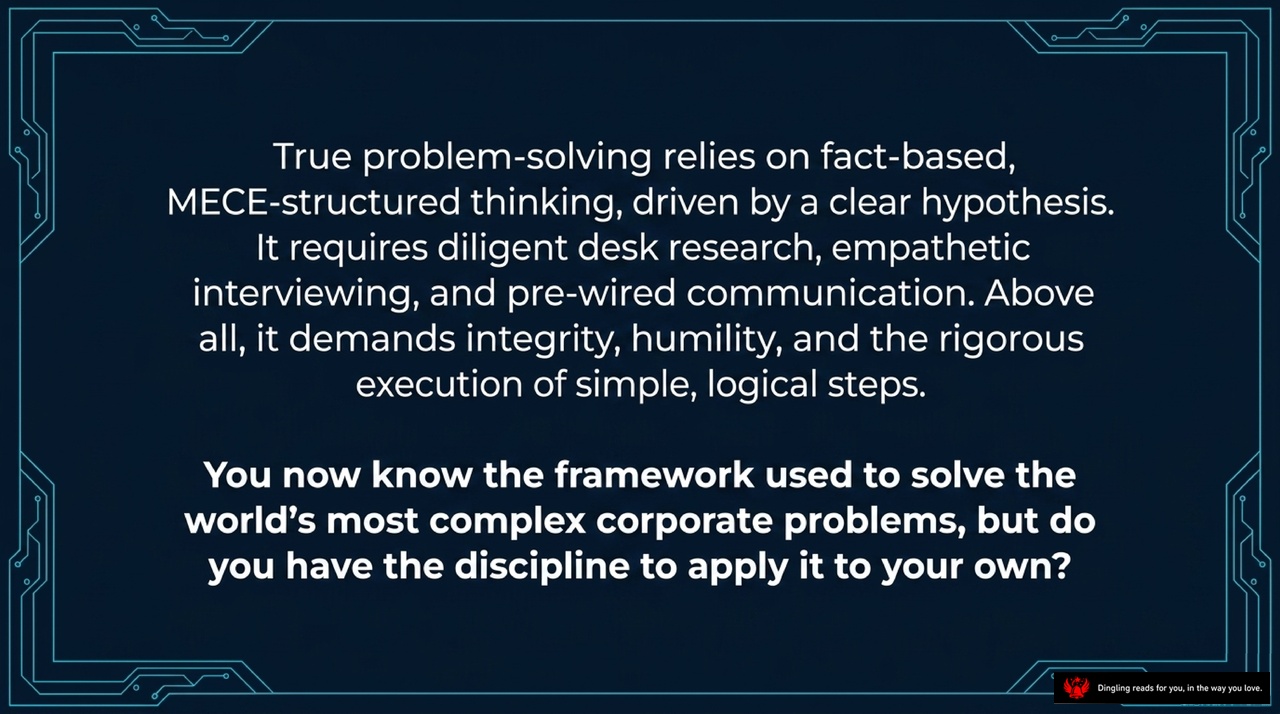
True problem-solving isn't about guessing or relying on gut feelings; it's a disciplined craft built on facts, structure, and clear hypotheses. As we've explored, tackling the world's most complex corporate challenges requires a specific mindset: fact-based research, empathetic interviewing, and pre-wired communication. But beyond the tools and frameworks, the real differentiator lies in the character of the solver. It demands integrity, humility, and the rigorous execution of simple, logical steps. You now possess the framework used to solve the world's most complex corporate problems, but do you have the discipline to apply it to your own? The knowledge is yours; the choice is now up to you.