
The Membership Economy: Complete Chapter-by-Chapter Summary

Welcome to our deep dive into "The Membership Economy" by Robbie Kellman Baxter. Today, we're not just talking about subscriptions; we're exploring a fundamental shift in how businesses connect with people.
The cover of this book beautifully captures the essence of the journey ahead with its infinity symbol. This visual isn't just artistic; it represents the core promise of the membership economy: a seamless, endless loop of value and loyalty. The text on the screen highlights our three main goals: discovering super users, mastering the "forever transaction," and building predictable, recurring revenue.
But here's the crucial insight we need to start with: there is a massive difference between a simple subscription and a true membership. A subscription is just a financial arrangement—a way to pay for access. A membership, however, is about emotion, community, and a deep, long-term relationship. It's the difference between renting a movie and belonging to a club where you feel respected and valued.
In the pages ahead, we will learn how to move beyond simple transactions to create this kind of powerful, enduring bond. We'll explore the psychology behind why people join, how to identify your most valuable members, and the strategies to keep them engaged for the long haul. Whether you are running a business, a non-profit, or just curious about the future of commerce, this book offers the blueprint for building a community that lasts. Let's get started.

The image on your screen presents a powerful "Comparison Matrix" that visually contrasts two distinct business eras: The Era of Ownership on the left, and The Era of Access on the right.
Let's break down what this shift actually means for your business.
Under the **Era of Ownership**, the logic was purely transactional. As the chart shows, the **Core Goal** was a simple **Transaction**. The **Primary Focus** was entirely on **The Product**. Success was measured by **Margin & Volume**, and the value proposition centered on **Privacy & Control**. Think of it as a world where you buy an asset, you own it, and you are responsible for everything from maintenance to storage.
Now, look at the right side: **The Era of Access**. Here, the **Core Goal** shifts dramatically to building a **Relationship**. The **Primary Focus** moves from the product to **The Customer**. Instead of chasing volume, success is now defined by **LTV & Retention**—your customer's lifetime value and how long they stay. Finally, the **Value Proposition** evolves from just privacy to offering **Access & Belonging**.
This isn't just a semantic change; it's a fundamental reimagining of how companies operate. We are moving away from selling things to selling experiences and connections. We are trading the burden of ownership for the freedom of access, and in doing so, we are building communities where customers feel they belong, rather than just being transactional buyers. This shift from "selling" to "serving" is the defining characteristic of the modern economy.

The Membership Economy succeeds because it taps into fundamental human psychology. Once basic survival needs are met, humans inherently seek out "tribes." They crave belonging, recognition, and esteem.
Look at this pyramid on the right. It maps our deepest psychological drives, from the foundation of physiological needs and safety up to safety, belonging, esteem, and finally, self-actualization. The Membership Economy works by shifting from a transactional commodity to a continuous membership. By doing this, organizations transform anonymous buyers into recognized community members, fulfilling their highest psychological needs.
Instead of just selling a product, you are selling a sense of belonging. When a company invests in its members like they are part of the family, offering recognition and a place to belong, it creates a bond that simple transactions can never match. This is why people stay—because they aren't just paying for a service; they are paying to be part of a tribe.

Pricing is the heartbeat of the membership economy, and getting it right is the difference between building a lasting relationship or just running a one-time transaction. Unlike traditional models that simply add a markup to costs, membership pricing must be built entirely on the unique value you deliver to the individual. It's not about what it costs you to provide the service; it's about what the member perceives they are gaining. And crucially, that value must evolve over time. If a member feels they aren't getting fresh, relevant benefits with every renewal, they will leave, no matter how good your model is.
But the real magic happens when you look beyond the basic subscription fee. Smart membership companies don't rely on a single revenue stream. They diversify into seven distinct areas to maximize value. First, there's the subscription itself, which often works best with tiered pricing to give members flexibility. Second, you can offer "à la carte" services for those one-off needs that don't require a full membership. Third, think about merchandise and products that enhance the core experience, like a gym selling branded apparel or a museum selling exclusive prints. Fourth, leverage partnerships by sharing revenue with other businesses that serve your members' needs. Fifth, monetize the rich data you collect by selling insights to other organizations. Sixth, carefully integrate advertising that aligns with member interests without disrupting their experience. And finally, use a "freemium" strategy to attract users with a free tier, guiding them toward paid features once they've experienced the core value.
The choice between these models isn't just about math; it's about psychology. Free trials are powerful for letting users taste the value, but be careful not to offer a complete experience that makes the paid version seem unnecessary. Similarly, free tiers can build a massive community, but you must ensure the paid tier offers enough differentiation to justify the cost. If you get this balance wrong, you risk attracting only users who expect everything for free. The goal is always to make the member feel that their continued investment is the smartest decision they can make.
Let's talk about how pricing actually drives the entire membership economy. It's not just about adding a markup to your costs; it's about defining the unique value you deliver to your members. If you can't show them why renewing makes sense every single time, even the best business model will fail.
Look at the seven revenue streams we can tap into. First, the classic subscription model, often with tiered pricing that gives members flexibility. Then, think about à la carte services for those one-off needs, or selling merchandise that deepens their connection to your brand. You can also earn through partnerships, by aggregating data insights for other businesses, or even through carefully curated advertising that enhances rather than distracts. And don't forget the power of a well-designed free strategy—whether it's a trial or a freemium model—to get people in the door and convert them into paying members.
But here's the catch: technology is the engine that makes all this work. You need robust billing systems to handle complex pricing, marketing automation to keep everyone engaged, and community platforms to foster real interaction. Without these tools, your membership program is just a list of names, not a thriving ecosystem. So, get your tech right, understand the value you're selling, and you'll build a revenue stream that's both predictable and powerful.

So, what happens when you actually try to build a community? You'll quickly discover a fascinating rule that explains almost everything: the 90-9-1 Rule. Look at this diagram. It breaks down any digital community into three distinct layers. The outer ring represents 90% of your members—what we call "The Lurkers." They are passive consumers. They browse, they read, they listen, but they rarely post or interact. Then, moving inward, you have the middle ring: 9% are "The Contributors." These are the occasional participants who share content or chime in from time to time. But right at the very center, the golden core, is just 1%: "The Superusers."
These superusers are the engine of your entire ecosystem. They drive the conversation, create the content, set the norms, and welcome new people. Without this tiny 1%, the rest of the community often stagnates. The goal of smart membership mechanics, as noted here, is to create a gravitational pull. You need to use targeted friction removal and rewards to draw those lurkers inward, encouraging them to become contributors, and eventually, turning them into ultimate brand evangelists. It's all about shifting that balance so more people find their way to the center.
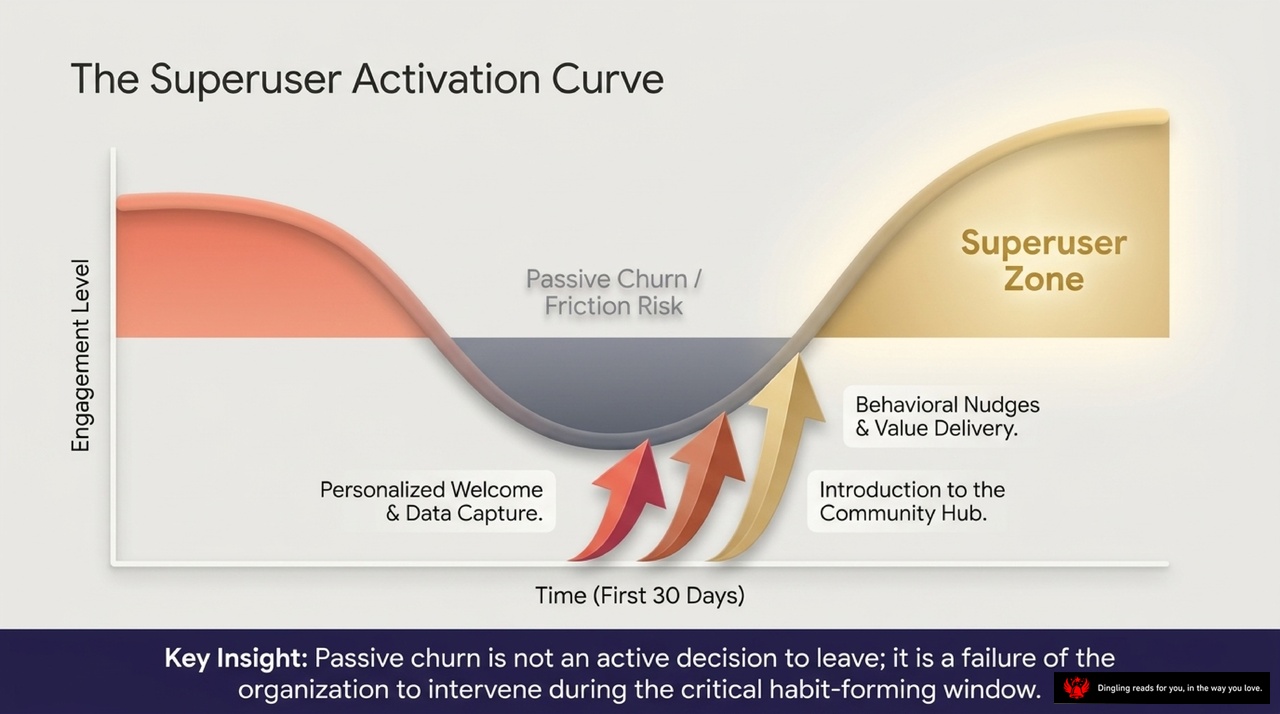
Today's slide breaks down the "Superuser Activation Curve," a roadmap for turning casual users into your most valuable assets within the first 30 days. You can see the curve dips into a "Passive Churn / Friction Risk" zone early on. This isn't just users leaving; it's a failure to intervene when they need it most.
To pull them back up, the curve highlights three critical levers. First, start with a "Personalized Welcome & Data Capture" to remove friction immediately. Next, introduce them to the "Community Hub" so they feel connected, not isolated. Finally, use "Behavioral Nudges & Value Delivery" to reinforce their habits.
The key insight at the bottom is crucial: passive churn happens because the organization fails to act during this critical habit-forming window. If you guide them through these steps, you don't just get a subscriber; you secure a Superuser who will drive the entire ecosystem.

Look at this quadrant. It perfectly illustrates the two main ways companies use "free" to grow. On the top left, you see "Free Trial." This is time-bound and offers full feature access. It's best for proving immediate, undeniable product value, like Netflix. You let users try everything for a short period so they can see the magic before they pay.
But look at the bottom right. That's "Freemium." Here, the access is limited forever, but the door is always open. This model is best for building massive scale and leveraging network effects, just like LinkedIn. You give away the core value for free to get everyone on the platform, knowing that the sheer number of users creates the real value.
The key insight at the bottom is crucial: "Free" is a customer acquisition tactic, not a standalone business model. It must be a deliberate bridge to a paid, premium relationship. Whether you use a trial or a free tier, the goal isn't just to give something away; it's to start a conversation that eventually leads to a lasting, profitable connection.

So, let's look at how digital natives are scaling trust using two distinct but powerful models: Netflix and LinkedIn.
On the left, we have the Netflix Model, which is all about Content Subscription. The magic here lies in leveraging behavioral data to hyper-personalize your experience. As you stay longer, the product gets smarter through algorithmic curation. It's not just about paying for access; it's about the membership value scaling because the service feels like it knows you better every single day.
On the right, we see the LinkedIn Model, defined by a Freemium Network Effect. Here, the community literally *is* the product. They rely on frictionless free access to build a massive database first. Once that density is established, they monetize recruiters and sales professionals who desperately need to rely on that exact density to succeed.
Both models prove that scaling trust isn't about one-size-fits-all solutions. Whether it's getting smarter through data or growing stronger through connections, the digital natives have cracked the code on building loyalty in a crowded world.
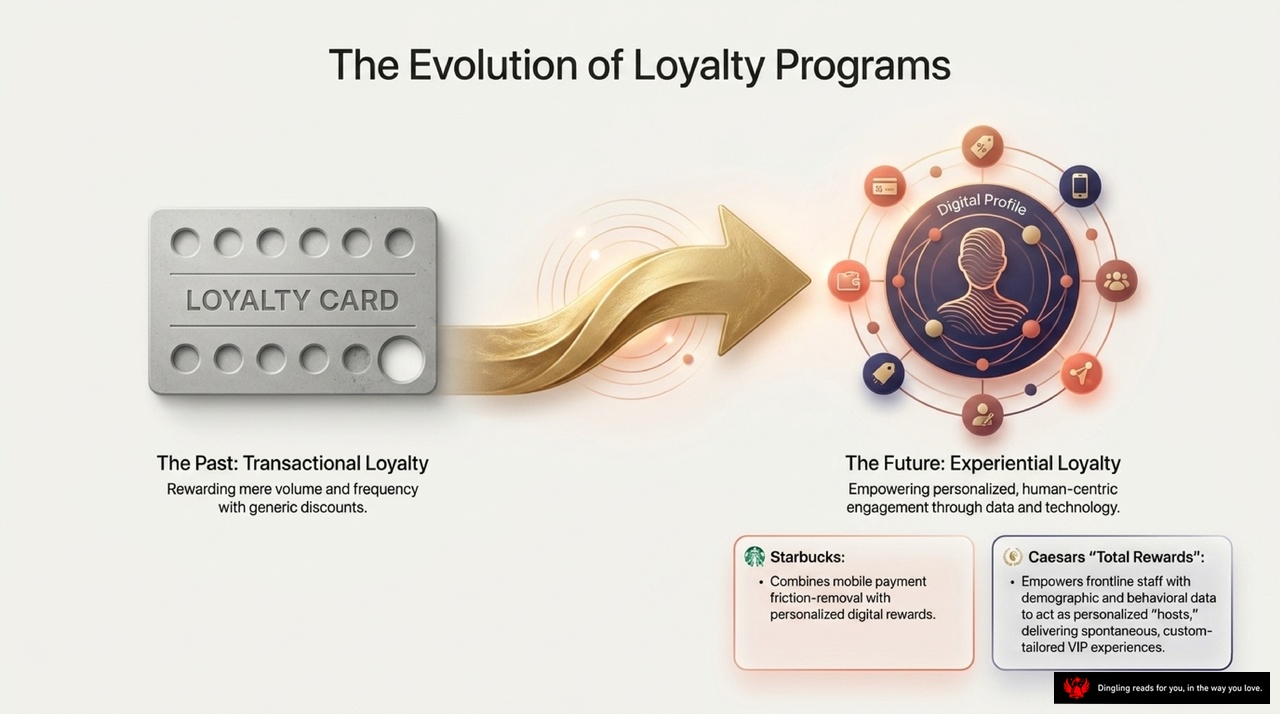
Look at this slide, "The Evolution of Loyalty Programs." We're moving from the past to the future. On the left, you see the classic punch card—symbolizing "Transactional Loyalty." It was all about volume and frequency. You buy more, you get generic discounts. It was a simple, mechanical exchange.
But the golden arrow points us toward the future: "Experiential Loyalty." This isn't just about points anymore; it's about a "Digital Profile." It's empowering personalized, human-centric engagement through data and technology. Think of the examples here. Starbucks isn't just giving you a free coffee; they combine mobile payment with personalized digital rewards. It's frictionless and feels like they know you.
Then look at Caesars "Total Rewards." They empower their frontline staff with demographic and behavioral data. These employees act as personalized "hosts," delivering spontaneous, custom-tailored VIP experiences. That's the shift. We are moving from rewarding a transaction to rewarding a person. We are trading generic discounts for a genuine, human connection that makes members feel truly seen and valued.

When we talk about adapting legacy and local businesses, we're really looking at two distinct but equally powerful strategies for survival in a disrupted market. On the left, we see the American Express playbook: Persona-Based Tiering. Instead of just selling a generic charge card, they shifted toward highly specific, lifestyle-based memberships. Think of their Everyday card designed specifically for busy parents. It's about aligning exact benefits with specific psychographic needs, making the customer feel understood rather than just processed.
On the right, we have Kepler's Books, a classic example of Community-Funded Hubs. This bookstore didn't just try to survive the rise of Amazon by fighting on price; it transitioned from a failing transactional retail model into a vibrant, community-supported cultural hub. By utilizing volunteer boards and member-funded event programming, they turned their customers into stakeholders. They didn't just sell books; they built a sanctuary where people gather, creating a business model that is resilient against industry disruption because it's rooted in human connection, not just inventory.
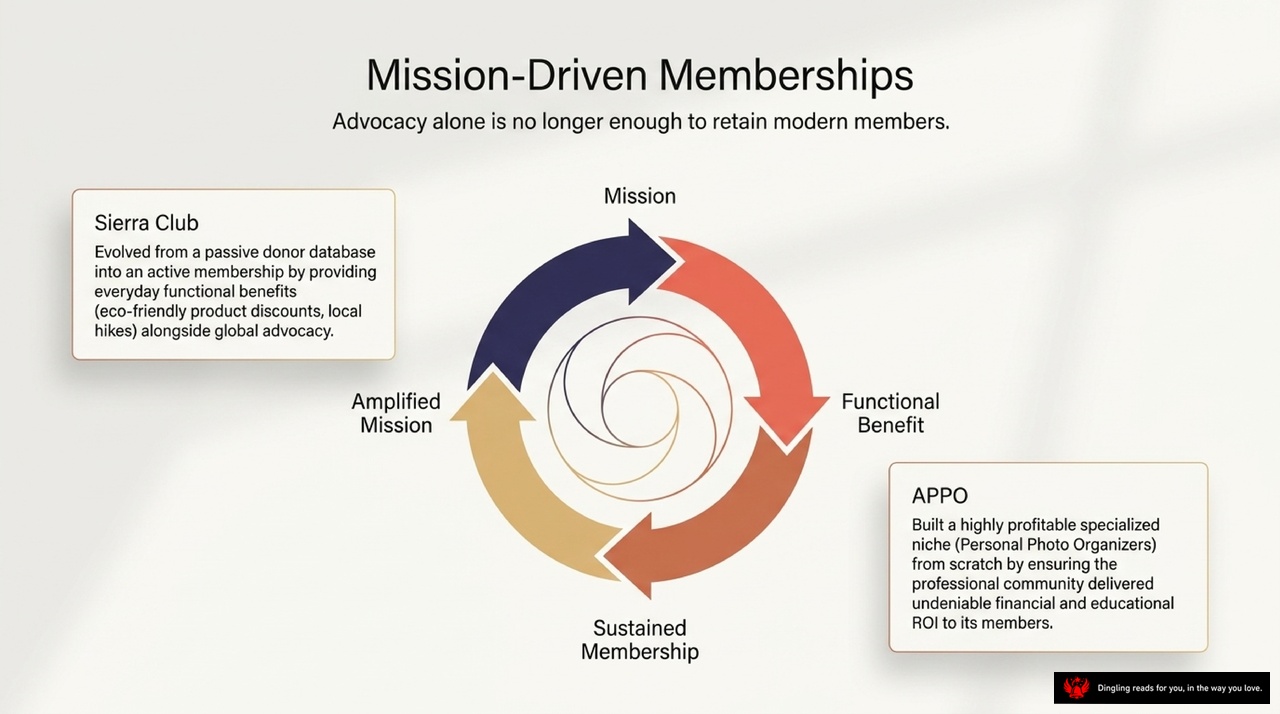
Mission-driven memberships are no longer just about advocacy; they require a complete ecosystem where purpose meets practical value. As the slide illustrates, the cycle begins with a clear **Mission**, which acts as the anchor. Take the **Sierra Club**, for instance. They evolved from a passive donor database into an active community by layering everyday functional benefits—like eco-friendly discounts and local hikes—onto their global environmental advocacy. This approach **amplifies their mission**, turning abstract ideals into tangible daily experiences for members.
On the other side of the cycle lies **Functional Benefit**, which drives **Sustained Membership**. Look at **APPO**, the Professional Photographers of America. They didn't just rely on the mission of professional development; they built a highly profitable niche by ensuring members received undeniable financial and educational ROI. By delivering real value, they secured a loyal community.
The key takeaway here is that modern retention demands a balance. Advocacy alone isn't enough to keep members engaged today. You must create a virtuous loop where your mission provides meaning, your functional benefits provide utility, and that combination fosters a sustained, thriving membership. It's about proving that being part of the organization is both meaningful and useful.
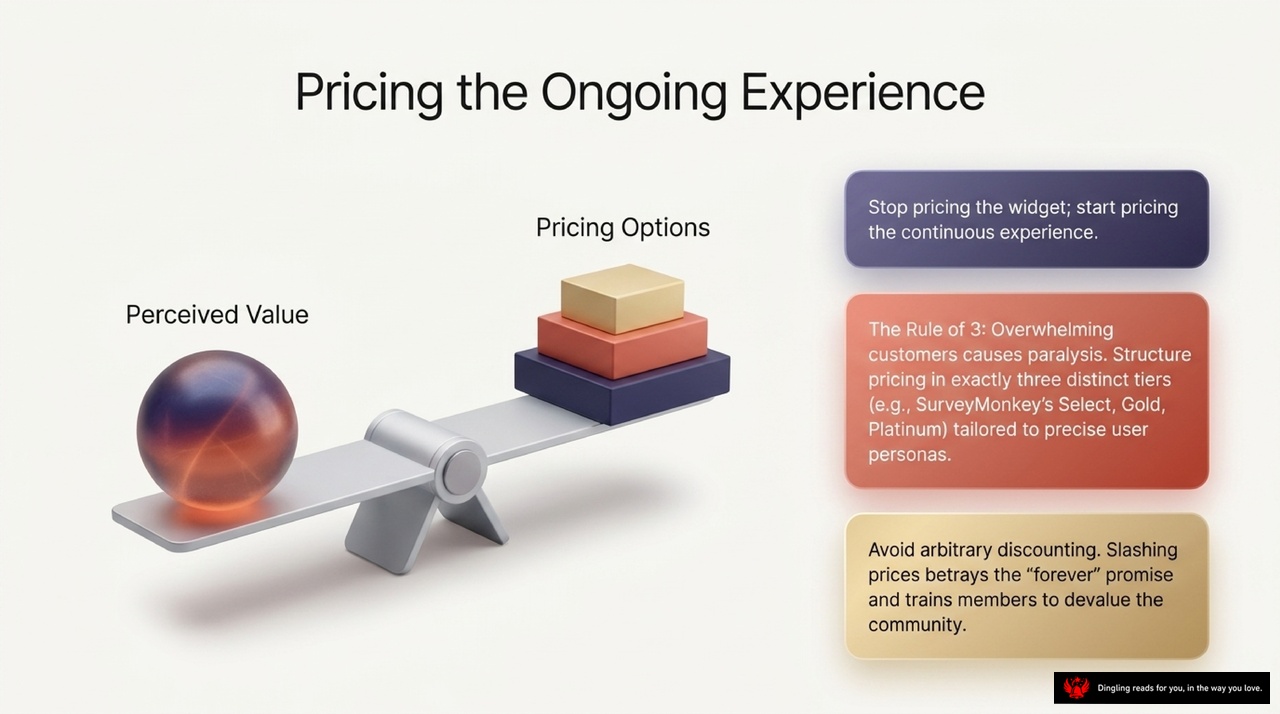
Pricing the Ongoing Experience
Stop thinking about pricing a single product or widget; start pricing the continuous experience itself. This slide captures the delicate balance between perceived value and your pricing options. On the left, we see the "Perceived Value"—the total worth a member feels they are getting over time. On the right, we have your "Pricing Options," which need to match that value perfectly to keep the scale balanced.
First, shift your mindset entirely. Instead of focusing on a one-time transaction, price the ongoing relationship. If you fail to deliver continuous value, no matter how perfect your initial offer, the member will eventually churn.
Second, apply the Rule of Three. Overwhelming customers with too many choices causes paralysis. Structure your pricing in exactly three distinct tiers, like SurveyMonkey's Select, Gold, and Platinum plans. These tiers should be tailored to precise user personas, making it easy for anyone to find the perfect fit without feeling confused.
Finally, and most importantly, avoid arbitrary discounting. Slashing prices betrays the "forever" promise of membership. When you constantly lower prices, you train members to devalue your community and wait for the next deal. Consistency builds trust, and trust is the true currency of a lasting membership.
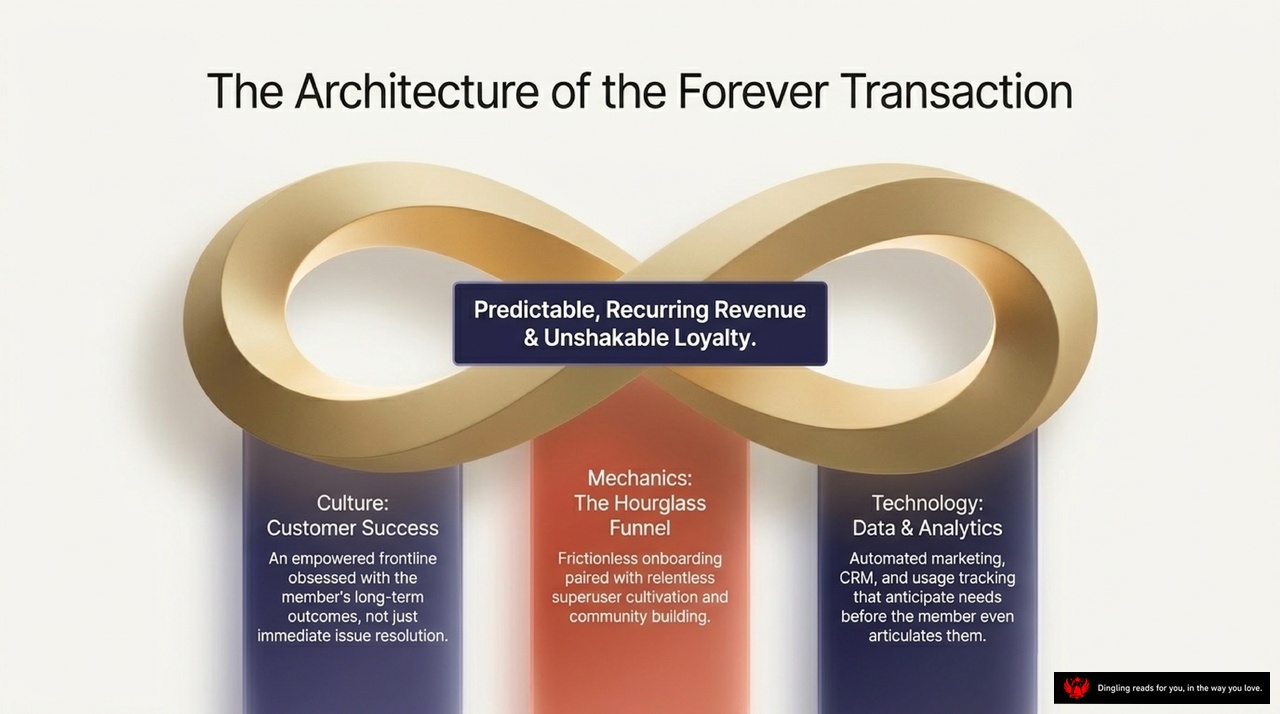
The architecture of the Forever Transaction is built on three essential pillars: Culture, Mechanics, and Technology. Think of it as a golden infinity loop, representing predictable recurring revenue and unshakable loyalty.
On the left, Culture is all about Customer Success. This isn't just about fixing immediate issues; it's about an empowered frontline obsessed with the member's long-term outcomes. You treat them like family, not just a transaction.
In the center, Mechanics relies on the Hourglass Funnel. You pair frictionless onboarding with relentless superuser cultivation and community building. It's about guiding new members seamlessly while nurturing the core contributors who keep the ecosystem alive.
Finally, on the right, Technology drives everything through Data and Analytics. This means automated marketing, CRM, and usage tracking that anticipate needs before the member even articulates them. By leveraging these tools, you don't just react to problems; you solve them before they happen.
When these three elements align, you stop chasing one-off sales and start building a self-sustaining cycle of value, creating a business model that is truly resilient for the future.
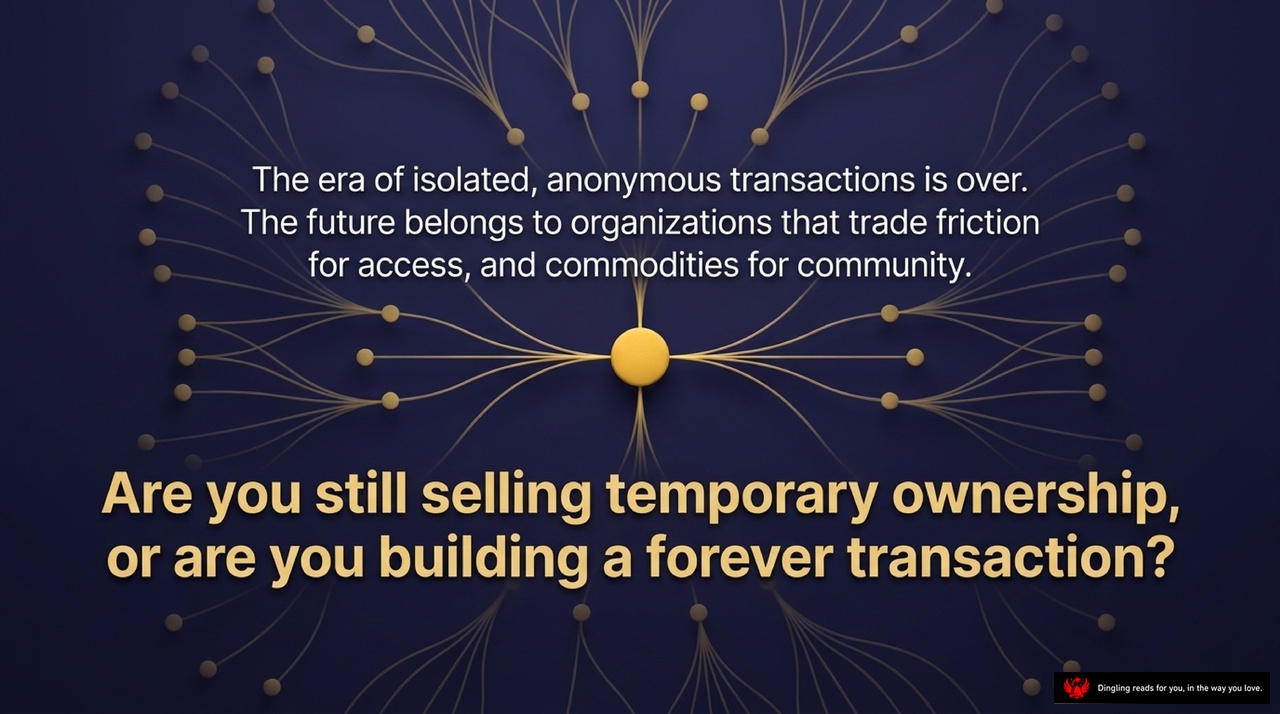
Let's be honest: the old days of isolated, anonymous transactions are officially over. We've moved past the era where you just buy something, get it, and disappear. The future belongs to organizations that trade friction for access and commodities for community.
So, the real question is: Are you still just selling temporary ownership, or are you building a forever transaction?
Think about it. In the past, if you bought a car or a software box, you owned it, but you also carried the burden of maintenance, updates, and eventual obsolescence. But today, technology is reshaping that dynamic. We are seeing a massive shift from ownership to usage. Whether it's streaming music instead of buying CDs, using car-sharing services instead of owning a second vehicle, or subscribing to creative software instead of managing physical discs—people are choosing to escape the pressure of ownership. They want access, they want flexibility, and they want to be part of a community rather than just a customer.
This isn't just about convenience; it's about the emotional connection. When you build a forever transaction, you stop being a vendor and start being a partner. You create a relationship where the value grows over time, where the user feels respected and part of something bigger. That is the essence of the membership economy. It's about turning a one-time sale into a lifelong partnership, ensuring that your organization doesn't just survive the next quarter, but thrives for decades to come.