
The Ming-Qing Ecosystem: Complete Chapter-by-Chapter Summary
Welcome to today's session on Chen Baoliang's *State Ideals and Shadow Realities: The Ming-Qing Ecosystem*. This book dives into a fascinating paradox of imperial China: how the rigid, top-down rules of governance inevitably created a thriving, adaptive underground world of shadow structures.
Think of the Ming and Qing dynasties not just as empires, but as complex ecosystems. On the surface, the state had strict systems for inspecting officials and listening to the people—what we call "visiting and investigating." But in reality, these mechanisms often backfired. Instead of rooting out corruption, they became tools for officials to extract bribes, turning honest inspection into a profitable racket.
Beyond the official bureaucracy, the empire was filled with hidden forces. We see this in the rise of rumor—what the ancients called "false talk." When the government couldn't communicate clearly, fear spread like wildfire. A simple rumor about selecting palace maids could force thousands of families to marry off their daughters in the dead of night. These weren't just lies; they were a shadow communication network that shaped reality more than the emperor's edicts ever could.
And let's not forget the unsung (and often unsavory) actors who ran the show behind the scenes. From the "shadow officials" or *Shiyeye*—private consultants who actually ran the courts and treasuries—to the secret societies that operated in the cracks of the law, and even the martial monks who blended Buddhism with swordplay. The state built its walls, but the people built the maze inside.
In short, the rigid ideals of the empire didn't just fail; they spawned a whole new, resilient reality beneath the surface. That's the core of Chen Baoliang's exploration.

Look at this "Diagnostic Matrix." It lays bare the pathology of officialdom, framing bureaucracy not as a system of governance, but as a disease with specific symptoms and fatal outcomes for the state.
Let's break down the first row: Procrastination and Hypocrisy. The symptom here is the relentless pursuit of empty titles and the art of passing the buck to neighbors or other departments. When officials do this, the fatal outcome is the evasion of responsibility. The system stops solving problems and starts just moving them around.
Next, we have Weakness and Softness. The symptom is subservience to protect one's position and feigning humility to avoid conflict. When leaders prioritize safety over integrity, the fatal outcome is a loss of moral courage. The entire administration becomes afraid to make tough decisions.
Finally, the third row: Careerism. This is the relentless fight for rank in broad daylight, often involving a cycle of speaking, snatching, and slander. When the system rewards self-promotion over service, the fatal outcome is institutional paralysis. The machinery of the state grinds to a halt because everyone is too busy fighting each other to actually get things done.
This matrix isn't just a critique of the past; it's a warning for any organization where the incentive to climb the ladder overrides the duty to serve the public.

Look at this scale. On the left sits "The True Official"—a solid, unmoving black cube. This represents someone who believes in doing things genuinely for the state, confronting difficulties head-on, and prioritizing public welfare over personal gain. But society often views this person as foolish, stubborn, or even naive. On the right, we see "The Smooth Bureaucrat"—a decorative, intricate sphere. This figure believes the world is just a stage play and shouldn't be taken too seriously. Their reputation is that of being smart, adaptable, and smooth. Their focus? Self-preservation and exploiting the system itself.
The image perfectly illustrates a harsh truth: when the system rewards the smooth, earnestness becomes a dangerous liability. In a world designed to favor the flexible and the opportunistic, the rigid integrity of the "True Official" struggles to find its footing. The smooth bureaucrat, by treating everything as a game, thrives in an environment where genuine effort is punished and adaptability is praised. It's a stark reminder that doing the right thing doesn't always make you successful; sometimes, it just makes you a target in a game where the rules have already changed.

The designed workflow depicted here illustrates the ideal mechanism of the Ming and Qing imperial administration: creating a direct line of sight and hearing for the Emperor. At the very top, we see the Emperor and the Capital, supported by the Board of Civil Office and the Censorate. Their mandate was clear: eradicate local bullies, dismiss corrupt officials, and protect the common people. To achieve this, the system dispatched two key forces. On one side, we have the Provincial Governors managing the administration, and on the other, the Inspecting Censors, who were sent as temporary, high-powered auditors to keep things in check. These officials were supposed to gather unvarnished public opinion from local magistrates, county officials, and the public, reporting the truth directly back to the center. However, history shows this ideal often broke down. Instead of protecting the people, the inspecting censors frequently became tools for extortion, demanding bribes from local officials. Meanwhile, the public, rather than being a source of honest feedback, often became a victim of misinformation. As we discussed earlier, rumors and false reports, or "Eyou," spread rapidly through the population, creating panic and distorting the reality that the Emperor was trying to govern. This breakdown in the information flow meant that the Emperor's "eyes and ears" were often blinded by corruption and lies, making the protection of the common people nearly impossible.

The actual workflow of corruption in Ming and Qing China wasn't just about a few bad apples; it was a fully operational business model known as "Extortion Rings." Look at this diagram: what we call "The Gatekeepers"—the Wo Fang or extortion rings—had completely hijacked the anti-corruption system. Instead of protecting the innocent, they turned the Emperor's own tools into the ultimate racket.
Here is how the flow worked. At the top, you have the Inspecting Censors, who were supposed to be the watchdogs. But in reality, they were the buyers. Their job was "Buying Truth": they extorted bribes from corrupt local officials to keep their names off the official reports. If a local magistrate or county official paid up, they stayed in power. If they refused, the system would punish them.
But here's the twist: the Censors also had to "Sell Truth." They framed innocent officials who actually refused to pay bribes, painting them as guilty to satisfy the demands of the higher-ups or to settle scores. The arrows in the middle show this vicious cycle. Corrupt clerks, local informants, and bullies controlled the information flow, ensuring that only the "right" version of reality reached the Provincial Governors and the Capital.
The result? The anti-corruption tool became the ultimate extortion racket. The public was left powerless, trapped in a system where the only way to survive was to play the game, and the only way to be punished was to refuse to pay. This wasn't just corruption; it was a structured, self-perpetuating machine designed to drain wealth from the bottom and protect the corrupt at the top.

The Justice Dilemma: The Ideal of No Litigation
Imagine a society where lawsuits are nonexistent, where magistrates act as peacemakers rather than judges. That was the "State Ideal" for the Ming and Qing dynasties—a harmonious world where conflict was resolved through mediation, not courts. The Confucian belief that "litigation always ends in disaster" made suing a shameful act, something only desperate people did. Families were expected to settle disputes internally, and even local officials tried to keep the "No Litigation" ideal alive by treating courtrooms as places for moral education, not punishment.
But here's the twist: the reality was the exact opposite. As we see in this diagram, the pursuit of this "No Litigation" ideal actually created a trap. To force peace, the state sometimes adopted a "40/60 Split Solution," where a magistrate would arbitrarily assign 60% of the blame to the guilty party and 40% to the innocent victim. The goal? To force both sides to compromise and stop fighting. But the result was perverse. The innocent victim suffered partial punishment, while the malicious actor gained a partial victory. This created a vicious cycle.
Because honest citizens were terrified of the unfairness of the courts, they stopped trusting the legal system. Meanwhile, swindlers realized that making false accusations was actually profitable. This led to an explosion of extortionate litigation, where people sued not to find justice, but to bully others into paying them off. The very system designed to prevent lawsuits ended up becoming the engine of a new kind of corruption. The ideal of no litigation didn't bring peace; it destroyed the trust necessary for a functioning society.

Look at this triangle of power—the "Unholy Alliance" that casts long shadows over justice. At the center sits the "Exploitation Engine," the core mechanism driving this corruption. It's fueled by three distinct but interconnected roles. On the left, we have "The Litigation Trickster." These are professional legal drafters who weaponize the law itself. They take trivial disputes and inflate them into capital crimes just to force payouts from their victims. On the right stands "The Local Bully," acting as the muscle and the orchestrator. They set up fraudulent scenarios and use intimidation to extort wealthy but timid neighbors. Finally, at the bottom, we see "The Corrupt Clerk." This is the insider controlling the bureaucracy. They process false warrants, deliberately delay cases to build pressure, and then split the extorted profits with their allies.
This diagram perfectly illustrates a system where the law isn't used to protect the innocent, but as a tool for predation. The trickster creates the false accusation, the bully enforces the fear, and the clerk ensures the system never catches up to stop them. Together, they form a closed loop where justice is systematically dismantled, replaced by a profitable racket. It's a grim reminder of how quickly legal institutions can rot when they become the primary vehicle for exploitation rather than a shield for the people.

Look at this slide: "Earthly Injustice vs. Divine Retribution." It perfectly captures the core tension of Ming and Qing literature. When the real world failed to deliver justice, stories turned to the underworld to fix it.
On the left, we have the grim reality of "Yin"—the earthly world. Here, the judge is corrupt, blinded by bribes. Evidence is easily forged, and even if you're 60% innocent, you might still lose. The ultimate outcome? The virtuous perish, while the corrupt thrive and pass their wealth down to the next generation. It's a brutal cycle of injustice.
But on the right, we see the literary ideal of "Yang"—the underworld literature. In these stories, Lord Bao rules with absolute clarity, omniscient and incorruptible. There are no bribes here; instead, there are supernatural clues, animal witnesses, and the infallible Mirror of Retribution that reveals the truth instantly. The outcome is cosmic balance restored. The corrupt officials are reincarnated as beasts, while the innocent victims receive heavenly rewards.
This contrast wasn't just fantasy; it was a societal pressure valve. As the text explains, when earthly justice broke down—when officials were too corrupt or information was too blocked for people to know the truth—literature stepped in. It offered a "spiritual compensation" for the lack of real-world fairness. By punishing the wicked in the afterlife, these stories reassured the public that justice would eventually be served, even if not in their lifetime. It was a way for society to cope with a broken legal system by projecting their desire for fairness onto the gods.

The Power Behind the Throne: The Shiye. Imagine an empire where the emperor sits on a golden throne, but the real work gets done by the people standing in the shadows. This slide reveals the secret engine of the Ming and Qing dynasties: the Shiye, or private secretaries.
Look at the diagram. On the left, you see "The Puppet: The Magistrate." These were the official face of the government, but they were often clueless. Unversed in complex law or local dialects, they relied entirely on their staff to avoid fatal career errors. They were just figureshead puppets.
On the right, the strings are held by "The Puppeteers: Private Secretaries (Shiye)." This was a nationwide, informal network that held the true administrative reins. These Shiye weren't government employees; they were hired experts.
Specifically, notice the two key roles listed here. First, "The Law (Xingming)." These secretaries mastered impenetrable legal codes. They dictated life and death in the courtroom. The magistrate might sign the order, but the Shiye wrote the script. Second, "Taxation (Qiangu)." These experts mastered the abacus and accounting. They controlled the financial lifblood of the county, deciding how much money flowed into the imperial treasury.
So, while the magistrate looked like the boss, it was actually the Shiye running the show. They were the brain behind the bureaucracy, managing everything from criminal justice to the empire's wallet. Without them, the entire system would have collapsed. This is the hidden power structure that actually governed China for centuries.

The Anatomy of Mass Panic isn't just a historical footnote; it's a blueprint for how fear spreads when the truth goes dark. Look at this flow: it starts with **The Vacuum**. When the state hides imperial edicts and military reports, it creates a silence that screams louder than any announcement. In an opaque system, rumors become the only currency people trust.
Then comes **The Spark**. Baseless stories ignite in the streets—like false reports of forced drafts for unmarried women. Without official facts to counter them, citizens immediately assume the worst. This is where **The Amplification** takes over. Opportunists, from matchmakers to speculators, exploit this panic for profit, turning a rumor into a financial frenzy.
Finally, we reach **The Climax**. The fear becomes so total that society collapses over a phantom threat. Strangers marry in the dead of night; widows are forced to remarry against their will. The state's failure to communicate doesn't just create confusion—it destroys the very fabric of trust, proving that in a crisis, silence is the most dangerous weapon of all.

Imagine stepping into a Huiguan, or merchant guild, and realizing you've walked into a fully functioning "shadow state" within the bustling city. While the imperial government struggled to reach every corner of the empire, these commercial fortresses stepped in to provide the security and infrastructure that the state simply could not. They were the unsung heroes of the Ming and Qing dynasties, quietly running a complex machine that kept trade alive and society stable.
Look at how they operated as a four-in-one powerhouse. First, they functioned as an economic cartel. They didn't just sell goods; they regulated local pricing, resolved disputes between merchants, and fiercely protected hometown traders from unfair competition. It was a built-in safety net for commerce.
Second, they served as political lodging. For traveling provincial officials, the Huiguan was a safe haven. It shielded them from the predatory and often corrupt environment of the capital, offering a place where they could rest and conduct business without fear.
Third, they acted as the examination hub. These weren't just inns; they were networking centers. They provided housing, stipends, and crucial connections for young scholars taking the imperial exams. In a world where success depended on relationships, the Huiguan was the ultimate launchpad.
Finally, they were the backbone of social welfare. They maintained cemeteries for the displaced, funded burials for the poor, and even hosted religious festivals. In a time without a robust social safety net, the Huiguan ensured that no one was left entirely behind.
From regulating markets to hosting scholars and caring for the needy, the Huiguan was far more than a meeting place. It was a resilient, self-sustaining ecosystem that held the commercial heart of China together.

The Underground State: Secret Societies. This slide reveals how, when the state failed to provide protection for the displaced, the poor, and the outcasts, a parallel power structure rose to fill the void.
Look at the top of our triangle: **The Void**. The state offered nothing but oppression to bandits and vagrants, creating a desperate need for an alternative authority. To solve this, secret societies introduced **The Blood Oath**. This replaced the lost family structures that the state had destroyed, providing brothers with mutual defense and a strict internal legal code.
But how did they legitimize this underground power? They relied on **The Symbolism of 3**—Heaven, Earth, and Man. Rooted in Daoist astrology and Buddhist mysticism, this gave them cosmic legitimacy, making their rebellion feel like a natural part of the universe rather than mere chaos. Finally, they established **Parallel Authority**. Operating with their own titles, origin myths, and secret codes like the *Seabed documents*, these societies created a complete, functioning government beneath the surface, ready to step in whenever the official state failed.

The Displaced Intellectuals: The Failed Scholar's Dilemma
Look at this graphic. It illustrates a crushing bottleneck that defined the fate of countless scholars in China's history. On the left, you see a massive funnel: millions of students pouring into a system with only thousands of quotas. The result? The vast majority are permanently locked out of officialdom. With the imperial ladder blocked, these educated men were forced to choose one of three desperate paths to survive.
The first path is "The Tutors." These scholars descended to the grassroots level, grinding through poverty to teach basic literacy to local children. They were essentially selling their words for food, finding dignity only in the survival of their students.
The second path is "The Hangers-on." These intellectuals became parasitic companions to the wealthy elite. They wrote poems and evaluated art, not out of genuine passion, but because it was their only way to eat. Stripped of any real dignity, they often acted as nothing more than elevated jesters, relying entirely on the whims of the rich.
Finally, the third and most dangerous path: "The Shadow Operators." Here, literacy became a weapon. These displaced scholars weaponized their knowledge against the state. Some evolved into litigation tricksters, using the legal system to exact revenge, while others drafted secret manifestos for underground societies. In this corner, the scholar transforms from a servant of the state into a revolutionary insurgent.
This diagram perfectly captures the tragic dilemma: when the state fails to provide a fair outlet for talent, intelligence doesn't disappear. Instead, it mutates into poverty, servitude, or rebellion.

Synthesis: The Ming-Qing Shadow Ecosystem
Here is the reality check: the official state wasn't the real power; it was just a rigid shell propped up by an adaptive shadow ecosystem that actually ran the show. Look at this diagram. On the left, you have the "Formal State"—the Emperor, Censors, and Magistrates. On the right, the "Informal State," where the real action happens.
Notice how the red lines—the shadow forces—completely bypass the green lines of the formal government. First, you have the **Shiye** manipulating the magistrate. They use anxiety and manipulation to control officials, effectively bypassing the entire judicial system. Then, there's **Wo Fang**, which blinds the censors. They create an ecosystem where corruption is hidden in plain sight, making oversight impossible.
Down below, the **Songshi** hijack the courts, promising justice while actually controlling the legal process. Meanwhile, the **Huiguan** controls the economy, turning the underground market into the real source of wealth and power. Finally, **Secret Societies** rule the underground, using violence and fear to enforce their will.
The core insight here is simple but profound: the parasites were actually the host. The formal state was just a facade, while these five shadow elements wove a complex web that dictated everything from law to money to life itself.
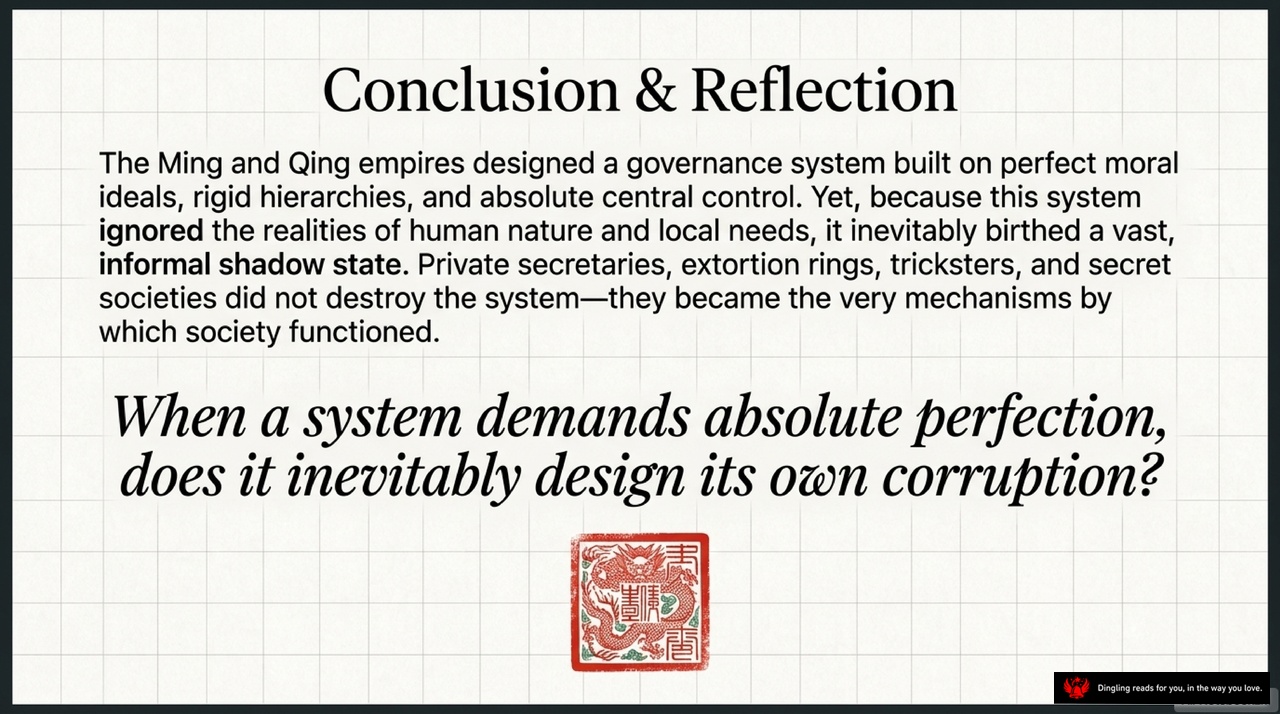
So, we've reached our final thought on the intricate tapestry of Ming and Qing governance. As we wrap up, let's look at the core lesson: these empires built their entire system on a pedestal of perfect moral ideals, rigid hierarchies, and absolute central control. They believed that if the rules were just and the hierarchy strict, society would run smoothly. But here is the tragic irony they missed: they completely ignored the messy reality of human nature and the diverse needs of local communities.
Because the official system was so far removed from how people actually lived, it inevitably birthed a vast, informal "shadow state." Think about it: private secretaries, extortion rings, tricksters, and secret societies. The official narrative would tell you these were enemies that needed to be crushed. But the reality was much darker and more complex. These very elements didn't just destroy the system; they became the actual mechanisms by which society functioned. When the top-down rules were too rigid to handle real life, the system had to bend, and it bent in ways that created corruption and informality.
This leads us to a question that echoes through history and still feels relevant today: When a system demands absolute perfection, does it inevitably design its own corruption? By trying to force a perfect order onto an imperfect world, the Ming and Qing empires didn't just fail to achieve that perfection; they created a parallel world where the rules were written by those who knew how to bend them.