
The Minimalist Entrepreneur: Complete Chapter-by-Chapter Summary
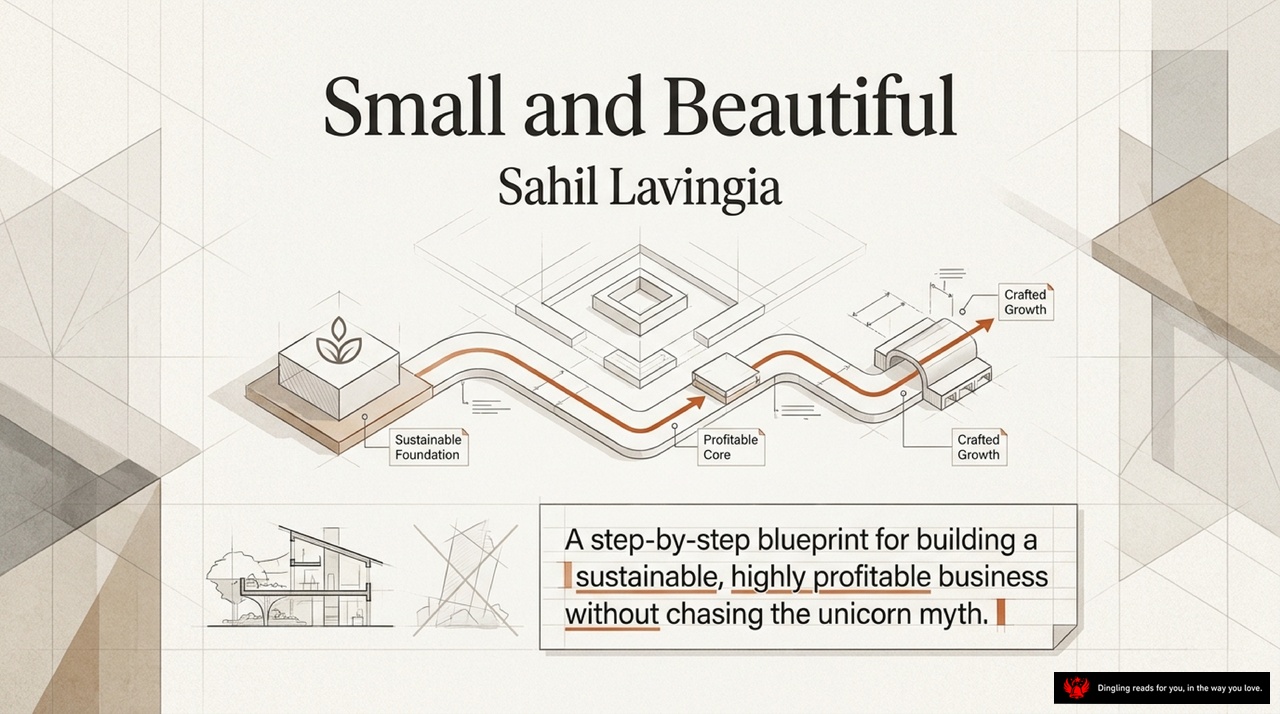
Welcome to "Small and Beautiful" by Sahil Lavingia. Today, we're exploring a step-by-step blueprint for building a sustainable, highly profitable business without chasing the unicorn myth. Instead of aiming for massive scale and risky funding rounds, this book guides you toward creating a business that thrives on its own terms. You'll learn how to start small, focus on what truly matters, and grow at a pace that allows you to enjoy the journey. Whether you're an aspiring founder or someone looking to rethink your current path, this is your invitation to build something real, something lasting, and something that aligns with your values.

Deconstruct the Billion-Dollar Myth. Look at these two structures side by side. On the left, we have "The Myth"—the classic Unicorn Path. It looks like a soaring skyscraper, but notice the cracks. This is the story of Sahil's early journey: raising over $10 million from top-tier venture capitalists, chasing rapid scaling at any cost, and burning through cash. The result? A top-heavy structure with an unstable foundation. It led to mass layoffs, a stalled company, and treating the business like a lottery ticket. The arrows point to inevitable collapse.
Now, look at the right side. This is "The Reality," the Minimalist Path. Instead of a fragile tower, this is a sturdy, anchored framework. Sahil later trimmed costs entirely, focused intensely on creators, and reached profitability without external saviors. He generated over $140 million in creator revenue with a tiny, asynchronous team. Notice the labels here: Sustainable Base, Solid Foundation, and Long-Term Viability. This approach treats the business as a sustainable tool to create, not a vehicle for a quick exit.
The core difference is simple but profound. The myth relies on funding to prop up a house of cards, while the reality builds on profitability and efficiency. By avoiding the trap of needing the next round to survive, you build a business that can stand on its own, creating real value without the risk of structural failure.
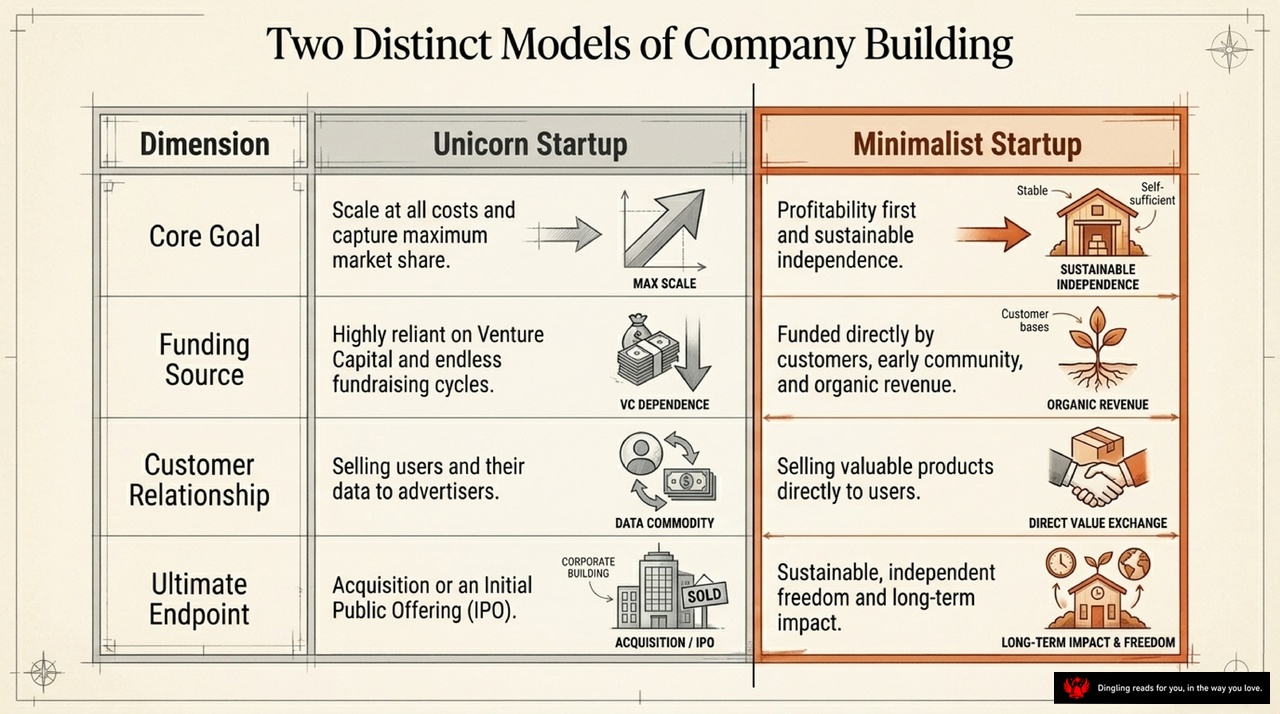
Two Distinct Models of Company Building: A Tale of Two Paths.
Imagine two very different ways to build a business. On the left, we have the "Unicorn Startup." Its core goal? Scale at all costs. It relies heavily on Venture Capital, constantly chasing the next funding round to fuel endless growth. In this model, the customer isn't the priority; often, the business sells users and their data to advertisers. The ultimate endpoint is an exit—either a massive acquisition or a high-stakes IPO. It's a high-risk game where you bet everything on becoming one of the few billion-dollar outliers, while hoping the rest of the failures can be covered by those few successes.
Now, look at the right side: the "Minimalist Startup." Here, profitability comes first. The goal isn't just to get big, but to achieve sustainable independence. Instead of relying on external investors, these companies are funded directly by their customers and organic revenue. They build a direct relationship with users, selling valuable products in exchange for value, not data. The endpoint isn't a sale to a larger corporation, but long-term impact and freedom.
This isn't just theory; it's a choice between a life of dependency and one of self-reliance. The Unicorn path requires you to please investors and prioritize speed over sanity. The Minimalist path allows you to build a business that serves a real community, generates steady cash flow, and ultimately gives you the freedom to steer your own ship. Which model will you choose to build your future?
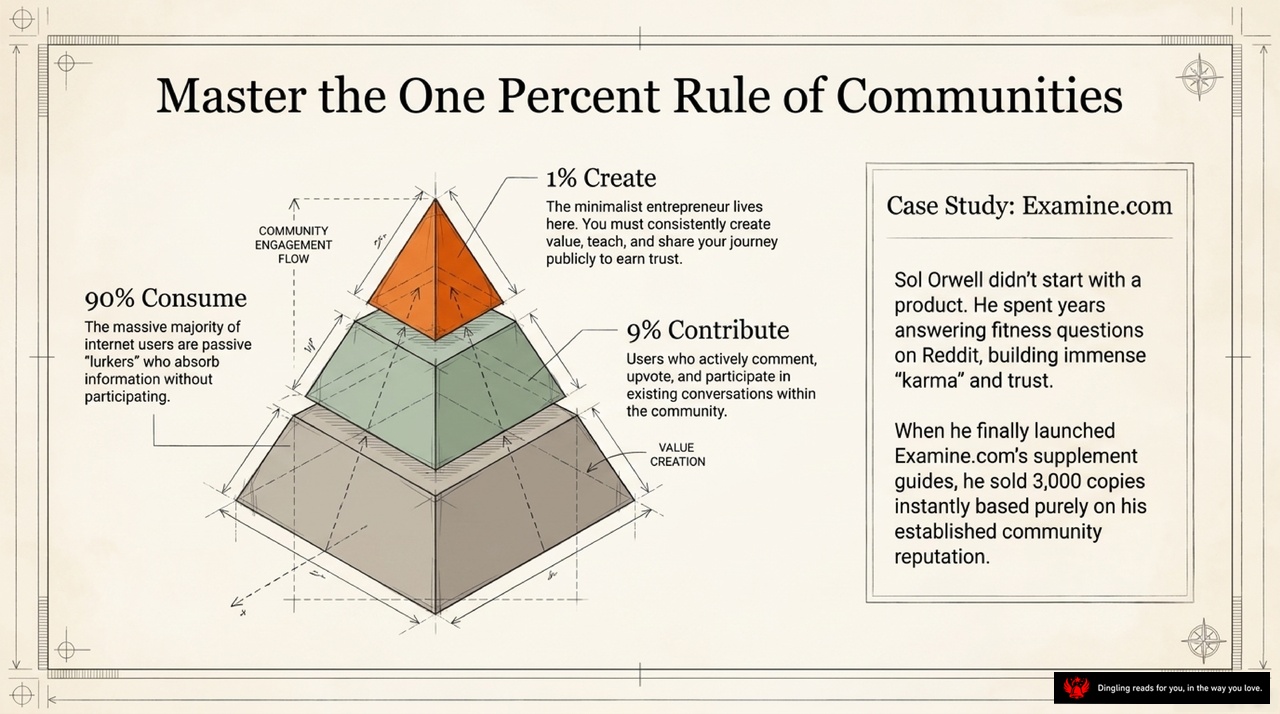
Master the One Percent Rule of Communities. Look at this pyramid: it reveals a simple truth about how internet communities actually work. The vast 90% are passive consumers, often just "lurkers" absorbing information without ever participating. Only 9% actively contribute by commenting and upvoting, and a tiny 1% creates the original value that fuels everything else. This is the engine of trust.
Take Sol Orwell as our case study. He didn't start with a product. For years, he simply answered fitness questions on Reddit, building immense "karma" and trust within that community. When he finally launched Examine.com, that established reputation allowed him to sell 3,000 copies instantly. The lesson is clear: before you build a business, you must become a pillar in a community. If you can contribute value, your exposure is ten times that of a lurker. If you go on to create, your influence grows ninety-fold. Don't wait to be an expert; if you are learning, you have something to teach. Start by helping others, and the market will eventually help you.
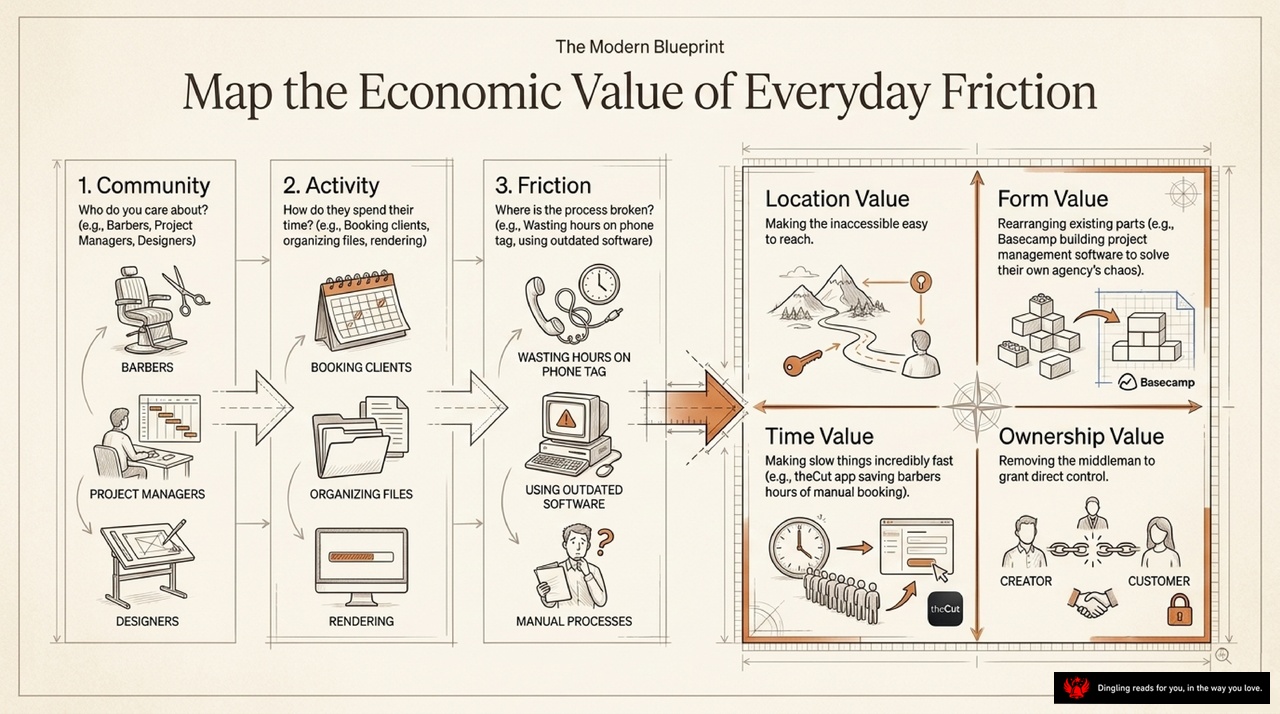
Mapping the Economic Value of Everyday Friction is all about spotting where life gets stuck and turning those annoyances into business opportunities. As the slide illustrates, we start by identifying the **Community**—the people who care about you, like barbers, project managers, or designers. Next, we look at their daily **Activity**: booking clients, organizing files, or rendering designs. But here lies the problem: **Friction**. Where is the process broken? Whether it's wasting hours on a phone tag, using outdated software, or getting stuck in manual processes, these pain points are where value is hidden.
The magic happens when we solve these frictions through four specific types of value. First, **Location Value**: making the inaccessible easy to reach, like delivering rare goods directly to a customer's door. Second, **Form Value**: rearranging existing parts to create something new, much like Basecamp did by building project management tools to solve agency chaos. Third, **Time Value**: making slow things incredibly fast, such as how apps like TheCut save barbers hours of manual booking. Finally, **Ownership Value**: removing the middleman to grant direct control, allowing creators to connect straight with customers without locks or gatekeepers.
The lesson is clear: don't invent problems from scratch. Instead, map out the friction in your community's daily life. By targeting these specific inefficiencies—whether it's saving time, reducing effort, or cutting out intermediaries—you transform everyday annoyances into a sustainable, profitable business that truly serves people.
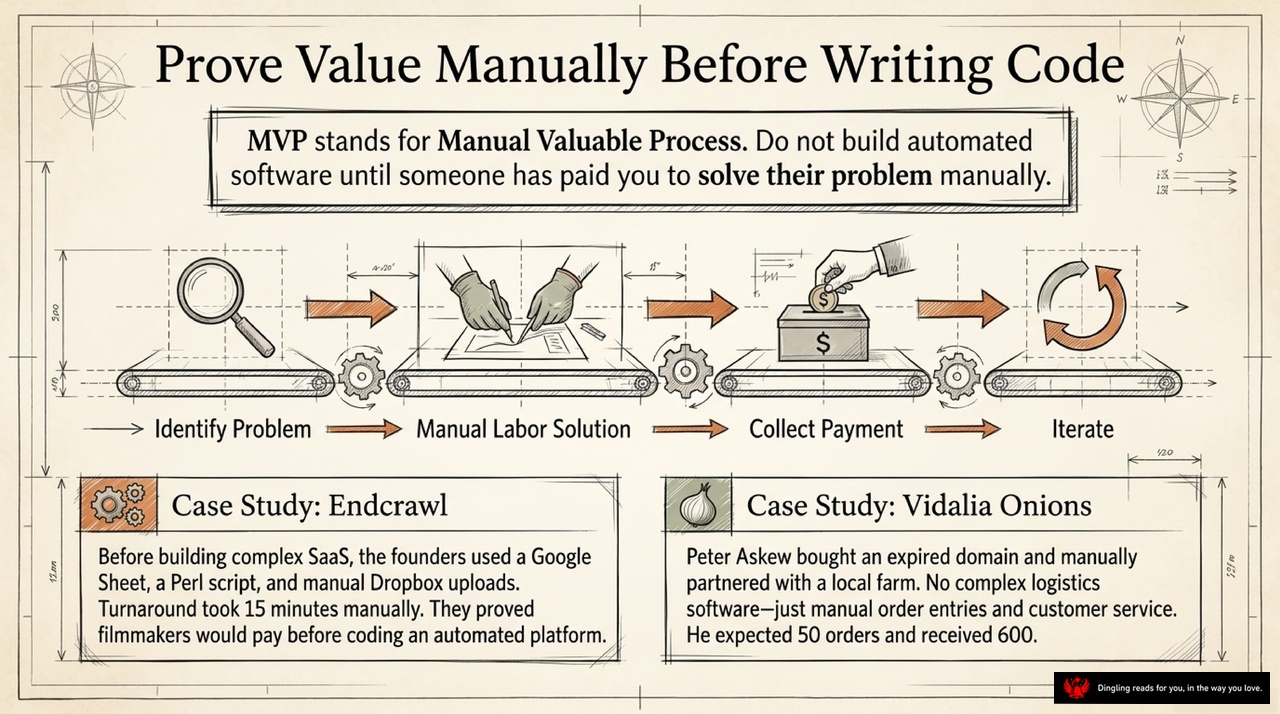
Before you write a single line of code, prove that your idea actually solves a real problem. The slide outlines a powerful strategy: build a Manual Valuable Process, or MVP, first. Don't rush to automate; instead, manually solve the problem for paying customers. This simple four-step cycle starts with identifying the pain point, then executing a manual labor solution, collecting payment to validate demand, and finally iterating based on real feedback.
Take Endcrawl as an example. Instead of building complex SaaS software, the founders used Google Sheets, a Perl script, and manual Dropbox uploads. They handled everything by hand, turning a 24-hour turnaround into just 15 minutes. Crucially, they proved filmmakers would pay before writing a single line of code. Similarly, look at the Vidalia Onions case. Peter Askew bought an expired domain and partnered with a local farm. He handled all the manual order entries and customer service himself. He expected 50 orders and ended up receiving 600. These stories illustrate the core lesson: don't build automated software until someone has paid you to solve their problem manually. Validate the value first, then automate the success.

Imagine your business as a machine that runs itself, freeing you from the daily grind. This slide outlines the ultimate evolution: moving from a manual process to a fully automated product. It starts with **Freelance**, where you solve problems one-on-one, trading your time directly for money. This is your classroom—learn the exact pain points of your first customers by being their dedicated partner.
Next, you move to **Processize**. Don't just do the work; document every single step. Create a "playbook" or standard operating procedure. This is where you build your operational system on paper, turning your personal skills into a repeatable workflow. Finally, you reach **Productize**. Translate that documented process into software, digital products, or automated systems. The goal? Automate the delivery so customers can buy without your direct involvement.
Notice the powerful quote at the bottom: "Start with less. Do not start with code." This means don't rush to build complex software before you understand the manual process. Master the workflow first, then automate it. By following this path, you build a resilient, scalable business that generates revenue even when you're not working.
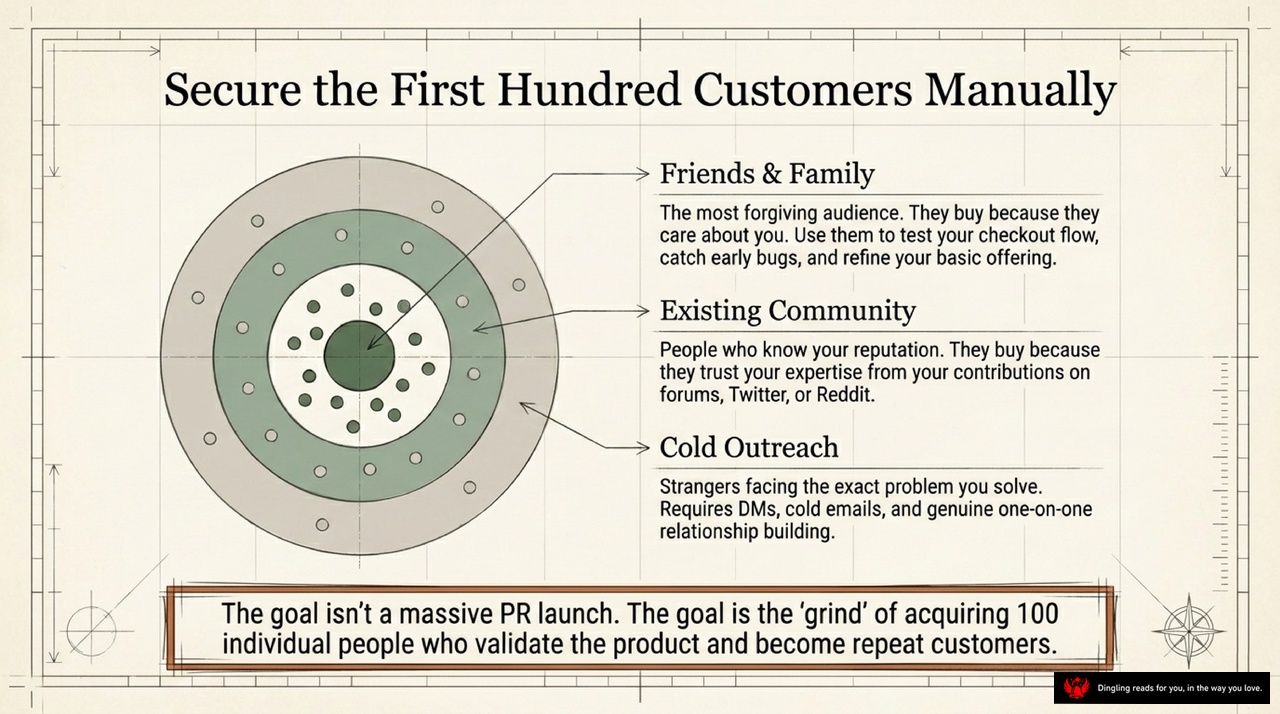
Stop chasing the shiny promise of a massive PR launch. The real goal of minimalist entrepreneurship is the grind of acquiring just 100 individual people who validate your product and become repeat customers.
Think of your customer acquisition as a concentric circle, starting from the inside out. First, tap into your inner circle of friends and family. They are your most forgiving audience because they buy out of care for you, not just the product. Use them to stress-test your checkout flow, catch early bugs, and refine your basic offering before anyone else sees it.
Next, expand to your existing community. These are the people who already know your reputation from your contributions on forums, Twitter, or Reddit. They buy because they trust your expertise, making them the perfect second wave of early adopters.
Finally, you move to cold outreach. This is where you target strangers facing the exact problem you solve. It requires the grit to send DMs, cold emails, and build genuine one-on-one relationships. While many founders dream of a viral explosion, the minimalist path is about steady, manual connection. Once you've secured those 100 loyal customers and proven your business can sustain itself, *then* you consider scaling. Until then, focus entirely on the human connection.
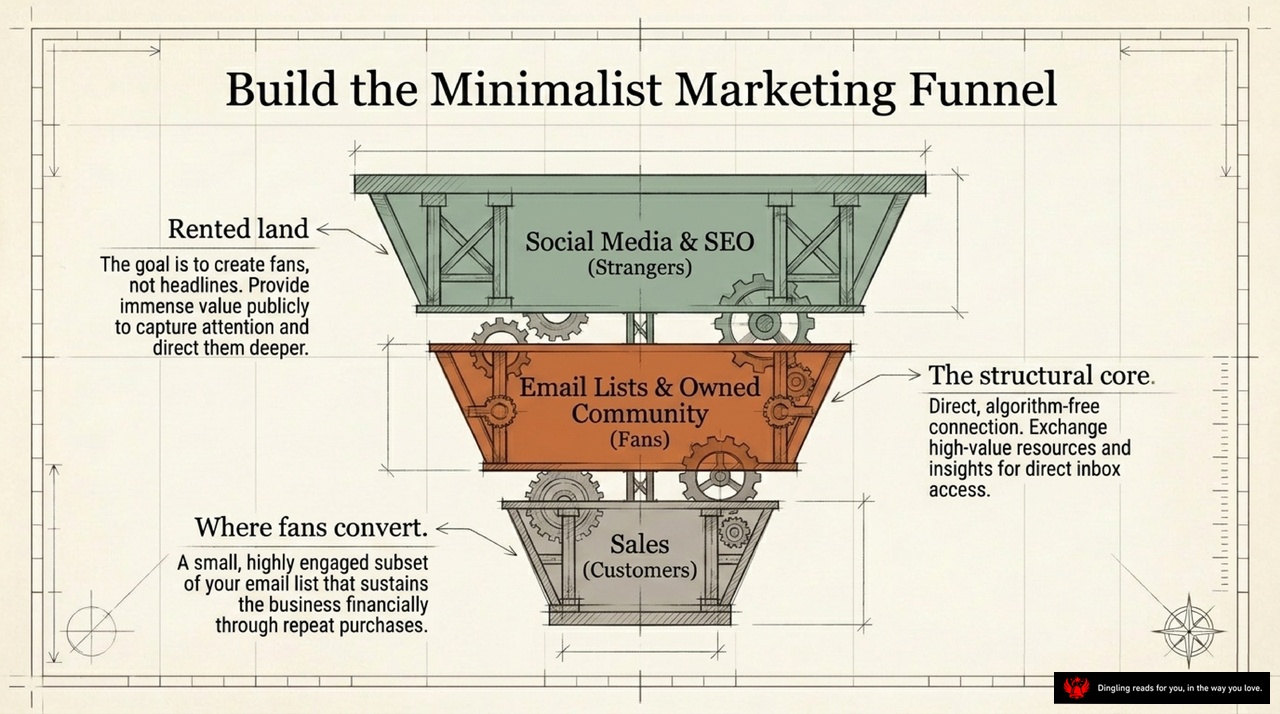
Look at this blueprint for the Minimalist Marketing Funnel. It's a simple, three-tiered structure designed to take you from strangers to loyal customers without relying on expensive ads.
At the top, you have "Social Media & SEO," labeled as your "Rented Land." Think of it this way: you don't own these platforms; you just rent space there. The goal isn't to chase viral headlines, but to create fans by providing immense public value. You're trying to capture attention and gently guide those strangers deeper into your world.
Once they engage, they move into the middle section: your "Email Lists & Owned Community." This is the structural core of your entire business. It's your algorithm-free connection where you exchange high-value resources and insights for direct access to people's inboxes. This is where the real relationship happens, away from the noise of social media algorithms.
Finally, at the bottom, is where the magic converts into revenue. This is your "Sales" section, representing a small, highly engaged subset of your email list. These are the customers who sustain your business financially through repeat purchases. By focusing on this funnel, you stop chasing fleeting trends and start building a sustainable, profitable business rooted in trust and direct communication.

Ascend the Three Tiers of Content Creation. Think of your content journey not as a flat line, but as a staircase with three distinct levels.
Level one is Teach. This is where you start by sharing what you are actively learning and documenting your process. It's about being helpful and transparent. A perfect example is the Missouri Star Quilt Company, which grew into a global empire simply by sharing ten simple YouTube quilting tutorials. They didn't need to be experts; they just needed to teach.
Step up to Level two: Inspire. Here, you share your struggles, failures, and your authentic journey. This builds deep loyalty. Look at Gimlet Media's "StartUp" podcast; they aired their own messy founding story, and that vulnerability created a fiercely loyal audience. You aren't just showing the finished product; you're showing the person behind it.
Finally, you reach Level three: Entertain. This is the hardest tier, but it offers the highest reach. It combines teaching and inspiring with humor, format-breaking ideas, and engaging storytelling to capture the masses. Think of the classic comedy masks symbolizing this level. By blending education with entertainment, you stop just informing people and start captivating them.
The goal is to climb these tiers. Start by teaching, move to inspiring, and eventually entertain. This progression allows you to build trust, deepen connections, and ultimately expand your impact to a much wider audience.

Look at this balance scale. On one side, we have near-zero fixed costs, and on the other, customer revenue. This visual perfectly captures the core of the "Default Alive" profitability strategy. Instead of chasing risky venture capital or building expensive offices in Silicon Valley, the goal is to keep your fixed costs as low as possible so your business can survive on its own.
This approach gives you something priceless: profitable confidence. When your business is immune to external pressure, you aren't forced to make desperate decisions just to please investors. You can build your product on your own timeline, focusing on what actually helps your customers rather than what looks good on a slide deck.
The core directives are simple but powerful: don't rent an office, hire software tools before people, and pay yourself a basic living wage first. By following these rules, you stop being a victim of market forces and start being the master of your destiny. You aren't building a ship to sell to investors; you're building a boat that can sail for decades, entirely on your own terms.
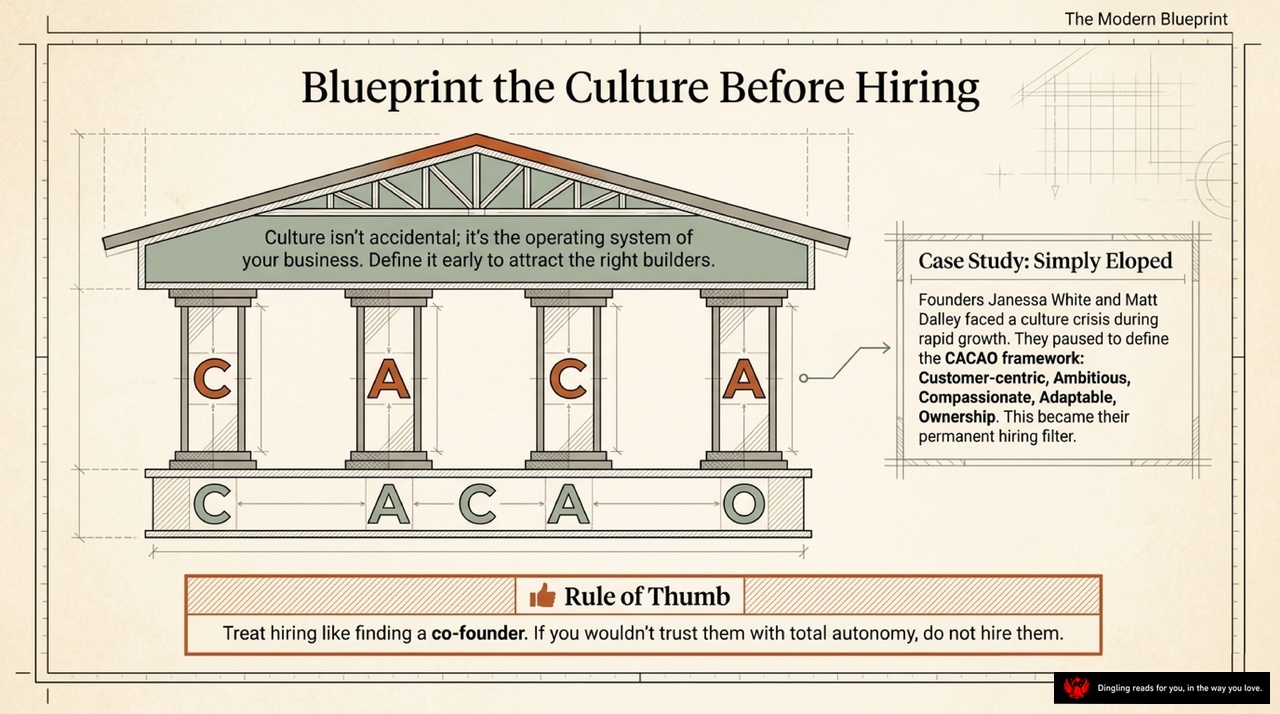
Blueprint the Culture Before Hiring. Think of your company not as a building you construct later, but as an operating system you must define before you even hire your first employee. As the slide illustrates, culture isn't accidental; it is the very foundation of your business. If you don't define it early, you risk attracting the wrong builders who will eventually tear your vision down.
Take the case of Simply Eloped. Founders Janessa White and Matt Dalley faced a culture crisis during rapid growth, largely because they had never formally defined their values. They paused to create the CACAO framework: Customer-centric, Ambitious, Compassionate, Adaptable, and Ownership. This became their permanent hiring filter, turning a chaotic situation into a structured path forward.
Here is a rule of thumb you should live by: treat hiring like finding a co-founder. If you wouldn't trust someone with total autonomy, do not hire them. In the minimalist startup model, you aren't looking for bodies to fill seats; you are looking for partners who align with your core values. By blueprinting your culture first, you ensure that every new team member is already speaking the same language, ready to build the future you've envisioned together.

Imagine a company not as a rigid hierarchy, but as a distributed network of autonomous nodes, where every single employee operates with the mindset of a CEO. This is the essence of radical transparency. When you give full autonomy over specific domains, employees stop waiting for permission and start acting as true executives of their own tasks.
The shift begins with a fundamental change in communication. By embracing a fully asynchronous workflow, you prioritize deep work and eliminate the constant interruption of disruptive real-time meetings. Instead, communication happens deliberately through tools like Notion and GitHub, allowing everyone to focus on what truly matters.
To support this, you must install an open metrics system. This means public roadmaps, open code reviews, and completely transparent salaries. When information asymmetry is completely eliminated, micromanagement becomes obsolete. Everyone has access to the exact same data as the founder, which builds a culture of trust and accountability. The result? A self-sustaining ecosystem where the entire organization runs efficiently without the need for traditional oversight.

Today's slide maps out the ultimate destination for a minimalist entrepreneur: buying back your time to achieve Ikigai. As you can see, the journey doesn't end with a massive IPO or a billion-dollar valuation. Instead, the real goal is to use your profitable business to definitively buy back your freedom.
Look at the center of this diagram. It's a loop where four circles intersect: what you love, what you are good at, what the world needs, and what you are paid for. This is the essence of Ikigai. By reinvesting that reclaimed time, you can create more creators, support your specific community, protect the earth, and align your daily work with profound personal purpose.
Success, in this context, isn't about a flashy exit; it's about building a house you actually want to live in. It's about finding that sweet spot where your skills and passions meet the needs of the world, all while generating enough revenue to support the life you truly desire.

The Final Blueprint. This isn't just a summary; it's your map to building a business that actually works for you.
First, remember these three non-negotiables: Profitability over scale. Don't chase a massive user base if you aren't making money today. Community over audiences. Build real trust with a specific group of people, not just trying to shout at everyone on the internet. And manual validation before writing code. Prove people want your solution with pen, paper, or spreadsheets before you hire a single developer.
You now have the blueprint to build a sustainable business that buys back your freedom. It's about creating a company you can run on your own terms, without relying on risky venture capital or endless fundraising.
So, here is the question that matters most: What is the smallest possible step you can take today for the community you care about most? Don't wait for the perfect moment. Just start there.