
The Model Thinker: Complete Chapter-by-Chapter Summary
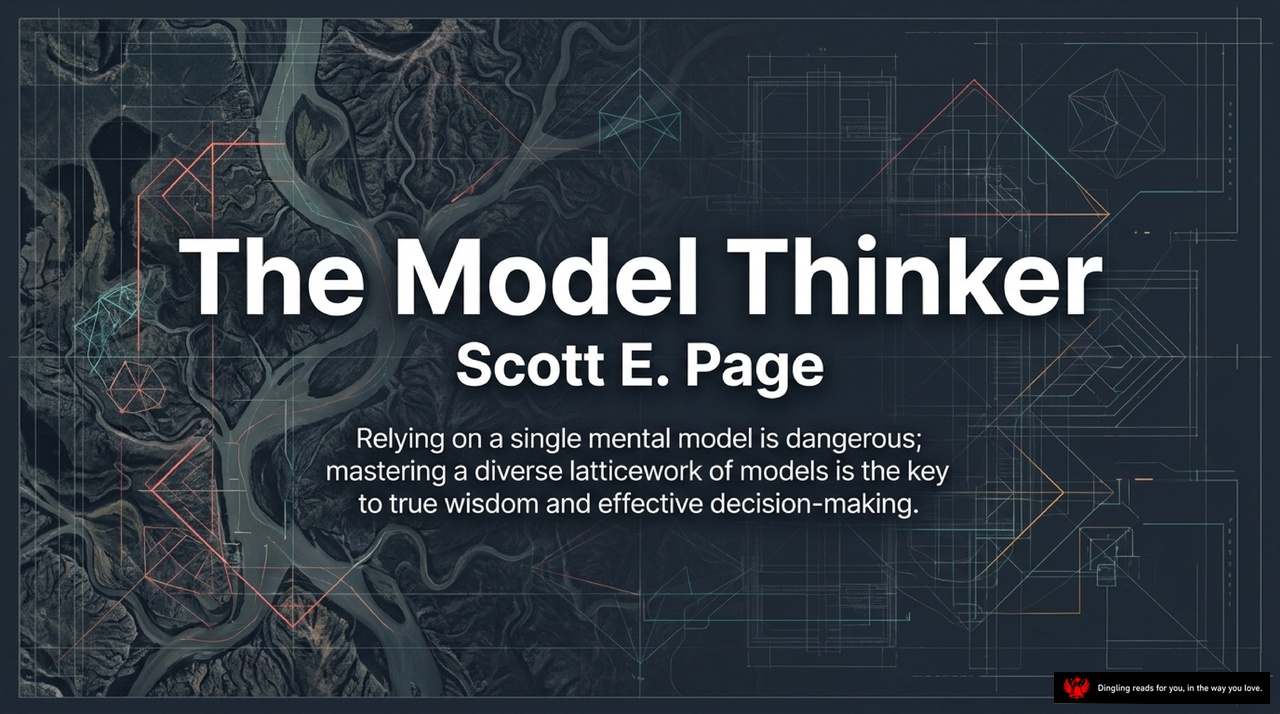
Welcome to the world of "The Model Thinker" by Scott E. Page. Today, we're diving into a concept that changes everything: the power of thinking with multiple mental models.
The cover of this book sets the stage perfectly. It reminds us that relying on a single mental model is dangerous. If you only have one lens to view the world, you will inevitably miss the full picture. True wisdom and effective decision-making come from mastering a diverse latticework of models.
Think of each model as a unique tool in your toolkit. Some help you understand the past, others predict the future, and many help you design better systems for the future. Whether you are analyzing complex social issues like opioid addiction or income inequality, or simply making everyday choices, the ability to combine these different perspectives allows you to see the forest, not just the trees.
In a complex world, no single explanation is enough. By integrating insights from economics, biology, physics, and sociology, we can approach the truth more closely than ever before. This book is your guide to building that diverse toolkit, transforming how you see, understand, and navigate the challenges of our time.
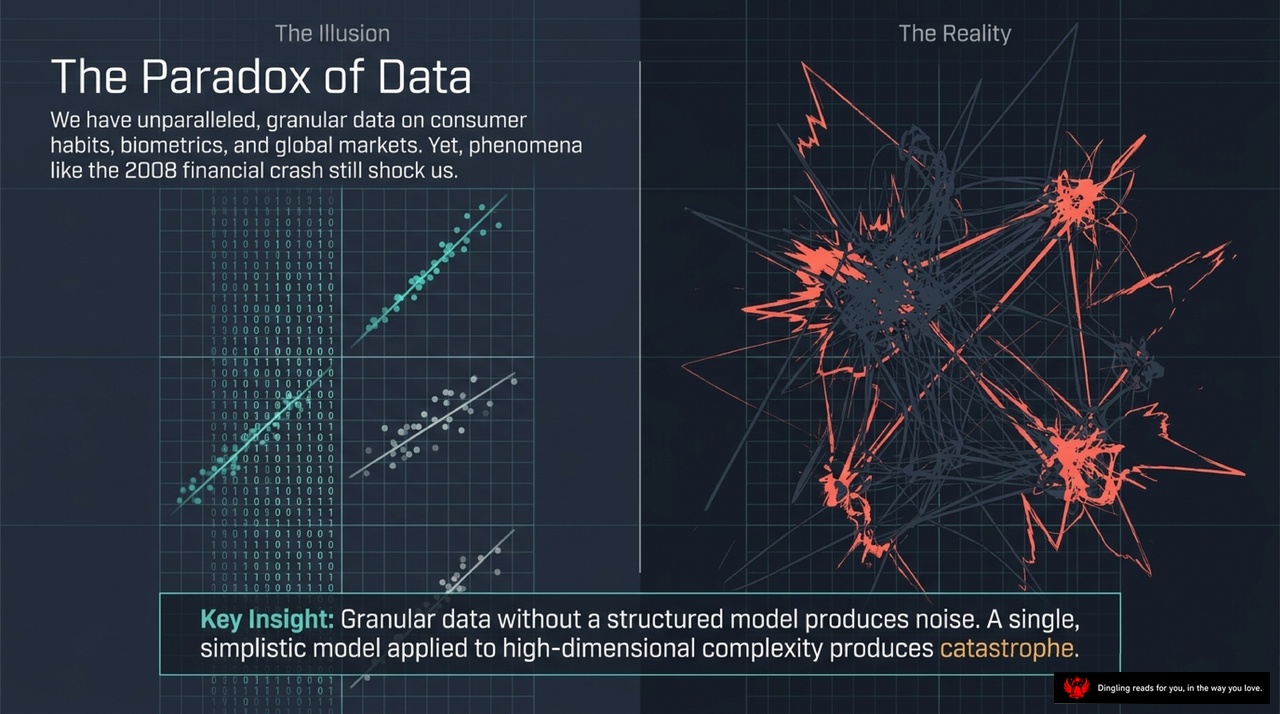
The Paradox of Data is strikingly illustrated here: on the left, we see the illusion of order—clean, predictable trends that suggest we have mastered the chaos. But on the right, the reality is a tangled web of complexity where simple models fail catastrophically.
We live in an era of unprecedented data. We have granular insights into consumer habits, biometrics, and global markets. Yet, despite this flood of information, we are still shocked by phenomena like the 2008 financial crash. Why? Because granular data without a structured model produces nothing but noise.
The key insight here is critical: applying a single, simplistic model to high-dimensional complexity doesn't just lead to errors; it produces catastrophe. We cannot rely on one lens to see the whole picture. Instead, we need to embrace multiple models to cut through the noise and find the signal hidden within the chaos.

Imagine a pyramid rising from raw data to pure wisdom. At the very base, we have **Data**—just raw events, like raindrops falling. One drop is just a drop; it tells us nothing on its own. But when we categorize these drops into "July rainfall totals in Burlington," we move up to **Information**. This is the first step of making sense, but information alone is still flat. It doesn't tell us what to do or how the world works.
To bridge the gap between flat information and useful **Knowledge**, we need a structural framework: a **Model**. Think of a model as a lens or a mathematical story that connects the dots. For instance, a fluid dynamics model or a weather prediction system takes our scattered data and transforms it into actionable knowledge. It answers the "why" and "how," allowing us to predict storms or understand climate patterns.
But the journey doesn't stop at knowledge. At the very peak of this hierarchy sits **Wisdom**. This is the most critical layer, defined by knowing *which* model to trust and when to act. As T.S. Eliot famously asked, "Where is the knowledge we have lost in information?" Wisdom is the antidote. It's the ability to navigate a world full of conflicting models and choose the right one for the situation. Without wisdom, we might have perfect data and complex knowledge, yet still make disastrous decisions. Ultimately, models convert flat information into actionable knowledge, but only wisdom allows us to wield that knowledge with clarity and confidence.
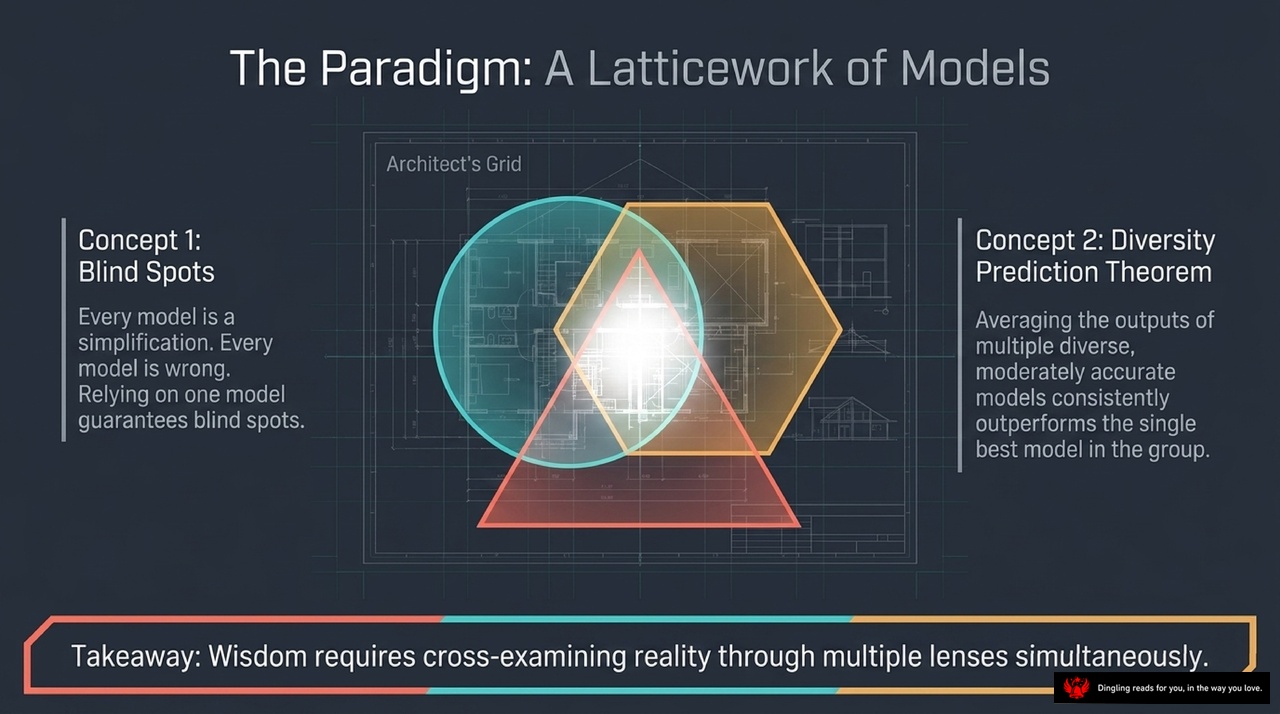
The Paradigm: A Latticework of Models. Look at this grid. It's not just a diagram; it's the operating system for thinking clearly in a messy world.
On the left, we have Concept 1: Blind Spots. The text reminds us that every model is just a simplification. Every model is, by definition, wrong. If you rely on a single lens—say, only an economic model or only a psychological one—you guarantee blind spots. You'll miss the parts of reality that don't fit that specific shape.
On the right, Concept 2: The Diversity Prediction Theorem. This is the antidote. It states that averaging the outputs of multiple diverse, moderately accurate models consistently outperforms the single best model in the group. Why? Because diversity reduces error. When different models look at the same problem from different angles, their individual mistakes cancel each other out, leaving you with a clearer picture.
The takeaway at the bottom ties it all together: Wisdom requires cross-examining reality through multiple lenses simultaneously. Don't just pick the "best" model. Build a latticework. Combine the strengths of different frameworks to see the whole truth, not just the fragment your single model wants to show you.
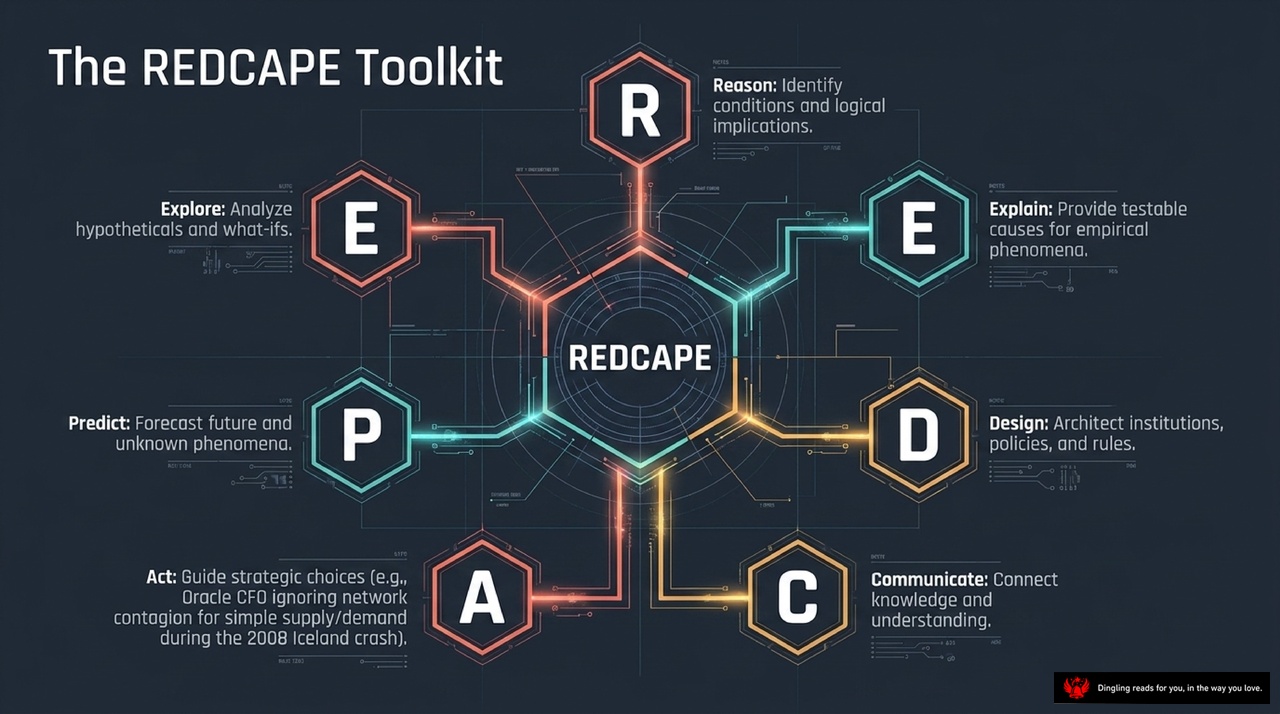
The REDCAPE Toolkit visualizes a powerful framework for navigating complexity, centering on six distinct capabilities: Reason, Explore, Explain, Predict, Act, and Communicate. At the heart of this system lies the ability to **Reason**, which involves identifying the underlying conditions and logical implications of any situation. This isn't just about logic; it's about digging deep to understand the "why" behind the "what." Moving outward, we **Explore** hypotheticals and "what-if" scenarios, allowing us to stress-test our ideas before they become reality. Once we've explored possibilities, we must **Explain** by providing testable causes for the empirical phenomena we observe, grounding our theories in observable data.
With a solid explanation, we can move to **Predict**, forecasting future trends and unknown phenomena based on our current understanding. But knowing the future isn't enough; we must use these insights to **Act**, guiding strategic choices. Think of the Oracle CFO example from the 2008 crisis, where understanding network contagion was crucial for deciding whether to bail out a failing firm or let it collapse. Finally, all these steps culminate in **Communicating**, connecting knowledge and understanding across different groups to build a shared reality. This toolkit transforms abstract models into a dynamic cycle of inquiry and action, empowering us to make sense of a chaotic world.

Imagine the human mind not as a single, monolithic entity, but as a dynamic network of interacting nodes. This slide, "Abstracting the Human Actor," breaks down exactly how we model that complexity. We don't just assume people act one way; instead, we use three distinct lenses to understand behavior.
First, on the left, we have the **Rational** actor. This model assumes perfect logic and unique optimal choices. It's built for high-stakes decisions where we need to establish a clear baseline. Think of it as the "perfect calculator" of the human mind.
Moving to the center, we see the **Rule-Based** approach. Here, humans aren't constantly optimizing; they follow heuristics or simple rules. This fits low-stakes, highly repetitive environments—like a trader following a fixed algorithm or a driver sticking to a traffic pattern. It's about efficiency through simplicity.
Finally, on the right, is the **Adaptive** actor. This is where learning happens. Behavior isn't static; it shifts based on past success and social influence. This model is essential for complex environments requiring trust or strategic interaction, where the rules of the game are constantly changing.
By combining these three abstractions, we stop trying to predict human behavior with a single formula. Instead, we select the right model for the context, capturing the full spectrum of how we think, learn, and evolve.
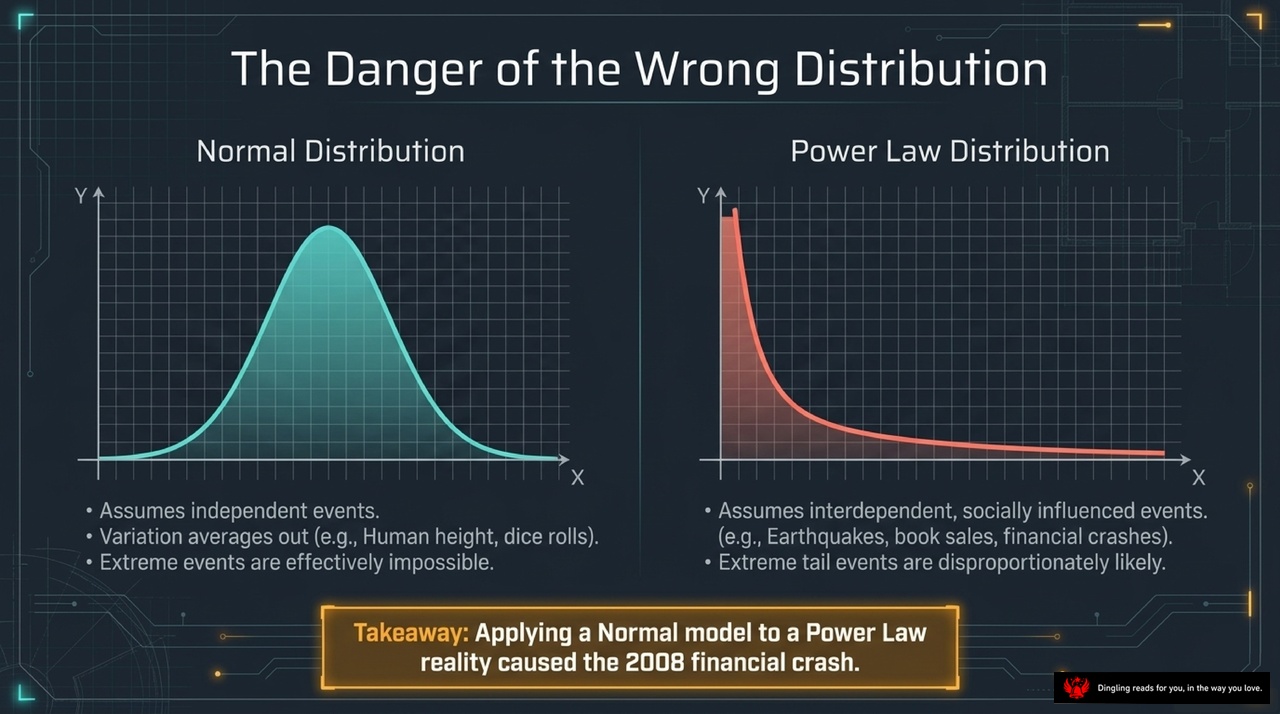
Today's slide contrasts two very different ways the world actually works: the Normal Distribution versus the Power Law Distribution. On the left, you see that classic bell curve. This is the "Normal" model, which assumes events are independent and average out over time. Think of human height or rolling dice; extreme outliers are effectively impossible here. But on the right, we have the Power Law, or what we often call the "Long Tail." This shape assumes interdependent, socially influenced events where variation doesn't average out. Instead, extreme tail events become disproportionately likely.
This distinction is critical because applying a Normal model to a Power Law reality is dangerous. It leads to massive blind spots. For instance, in a Power Law system, a few massive players dominate, while in a Normal system, everyone is roughly equal. The slide highlights a terrifying historical lesson: the 2008 financial crash occurred precisely because regulators used a Normal model to analyze a Power Law reality, failing to see that extreme crashes were not impossible, but actually inevitable. Understanding which distribution governs your system is the first step to avoiding catastrophic miscalculations.
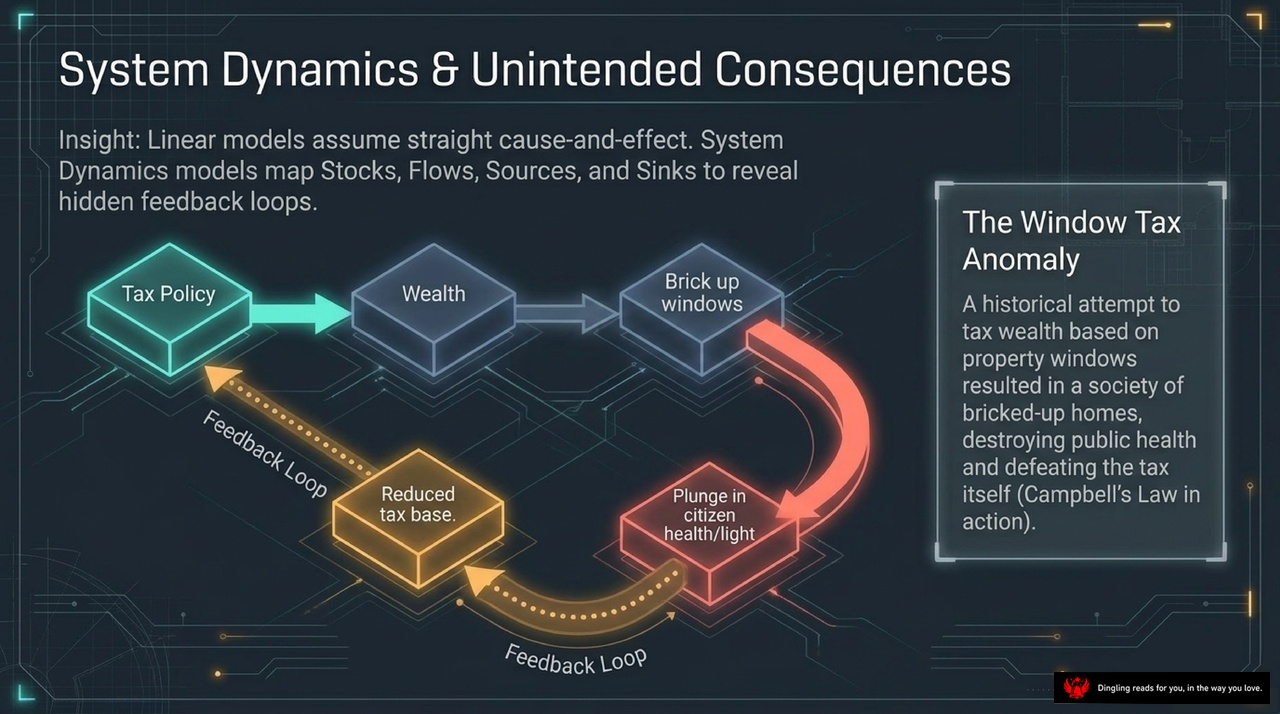
System Dynamics and Unintended Consequences: How Good Intentions Backfire.
We often assume the world works on a simple, straight line: if we push here, that happens there. But reality is rarely that simple. System Dynamics models break this illusion by mapping Stocks, Flows, Sources, and Sinks to reveal hidden feedback loops that linear models miss.
Let's look at a classic historical example: The Window Tax Anomaly. In the past, governments tried to tax wealth by levying fees on every window in a home. The logic seemed sound: more windows, more wealth, more tax revenue. But the system created a deadly feedback loop. To avoid the tax, people simply bricked up their windows. This led to a society of dark, unhealthy homes where public health plummeted. As homes became uninhabitable, the property value crashed, which actually reduced the tax base, defeating the very purpose of the tax. This is Campbell's Law in action: when a measure becomes a target, it distorts the system.
The key insight here is that linear models assume straight cause-and-effect, but System Dynamics shows us that actions often trigger reactions that circle back to influence the original cause. Whether you are designing public policy, managing a business, or navigating life, ignoring these feedback loops can lead to strategies that solve the symptom while destroying the system itself. To make smart decisions, we must stop looking at straight lines and start seeing the loops.
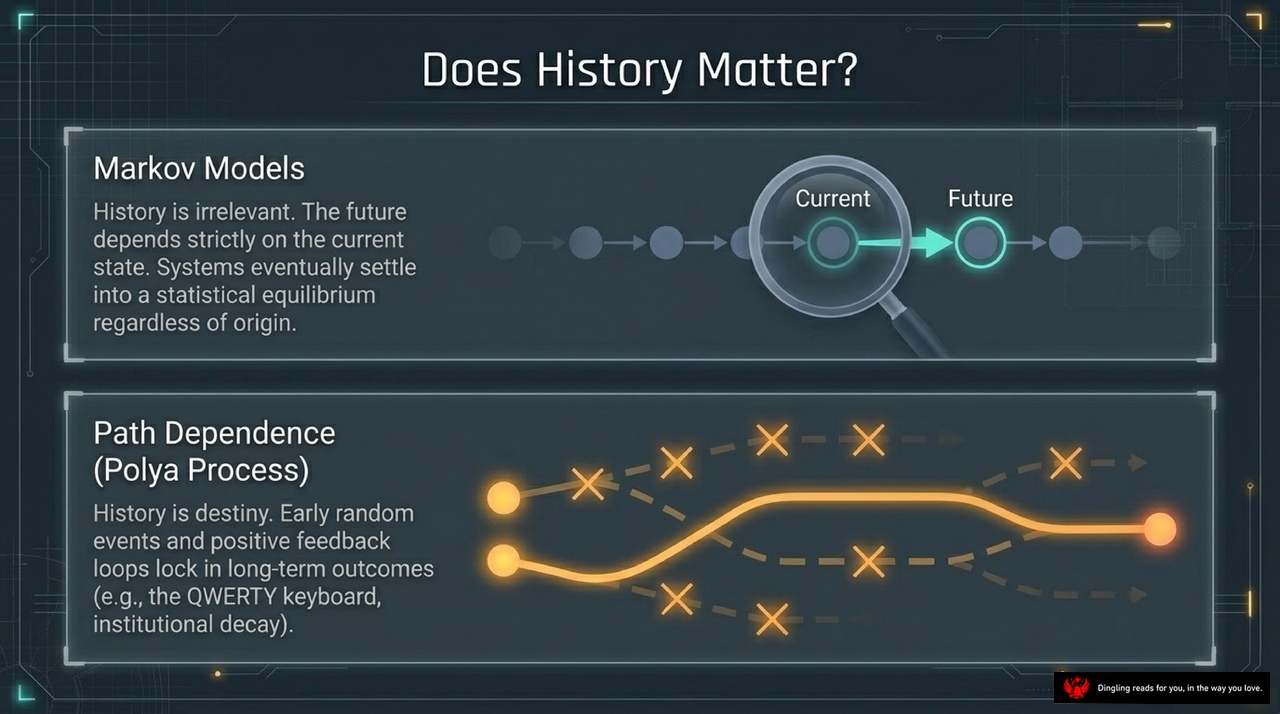
Does history actually matter? The answer depends entirely on the model you choose to look through. On the top half of your slide, we see the Markov Model, where history is irrelevant. In this view, the future depends strictly on the current state. Systems eventually settle into a statistical equilibrium regardless of their origin, much like a coin toss where the next flip has no memory of the last one.
However, look at the bottom half. This illustrates Path Dependence, also known as the Polya Process. Here, history is destiny. The slide shows how early random events and positive feedback loops can lock in long-term outcomes, even if they weren't the best choices initially. Think of the QWERTY keyboard layout or the standard gauge of railroad tracks—decisions made long ago that are incredibly hard to change today. While Markov models suggest we can always reset and optimize from scratch, path dependence warns us that our past choices often constrain our future possibilities. Understanding which lens applies to your situation is the key to navigating complex systems.

Look at this slide, "Modeling Value and Competition." It breaks down how we measure worth into two very different categories: Spatial Attributes and Hedonic Attributes.
Think about your last meal. Was the value determined by the exact spice level? If you love spicy food, a little bit might be perfect, but too much ruins it. That's a Spatial Attribute. As the text says, "There is no universal best. Value is determined by proximity to an individual's ideal preference." It's about being close to your sweet spot, whether it's the right amount of salt or a politician's specific stance on an issue.
Now, look at the graph on the right. That represents Hedonic Attributes. Here, the logic is simple: "More is unequivocally better." Unlike spatial attributes where too much is bad, with hedonic traits, value scales linearly or even exponentially. Think about smartphone battery life or computer processing speed. If you have a better battery or a faster processor, you are objectively better off. There is no "too much" battery life; just more is always better.
In business and life, recognizing which category you're in is crucial. If you're competing on spatial attributes, you need to find the niche that fits your customer's ideal. If you're competing on hedonic attributes, you simply need to outperform the competition on volume and scale. Understanding this distinction changes how you model your strategy.
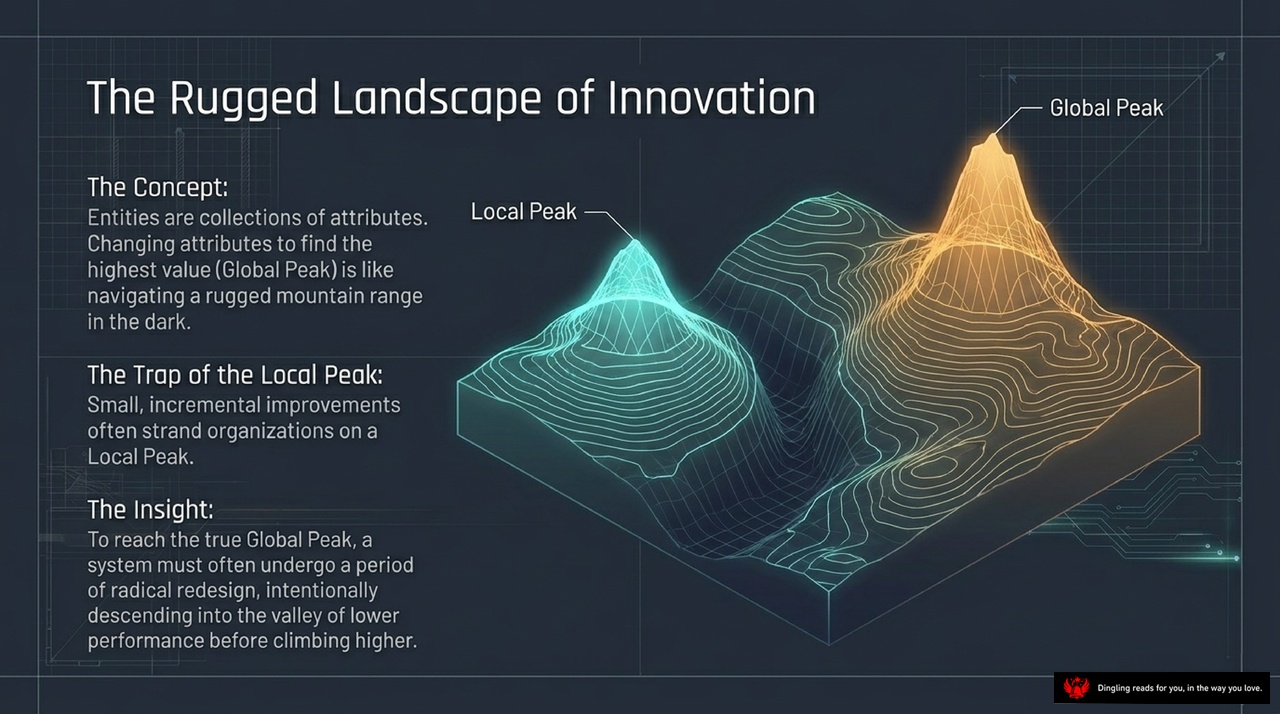
The rugged landscape of innovation is a powerful metaphor for how we solve complex problems. Imagine your entity—whether a company, a product, or a strategy—as a collection of attributes. To find the highest possible value, known as the **Global Peak**, you have to navigate a mountain range shrouded in darkness. This isn't a smooth climb; it's a rugged terrain where the path isn't obvious.
Here lies the danger: the **Trap of the Local Peak**. In our pursuit of improvement, we often focus on small, incremental changes. These tweaks might feel safe and effective, leading us to settle comfortably on a **Local Peak**. But this is a trap. You've reached a high point, yes, but it's not the highest. By sticking with minor optimizations, organizations get stranded, unable to see the much higher summit just beyond the valley.
The breakthrough insight here is counterintuitive but essential. To reach the true **Global Peak**, a system often has to undergo a period of **radical redesign**. You must be willing to intentionally descend into the valley of lower performance. It feels like a step backward, a loss of stability, but it is the only way to climb higher. You have to break the local optimum, embrace the uncertainty of the descent, and then find a new path to the global maximum. Innovation isn't about climbing steadily; sometimes, it requires the courage to go down first.
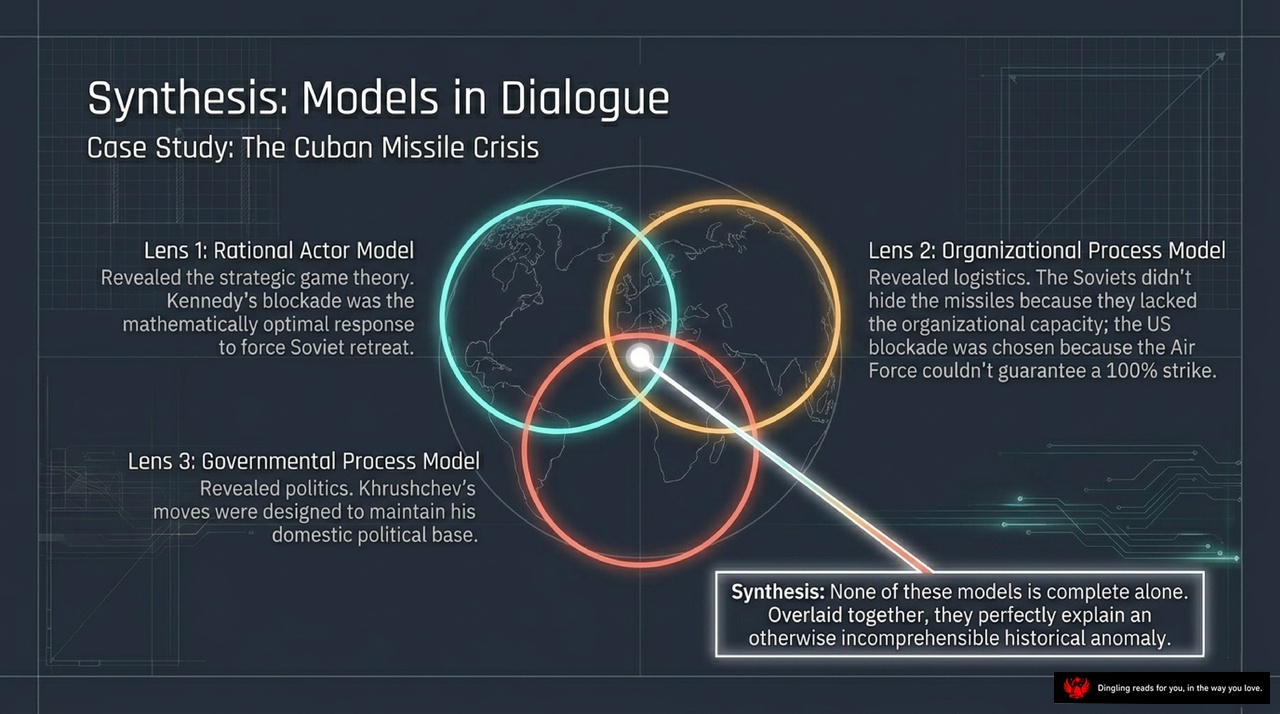
Synthesis: Models in Dialogue. Today, we're looking at the Cuban Missile Crisis not as a single story, but as a puzzle solved by three different lenses.
First, the Rational Actor Model. It treats this as a strategic game. From this view, Kennedy's blockade wasn't just a political move; it was the mathematically optimal response to force the Soviets back.
Second, the Organizational Process Model. This lens reveals the logistics. It explains why the Soviets didn't hide the missiles immediately—they simply lacked the organizational capacity to do so. It also clarifies why the U.S. chose a blockade over an airstrike: the Air Force couldn't guarantee a 100% strike.
Third, the Governmental Process Model. This brings politics to the forefront. It shows that Khrushchev's moves were driven by a need to maintain his domestic political base, not just cold strategic calculation.
Here is the key takeaway: None of these models is complete alone. When overlaid together, they perfectly explain an otherwise incomprehensible historical anomaly. This is the power of synthesis.
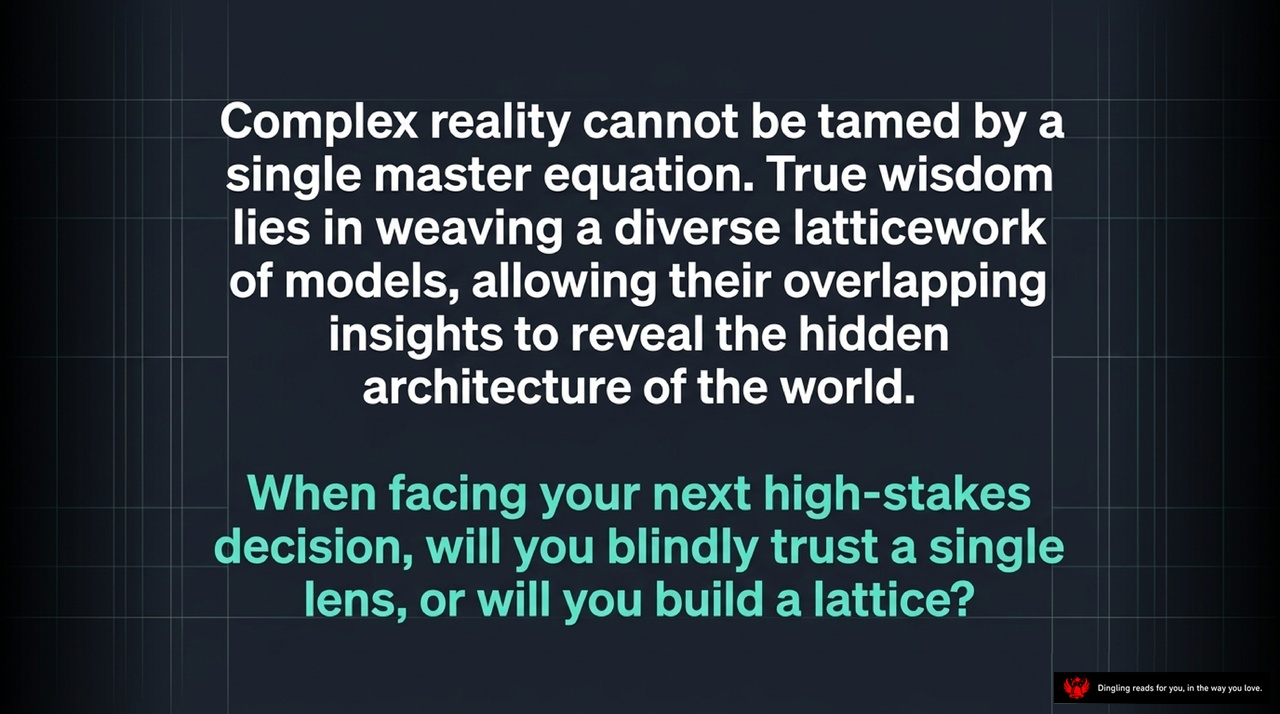
Complex reality resists being solved by a single master equation. True wisdom isn't found in one perfect lens, but in weaving a diverse latticework of models. This is the core message we've explored throughout our journey: from the statistical foundations of normal and power-law distributions, to the mechanics of linear and nonlinear growth, and the strategic depths of game theory.
When facing your next high-stakes decision, will you blindly trust a single lens, or will you build a lattice? As we've seen with examples like the opioid crisis and income inequality, no single model captures the whole truth. Whether it's understanding network effects, predicting market shifts, or navigating social dynamics, it is the overlapping insights of multiple models that reveal the hidden architecture of the world. By integrating these diverse perspectives, we move from fragmented data to a coherent, actionable understanding of complex reality.