
The Molecule of More: Complete Chapter-by-Chapter Summary

Welcome to the world of *Dopamine Nation*. Today, we're diving into a fascinating question: How does a single chemical in your brain drive love, sex, and creativity—and ultimately, determine the fate of the human race?
In this book, authors Daniel Z. Lieberman and Michael E. Long explore the powerful role of dopamine. For a long time, scientists thought of it simply as the "happy molecule," believing it was the source of pleasure. But groundbreaking research has completely changed that understanding. We now know that dopamine isn't about happiness itself; it's actually about anticipation. It's the brain's response to the unexpected and the possible. It thrives on the gap between what we expect and what actually happens.
Think about it: when you see a sign for a bakery you've never visited, your brain lights up with excitement before you even taste the coffee. That surge is dopamine. It drives us toward the "future space"—the possibilities that haven't happened yet. But once we reach our goal, once the future becomes the present, that chemical fizzles out. This is why the initial spark of a new romance often fades; the thrill of the unknown is replaced by the comfort of the familiar.
So, how do we move from this fleeting "passionate love" to something lasting? The answer lies in balancing our brain's chemistry. While dopamine pushes us forward with its endless "wanting," other chemicals like oxytocin and vasopressin help us enjoy the "being" of the moment. True, enduring happiness doesn't come from chasing the next high, but from learning to find value in the reality right in front of us. It's about mastering the balance between dreaming big and living fully.
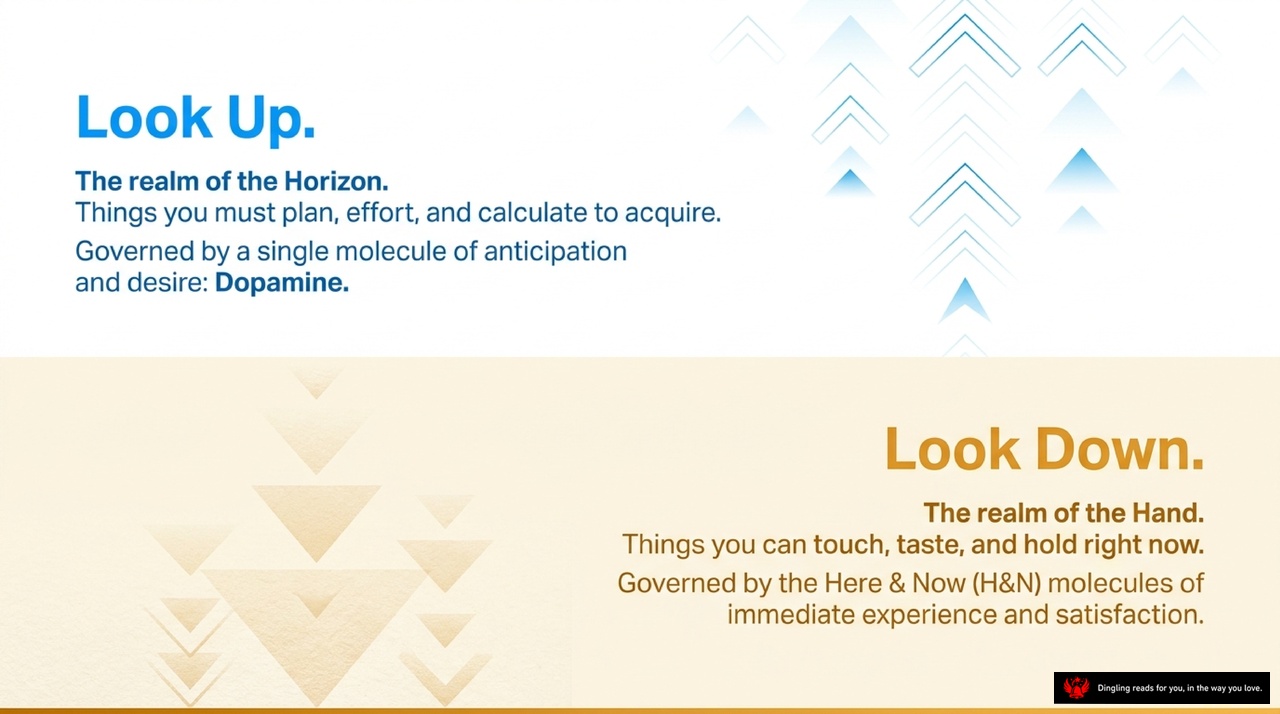
Look Up. Look Down. This slide perfectly captures the two opposing forces running our brains. Up here, in the realm of the horizon, we live in a world governed by dopamine. It's the realm of the future, where everything requires planning, effort, and calculation. Dopamine is fueled by anticipation and desire; it keeps us chasing what we don't have yet, promising us a better tomorrow. But look down. In the realm of the hand, we enter the world of immediate experience. This is governed by "Here & Now" molecules that reward us for what we can touch, taste, and hold right now. While dopamine drives us to dream and strive, these present-moment molecules ground us in reality. The secret to a fulfilling life isn't choosing one over the other, but learning to balance the exciting pull of the horizon with the satisfying weight of the hand.

Have you ever wondered why that thrilling new relationship often feels like it burns out so quickly? The answer lies in the geography of your brain. As our slide illustrates, the brain divides the world into two distinct zones: **Peripersonal Space** and **Extrapersonal Space**.
Think of **Peripersonal Space** as your immediate reality—what you can touch right now. It's the coffee in your hand, the person sitting next to you, the present moment. This is where "Here & Now" chemistry takes over, giving you a sense of solid, tangible reality.
Then, you have **Extrapersonal Space**. This is everything beyond your arm's reach—what you want, what you plan for, and the future. In this zone, the brain runs on dopamine. Dopamine doesn't just create happiness; it fuels the drive to explore, to seek, and to maximize potential resources. It thrives on the unknown.
Here is the critical insight: To the brain, anything in the extrapersonal space exists only in the future. As long as something is distant or unattained, dopamine keeps you excited and chasing it. But the moment you cross that boundary—when you finally get what you wanted, or when a new relationship becomes routine and moves into your peripersonal space—that dopamine surge stops. The thrill fades because the "future" has become the "present," and the brain is no longer hunting for a prize. This is exactly why the magic of new love often evaporates once the novelty wears off. We are biologically wired to crave the hunt, not the capture.

Think of your brain as running on a dual-core operating system, constantly balancing two opposing forces to help you navigate life. On one side, you have the "Desire Dopamine" system, which acts like an impulsive engine always hunting for the next big thing. It drives that exciting feeling of anticipation and craving, pushing you to calculate possibilities and plan for a better future. However, this system has a major flaw: it never gets satisfied and can make you blind to the real consequences of your actions.
On the other side, you have the "Control Dopamine" system, which serves as your brain's built-in brake and steering wheel. Located in the prefrontal cortex, this system focuses on cold rationality, willpower, and tenacity. It allows you to pause, analyze situations, and make calculated decisions that benefit you in the long run, effectively turning your raw impulses into productive actions. But if this system goes into overdrive, it can distance you from your emotions, making you feel robotic or overly detached.
Finally, there is the "Here & Now" system, powered by molecules like serotonin, oxytocin, and endorphins. While the first two systems look forward to what *could* be, this system is dedicated to experiencing the present reality. It generates feelings of genuine satisfaction, empathy, and sensory pleasure. Its downside, however, is that it can sometimes make you resistant to change or afraid of progress.
The magic of a healthy life—and a successful relationship—lies in how well these three systems work together. You need the drive of desire to set goals, the discipline of control to achieve them, and the warmth of the present moment to actually enjoy the journey and the destination.

Have you ever wondered why the thrill of a new relationship inevitably fades, leaving us craving the next "spark"? The answer lies in a fascinating biological equation: the Equation of Surprise.
As the slide illustrates, dopamine isn't actually the "pleasure molecule" we thought it was. It's the "anticipation molecule." It doesn't fire when you get a reward; it fires based on a "Reward Prediction Error"—the gap between what you expected and what actually happened.
Look at that bar chart. When a reward is perfectly predictable, like the monkey expecting food after a light, dopamine flatlines. But when there's a "Dopamine Surprise"—when reality exceeds expectation—dopamine spikes. This is why the early days of love feel so electric; everything is unknown and full of possibility. But once the relationship becomes routine, that surprise vanishes, and so does the chemical drive.
The lesson here is clear: our brains are wired to chase the unknown. To reignite that feeling, we don't need to find someone new; we need to reintroduce the element of surprise and possibility into our existing lives, shifting our focus from the predictable "near body" of daily routine back to the exciting "far body" of potential.

Look at this graph: "The Lifecycle of Love." It tells a fascinating story about why the honeymoon phase ends and what actually keeps a relationship alive for decades.
See that blue spike? That's "Passionate Love," driven by dopamine. The slide explains it perfectly: early romance is fueled by our brain's obsession with the unknown. Dopamine thrives on prediction errors—the thrill of surprises and things we haven't seen before. As long as the future feels uncertain and exciting, that chemical high keeps us hooked.
But notice what happens after month 12 or 18. The blue line crashes. Why? Because eventually, the future becomes the present. When you know exactly what your partner is going to do, the prediction error vanishes, and dopamine shuts off. The magic fades.
However, look at that golden curve rising alongside it. That's "Companionate Love," driven by what the slide calls "H&N molecules"—the chemistry of the here and now. This is the key to survival. While dopamine is obsessed with chasing the next thing, these molecules anchor us in the reality of what we have right now.
The slide makes a crucial point: the survival of a relationship requires handing control over from the dopamine-driven obsession with the future to these "Here & Now" molecules. Passionate love gets you started, but companionate love keeps you going. It's the shift from chasing a fantasy to enjoying the real, tangible moments of being together. That's the real secret to lasting love.
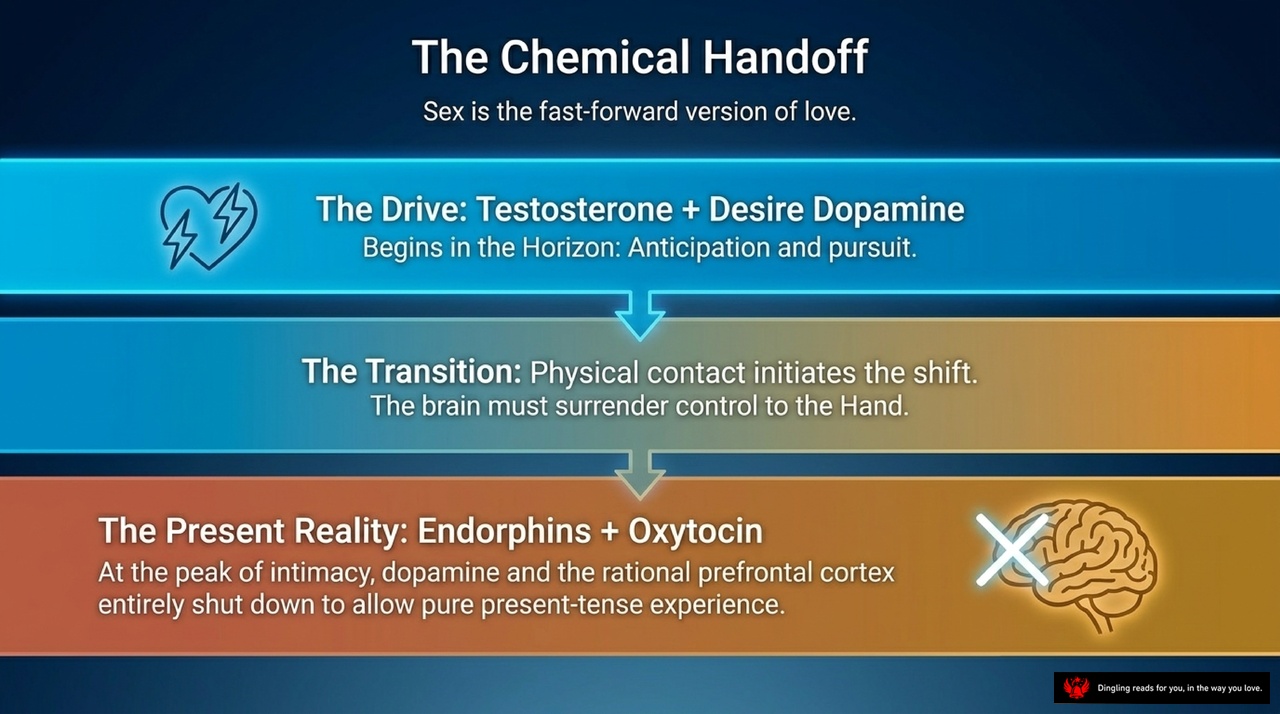
Imagine a world where your brain is constantly racing toward the horizon, fueled by a chemical called dopamine. This is the essence of the "Chemical Handoff" we're discussing today. As the slide illustrates, sex is often described as the fast-forward version of love, but the chemistry behind it is a complex journey from anticipation to pure presence.
It all starts with **The Drive**. Here, testosterone and desire-dopamine take the wheel, launching us into the horizon of anticipation and pursuit. This is the realm of the "wanting" system, where the brain fixates on the future, the unknown, and the potential for something better. It's the thrill of the chase, the spark of a new connection, like the initial rush when you meet someone fascinating.
But as you move closer, into physical contact, you enter **The Transition**. This is the critical moment where the brain must surrender its control. The frantic planning and future-gazing begin to quiet down. The brain shifts gears, preparing to leave the horizon behind and step into the immediate now.
Finally, you arrive at **The Present Reality**. This is where the magic happens. At the peak of intimacy, the dopamine-driven chase effectively shuts down. The rational prefrontal cortex—the part of your brain that worries, plans, and judges—goes offline. In its place, endorphins and oxytocin take over. These are the "being" molecules that anchor you in the moment, creating a state of pure, present-tense experience where you are fully connected, without distraction or desire for more. It's the difference between dreaming about a journey and actually feeling the road beneath your feet.

We assume that what we crave is what we truly enjoy, but science tells a much stranger story. As this slide illustrates, our brains run on two separate gauges: one for "Wanting" and another for "Liking." On the left, the glowing blue meter represents the Dopamine Desire Circuit. It measures infinite, insatiable craving. Experiments show that when rats are injected with dopamine, they don't just feel happy; they go crazy, consuming vastly more sugar than ever before. This is the engine of addiction. Drugs hijack this circuit, creating a loop of endless desire that is completely detached from actual pleasure.
On the right, the quiet, beige meter represents the H&N Circuit, responsible for "Liking." This is where real enjoyment lives—the taste of a meal, the warmth of a hug. Here's the twist: when scientists injected rats with chemicals that directly boosted their "liking" response, the animals showed zero increase in wanting behaviors. They didn't crave more; they just enjoyed the moment more. This proves that addiction is a failure of the desire circuit, not a failure of happiness. We can be hooked on something that brings us no joy at all, chasing a phantom feeling that never arrives. Understanding this split is the first step to breaking free from the cycle of endless wanting.

Look at this diagram titled "The Loop Without an Exit." It perfectly illustrates the trap we all fall into. On the left, we have the "Natural Reward Loop." It's a healthy cycle: Desire leads to Action, which gives us a Reward. But here is the crucial part: Satiation. Once we feel full, our brain's satiety switch kicks in, and we stop. Dopamine levels drop, and we move on. It's a sustainable system.
But look at the right side: the "Addictive Drug Loop." Notice what happens here. The "Satiation Checkpoint" is completely bypassed. Drugs artificially trigger a massive chemical spike of dopamine, but they eliminate the natural stop signal. Because there is no exit, the brain registers this as a survival-level emergency that never gets resolved. Instead of feeling satisfied, you feel an infinite demand for more. The loop spins endlessly, driving you to chase the next hit because the previous one never truly fed your brain. This is the core mechanism behind addiction—it's not just about pleasure; it's about a broken circuit that never allows us to rest.

Look at this blueprint of the mind. It breaks down the secret to lasting love into two distinct parts: the engine and the steering wheel. On the right, you see the "Desire Circuit" labeled as our raw energy. This is the fuel that drives us forward, constantly seeking new possibilities. But on the left, the text reminds us that simply wanting something rarely gets us what we want. That's where the real magic happens.
The "Control Circuit," marked here for Direction and Planning, acts as our cold, rational architect. While the engine burns with the heat of desire, this steering wheel uses that raw energy to fuel calculation and willpower. It doesn't just react; it plans. It figures out how to conquer the environment to secure our future resources. Without this control, we are just a runaway vehicle, chasing every new thrill until we crash. But with it, we can turn our fleeting impulses into a deliberate path toward the life we actually want to build.
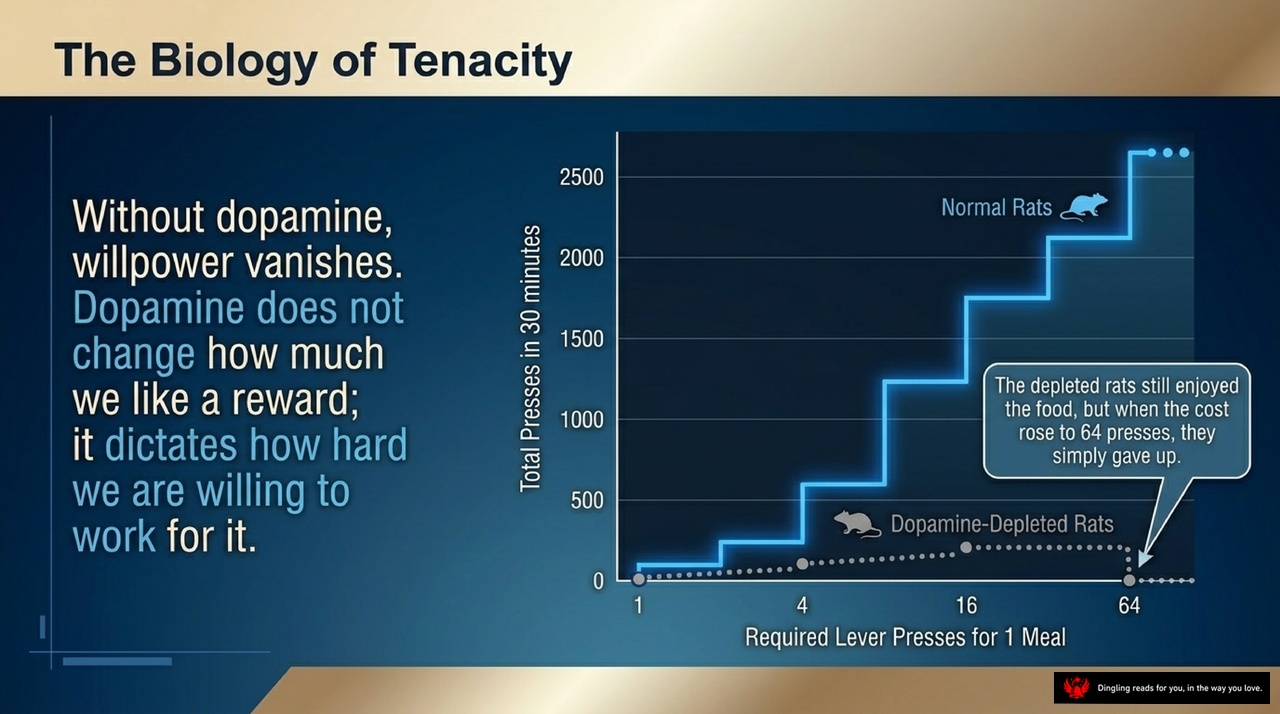
Have you ever wondered why, even when we love something deeply, we suddenly lose the drive to work for it? This slide reveals the biological secret behind tenacity: without dopamine, willpower simply vanishes. Look at the graph here. On the left, you see "Normal Rats." These rats are relentless. Even when the cost to get a meal skyrockets to 64 lever presses, they keep going. They are willing to suffer because their dopamine system tells them the reward is worth the effort. But look at the dotted line for the "Dopamine-Depleted Rats." These rats still liked the food just as much as the others. They enjoyed the meal. Yet, the moment the cost rose to 64 presses, they gave up immediately. Their desire was intact, but their willingness to work for it was gone. This proves a crucial point: dopamine doesn't change how much we like a reward; it dictates how hard we are willing to work for it. In our daily lives, this explains why some people grind through tough projects while others quit at the first sign of difficulty. It's not just about motivation or discipline; it's about the biology of tenacity. If we want to build resilience, we need to understand that our brain's drive to push through challenges is fueled by this specific chemical signal.

Imagine a spectrum that defines how your brain decides what matters. On the far right sits "High Inhibition"—the normal, balanced state where your brain acts like a skilled editor, filtering out the noise of irrelevant data so you can focus on what truly counts. But move left to "Low Inhibition," and you enter the realm of the creative genius. Here, the filter loosens, allowing you to connect the unconnected and see hidden patterns that others miss. This is the sweet spot where innovation happens. However, slide all the way to the left into "Zero Inhibition," and the filter fails entirely. Without any ability to filter out chaos, the brain becomes overwhelmed by a storm of salience, a state often associated with schizophrenia or madness. The lesson here is clear: true brilliance isn't about seeing everything; it's about having just enough inhibition to spot the extraordinary amidst the ordinary.

The Architecture of Dreams isn't just a poetic title; it's a biological reality where your brain builds worlds that don't exist. Look at this image: on the left, a snake biting its own tail, and on the right, the chemical structure of benzene. This isn't a coincidence. It's the story of August Kekulé, a chemist who spent years trying to decode the benzene molecule using physical models but hit a dead end. Then, one night, falling asleep, his frontal lobes relaxed, and without the constraints of reality, his dopamine flowed freely. He dreamt of a snake eating its tail, and in that moment of abstract thought, he woke up with the answer: the molecule was a ring.
This illustrates the core function of dopamine: it allows us to model the future, to simulate possibilities that aren't physically present right now. While other chemicals like serotonin handle the tangible joy of the present moment—like the taste of food or the warmth of a hug—dopamine is the architect of the "what if." It drives us to imagine better futures, to plan, and to create. Without this ability to dream of a world that isn't here yet, we would be stuck in the immediate, unable to innovate or love in a way that transcends the now. So, while we must cherish the reality of today, we also owe a debt to the dreamers who used their dopamine to build the blueprints for tomorrow.

The Ideology Diagnostic reveals a fascinating truth: our political leanings aren't just about beliefs; they are a direct mirror of our brain chemistry. Look at the split on this slide. On the left, the Progressive or Liberal side is defined by a dopamine-dominant system. This chemical profile drives a focus on the future and progress, fostering an abstract, global empathy that allows for high tolerance of rapid change. It's a mindset oriented toward what *could* be, often driven by a desire to avoid harm and embrace new possibilities.
On the right, the Conservative side operates under a different chemical logic, dominated by the "Here & Now" system. This orientation prioritizes the present and tradition, relying on tactile, local community empathy rather than abstract global concerns. This chemical foundation creates a high loss-aversion response, making individuals protective of the existing social fabric and resistant to sudden shifts. Essentially, one side is fueled by the excitement of future potential, while the other is anchored by the security of what is already here. Understanding this biological divide helps explain why these two groups often speak past each other; they are literally experiencing the world through different neurological lenses.

The Empathy of Distance isn't just about miles; it's about how our brain chemistry shifts based on proximity. As the slide illustrates, when physical distance is zero, like pushing someone right in front of you, our "H&N chemistry"—the compassionate molecules like oxytocin—triggers an overwhelming empathy that makes it nearly impossible to do harm. But as we move into the "Nearby" zone, that empathy begins to fade. Finally, once we cross the threshold of 5,000 miles, something drastic happens: H&N empathy vanishes completely.
In that vast distance, the ruthless, calculating power of dopamine takes over. Instead of feeling compassion, our brains effortlessly switch to "Control Dopamine," a system designed for planning and calculation. This is why it feels so easy to justify the "deadly math" of sacrificing one life to save five when the victims are thousands of miles away. We aren't being cruel; we are simply operating in a mode where emotional connection has been severed by distance, leaving only cold logic to make the hard choices.

Imagine a world where your ancestors didn't just survive, but thrived by constantly moving. That's the story of "The Migratory Brain." As you see on this slide, our species nearly went extinct 200,000 years ago. The only reason we didn't vanish? Dopamine. It wired us to be intolerant of boredom and deeply restless, pushing us to leave safe zones and explore the unknown.
This drive is encoded in a specific gene: the DRD4 7R Allele. Known as the "risk-taking" gene, it's found in roughly 20% of the global population. But here's the fascinating part: the farther a population migrated from Africa, the higher the concentration of this gene. Today, South American indigenous groups carry it at nearly 70%, while populations closer to the origin have less.
This genetic legacy built America. As a nation founded by immigrants, we represent a highly dopaminergic society. We are a people wired for novelty, risk, and the relentless pursuit of the next horizon. While this engine drove our ancestors to conquer the globe and gave us a unique cultural edge, it also warns us that our brains are designed for motion, not stillness. To find lasting happiness, we must learn to balance this drive for the future with the joy of the present.

We are constantly chasing a future that doesn't exist. As the slide illustrates, we are trapped in what the author calls "The Phantom Future." Look at that figure walking forward, yet their head is encased in a glowing, digital box—it perfectly symbolizes our modern condition. We are locked in the horizon, endlessly scrolling through infinite newsfeeds, obsessed with the "more" that dopamine promises us.
The text warns us that this wandering, future-obsessed mind is actually an unhappy one. Dopamine tricks us by promising satisfaction, but biologically, it is incapable of delivering it. It creates a phantom future where we ignore the sensory present. We mistake the anticipation of a reward for the reward itself. The excitement we feel is just the brain's reaction to the *possibility* of something happening, not the thing itself.
This is why so many of us feel empty despite having everything we thought we wanted. The thrill of the chase is a chemical illusion. Once we get what we desire, the dopamine spike fades, leaving us craving the next high. We are stuck in a loop, forever running toward a horizon that keeps moving, unable to find peace in the only place that is real: the present moment. To be happy, we must stop living in the phantom future and start feeling the sensory present.

We cannot abandon the modern world, but we can manually adjust the sliders to restore the balance. Think of your life as a mixing board where you control the tension between the future and the present.
First, look at the "Future vs. Present Reality" slider. Multitasking destroys efficiency because it keeps your brain stuck in the future, constantly chasing the next possibility. But when you commit to complete focus on a single task, you extract the maximum reward from the present moment.
Next, consider the "Digital vs. Nature" balance. We often live in a digital environment, but just 40 seconds of looking at a green roof or natural setting restores your cognitive control. It blends the dopamine arousal we crave with a present-tense calm, grounding you back in reality.
Finally, adjust the "Multitasking vs. Mastery" dial. Instead of jumping between activities, dedicate yourself to a single craft. This forces your dopamine to pause, allowing the body's H&N molecules to enjoy the job well done. By shifting from chasing the future to mastering the now, you reclaim your life.

Have you ever felt that strange disconnect where the dream feels perfect, but the reality falls flat? We all know that feeling. Think about it: the thrill of planning a vacation, the endless excitement of "what if," versus the mundane reality of traffic, hotel bills, and tired feet. Why does the anticipation often outshine the actual experience?
The answer lies in a fascinating biological duality. Our brains operate with two distinct systems. One is the "Horizon"—a dopaminergic engine fueled by abstract planning and future possibilities. It builds the dream, the "what could be," and keeps us chasing the next big thing. But the other system? That's the "Hand." It's about tangible execution, grounded in the Here & Now. This is where real satisfaction lives, driven by the sensory reality of what we actually touch and do.
Look at the image on your screen. We see a blueprint floating in the air, representing that abstract, dopamine-fueled vision. But below it, hands are firmly laying a brick. This isn't just a metaphor; it's a scientific truth. When researchers surveyed 30,000 employees, they found a surprising secret to happiness: the happiest workers weren't the tech founders or the high-flying executives. They were construction workers. Why? Because they perfectly fused these two realms. They built the Horizon by literally using their Hands.
True harmony isn't found in just dreaming or just doing; it's found when the Horizon is built by the Hand. When we stop letting our abstract plans float away and start grounding them in physical action, we bridge the gap between the exciting future and the satisfying present. So, the next time you're stuck in the loop of endless planning, remember: pick up a brick. Build something real. That's where the real joy lives.