
The Most Important Thing: Complete Chapter-by-Chapter Summary

Welcome to the masterclass on second-level thinking, risk control, and the pursuit of asymmetric returns in an irrational market.
We're diving into Howard Marks' most important lesson: investing isn't about being right all the time; it's about being less wrong than everyone else. The core of this strategy lies in understanding the gap between price and value. While the market often acts like a voting machine, driven by the collective emotions of greed and fear, it's ultimately a weighing machine that reflects the underlying value of assets.
True success comes from identifying when the market is overreacting. When everyone is euphoric and prices soar beyond reason, that's when you should be cautious. Conversely, when panic sets in and prices crash below intrinsic value, that's your moment to buy. This approach requires a shift from first-level thinking—looking at a company in isolation—to second-level thinking, which asks: How is the market reacting to this company, and is that reaction rational?
By focusing on the relationship between price and value, and by maintaining a defensive mindset that prioritizes capital preservation over chasing the next hot trend, you can navigate the inevitable cycles of the market. As Marks reminds us, the goal isn't to predict the future, but to prepare for it, ensuring that when the tide eventually turns, you are positioned to thrive while others suffer.

Markets don't just move; they dance wildly around a single, unshakeable anchor: intrinsic value. Today, we're looking at the gap between what theory says should happen and what reality actually does. On the left, you see the "Efficient Market Hypothesis." This is the academic consensus view. It assumes that markets are perfectly rational machines where price instantly equals value. If this were true, outperforming the market would be impossible. But look at the right side—this is "The Reality." Here, market price swings erratically, often drifting far away from that golden line of intrinsic value. Why? Because humans aren't robots. We are emotional, inconsistent, and reactive. This psychological friction is what creates the opportunity. Those irrational deviations between price and value are the raw materials for superior returns. While the consensus tries to follow the herd, the pragmatic truth is that understanding the gap between what an asset is worth and what it costs is where the real money is made.

Superior returns demand a divergence from consensus logic. To outperform the market, you must move beyond simple, reactive thinking and embrace a more complex, contrarian approach.
Consider the difference between First-Level and Second-Level Thinking. First-level thinking is straightforward: if a company is good, buy the stock. It's what everyone does, and consequently, it only yields average returns. You cannot expect to beat the crowd by doing exactly what the crowd does.
Second-level thinking, however, asks deeper questions. It recognizes that if everyone thinks a company is great, the price is likely dangerously inflated, and the smart move is to sell. It involves weighing the range of possible outcomes, assessing the probability of your judgment being correct, and identifying where your view differs from the market consensus.
The result? First-level thinkers get average returns because they follow the herd. Second-level thinkers achieve exceptional returns because their thinking is measurably different and objectively better. In a world where everyone agrees on the obvious, the opportunity lies in seeing what others miss.

In the chaotic sea of market volatility, intrinsic value is the only reliable anchor you can trust. As we see on this slide, the core distinction lies not in simply buying a great asset, but in buying it well. Think of it like a scale balancing "Intrinsic Value" against "Market Price." If you purchase an objectively great asset at an exorbitant price, you've fallen into a value trap—it becomes a catastrophic investment, no matter how good the company is. Conversely, a fundamentally flawed asset bought at a heavily discounted price can yield massive returns; this is your contrarian edge.
Your primary task is to accurately estimate that intrinsic value and refuse to pay more than it dictates. Many investors make the mistake of confusing "buying good" with "buying well." History shows us that even the best companies, like those in the "Nifty Fifty" era, can destroy capital if bought at inflated prices. The market is often driven by psychology—greed pushes prices up while fear drives them down, creating a cycle where the smartest money is often made by being contrarian. When everyone is excited, the market is usually overvalued; when panic sets in, it might be undervalued. By focusing on value rather than momentum, and by having the discipline to wait for the right price, you turn market irrationality into your greatest advantage.

Higher risk guarantees a wider range of outcomes, not higher returns. This slide exposes a critical flaw in how we traditionally think about investing. The top chart illustrates the "Academic Flaw": the mistaken belief that risk and return move in a straight line. But as the text clarifies, risk is not short-term volatility or price fluctuation. True risk is the probability of permanent capital loss.
Look at the bottom graph. It shows the "Illusion of Risk Premiums." When we take on higher risk, we aren't just aiming for higher gains; we are simply widening the distribution of possible futures. We are stretching the curve further to the left, increasing the chance of total ruin. Many people chase these high-risk assets because they promise higher rewards, but they ignore the terrifying tail of the graph—the red zone labeled "Loss."
The reality is that if a high-risk investment reliably produced higher returns without the threat of ruin, it wouldn't be risky at all. It would just be a better asset. The danger lies in the uncertainty. By expanding the range of outcomes, you are making it more likely that you will end up on the losing side. So, don't be fooled by the promise of high returns. True safety comes from narrowing the range of bad outcomes, not just betting on a bigger win.

Market psychology swings endlessly between euphoria and despair, much like a pendulum that rarely stays at its center. As this slide illustrates, investor behavior constantly oscillates between the blue side of fear and depression, and the golden side of greed and euphoria. The rational fair value sits right in the middle, but the market almost never lingers there. Instead, it swings continuously between extremes.
Look at the four key dynamics driving this motion. First, we have the perpetual motion of investor psychology, which rarely spends time at the rational midpoint. Second, there is the illusion of safety. The greatest risk actually lies at the extreme right, where everyone believes there is no risk—this is the state of euphoria. Conversely, the greatest potential for profit lies at the extreme left, where the crowd is paralyzed by terror. Finally, we face the inevitable snapback. That extreme swing itself generates the accumulated energy for a violent reversion to the mean.
This pendulum effect explains why so many investors fail. When the market swings too far to the right, prices detach from reality, creating a bubble. When it swings too far left, panic drives prices down to absurd levels. The smartest investors know that these extremes create the best opportunities. While the crowd chases safety at the top or flees in fear at the bottom, the true winners act counter-cyclically. They buy when others are paralyzed by terror and sell when everyone is blinded by greed. By understanding this endless swing between euphoria and despair, you stop fighting the market's nature and start using its momentum to your advantage.
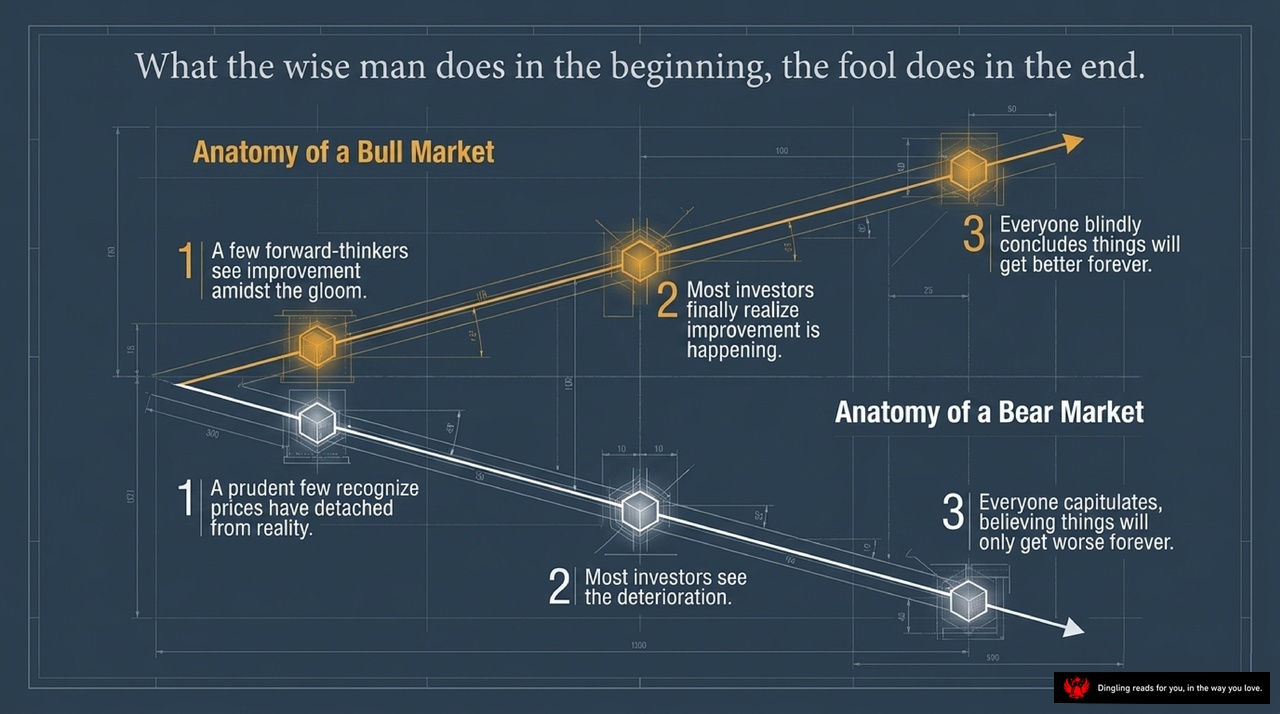
Imagine the market not as a straight line, but as a giant pendulum swinging wildly between extremes. As this slide illustrates, the anatomy of a bull market and a bear market are mirror images of human psychology. In the early stages of a boom, only a few forward-thinkers see improvement amidst the gloom, while in a crash, only a prudent few recognize that prices have detached from reality. But here is the critical part: the pendulum always swings back. When everyone blindly concludes things will get better forever, the market is actually at its peak, just as when everyone capitulates believing things will only get worse, the bottom is often near. This is the essence of what the wise man does in the beginning, while the fool does in the end. Most investors finally realize improvement is happening only after the trend is well underway, or they see deterioration only after it has already caused significant pain. True success comes from understanding these cycles, identifying when the pendulum is swinging too far, and having the courage to act against the crowd—buying when others are fearful and selling when they are greedy.

True contrarianism isn't just about doing the opposite of the crowd; it requires the courage to stand completely alone. As the slide illustrates, exceptional returns only happen when you combine unconventional behavior with superior judgment. The paradox is stark: buying when others are despondently selling, and selling when they are euphorically buying, is agonizingly lonely. But this isolation is the price of admission. Being a contrarian isn't mechanically doing the opposite; it demands that you truly understand why the consensus is wrong. If your portfolio looks exactly like everyone else's, exceptional performance becomes mathematically impossible. The real reward comes from that unique insight, allowing you to navigate the market's inevitable pendulum swings and find value where others see only disaster.

To find real bargains, you have to look where others don't. As the slide suggests, perception must be significantly worse than the underlying reality. You aren't looking for assets that feel comfortable; in fact, if an asset feels entirely safe to buy, it rarely yields a bargain price. Instead, you need to hunt for assets bearing specific scars. Think of it as the anatomy of a bargain. First, look for what is "Ignored"—assets that are obscure, misunderstood, or structurally overlooked by institutions. Next, seek the "Ugly"—those suffering from surface-level fundamental flaws that everyone else sees. Then, find the "Toxic"—assets that are controversial, unseemly, or frightening to the general public. Finally, target the "Punished"—those recently suffering from a prolonged period of poor price performance. These four categories form the diamond of opportunity on your right. The key is to deploy capital where the market is fearful or indifferent, not where it is excited. By embracing these negative perceptions, you position yourself to buy when others are running away, creating the gap between price and value that defines true investing success.

Imagine a world where the most powerful competitive advantage isn't about knowing the future, but simply admitting that you don't. This slide brilliantly contrasts two opposing schools of thought that define how investors navigate uncertainty. On the left, we have the "I Know" school. These investors believe the macro future is predictable and controllable. Their action? They concentrate their positions, utilize heavy leverage, and bet boldly on specific outcomes. They act like they have a crystal ball. But their vulnerability is fatal: they are fragile to Black Swans. When their single predicted future fails to materialize, their capital is destroyed.
On the right stands the "I Don't Know" school, which I believe is the superior approach. They understand that the future is a wide probability distribution, largely unknowable. Their strategy is to diversify intelligently, use minimal leverage, and demand a deep margin of safety. Instead of betting on one specific outcome, they prepare to survive a vast array of alternative futures. This makes them robust. As the text suggests, acknowledging the limits of forecasting isn't a weakness; it's a massive competitive advantage. While the "I Know" school tries to outguess the market and often gets crushed by volatility, the "I Don't Know" school stays in the game, ready to thrive no matter what the future holds. In an unpredictable world, knowing what you don't know is the only way to stay alive.

A good outcome does not prove a good decision was made. This slide tackles one of the most dangerous traps in investing: the "Lucky Fool" Trap.
Look at the diagram. We start with "The Decision," which branches out into many possible paths, representing the massive distribution of possibilities that could have happened. Yet, history only plays out one specific line, leading to "The Actual Outcome."
This visual perfectly illustrates why luck often masquerades as skill. You can be completely right for the entirely wrong reasons. A master investor knows that because the market is governed by randomness, a single successful result tells you nothing about the quality of your process.
That is why we must shift our Evaluation Metric. Instead of judging ourselves solely by what actually happened, we must evaluate our strategies against the entire range of things that could have happened. We need to ask: if I had made this decision in a different market environment, would it still have worked? If the answer is no, then your success was likely just a lucky break, not a repeatable strategy.
True investing isn't about celebrating a single win; it's about building a system that survives the many paths that didn't happen.

Look at this slide. It captures the single most important lesson in investing: the difference between an "offensive illusion" and a "defensive reality." On the left, we see a baseball bat swinging wildly at a ball. This represents aggressive investing. It's all about chasing home runs, swinging for the fences, and hoping for massive gains. But as the text warns, this strategy risks a massive number of strikeouts. You might hit a few dingers, but you're also likely to get whacked out repeatedly, leaving you with nothing.
Now, look at the right side. This is the defensive reality. It's illustrated by a tennis racket hitting a ball over a net. Masterful investing isn't about hitting the hardest shot; it's like amateur tennis. It's what Charlie Munger called a "loser's game." In this game, the winner isn't necessarily the person who hits the ball the fastest, but the one who simply makes the fewest unforced errors.
The objective here is crystal clear, written right at the bottom: focus relentlessly on eliminating catastrophic mistakes and avoiding permanent capital loss. Why? Because in investing, you don't need to be right every time to win. You just need to avoid being wrong when it counts. If you can prevent your portfolio from getting wrecked during a crisis, you survive. And if you survive, you stay in the game long enough to let the winners take care of themselves. So, stop obsessing over how much you can make in a good year. Instead, ask yourself: how can I ensure I don't lose everything when the market turns? That is the true path to success.

The margin of error is the ultimate cushion against an unknowable future. Think of investing not as predicting the future, but as building a safety net for it. As the slide illustrates, this "cushion" is the gap between the current market price and the asset's intrinsic value. It is what allows you to survive when your thesis is flawed or when an impossible macro event occurs, ensuring you face a setback rather than financial ruin.
Achieving this margin of error isn't about guessing right every time; it's about discipline. First, you must pay a rock-bottom price relative to the tangible value of the asset. Second, you must refuse to use dangerous leverage that could wipe you out in a downturn. Finally, you must maintain healthy diversification to protect yourself from correlated risks. By combining these three elements—buying deeply, avoiding leverage, and diversifying wisely—you create a buffer that lets you stay in the game when others are forced to exit. In an uncertain world, the smartest move isn't to be right; it's to be safe.

True alpha isn't about beating the market every single day; it's about mastering the pursuit of asymmetric returns. Look at this chart: in a bear market, the market drops 10%, but a smart portfolio only loses 3%. In a flat market, the market stays neutral while the portfolio gains 5%. And in a bull market, when the market rallies 15%, the portfolio captures almost all of that upside at 14%. This is the math of asymmetry. You capture the vast majority of gains during upturns while suffering only a fraction of the losses during downturns. The result? Compounding capital from a higher baseline after a crash mathematically guarantees long-term superiority over the index. Investing mastery means protecting your downside so you can thrive when the tide turns.

Look at this swinging pendulum. It perfectly captures the chaotic rhythm of the investment market. Just like a clock's pendulum, market sentiment doesn't stay in the middle; it swings violently between extremes of greed and fear, often spending very little time at the average.
The text on your slide makes a crucial point: exceptional investing isn't about finding a magic formula. True success comes from superior insight, emotional discipline, and relentless risk control. But here is the real challenge: when this pendulum swings to the extreme, and the crowd blindly chases the illusion of safety, will you have the courage to stand alone?
Most investors are trapped in the swing, buying at the peak of euphoria and selling at the bottom of panic. But the most profitable opportunities arise exactly when everyone else is terrified. As we discussed, the market is driven by human psychology, which is prone to repeating the same mistakes over and over. When the pendulum swings too far to one side, creating extreme valuations, that is actually when the smart money steps in.
So, the question isn't just about predicting the future, which is nearly impossible. It's about recognizing where you are in the cycle and having the fortitude to act against the crowd. If you can remain disciplined when others are losing their heads, you don't just survive the market; you thrive in it.