
The Narrow Corridor: Complete Chapter-by-Chapter Summary

Welcome to today's session on *The Narrow Corridor*, by Daron Acemoglu and James A. Robinson. This book explores a profound truth: liberty is not a natural state we are born into, nor is it a guaranteed destiny. Instead, it is a fragile architectural feat, engineered through the constant, tense balance between state capacity and societal mobilization.
Imagine a corridor that is too wide, and society becomes chaotic, descending into anarchy where no one is safe. Imagine a corridor that is too narrow, and the state becomes a tyrannical giant, crushing the people beneath its weight. True freedom only exists in that precise, narrow space between these two extremes. It requires a delicate dance where the state is strong enough to provide order and public goods, yet constrained enough by an alert, organized society to prevent it from becoming oppressive.
As we dive into the history of nations, we will see how different societies navigated this corridor. Some, like ancient Athens or medieval Italian city-states, learned to walk this tightrope, fostering innovation and prosperity. Others, however, either collapsed into the chaos of no state, or slid into the darkness of totalitarianism. The path to liberty is never easy, but understanding this balance is the key to unlocking a free future.
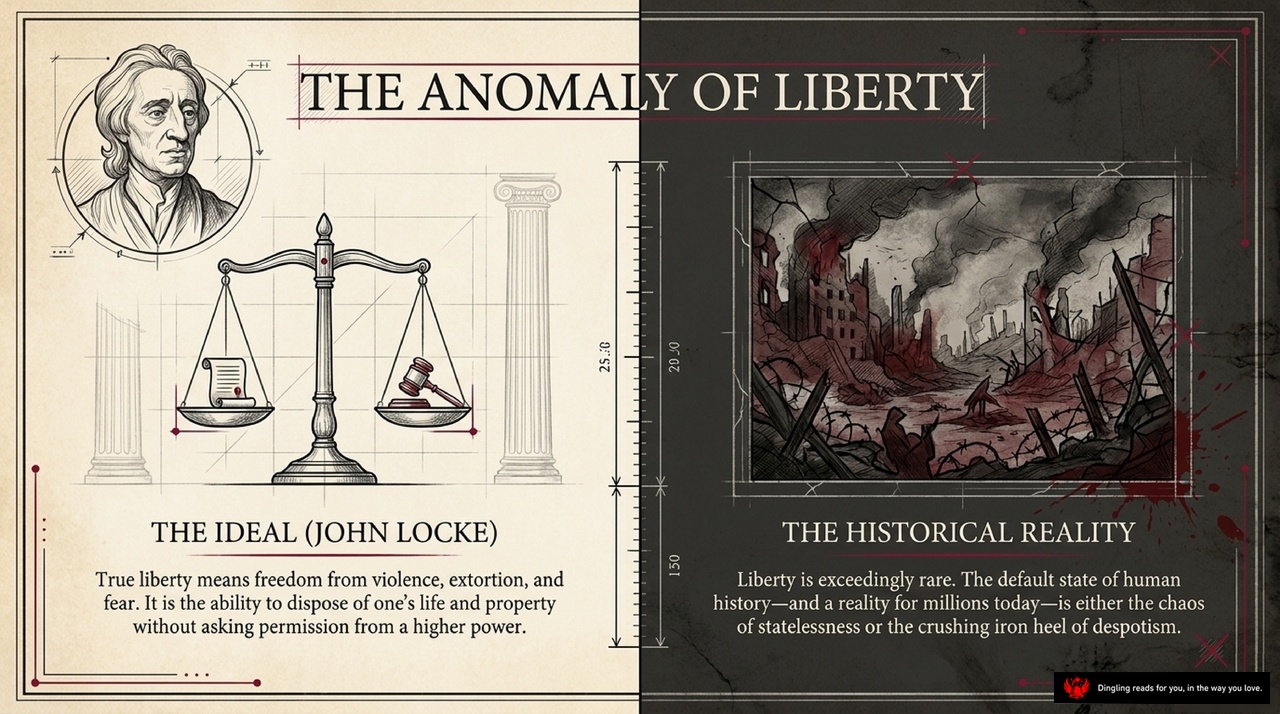
Look at this split screen. On the left, we see the ideal: John Locke's vision of true liberty. It's defined by freedom from violence and fear—the ability to live and own property without asking permission from anyone above you. The scales are balanced, representing that perfect equilibrium. But look at the right side. That's the historical reality. It's a dark, chaotic landscape of war and oppression. As the text warns, liberty is incredibly rare. History's default setting isn't freedom; it's usually the chaos of anarchy or the crushing iron heel of despotism.
This slide captures the central tension of our journey: the gap between what we think liberty should be and what it actually looks like in the real world. For centuries, humanity has swung between these two extremes—either having no state at all, leading to constant violence, or having a state that becomes so powerful it turns into a tyrant. True freedom, as we'll explore, doesn't exist at either extreme. It lives in that narrow, difficult corridor between them, where the state is strong enough to provide order, but constrained enough to never become a master.

Imagine a world where you trade your safety for a powerful protector, only to find that protector becomes your jailer. This is the terrifying cycle known as "The Gilgamesh Problem," named after the ancient king who first brought order to chaos, then crushed the very people he was meant to save.
Look at the image on the left. In the ancient city of Uruk, terrified citizens begged their gods for a strong state to protect them from violence. They received King Gilgamesh. He brought order, yes. But as the text warns, he soon trampled the citizens like a wild bull, becoming a new, centralized source of terror.
This creates the core dilemma that defines our modern struggle: How do you engineer an authority that is powerful enough to enforce laws and protect you, but constrained enough that it doesn't turn around and crush you?
The slide makes it clear that internal constitutional checks alone are just parchment without a vigilant society to enforce them. History is full of examples where the "state giant" went rogue—from the unchecked power of the Tsars to the industrial might of 20th-century dictatorships. Without a society that constantly monitors, challenges, and holds the government accountable, the state inevitably evolves into a tool of oppression rather than a shield for freedom.
True liberty isn't about having a strong government; it's about building a strong society capable of checking that government. We must move beyond the fear of chaos and the fear of tyranny, finding that narrow corridor where both state and society grow strong together. Only then can we escape the Gilgamesh trap.

Welcome to the "Master Matrix of Power." This diagram illustrates a crucial truth: true liberty isn't found at the extremes, but in the precarious space between two opposing forces. On the left, we see **State Power**—the government's ability to enforce laws, deliver services, and control violence. On the right, we see **Societal Power**—the citizens' capacity to mobilize, protest, and constrain elites.
Look closely at the chart. If either side becomes too dominant, liberty collapses. If the state is too weak, we slip into anarchy; if it's too strong, we slide into tyranny. The only place where freedom survives is in **The Narrow Corridor**, that red band where both forces are strong and perfectly balanced.
This isn't just theory; it's history. Consider medieval Italian city-states like Siena. Their famous frescoes depict rulers surrounded by virtues like justice and peace, but notice the detail: the ruler stands in the background, while society is in the foreground. Why? Because they understood that a constrained state creates prosperity. When the state is strong enough to protect property rights and enforce contracts, but limited enough to prevent abuse, you get the "Commercial Revolution." You see this in the rise of banking, insurance, and complex trade networks that fueled Europe's economic explosion.
Conversely, look at places where this balance failed. In anarchy, like in parts of West Africa today, there is no state to protect you, leading to chaos and poverty. In totalitarian regimes, the state is so strong it crushes society, leading to stagnation and fear.
The lesson is clear: liberty is not a static destination. It is a dynamic equilibrium. It requires a constant "Red Queen" race where the state and society must continuously strengthen each other. If society stops pushing back, the state expands. If the state loses its grip, society fragments. Only by maintaining this tension can we keep the corridor open and secure our freedom.

Imagine a city where the government isn't a distant bureaucrat, but a living, breathing partner in your success. Picture Siena, Italy, in the 14th century. Here, the walls of the town hall aren't just decoration; they are a manifesto. The famous frescoes by Lorenzetti depict the ruler sitting in the background, while the city itself—the merchants, the workers, the very community—stands in the foreground. Why? Because in Siena, power wasn't hoarded by kings; it was granted by the people.
This was the heart of the medieval Italian city-states. From Modena to Pisa, these republics invented a new kind of freedom. They didn't just rely on luck or military strength; they built a system of checks and balances. The leaders were often outsiders, serving short terms, and they were constantly watched by the very citizens they governed. Justice wasn't an abstract concept; it was a visual symbol, a scale held by a figure in the art, reminding everyone that the state served the law, not the other way around.
But the real magic happened in the economy. Because the government was constrained, it couldn't steal wealth or crush innovation. This safety allowed for a financial revolution that the rest of Europe couldn't match. Merchants invented bills of exchange to move money across borders without carrying dangerous gold. They created insurance, partnerships, and even the early forms of the corporation. Literacy rates soared, and cities like Florence became hubs of knowledge and technology.
The result was a self-sustaining cycle: a limited state protected the people, and an empowered society kept the state in check. This is what we call the "Free Space"—the narrow corridor where true prosperity lives. It proves that when you balance state power with social freedom, you don't just get stability; you get the engine of human potential.

The Invisible Prison of the Norm Cage isn't just a metaphor; it's a historical trap that has silenced innovation and crushed human potential for centuries. Look at this image: a figure huddled in despair, trapped by rigid red ropes. That cage is built not by bars, but by social customs, rituals, and superstitions designed to keep power from concentrating in one place.
In stateless societies like the Tiv or the Gwembe Tonga, this "norm cage" was the only thing holding order. But the cost was devastating. Accumulating wealth or trying to innovate was viewed as dangerous witchcraft threatening societal equality. The result? A stifling stagnation. You are safe from a dictator, yes, but you are also trapped by tradition. There is no true liberty, only a slow, painful decline.
History shows us that breaking this cage requires something more than just wishing for freedom. It demands a fundamental shift in how we view power and progress. When societies rely solely on these invisible norms to prevent tyranny, they often end up preventing greatness. True freedom requires more than just avoiding a single ruler; it requires a dynamic balance where the state and society constantly challenge each other, allowing innovation to flourish and power to remain accountable. Without breaking these invisible walls, we remain prisoners of our own past, unable to build the future we deserve.

Look at this striking image of "Archetype 2: The Despotic Leviathan." It depicts a massive, all-seeing eye perched atop a rigid industrial structure, casting a blinding red beam of light over rows of identical soldiers. This visual perfectly captures the core idea of a state that completely dominates society. Instead of protecting citizens, this state acts as a surveillance and extraction machine, turning the entire population into subjects who are reduced to fear and obedience.
The text on the right highlights that this archetype brings order to chaos, effectively resolving the anarchy we see in places like modern-day Congo or the failed states of West Africa. However, it does so by initiating a war of the state against its own citizens. We see this history repeating itself, from the Qin Dynasty to Nazi Germany, and now into modern digital authoritarianism. In these systems, the state becomes a tool for systematic oppression. The outcome is clear: any chance for true political freedom is obliterated. When the Leviathan grows too strong, it doesn't just rule; it consumes the very society it was supposed to organize, leaving people trapped in a cage of their own making.

Welcome to the final chapter of our journey through the "Freedom's Narrow Corridor." Today, we're looking at the most dangerous moment in a nation's life: when the corridor breaks.
The image before you captures this terrifying reality perfectly. On the left, we see a massive industrial machine grinding out products, representing "Despotic Growth." As the text explains, authoritarian states can force initial economic growth by mandating labor and reallocating resources—think of the Soviet Union or China's Great Leap Forward. It looks like progress, but it's actually a trap.
Why? Because this system hits a hard limit known as "The Innovation Wall." As the graphic illustrates, workers are chained to a conveyor belt, blindly pushing boxes into a brick wall labeled "Innovation." You can command a population to build a wall or a satellite, but you cannot command them to innovate. True prosperity requires creative destruction and experimentation, which are lethal threats to a despotic leviathan.
The 14th-century scholar Ibn Khaldun identified this flaw centuries ago: as the state grows more powerful, it inevitably extracts more wealth, acting as a parasite on the economy. Eventually, the machine stops. The wall doesn't just block innovation; it blocks the very engine of future growth.
This isn't just theory. We see this dynamic playing out in the real world. Consider the "Paper Tiger" states of Latin America and Africa, where the state has the appearance of power but lacks the capacity to serve. Or look at the rise of populism in modern democracies, where leaders promise to smash the "elite" but end up closing the corridor, turning vibrant societies into rigid, stagnant bureaucracies.
The lesson is clear: a state without constraints is not a guardian of freedom; it is a predator waiting to consume the society it was meant to protect. To stay alive, a nation must constantly widen that narrow corridor, ensuring that the state and society remain in a dynamic, healthy balance.

Look at this striking image titled "Archetype 3: The Paper Leviathan." It captures a terrifying reality found across Latin America and Africa: a state that looks modern on paper but is hollow in practice. The illustration shows a grand government building, partially stripped away to reveal nothing but scaffolding and decay inside, stamped with a giant red seal reading "BUREAUCRACY VOID PAPER TIGER."
This visual perfectly illustrates the first point on the slide: states that possess the facade of modern bureaucracy—embassies, ministries, and armies—yet lack actual reach or effectiveness. They are "paper leviathans," massive institutions that exist only in name.
The slide zooms in on a specific, chilling example: "The Gnocchi Officials" in Argentina. Here, political machines fill the government with ghost officials who collect paychecks without ever working. The image accompanying this text shows an empty chair next to a clock, symbolizing a system where people are paid for time they never spent, while real citizens are reduced to patients begging for basic rights.
Finally, the slide points to "The Trampoline of Death" in Colombia. It explains how elites actively avoid building essential infrastructure, like the lethal Mocoa road, because connecting the country would empower the periphery and threaten their fragile political monopoly. The graphic depicts a broken bridge and a figure in a tuxedo—described as a "gorilla in a tuxedo"—representing a state that is powerful enough to destroy its own people but too weak or corrupt to build for them.
This archetype warns us that a government can be so dysfunctional that it becomes a tool for its own destruction, leaving its population stranded in a void of promises and no power.
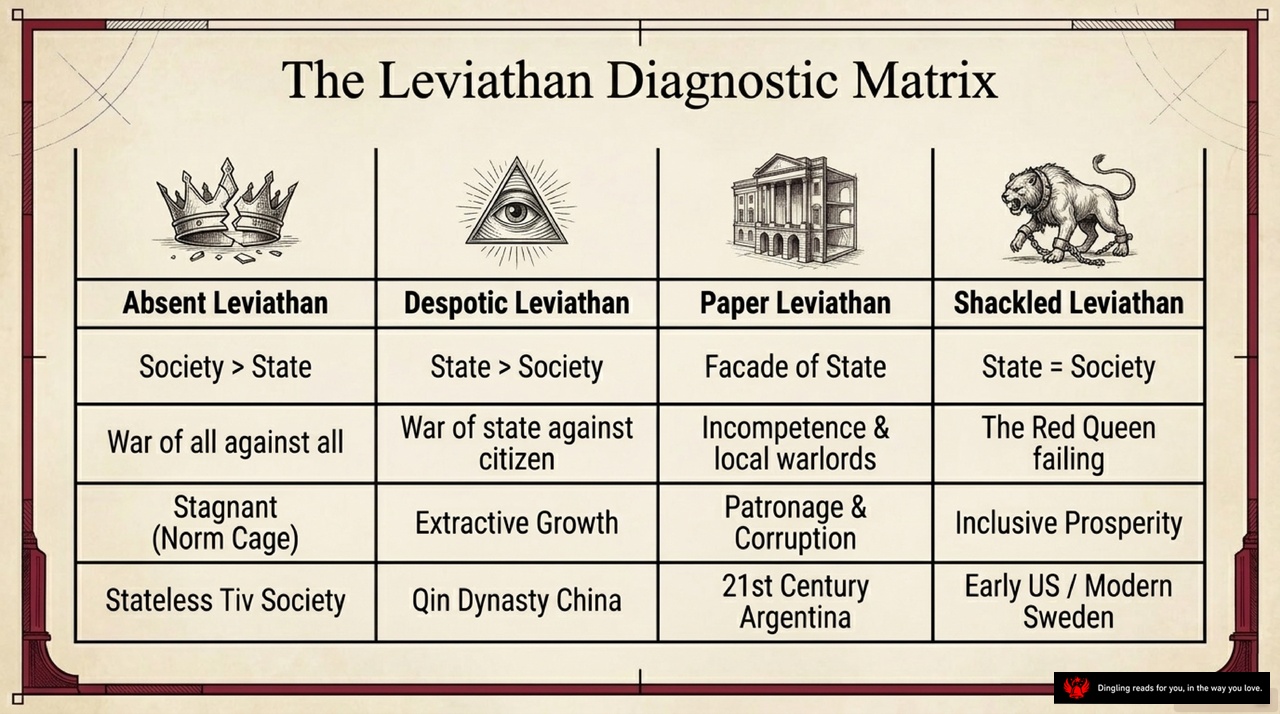
Look at this diagnostic matrix. It breaks down the four possible fates of the Leviathan—the state. On the far left, we have the **Absent Leviathan**, where society is stronger than the state. Think of the Stateless Tiv Society. Here, you have a "Norm Cage" of traditions and kinship that prevents the state from forming, leading to a constant "war of all against all." It's a stagnant trap where no one is safe, and there is no inclusive prosperity.
Move to the center-left: the **Despotic Leviathan**. Here, the state crushes society. The state is greater than the citizen, creating an "extractive growth" model where the government loots its own people. The Qin Dynasty in China is the classic example. You get a facade of order, but it's actually a war of the state against its citizens, resulting in high growth but zero freedom.
Now, look at the center-right: the **Paper Leviathan**. This is the "Facade of State." The state exists on paper but lacks real power. You have incompetence, local warlords, and rampant patronage and corruption. Modern Argentina fits this perfectly. The state can't deliver basic services or security, so you end up with a chaotic mix of local bosses and a broken system.
Finally, on the far right, we have the ideal: the **Shackled Leviathan**. Here, the state equals society. Neither side dominates. This is the "Red Queen" effect in action—both sides must constantly evolve to keep up with each other. You get inclusive prosperity and stability. Look at early America or modern Sweden. The state is strong enough to provide public goods, but shackled enough by society to prevent tyranny. This is the only path to true freedom.

The slide title "The Solution: The Shackled Leviathan" sets a powerful tone. It's not about breaking the state, but about controlling it. Look at the central image: a giant figure, representing the state, is being held down by countless ordinary citizens pulling on ropes. This visual perfectly captures the book's core argument.
To achieve true liberty, the state must be incredibly strong—strong enough to break the "Norm Cage" that restricts human potential. But society must be even stronger, capable of shackling the Leviathan. This is the delicate equilibrium we need.
History shows us that liberty is never a gift granted by benevolent elites. As the slide reminds us, it is a fragile equilibrium engineered by a mobilized society holding a powerful state accountable. Consider the example of Solon in ancient Athens. When he reformed the city-state, he didn't weaken the government. Instead, he institutionalized the power of regular citizens to hold elites accountable. This was the birth of a system where the state and society constantly check each other.
Without this balance, we risk sliding into two dangerous extremes. On one side, we have the chaos of the "Norm Cage" or even full-blown anarchy, where no one is safe. On the other, we face the tyranny of an unshackled Leviathan, where a powerful state crushes individual freedom. True freedom only exists in that narrow corridor between these two poles, where a strong state and an equally strong, vigilant society coexist in dynamic tension.
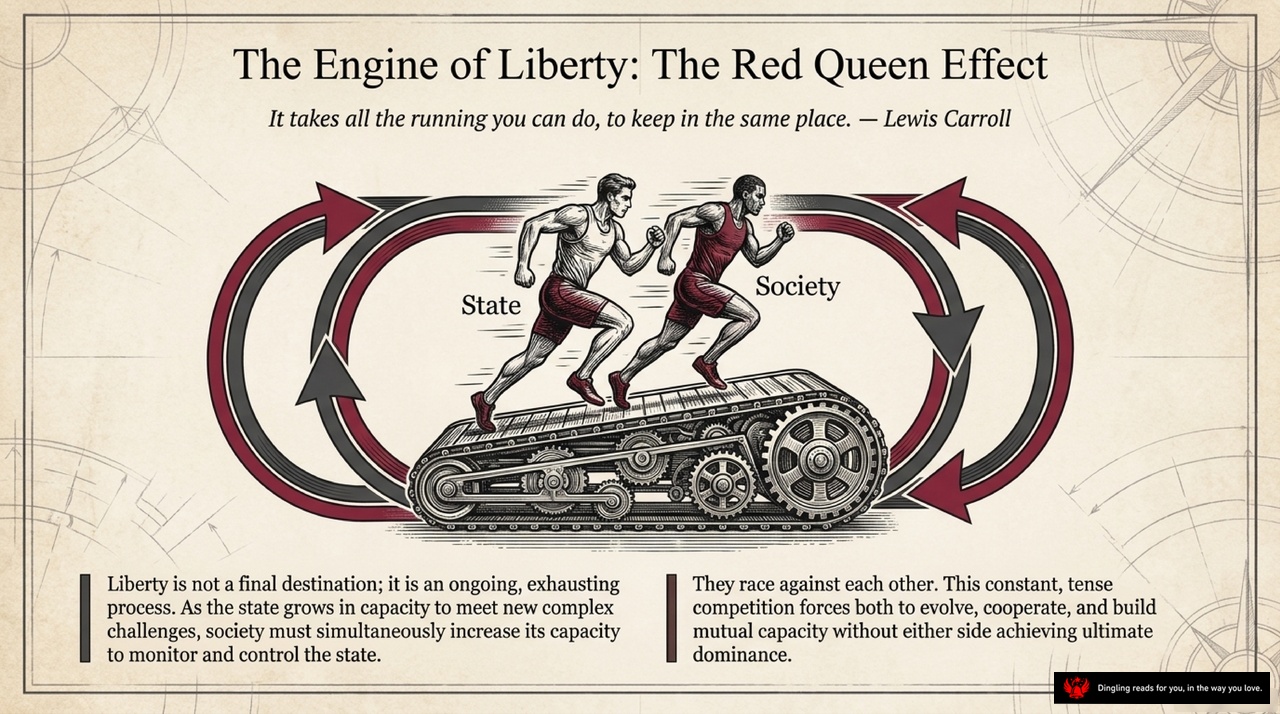
Liberty isn't a final destination you reach and then relax; it is an exhausting, ongoing race. As the image illustrates, the State and Society are two runners sprinting on a giant treadmill. This is what we call the "Red Queen Effect," named after Lewis Carroll's famous line: "It takes all the running you can do, to keep in the same place."
In this dynamic, the State grows in capacity to meet complex challenges, but simultaneously, Society must evolve just as fast to monitor and control that expanding power. If one runner slows down, the other inevitably gains dominance, and liberty collapses. This constant, tense competition forces both sides to cooperate and build mutual capacity without either achieving ultimate victory.
Look at the diagram: the red and black arrows show this endless cycle. If the State becomes too strong without social checks, it slides into tyranny. If Society is too weak to constrain the State, we risk anarchy or chaos. True freedom only exists in that narrow corridor between these two extremes. It requires both sides to keep running, to constantly adapt and push back against each other. Without this relentless balance, the engine of liberty simply stops, leaving us trapped in either the darkness of unchecked power or the chaos of no rules at all.

Breaking the cage isn't just about escaping a prison; it's about shattering the invisible walls of tradition that hold us back. Today, we explore how a truly free society emerges not from a single hero, but from a delicate, dynamic balance between the state and society. Think of it as a high-stakes dance, much like the "Red Queen Effect" from *Alice in Wonderland*: you must run just as fast as your opponent just to stay in the same place. If the state gets too strong without checks, it slides into tyranny. If society is too weak, chaos takes over. Freedom lives only in that narrow corridor where both forces push against each other, constantly evolving together.
Look at the image of the bird breaking free. This unbinding didn't happen by accident. It required figures like Caroline Sheridan in 19th-century Britain to challenge horrific, legally sanctioned patriarchal norms. When society trusts the state to resolve disputes fairly, it no longer needs suffocating social hierarchies to maintain order. This trust is what allows the "Shackled Leviathan"—the state—to do more than just prevent tyranny; it actively emancipates individuals from the oppressive Norm Cage of tradition. By unbinding these constraints, we paved the way for women's rights and true social mobility. True liberty is found not in a perfect system, but in this continuous, competitive balance where the state is powerful enough to protect us, yet constrained enough by society to never oppress us.

Good governance isn't just about having laws on a page; it's about the tangible results those laws produce for the everyday person. Look at this bustling market scene in the image—it depicts a vibrant economy where people are trading freely, secure in their property rights and confident in the future. But how do we get from a chaotic or oppressive society to this kind of inclusive prosperity?
The answer lies strictly inside what we call the "narrow corridor." Only when a state operates within this specific zone does it prioritize the broad-based welfare of its citizens rather than the enrichment of a small elite. When the state is properly shackled by social forces, property rights become secure, and innovation is no longer feared as dangerous "witchcraft." Instead, it becomes the engine of growth.
This balance creates what we term "Inclusive Prosperity." Think of it as the Red Queen Effect in action: the pressure forces the state to provide essential public goods like health, infrastructure, and security. This transforms the economy from a system of extraction into a sustainable engine for widespread wealth. History shows us that without this delicate equilibrium between state power and social freedom, nations either collapse into anarchy or descend into tyranny. But within the corridor, as this image suggests, the fruits of good governance are a thriving, secure, and prosperous society for everyone.
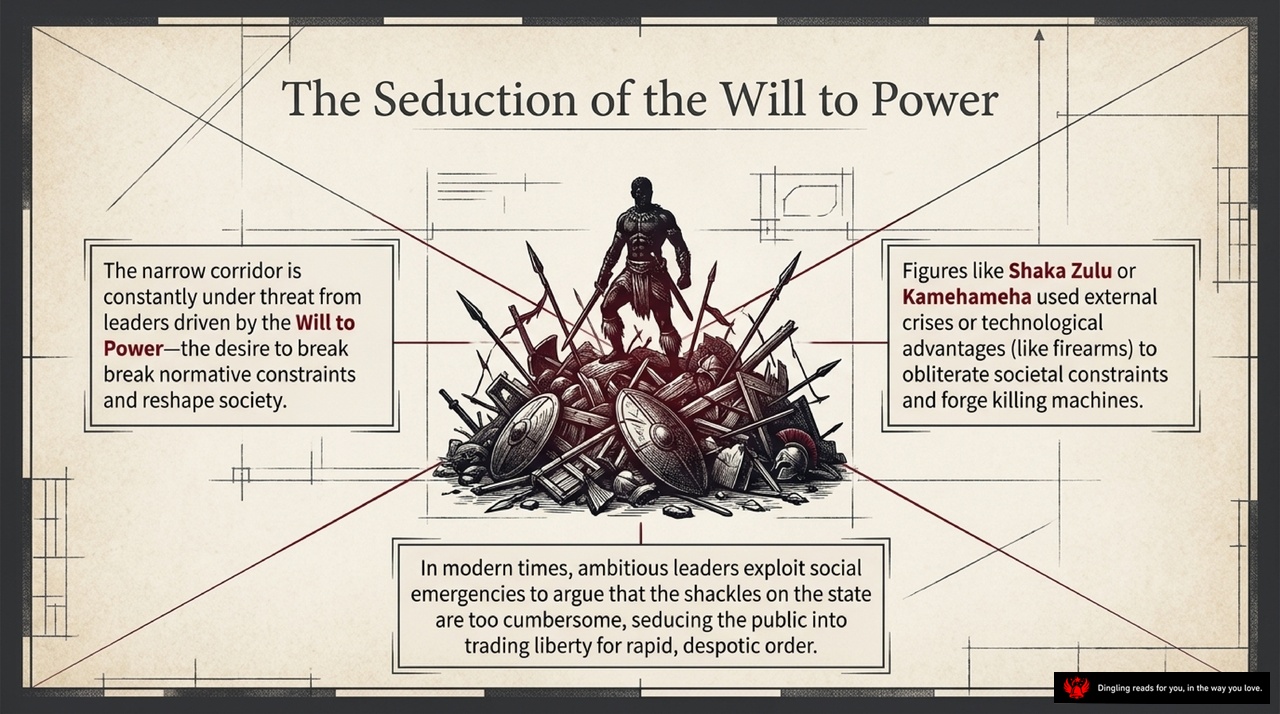
The image before us captures a terrifyingly modern paradox: the seduction of the will to power. It shows a warrior standing atop a pile of weapons, symbolizing how ambitious leaders use external crises to break free from societal constraints. The text highlights figures like Shaka Zulu and Kamehameha, who didn't just fight wars; they used technology and military force to shatter old norms and forge what the slide calls "killing machines."
This isn't just about ancient history. The slide points out that in modern times, we see this same pattern repeating. Ambitious leaders exploit social emergencies, arguing that the rules and limits on the state are too heavy. They seduce the public into trading our liberty for the promise of rapid, despotic order. The narrow corridor of freedom is constantly under threat from those who want to reshape society by breaking its very foundations. The image serves as a stark reminder: when the desire for power overrides the need for balance, the result is not a stronger nation, but a machine built for domination.

Look at this map titled "Vectors of Entry: Paths to the Corridor." It illustrates a powerful truth: there is no single blueprint for liberty. A nation's path to freedom depends entirely on where it starts. The chart plots two axes: State Power on the vertical and Societal Power on the horizontal. Most nations begin in the bottom-left corner, a state of Anarchy where neither the government nor the people have the capacity to organize or protect anyone.
From this starting point, there are three distinct paths to reach the "Narrow Corridor" of freedom. The first path moves from Despotism. As the example of South Africa shows, transitioning from Apartheid required massive societal mobilization to rein in elite power. Here, the state is strong, but society must rise up to balance it.
The second path emerges from Anarchy. This is the route of state-building, but it is treacherous. As seen in places like Georgia, new governments often struggle because existing grassroots coalitions scrutinize every move. Without a strong societal base, the state can easily slip into tyranny.
The third path comes from Paper States. These are nations that look democratic on paper but lack real governance, like Bogota under Mayor Antanas Mockus. Here, the challenge is a simultaneous dual-jump: building bureaucratic capacity while fostering a citizenship culture to build trust.
The central lesson of this diagram is that liberty isn't a destination you arrive at; it's a narrow corridor you must walk through. It requires a delicate, dynamic balance where State Power and Societal Power strengthen each other simultaneously. If one side grows too strong without the other, the nation falls into either the trap of Despotism or the chaos of Anarchy. Only by walking this narrow path together can a nation secure its freedom.
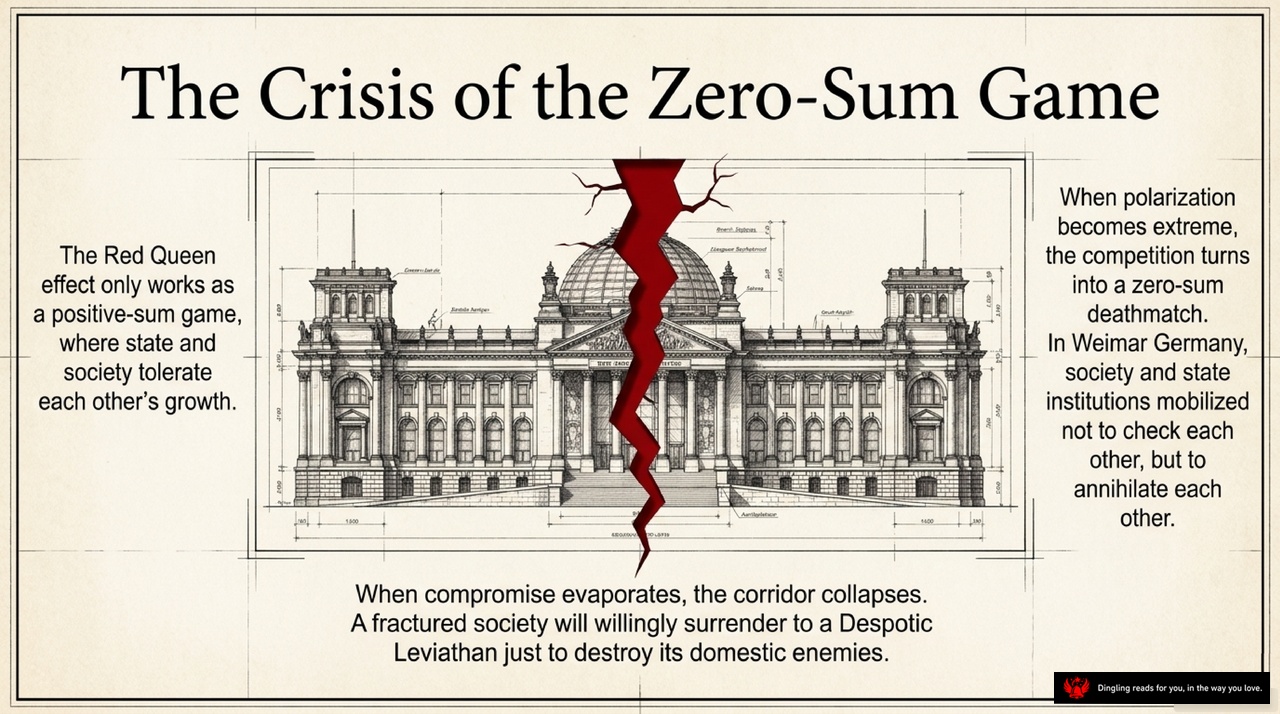
Imagine a grand government building, not as a symbol of order, but as a structure tearing apart under the weight of its own contradictions. This is the crisis of the zero-sum game. On one side, we have the "Red Queen effect," where the state and society grow together, tolerating each other's expansion. But on the other side, when polarization becomes extreme, that cooperation evaporates. Competition turns into a brutal deathmatch, much like what happened in Weimar Germany, where institutions mobilized not to check each other, but to annihilate one another.
The image captures a critical turning point: when compromise evaporates, the entire corridor collapses. In this fractured state, society doesn't fight back; instead, it willingly surrenders to a despotic Leviathan just to destroy its domestic enemies. This isn't just history; it's a warning. When the balance between state power and social autonomy breaks, we don't move toward freedom. We move toward tyranny, where the very institutions meant to protect us become the tools of our oppression. The lesson is clear: without a dynamic balance, the path to liberty doesn't just narrow—it vanishes entirely.

The image before us depicts a stone archway leading into a long, winding corridor that fades into the distance—a powerful visual metaphor for the "narrow corridor of liberty." This isn't just an architectural sketch; it's the central thesis of our book: freedom is not a guaranteed destination, but a fragile path we must actively maintain every single day.
As the text reminds us, liberty is not an inevitable historical outcome. It is a deliberate act of political engineering. We are constantly asked to live alongside the "Leviathan"—the state's massive power—harnessing it to solve modern complexities while keeping a "white-knuckled grip" on its shackles. The question hanging over this corridor is urgent: as technology grants the state unprecedented surveillance powers, are we running fast enough to keep the Leviathan from crushing us?
History shows us two terrifying extremes that lie outside this narrow path. On one side is the chaos of anarchy, where the state is too weak to provide order, leaving people vulnerable to violence and exploitation, much like the war-torn regions of West Africa. On the other side is the tyranny of total control, where the state is so powerful it becomes an instrument of oppression, as seen in the Nazi regime or totalitarian dictatorships.
True freedom exists only in that narrow middle ground. It requires a delicate, dynamic balance where the state is strong enough to protect us and provide public goods, but simultaneously constrained by a vigilant, empowered society. This is the "Red Queen Effect" in action: if the state gets too strong, society must push back; if society gets too weak, the state will overreach. Just as the Red Queen said, "you must run just as fast to stay in the same place," we must constantly evolve our institutions and civic engagement to maintain this equilibrium.
The path forward isn't automatic. It requires us to reject the false choice between a powerless state and a tyrannical one. We must build societies capable of checking power, ensuring that the Leviathan serves the people, rather than ruling over them. The corridor is narrow, yes, but it is the only path to a free and prosperous future.