
The Nature of Technology: Complete Chapter-by-Chapter Summary

Welcome to our deep dive into the very fabric of our modern existence. Today, we're exploring a profound question: What is technology, really?
As we look at this cover, featuring the intricate blueprints of human engineering merging with the glowing, organic structures of neurons, we see the central thesis of W. Brian Arthur's work. The image perfectly captures the book's promise: an exploration of how technology truly is, how it evolves from within itself, and why it is fundamentally becoming biological.
We often treat technology as mere tools—just a collection of cold, mechanical parts. But Arthur challenges us to see that technology is actually a living system. It doesn't just exist; it evolves. Just like the biological cells depicted on the right side of our slide, technology grows, combines, and adapts. It starts with simple components and, through a process of recursive combination, builds increasingly complex structures that can even self-repair and adjust to their environment.
The beauty of this perspective is that it reveals technology not as something separate from nature, but as a natural extension of it. We are no longer just observers of the natural world; through our creations, we are actively programming and shaping it. So, as we move forward, let's leave the idea of technology as a static tool behind and embrace the exciting reality that we are witnessing the birth of a new, evolving kind of life—one that we have helped create ourselves.

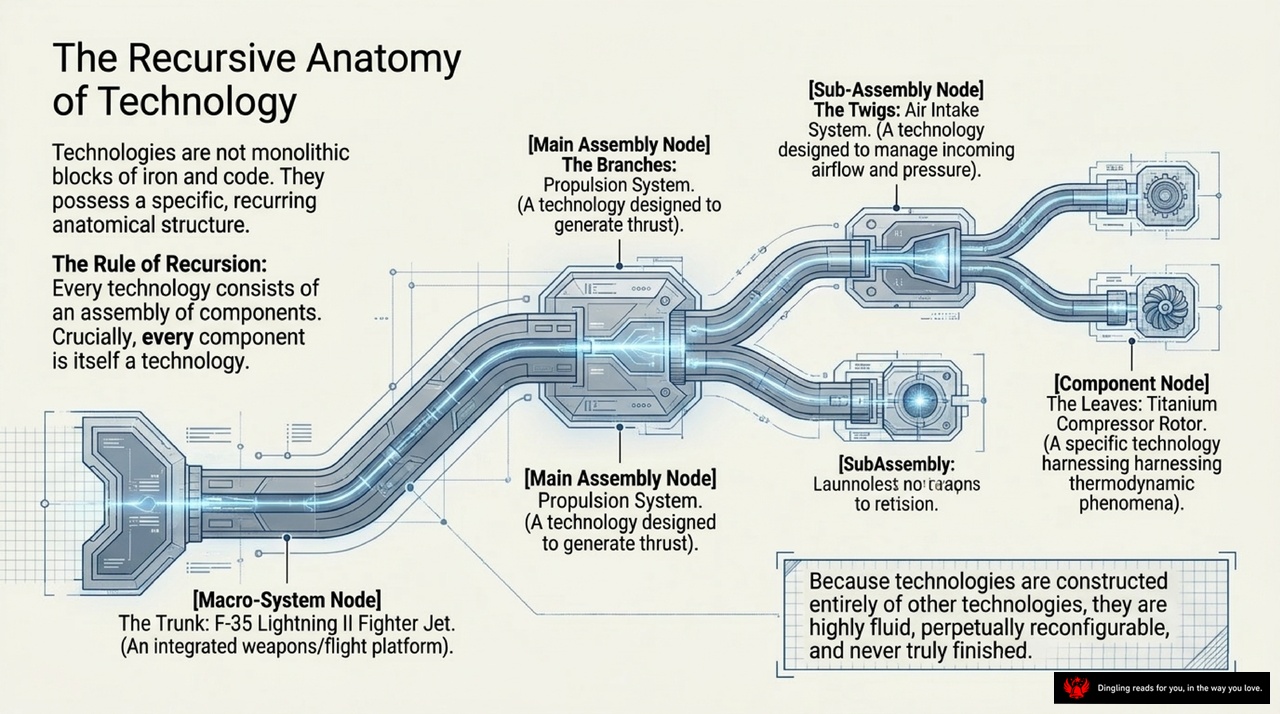
We live in a world entirely built by technology, yet we often treat it as a simple collection of tools rather than a living, evolving system. Look at this blueprint of a jet engine. We possess exhaustive micro-knowledge about its parts—we know exactly how electrons move in the silicon chips or how thermodynamics limits a turbine blade. We know the compressor stages and the combustion chamber down to the atomic level. But here is the critical gap: unlike biology, which is governed by Darwinian evolution, or physics, which follows the rules of general relativity, we lack a unifying macro-framework for technology itself.
We have no theory of evolution for technology. What is missing is a general principle that provides a logical framework. We can identify individual mechanisms, but we lack the theory that explains how they fundamentally originate, what internal rules govern their evolution, and how they autonomously generate the economy. We have the parts, but we are missing the whole.

Defining the Indefinable: The Three Lenses of Technology. We often treat technology as just a collection of tools—a hammer here, a computer there—but what if we looked at it through a different set of glasses? Today, we're breaking down technology into three distinct scales: The Singular, The Plural, and The Universal.
First, let's look at **The Singular**. Think of this as "A Means to a Purpose." It's the specific device or process engineered to fulfill a single human need. Whether it's a specific engine or a unique method, at this scale, technology is simply **The Tool**. It's designed to do one thing well.
Moving to the next lens, **The Plural**. This isn't just one tool; it's "An Assemblage of Practices." Imagine a cluster of related practices, shared components, and engineering vocabologies working together. It's like a whole workshop rather than a single instrument. At this scale, we stop looking at isolated tools and start viewing technology as **The Toolbox**—a connected set of solutions for a broader domain.
Finally, we arrive at **The Universal**, which we call **The Technium**. This is the big picture: the entire collective of devices, methods, and engineering practices available to a culture. It's the sum total of all human-created material culture. Here, technology isn't just a tool or a toolbox; it's a vast, interconnected **System** that evolves and shapes our entire world.
By shifting our view from the single tool to the toolbox, and finally to the global system, we begin to understand that technology is far more than just machines—it's the very fabric of our modern existence.

So, let's look at this slide. It's all about the "Essential Genes of Technology." The core idea here is simple but powerful: technology doesn't just appear out of nowhere. It's actually the capture and programming of natural phenomena. Think of it this way: if biology uses genes as its basic building blocks, then technology uses phenomena.
The diagram in the center shows us a laser principle—concentrating emission into a coherent beam of light. This single phenomenon branches out into four completely different applications. On the top left, we see surgical lasers in medicine, using that focused light to cut or cauterize tissue. On the top right, it's barcode scanners in retail, where that same beam reads data instantly. Down to the bottom left, we have fiber-optic networks for telecommunications, carrying massive amounts of data across the globe. And finally, on the bottom right, CD players in consumer electronics, reading data from discs.
All four of these technologies—medical, retail, telecom, and consumer electronics—rely on the exact same underlying physical phenomenon: electrons emitting photons when hit by a coherent beam of light. This illustrates the point perfectly. Technology isn't magic; it's the purposeful programming of natural phenomena. Without harnessing an underlying physical, behavioral, or chemical effect, technology simply cannot exist. We aren't inventing new laws of physics; we are finding clever ways to arrange the ones we already have to solve our specific problems.
To define a truly groundbreaking technology, we have to look past simple improvements and ask one critical question: Did it adopt a fundamentally different underlying principle? This distinction is the key to separating incremental upgrades from real innovation. Take the Boeing 747, for instance. While it's a marvel of engineering, it's essentially an evolution of the 707, using the same piston-and-propeller logic, just on a larger scale. That's an improvement, not an invention. The same applies to Watt's steam engine; adding a separate condenser was a brilliant tweak, but the core principle remained Newton's.
However, look at the laser printer. It didn't just make the typewriter faster; it replaced the mechanical typing mechanism entirely with laser electrostatic imaging. That's a shift in the core operating principle. Or consider the jet engine, which swapped the piston-screw propeller for a turbine-based thrust system. These are the moments where we see true novelty. Of course, the line isn't always black and white. Sometimes, like in Maillart's reinforced deck, a component tweak subtly hints at a new principle, creating a gray zone between standard engineering and fundamental invention.
But how do these breakthroughs actually happen? It comes down to a specific process: linking a clear need with a capturable natural phenomenon. On one side, you have a problem or a demand—maybe a plane needs to fly faster in thin air. On the other, you have a phenomenon waiting to be used. The magic happens in the middle, where you bridge the gap by turning that phenomenon into a working principle, and then building the solution around it. This is often a recursive journey. You might start with a concept, but turning it into a physical prototype is a mountain of work. You have to fill in the details, build components, balance the system, and solve a cascade of secondary problems.
Think of Gary Starkweather at Xerox. He wanted to print digital bytes directly using a laser. The idea was simple, but the reality was brutal. The technology couldn't switch the laser fast enough, and the heavy mirrors caused vibrations. He didn't give up; he solved the switching speed with piezoelectric filters and the vibration with a rotating polygon mirror. When he finally got the first prototype running, even if it was rough, the principle was proven. That moment marks the birth of the technology.
Sometimes, the spark comes from a discovery rather than a need. In 1928, Fleming noticed that mold killed bacteria. He didn't set out to create an antibiotic, but his memory of the war's infections made him see the potential. It took another team 13 years to turn that observation into penicillin. Whether you start with a problem or a phenomenon, the core of invention is that creative link in your mind. You have to imagine how a known principle or phenomenon can solve a specific need. This requires deep knowledge and the ability to make connections across different domains.
Every new technology stands on a "causal pyramid." It's built on layers of accumulated knowledge, past inventions, and the specific timing of discoveries. It's not magic; it's the result of many conditions aligning. And here's the fascinating part: the logic behind inventing technology, science, and math is actually the same. Whether you're building an engine, explaining evolution, or proving a theorem, you are all constructing purposeful systems by creatively rearranging what already exists. You aren't creating from nothing; you are reconstructing the world with a new purpose.
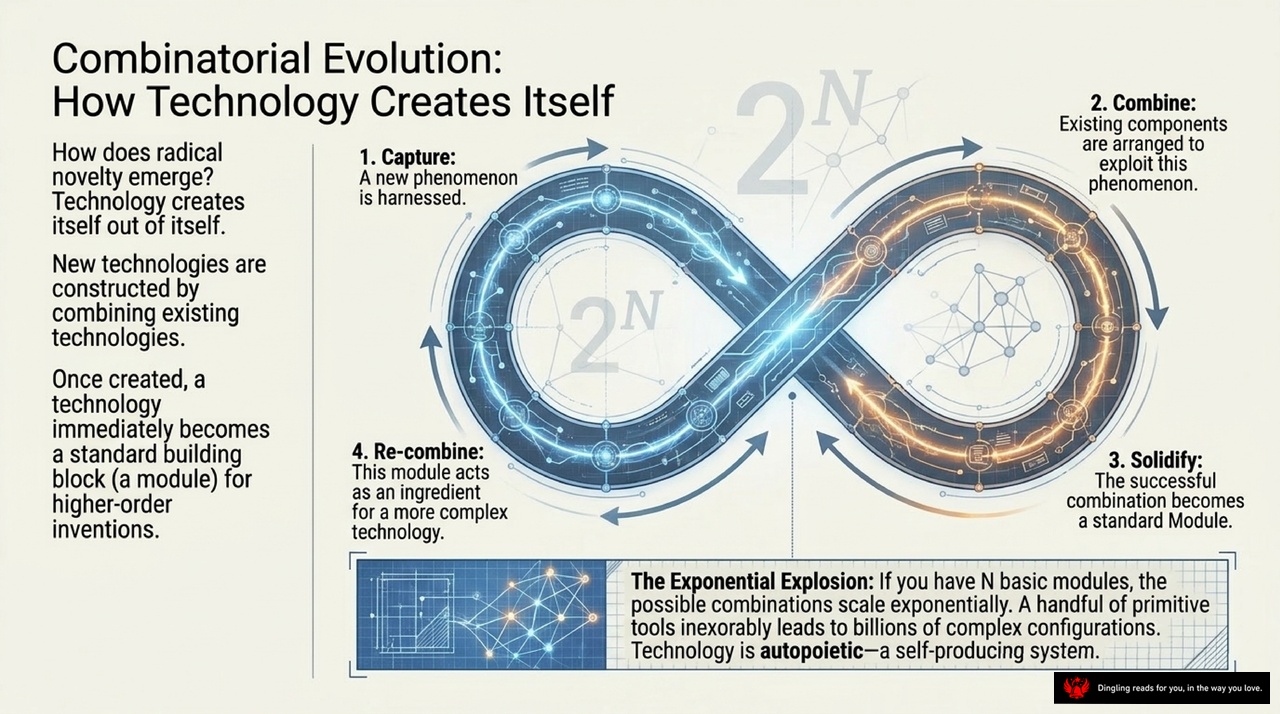
Imagine technology not as a cold machine, but as a living, self-organizing system that creates itself out of itself. This slide illustrates the concept of "Combinatorial Evolution," a powerful framework explaining how radical novelty emerges. It all starts with a simple, yet profound truth: new technologies aren't magic; they are constructed by combining existing ones.
Look at that infinite loop in the center. It represents a continuous cycle of four stages. First, we **Capture** a new phenomenon. Then, we **Combine** existing components to exploit that phenomenon. Next, we **Solidify** that successful combination into a standard module. Finally, we **Re-combine** that module as an ingredient for even more complex technologies.
Notice the $2^N$ formula floating above. This is the "Exponential Explosion." If you have just a handful of primitive tools or basic modules, the possible combinations scale exponentially. A few simple elements inevitably lead to billions of complex configurations. This is why technology feels like it's accelerating so fast; it's not just adding parts; it's multiplying possibilities.
The text on the left reinforces this: once a technology is created, it immediately becomes a building block for the next generation of inventions. We take the "standard modules"—like the turbine from an old power plant—and use them to build a jet engine. This process is what makes technology "autopoietic," or self-producing. We are essentially programming nature, rearranging its phenomena to solve new problems, and in doing so, we create the very tools that allow us to create the future. It's a recursive engine of innovation, where every solution becomes the foundation for the next breakthrough.

When we peel back the layers of our modern world, we see that technology is increasingly behaving like life itself. It's no longer just a collection of cold, mechanical parts; it's evolving into a complex, self-organizing system that breathes, adapts, and even "reproduces."
Think about it: just as biological life relies on the recombination of genes to create new organisms, today's technology thrives on the recombination of modules. In this new "proliferative economy," the goal isn't just to optimize an existing product for maximum efficiency. Instead, the focus shifts to creating entirely new combinations. Startups become the primary engines of this evolution, constantly mixing and matching technologies to discover fresh opportunities, while venture capital acts as the catalyst, funding these rapid cycles of trial and error.
This shift changes how we manage and think about success. We've moved away from the old industrial model of rigid, standardized processes. Now, the real competitive advantage lies in your ability to quickly sense market shifts and reconfigure your resources into new strategic combinations. It's less about controlling a predictable machine and more about navigating a living ecosystem.
This convergence of technology and biology reflects a deeper truth about our world. We've outgrown the dream of a perfectly ordered, mechanical universe. Instead, we now embrace the messy, vibrant reality of an evolving system. The future isn't about imposing order on nature; it's about understanding how to work *with* the organic forces of innovation. The challenge ahead is to ensure our technology remains an extension of humanity—a bridge to a richer life—rather than a force that separates us from the natural world we call home.

We often think of technology as just a collection of cold, mechanical parts—gears, circuits, and wires—plugged together like a clock. But if you look closer, the reality is far more alive. Today's technology is evolving into something that shares the very traits of biological life.
Think about it from the top down. At the component level, technology is indeed mechanical, following precise physical rules like a watch. But look at it from the bottom up, as a whole system, and it starts to feel organic. Complex systems like smart grids or self-driving cars don't just run; they sense their environment, adjust their state, and even repair themselves. This is the same adaptive behavior we see in living organisms.
In the digital age, this becomes even clearer. Modules from different domains can now be remotely combined and re-encoded, much like genes reshuffling to create new proteins. Meanwhile, our understanding of biology is flipping the script. We realize that a cell itself is a sophisticated technical system, executing complex tasks with incredible precision. As a result, biology is borrowing engineering language to explain life, while technology is borrowing biological mechanisms to build better systems.
This convergence is driving a shift in how we do business. We are moving from an economy focused on optimizing fixed processes to a "proliferative economy." In this new model, the goal isn't just efficiency; it's about creating new combinations. Startups become the primary engine of innovation, supported by risk capital that fuels rapid experimentation. Management styles are changing too, shifting from rigid control to a more intuitive, agile approach where leaders must find the right fit between technology and market uncertainty.
Ultimately, we are moving away from the old dream of a perfectly ordered, mechanical world. We are embracing an organic view where hybridization, compromise, and complexity are not bugs, but features. The key takeaway is to distinguish between technology that enslaves us and technology that expands us. We don't need to reject technology, but we must ensure it remains an extension of nature and humanity, a bridge that connects us rather than a wall that isolates us.

The Anatomy of Radical Invention isn't just about putting parts together like a stagecoach; it's about fundamentally changing the rules of the game. As the slide illustrates, true innovation starts with a gap in the market—a specific need that demands a new approach. From there, inventors identify a core principle, like using radio wave echoes to detect planes, and then face the messy reality of translation. That's where the real work happens: trying to build that principle inevitably creates physical obstacles, requiring recursive problem-solving to find the right sub-technologies, such as creating an oscillator that can withstand extreme heat. Finally, every solution must be anchored in reliable physical laws. This deliberate, recursive process is what separates a radical invention from a simple rearrangement of existing parts.

Structural Deepening and Internal Replacement: How Technology Gets Complicated
Once a technology is invented, it rarely stays static. As engineers push it to perform better in harsher conditions, it evolves internally through two primary mechanisms. Look at the curve on your screen: it starts simple, then splits into two distinct paths of innovation.
The first path is Internal Replacement. Think of this as swapping out sub-components for superior ones without altering the core architecture. A classic example is upgrading a jet engine's fan blades from standard aluminum to advanced titanium alloys. The fundamental design remains the same, but the internal parts get stronger and more efficient.
The second path, and often the bigger driver of complexity, is Structural Deepening. This happens when we add entirely new sub-systems to bypass physical limits, adapt to new environments, or increase safety. Instead of just replacing a part, we layer on new systems. For instance, early aircraft piston engines couldn't "breathe" in thin, high-altitude air. To solve this, engineers didn't just make the engine bigger; they added superchargers and complex cooling loops. The technology becomes heavily layered.
These two mechanisms explain the Complexity Trap shown at the bottom: technologies inevitably mature from simple, elegant concepts into immensely complex, encrusted mechanisms. We start with a clean idea, but as we fight physics and demand more performance, we are forced to add layers upon layers of subsystems. That's why a modern jet engine has over 22,000 parts compared to a few hundred in its early days. We trade simplicity for capability, and in doing so, we build a self-reinforcing cycle of increasing complexity.
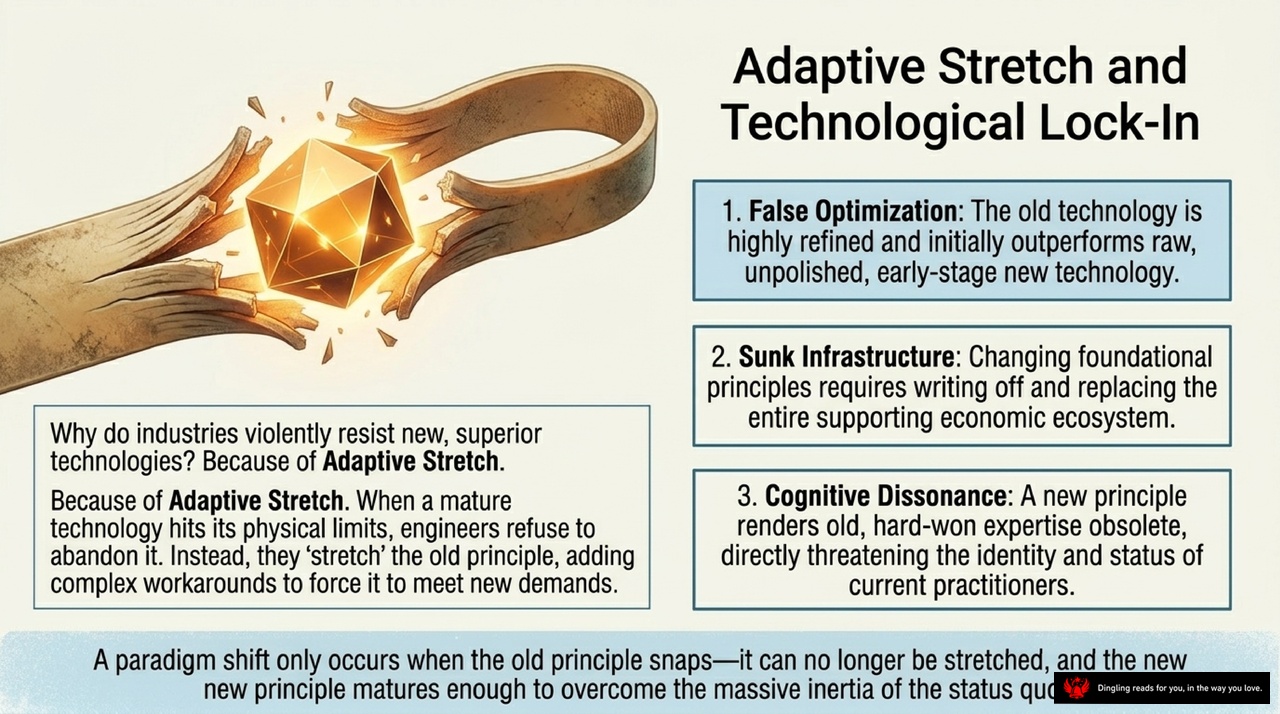
Why do entire industries suddenly stop in their tracks, refusing to adopt a superior technology that clearly outperforms the old one? It's not because the new thing is bad. It's because of a phenomenon we call "Adaptive Stretch."
As you can see on this slide, the core idea is that when a mature technology hits its physical limits, engineers refuse to abandon it. Instead, they try to "stretch" the old principle, adding complex workarounds and layers of complexity just to force it to meet new demands. It's like trying to make a horse run faster by adding more reins, rather than building a car.
This leads to what we call "Technological Lock-In." There are three main reasons this happens. First, **False Optimization**. The old technology is highly refined and polished. Even though a raw, early-stage new technology might be theoretically better, the old one feels superior because it's already optimized for its specific context. Second, **Sunk Infrastructure**. Changing the foundational principle of a technology means you have to write off the entire supporting economic ecosystem—the factories, the supply chains, the training. It's too expensive to restart. And third, **Cognitive Dissonance**. This is the human factor. A new principle renders old, hard-won expertise obsolete. It directly threatens the identity and status of current practitioners. If you switch, your years of experience become worthless.
So, a paradigm shift only occurs when the old principle finally snaps—it can no longer be stretched. At that breaking point, the new principle matures enough to overcome the massive inertia of the status quo. Until then, we are trapped in a cycle of stretching the old, rather than embracing the new.

The economy isn't just a container where technology lives; it is actually an expression of technology itself. Standard economics often treats tech as a tool dropped into the system to boost efficiency, but Arthur flips this script: the economy emerges directly from its technologies. Think of it as a living ecology that constantly rebuilds itself from the inside out.
Look at this cycle. It starts with Phase 1: Technologies Form the Structure. Markets, financial systems, and distribution networks aren't just social rules; they are themselves purposed technological systems. Then, in Phase 2, we hit The Encounter. Industries don't just passively 'adopt' new tech; they encounter it and fundamentally mutate. Just like Bessemer steel rewrote the rail and construction industries, new tech forces the entire economic structure to change.
This leads to Phase 3: New Niches. These mutations spawn entirely new problems, new industries, and fresh opportunity niches. Because of these new niches, we enter Phase 4: Demand for Novelty. These open niches demand new technologies, which starts the cycle all over again. So, the economy is not a static box holding tools. It's a dynamic, evolving ecosystem where technology drives the creation of new economic realities, which in turn create the demand for the next wave of innovation.

The Convergence: Technology is Becoming Biology. Look at this visual transformation. On the left, we see the rigid, clockwork gears of the industrial age—predictable, mechanical, and built for mass production. On the right, we see a vibrant, self-organizing network of cells—adaptive, cognitive, and deeply interconnected. This slide captures the defining shift of our time: the dual convergence where biology is becoming technology, and technology is becoming biology.
For centuries, we viewed the world through a Cartesian lens, treating everything as a machine. But that era is ending. We are moving from a "Machine-like Economy" to a "Generative Economy." In this new paradigm, we treat DNA and cellular networks as programmable components, engineering outcomes like software code. This is biology as tech. Conversely, our artificial networks—the internet, sensor webs, and AI—are increasingly behaving like living organisms. They are self-organizing, self-healing, and cognitively interconnected, much like coral reefs. This is tech as biology.
Conceptually, biology is becoming technology; practically, technology is becoming biological. We are no longer just building machines; we are cultivating systems that evolve, adapt, and thrive on their own. This shift from rigid mechanics to generative vitality is the fundamental story of our future.
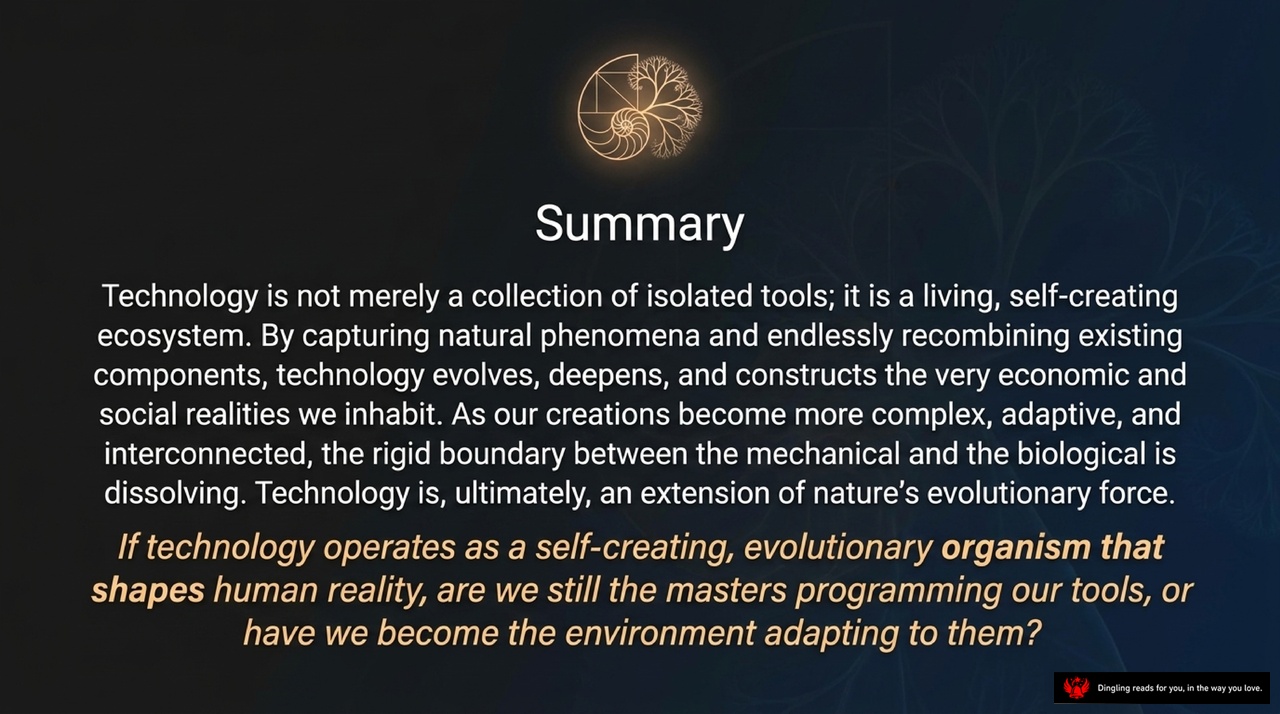
Technology is no longer just a collection of isolated tools sitting on a shelf; it is a living, self-creating ecosystem that evolves right before our eyes. Think about it: by capturing natural phenomena and endlessly recombining existing components, technology doesn't just serve us—it actively constructs the economic and social realities we inhabit every day. As our creations become more complex, adaptive, and interconnected, that rigid boundary between the mechanical and the biological is simply dissolving. We are witnessing technology becoming an extension of nature's own evolutionary force.
But here is the critical question that keeps us up at night: If technology operates as a self-creating, evolutionary organism that shapes human reality, are we still the masters programming our tools, or have we become the environment adapting to them? The answer defines not just our future, but our very existence.