
The Nurture Assumption: Complete Chapter-by-Chapter Summary

Welcome to today's session on *The Nurture Assumption* by Judith Rich Harris. Look at the image on your screen: on the left, you see the blueprints of a house, representing the traditional belief that parents are the architects who build their children's personalities. On the right, there is a vibrant, wild forest with a playground hidden within the trees, symbolizing the peer group—the true environment where children actually grow.
The central question we are tackling today is whether parents really shape their children's personalities, or if the true architect is the peer group we grow up with. For centuries, the "Nurture Assumption" has been our common sense. We believed that good parenting could fix any flaw, while bad parenting could ruin a child's potential. We treated children like raw jade, waiting for parents to carve them into their final form.
However, as Harris explores in her book, this view is fundamentally flawed. The evidence suggests that the wild, social forest of peer interaction plays a much larger role in shaping who we become than the structured house of the family. We will dive into the scientific data that challenges this deep-seated belief and explore how the groups we join actually define our adult selves.

The crushing weight of modern parenting isn't just about stress; it's about a fundamental misunderstanding of how children actually develop. Look at this blueprint on the left. It depicts a massive, 5,000-unit cultural block—maximum density, perfect dimensions—pressing down on a parent until the ground cracks beneath them. This visual represents the impossible standard society has created: the belief that parents are the sole architects of their child's destiny.
This is the core of the "Cultural Myth" highlighted on the right. Society operates on a rigid, inescapable dogma: if a child succeeds, we praise the parents; if a child fails, we blame them. It treats children like engineering projects, molded step-by-step in a vacuum. But the reality is far more complex. The text reveals that we carry a crushing guilt, believing we are 100% responsible for our child's psychological destiny. We fall for the illusion that good parenting can perfectly offset natural flaws, ignoring the powerful forces of genetics and peer influence that actually shape who we become.
The truth is, children aren't blank slates waiting to be carved by their parents. They are social creatures who learn primarily from their peers, not their home. The "burden of the blueprint" is a lie. Parents don't sculpt the child's personality; they simply provide the initial conditions. The real work of socialization happens outside the home, in the chaotic, unpredictable world of the playground and the classroom, where children learn the true rules of society. It's time to drop this crushing weight and realize that raising a child is less about controlling the outcome and more about supporting their journey into the world.

So, we've established that for millions of years, our survival depended on one thing: belonging to a group. From our chimpanzee ancestors to modern humans, the script was always the same: be friendly and cooperative with your own "in-group," but be aggressive and suspicious of anyone from a different group. This evolutionary strategy is hardwired into our DNA.
But here's where it gets tricky. Our brains are wired to categorize. We automatically sort people into "us" and "them" based on things like where we live, what we wear, or even just who we hang out with. Once that line is drawn, something powerful happens: we start to exaggerate the differences between our group and everyone else. We amplify the traits of our own group while minimizing the differences within it.
Think about the classic "Rashomon" or Robbers Cave experiments. When kids were randomly split into two teams, they didn't just like their own team; they actively disliked the other one. They invented new rules, developed unique slang, and even created enemies out of thin air just to prove their group was superior. This is the "between-group contrast effect" in action. It's not that the groups were actually that different; it's that our brains *need* to see them as different to feel secure in our own identity.
This same mechanism drives how children learn. They aren't just copying their parents; they are joining a tribe. Whether it's a gender group at school, a sports team, or a peer clique, the moment a child identifies as part of a group, they feel pressure to conform. If you don't act like the "boys" or the "cool kids," you risk being ostracized. That's why a girl might refuse to wear shoes her dad loves just because her friends call them "for boys," or why a boy might stop being shy to fit in with his peers.
The group's influence is often stronger than the parents'. In fact, parents' own behaviors are often just a reflection of the groups *they* belong to. But for the child, the peer group is the new authority. They learn the rules of the playground, the norms of the classroom, and the values of their subculture by watching and mimicking the people right next to them. This is how culture gets passed down—not just from parents to children, but from group to group.
So, when we look at a child's personality or behavior, we have to ask: Which group are they in right now? Are they acting like a "good student" in the classroom, or a "tough guy" on the basketball court? The answer lies in their group membership. It's not about what the parents taught them; it's about what the group demands of them. And that's a lesson that sticks for a lifetime.

The Blueprint Fails: Three Real-World Paradoxs
Let's talk about where the old parenting rules actually break down. We've all heard the story: if you raise a child right, they turn out right. But what happens when that logic just doesn't add up?
First, look at the immigrant child. Why do kids from immigrant families instantly master the perfect local accent at school, completely ignoring their parents' heavy accents and grammar mistakes? If the home environment was the blueprint, they should sound like their parents. Instead, they adapt to the peer group, proving that the playground, not the living room, is the classroom.
Next, consider the twin mystery. Identical twins raised in completely different homes end up with personalities just as similar as those raised together. If parenting were the master architect, these twins should be strangers. But genetics and shared human nature play a much bigger role than we admit.
Finally, there's the Cinderella Effect. Why do some kids be submissive at home but dominant on the playground? The same child acts like two different people depending on the audience. This isn't hypocrisy; it's adaptation. Kids learn different rules for different groups. They don't bring their home behavior to school, and they don't bring their school persona home.
These three paradoxes show us one thing: the "Nurture Assumption" is cracked. It ignores the powerful, invisible force of peer groups that actually shapes who we become.

The "Missing 50%" isn't just a statistic; it's the crack in the foundation of how we've been raising kids for generations. Look at this chart. We've long believed that 50% of who we are comes from our genes, and the other half is up to our parents—our "shared home environment." But behavioral genetics has shattered this equation.
Here's the reality: that "shared home" factor—the parenting style, the family income, the dinner table conversations—accounts for almost nothing. Between zero and ten percent. If it's not genes, and it's not the family you grew up in, then what is shaping the remaining half of human personality?
The answer lies in the "non-shared environment"—the 40 to 50% that traditional theories completely missed. This isn't about your parents' personality or your childhood home. It's about the unique experiences you have outside the house: the friends you make, the schools you attend, the peer groups you join. These are the forces that actually carve out your character. Your parents might give you the genetic blueprint, but your peer group is the one that builds the house.

The "Two-Way Street" Illusion is a powerful way to rethink how we see parenting. We often assume that good parents automatically create good kids, but this slide reveals that traditional psychology has been confusing correlation with causation. It's not just a one-way street where parents dictate the outcome; it's a complex loop.
Look at the top blue arrow: the Genetic Hand-Me-Down. Parents pass down genes that predispose a child to a calm or spirited temperament. But there's also the Elicitation Effect, shown in the orange arrow. A naturally agreeable infant doesn't just passively receive love; their behavior actually elicits warm, relaxed parenting from their parents. The child's innate personality shapes the parenting style just as much as the parenting style shapes the child.
This creates a critical distinction between the myth and the reality. The parenting myth treats parenting as a monologue, where the parent is the sole speaker and the child is a silent recipient. But the reality is that parenting is a negotiation. Your child's innate traits influence how you react to them, creating a feedback loop. So, when you see a "good kid," ask yourself: is it because you raised them perfectly, or did their easygoing nature simply make you a better parent? Understanding this two-way dynamic is the first step to letting go of the burden of total control and embracing the reality of human connection.
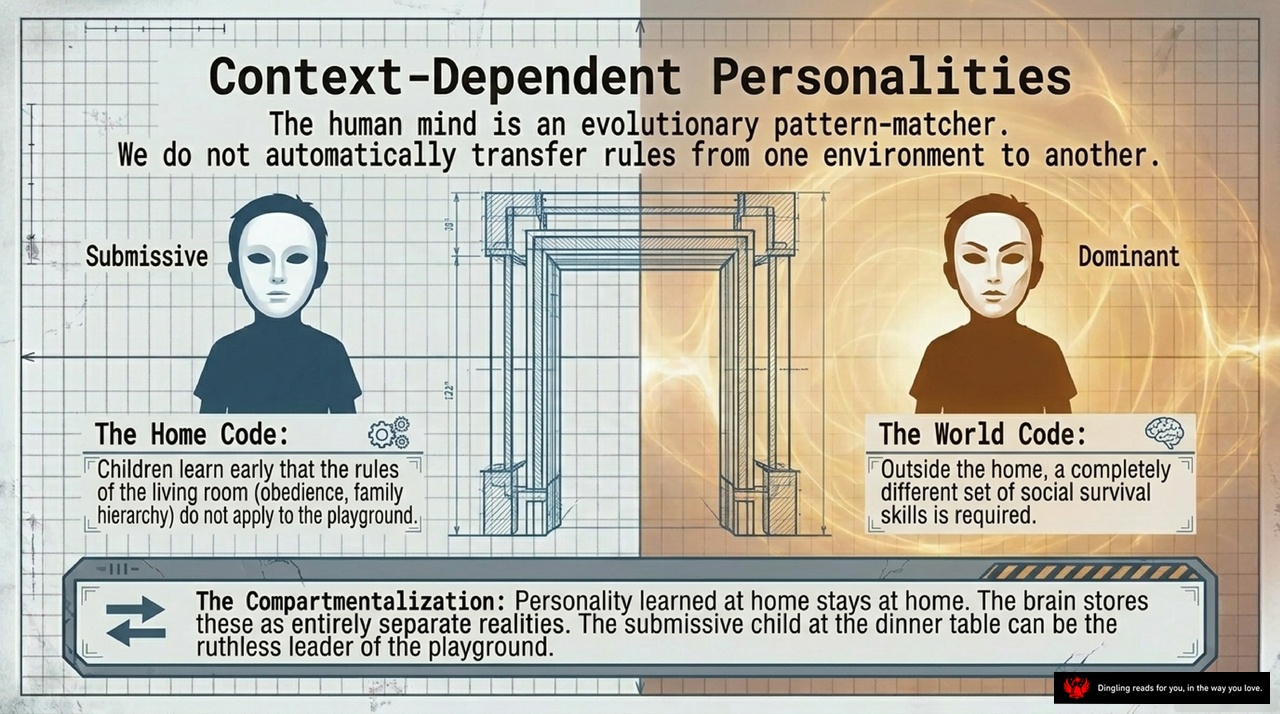
Context-Dependent Personalities. The human mind isn't a rigid robot that carries the same rulebook everywhere. It's actually an evolutionary pattern-matcher designed for one thing: spotting the rules of the specific room we're standing in. We don't automatically transfer what works at home to the playground.
Look at this split screen. On the left, we have "The Home Code." Here, the child learns the rules of the living room—obedience, family hierarchy, listening to authority. That's why they might appear submissive at the dinner table. But on the right, we see "The World Code." Outside the home, a completely different set of social survival skills is required. In the playground, the hierarchy flips. The submissive child at home might become the ruthless leader of the group.
This is what we call compartmentalization. The brain stores these as entirely separate realities. A shy kid in the classroom can be a bold negotiator with friends. This isn't hypocrisy; it's adaptation. If we forced a child to use the same behavior everywhere, they'd fail. Instead, our brains are brilliant at switching modes instantly. The submissive persona stays at home, while the dominant one takes over the world. This flexibility is exactly why we survive in such a complex society.

The blueprint is a myth. Human development is actually an ecosystem, and the true architect behind our personalities is something far more powerful than our parents: it's the group.
This slide breaks down Group Socialization Theory, showing us that childhood isn't about becoming a successful adult; it's about becoming a successful child. Kids don't just mimic their parents; they actively negotiate their identity horizontally with their peers. Once a child steps outside the home, the peer group takes over. It is this complex, horizontal world of peer networks where children actually forge the personalities they will carry into adulthood.
Think about it: socialization isn't handed down vertically from parent to child. Instead, it's negotiated horizontally, from child to child. We learn to fit in, to laugh at the same jokes, and to follow the unwritten rules of our specific crowd. Whether it's the gender norms we adopt in school, the slang we use with friends, or the behaviors we suppress to avoid being the "odd one out," these group dynamics shape us more profoundly than any lesson our parents ever taught.
So, remember this revelation: your parents gave you life, but your peers gave you your character. The true architect of who you are isn't the family you grew up in, but the groups you chose to belong to.

The peer ecosystem isn't just a place where kids hang out; it's a powerful factory that actively shapes who we become. As the slide illustrates, this happens through two opposing but simultaneous forces: Assimilation and Differentiation.
On the left, we see Assimilation—the pull of the group. Think of it as the invisible pressure to blend in. Whether it's mimicking an accent, adopting a specific fashion style, or aligning with cultural values, group norms force children to become more similar to their peers. This is how we learn to survive within the tribe. If you don't fit the mold, you risk being excluded.
But here's the twist: the group doesn't just make us the same. On the right, we see Differentiation—the push of the individual. Within that same group, people compete for status by carving out unique niches. You might become the leader, the clown, the rebel, or the peacemaker. This competition widens personality differences and actually defines our adult character.
So, peer groups don't just copy us; they sculpt us. They pull us toward conformity to ensure we belong, while simultaneously pushing us to stand out so we can gain status. It's a constant dance between fitting in and standing out, and it's the key to understanding how our personalities are truly forged.
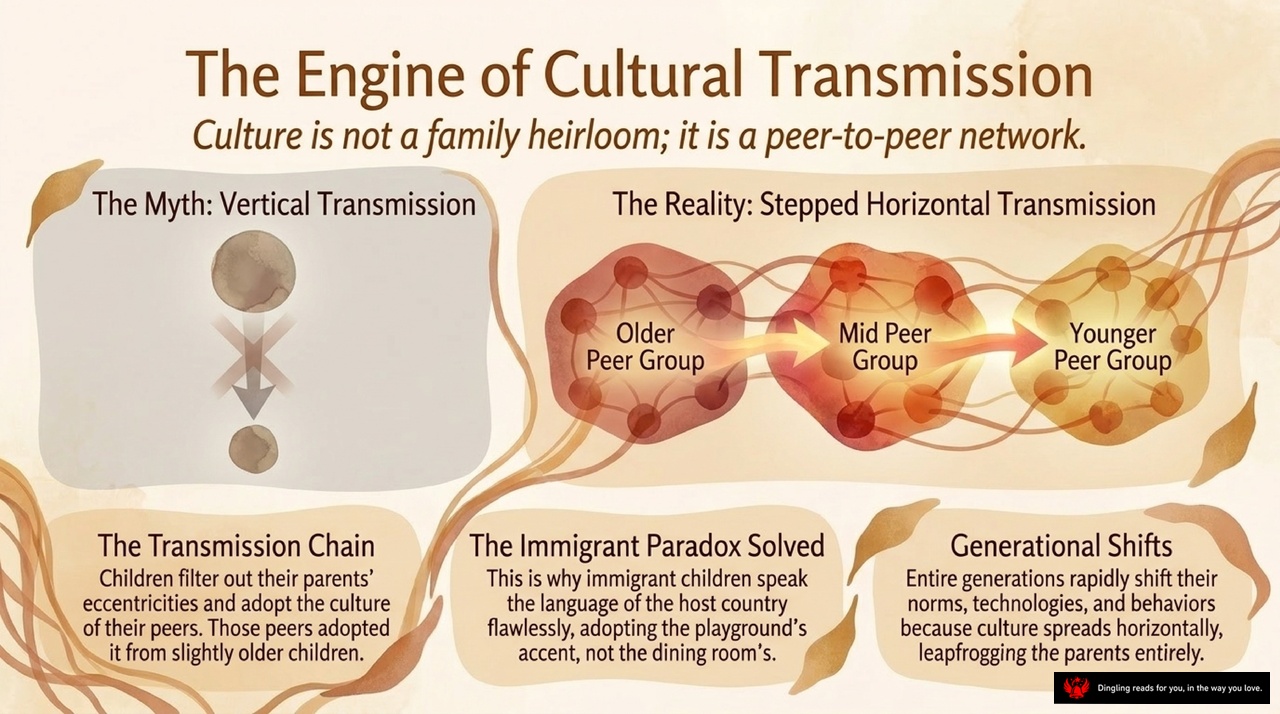
The slide clearly challenges a deep-seated myth: that culture is a family heirloom passed down vertically from parents to children. But the reality, as this diagram illustrates, is a "stepped horizontal transmission." Culture isn't a straight line; it's a peer-to-peer network.
Look at that flow: it moves from an older peer group to a mid peer group, and finally to a younger one. This is the engine of cultural change. Children aren't passive recipients of their parents' values; they are active participants in a horizontal chain. They filter out their parents' eccentricities and instead adopt the culture of their peers, who themselves learned it from slightly older kids.
This mechanism solves the "immigrant paradox." You might wonder why immigrant children often speak the host country's language flawlessly, adopting the playground's accent rather than their parents' dining room one. It's because they are locked into the peer network, not the family bubble.
This also explains rapid generational shifts. Entire generations can leapfrog their parents entirely, quickly adopting new norms and technologies because culture spreads horizontally, bypassing the parents altogether. So, remember: while parents provide the foundation, your true social blueprint is drawn by the people your own age.

The Contrast Effect: Why Teenagers Rebel. This slide cuts through the noise to tell us the truth: teenage rebellion isn't about hormones or trying to be the opposite of their parents. It's actually about group polarization.
Look at this visual breakdown. On the left, we see the "In-Group" of teens defining their boundaries. They act out specifically to separate themselves from the "Out-Group"—that's the adults, teachers, and rivals. This is the first step: drawing a hard line.
Then, in the middle, we see the "Group Contrast" in action. When these two groups interact, they don't just see differences; they exaggerate them. If adults value being neat and quiet, the teen group will aggressively enforce messiness and loud volume. It's a psychological game where the contrast makes the differences look huge.
Finally, on the right, we reach "Social Survival." Those bizarre behaviors we label as rebellion? They are highly calculated moves. Teens are securing their status and survival within their specific ecosystem. By creating a stark contrast with adults, they ensure they belong to their own tribe. So, remember this: rebellion is just a strategy for fitting in with the crowd, not a rejection of the family.

Think about the two worlds we navigate every day: the home and the outside world. They operate on completely different operating systems.
Look at this comparison matrix. On the left, we have **The Home**, which is a vertical structure. The currency here is intimacy and unconditional love. The rules are clear and strict, built on a hierarchy where adults are always above children. Your role is fixed; you are either the baby or the oldest, and that's just how it is.
Now, look at the right side: **The World**. It's horizontal and wildly different. The currency shifts from love to status, reputation, and social survival. The structure isn't hierarchical; it's egalitarian but fiercely competitive. Here, your roles aren't assigned at birth; they are fluid and earned. You aren't just "the baby"; you become the tough one, the smart one, or the leader based on how you perform.
This is where the disconnect happens. The synthesis at the bottom of the slide is crucial: Success, compliance, or role-playing in the 'Home' environment has almost zero bearing on social success in the 'World' environment.
If you spend all your energy trying to be the perfect child to satisfy your parents, you are playing a game that doesn't matter in the real world. To truly succeed, you have to learn the rules of the horizontal world: how to compete, how to build your reputation, and how to navigate a landscape where no one owes you anything. The skills that make you a good family member often make you a liability in the professional world. The real education for life happens not in the vertical hierarchy of the home, but in the horizontal arena of the world.
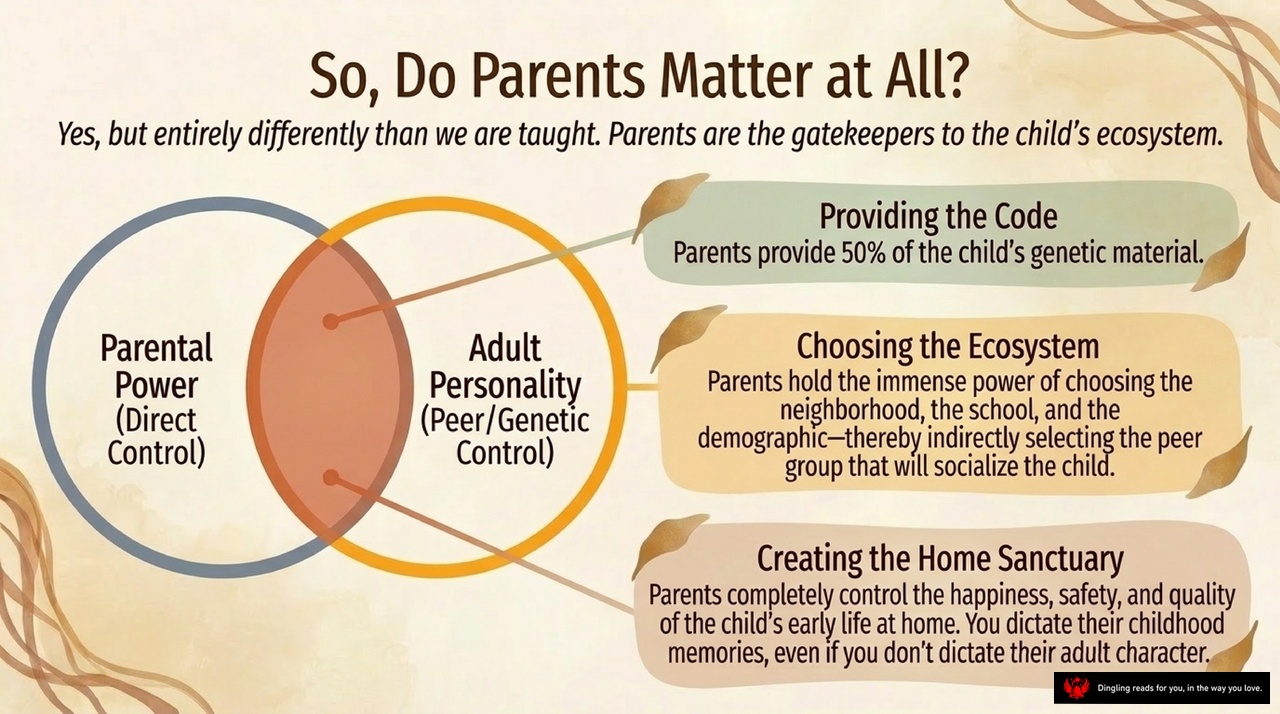
So, do parents actually matter at all? The short answer is yes, but not in the way we've been taught to believe. Think of parents not as the architects of a child's personality, but as the gatekeepers to their entire ecosystem.
The slide breaks this down into three key areas where parents hold real power. First, they provide the code. Parents contribute 50% of the child's genetic material, setting the biological foundation for who the child becomes. Second, they choose the ecosystem. This is a massive, often overlooked power. By selecting the neighborhood, the school, and the specific demographic, parents indirectly choose the peer group that will socialize the child. These peers are the ones who will ultimately shape the child's behavior and values.
Finally, parents create the home sanctuary. They completely control the happiness, safety, and quality of a child's early life at home. You dictate their childhood memories and the emotional tone of their first few years. While this doesn't necessarily dictate their adult character, it sets the stage for their emotional world. So, while parents aren't the sole authors of a child's story, they are the ones who write the setting, cast the genetic characters, and choose the community where the story unfolds.
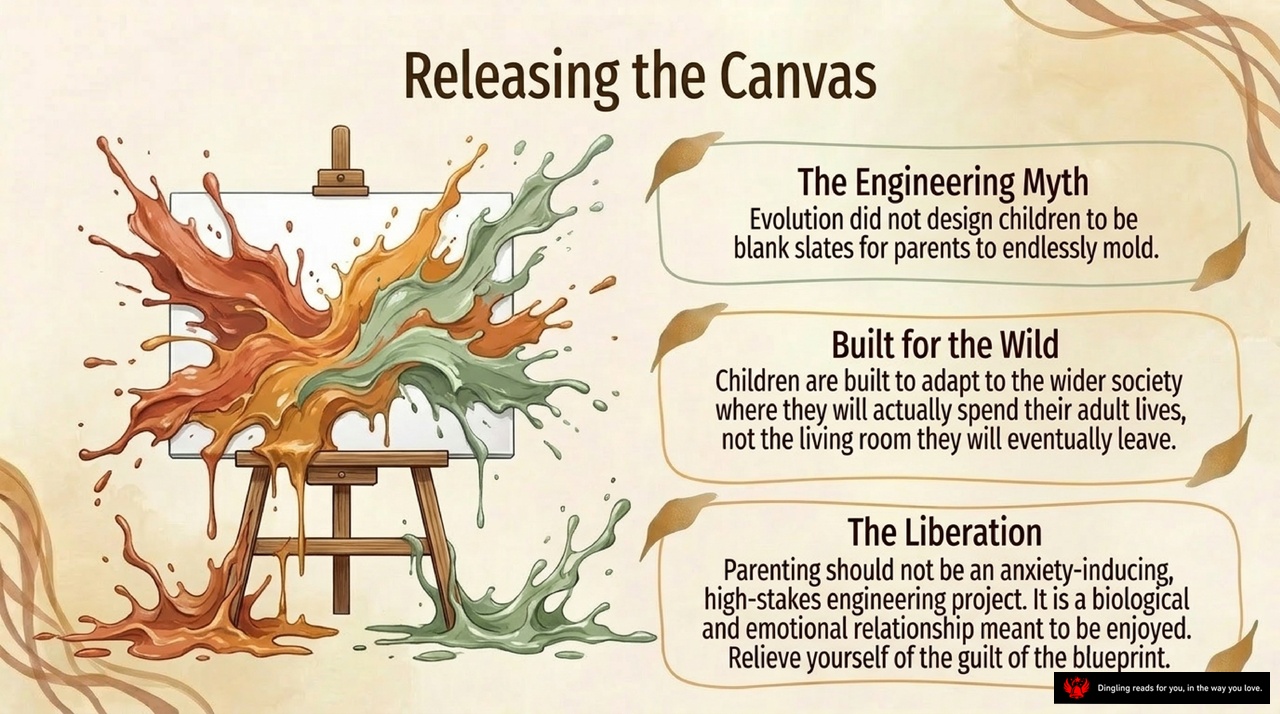
Releasing the Canvas: Stop Engineering Your Child
Look at this painting splashing off the easel. It represents a powerful shift in how we view parenting: Releasing the Canvas. For too long, we've been trapped by "The Engineering Myth," believing we are the master sculptors and our children are blank slates waiting to be molded. But science tells us evolution never designed kids to be passive projects for us to endlessly shape.
Instead, children are "Built for the Wild." They are hardwired to adapt to the wider society where they will actually spend their adult lives, not just the living room they eventually leave. While we often think our home is the primary school, research shows that peer groups and the broader social world have a far greater impact on personality than our direct parenting styles.
This realization brings "The Liberation." Parenting should not be an anxiety-inducing, high-stakes engineering project where every mistake feels catastrophic. It is a biological and emotional relationship meant to be enjoyed. By letting go of the guilt of the blueprint, we stop trying to force a specific outcome and instead support the child as they naturally develop their own unique path within their community.
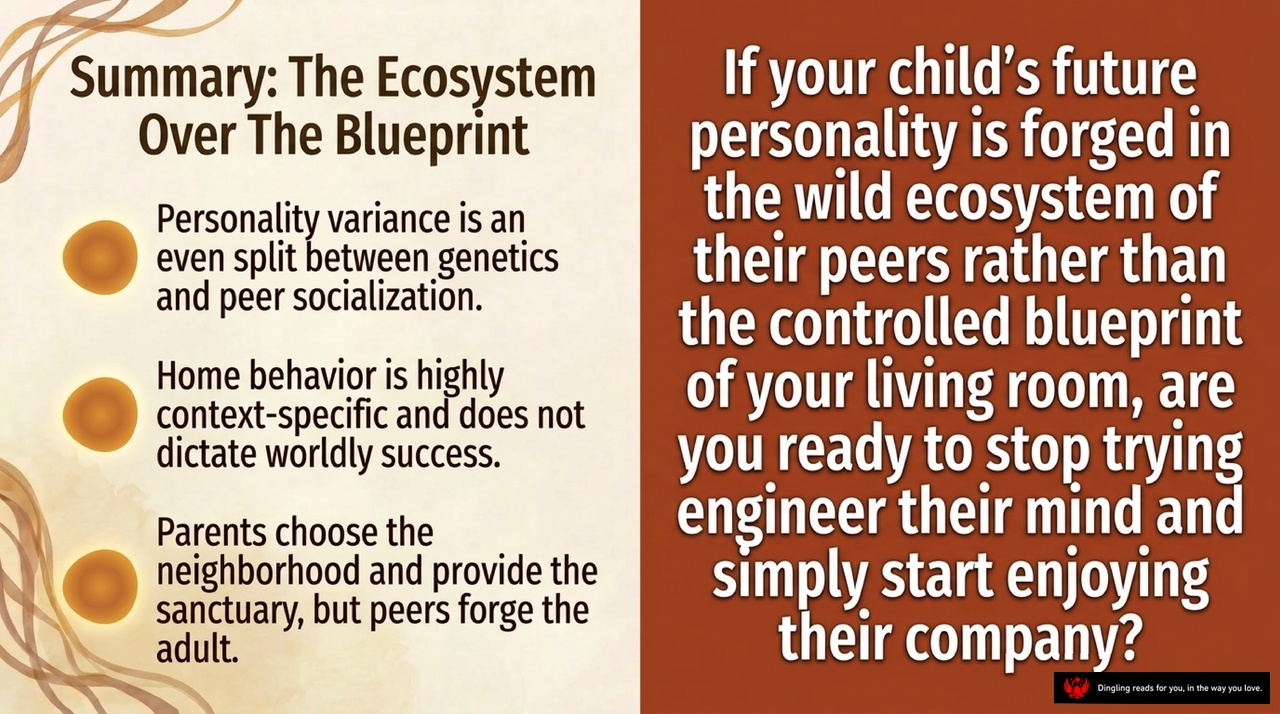
So, here is the final takeaway: the ecosystem wins over the blueprint. Personality isn't a fixed design you can engineer in the controlled safety of your living room; it's forged in the wild, unpredictable ecosystem of your child's peer group. Science shows that genetics and peer socialization are an even split, meaning the friends they choose are just as powerful as their DNA in shaping who they become.
Think about this: home behavior is highly context-specific. A child might be timid with you but bold with their friends. That "home behavior" doesn't dictate worldly success. You can choose the neighborhood and provide a sanctuary, but you cannot script their personality. As the research shows, parents choose the environment, but peers forge the adult.
So, are you ready to stop trying to engineer their mind? The answer lies in letting go of the blueprint and simply starting to enjoy their company.