
The Old Regime and the Revolution: Complete Chapter-by-Chapter Summary

Welcome to a deep dive into Alexis de Tocqueville's masterpiece, *The Old Regime and the Revolution*. This book isn't just a history lesson; it's a structural autopsy of how a seemingly prosperous empire could collapse from the inside out.
Imagine the French monarchy not as a fortress, but as a massive, intricate blueprint—like the one you see on this cover. Tocqueville argues that the collapse wasn't caused by a single event, but by three invisible cracks in the foundation: unprecedented prosperity, abstract political theory, and administrative centralization.
First, look at the economy. The rulers were obsessed with driving economic growth, yet they completely ignored the minds of their people. On one side, officials were flatteries, promising a utopia that didn't exist. On the other, thinkers and writers were radicalizing the public, teaching them that they had rights and that the current system was fundamentally wrong. It was a perfect storm: the government was feeding the body with empty promises while the intellectuals were poisoning the mind with revolutionary ideas.
Then, consider the irony of the rulers themselves. They were brutally exposing their own cruelty. Officials would openly complain about the suffering of the poor, even admitting that the tax system was broken, yet they did nothing to fix it. It was like screaming, "I'm hurting you!" while simultaneously pulling the knife deeper. This hypocrisy destroyed any remaining trust the people had in the monarchy.
Finally, look at the structure. The state had become a giant, suffocating machine. Power was centralized in Paris, stripping local towns and villages of their autonomy. The nobility had lost their political role, and the middle class had no real power. Everyone was isolated, cut off from one another, with no channel to express their grievances.
Tocqueville's genius lies in showing us that the French Revolution wasn't a sudden explosion, but an inevitable structural failure. When the pressure from economic inequality, ideological awakening, and political isolation became too much, the entire system simply snapped. This book teaches us that sometimes, the very things that make a society seem strong—its wealth, its central control, and its intellectual fervor—can actually be the seeds of its destruction.

The biggest myth about the French Revolution is that it was born out of absolute misery. Look at this slide: on the left, we have the "Expectation"—a crumbling house representing total poverty. But on the right, the "Reality" shows something completely different: a building reaching for unprecedented prosperity, with arrows pointing skyward.
Here is the shocking truth from the text: the collapse actually happened during the most prosperous period of the monarchy under Louis XVI. The economy was booming, trade was doubling, and people were richer than ever. So why did it fall? The core paradox is this: improving social conditions doesn't necessarily pacify a population. Instead, it heightens the contrast of inequality. When everyone gets slightly better off, but the gap between the rich and the poor widens, the remaining abuses become completely intolerable.
The revolution wasn't a reaction to starvation; it was a reaction to a society that was too successful at revealing its own hypocrisy. The rulers were publicly exposing the system's flaws while doing nothing to fix them, turning a thriving economy into a powder keg. As the text says, this prosperity made the remaining injustices unbearable, setting the stage for the explosion that followed.

Two distinct passions fused to ignite the total destruction of the old order. Look at this diagram: it shows the "Engine of Revolution," driven by two gears. On the left, you have the "Hatred of Inequality"—deeply rooted and ancient. On the right, the "Desire for Freedom"—newer and reactive. The text below explains that the revolution wasn't driven by a single unified goal, but by the collision of these two distinct emotional engines.
The first gear was an unrelenting hatred of systemic inequality, built over centuries of oppression. The second was a newer, burning desire to live freely. When these two forces fused, they created an explosive force demanding the eradication of the past. This wasn't just a political shift; it was a psychological explosion where the anger against unfairness met the urgent need for liberty, making the collapse of the old regime inevitable.

Administrative centralization hypertrophied the head and withered the body. By 1789, Paris wasn't just a capital; it had become the entire nation of France. The map on the screen perfectly illustrates this dangerous imbalance. You see a massive orange hub in the center, representing Paris, with countless lines radiating out to the provinces, draining all their life. The monarchy systematically stripped the provinces of their local political life, autonomy, and leadership, leaving them powerless.
As the slide notes, the entire nation was effectively ruled by just 30 Intendants acting as the central government's eyes and ears. This extreme concentration of power created a fatal weakness. As Tocqueville famously observed, if a head becomes too large, the body suffers apoplexy. When the central apparatus in Paris eventually collapsed, the entire national structure instantly disintegrated because there was no independent strength left in the provinces to hold it together. The body had simply withered away, leaving only a fragile, oversized head that could not survive on its own.

The Old Regime didn't just collapse; it shattered because it fundamentally broke the social contract. Look at this matrix: it reveals a society where the classes were not just separated, but actively hostile to one another.
At the top, the **Nobility** had it all wrong. They held **extreme economic privilege** and were completely **exempt from the tax burden**, yet they had been **stripped of all political authority**. They were a closed caste, living in a bubble of wealth while losing their traditional role as leaders.
Below them, the **Bourgeoisie** were the frustrated middle. They **hoarded the wealth** but had **zero authority** to use it effectively. Worse, they bore only a **moderate burden**, often buying their way out of taxes, which created a deep resentment toward the nobles above them.
And at the bottom, the **Peasantry** suffered the most. They had **zero privilege** and **zero authority**, yet they carried a **crushing tax burden**. They were isolated, with no voice and no protection.
The fatal flaw here was total isolation. The centralization of power destroyed any mutual reliance between these groups. Instead of governing together, they became strangers sharing the same soil, turning the entire nation into a powder keg waiting for a spark.
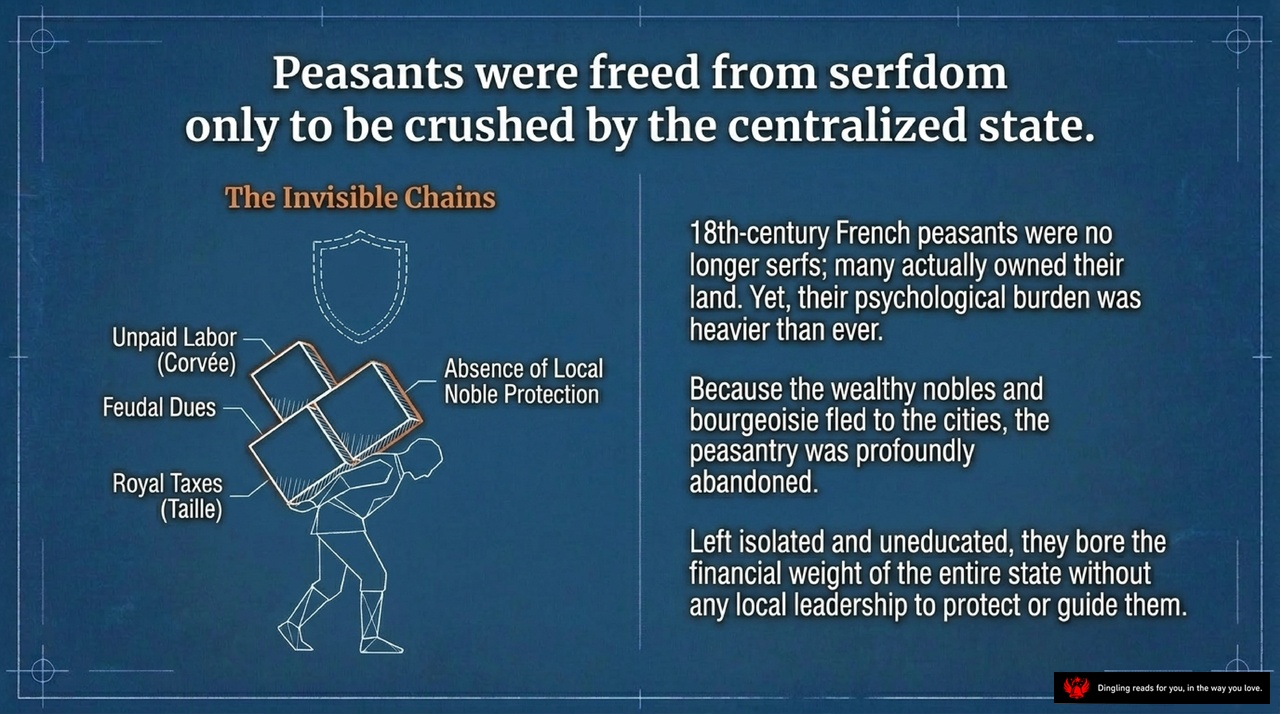
In the 18th century, French peasants faced a cruel paradox: they were finally freed from serfdom, only to be crushed by the weight of a centralized state. As the slide illustrates, these "invisible chains" became heavier than any feudal shackles they had previously known. Although many peasants actually owned their land, they were left isolated and unprotected. The wealthy nobles and the rising bourgeoisie fled to the cities, abandoning the countryside to its own devices.
Left without local leadership or education, the peasantry bore the entire financial burden of the state alone. They struggled under the crushing weight of unpaid labor, known as *Corvée*, heavy feudal dues, and the royal tax called the *Taille*. With no one to defend them, these farmers became the most exploited class in Europe. Their poverty deepened, and their resentment grew, turning them from passive subjects into the most powerful force of destruction against the old regime. When the revolution finally arrived, it was these isolated, hungry, and angry peasants who would tear the foundations of the monarchy apart.

When we look at this slide, we see a powerful mechanism that turned France into a pressure cooker. The headline states it clearly: "With no free institutions, political leadership defaulted to men of letters." Because the government refused to let citizens debate or organize, the only place for ideas to grow was in the minds of writers and philosophers.
The diagram illustrates this "Echo Chamber" perfectly. At the top, "Men of Letters"—writers and philosophers—were generating abstract theories and natural law. They weren't politicians; they had no power, but they had all the time to think. They created a vacuum because there were no practical political institutions to filter or test these ideas. Without a safety valve, these pure, theoretical concepts poured down into a void.
At the bottom, the "Uneducated Masses" eagerly adopted these pristine theories as uncompromising dogma. The text at the bottom explains why: these philosophers, possessing zero practical experience in governance, engineered highly symmetrical, utopian theories of government. They ignored the messy reality of human nature. Meanwhile, the masses, suffering under complex feudal remnants, were desperate for a solution. They didn't want a gradual fix; they wanted a perfect world. So, they eagerly adopted these abstract theories as violent dogma.
This disconnect is where the danger lies. The revolutionaries were marching toward a blueprint drawn by people who had never governed a city or balanced a budget. They tried to force a complex, messy society into a perfect, geometric shape. The result wasn't a peaceful transition, but a chaotic explosion. The "men of letters" provided the fuel, and the lack of free institutions provided the spark. When the abstract ideals met the brutal reality of the old regime, the only outcome was total destruction.

The government didn't just fail to educate the masses; it accidentally became the very teacher that trained them for revolution. Look at this diagram: the "Royal Decrees & Reforms" act as the pipe, but the "Broken Pressure Valve" is the fatal flaw. King Louis XVI and his ministers publicly condemned the cruelty of the tax system and the greed of the privileged, all to show sympathy for the poor. By using the lofty rhetoric of the Enlightenment in official royal decrees, they highlighted the suffering of the peasantry and, ironically, legitimized their anger. Instead of solving the problem, they turned passive, unarticulated misery into active, righteous rage. They essentially taught the people how to hate the system they were running. They turned passive, unarticulated misery into active, righteous rage, proving that the old regime was teaching the masses exactly how to destroy it.

The image clearly illustrates a pivotal moment in history: the Church was not just a spiritual institution, but a political pillar that the revolution aimed to destroy. As the slide shows, the violent anti-religious streak of the revolution was a political necessity, not merely a theological dispute. The Church was attacked primarily because it was the most visible, entrenched political and land-owning institution of the Old Regime. To tear down the political structure, they had to dynamite its foundation.
This aligns with what we learned in Chapter 7. The revolution wasn't just about changing kings; it was about dismantling the entire system. The Church held immense power, controlling vast lands and wealth, making it a direct rival to the rising bourgeoisie and a symbol of the old aristocratic order. By targeting the Church, the revolutionaries were striking at the heart of the old regime's power.
Think about it: if you want to overthrow a corrupt system, you can't just change the rules; you have to destroy the institutions that uphold it. The Church, with its deep roots and significant influence, was one of those key pillars. The revolutionaries understood that without removing the Church's power, the new political order would never take hold. This was a bold and necessary move, even if it meant breaking with centuries of tradition and faith.

The most dangerous moment for a bad government is when it begins to reform. It's a counterintuitive idea, but one that captures the terrifying paradox of the French Ancien Régime. Look at this "Activation Curve." As economic and social reforms started to take root, the public's intolerance of oppression didn't just rise linearly; it exploded exponentially. This is what we call "The Tocqueville Effect."
Here is the logic: when a tyrannical system is in total darkness, people can endure it. They resign themselves to the status quo. But the moment you introduce a little light—when the government starts promising freedom, equality, and justice—the remaining shadows of injustice become infinitely more glaring and unbearable.
The text on the right explains this perfectly. Removing parts of an oppressive feudal system doesn't buy gratitude; it makes the remaining oppressive parts feel infinitely more glaring and intolerable. People can endure total darkness with resignation, but the introduction of a little light makes the remaining shadows unbearable.
In 18th-century France, the rulers were trapped in a fatal double mistake. They were trying to reform the economy and speak of liberty, yet they refused to touch the core of their power. They publicly acknowledged the suffering of the poor, promised to abolish serfdom, and even criticized their own corrupt institutions. But they never actually did anything to fix it.
This hypocrisy was the fuel for the revolution. By pretending to care while actively maintaining the system that crushed them, the government made the peasants realize that their misery wasn't just fate—it was a deliberate choice by the elite. The reformers had awakened the people's consciousness, giving them a new language of rights and justice. Suddenly, the old grievances that were once accepted as normal now looked like crimes. The reform didn't calm the people; it radicalized them.
The curve on the left shows us the result. As the government moved from doing nothing to doing "some" things, the anger didn't fade. It skyrocketed. The reformers had inadvertently taught the French people how to be free, and once they understood what true freedom looked like, the old, half-baked system became completely unacceptable. The revolution wasn't a sudden explosion; it was the inevitable, explosive release of pressure that had been building up for centuries, triggered by the very attempt to change the status quo without ever truly changing the rulers.

When the chaos of liberty became too taxing, the nation defaulted to its deeper passion for equality. As this slide illustrates, the French Revolution wasn't just about freedom; it was a tragic trade-off. Initially, revolutionaries wanted both, but history shows that freedom requires active, arduous civic responsibility. When the revolution descended into chaos, the nation abandoned its fragile desire for liberty and retreated to its ancient, deeply rooted demand for equality—ultimately willing to accept equal servitude under a new autocratic master.
This is a crucial lesson for us today. In the modern world, we often crave the safety and uniformity of equality, sometimes at the expense of the messy, difficult, but essential freedom that allows individuals to truly thrive. The French people learned this the hard way: when the burden of maintaining a free society became too heavy, they chose the comfort of being equal, even if it meant sacrificing their liberty. This tension between the two ideals is not just a historical footnote; it's a dynamic that still shapes our political debates and social structures. Understanding this shift helps us see why revolutions often start with a cry for freedom but can end with a demand for control. It reminds us that true liberty is not a destination we reach once and for all, but a constant practice that requires vigilance, responsibility, and a willingness to embrace the discomfort of self-governance. Without that commitment, we risk trading our freedom for a false sense of security.

The image you see here captures a profound truth about the French Revolution that often gets missed in history books: the Revolution destroyed the political façade but preserved the administrative machinery. Look at this blueprint. Above the line, you see the "Political Façade"—the Monarchy crumbling under structural failure. The grand columns are breaking, the roof is collapsing, and the smoke of revolution rises up. This is the visible part of the Old Regime that the people tore down.
But look below the line. Beneath the rubble lies "The Hidden Continuum." While the monarchy fell, the "Administrative Centralization"—the State itself—was entirely preserved. In fact, it was strengthened. The text at the bottom calls this "The greatest illusion of 1789": the belief that the Revolution destroyed everything. It didn't. It violently eradicated the kings and the aristocracy, but it adopted, and even strengthened, the Old Regime's hyper-centralized administrative apparatus.
Think about it this way: the kings had created a powerful, centralized state to control their country. When the Revolution came, the new Republic didn't have to build a new system from scratch. They simply took the ready-made machine the kings built and flipped the switch. The hyper-centralization that was once a tool for the King became the perfect tool for the new Republic, and soon, for the Empire. The Revolution was a political revolution, but administratively, it was a continuation of the very system it claimed to overthrow.
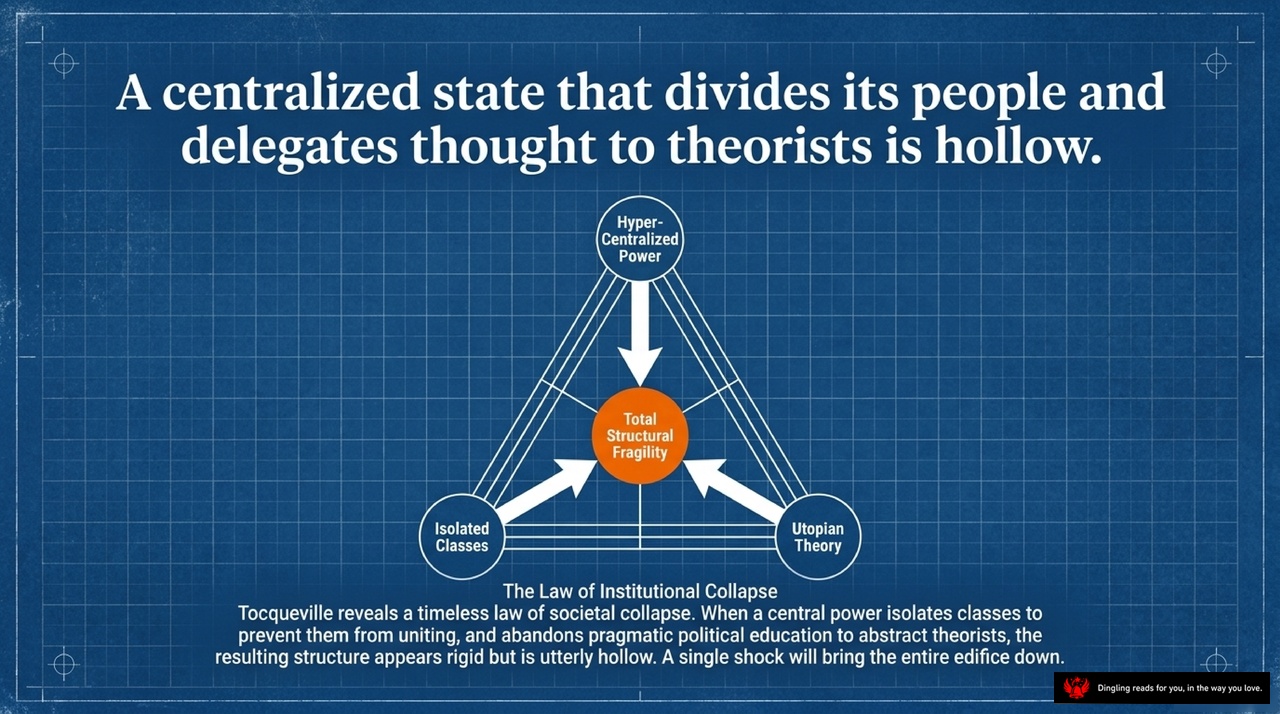
Look at this blueprint. It illustrates a terrifyingly simple truth about how empires fail: "A centralized state that divides its people and delegates thought to theorists is hollow."
The diagram breaks this down into three fatal pillars. At the top, you have "Hyper-Centralized Power." This is the state itself, stripping away all local autonomy and forcing everyone to obey a single, distant command. In the book, we see how the French government micromanaged everything from road repairs to farming techniques, creating a rigid structure that looked strong on the outside but had no roots to hold it up.
On the bottom left, you see "Isolated Classes." The state didn't just rule; it actively split society. By crushing local freedom and making every group fight for its own survival against the center, the state ensured that no one could ever unite to challenge it. The peasants were cut off from the nobles, the bourgeoisie from the workers. It was a society of lonely individuals, unable to form a collective force.
And on the bottom right, "Utopian Theory." Because the real world was so broken and the state refused to fix it, intellectuals stepped in. They offered abstract, perfect solutions—like a map for a city that doesn't exist yet. These theorists became the actual leaders of public opinion, promising a glorious future while ignoring the messy reality of how to get there.
When these three forces converge, they create "Total Structural Fragility." The state appears rigid and unbreakable, but it is actually empty inside. It has no local support, no unified people, and no practical plan. As the text warns, this structure is "utterly hollow." You don't need a massive army to bring it down; you only need a single shock. And in 1789, that shock was about to arrive.
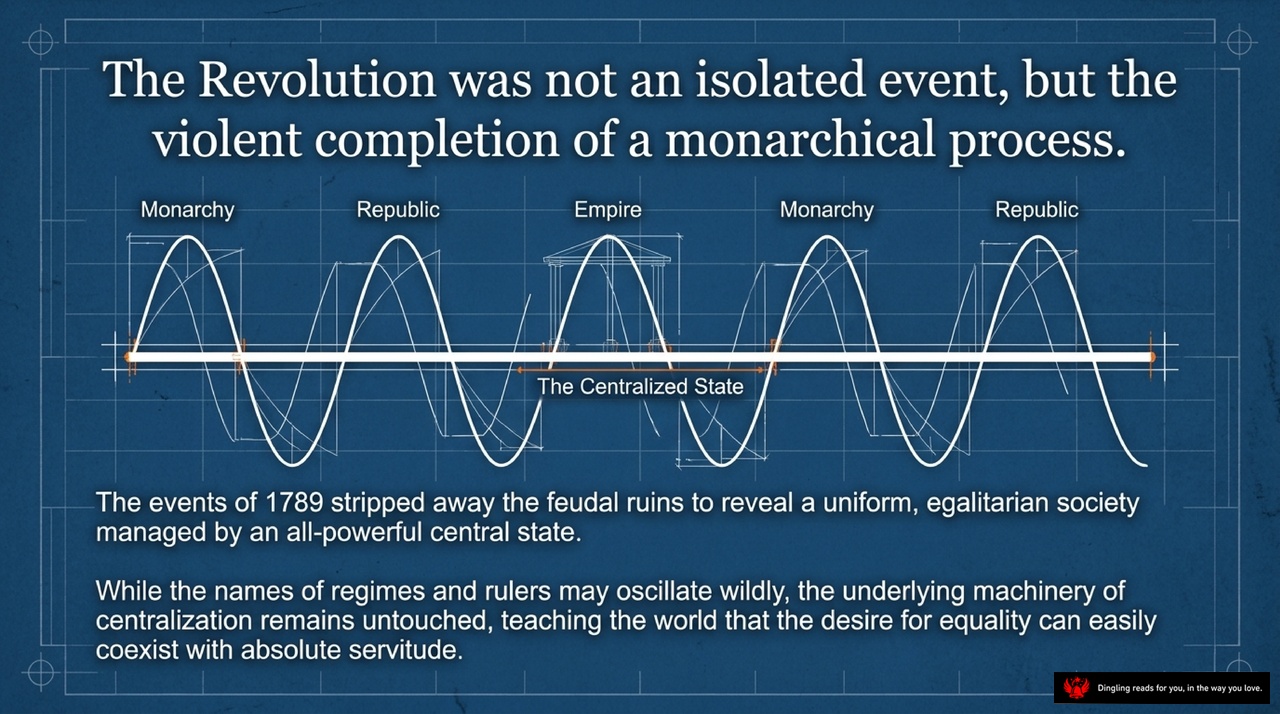
The Revolution wasn't an isolated explosion; it was the violent, final act of a long-standing monarchical play. As this slide illustrates, the pendulum swung wildly between Monarchy, Republic, and Empire, yet one constant remained: The Centralized State. While the names of our rulers and the labels of our governments changed with the seasons, the underlying machinery of centralization never budged.
Look at the timeline here. We see the cycles of Monarchy and Republic, but notice the unbroken line beneath it. The events of 1789 stripped away the old feudal ruins to reveal something new: a uniform, egalitarian society managed by an all-powerful central state. It sounds like a victory for equality, but here is the paradox the slide highlights. While the regimes oscillated wildly, the desire for equality coexisted with absolute servitude. The revolution didn't destroy the central state; it merely perfected it. By tearing down the old nobility, the new government concentrated all power in Paris, creating a system where the name of the ruler might change, but the grip on the individual remained unshaken. This is the core lesson of the French Revolution: it taught the world that the dream of equality can easily become the blueprint for a new, totalizing tyranny.

The slide poses a haunting question: if the machinery of centralized power always survives revolutions, are we simply changing the names of our masters? The answer, as we've seen throughout the French Revolution, is a tragic "yes."
The text on your screen reveals a profound irony. The Revolution didn't destroy the centralization of power started by the monarchy; it merely completed it. The very system that oppressed the people under the King was the same system that rose under the Republic. When a society values equality over liberty, it inevitably reconstructs the machinery of its own subjugation.
Think about this in a modern context. We often believe that toppling a corrupt leader or a tyrannical government is enough to create freedom. But history shows that without a fundamental shift in how power is distributed and checked, the old structures simply reappear in new clothing. The French people overthrew their kings, only to find that the administrative machinery—bureaucrats, centralized laws, and a powerful central authority—remained intact, often even stronger.
This is the core lesson here: you can change the face of your ruler, but if you don't dismantle the underlying structures of control, you are just swapping one master for another. True reform requires more than just a revolution; it requires a complete reimagining of the foundation itself. Are we condemned to repeat this cycle? Or can we ever truly break free? That is the challenge we all face.