


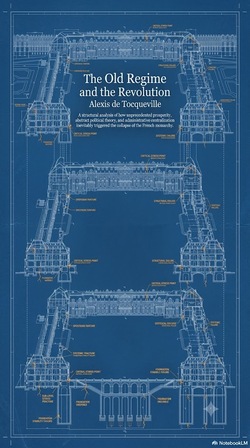
Tocqueville proves revolution was inevitable due to hollowed institutions.
Your Review
Tocqueville proves revolution was inevitable due to hollowed institutions.

Tocqueville proves the revolution was a slow collapse caused by centralization and broken promises, not a sudden heroic uprising.


Tocqueville argues that prosperity fueled the revolution because it raised expectations the rigid system could not meet, making the eventual collapse feel like a betrayal of the progress everyone had seen.

Tocqueville shows how centralization killed local freedom, making people passive and unable to govern themselves when the revolution finally arrived.

This book flips the common story of the French Revolution on its head by showing how prosperity actually fueled the anger that destroyed the old regime.

The idea that wealth caused the revolution instead of poverty is a shocking twist.

Tocqueville argues the revolution was a collapse, not a sudden break.

Tocqueville shows how centralization killed local freedom before the revolution started. The story of a village waiting months to fix a church roof makes this point clear. When people lose control over their own lives, they stop caring about community. This lack of civic experience later caused chaos when the monarchy fell. The nobility abandoned their role as local leaders, leaving a vacuum filled by abstract Enlightenment ideas. These thinkers had no practical governance experience, so their utopian plans ignored real human needs. Without intermediate institutions like guilds or town councils to buffer citizens, the population became isolated individuals. This isolation made them desperate for simple, universal solutions rather than complex, local fixes. The result was a revolution that rejected every traditional institution, even useful ones like regional courts, just because they represented the old order. This all-or-nothing approach left no room for gradual improvement. Instead, the vacuum of civic competence was filled by radicalism, leading to the Reign of Terror. Tocqueville warns that destroying social bonds without replacing them with functional democracy creates instability. We see this today when governments ignore local needs for ideological purity. The French Revolution wasn't a sudden uprising but the inevitable collapse of a system that hollowed itself out. Centralization, inequality, and ungrounded ideals combined to destroy a prosperous nation. This analysis remains crucial for understanding modern political fragility.

Tocqueville explains that local councils were replaced by distant bureaucrats, turning active citizens into passive onlookers who could not govern themselves.

Tocqueville details how destroying guilds and local institutions left citizens isolated, making them vulnerable to dangerous abstract ideals and eventual chaos.

Tocqueville argues that centralized power destroyed local autonomy, turning citizens into passive onlookers who could not govern themselves when the system finally collapsed. This insight explains why the revolution led to chaos instead of stability, as people lacked the civic experience needed to build a new society from the ruins of the old one. The author shows how the monarchy systematically dismantled city councils and parlements, replacing them with bureaucrats in Paris who ignored local needs, leaving communities isolated and unable to solve their own problems. Without these intermediate institutions to buffer citizens from distant rulers, abstract Enlightenment ideals became irresistible but dangerous, driving people to reject every vestige of the old regime without a practical plan for what would replace it. This loss of local governance meant that when the crisis hit, there was no framework for incremental change, so frustration festered until it exploded into a full-scale social upheaval that tore France apart and left a vacuum filled by authoritarianism under Napoleon.

The book brilliantly explains how prosperity itself fueled the revolution by raising expectations that the rigid, unequal system could no longer satisfy.

Tocqueville explains how the revolution was inevitable because the old system destroyed itself long before the fall.

This book completely changed how I view the French Revolution. It was not a sudden heroic uprising but the inevitable collapse of a system that had already destroyed itself from within by hollowing out local autonomy and replacing it with centralized power that choked community life.

The analysis of how prosperity made inequalities glaring and fueled anger feels very relevant to understanding modern political instability and societal fractures today.

Shocking analysis.

The idea that prosperity itself was part of the problem because it made inequalities more glaring is a shocking insight that changes how I see history.

Interesting take on history.

The idea that prosperity fueled the revolution by raising expectations too high for the rigid old system to handle is a shocking insight.
Reading this changed how I view the French Revolution, revealing it wasn't a sudden heroism but the inevitable collapse of a system that had already destroyed itself from within.