
The One Minute Manager Meets the Monkey: Complete Chapter-by-Chapter Summary

Welcome to today's session on *The One Minute Manager* and *The Monkey Management* philosophy by Ken Blanchard and William Oncken Jr.
Today, we are diving into a powerful concept that will change how you view your workload and leadership: "Meet the Monkey."
Imagine a shiny, amber-colored marble sitting right here on this pedestal. This represents your time and your energy. The book's core promise is simple yet transformative: this is the ultimate guide to freeing up your time by ensuring the next move stays exactly where it belongs.
In the corporate world, we often confuse "being busy" with "being productive." But true leadership isn't about doing everything yourself. It's about using your judgment and influence to drive your team toward goals. The real challenge for a manager isn't managing tasks; it's managing the "monkeys."
What is a monkey? It's not a project or a problem. A monkey is simply the next specific action required to solve a problem or move a project forward. Think of it as the next step. If someone says, "I have a problem," that's not a monkey yet. But if they say, "What should I do next?" that monkey has jumped onto your back.
The book teaches us that your goal as a leader is to keep these monkeys on your team's backs, not yours. When you take their monkey, you stop them from growing, and you fill your own schedule with tasks that aren't yours. By mastering the art of keeping the monkey on their back, you reclaim your time for strategic thinking and innovation, while your team learns to take ownership and thrive.

The Manager's Time Dilemma isn't just about being busy; it's about where your time actually goes. Look at this breakdown: your day is split between what your boss demands, what the system forces on you, what your team pushes up to you, and the small sliver of discretionary time left over. That gray section on the right? That's your true value. It's the time you control to plan, innovate, and lead. But here's the trap: subordinate-imposed time is constantly cannibalizing it. Every time your team dumps their problems on you, they aren't just asking for help; they are stealing your ability to lead. The real challenge for any manager is figuring out how to push those problems back so you can finally reclaim your discretionary time and do the work that actually moves the needle.
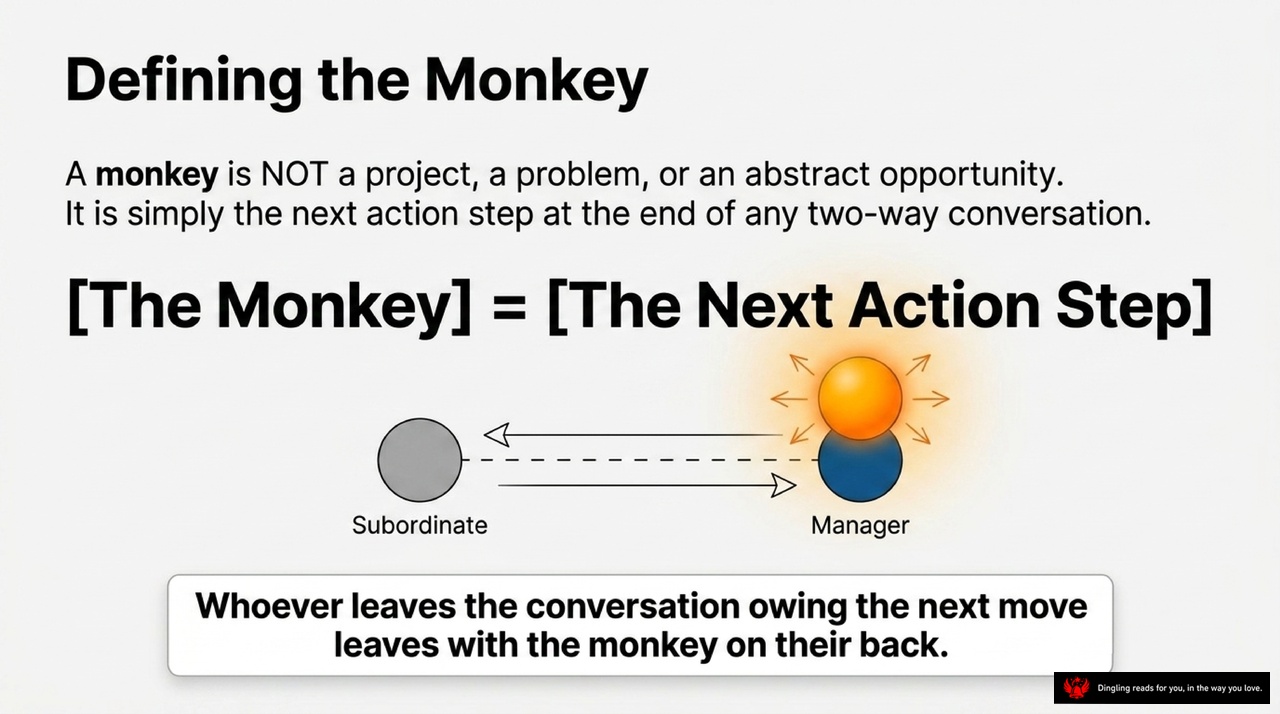
Defining the Monkey isn't about confusing a project or a problem with actual work. As this slide clearly states, a monkey is simply the next action step at the end of any two-way conversation. It is that specific, immediate move required to move things forward.
The core equation here is powerful: [The Monkey] equals [The Next Action Step]. In our diagram, you see a Subordinate and a Manager. The rule is straightforward: whoever leaves the conversation owing the next move leaves with the monkey on their back. If the subordinate says, "I'll figure that out," the monkey stays with them. If the manager says, "Let me think about that," the monkey instantly jumps to the manager's back.
Many managers accidentally let monkeys hop onto their backs by promising to solve problems they don't own. But true management happens when you keep the monkey on the subordinate's back, ensuring they own the next step. This simple distinction transforms how you spend your day, turning you from a bottleneck into a true leader.
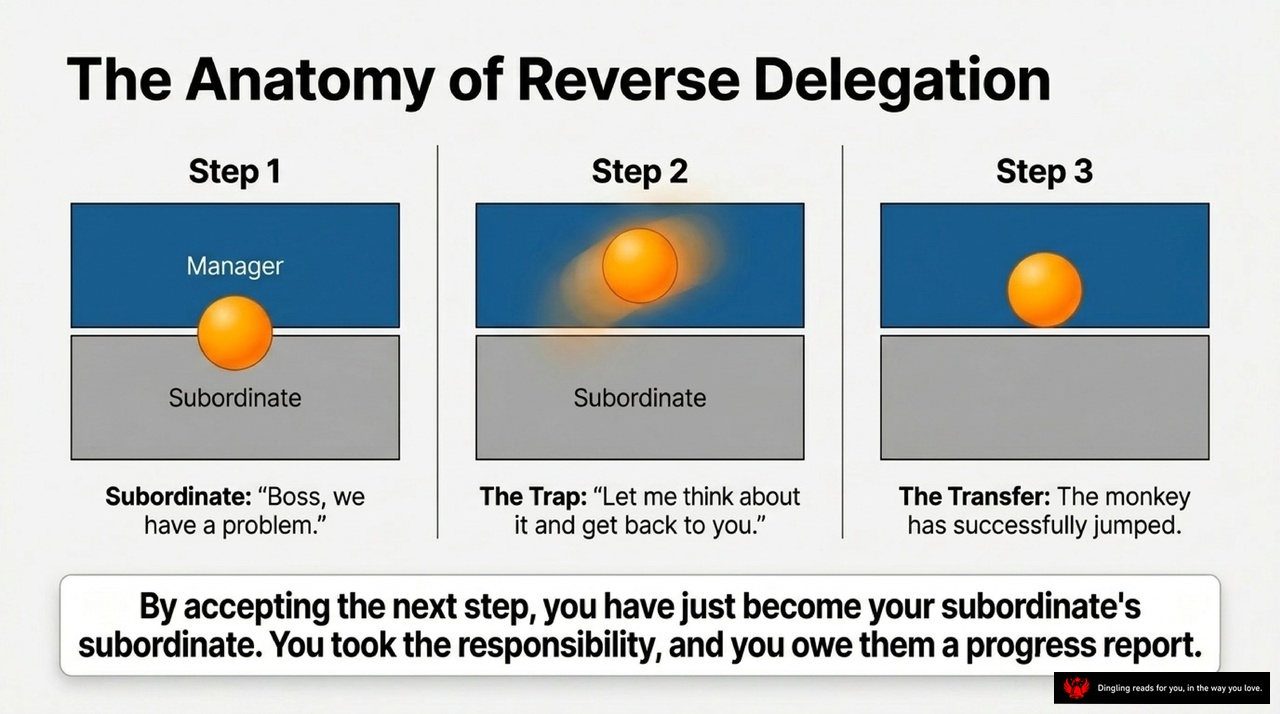
Have you ever felt like your day just got hijacked the moment someone walked by your desk? Look at this diagram: it breaks down exactly how "Reverse Delegation" happens, step by step.
It starts with Step 1. A subordinate approaches you and says, "Boss, we have a problem." In the image, you see the orange ball—the "monkey"—sitting on the edge between the subordinate and the manager. At this exact moment, the responsibility is still theirs. They are the ones who need to solve it.
But then comes Step 2, which is the real trap. The subordinate says, "Let me think about it and get back to you." That simple sentence is a hook. In the visual, you'll notice the monkey is now hovering right over the manager's box. By agreeing to "think about it," you have unconsciously accepted the monkey. You've shifted from being a supervisor to being the problem solver.
Finally, Step 3 shows the transfer complete. The monkey has fully jumped onto the manager's back. The subordinate is now gone from the frame, effectively becoming the supervisor who waits for your updates. The text at the bottom warns us: "By accepting the next step, you have just become your subordinate's subordinate."
This is the dangerous cycle of reverse delegation. When you take the monkey, you don't just solve their problem; you steal their growth opportunity. They stop thinking and start waiting for your instructions. You, on the other hand, end up drowning in a pile of other people's work, losing all your own time. The key to breaking this is realizing that the moment you say, "Let me think about it," you've already lost. You must keep the monkey on their back until they are ready to feed it themselves.

Have you ever felt like you're running on a treadmill, spinning your wheels just to stay in the same place? That's exactly what happens when a manager falls into the trap of "catching up." As the slide illustrates, this isn't just about being busy; it's a dangerous cycle that destroys your team's potential and your own effectiveness.
It all starts with **Phase 1: Accepting Subordinates' Monkeys**. In the book, we learn that a "monkey" isn't just a task; it's the next specific step required to solve a problem. When a team member says, "We have a problem," and you jump in to fix it, you've just transferred that monkey from their back to yours. You've inadvertently become their subordinate, and they've become your supervisor.
This leads directly to **Phase 2: How the Multiplier Works**. Instead of multiplying results, you multiply your workload. Because you've taken ownership of their problems, they no longer need to think or act. They simply wait for your decision. As the text warns, the more you try to catch up on their work, the further behind you actually fall. You are actively reinforcing their dependency on you.
Now, look at the next stage, **Phase 2 again: Work Harder & Longer**. This is the illusion of productivity. You think working longer hours is the solution, but in management, input does not equal output. When you spend your day solving other people's problems, you aren't producing value; you're just consuming time. You become a bottleneck, a "bottleneck" that slows down the entire organization.
Finally, we hit **Phase 3: Subordinates Run Out of Work & Generate More Problems**. This is the most critical part. When you constantly take their monkeys, your team ends up with nothing to do. They sit idle, anxious, and frustrated. To fill the void, they start creating new, artificial problems just to get your attention again. This creates a vicious cycle: the more you help, the more problems they generate, and the more you have to work.
The slide concludes with **Phase 4: Managerial Bottleneck Worsens**. The cycle closes on itself. You are now trapped in a state of perpetual crisis, drowning in a sea of other people's responsibilities. The core lesson here is simple but powerful: in management, if you are constantly busy, you are likely doing the wrong things. True leadership isn't about being the most productive individual contributor; it's about creating a system where your team can solve problems without you, freeing you up to do the strategic work that actually drives the business forward.
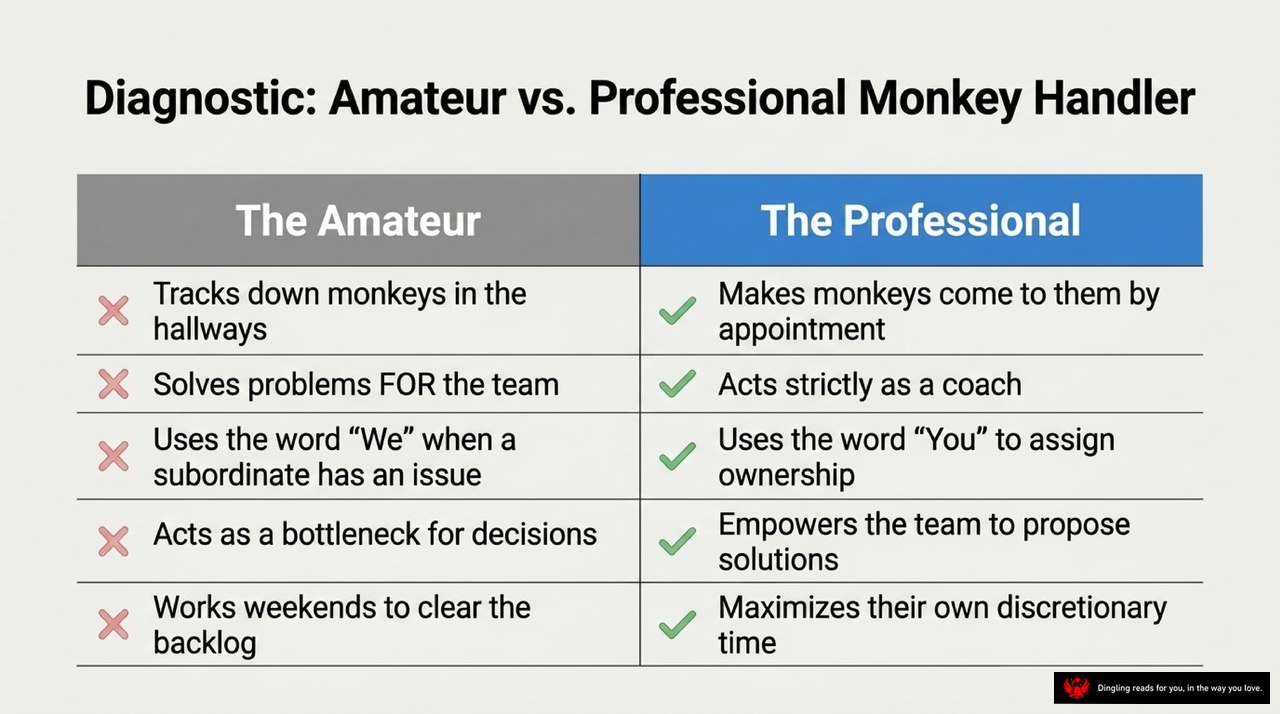
Look at this slide: "Diagnostic: Amateur vs. Professional Monkey Handler." It's a stark comparison between how amateurs manage time and how true professionals do it.
On the left, you see "The Amateur." They chase problems around the office hallways, solving issues for their team instead of coaching them. They use "We" when things go wrong, which secretly shifts the blame to the leader. They become the bottleneck for every decision and even work weekends just to clear their own backlog.
On the right, "The Professional" does it completely differently. They don't chase; they attract problems by appointment, acting strictly as coaches. They use "You" to assign ownership, empowering the team to propose solutions themselves. Instead of clearing the backlog personally, they maximize their own discretionary time.
This isn't just about being busy; it's about who owns the work. The amateur gets trapped in a cycle of doing everything, while the professional builds a system where the team is responsible for their own "monkeys," allowing the leader to focus on strategy and innovation. The goal is simple: stop solving the team's problems and start teaching them how to solve their own.

Imagine a high-stakes game of catch, but instead of a ball, we're talking about responsibility. Look at this diagram illustrating the "Core Law of Monkey Management." It visualizes a critical flow: a "monkey" starts with a subordinate, moves through "The Conversation," and ideally, returns to the subordinate without ever landing on the manager's side.
Here is the golden rule displayed at the bottom: "Output must equal input." In plain English, this means the dialogue you have must ensure that the monkey leaves on the exact same back it arrived on. If you, as a leader, simply listen to a subordinate's problem and say, "Let me think about that," you've just thrown that monkey onto your own back. Suddenly, you are the one who needs to solve it, and the subordinate becomes your supervisor, waiting for your instructions.
The image clearly shows that when the monkey stays with the subordinate, the manager remains free to focus on high-level strategy, represented by the gears and charts on the left. But if the monkey jumps to the manager, it gets crossed out with a big red X. Why? Because once the monkey is on your back, you are no longer a manager; you are just an employee trying to solve someone else's tasks. This single misstep traps you in a cycle of endless "subordinate-occupied time," where you are constantly reacting to crises instead of driving the team forward.
True professional management isn't about being the hero who fixes everything. It's about mastering the conversation so that every time you talk, the responsibility stays where it belongs. By ensuring output equals input, you protect your most valuable asset—your discretionary time—and empower your team to grow. Don't let the monkey jump. Keep it on their back, stay in your seat as the leader, and watch your team thrive.

Look at this pyramid. We call it the Freedom Scale, and right now, we are staring at the "Prohibited Zones." Specifically, look at Level 1 and Level 2. These are the traps that kill your productivity.
Level 1 is "Wait until told." Level 2 is "Ask what to do." The slide is very clear: these behaviors are marked as "Prohibited" and must be "Eliminated." Why? Because operating at these levels guarantees that you, as the manager, retain all the monkeys.
Think about it. If your team only comes to you to wait for instructions or asks you how to do their work, you have effectively become their employee. You are no longer leading; you are just executing tasks for them. Every time you answer a question or give an order, you are taking a monkey off their back and placing it squarely on yours.
The solution, as the text at the bottom suggests, is strict and simple. You must mandate that subordinates always bring a recommendation, never just a question. Stop asking them what to do. Instead, force them to think, formulate a plan, and bring you a solution. By eliminating these prohibited zones, you stop the reverse management where your team ends up supervising you. This is the only way to reclaim your time and stop being the bottleneck for your own team.

Look at this pyramid on the screen. It's called "The Freedom Scale," and it maps out the five levels of empowerment where an employee operates. At the very bottom, Level 1, employees are just waiting to be told what to do. Move up one step to Level 2, and they're asking, "What should I do?" This is where things get interesting. Level 3 is where true management actually begins. Here, the employee recommends a solution, then takes action. By Level 4, they are acting independently but still advise you immediately. And at the top, Level 5, they act on their own and only provide routine reporting.
Notice the golden arrow labeled "Path of Empowerment." It cuts through the pyramid, showing the direction we want to go. The manager's goal isn't to micromanage or stay at the bottom; it is to coach employees up from Level 3 all the way to Level 5. As they climb these levels, you progressively transfer ownership of their work and expand their discretionary time. At Level 5, they have maximum discretionary time, meaning they control the pace and direction of their own work. This shift transforms the relationship from supervision to true empowerment, creating a team that is self-reliant and highly effective.
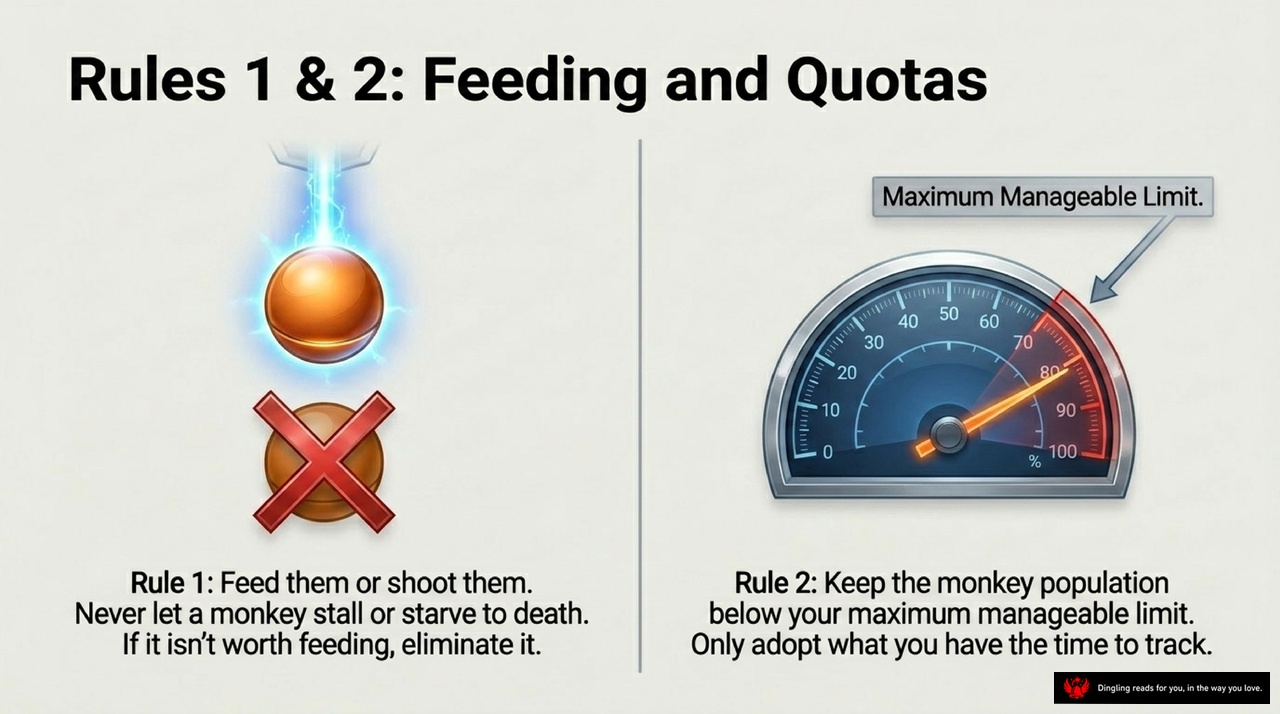
Today's slide outlines the first two golden rules for managing your team effectively: Feeding and Quotas. Think of your projects not as tasks, but as "monkeys" that need constant attention. Rule one is simple but critical: Feed them or shoot them. If a project isn't worth the energy required to nurture it, don't hesitate to eliminate it. Never let a monkey starve to death, as that creates chaos, but also never feed a project that offers no real value.
On the right, we see Rule two: Keep the monkey population below your maximum manageable limit. This speedometer represents your capacity. No matter how motivated your team is, you cannot manage an infinite number of projects. You must only adopt what you have the time and resources to track. By strictly enforcing these two rules—cutting the dead weight and capping the load—you stop drowning in trivialities and create the space needed to drive real results.
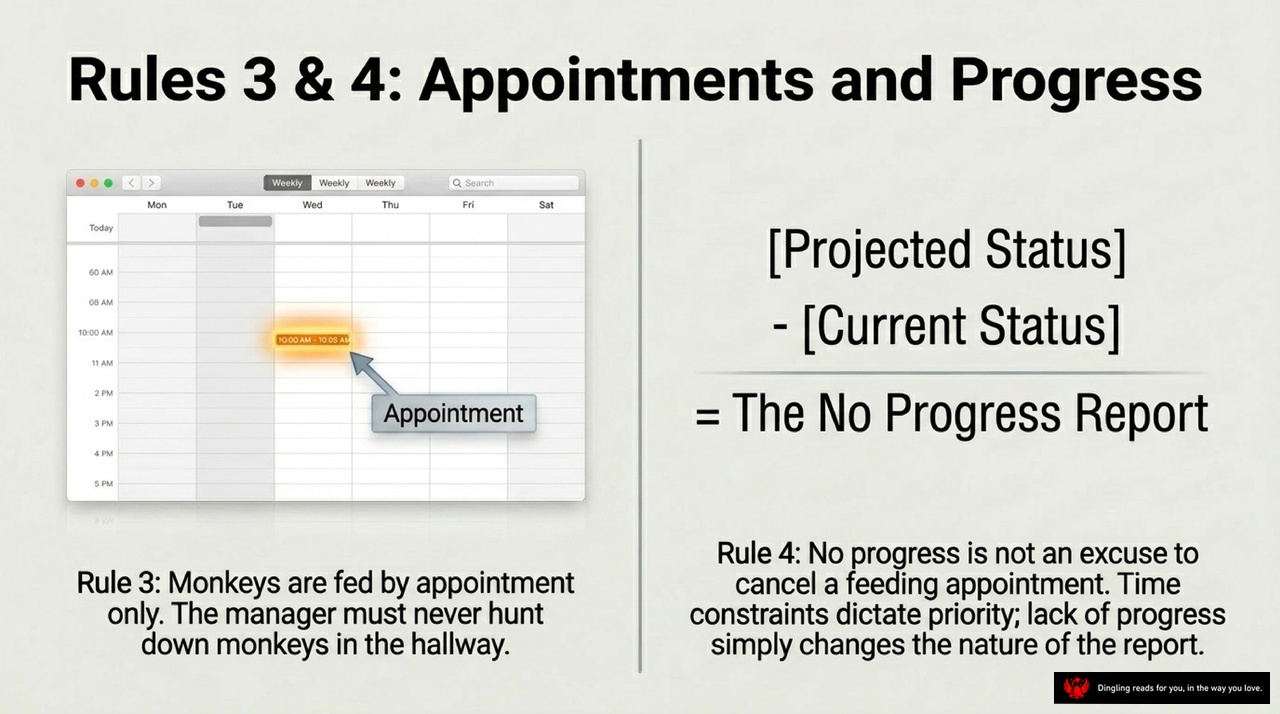
Rules 3 and 4: Appointments and Progress. Let's talk about how we manage our time and track our actual work.
Look at this calendar on the left. It shows a specific appointment from 10:00 AM to 10:05 AM. Rule 3 states that monkeys are fed by appointment only. This means your team should never come to you unannounced to dump problems on you. Instead, they must schedule a time to bring you their issues. You must never hunt down monkeys in the hallway. If you do, you are just feeding the monkey, and it will climb onto your back.
Now, look at the formula on the right: Projected Status minus Current Status equals The No Progress Report. This is the essence of Rule 4. No lack of progress is an excuse to cancel a feeding appointment. Even if nothing has changed, you must still show up and report. Time constraints dictate priority, but a lack of progress simply changes the nature of your report. It forces you to explain what you've done so far and why you are stuck.
If you cancel because there is no progress, you are signaling that the work isn't important enough to report. But by showing up and giving a "no progress" report, you are actually forcing the monkey to stay on their back. You are making them accountable for the gap between where they thought they would be and where they actually are. This creates the pressure they need to move forward. So, keep your appointments, even when the news is bad. That is the only way to ensure real progress.
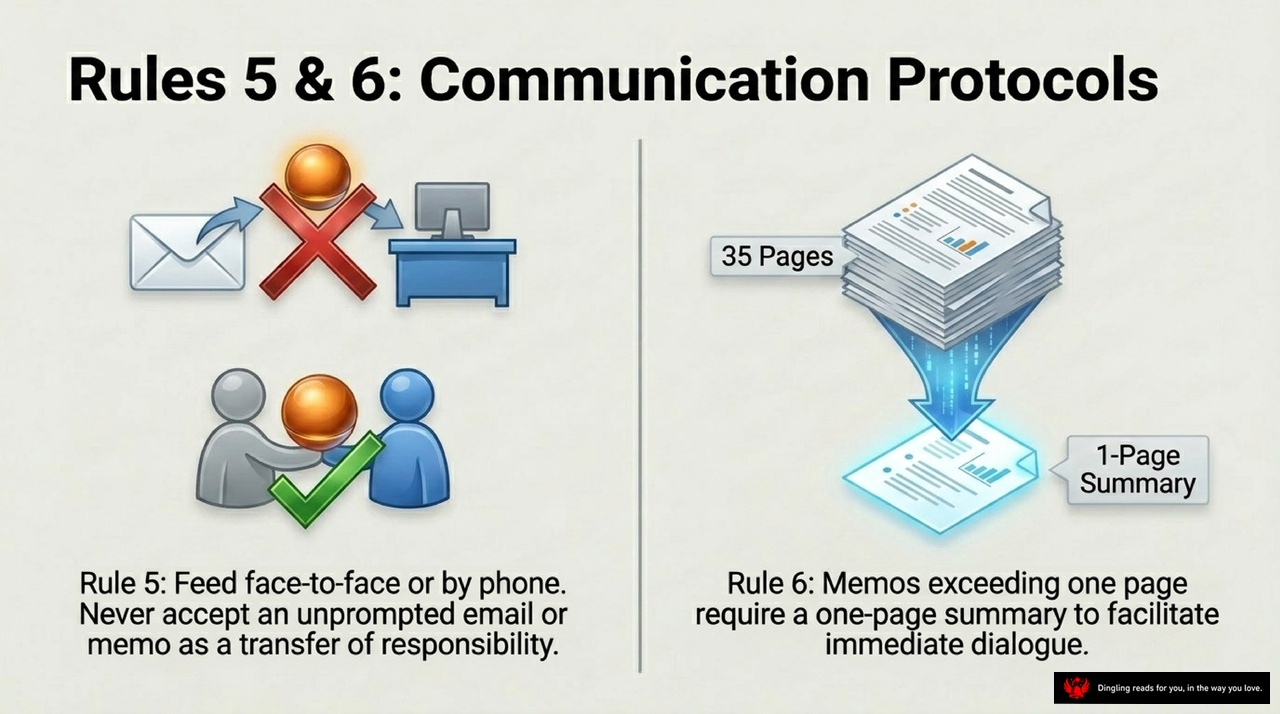
Today's slide highlights two critical rules for effective management: Rule 5 and Rule 6, focusing on communication protocols. Let's break down what this means for your daily workflow.
First, look at Rule 5: "Feed face-to-face or by phone." The graphic clearly shows an email being blocked by a red 'X' when trying to transfer responsibility. This is a hard boundary. Never accept an unprompted email or memo as a way to pass off your work. If someone tries to dump a problem on you via email, stop it immediately. Instead, pull them aside or pick up the phone. Why? Because real problems need real-time dialogue. You can't solve a complex issue by reading a static document; you need to hear their tone, ask clarifying questions, and guide them together. By insisting on live interaction, you ensure the "monkey"—the task or problem—stays on their back, not yours.
Now, turn your attention to Rule 6 on the right. It illustrates a common trap: the "35 Pages" of documentation collapsing into a useless pile, versus a single, powerful "1-Page Summary." The rule states: "Memos exceeding one page require a one-page summary to facilitate immediate dialogue." If you receive a long report, don't just read it all. Ask for a one-page summary first. This forces the sender to think critically about what truly matters. It also prevents you from getting buried in administrative work. A long memo often signals that the sender hasn't distilled the core issue, or worse, they are trying to hide the complexity behind words. By demanding that summary, you keep the conversation focused and the monkey on their back.
Together, these rules protect your most valuable asset: your discretionary time. They stop you from becoming a bottleneck where everyone waits for your response to an email or a long report. Instead, you create a culture of direct communication and concise thinking. This isn't just about being strict; it's about empowering your team to take ownership. When you refuse the email dump and demand the one-page summary, you are teaching them how to think and act professionally. You reclaim your time for strategic decisions, and they learn how to solve problems without constant supervision. Stick to these protocols, and you'll see a dramatic shift in your team's efficiency and your own peace of mind.
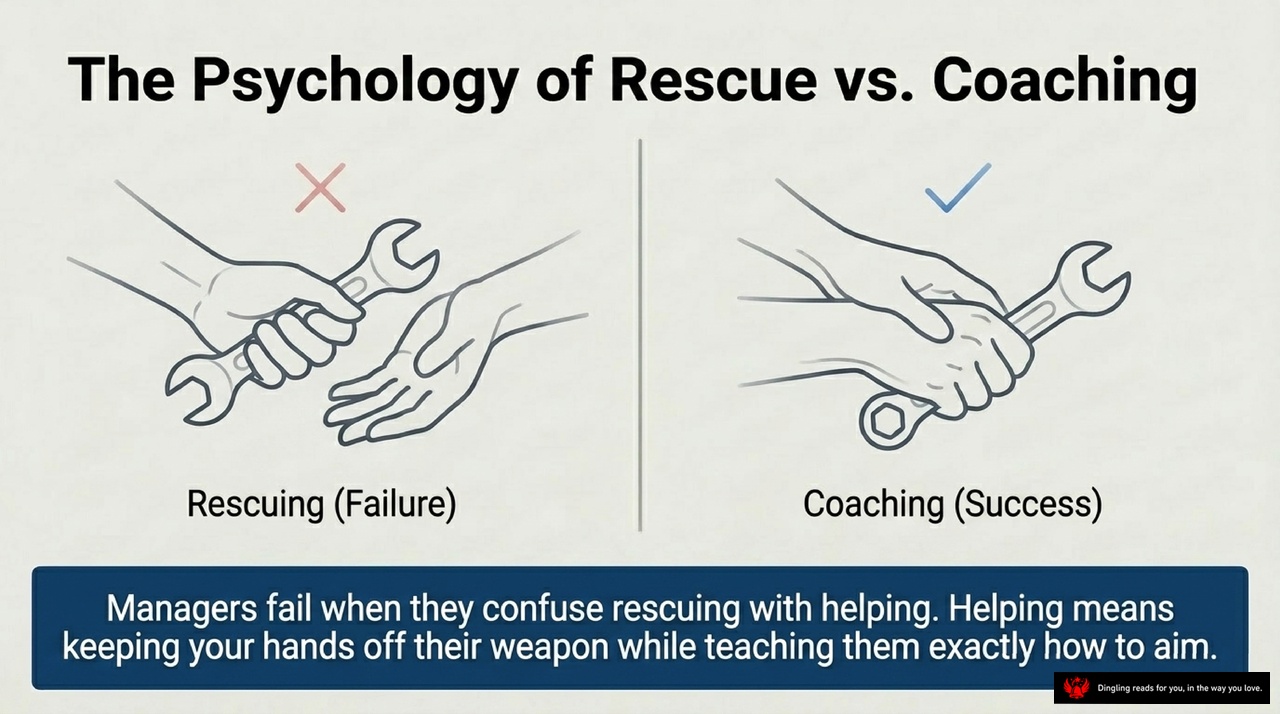
Most managers make a fatal mistake: they confuse "helping" with "rescuing." On this slide, you see the difference clearly. On the left, we have "Rescuing," marked with a red X. It shows a manager taking the wrench directly from an employee's hands. This is the trap of doing things for them. It might feel like support in the moment, but it's actually a failure because it robs the employee of the chance to learn and grow.
On the right, we see "Coaching," marked with a blue check. Here, the manager's hand stays on the employee's hand, guiding them on how to hold and aim the wrench, but the employee still holds the tool. This is the key to success. True helping means keeping your hands off their weapon while teaching them exactly how to aim. When you rescue, you become the bottleneck; when you coach, you empower them to solve problems independently. Stop grabbing the wrench and start guiding the hand. That is the psychology of effective leadership.

The image on the screen outlines a powerful concept: a virtuous cycle known as the Delegation Ecosystem. At its heart is a simple but profound truth—predictable appointments and strictly enforced ownership lead to autonomous execution. Let's break down how this cycle actually works in practice.
It all starts with a trigger: a problem arises. Instead of jumping in to fix it yourself, a professional manager waits for the subordinate to bring a recommendation. This is what we call Freedom Level 3. The employee isn't just reporting a problem; they are already thinking about solutions.
Once that recommendation is on the table, the manager engages in dialogue to assign the next specific step. Crucially, the "monkey"—the responsibility for that next action—stays with the subordinate. The manager does not take it. This ensures that ownership remains clear.
Finally, we arrive at the follow-up phase. This is where the magic happens. We schedule a specific feeding appointment for the subordinate to report back on their progress. By committing to a time and place, we create predictability. This scheduled check-in reinforces accountability and keeps the monkey active and alive on the subordinate's back.
When you consistently apply these four steps—Trigger, Action, Dialogue, and Follow-up—you stop being a bottleneck and start building a team that operates independently. You trade your time for their growth, creating a sustainable ecosystem where everyone thrives.

Effective management isn't about being the hero who solves every problem for your team. It's about relentlessly managing the next step. By cutting out unnecessary delegation, setting strict protocols for task updates, and pushing decision-making down the Freedom Scale, you rescue your discretionary time and transform dependent workers into empowered leaders.
So, look at your desk right now. Whose monkeys are you currently carrying? Are you busy solving their problems, or are you simply letting their responsibilities pile up on your back?