
The Order of Time: Complete Chapter-by-Chapter Summary

Welcome to *The Order of Time* by Carlo Rovelli. Imagine a journey to the very heart of reality, where the familiar, steady flow of time you know so well begins to dissolve. In this cosmic dance, time isn't a single river rushing forward for everyone; instead, it unravels into a vast, intricate network of individual quantum events. What we perceive as a universal clock is actually an illusion created by our perspective. As we explore this book, we'll discover that time is relative, that the past and future might be equally real, and that at the deepest level, time itself might not even exist as we think it does. It's a mind-shifting adventure into the fabric of our universe.

Imagine you've always thought of time as a steady, universal river flowing from past to future. That's the "grand illusion" we see on the left: a perfect, ticking clock. But modern physics shatters this comforting picture.
Look at the right side of the image. That smooth clock face is melting and warping. Why? Because time isn't a uniform river. It's more like a fabric that gets stretched and distorted by mass and speed.
Think about this: if you stand on a mountain versus lying on the floor, time actually passes at different rates. The clock on the floor ticks slightly slower because Earth's gravity slows time down closer to its surface. Even your aging slows down just a fraction more at sea level than at the peak of a mountain.
And it's not just gravity. Speed does it too. The faster you move, the slower time flows for you. Einstein figured this out long before we could measure it with atomic clocks.
So, there is no single "now" for the entire universe. Your "now" is different from someone else's if you are moving differently or sitting in a different gravity well. The rigid clock on the left is a lie; the fluid, distorted reality on the right is the truth. Time is not a fixed stage; it's a dynamic, malleable part of the universe itself.

When we zoom in on the fabric of reality, we lose the comforting illusions we've held about time. This slide breaks down exactly what disappears when we swap our classical view for quantum truth.
First, look at Unity. Classically, we imagined one universal, synchronized clock for the whole cosmos. In quantum reality, that vanishes. Instead, we have infinite local times ticking at completely different rhythms. There is no master clock; every point in space has its own private time.
Next, consider Direction. Our intuition tells us time is a strict one-way street, flowing irreversibly from past to future. But at the fundamental level, there is no inherent arrow of time. The underlying physics is symmetric; the flow we perceive is a higher-level effect, not a basic law.
Then there is The Present. We love the idea of a shared, universal "Now" that everyone experiences simultaneously. Quantum mechanics shatters this. Reality is made of isolated, local bubbles of simultaneity. What is happening "now" for you is disconnected from what is happening "now" for someone far away; there is no single global present.
Finally, look at Continuity. We perceive time as a smooth, continuous flow, like a flowing river. But the quantum world is granular. Time isn't smooth; it's made of discrete jumps. It's not a continuous stream, but a series of distinct quantum leaps.
So, when we look closely, the smooth, unified, one-directional river of time dissolves into a complex, granular, and locally defined network of events.

We often think of the world as built from solid, enduring objects—rocks, trees, mountains—that just sit there while time flows around them. But at the deepest level of reality, physics tells us this is a complete illusion. In the quantum world, nothing really "is." Instead, everything is a fleeting event. A stone isn't a permanent object; it's just a temporary pattern of forces holding together for a moment. A kiss isn't a thing that exists; it's an event that happens and then vanishes.
This shift changes everything. We stop thinking in terms of static things existing in time, and start seeing a universe made entirely of processes and interactions. The best way to understand the world isn't to look for what stays the same, but to focus on what is constantly changing and being created. It's about generation, not existence.
There is no single, master clock ticking for the whole universe. Every event has its own rhythm, its own local time. The universe isn't a grand army marching in step under one commander; it's a vast, chaotic network where every node dances to its own beat. It's less like a synchronized line of soldiers and more like a million different Shivas dancing at once, or the swirling, dynamic figures in a Matisse painting. We are not watching time pass by; we are immersed in a web of events, each one happening, changing, and transforming in its own unique way.

So, what happens when we zoom out to look at the entire universe? Here's a mind-bending truth: asking "what is happening right now" across the cosmos is actually physically meaningless. Why? Because light takes time to travel. When you look at a star, you are seeing it as it was in the past, not as it is "now."
This leads us to the concept of the "Myth of the Universal Now." As the slide illustrates, the "Present" isn't a single moment shared by everyone in the universe. Instead, it's just a tiny, local bubble around us. Think about it: if you were looking at Proxima b, the nearest star to our solar system, the "now" you see there is actually four years in the past. There is no such thing as a universal "today."
Physicists use a tool called a light cone to map this out. Imagine an event happening on Earth. Everything that could have influenced that event lies in the past cone, and everything that event could influence lies in the future cone. But anything outside that cone? It's completely isolated from us. Events happening far away simply cannot affect our "now," nor can our "now" affect them.
So, the idea that the entire universe is marching forward together in a single, synchronized timeline is an illusion. We live in a world where "now" is relative, defined only by our own immediate surroundings and the speed of light. It's a profound shift from thinking of time as a global clock to understanding it as a local experience.
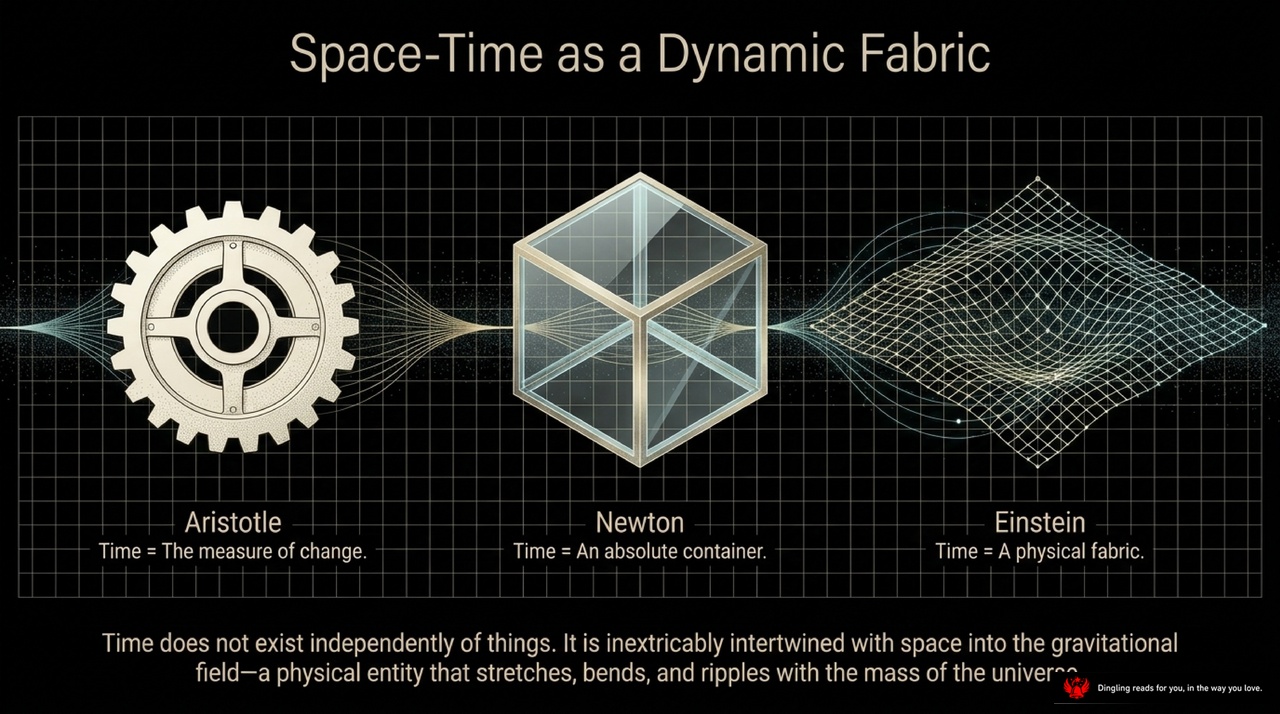
Space-Time as a Dynamic Fabric isn't just a metaphor; it's the stage where the universe actually plays out. Look at this evolution: we moved from Aristotle seeing time as a simple measure of change, to Newton viewing it as a rigid, absolute container, and finally landing with Einstein's revolutionary idea—that time is a physical fabric itself.
This shift changes everything. Time doesn't float independently; it gets stretched, bent, and rippled by mass. Think of it like a trampoline. When you place a heavy object, like Earth, on that fabric, it creates a dip. Objects don't just fall because gravity pulls them; they are actually following the curvature of time itself, sliding toward where time moves slower.
But here's the mind-bending part: this fabric isn't smooth or continuous. In the quantum realm, time breaks apart into discrete chunks, like pixels on a screen. We call this the Planck time. At this scale, the clock stops ticking smoothly and starts jumping. This means our familiar, flowing time is actually an illusion created by our macroscopic perspective.
Furthermore, because we can't see every tiny detail of the universe, we perceive time as a one-way arrow. This "arrow of time" is really just a result of our limited knowledge and the increase of entropy. We remember the past because it was a low-entropy, ordered state, but the future remains a blur of possibilities.
Ultimately, time isn't a universal ruler we all share. It's a complex network woven from our interactions, our memories, and the very structure of reality. We don't just live *in* time; we are the story of time itself.
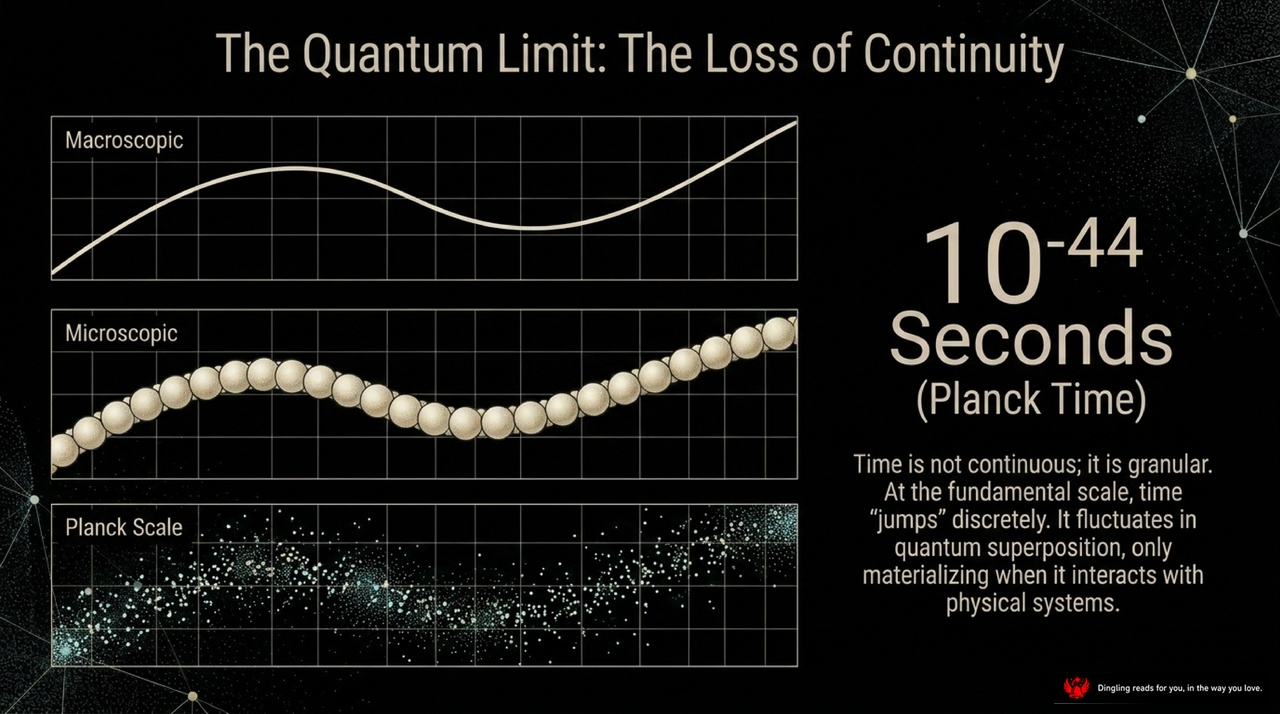
Imagine a world where time doesn't flow like a smooth river, but instead stutters and jumps. This is the reality at the smallest scales of the universe, a concept known as the Quantum Limit. As our slide illustrates, we live in a "Macroscopic" world where time appears continuous, like a perfectly drawn line. But zoom in to the "Microscopic" level, and that line breaks into distinct beads. Zoom further to the "Planck Scale," and time dissolves entirely into a chaotic cloud of points.
This fundamental shift happens at a specific threshold: $10^{-44}$ seconds, known as Planck Time. At this scale, the very fabric of time loses its continuity. It isn't a smooth background against which events happen; instead, time itself is granular. It exists in a state of quantum superposition, fluctuating wildly until it interacts with physical systems to "materialize" into something we can measure.
This challenges our deepest intuition about reality. We are used to thinking of time as a reliable, ticking clock that marches steadily forward. But at the Planck scale, that clock stops working. We can't measure anything shorter than this "atomic" unit of time. It's not just that our instruments aren't precise enough; it's that time itself has no resolution finer than this. The universe isn't a stage where actors perform; at its core, it's a frenetic dance of discrete events, where the past and future blur together in a haze of probability. This loss of continuity is the key to understanding why the universe behaves so strangely at its smallest levels, moving us away from a world of certainty into one of pure quantum possibility.
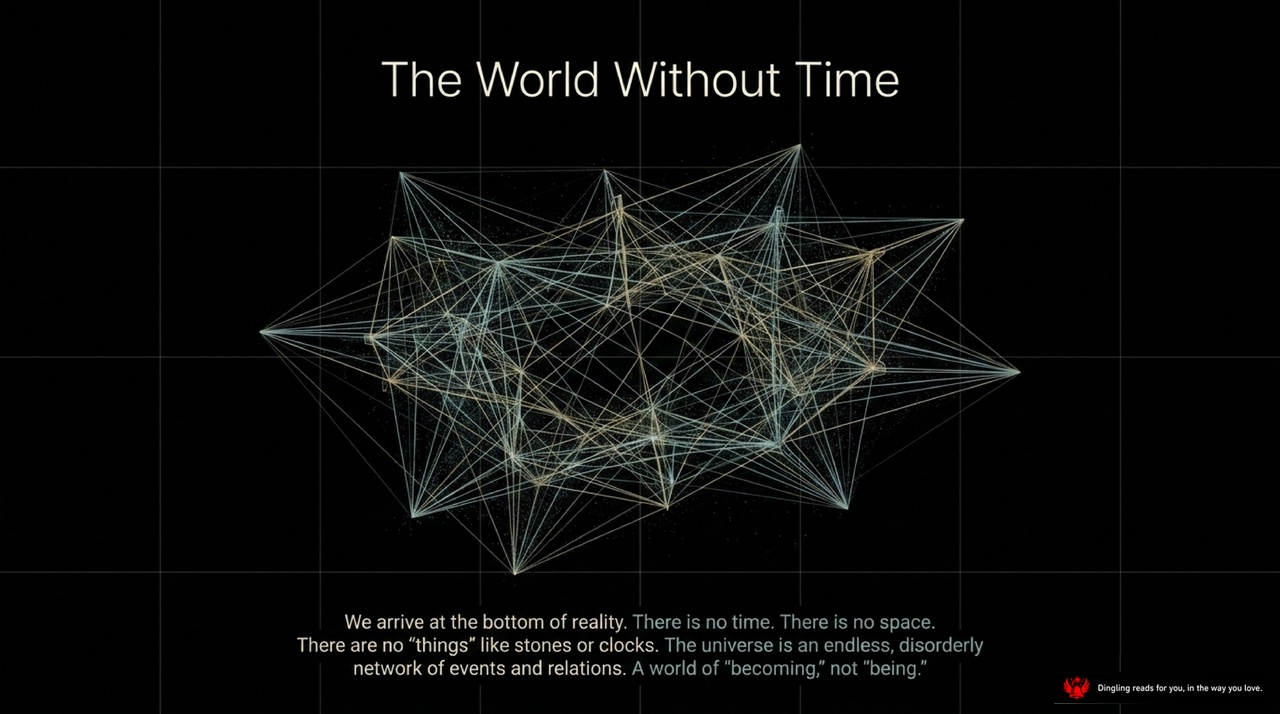
Imagine a world where the concept of "time" as we know it simply vanishes. Look at that intricate, glowing web in the center of the screen. This isn't just a random geometric pattern; it represents the universe stripped of its familiar dimensions. As the text suggests, when we dig down to the very bottom of reality, we find a world without time, without space, and without distinct "things" like stones or clocks.
In this fundamental layer, the universe isn't a stage where events happen in a sequence. Instead, it is an endless, disordered network of pure events and relationships. Think of it less as a movie playing out frame by frame, and more like a vast, simultaneous tapestry where everything exists all at once. The text describes this as a world of "becoming," not "being." We don't have a fixed existence that moves through time; we are constantly emerging, defined entirely by our connections to other events.
This idea challenges our deepest intuition. We are so used to thinking that the past is gone, the future is coming, and the present is the only real thing. But in this quantum view, that linear arrow dissolves. The rigid boundaries between past, present, and future blur away, replaced by a complex web of probabilities and interactions. It's a shift from a clockwork universe to a dynamic, fluid network where every point is vibrating with potential. So, when we talk about the "flow" of time, we might actually be describing our own limited perspective on a reality that is far more interconnected and timeless than we ever imagined.

Imagine a deck of cards perfectly stacked in order, representing a cold, highly organized state. Now, watch it explode into chaos as it shuffles. This visual perfectly captures the core of the "Heat of the Arrow": the relentless march from order to disorder, where entropy never decreases.
In the fundamental equations of physics, the past and future look identical. There is no built-in arrow pointing forward. But this arrow only appears when heat enters the equation. As our slide illustrates, heat means friction, and friction means shuffling. This shuffling is the act of moving from order to disorder, a process physicists call entropy.
Think about it this way: if you could rewind a video of a ball bouncing and stopping due to friction, it would look unnatural because the ball would magically generate heat out of nowhere. Our brains are wired to see this shuffling. We perceive time flowing forward simply because we are constantly generating heat through our thoughts and actions. We remember the past because those events left a low-entropy trace, like a footprint in the sand, while the future remains a high-entropy blur.
So, the direction of time isn't a universal law written into the universe's fabric. It's a local phenomenon born from our specific perspective. We are standing in a special, low-entropy corner of the cosmos, watching things inevitably drift toward chaos. The arrow of time points forward not because the universe demands it, but because we are the observers who create friction, generate heat, and inevitably, shuffle the deck.

Imagine a universe where time doesn't actually exist at the fundamental level. Instead, what we perceive as the steady flow of time is nothing more than a beautiful illusion born from our own ignorance.
Look at the split on this slide. On the left, we see "Micro-Reality"—a chaotic, intricate web of particles where the laws of physics are perfectly symmetric. In this microscopic world, there is no arrow of time; the past and future are indistinguishable. But on the right, we see "Macro-Illusion." Here sits a simple glass of water, representing our everyday world. Why does time seem to flow forward here, creating a clear distinction between past and future?
The answer lies in the blur. We simply cannot see the microscopic details of the universe. Because our vision is blurred, we lose the ability to track every individual particle. This macroscopic "blurring" forces the system into specific thermodynamic states. From this very blur, the variable of "thermal time" emerges.
As the book explains, entropy is essentially a measure of this lack of knowledge. It quantifies the number of microscopic states we cannot distinguish. When we ignore the chaotic, time-symmetric details of the quantum realm and focus only on the macroscopic average, we create the illusion of irreversibility. We mistake our own limited perspective for a universal law.
So, time isn't a river flowing through the universe. Time is the shadow cast by our inability to see the full picture. If we could somehow perceive every single detail of the micro-reality, the blur would vanish, and the arrow of time would dissolve, leaving us with a timeless, static universe. Our experience of time is, quite literally, a product of what we do not know.

Imagine a universe that doesn't actually start in a special, low-entropy state. That's the radical idea we're exploring today. The slide highlights this with a powerful visual: the Earth spinning, surrounded by concentric rings of time and space, reminding us that our reality is defined by our specific vantage point.
Think about it this way: the past doesn't look so ordered and distinct simply because the universe began that way. Instead, it's our unique, limited interaction with a tiny subset of the universe's variables that makes the past look highly ordered to us. It's an illusion created by our perspective.
Consider the sky. It only appears to rotate around us because the Earth is spinning. If you were floating in deep space, the sky wouldn't move at all. Similarly, the arrow of time—the sense that the past is fixed and the future is open—is a product of our specific perspective. We are trapped in a special, low-entropy pocket of the cosmos. Because we can only see a fraction of the universe's complexity, we mistake our local statistical anomaly for a universal law.
So, the universe itself might be chaotic and time-symmetric everywhere. But for us, right here, time flows forward because we are observers embedded in a system that happens to be far from equilibrium. We aren't watching time move; we are watching our own limited view of a vast, complex system evolve.

Imagine a deck of cards perfectly ordered, representing a low-entropy past. Now, imagine shuffling it. That irreversible act of mixing—the "shuffling of the deck"—is the physical essence of heat loss. As entropy increases, it leaves behind undeniable "traces" in the present: footprints in the sand, fossils in the rock, and impact craters on the moon. These physical traces are the only reason we can deduce cause and effect. Without the irreversible flow of heat and the rise of entropy, there would be no memories, no records, and no history at all. We wouldn't just be drifting in a timeless void; we would have no way to distinguish the past from the future. The arrow of time exists not because the universe forces us to move forward, but because the low-entropy state of our past has left these permanent marks, allowing us to reconstruct the story of what happened before.

Look at this image. It visualizes our brain not as a static object, but as a sophisticated time machine. On the left, we see the "Remembered Past," and on the right, the "Anticipated Future." The core idea here is profound: we are not just physical entities; we are stories. Our brains use the traces of the past to calculate and shape the future.
This concept is deeply rooted in physics, specifically in the second law of thermodynamics and the concept of entropy. Think about it: the reason we can remember the past but not the future is because the past was a state of lower entropy, a more ordered state. When we store a memory, we are essentially creating an ordered trace in our brain against the natural trend of disorder. That's why the past feels solid and certain, while the future remains open and uncertain.
Furthermore, this mechanism is what allows us to exist as a continuous "self." Without the ability to link our current moment to our past memories and project them into future possibilities, we would just be a series of disconnected, fleeting events. Our brain's unique ability to anticipate—using the low-entropy structure of the past to model what comes next—is the very engine of human survival and consciousness. We are constantly running simulations of the future based on the data of the past, weaving a narrative that gives our lives meaning and direction.

"Time" is not a single, fundamental law. It is a complex, multi-layered emergent phenomenon. We are creatures of entropy, bound to the flow, holding the universe together through our memories.
Look at this diagram. It layers the very fabric of reality. At the core, we have Quantum Events—fundamentally timeless relational networks. Moving outward, we encounter Gravitational Fields, where mass warps spacetime itself. Next is Thermodynamics, introducing the directional arrow of entropy and heat. And finally, at the outermost layer, Human Biology: our perspective, memory, and anticipation.
This structure reveals the truth that time is not a universal clock ticking for everyone. Instead, it emerges from how we interact with a universe that is constantly evolving from order to disorder. Our sense of the past and future isn't written into the stars; it's born from our specific vantage point within this flow. We don't just live in time; we construct it, stitch by stitch, through the memories we keep and the futures we anticipate. That is the anatomy of our time.

Time isn't a fundamental law of the cosmos; it's a reflection of our own blurred vision, woven from entropy, memory, and our fleeting perspective. We do not exist within time—time exists because of us.
If time is merely the story our minds tell to make sense of the quantum void, what remains of reality when we stop telling the story?
Think about it this way: in the quantum realm, the future and the past are symmetrical. The laws of physics don't care which way you look. But our perception of a flowing arrow of time? That's an illusion born from our inability to see the full picture. We are like observers looking through a frosted glass, unable to track every single molecule. This "blur" creates entropy. It forces a direction. Without our limited, fuzzy perspective, without the heat generated by our very act of observing and interacting, time would have no arrow. It would just be a static, timeless web of events.
So, when you feel time rushing forward, remember: it's not the universe moving. It's your brain, constrained by entropy and memory, constructing a narrative to navigate a chaotic, timeless reality. We are the ones creating the clock, not the other way around.