
The Origin of Wealth: Complete Chapter-by-Chapter Summary
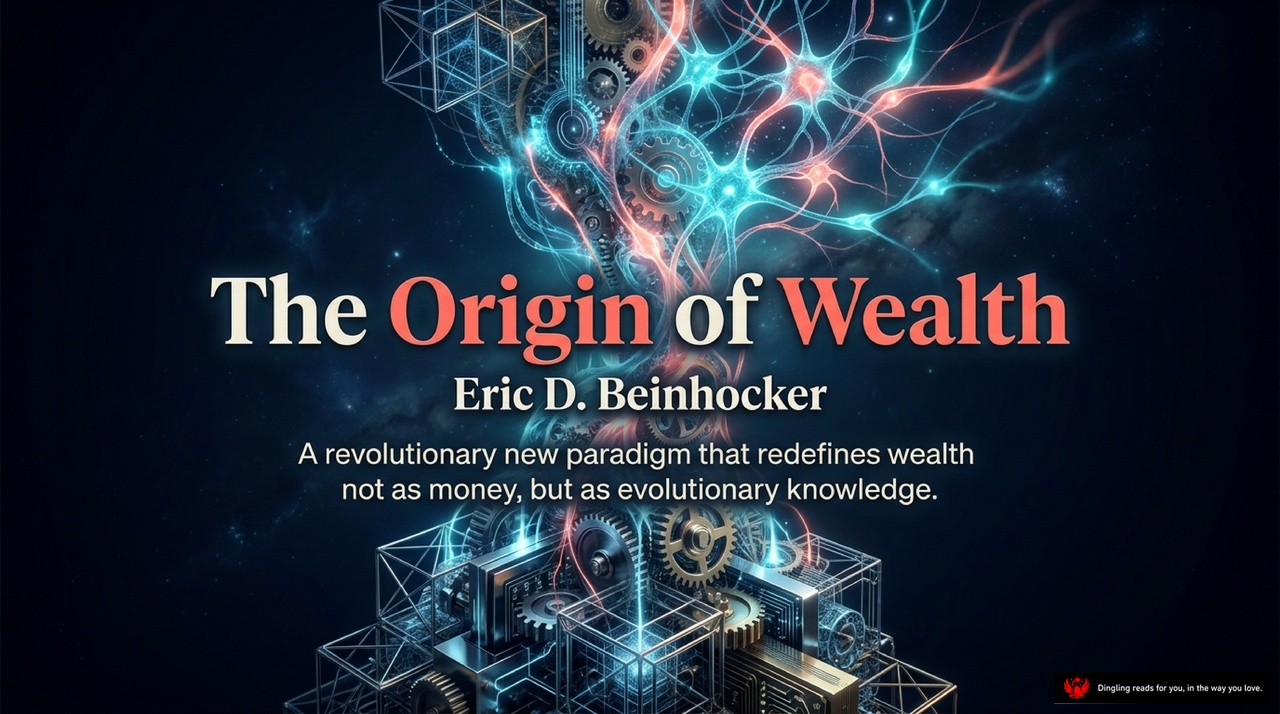
Welcome to the beginning of a journey that changes how we see money. For centuries, we've been taught that wealth is simply the accumulation of things—cash in the bank, gold in the vault, or stocks on a screen. But what if that definition is completely wrong?
Today, we are flipping the script with a revolutionary new paradigm introduced by Eric D. Beinhocker in his book, *The Origin of Wealth*. As the title suggests, this isn't just about economics; it's about the very origin of value itself.
The core idea is stunningly simple yet profound: Wealth is not money. Wealth is evolutionary knowledge.
Think about it. For over two and a half million years, human history has been a story of survival turning into development. From the first stone tools to the complex global supply chains we rely on today, every breakthrough was essentially new knowledge being created and shared. When the Maasai tribe in Kenya valued cattle, they were measuring a specific type of knowledge—how to herd, breed, and trade them. In our modern world, that knowledge has evolved into software, patents, and business models.
The book argues that the economy isn't a machine that runs on fixed rules, waiting for external shocks to move it. Instead, the economy is a living, breathing, complex adaptive system. It evolves through a process similar to natural selection: variation, selection, and amplification. Just as life evolves through trial and error, economic systems constantly generate new ideas—some fail, some succeed, and the successful ones are copied and scaled up.
This shift in perspective is everything. It moves us away from the old idea of a perfect, predictable equilibrium and toward a reality where uncertainty, innovation, and continuous change are the only constants. We are not just counting assets; we are tracking the speed at which human knowledge expands and solves problems.
So, forget the traditional view of wealth as a static pile of resources. The true origin of wealth lies in the dynamic, evolving process of creating the knowledge that allows us to build a better future. Welcome to the new way of thinking about economics.
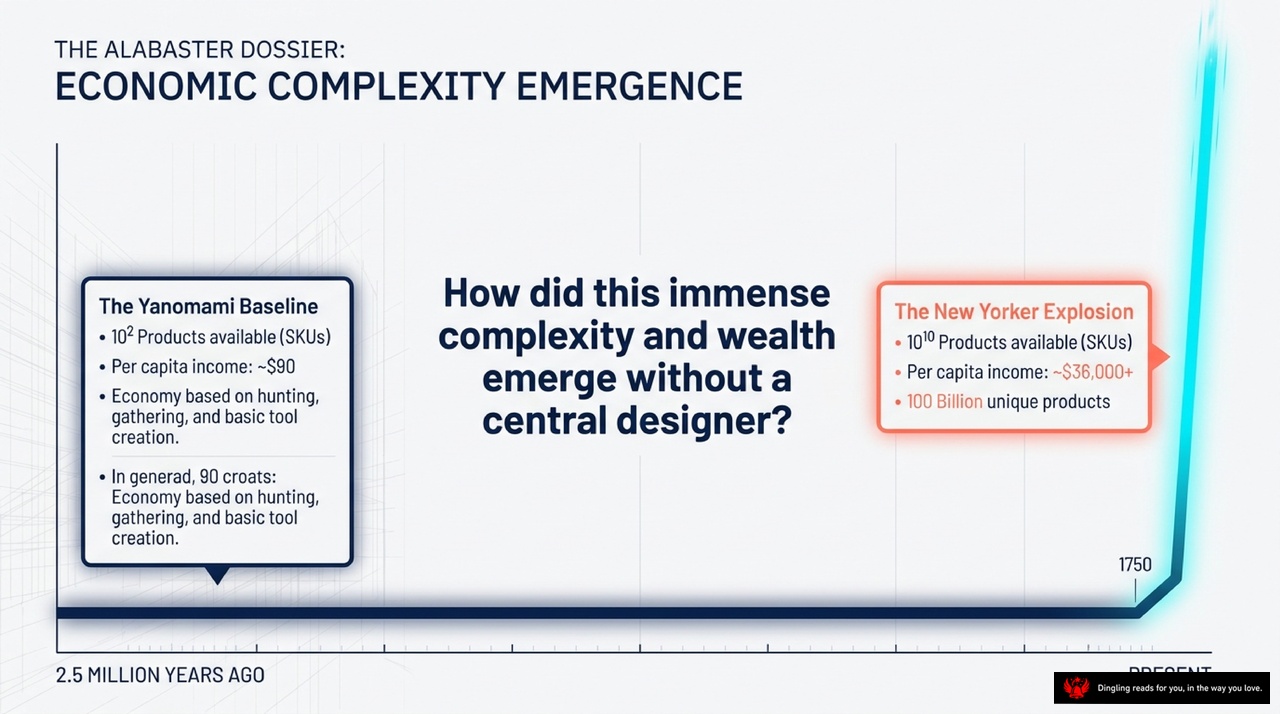
Imagine the dramatic leap from the Yanomami baseline to the New Yorker explosion. On the left, we see a world of 100 products and roughly $90 per capita income, built on hunting and gathering. On the right, just a few centuries later, we are looking at a staggering 10 to the 10 products available, a per capita income soaring past $36,000, and an unimaginable 100 billion unique products. This isn't just a line on a graph; it's the story of how immense complexity and wealth emerged without a single central designer.
So, how did this happen? The answer lies in the very nature of economic evolution. Think of it as a massive, self-organizing system where countless commercial plans are constantly being tried, tested, and either amplified or discarded. Just as nature selects the best-adapted species, our economy selects the most valuable ideas. When a business model works, it gets copied and scaled; when it fails, it vanishes. This process of variation, selection, and amplification creates the intricate web of global trade and innovation we see today.
The graph shows us that this wasn't a slow, steady climb. Instead, it was a long period of relative stillness followed by a sudden, explosive acceleration around 1750. This shift wasn't caused by a master plan from above. It was the result of physical technologies, social technologies, and business designs evolving together in a feedback loop. A small improvement in tools or a new way of organizing work could trigger a cascade of changes, unlocking new possibilities and driving the economy forward at an ever-faster pace.
The key takeaway here is that complexity doesn't require a designer. It emerges from the bottom up, driven by human ingenuity and the relentless pressure of competition. We didn't plan for 100 billion unique products; we simply created the conditions where the best ideas could survive and thrive. This perspective changes everything about how we understand wealth and progress. It tells us that the future isn't something to be predicted or controlled, but something to be shaped through experimentation and adaptation. The next time you look at the vast array of products and services in your life, remember: this incredible diversity is the result of millions of tiny, local decisions interacting over time, creating a global system far more complex and powerful than any single mind could have designed.

Traditional economics has long relied on a flawed metaphor: imagine a marble in a bowl. No matter how you shake it, the marble eventually settles at the bottom, reaching a state of perfect, static equilibrium. This is the old map, borrowed from Newtonian physics, which treats the economy as a closed, mechanical system always seeking balance. But this view has a massive blind spot. It treats innovation, technological leaps, and even market crashes as just "weather shocks"—external forces pushing the system around, rather than internal dynamics. It fails to explain how new wealth is actually created; it only explains how existing wealth gets redistributed.
Complex economics flips this script. Instead of a bowl, think of the economy as a turbulent, swirling river. It's an open, dynamic system where order emerges from chaos. We aren't just waiting for the system to settle; we are actively creating new patterns, new strategies, and new wealth through constant interaction and evolution. The river never stops flowing, and that's exactly where the opportunity lies.

Look at this slide, "The Paradigm Shift." It's a stark comparison between how we used to think about the economy and how complexity economics sees it today. On the left, you have the old way: Traditional Economics. It assumes a static, closed system where perfectly rational robots interact only through prices, and the macro economy is just the sum of all the micro parts. It's mechanistic, like a clockwork machine.
But on the right, we have the new reality: Complexity Economics. This view treats the economy as a dynamic, open system. Agents aren't perfect calculators; they are humans who learn, make mistakes, and adapt. Networks aren't just price signals; they are direct, tangled webs of interaction. Here, the macro doesn't just add up from the micro; it emerges organically from the bottom up. Instead of a mechanical engine, the economy runs on an evolutionary, biological engine.
The shift is fundamental. We are moving from a world of equilibrium and prediction to one of far-from-equilibrium dynamics and emergence. This isn't just a theoretical tweak; it's a complete reimagining of how value is created and how the economy actually works.

The economy isn't a machine we can fine-tune to a perfect equilibrium; it's a living, breathing complex adaptive system. Look at this landscape of peaks and bursts—it visualizes the concept of **emergence**. Things like wealth inequality, market crashes, and sudden booms aren't errors in a broken system. They are the natural, organic outcomes of an open ecosystem where billions of agents interact.
Think about the connection between the micro and the macro. Just as a single water molecule isn't "wet," but a billion of them create a whirlpool, simple micro-behaviors—like individuals seeking resources—organically generate massive, unequal macro-structures. We don't need a central designer to orchestrate this; the complexity arises from the interactions themselves.
This shifts how we see the economy. It's not a predictable clockwork, but an evolutionary process driven by variation, selection, and amplification. It's a system where small changes can ripple into huge shifts, creating the dynamic, uneven terrain we see today.
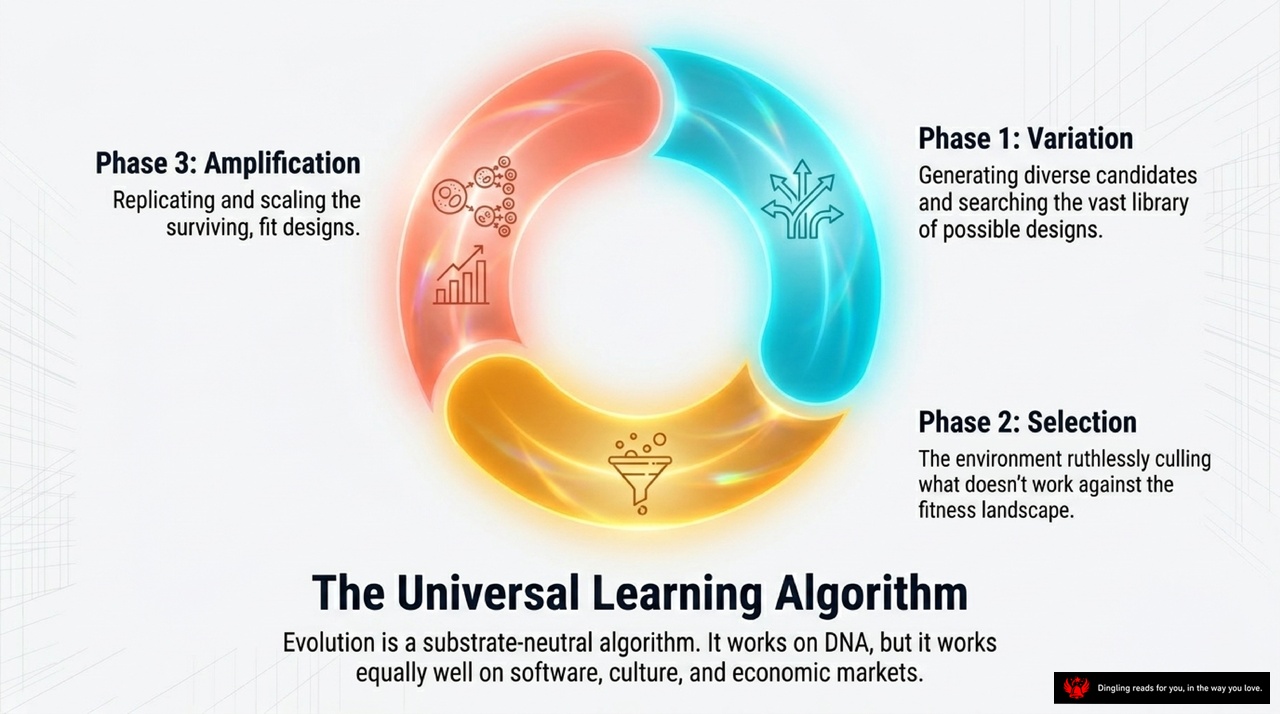
The Universal Learning Algorithm isn't just a theory; it's the engine driving everything from biological life to our modern economy. Look at this cycle: Variation, Selection, and Amplification. It starts with generating diverse candidates—exploring a vast library of possibilities, much like trying thousands of business plans or genetic mutations. Then comes the ruthless filter: the environment culls what doesn't work, keeping only those that fit the current landscape. Finally, successful designs get replicated and scaled, turning a winning idea into a dominant force.
This is evolution in action, and it's substrate-neutral. It works on DNA, but it works equally well on software, culture, and economic markets. That's why we see boom and bust cycles, why certain tech innovations explode while others fade, and why wealth isn't just about hoarding resources. It's about creating "fit" orders—systems and strategies that adapt to human needs and survive the competition. Whether it's a new business model or a societal shift, if it can't navigate this cycle of variation, selection, and amplification, it gets left behind. Understanding this algorithm helps us stop trying to predict the future and start building systems that can evolve with it.

Look at this visual timeline of Force 1: Physical Technology. It starts on the left with a raw tree, symbolizing nature, and flows into a hammer, a wheel, a steam engine, and finally, a glowing microchip on a circuit board. This isn't just a history of tools; it's a story of how we learned to transform matter, energy, and information to serve our own purposes.
The text at the bottom captures the essence perfectly: "Physical technology evolves by constantly combining existing tools into new, exponentially more complex structures." Think about it. We started with simple stones and sticks, then moved to the wheel and the steam engine, and now we are living in the age of silicon. Each step wasn't just an upgrade; it was a fundamental shift in how we interact with the world.
This evolution follows a distinct S-curve. New technologies begin with slow progress, then hit a tipping point where performance explodes, and finally, they mature and plateau. But here is the critical insight for us today: the space between these curves is where the real magic happens. It's where the old guard often fails because they are too focused on squeezing the last drop of value from the old technology, while the new disruptors are building the next curve.
From the hammer to the chip, this force has been the engine of human progress. It's not just about making things; it's about creating the very structures and systems that allow us to build wealth, innovate, and thrive. As we move forward, remember that every great leap in our economy, from the Industrial Revolution to the Digital Age, is rooted in this relentless drive to combine and evolve our physical tools.
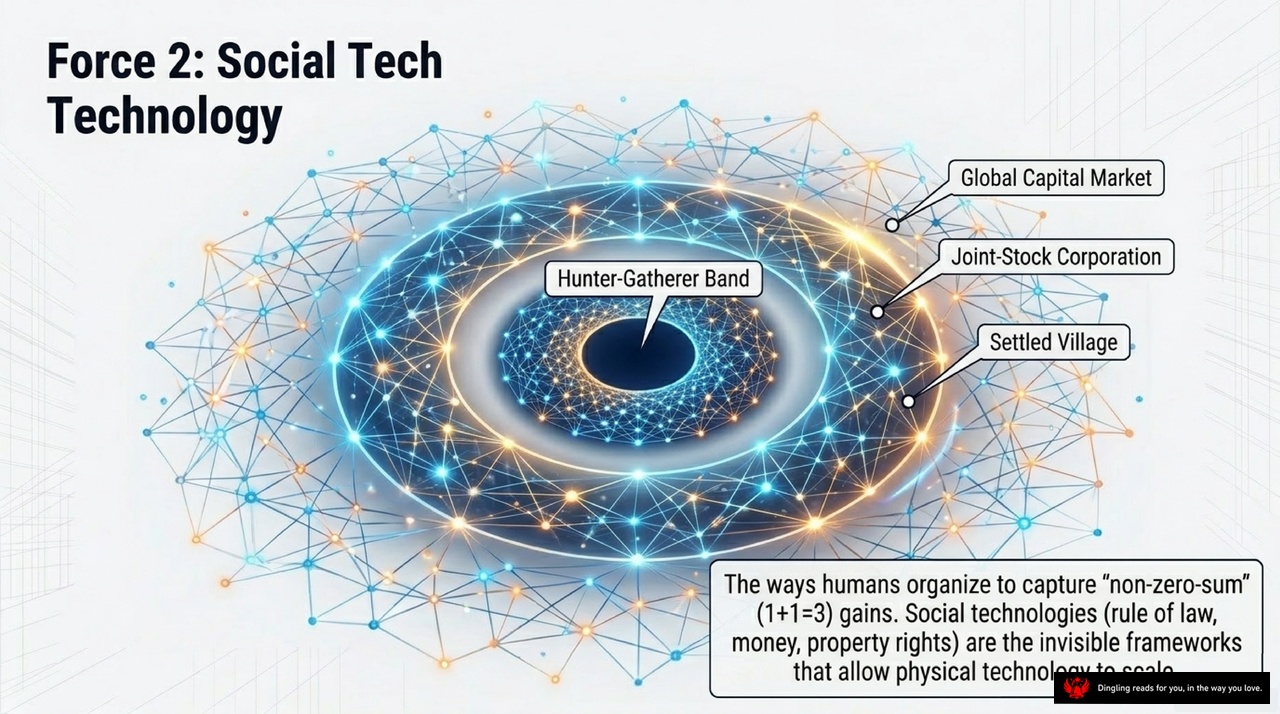
Force 2: Social Tech Technology. Look at this diagram. At the very center, we have the Hunter-Gatherer Band. As we move outward, we see the evolution into Settled Villages, then Joint-Stock Corporations, and finally, the Global Capital Market. This visual represents the core idea of Social Tech: the invisible frameworks that allow physical technology to scale.
Think about it this way. Imagine you have a brilliant new invention, a piece of physical technology. On its own, it's just an object. It might be useful to one person, but it can't create massive wealth or transform the world by itself. That's where Social Tech steps in. It acts like the operating system for our economy.
The text on your slide explains this perfectly: "Social technologies, like the rule of law, money, and property rights, are the invisible frameworks that allow physical technology to scale."
Let's break down what that means in real life. Take the concept of a "Joint-Stock Corporation." Without this social invention, a single rich person could never build a ship that circles the globe or a factory that employs thousands. The corporation is a social technology. It allows strangers to pool their resources, share risks, and coordinate actions across vast distances. It turns a chaotic group of individuals into a unified, powerful entity.
Similarly, look at the "Global Capital Market." This is another layer of social tech. It allows capital to flow instantly from savers in one country to innovators in another, fueling growth on a planetary scale. Without the trust that money has value and that contracts are honored, these massive networks would collapse instantly.
We are moving from small, face-to-face groups where everyone knows everyone, to complex, global networks where we rely entirely on these invisible rules to function. These rules—our laws, our financial systems, our property rights—are the glue that holds our modern world together. They are the force that multiplies the impact of our tools, turning simple human ingenuity into the global economy we see today.
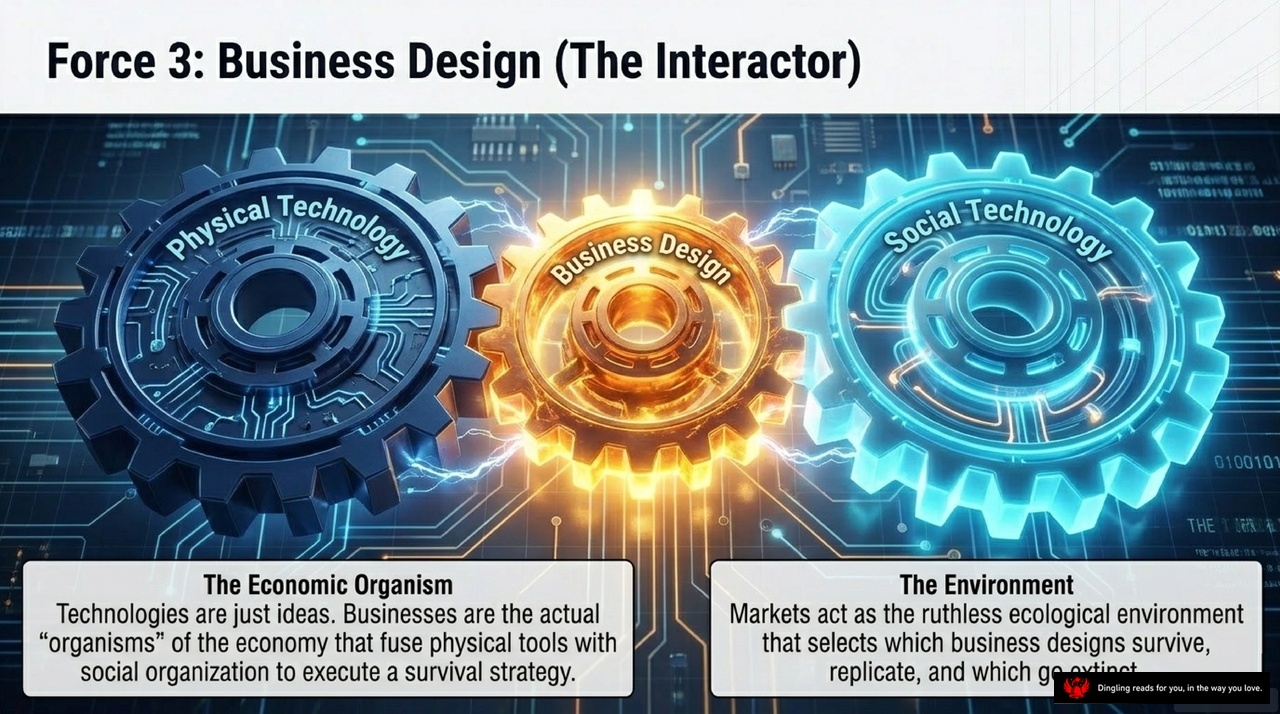
Force 3: Business Design (The Interactor). Look at these three gears: Physical Technology, Social Technology, and Business Design. They aren't just separate parts; they are the engine driving economic evolution. Think of businesses as living organisms in a market ecosystem. They fuse physical tools with social organization to execute a survival strategy. But here's the catch: the market acts as a ruthless ecological environment. It constantly selects which business designs survive and replicate, while forcing others to go extinct.
This isn't about a master plan. It's about co-evolution. When physical technology advances, like the invention of the computer, it creates new possibilities for social organization, like remote work. But you can't have that new social structure without a corresponding business design to organize it. Conversely, a brilliant business idea needs the right tools and social norms to take root. If you try to push one gear without the others turning, the whole system jams.
So, what does this mean for you? It means there is no single "best" strategy that lasts forever. The winning formula is always a dynamic combination of these three forces, constantly adapting to the environment. Just like nature, the economy rewards those who can best integrate new tools with new ways of working. If you ignore the evolution of technology or social norms, your business design becomes obsolete, and eventually, you get left behind. The key is to keep all three gears spinning together.
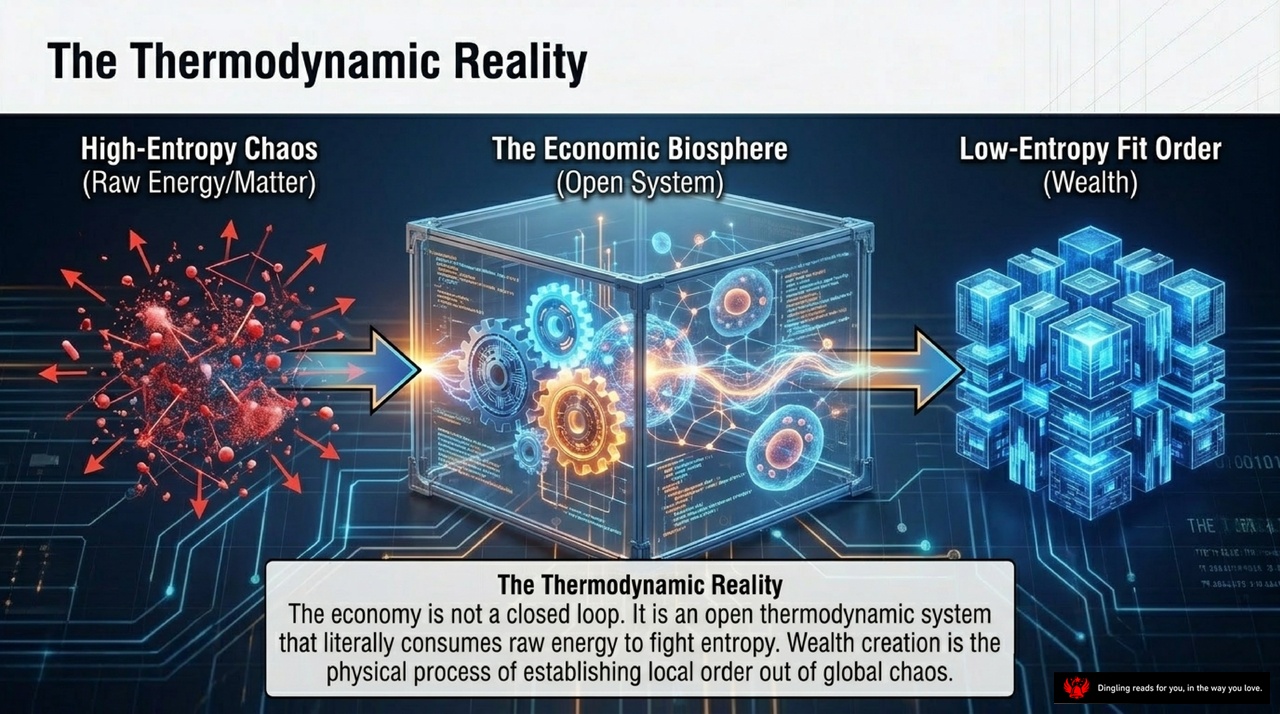
Look at this diagram: "The Thermodynamic Reality." It visualizes the economy not as a closed loop, but as an open thermodynamic system. On the left, we see "High-Entropy Chaos"—raw energy and matter scattered in disorder. On the right, we see "Low-Entropy Fit Order," which we define as wealth. The middle box represents "The Economic Biosphere," an open system where transformation happens.
The core insight here is that wealth creation is a physical process. It is literally the act of fighting entropy. Just as life requires energy to build order against the natural tendency toward chaos, the economy consumes raw resources to establish local order out of global chaos. Every time we build a factory, craft a product, or organize a service, we are taking disordered inputs and converting them into a structured, useful output. This reduction of local entropy is what we value as economic value. Without this constant input of energy and work to create order, everything would simply dissolve back into chaos. So, remember this: wealth isn't just numbers on a screen; it is the physical manifestation of organized order standing firm against the relentless push of disorder.
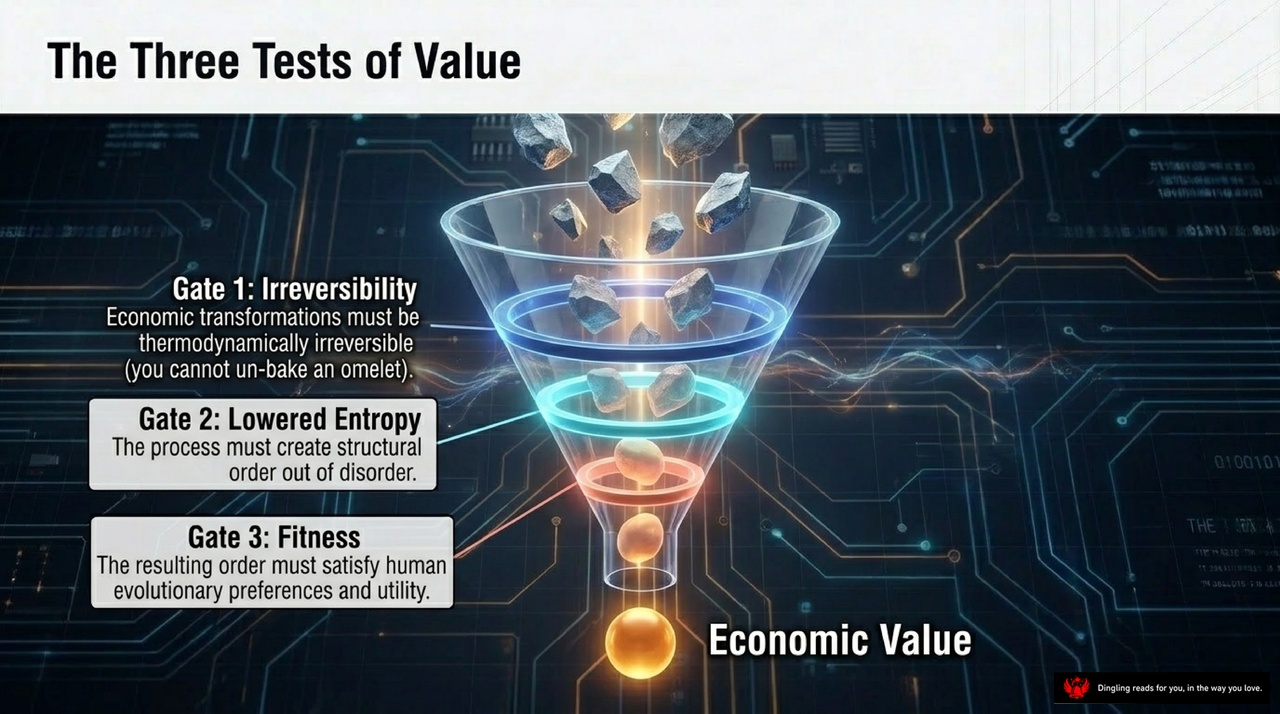
So, how do we actually identify what creates real economic value? The slide outlines a rigorous three-step filter, essentially a funnel that separates genuine wealth from mere chaos.
First, we have Gate 1: Irreversibility. Think of it as a thermodynamic checkpoint. Just like you can't un-bake an omelet or reverse the burning of coal, any process that creates economic value must be irreversible. Time only moves forward, and true value creation involves a permanent transformation of matter, energy, or information.
Next, we move to Gate 2: Lowered Entropy. This is about creating order out of disorder. Value isn't just about having things; it's about organizing them efficiently. Whether it's weaving raw fibers into a structured fabric or refining chaotic ore into precise metal, the process must reduce local chaos to create something useful.
Finally, we arrive at Gate 3: Fitness. This is the ultimate human test. The resulting order must actually satisfy our evolutionary preferences and utility. It's not enough to create something organized; it must be something we actually want and need. If a structure doesn't align with human goals, it has no economic value, no matter how perfectly ordered it is.
Only when a process passes all three gates—being irreversible, creating order, and satisfying human needs—does it truly emerge as Economic Value.
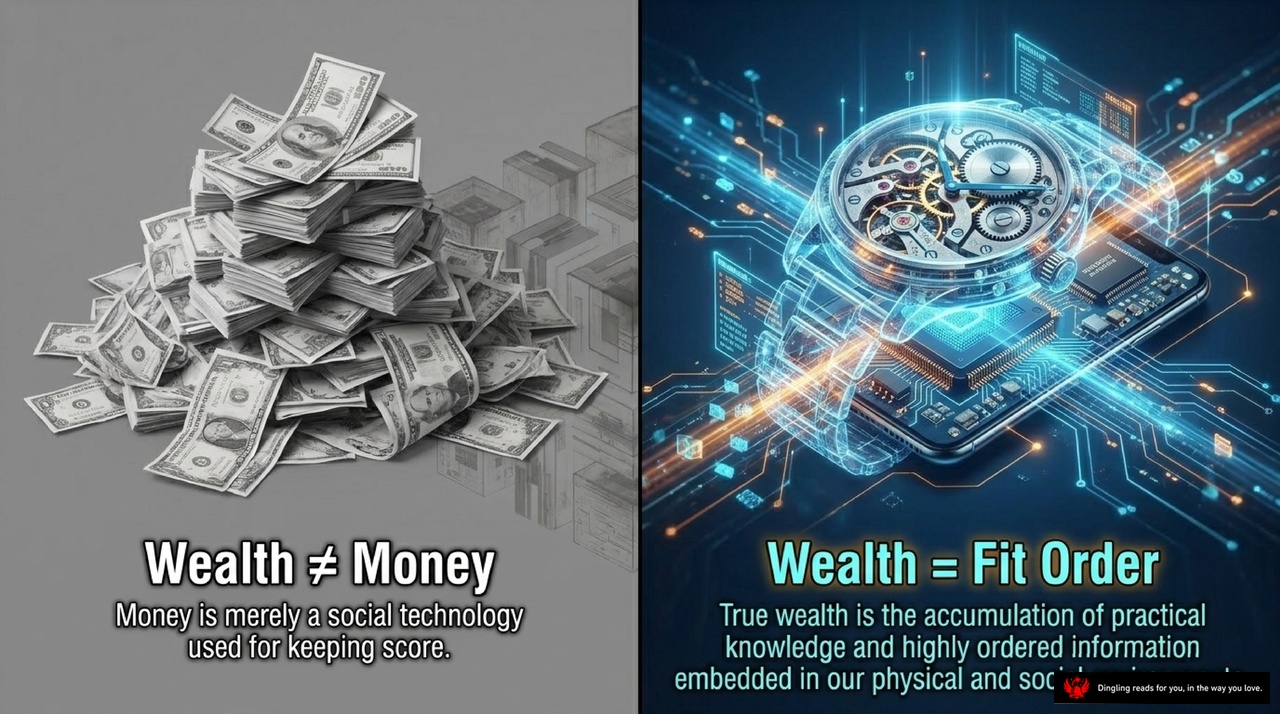
Money is just a social technology we use to keep score—a pile of paper with no inherent power to change the world. But true wealth? That's something entirely different. It's not about the cash in your pocket; it's about "Fit Order."
Think of it this way: real wealth is the accumulation of practical knowledge and highly ordered information embedded in our physical and social lives. When you look at that high-tech watch on the right, you're seeing the essence of this concept. It represents a sophisticated, organized system of information and design that solves problems and creates value. That structured complexity is what we call wealth.
In contrast, the stack of cash on the left is just a scorecard. It's a token of value, yes, but it's not the value itself. You can have millions in the bank and still lack the knowledge, the skills, or the organized systems to actually create something new. Wealth is the engine; money is just the receipt.
The book argues that throughout human history, we've been building these "fit orders"—from the simple tools our ancestors crafted to the complex digital networks we use today. Every time we create a new, more efficient way to organize information or physical resources, we generate wealth. It's about creating order out of chaos that actually serves human needs. So, when we talk about building wealth, we aren't just trying to hoard dollars. We are trying to design better systems, accumulate deeper knowledge, and create more order in our lives. That is the true definition of getting rich.
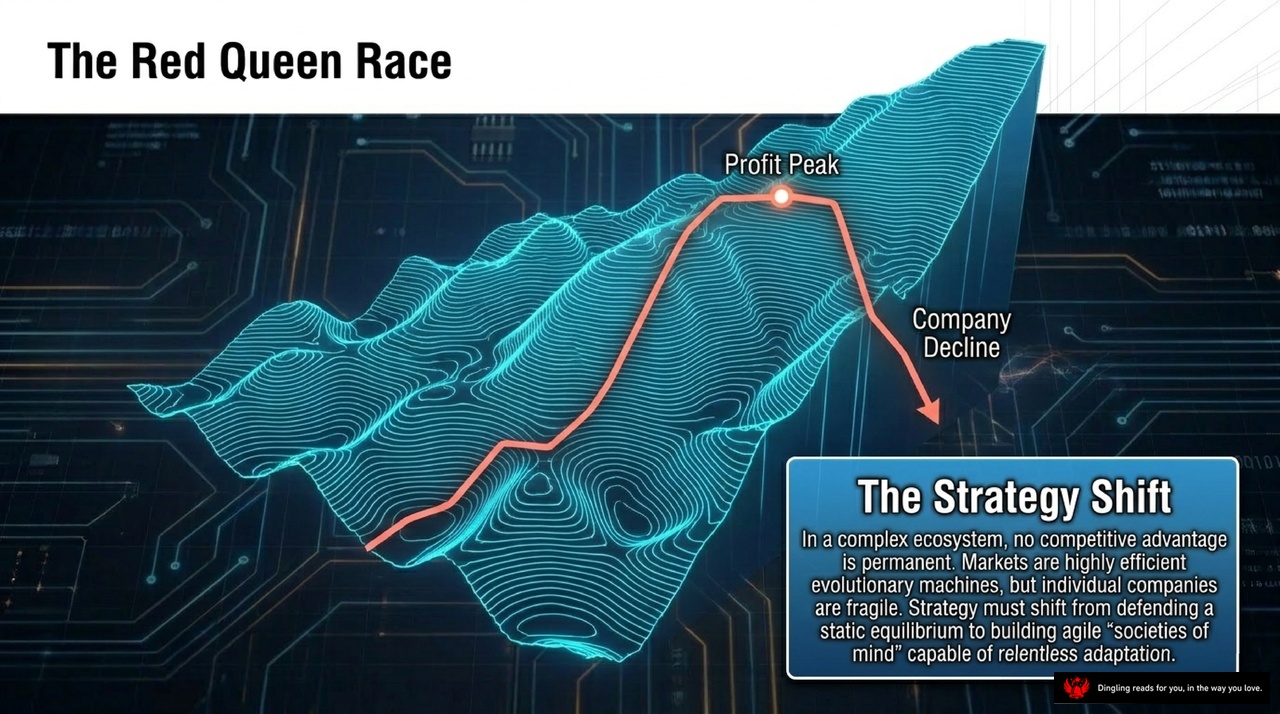
The Red Queen Race isn't just a metaphor; it's the brutal reality of modern business. Look at that curve on the screen. You climb the mountain of innovation, hit a Profit Peak, and then—inevitably—slide into Company Decline. Why? Because in a complex ecosystem, no competitive advantage is permanent. Markets are highly efficient evolutionary machines, but individual companies are fragile.
The key takeaway here is The Strategy Shift. We can no longer rely on defending a static equilibrium. That era is over. Instead, strategy must shift from holding the line to building agile "societies of mind" capable of relentless adaptation. Just like in nature, where you have to run just to stay in place, businesses must constantly evolve or risk being left behind. The only way to survive the Red Queen Race is to make adaptation your core strategy, not an afterthought.
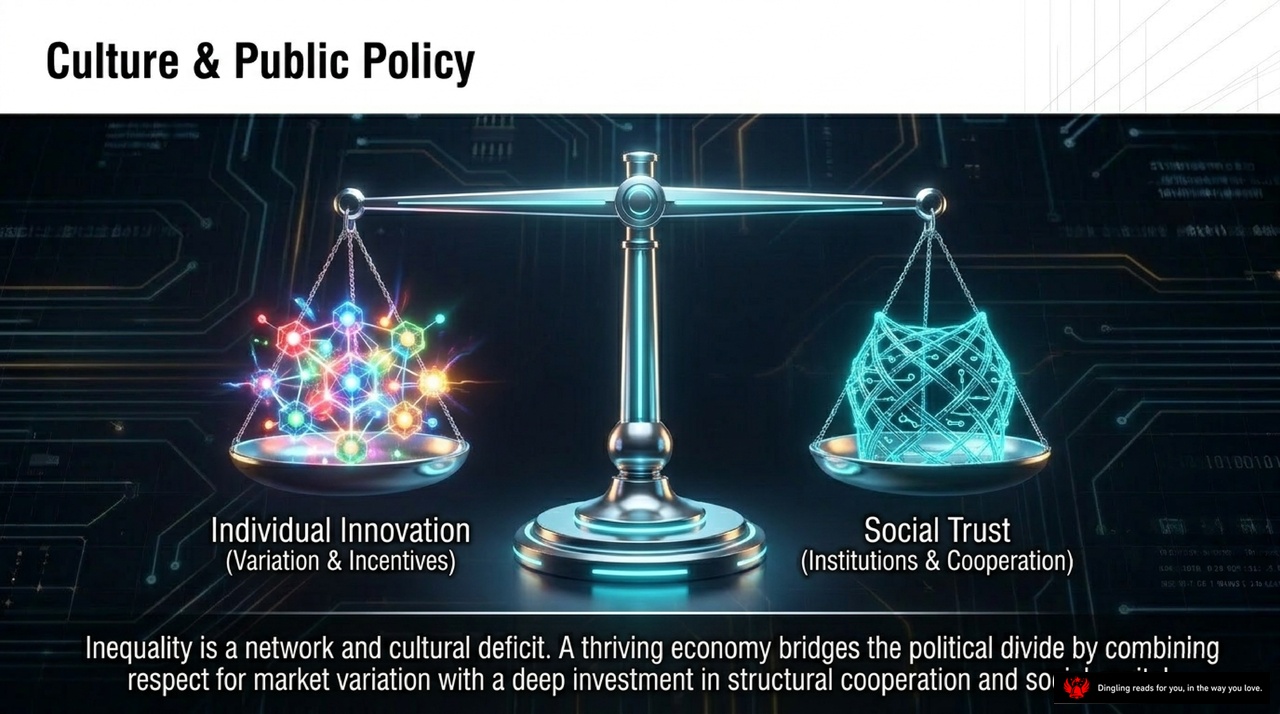
Culture & Public Policy isn't just about balancing budgets; it's about balancing the very DNA of our society. Look at this scale: on one side, we have Individual Innovation, fueled by variation and incentives—the spark that drives new ideas. On the other, we have Social Trust, built on institutions and cooperation—the glue that holds us together.
Traditional economics often treats these as separate forces, but reality shows they are deeply intertwined. As we've discussed, inequality isn't just a number; it's a network and cultural deficit. When trust erodes, cooperation falters, and the very mechanisms that allow innovation to thrive begin to collapse. Conversely, without the risk-taking freedom that comes from a supportive environment, innovation stalls.
A thriving economy bridges the political divide not by choosing one side over the other, but by combining our respect for market variation with a deep investment in structural cooperation. It's about creating a system where individual brilliance can flourish within a framework of shared trust. When we nurture both the capacity to invent and the willingness to collaborate, we unlock the true potential for growth and stability. This balance is the key to navigating the complex challenges of our modern world.

Imagine holding the future in your fingertips, not as a static treasure to hoard, but as a living, breathing ecosystem waiting to be shaped. Today's slide challenges a fundamental misconception: wealth isn't a finite resource we guard, but a continuous evolutionary process. It's about creating "fit order" and knowledge.
Think of the economy not as a predictable machine, but as a complex, dynamic system. When we shift our perspective to see it this way, we unlock the true engine of human progress: Variation, Selection, and Amplification. These aren't just buzzwords; they are the biological laws driving our economy. Just as nature selects the fittest species, the market selects the most valuable ideas and business models, amplifying those that work while letting the rest fade away.
But here lies the critical question for our organizations today. If wealth is ultimately the accumulation of this adaptive knowledge, are we building companies designed to relentlessly evolve, or are we stuck waiting for old mechanics to fail? The difference between a thriving ecosystem and a dying machine comes down to one thing: do we embrace the chaos of variation and selection, or do we cling to the illusion of a perfect, unchanging equilibrium? The future belongs to those who understand that progress is never guaranteed—it's always being created.