The Origin of Wealth: Reader Reviews & Ratings

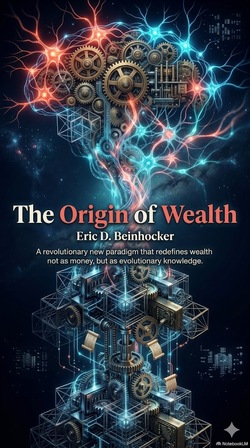
The Origin of Wealth
Loading…

The Origin of Wealth

Eric D. Beinhocker

Write a Review

Your Review

0/500

Other reviews

23 total
Gia

Beinhocker proves traditional equilibrium models fail to explain modern wealth, using clear examples like the 2008 crisis and FAANG growth to show how variation, selection, and amplification drive real economic evolution instead of static predictions.

Arturo

Beinhocker's evolutionary model replaces static equilibrium with variation-selection-amplification, explaining how wealth emerges from dynamic feedback loops rather than predictable rules.

Deirdre8

Beinhocker explains that wealth is fit order, not static money, using clear examples like the 2008 crisis and toilet paper shortages to show why traditional equilibrium models fail to predict real-world chaos, making complex economics feel like a necessary and practical tool for understanding how our dynamic, messy modern economy actually creates value through evolution rather than rigid rules, which helps me see that inequality and innovation are natural outcomes of feedback loops and co-evolving technologies instead of moral failures or simple policy fixes, ultimately offering a refreshing perspective on navigating uncertainty.

Keith

Beinhocker replaces static equilibrium with an evolutionary model where variation selection and amplification explain wealth creation through complex adaptive systems instead of predictable rules.

Yvonne

I struggled with the concept of frozen accidents but found the Microsoft example very clear.

Theo

Beinhocker brilliantly replaces static equilibrium with evolution, showing how variation, selection, and amplification drive wealth. The 2008 crisis example proves traditional models failed because they ignored feedback loops and time delays in complex adaptive systems. His framework explains why tech booms happen while old industries stagnate, offering a realistic view of how economies actually evolve through messy trial and error rather than predictable formulas. This shift from rigid rules to dynamic processes helps us understand inequality and innovation as natural outcomes of system dynamics, not policy failures or moral flaws. The book also clarifies that wealth is fit order, meaning organized systems that solve real problems, not just money accumulation. For anyone tired of outdated economic theories, this evolutionary perspective is essential for navigating modern uncertainty.

Abby

Beinhocker replaces the outdated equilibrium model with an evolutionary framework. He explains how wealth is actually created through variation, selection, and amplification rather than a static balance. The idea that the economy is a complex adaptive system where feedback loops and time delays drive unpredictable outcomes is fascinating. I now understand why traditional models failed to predict the 2008 crisis. The concept of fit order, where wealth is organized systems that solve human needs instead of just money, is a powerful shift in perspective that makes sense of modern tech booms and financial crashes.

Irwin

Beinhocker's explanation of wealth as 'fit order' instead of just money was a revelation, helping me understand why traditional economic models fail to predict modern crises like the 2008 crash or the rise of tech giants through an evolutionary lens focused on variation, selection, and amplification rather than rigid equilibrium assumptions that simply cannot account for the messy, interconnected reality of how technology, social norms, and business strategies co-evolve to create real value in a complex adaptive system where feedback loops and time delays make linear predictions useless and where human decision-making relies on inductive heuristics instead of perfect rationality.

Deanna

The idea that wealth comes from evolving fit order instead of static equilibrium completely changed how I view economic history and current crises.

Seth

The idea that wealth is fit order rather than just money is a powerful shift in perspective.

Hazel

The book challenges traditional equilibrium models but feels a bit too optimistic about market self-correction and ignores how policy often exacerbates systemic risks rather than fixing them through these evolutionary cycles.

Blanche

The concept of fit order is powerful, yet the book struggles to fully address how inequality emerges from these very feedback loops that drive innovation, leaving readers wondering if evolution naturally favors the wealthy over the vulnerable without intervention.

Burt

Beinhocker explains how feedback loops and time delays create the unpredictability of modern markets, offering a much-needed alternative to static models that fail to account for the messy reality of human behavior and technological change.

Chris7

Beinhocker's evolutionary framework explains why traditional economics failed during the 2008 crisis by showing how interconnected feedback loops and positive feedback cycles, rather than stable equilibrium, drive modern economic systems where businesses test new ideas, the market selects successful ones, and amplification scales them, revealing that wealth is actually fit order created through variation, selection, and amplification instead of static balance, which helps us understand why tech companies grow exponentially while old models predict collapse, making complex adaptive systems the true engine of innovation and wealth in our unpredictable world.

Iris

Beinhocker explains the 2008 crisis better than any equilibrium model I have ever read before.

Rowan

The evolutionary framework makes complex economic dynamics suddenly clear.

Claire

I found the idea that traditional economics fails to predict modern crises really surprising and thought-provoking.

Fritz

This book completely changed how I see the economy.

Debbie

The idea that wealth is fit order instead of just money feels like a fresh perspective I needed.

Victoria01

This book completely changed how I view the economy as a living ecosystem instead of a static machine.