
The outsiders: Complete Chapter-by-Chapter Summary
Welcome to a book club session on "The Outsiders" by William N. Thorndike, Jr. Today, we're diving into a world where the greatest CEOs aren't the ones everyone sees on the cover of Fortune magazine, but the quiet, rational operators who quietly build massive wealth.
The cover promises us eight unconventional CEOs and their radically rational blueprint for success. And that's exactly what we find inside. While the world often worships figures like Jack Welch for their media presence and operational tweaks, Thorndike reveals a harsh truth: true greatness is measured by shareholder value, not headlines.
Think about it. Welch looked impressive on paper, but when you strip away the market boom he rode, his returns pale in comparison to legends like Henry Singleton. These "Outsiders" don't follow the herd. They reject the pressure to constantly expand or please Wall Street. Instead, they act like investors, focusing on capital allocation, buying back stock when it's cheap, and making bold moves while everyone else is frozen in fear.
From the math genius who built a conglomerate without a single headquarters to the media mogul who treated his company like a portfolio of assets, these leaders share one thing: a cold, hard commitment to rationality. They don't rely on charisma or industry jargon. They rely on data, patience, and the courage to do what's right for the shareholder, even when it goes against the grain.
So, are you an insider chasing trends, or an outsider building real value? Let's turn the page and explore how these eight leaders rewrote the rules of business.
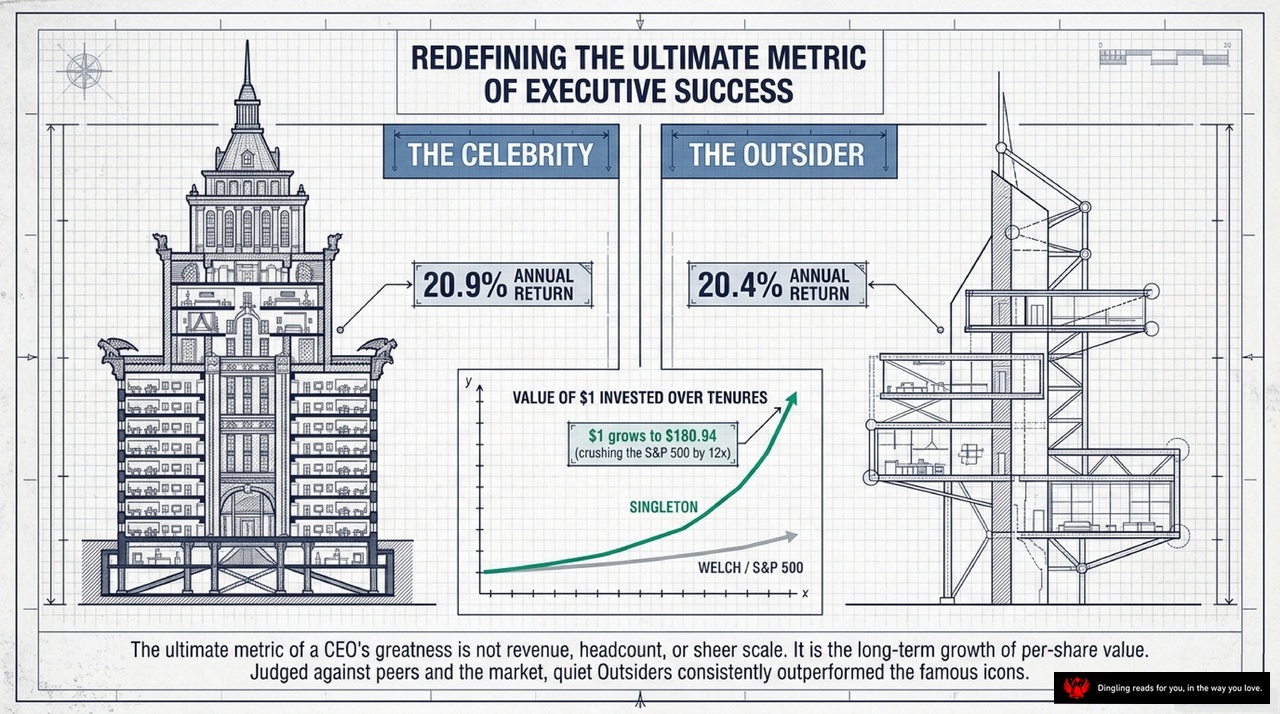
The ultimate metric of a CEO's greatness isn't about revenue, headcount, or sheer scale. It's about the long-term growth of per-share value. When we judge against peers and the market, quiet "Outsiders" consistently outperform the famous icons. Look at this blueprint: on the left, we have "The Celebrity," represented by the grand, ornate building. This is the archetype of the famous CEO—think Jack Welch, the media darling who loved the spotlight. His annual return was 20.9%, impressive, but let's look at the right side. There's "The Outsider," depicted as a stark, functional structure. This is the true operator who stays out of the headlines. Their annual return was 20.4%. At first glance, that 0.5% difference seems negligible, but the real story is in the middle, where the math tells the truth.
Notice the graph showing the value of $1 invested over tenures. For the Outsider, labeled "Singleton," that single dollar grows to $180.94, crushing the S&P 500 by 12 times. In contrast, the path for Welch and the broader market is significantly flatter. This visual proves a critical point: while celebrities rely on operational management and media influence to build empires, true legends like Singleton rely on the hard power of capital allocation. They don't just run the business; they reinvent it. As the text reminds us, the most successful CEOs aren't the ones everyone knows, but the ones who quietly maximize value for shareholders, often by doing the opposite of what the crowd expects.
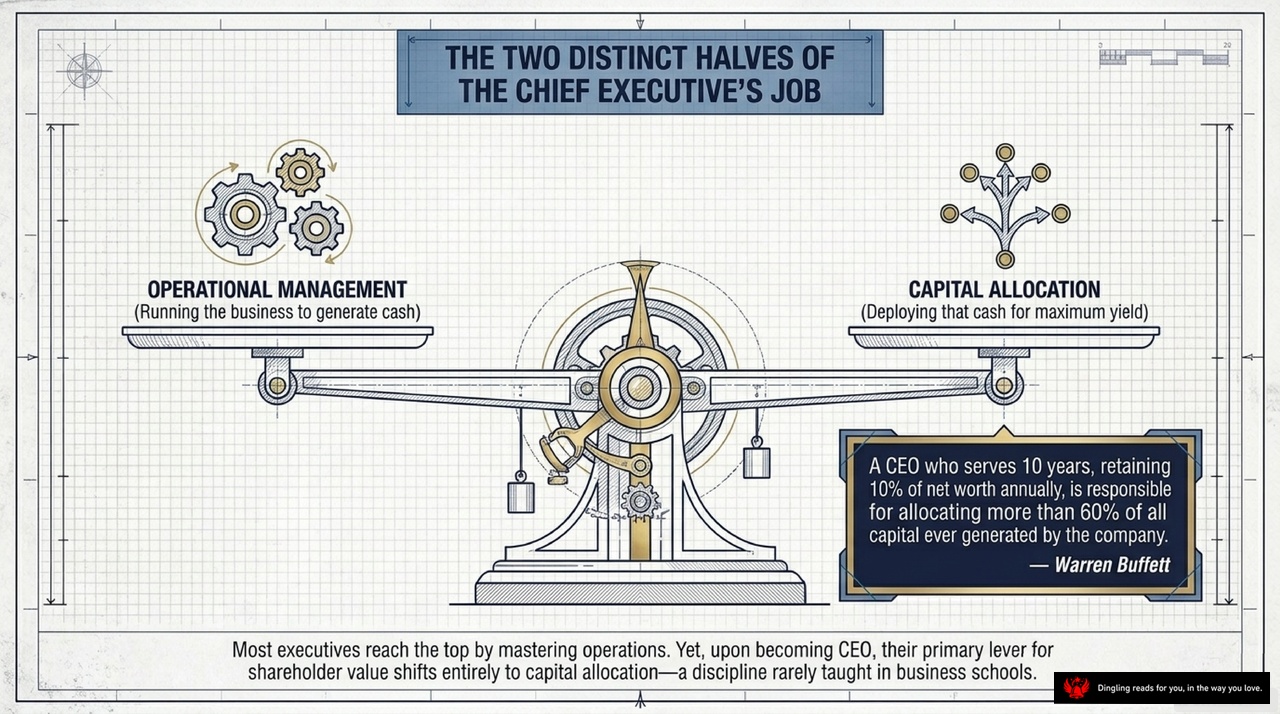
Picture this: a classic balance scale, perfectly centered. On the left, gears turning in a circle, labeled "Operational Management"—running the business to generate cash. On the right, arrows radiating outward, labeled "Capital Allocation"—deploying that cash for maximum yield.
This simple graphic captures the entire arc of a CEO's journey. Most executives climb to the top by mastering operations. They are the experts at building the engine, optimizing the factory, and driving the numbers up. But here is the critical shift: once you become the CEO, your primary lever for creating shareholder value doesn't stay with the gears. It shifts entirely to the other side of the scale—capital allocation.
Think about the math behind this. Warren Buffett put it perfectly: a CEO who serves for 10 years, retaining just 10% of the company's net worth annually, is responsible for allocating more than 60% of all capital ever generated by that company. That is an immense amount of power. The difference between a great CEO and a mediocre one often isn't how well they run the daily operations, but how wisely they decide where to send the company's money.
While business schools spend years teaching you how to manage people and processes, they rarely teach you how to allocate capital. Yet, that discipline is the true differentiator. It's the moment where the CEO stops being just the "head of operations" and starts acting as the ultimate investor for the firm, deciding whether to buy a competitor, buy back their own stock, or invest in new technology. That is where the real value gets created or destroyed.
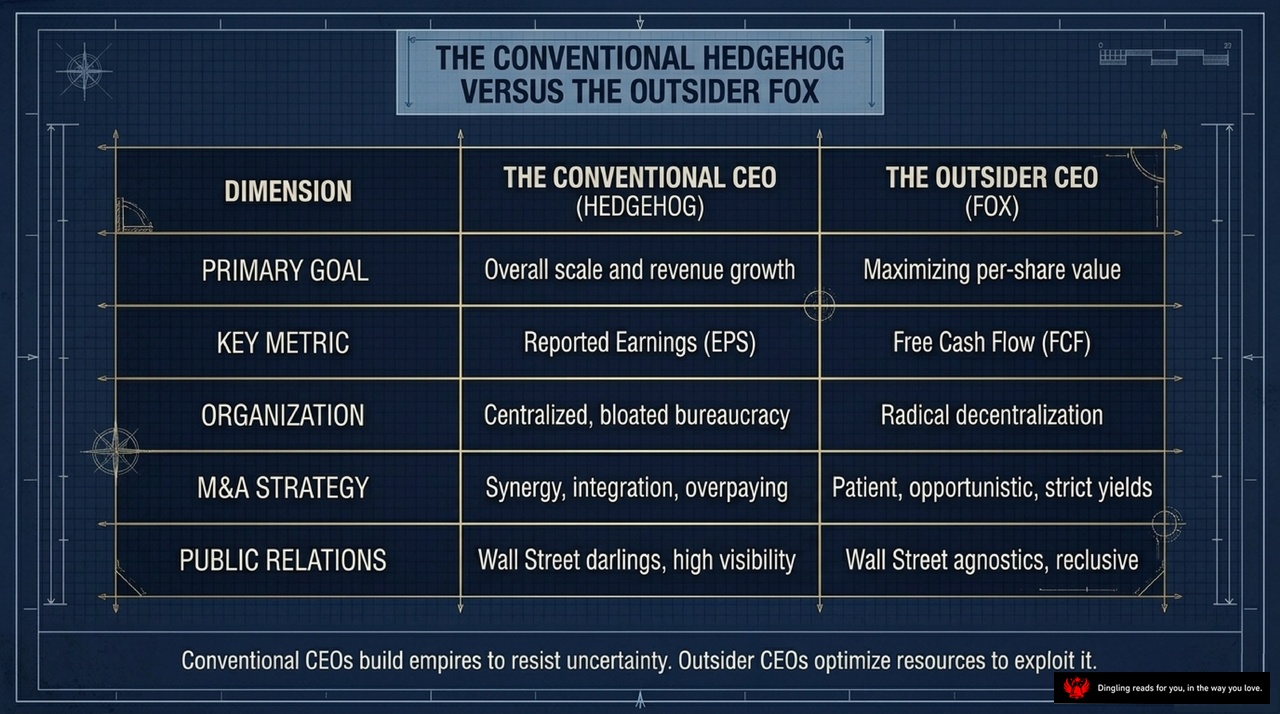
The chart on your screen lays out a stark contrast between two archetypes of leadership: The Conventional CEO, or the "Hedgehog," versus the Outsider CEO, the "Fox." This isn't just about personality; it's about fundamental strategy.
Let's look at the first row: the Primary Goal. The Hedgehog focuses on overall scale and revenue growth, often building empires to resist uncertainty. The Fox, however, is laser-focused on maximizing per-share value. They don't care about how big the train is; they care about getting to the station with the least amount of fuel.
This difference drives every decision. Notice the Key Metric. Hedgehogs chase Reported Earnings per Share, often engaging in accounting tricks to look good. Foxes ignore the noise and fixate on Free Cash Flow, because that's the only money that actually belongs to the shareholders.
Look at the Organization column. Hedgehogs build centralized, bloated bureaucracies where decisions get stuck in layers of approval. Foxes practice radical decentralization. They hire the best people and give them authority, keeping their own headquarters tiny. As we've seen with leaders like Warren Buffett and Henry Singleton, a small, lean headquarters is far more efficient than a massive middle management layer.
Their M&A strategies are opposites too. Hedgehogs love synergy stories, integration, and often overpaying for the next big thing. Foxes are patient and opportunistic. They wait for the market to misprice assets, then they buy and hold, or they buy low and sell high, prioritizing strict yields over hype.
Finally, Public Relations. Hedgehogs are Wall Street darlings, constantly in the media to boost their visibility. Foxes are Wall Street agnostics. They are reclusive, often ignoring analysts and focusing solely on the long-term health of the business, even if it means being misunderstood in the short term.
The bottom line, as the chart states, is that Conventional CEOs build empires to resist uncertainty, while Outsider CEOs optimize resources to exploit it. The Fox wins in the long run because they treat the company like an investment portfolio, constantly reallocating capital to its highest and best use.
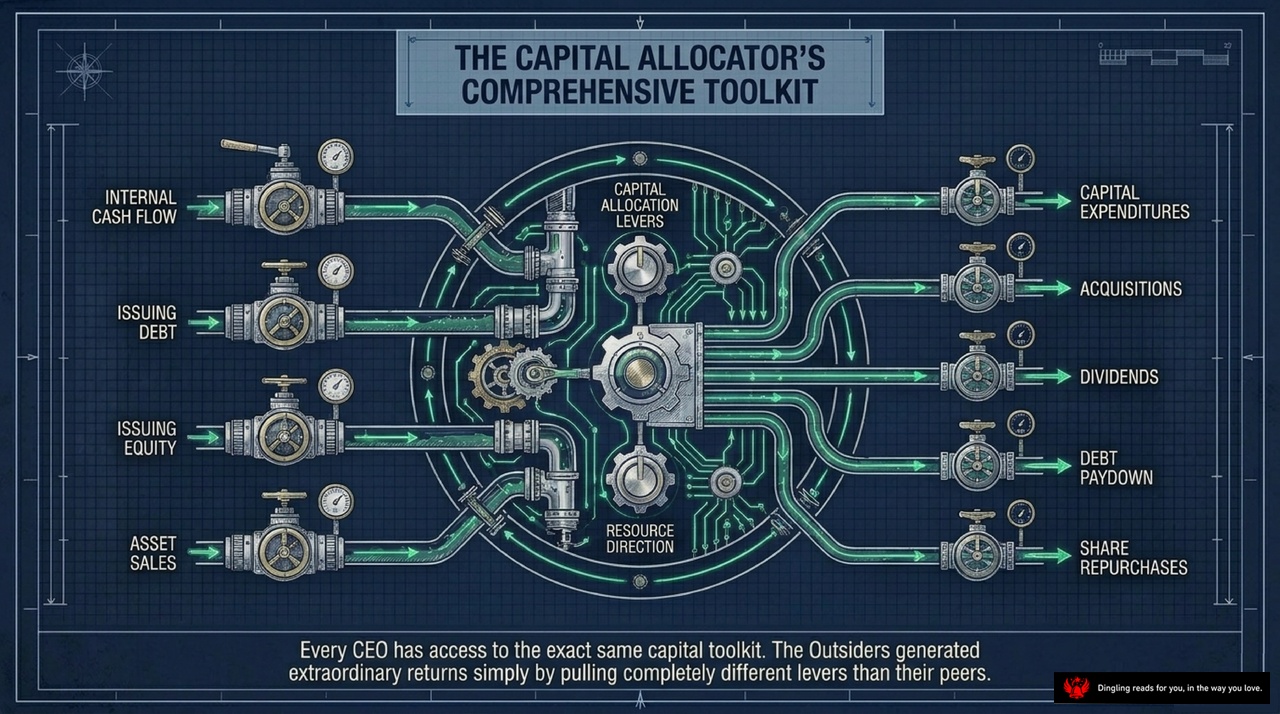
Bill Anders is the most legendary "outsider" CEO you'll ever meet, literally walking on the moon before leading a company. When he took over General Dynamics in 1989, the company was on the brink of bankruptcy, drowning in debt with a massive, obsolete fighter jet program that analysts said should be scrapped immediately. While the industry's standard playbook was to hire consultants, cut costs, and sell the company for a quick exit, Anders did something completely different.
He didn't just manage; he radically reimagined the business. His strategy was brutally simple: focus only on the top two positions in any market and ruthlessly cut everything else. He sold off half the company's businesses, including the very F-16 fighter jets he loved, just to unlock $5 billion in cash. This wasn't about growth for growth's sake; it was about survival and value creation.
Once he had that cash, Anders deployed it with surgical precision. He returned capital to shareholders through creative tax-efficient methods and strategic acquisitions, turning a failing defense contractor into a high-yield machine. His legacy isn't just about saving General Dynamics; it's about proving that when the industry is panicking and everyone is selling, the smartest move is often to buy low, strip out the inefficiencies, and own the best assets. Anders taught us that being an outsider means having the courage to do what the crowd refuses to do, turning a corporate crisis into a decades-long empire builder.
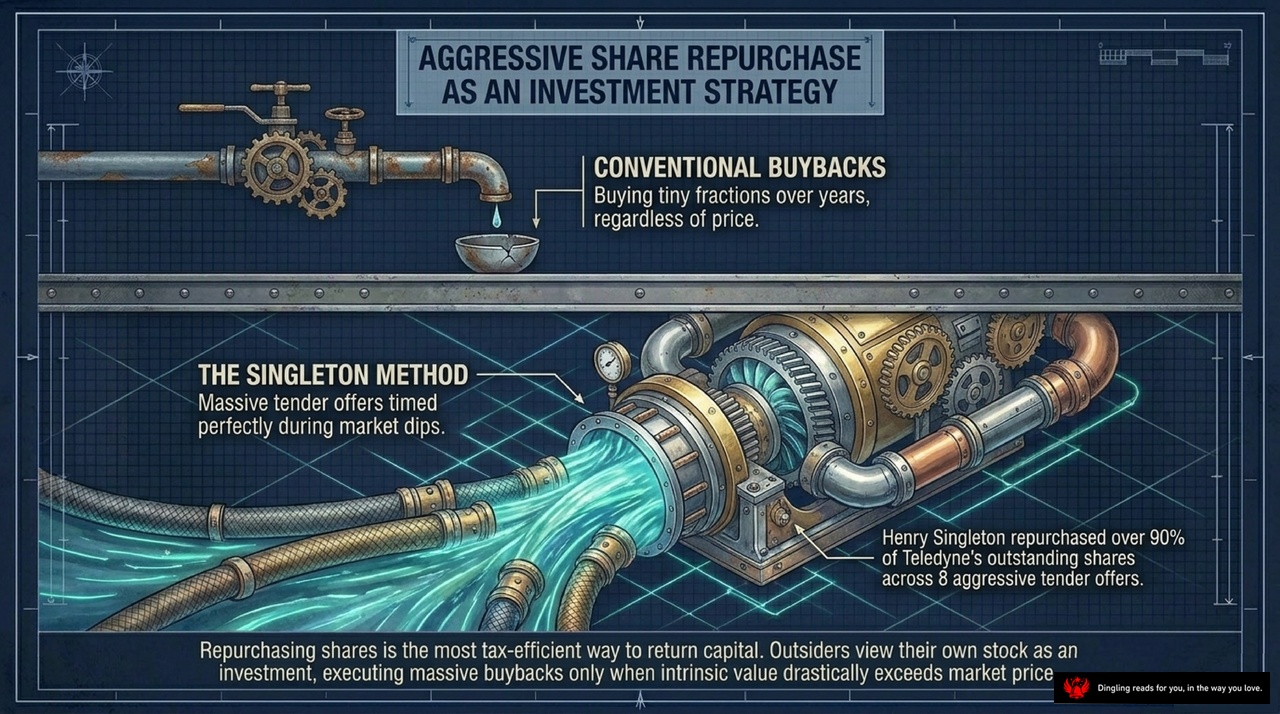
John Malone, often called the "Godfather of Cable," is a man who thinks like an engineer and acts like a ruthless investor. With nearly 9,000 square kilometers of land under his ownership and billions in assets sold, he built an empire not by building more, but by optimizing what he already had.
When Malone took over TCI in 1973, the company was drowning in debt—its liabilities were 17 times its revenue. He faced a crisis so severe he joked his starting point was "lower than whale feces." But instead of panic, he deployed a strict, almost military-style culture of frugality. Offices had peeling paint, executives stayed in motels, and the headquarters operated with just a handful of people. He believed that every dollar spent on overhead was a dollar stolen from the shareholders.
But Malone's true genius wasn't just in cutting costs; it was in his masterful capital allocation and platform strategy. He viewed TCI not just as a cable operator, but as a platform to acquire content. He partnered with Ted Turner and others, trading access to his millions of subscribers for equity in content companies like Turner Broadcasting. This gave TCI exclusive programming that competitors couldn't match, creating a moat that was both deep and wide.
When the satellite TV threat finally arrived, Malone didn't fight it head-on with expensive infrastructure upgrades. Instead, he made the rational, counter-intuitive move to sell the entire company to AT&T. He negotiated a deal that allowed shareholders to avoid capital gains taxes, effectively doubling the value of their investment. By selling at the peak of the cycle, he turned a struggling regional provider into a legendary success story, delivering a 30% compound annual return.
Malone's legacy is a lesson in the power of leverage and engineering thinking. He used debt strategically to amplify returns, he treated tax avoidance as a core strategic pillar rather than an accounting afterthought, and he never let emotion dictate his exit strategy. He proved that in business, the smartest move is often the one that looks most different from everyone else's.
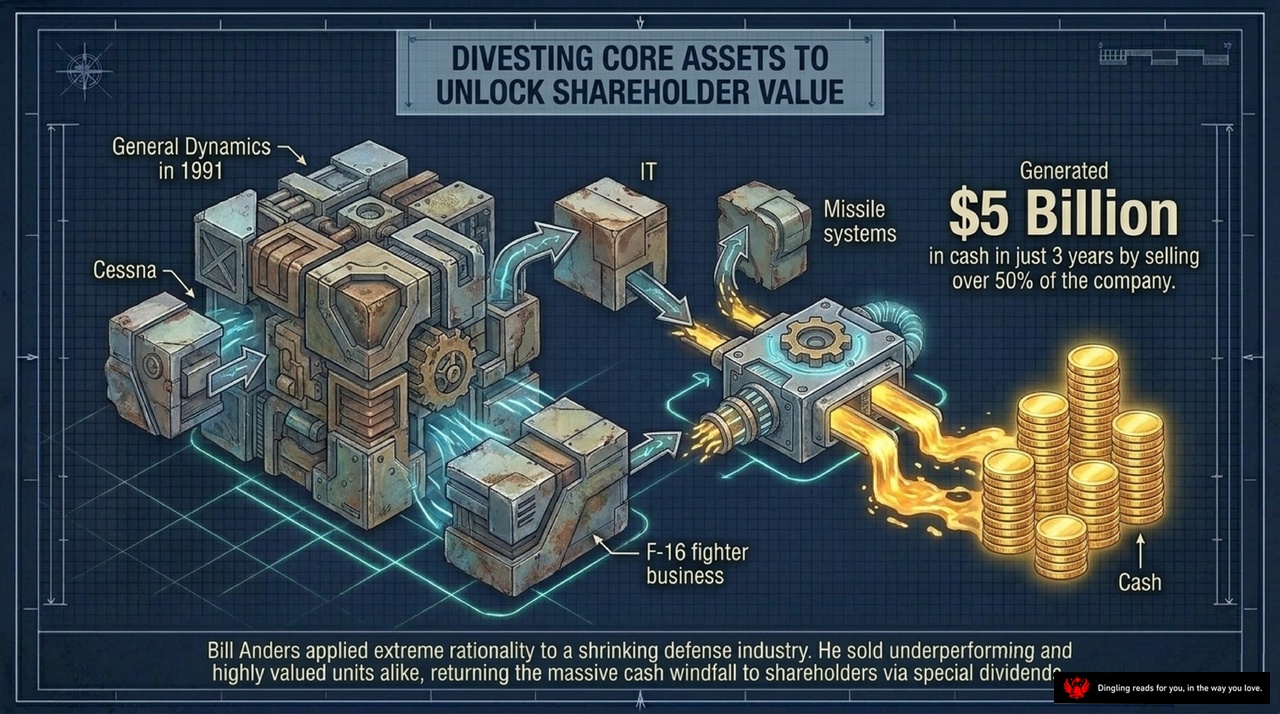
Katharine Graham took the helm of The Washington Post in 1963, stepping into a role that made her the first female CEO of a Fortune 500 company. At the time, the newspaper was struggling with loose management and weak profitability. Instead of rushing into quick fixes, she chose patience, spending years understanding the business and building her authority before making her first major move: appointing Ben Bradlee as editor in 1967.
But her most defining decision came in 1974, when she invited Warren Buffett onto the board. Buffett didn't just provide capital; he taught her to think like an investor, shifting the company's focus from mere operations to maximizing shareholder value. Under her guidance, the Post transformed into a powerhouse, delivering a staggering 22.3% annual compound return for shareholders over 22 years. While others chased the 80s acquisition frenzy, she stayed disciplined, avoiding dilutive deals and waiting for the right opportunities.
When the market dipped in the 90s, while competitors were forced to sell off assets due to high leverage, Graham used her strong balance sheet to buy undervalued cable systems, TV stations, and education businesses at rock-bottom prices. She also embraced diversification, investing in cell phone franchises and exam prep services, eventually making half of the company's revenue come from non-print sources.
Her capital allocation strategy was built on extreme prudence. She kept debt levels conservative, avoided unnecessary dividends, and strictly controlled capital expenditures, only approving projects that could generate over 11% cash returns. She also empowered her managers with a decentralized structure, trusting professionals like Dick Simmons and Alan Spungen to drive efficiency and cash flow. By combining this operational freedom with Buffett's investment wisdom and her own patient, data-driven decisions, she turned a struggling newspaper into a diversified media empire, proving that sometimes, the most powerful move is simply waiting for the right moment to strike.
Welcome back. Today, we're diving into the final chapter of our deep dive into the "Outsider CEOs"—the masterminds who redefined success by rejecting the status quo.
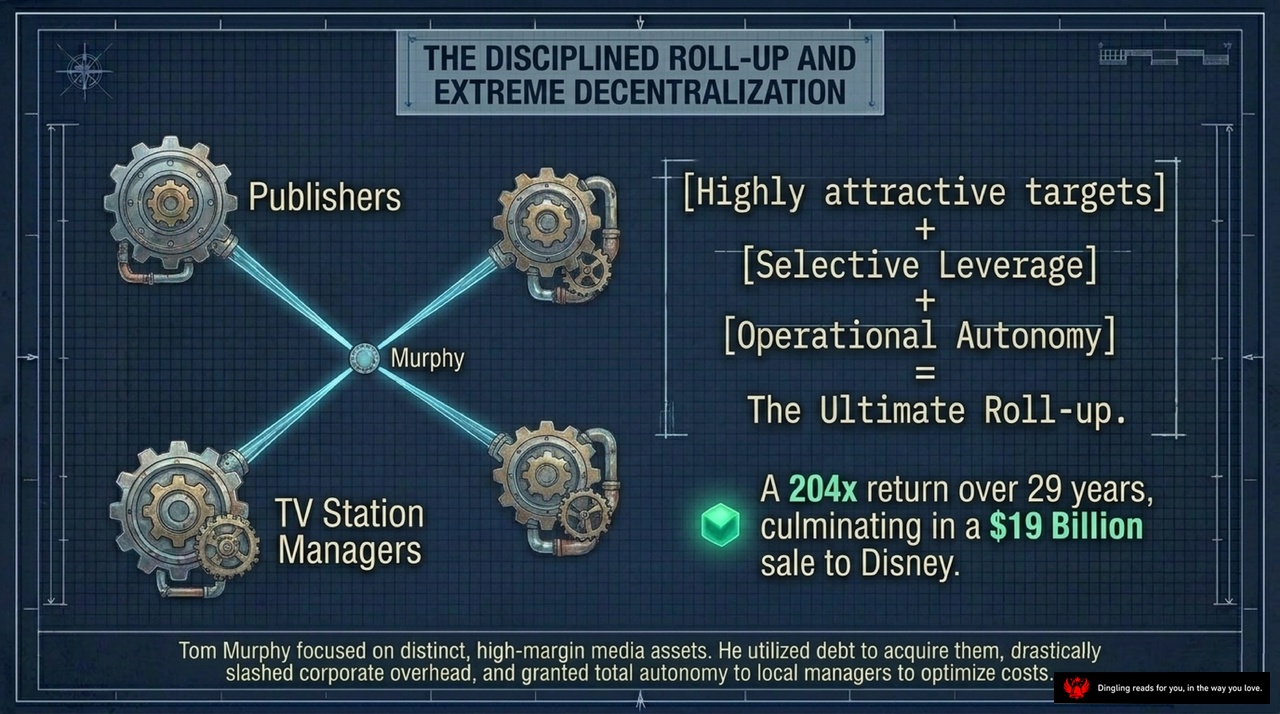
The slide in front of you outlines the ultimate playbook for these legends: **The Disciplined Roll-Up and Extreme Decentralization**.
Let's break down this formula. On the left, you see the mechanics of the "Roll-Up." Think of it as a central hub, like Murphy at Capital Cities/ABC, connecting disparate assets—publishers, TV stations, and media managers. Instead of trying to micromanage every detail, these CEOs acted as the orchestrator, selectively acquiring high-margin assets and then handing over the keys.
Look at the equation on the right. Success wasn't magic; it was math. It was the combination of **[Highly Attractive Targets]** plus **[Selective Leverage]** plus **[Operational Autonomy]**.
Why did this work? Because they prioritized **Operational Autonomy**. They believed the best decisions come from the front line, not the distant headquarters. By slashing corporate overhead and granting total freedom to local managers, they created an agile organization that could outpace the bloated giants of the era.
This approach delivered legendary results. As the slide highlights, Tom Murphy's strategy at Capital Cities/ABC generated a **204x return over 29 years**, culminating in a massive **$19 Billion sale to Disney**.
The lesson here is clear: True value isn't created by building the longest train; it's created by burning the least amount of fuel to get there first. By combining disciplined acquisitions with radical decentralization, these Outsiders proved that they could outperform the entire market, leaving traditional management models in the dust.
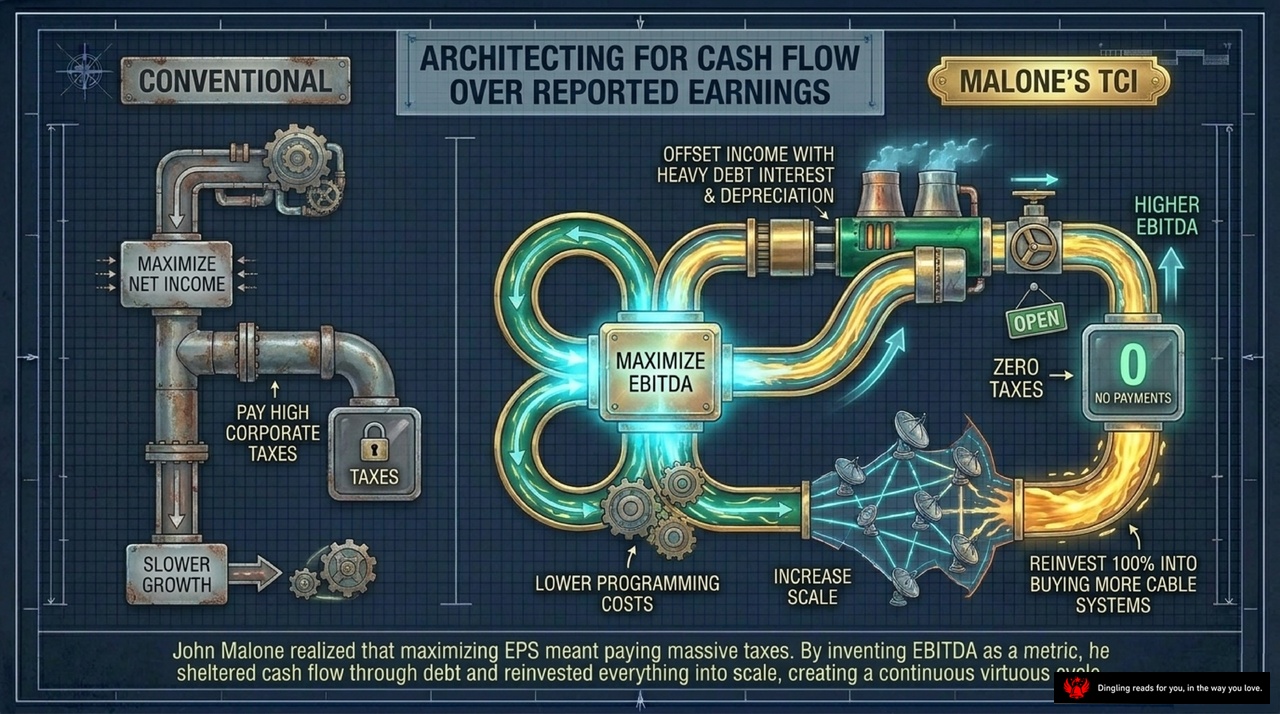
Look at this blueprint for building a cash-rich empire versus the traditional path most CEOs take. On the left, you see the "Conventional" model: chasing net income means paying massive corporate taxes, which locks up cash and leads to slower growth. It's a leaky pipe.
But look at the right side: Malone's TCI model. This is where the real magic happens. Instead of maximizing earnings on paper, the goal is to maximize EBITDA. By offsetting income with heavy debt interest and depreciation, you shelter your cash from the taxman. The result? Zero taxes and no payments out the door.
All that freed-up cash doesn't sit idle. It gets reinvested 100% into buying more cable systems, increasing scale and lowering programming costs. This creates a virtuous cycle: higher EBITDA feeds more growth, which feeds even more cash. John Malone realized that maximizing EPS meant paying massive taxes. By inventing EBITDA as a metric, he sheltered cash flow through debt and reinvested everything into scale, creating a continuous virtuous cycle that turned TCI into a financial juggernaut.
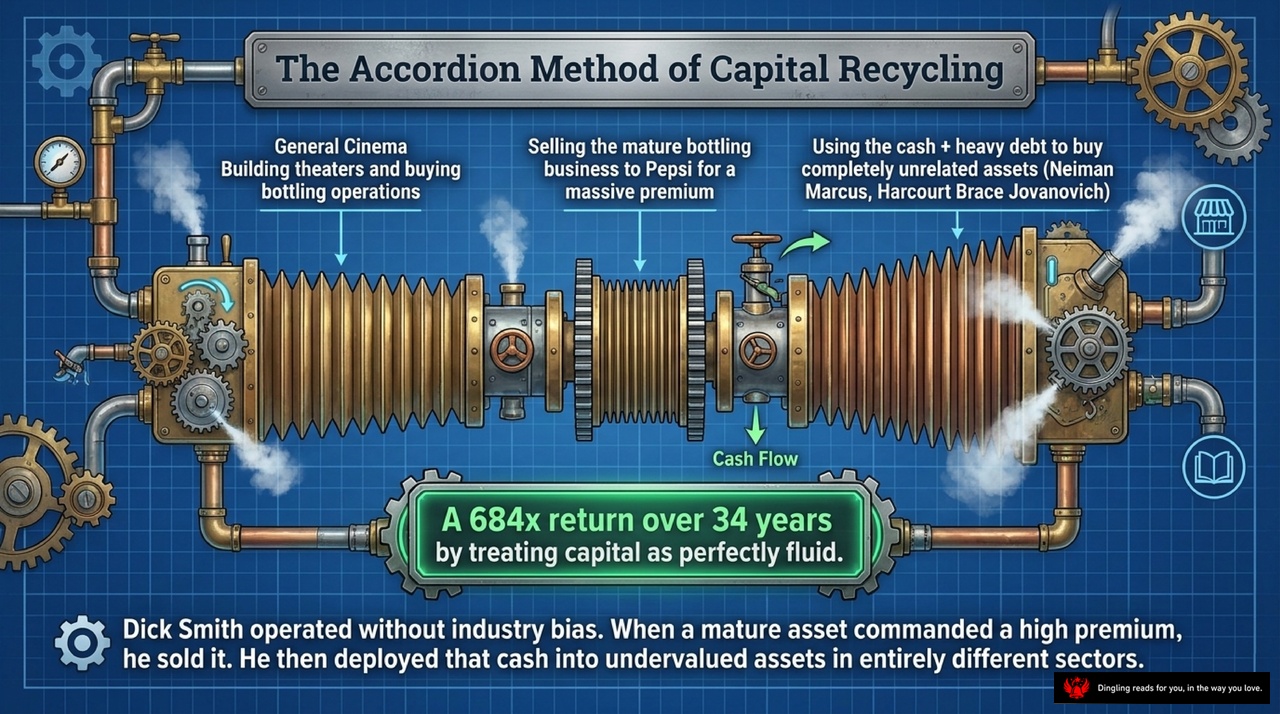
Welcome back. Today, we're diving into the final chapter: the master blueprint of the "Outsider CEO."
Look at this diagram. It illustrates the "Accordion Method of Capital Recycling," a strategy perfected by legends like Dick Smith. The image breaks down a fascinating cycle: first, you build a business, like General Cinema, to generate steady cash flow. Then, when that mature business commands a high premium, you sell it—perhaps to a giant like Pepsi—for a massive gain.
The magic happens in the next step. Instead of letting that cash sit idle, you deploy it immediately into completely unrelated, undervalued assets. Dick Smith didn't stick to movies; he bought bottling operations, then retail stores like Neiman Marcus, and even publishing houses. He treated capital as a perfectly fluid resource, constantly expanding and contracting like an accordion to capture value across different sectors.
The result? A staggering 684x return over just 34 years. This proves that the true job of a CEO isn't just running a factory or managing a brand. It's about ruthless capital allocation. As the text reminds us, these outsiders operate without industry bias. When an asset becomes expensive, they sell it. When new opportunities appear at a discount, they buy them. They ignore the noise of Wall Street and focus entirely on one metric: maximizing shareholder value.
This mindset—buying low, selling high, and reinvesting relentlessly—is the secret to building empires that outlast generations.

Unlocking hidden value through strategic spin-offs isn't just about splitting a company; it's about surgically removing dead weight to reveal the true worth of what remains. Look at the transformation of Ralston Purina. Under the leadership of Bill Stiritz, this massive conglomerate was viewed not as a monolith, but as a portfolio of distinct assets. The image shows how a complex, tangled structure evolved into separate, high-performing units like Energizer and Continental Baking.
This wasn't random fragmentation. It was a deliberate strategy to align incentives and force Wall Street to accurately value these previously ignored sub-units. By spinning off the non-core businesses, Stiritz eliminated bureaucracy and shed the drag of underperforming assets. The result was a massive unlock of value, allowing the remaining brands to soar. As the text notes, Stiritz operated like a private equity investor, using these spin-offs to highlight the true economic power of isolated brands. In a world obsessed with scale, the greatest CEOs often find that focusing on the right pieces—and letting go of the rest—is the ultimate path to growth.
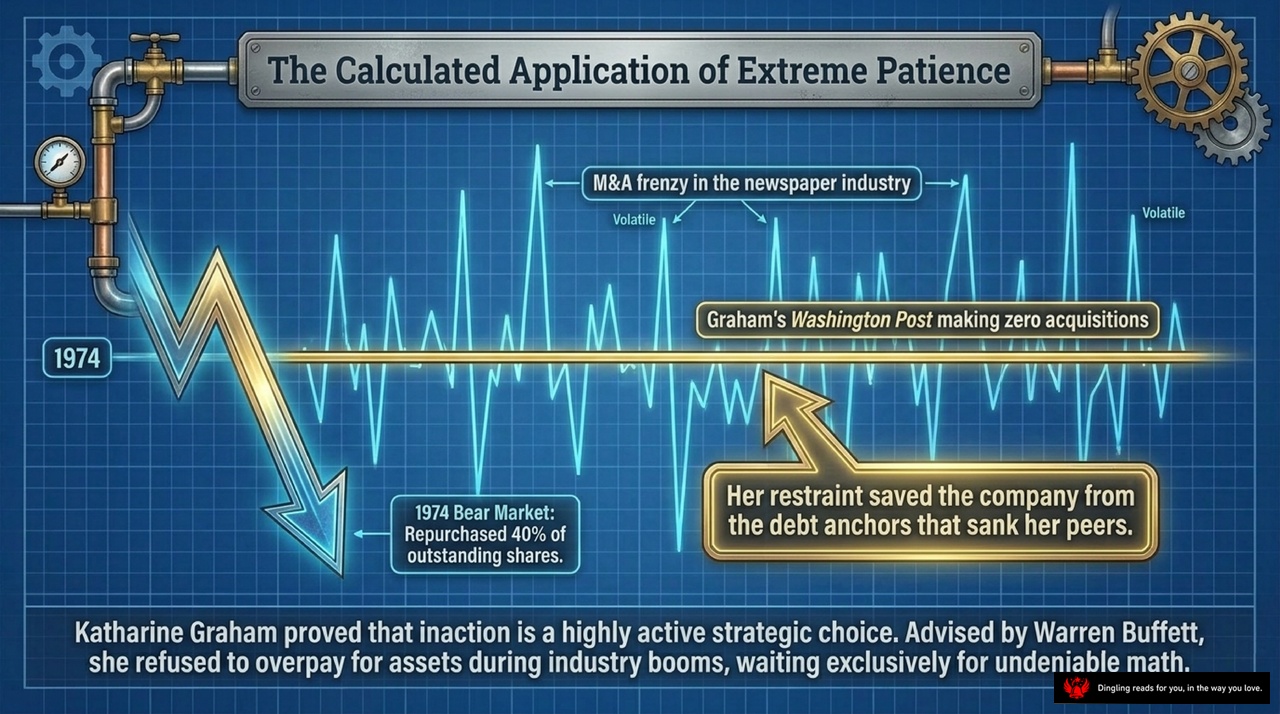
Imagine a chaotic market where everyone is frantically buying and selling, chasing every trend like it's the last train out of town. In 1974, the newspaper industry was in the throes of a mania, with mergers and acquisitions happening at a dizzying pace. While the rest of the market was volatile and panicking, Katharine Graham made a calculated, counter-intuitive choice: she did nothing.
This slide highlights that critical moment. While the industry was drowning in debt anchors that would eventually sink her peers, Graham's Washington Post made zero acquisitions. She refused to overpay for assets during the boom, waiting exclusively for undeniable math. Her restraint wasn't inaction; it was a highly active strategic choice.
When the 1974 bear market hit, while others were bleeding, Graham repurchased 40% of her outstanding shares. This bold move, advised by Warren Buffett, saved the company from the very debt traps that destroyed her competitors. She proved that in the face of chaos, extreme patience is the ultimate weapon. By staying out of the frenzy and buying when others were selling, she turned a crisis into the greatest opportunity of her career, securing a legacy built on the power of saying "no" when everyone else was screaming "yes."
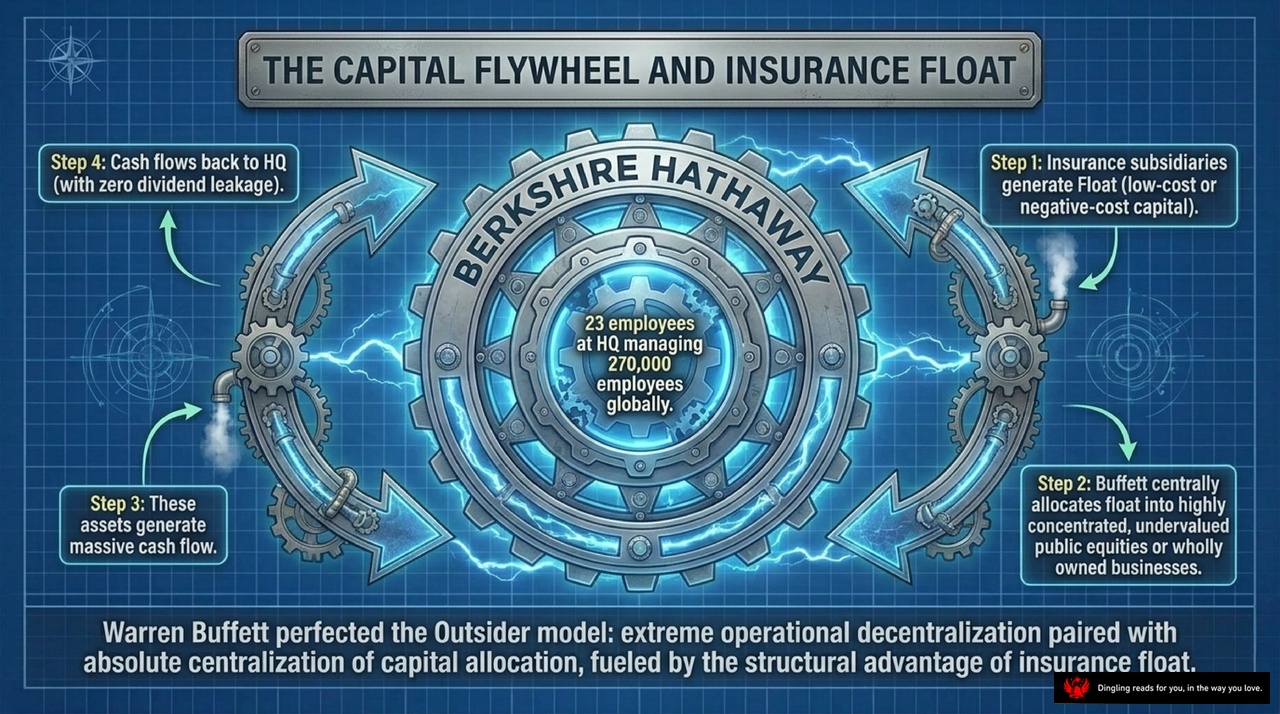
Look at this incredible machine: The Capital Flywheel and Insurance Float. At the very heart of this engine sits Berkshire Hathaway, managed by just 23 people at headquarters who oversee a global workforce of 270,000. It's the ultimate example of operational decentralization paired with absolute centralization of capital allocation.
The cycle starts with Step 1: Insurance subsidiaries generate float—essentially low-cost or even negative-cost capital. This is the fuel. In Step 2, Buffett centrally allocates this massive float into highly concentrated, undervalued public equities or wholly owned businesses. Then, in Step 3, these assets generate massive cash flow. Finally, in Step 4, that cash flows back to HQ with zero dividend leakage, ready to fuel the next revolution.
Warren Buffett perfected the "Outsider" model by leveraging this structural advantage of insurance float. While most CEOs are trapped in the daily grind, Buffett acts as a master capital allocator, constantly reinvesting free money to compound value. This isn't just about running a company; it's about building a self-perpetuating engine where the business funds its own growth without ever asking the shareholders for more.
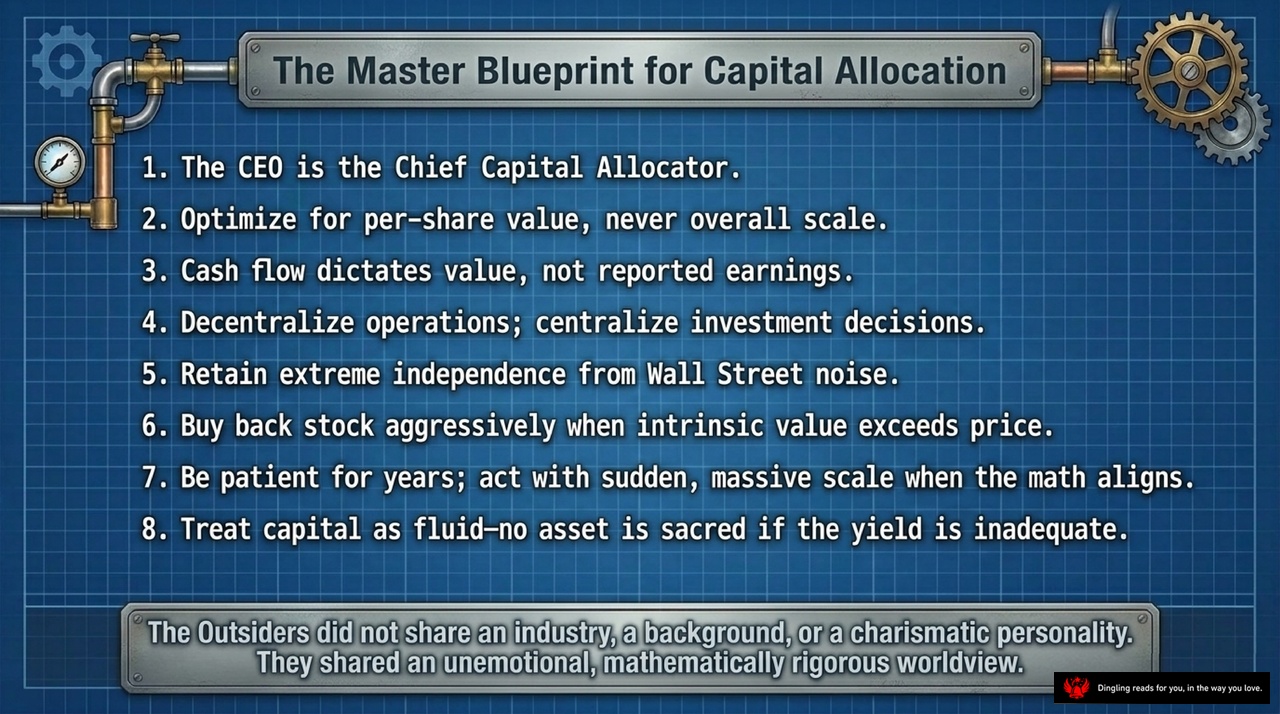
Look at this blueprint. It's not just a list of rules; it's the operating system for the most successful CEOs in history. Notice the first line: "The CEO is the Chief Capital Allocator." That's the non-negotiable truth. Most leaders obsess over operations, but the true masters know their primary job is deciding where capital goes.
Check point two: "Optimize for per-share value, never overall scale." It's a brutal reminder that growing the company's size doesn't always grow your wealth. You need to focus on the value in every single share. Then look at point three: "Cash flow dictates value, not reported earnings." Ignore the accounting tricks; real wealth is generated by actual cash moving through the business.
The rest of the list reinforces this mindset. You need to decentralize operations so your teams can move fast, but centralize investment decisions so you stay in control. You must retain "extreme independence from Wall Street noise," refusing to chase trends just because everyone else is doing them. When the math works, "buy back stock aggressively," and be patient for years before acting with massive scale. Finally, treat capital as fluid: "no asset is sacred if the yield is inadequate." If an investment isn't working, cut it loose immediately.
As the bottom note states, these "Outsiders" didn't share an industry or a personality. They shared one thing: an unemotional, mathematically rigorous worldview. This is how you build a legacy that outlasts the market.
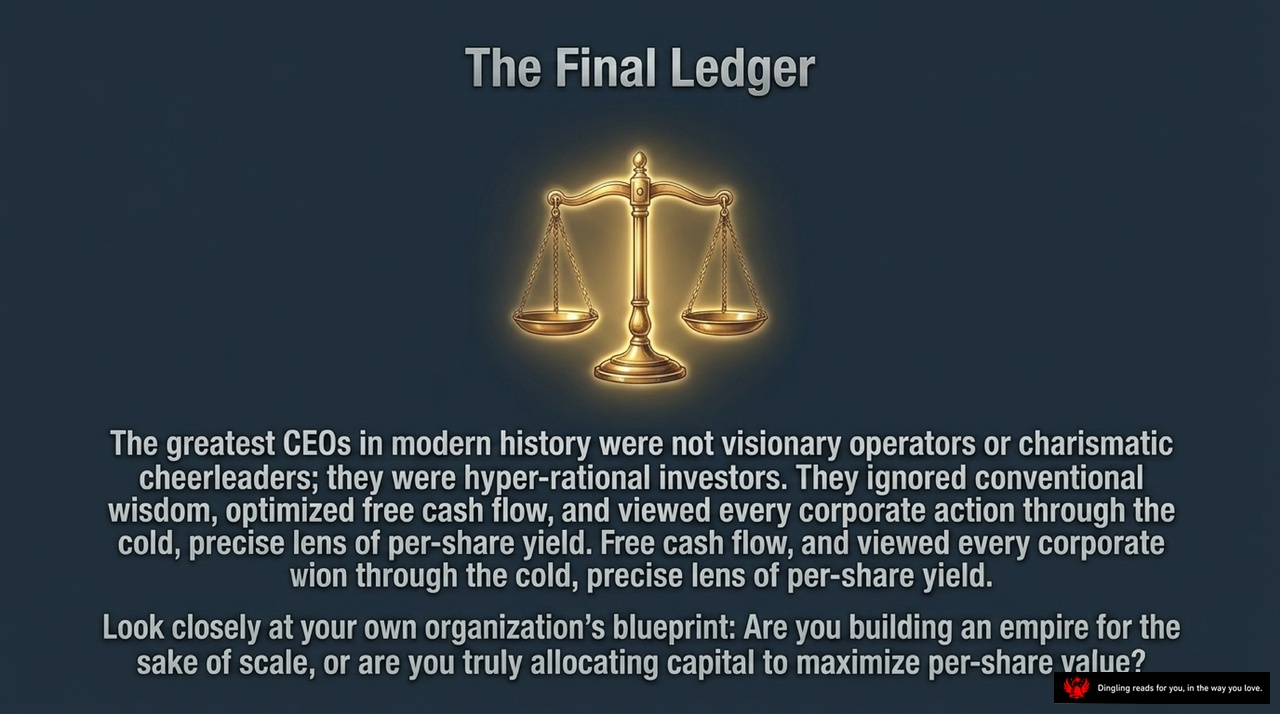
The greatest CEOs in modern history weren't the charismatic cheerleaders we often see in the media; they were hyper-rational investors. As this slide illustrates, their success wasn't about building the biggest empire for the sake of scale, but about treating every corporate action through the cold, precise lens of per-share yield.
Think of it this way: instead of asking, "How many employees do we have?" or "How big is our logo?", these leaders asked, "Where is our capital going, and is it creating maximum value for the shareholder?" They ignored conventional wisdom that equates growth with hiring more people or expanding into trendy markets. Instead, they optimized free cash flow and viewed the company as a portfolio of assets. If an asset stopped generating high returns, they sold it. If the stock was undervalued, they bought it back.
Look closely at your own organization's blueprint today. Are you running a factory that just gets bigger every year, or are you truly allocating capital to maximize per-share value? The difference between a mediocre manager and a legendary CEO often comes down to this single question: Are you building an empire, or are you building wealth?