
The Partnership: Complete Chapter-by-Chapter Summary

Welcome to the definitive history of how a marginalized commercial paper dealer transformed into the world's most powerful and enduring investment banking empire. This is the story of Goldman Sachs, told by Charles D. Ellis.
It all began in 1907, with a young man named Sidney Weinberg. At just 16, he was kicked out of three retail brokerages and forced to drop out of school. Desperate, he walked into the Goldman Sachs building with a vague letter from his teacher, starting as a janitor's assistant. His job? Cleaning spittoons. But Sidney was sharp and hardworking. He quickly caught the eye of partner Paul Sachs, who funded his education and taught him the ropes of survival.
From a bond trader to the creator of the over-the-counter stock business, Sidney bought his seat on the New York Stock Exchange in 1925. By 1927, he became the second non-family partner in a firm dominated by relatives—a huge breakthrough. But the road wasn't easy. The firm's founder, Marcus Goldman, had started by selling commercial paper out of his hat. Later, they pivoted to industrial financing when giants like Morgan excluded them from the lucrative railroad bond market.
Then came the First World War. A partner named Henry Goldman publicly supported Germany, causing a total split with the Sachs family and nearly bankrupting the firm. It was a dark time. But Sidney Weinberg, along with the Sachs family, stepped up. They filled the capital gaps, took a pay cut, and handed the leadership over to Sidney. He refused to let the firm fail, even forgiving his own massive losses from a failed trust company. Under his guidance, Goldman Sachs rebuilt its reputation, forged deep ties with President Roosevelt, and emerged as a true powerhouse.
Sidney was the soul of the firm. He sat on the subway to observe the streets, refused to use a slide rule, and treated loyalty above all else. He famously handled the Ford Motor Company IPO, turning it into the largest stock offering in history at the time. He built a culture of integrity and teamwork, proving that even from humble beginnings, you can build an empire that lasts.

Picture this: In 1869, the financial world was divided by an invisible wall. On one side, you had the elite "WASP Syndicate"—think J.P. Morgan and his circle—holding a tight monopoly on lucrative railroad bonds. They guarded their gates like a fortress, leaving Jewish immigrants like Marcus Goldman completely locked out of this inner circle. Goldman realized that if he tried to break in, he'd just hit a brick wall. So, instead of fighting the door, he built a new one.
He pivoted to commercial paper, targeting small industrial merchants on the fringes—jewelers, cigar makers, and retail giants like Woolworth. While the elite banks were stuck looking at hard assets, Goldman pioneered a bold new strategy: financing based on future earning power. He bought discounted merchant paper at 8-9%, flipped it to commercial banks for rapid, high-volume profit, and essentially invented the modern investment bank. This wasn't just about bypassing the blockade; it was about turning exclusion into the ultimate innovation, laying the foundation for Goldman Sachs as we know it today.

Today's slide outlines the very DNA that has defined Goldman Sachs for over a century: The 14 Business Principles, built upon three non-negotiable pillars.
At the top sits Pillar 1: Client Supremacy. This isn't just a slogan; it's the operational engine of the firm. As the slide states, "Client interests always come first." The logic is simple but powerful: if you serve the client relentlessly, institutional success will inevitably follow. This philosophy was forged in fire. When the firm faced a massive crisis involving the Maxwell family, or when they lost a billion-dollar deal in the UK, the leadership—like John Thain or Bob Rubin—made the hard choice to prioritize the client's long-term trust over short-term profits or even the firm's immediate safety. That relentless focus on the client's needs is what built their reputation as the most trusted advisor in the world.
Underpinning this is Pillar 2: Relentless Excellence. The slide captures this perfectly with the mantra: "Reputation over Capital." It's about the absolute commitment to being the best, not necessarily the biggest. This principle drove the firm to hire only the top 1% of talent, from the earliest days of Sidney Weinberg to the modern era. It means demanding perfection in execution, whether it's pricing a bond or executing a massive IPO like the Ford transaction. Choosing to be the best creates a moat that competitors simply cannot cross.
Finally, we have Pillar 3: The One-Firm Culture. Here, the slide emphasizes "Teamwork over Ego." Goldman Sachs has always operated on the belief that the firm is greater than any individual. There is "total intolerance" for those who put personal ambition above the collective good. This culture fosters deep loyalty and shared risk. It's why partners are willing to step in during crises, and why the firm can execute complex, multi-departmental deals with such precision. It's a culture where everyone pulls in the same direction, ensuring that the firm's success is truly everyone's success.

Leadership Evolution: Building the Modern Firm. This slide maps the transformation of Goldman Sachs from a small boutique into a global powerhouse through three distinct eras, each defined by a unique leader.
First, we see Sidney Weinberg, The Networker, from the 1930s to the 1960s. Starting as a janitor's assistant, he rose to become the soul of the firm. His era was built on boardroom diplomacy and unparalleled relationship building. He famously transformed Goldman from a personality-driven shop into a scalable global machine by institutionalizing success through strict principles and organized sales forces. He codified the 14 Principles, creating a culture where loyalty and integrity were paramount, turning the firm into an indispensable force in corporate America.
Next is Gus Levy, The Aggressive Trader, leading the firm from the 1960s through the 1970s. His philosophy was simple yet powerful: "Greedy, but long-term." He focused absolutely on risk and capital execution. Levy pioneered block trading, personally overseeing major risks from behind a glass wall. He pushed the firm to seize new opportunities, even when others feared them, effectively doubling the firm's profits and laying the groundwork for its modern trading dominance.
Finally, we have John Whitehead, The System Builder, who steered the ship from the 1970s to the 1980s. While Levy built the engine, Whitehead built the chassis. He focused on institutionalizing success through strict principles and organized sales forces. Whitehead codified the 14 Principles, transforming the firm from a personality-driven shop into a scalable global machine. He separated deal-making from execution, creating a system that could grow without relying on individual stars.
Together, these three leaders—The Networker, The Aggressive Trader, and The System Builder—didn't just run a company; they engineered a legacy. They took a small firm and built it into the modern financial giant we know today.

The Breakthrough: The Ford IPO (1956) represents the moment Goldman Sachs truly entered the pantheon of Wall Street's elite. This wasn't just a stock sale; it was Weinberg's strategic masterpiece that fundamentally restructured the industry's hierarchy. To understand the scale of this achievement, you have to look at the intensity behind the scenes. The operation was defined by extreme secrecy. For two years, covert operations ran under code names—Henry Ford was "Alice," the Foundation was "Grace," and Weinberg himself operated as "Edith." To prevent leaks, a staggering 56 restructuring drafts were written entirely by hand.
This painstaking secrecy led directly to the ultimate prize: the mandate to manage the largest private company IPO in history. Weinberg successfully transformed a highly secretive family business into a public behemoth, raising over $700 million in 1956. But the real game-changer was the execution. Weinberg engineered an elite seven-firm primary syndicate out of over 100 competing banks. By unilaterally dictating the allocations, he didn't just manage the deal; he permanently established Goldman Sachs at the absolute top of the Wall Street hierarchy. This single transaction proved that with the right strategy and discipline, Goldman could outmaneuver even the most powerful legacy players.

Today's slide, "The Crucible: Crises, Failures, and Resilience," captures the defining tension of Goldman Sachs' history: the constant balancing act between short-term financial catastrophe and long-term reputational survival.
On the left, we see the Penn Central Crisis of 1970, a moment of profound failure. Under Gus Levy's leadership, Goldman failed to disclose non-public information about the railroad's imminent collapse while selling its commercial paper. This blind spot led to massive lawsuits, deep institutional embarrassment, and a total overhaul of internal compliance. It was a stark reminder that even in their golden age, ignoring the truth could bring the house down.
But look at the right side: The BP Underwriting Trial of 1987. This was the ultimate test of their principles. When the UK government privatized BP right as global markets crashed, competitors sought legal loopholes to abandon the deal. Yet, John Weinberg ordered Goldman to swallow a historic capital loss. He chose integrity over profit. The result? Goldman proved its word was an ironclad bond. They bought permanent, unquestioned credibility in London and across Europe.
The scale in the center illustrates this perfectly. Failure weighs heavy, but resilience, built on keeping promises when it costs everything, is the only asset that truly matters.

Look at this diagram, "Institutionalizing the Machine." This slide captures the moment Goldman Sachs truly became a machine—a well-oiled, collaborative engine driven by the Whitehead and Weinberg co-CEO era.
On the left, we see the old problem: traditional Wall Street models created internal warfare. Relationship bankers and trading executors constantly cannibalized each other over who owned the client revenue. It was a zero-sum game. But on the right, we see the innovation. A revolutionary compensation structure alongside a strict separation of functions. This led to the creation of the Dual-Credit System.
The core of this machine is the "100/100" Rule. As the text explains, both the relationship manager who originated the client and the product expert who executed the trade received 100% internal credit for the deal. This simple shift eliminated infighting. It forced a hyper-collaborative, ego-suppressing One-Firm culture where performance appraisals heavily weighted peer reviews on helpfulness.
Essentially, instead of fighting over scraps, the gears of Origination and Execution meshed perfectly. This structural change transformed Goldman from a collection of competing individuals into a unified global powerhouse, setting the stage for its future dominance.

The Global Frontier: Conquering Europe isn't just about expanding a map; it's about refusing to play by local rules in closed, oligopolistic markets. Look at London first—this was "The Purge." When Gene Fife inherited a money-losing cost center, he didn't ask for patience. His strategy was aggressive: fire the deadwood, force partners to buy local homes to prove permanence, and absolutely refuse to be treated as a "pigeon" American bank. He made it clear that the depression to buy back from the partner was a non-negotiable path to performance.
Then, shift your gaze to Germany for "The Frontal Assault." This was a direct attack on Deutsche Bank's 100-year monopoly on the Siemens account. They relentlessly pitched aggressive, innovative financial ideas until local CFOs finally yielded. Crucially, they hired elite indigenous talent like Guillermo de la Dehesa not as a figurehead, but as an active cultural navigator to decode complex political and business landscapes. This slide illustrates how Goldman Sachs conquered Europe by blending ruthless execution with deep local intelligence, turning regional barriers into their greatest advantage.

Imagine a machine designed not just to hire people, but to forge an unbreakable elite. This is the "Talent Engine," where recruiting isn't a department—it's the firm's ultimate strategic moat. Look at this funnel: it starts with **Mandated Priority**. At the top, recruitment supersedes everything else. We see the story of John Whitehead, who once ordered a partner to abandon an urgent crisis at Ford Motor Company simply to attend a recruiting event at Stanford. That is the level of commitment required.
Next, candidates face **Extreme Filtration**. It's a grueling gauntlet of 15 to 30 interviews. The goal isn't just to test intellect; it's to rigorously test cultural endurance and, crucially, the absence of individual ego. Only those who can withstand this pressure move forward.
Finally, we reach the bottom: **The 'Uncle' System**. This is where the magic happens. Partners mandate attendance at weddings, funerals, and life events of their juniors. By cultivating a tribal, family-like loyalty, the firm ensures a turnover rate near zero among the elite ranks. This isn't just hiring; it's building a dynasty where the best stay forever.
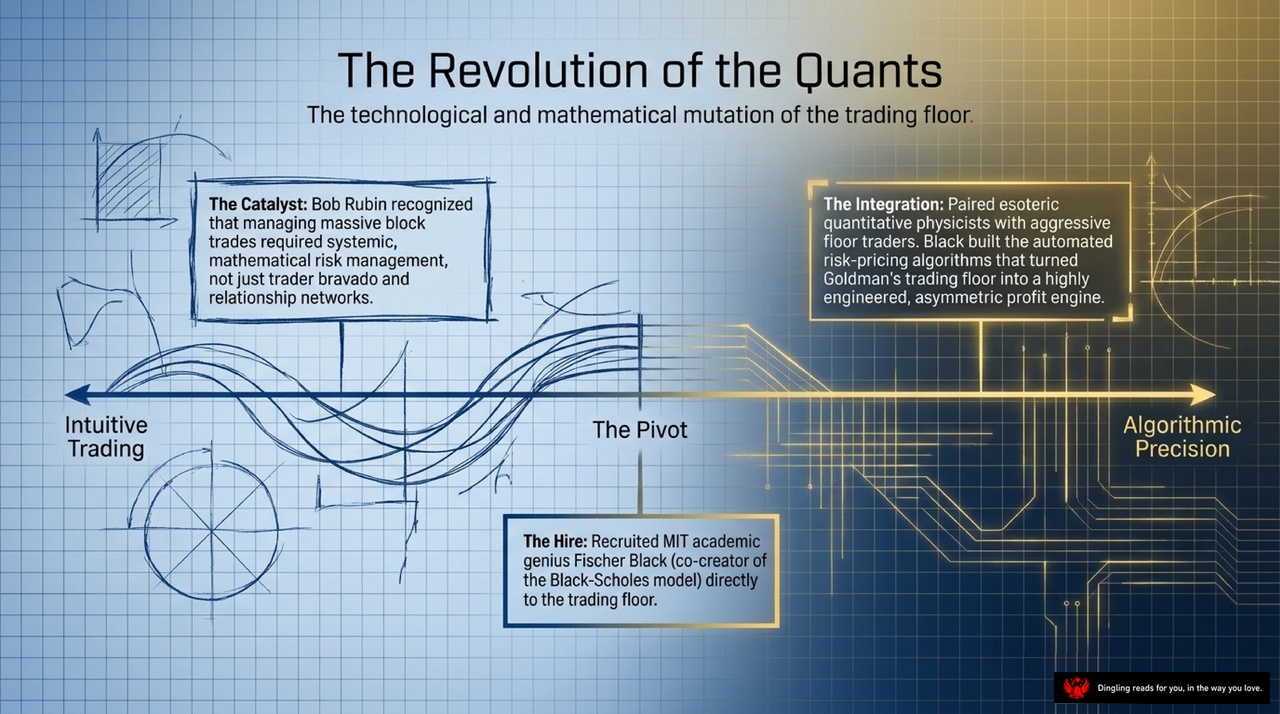
The Revolution of the Quants
Imagine a trading floor that was once defined by intuition, handshakes, and sheer bravado. Now, picture it transformed into a highly engineered, asymmetric profit engine driven by algorithmic precision. This is the story of how Goldman Sachs fundamentally mutated, turning from a traditional investment bank into a global powerhouse through the power of mathematics and technology.
It all started with a pivotal moment in the 1980s. Bob Rubin, recognizing that managing massive block trades required more than just relationships, identified a critical need for systematic, mathematical risk management. He didn't just rely on trader bravado; he demanded a new approach. To execute this vision, Rubin recruited a true genius: Fischer Black, the co-creator of the Black-Scholes model, directly from MIT. This wasn't just a hire; it was a strategic game-changer. Black brought esoteric quantitative physics to the floor, pairing these theoretical minds with aggressive traders.
The result was "The Integration." Goldman paired these quantitative physicists with aggressive floor traders, building automated risk-pricing algorithms that revolutionized the industry. This shift allowed them to turn the trading floor into a highly engineered machine. While traditional firms were still reacting to the market, Goldman was now predicting and pricing risk with unprecedented accuracy. This technological and mathematical mutation didn't just improve their numbers; it fundamentally changed the DNA of Wall Street, proving that in the modern era, the future belongs to those who can quantify the unquantifiable.

Imagine a small, struggling commodity shop on the verge of irrelevance. Goldman Sachs acquired it for a mere $5 million in annual profit. Mark Winkelman, the CEO, presented a safe, heavily researched plan to simply double that profit to $10 million—a classic incremental approach. But Bob Rubin, the powerful executive, flatly rejected it. He didn't want a 2x return; he demanded a 20x jump to $100 million this year. This wasn't about working harder; it was about thinking exponentially. Rubin backed the team with infinite capital and aggressive targets, transforming a fringe player into a globally dominant trading powerhouse. The lesson is clear: in finance, the difference between a small shop and an empire isn't just effort—it's the courage to break the box and think bigger than the numbers suggest.

The Build-Out of GSAM: Absorbing short-term pain for massive long-term scale.
Look at this cube. It represents the deliberate, almost painful architecture Goldman Sachs built to become a global giant. On the right, "The Strategic Insight" tells the real story: management swallowed years of intentional, heavy financial losses. They defied partner pushback to build a permanent, globally dominant asset management brand that generated infinite, low-risk fee loops.
This wasn't about quick wins; it was about buying time and scale. To achieve this, they expanded across three distinct channels: direct institutional investors, third-party advisors, and ultra-high-net-worth private wealth. Simultaneously, they launched across three major markets—North America, Europe, and Asia—ensuring no geographic blind spots.
But what filled the cube? Ten diverse products. Ranging from safe money market funds to complex quantitative strategies and esoteric hedge funds. This diversification was the key. By absorbing short-term volatility and losses in these various vehicles, they created a fortress of steady, recurring fees. This strategic build-out transformed GSAM from a struggling experiment into the engine that would power Goldman Sachs through decades of market cycles, proving that sometimes, the path to dominance requires the courage to lose money today to secure an empire tomorrow.

The ultimate debate shaping Goldman Sachs wasn't just about strategy; it was a fierce internal war led by two titans: Jon Corzine and Hank Paulson. On one side stood the mystique of the partnership, a world built on absolute secrecy where partners funded their own collective capital, fostering fierce loyalty and rapid decision-making within an exclusive club. Yet, they feared that the pressure of public quarterly earnings would destroy their long-term, client-first soul. On the other side was the undeniable power of public capital. Going public would have provided the permanent funding necessary to finance massive global M&A and proprietary trading, allowing them to retain top-tier talent through stock-based compensation and defend their moat against the rising tide of hedge funds and private equity. This tension between the old guard's protective secrecy and the new era's demand for scale defined the agonizing crossroads Goldman Sachs faced, ultimately leading to the historic IPO that transformed them from a private partnership into a global powerhouse.

Welcome to the final synthesis of our journey through Goldman Sachs. What we're looking at here is the "One-Firm Flywheel"—a self-reinforcing business model that explains the firm's perpetual dominance. It's not just a diagram; it's the engine that keeps the entire machine running.
Let's start at the top with **Attract & Filter Top Talent**. This is where the flywheel begins. Goldman is obsessed with recruitment, utilizing a grueling 15-to-30 interview gauntlet to find that elusive top 1 percent. They don't just hire anyone; they hunt for the best.
Once that elite talent is on board, the next step is to **Cultivate "One-Firm" Culture**. This is about suppressing individual ego and enforcing dual-credit teamwork. Every action must align around the 14 Principles. By creating an environment where everyone pulls in the same direction, Goldman ensures that their collective output is far greater than the sum of its parts.
That strong culture and top-tier execution lead directly to **Deliver Unmatched Execution**. Goldman combines algorithmic precision, vast capital pools, and elite boardroom relationships to execute deals that no one else can. They are simply better at getting things done.
This superior performance generates **Premium Profits & Prestige**. The firm reinvests these profits to reward the partnership, which expands the mystique of the brand. This prestige feeds directly back into the first step, attracting the next generation of top talent.
See how the cycle connects? By constantly feeding into itself, this flywheel creates a loop of continuous success that is incredibly difficult for competitors to break.

Goldman Sachs didn't just survive a century of financial disasters; it thrived by constantly reinventing itself while holding fast to its core identity. As the slide highlights, the firm's longevity comes from a delicate balance: relentlessly adapting market strategies while zealously guarding its "One-Firm" culture, its unparalleled talent pool, and its absolute commitment to client interests.
Think about the stakes here. From the chaotic leadership transitions of the past to fierce global expansions, Goldman's ability to pivot was its survival mechanism. But there's a deeper question lurking beneath the surface: as the secretive, long-term ethos of the private partnership fades into history, can the soul of an elite institution truly survive the unrelenting, quarter-by-quarter pressures of the public market?
This tension defines Goldman's journey. It's a story of a company that learned to dance with the market's volatility without losing its own rhythm, proving that even in the most ruthless financial arena, culture and adaptability are the ultimate competitive advantages.