
The Path Between the Seas: Complete Chapter-by-Chapter Summary

Welcome to the story of a colossal failure—and the birth of an empire. This image sets the stage for a tale of hubris, where the grandest engineering dream of the 19th century nearly cost thousands of lives.
Look at the blueprint on the left: it represents the vision of Ferdinand de Lesseps, the hero of the Suez Canal. In 1879, confident in his past success, he promised to conquer the Americas. He believed he could bring "exact mathematics" to a land that was anything but predictable—a place ruled by floods, fever, and chaotic nature.
But the reality, as the chaotic, blood-stained illustration on the right shows, was far more brutal. The plan assumed a simple cut-through, ignoring the deadly reality of the Darien Isthmus. It was a gamble that would cost thousands of lives and bankrupt a nation. This page captures the moment when arrogance met the unforgiving jungle, marking the tragic anatomy of a project that failed before it could truly begin.

In the 19th century, a dangerous illusion took hold: the belief that steam power and engineering could conquer any geography. This was the spirit of the age, a profound conviction that barriers were simply waiting to be broken. Look at the map here; the red lines show the triumphant routes of the Suez Canal and the American transcontinental railroad. These massive projects made the world feel small, convincing everyone that distance was no longer an obstacle.
But this confidence created a fatal blind spot. Because the world had successfully conquered the deserts and plains, everyone viewed the narrow land bridge of Panama as just the final puzzle piece. They ignored the terrifying reality of the rainforest and the complex geology beneath their feet. They believed the barrier was down, forgetting that nature often fights back in ways we can't predict.
This arrogance, or hubris, blinded the engineers of that era. They saw a shortcut where there was only a trap. They focused on the 13,000-mile detour around Cape Horn as the only logical path, completely dismissing the potential of the isthmus until it was too late. The 19th-century illusion of invincibility turned a promising project into a deadly gamble, proving that even the most advanced technology cannot outsmart the earth without deep respect and understanding.

The slide you see here lays bare a terrifying truth: the fatal assumption that "a canal is a canal." It wasn't. The Suez Canal was built in the desert—flat sand, dry air, and a manageable elevation of just 50 feet. But the Panama Canal? That was a completely different beast. Imagine trying to build in a jungle instead of a desert. You're facing solid rock and steep volcanic mountains, with a peak elevation of 330 feet, not 50. While the desert got only 9 inches of rain a year, Panama was drenched with up to 120 inches annually. And the health environment? The desert was dry and healthy, but Panama was what one source called "a hell upon earth," rife with malaria and yellow fever. The fatal flaw, stamped clearly at the bottom, was that the blueprint for Suez was a blueprint for disaster in Panama.

Look at this profile of Ferdinand de Lesseps, the man who made the Suez Canal a reality. On the left, we see his pedigree: an aristocratic diplomat with a flair for the dramatic, but a glaring deficit—absolutely no technical engineering or financial training. On the right, his superpower: boundless optimism, masterful public relations, and a hypnotic ability to raise capital from ordinary citizens.
This slide captures the essence of his downfall. Because he defeated British skeptics at Suez, he built a "Suez Halo." The French public—and Lesseps himself—believed he was infallible. He convinced the world in 1879 that a sea-level canal in Panama was easy, ignoring the complex geology and the deadly climate. His quote at the bottom, "I wait with patience... patience which I assure you requires more force of character than does action," was a fatal miscalculation. He mistook stubborn optimism for strategic foresight, leading to one of history's greatest financial and engineering disasters.

The 1879 Paris Congress was a masterclass in the illusion of science. On paper, it looked like a global summit of 136 international delegates, but the reality was far more selective. As the slide illustrates, this gathering functioned less as a scientific inquiry and more as a rigid information filter. Out of those 136 attendees, only 19 were actual engineers, while 73 were French, creating a demographic that was heavily skewed toward political ambition rather than technical expertise.
The most glaring failure of this "scientific" process was how it handled hard data. American engineer A.G. Menocal had already presented irrefutable evidence proving that a sea-level canal through Panama was geologically impossible. Yet, this critical data was systematically blocked and ignored. Instead of listening to the experts, the congress relied on the sheer force of personality and the charismatic authority of Ferdinand de Lesseps, the man who had built the Suez Canal.
The outcome of this flawed process was a forced vote that dictated a sea-level canal at Panama, a decision that would eventually cost thousands of lives and millions of francs. The statistics on the right tell the tragic story of this blindness: 74 voted yes, and 8 voted no. Perhaps most chilling is the fact that only one of those who voted yes had ever actually been to Panama. They were building a canal based on a map in their heads, not the reality on the ground.
Dr. W.E. Johnston later described it as a "singular spectacle of a congress which saw its way clear to the truth, and yet which was obliged to remain dishonest." The Paris Congress didn't just make a mistake; it created a perfect storm of misinformation that would define the next decade of engineering history.
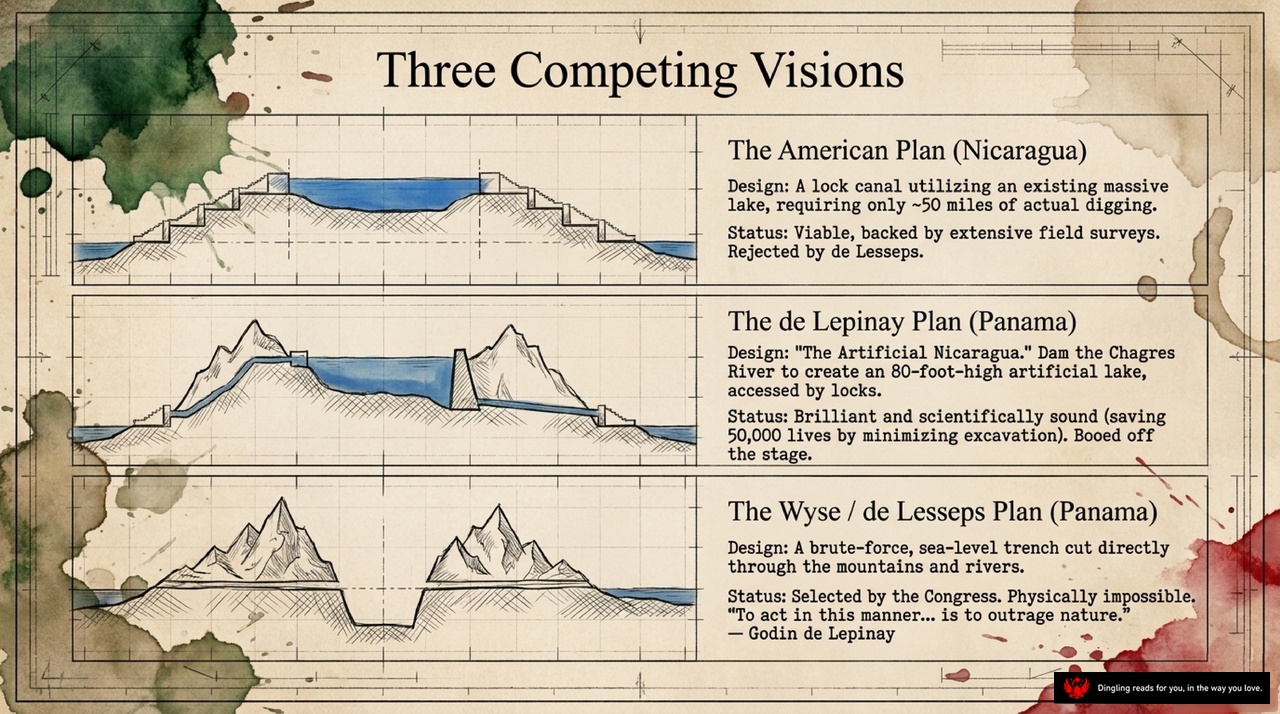
Look at these three competing visions that defined the early days of the canal project. The top plan, the American choice for Nicaragua, relied on an existing lake and required only about 50 miles of digging. It was scientifically viable and backed by solid surveys, yet it was ultimately rejected by key figures like de Lesseps.
In the middle, we see the de Lepinay Plan for Panama. This design proposed creating an artificial lake by damming the Chagres River, which would save tens of thousands of lives by minimizing excavation. It was brilliant on paper, but it never gained the traction needed to move forward.
Finally, at the bottom, is the Wyse and de Lesseps Plan. This was a brute-force approach: a sea-level trench cut directly through the mountains and rivers. While it was selected by the U.S. Congress, experts immediately called it physically impossible. As Godin de Lepinay famously warned, "To act in this manner... is to outrage nature." This vision ignored the geological reality and set the stage for the catastrophic failures that followed.
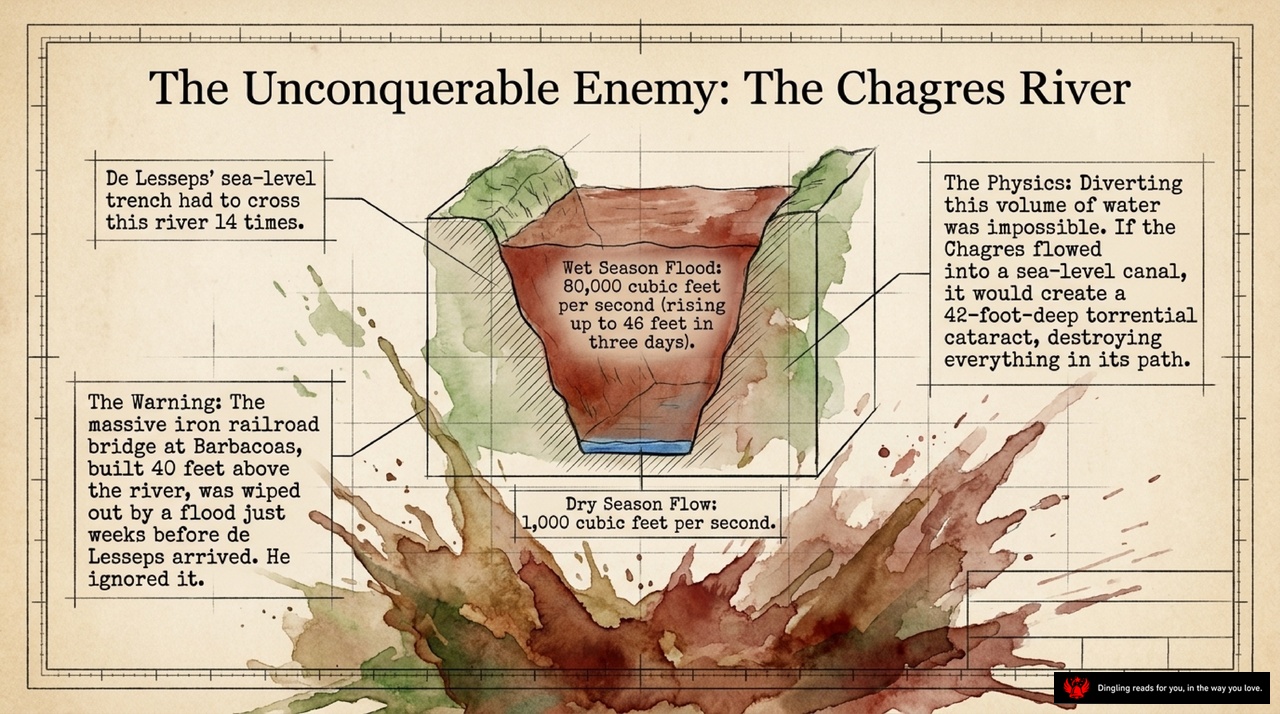
The Chagres River wasn't just a river; it was an unconquerable enemy. Look at this diagram: the physics of moving this much water into a sea-level canal were simply impossible. If you tried to divert the wet season flood—80,000 cubic feet per second surging up to 46 feet in just three days—you wouldn't just create a canal; you'd unleash a 42-foot torrential cataract that would destroy everything in its path.
This wasn't theoretical. The warning was already written in blood. Just weeks before Ferdinand de Lesseps arrived, a massive iron railroad bridge at Barbacoas, built 40 feet high, was wiped out by a flood. Lesseps ignored it. He thought his sea-level trench could cross the river 14 times without issue, but the reality was far harsher. In the dry season, the flow was a manageable 1,000 cubic feet per second, but the wet season volume was a tidal wave that no 19th-century engineering could tame. This was the fatal flaw that doomed the French effort and defined the impossible challenge that would later reshape the world.

Look at the ledger of lies behind the Panama Canal. This slide, titled "The Price of the Illusion," exposes the staggering costs of Ferdinand de Lesseps' grand deception. First, there was the Sloppy Concession: a paltry two-week survey that never even fully crossed the terrain, yet he paid the Turr/Wyse syndicate a massive 10 million francs. Then, he built The PR Machine, spending 1.5 million francs to bribe the French financial press into writing glowing articles and suppressing any negative reports.
But the greed went global. In The Railroad Extortion, he paid Wall Street speculators a staggering 20 million dollars for shares in the Panama Railroad, selling stock at 292 dollars when its actual value was under 100 dollars. Finally, there was The Arbitrary Math. Sitting comfortably in a ship's stateroom, De Lesseps unilaterally slashed the official cost estimate from 240 million down to 131 million purely to make the stock look safer and easier to sell. These weren't just numbers; they were the fuel for a financial disaster that would eventually engulf France.

The Collision: Academic Ideal vs. The Muck.
On the left, you see the pristine world of the French engineers. Trained at the École Polytechnique, they were the elite of Europe, obsessed with abstract mathematical perfection and rigid rules. They believed that if you designed it correctly on paper, the earth would simply obey. But look to the right. That's the reality waiting for them: a swampy jungle with 98% humidity, venomous snakes, and soil so soft it swallowed train tracks overnight. Iron rusted in hours; leather molded instantly.
The breakdown was total because their mindset was entirely wrong. They were trained to build exactly what they designed, but they had zero ability to improvise when the environment fought back. Every day, the jungle erased their progress. This clash between rigid academic theory and chaotic reality is exactly why the first attempt failed so spectacularly.

Imagine the French hospitals in the tropics, like L'Hôpital Notre Dame, built with the finest materials imaginable. But here lies the tragedy: without knowing how the diseases spread, these very hospitals became death traps. The slide contrasts two invisible killers that defined this era. On one side, Malaria, an endemic enemy that acted as a constant, inescapable attrition on the workforce, leaving survivors with lifelong physical debility and acute depression. There was no immunity possible, just a relentless drain on human potential. On the other side, Yellow Fever, a terrifying epidemic that struck unpredictably in waves. It targeted newcomers and white Europeans mercilessly, causing paralyzing panic with symptoms like severe bone pain, jaundice, and the horrific terminal black vomit. With a mortality rate exceeding 50%, it was a massacre that no amount of architectural grandeur could stop. The French thought they could build their way out of the jungle, but nature had other plans.

The Medical Blindspot. For centuries, the medical establishment operated under a dangerous assumption: that diseases like Yellow Fever were caused by "noxious vapors" and bad air. This miasma theory led to flawed actions, like moving hospitals to high ground or placing water rings under bedposts to protect patients from ants, only to accidentally create the perfect breeding grounds for mosquitoes right inside the wards. But the truth was hiding in plain sight. By 1881, pioneers like Dr. Carlos Finlay had finally identified the real culprit: the mosquito. They knew the *Aedes aegypti* was the carrier, yet the medical establishment completely ignored this fringe truth. This blindness wasn't just a scientific error; it was a tragedy that cost thousands of lives and nearly doomed the canal project. While the world looked at the "bad air," the real enemy was buzzing right above their heads, waiting for the next wave of construction to begin.

The irony of the "Panama Family" lies not in their blood, but in their blindness. As Charles de Lesseps famously declared, he wanted to unite everyone "by sentiment," believing that supreme dedication and lavish funding could overcome any obstacle. He poured millions into pristine hospitals and comfortable barracks, convinced that bad science and impossible geography could be outsmarted by willpower alone.
But the reality was far crueler. The French didn't fail because they were cheap or cruel; they failed because they ignored the earth itself. When the rain came, the mountains didn't care about their promises. The very "family" de Lesseps tried to build with optimism and rhetoric was ultimately destroyed by the relentless, indifferent power of nature. It stands as a timeless lesson: no amount of money, no matter how well-intentioned, can override the laws of physics when you try to conquer the impossible.

The Cost of Hubris. This slide distills the brutal lessons of the Panama Canal's first attempt into three fatal failures. First, the PR Trap. Ferdinand de Lesseps didn't just overpromise; he refused to change the story when engineering reality demanded it. He optimized for capital and narrative, ignoring the facts. Second, the Echo Chamber. By silencing dissenting experts and rigging the 1879 Congress, the project was scientifically doomed before a single shovel hit the dirt. No one was allowed to say "no." Finally, Nature's Veto. You cannot apply the solution of a desert, like Suez, to the realities of a rainforest like Panama. When reality is subordinated to charisma, Nature always wins. The French didn't fail because they lacked skill; they failed because they lacked humility.