
The Path to Power: Complete Chapter-by-Chapter Summary

Welcome to the definitive story of how one man built modern political power. Tonight, we're diving into *The Years of Lyndon Johnson: The Path to Power* by Robert A. Caro.
Set against the iconic silhouette of the U.S. Capitol, this book is more than just a biography; it is a masterclass in the mechanics, paradoxes, and dark arts of building influence in Washington. It peels back the layers of ambition, showing us exactly how a young man from the Texas hills learned to control the very engine of the American government.
Caro takes us from the humble beginnings of the Johnson family, where political dreams were born in poverty, to the ruthless strategies employed in the halls of Congress. You'll see how Lyndon transformed from a struggling teacher in a small town into the most powerful figure in the room, mastering the art of persuasion, manipulation, and the relentless pursuit of authority.
This is the gripping tale of how a single individual shaped the 20th century, revealing the extraordinary and often uncomfortable truth behind the throne.

Welcome to the story of the trap that forged a legend. We are in the Hill Country of Texas, a rugged landscape that defined the early life of Lyndon B. Johnson. This map highlights Johnson City, the epicenter of a world that was isolated by unforgiving terrain and completely cut off from 20th-century infrastructure.
Living in the Middle Ages meant a life of destitution. The unyielding soil and nonexistent electricity forced families into backbreaking, impoverished manual labor. Women worked until their hands bled, washing clothes by hand under kerosene lamps, while children struggled to see in the dark. There was no modern life here; the future felt like a distant dream.
But amidst this hardship, a primal fear took root. It was the terror of failure, instilled by watching a family descend into poverty. This fear became a lifelong driving force, a shadow that would never leave him. Yet, from this darkness, a powerful ambition emerged. Johnson realized that the only way out was through power. He saw that political influence was the only weapon capable of changing this reality, of bringing electricity to these dark homes, and of lifting his family out of the abyss. The trap was real, but it also forged an unbreakable will.

Look at this diagram: "The Bloodline: The DNA of Power." It perfectly captures the two opposing forces that shaped Lyndon B. Johnson. On the left, we have the Buntons. They were tall, imposing, and fiercely proud. They possessed that legendary "Bunton Eye"—a dark, piercing look that carried a shadow of deep ambition. This was the family of pragmatic wealth-builders, the kind who didn't just dream; they executed.
On the right, you see the Johnsons. They were romantic and idealistic, deeply beloved by voters, but often lacking the hard-edged pragmatism required to survive. This idealism led to financial ruin and social humiliation for the family.
But here is where the story gets fascinating. Look at the center: "The LBJ Synthesis." LBJ didn't just inherit traits; he forged a unique weapon. He took the Johnson political charm and the Bunton ambition, but his father's catastrophic financial failure forced him to adopt a ruthless, win-at-all-costs pragmatism. He became the ultimate hybrid: the charisma of a beloved son with the iron will of a proud, wealthy heir. This synthesis wasn't just about genetics; it was the DNA of a man who would eventually conquer the American political landscape.

Hacking the Campus: The First Blueprint.
Look at this schematic. It maps out the very first time LBJ tried to "hack" the system. The obstacle was clear: he was deeply unpopular. Peers even called him "Bullshit Johnson" because they saw right through his compulsive lying and manipulation. He couldn't buy popularity through charm.
So, what was the tactic? He formed the "White Stars," a secret campus society. But instead of trying to win hearts and minds, he bypassed student popularity entirely. This is the execution phase. He captured the hidden levers of institutional power. He controlled the student government, manipulated campus job distribution, and utilized blackmail and extortion.
Notice the flow on the right side of the diagram. By controlling these three specific areas—Student Government Control, Campus Job Distribution, and Blackmail & Extortion—he didn't just gain a few votes; he consolidated Absolute Institutional Power. He realized that if you control the rules and the resources, you don't need to be liked. You just need to be indispensable. This blueprint, born in his student days, became the foundation for every political strategy he would use for the rest of his life.
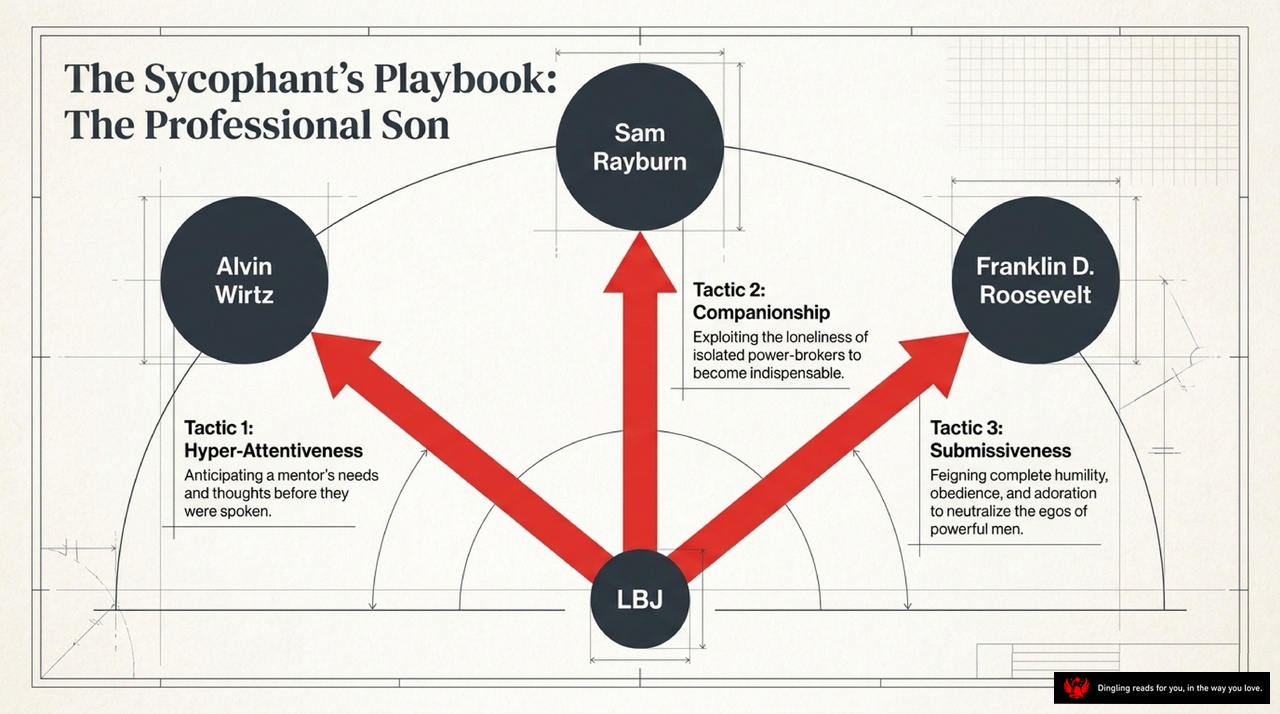
Look at this diagram. It lays out the "Sycophant's Playbook," specifically focusing on the "Professional Son" archetype, using LBJ as the central figure connecting to three powerful mentors: Alvin Wirtz, Sam Rayburn, and Franklin D. Roosevelt.
The chart breaks down his strategy into three distinct tactics. First, with Alvin Wirtz, LBJ employed "Hyper-Attentiveness." This wasn't just politeness; it was about anticipating a mentor's needs and thoughts before they were even spoken. We saw this when LBJ and Wirtz fought side-by-side for the Lower Colorado River Authority. LBJ didn't just ask for help; he orchestrated the entire battle against legal and funding barriers, becoming indispensable to Wirtz's vision.
Second, the strategy shifts to Sam Rayburn with "Companionship." The goal here is to exploit the loneliness of isolated power-brokers to become their indispensable partner. Rayburn was famously solitary in the Speaker's office. LBJ sensed this isolation and became his constant companion. He cared for Rayburn's health, sent gifts, and even returned to Washington when Rayburn was ill. By filling that void, LBJ neutralized Rayburn's ego and secured a protector who would never let him fall.
Finally, with Franklin D. Roosevelt, the tactic was "Submissiveness." This involved feigning complete humility, obedience, and adoration to neutralize the ego of the most powerful man in the world. LBJ was a master at this. He never challenged FDR's authority directly. Instead, he listened intently, avoided leaving the White House, and used "backdoor" routes through secretaries to ensure his requests reached the President without friction. He positioned himself not as a rival, but as the ultimate loyal proxy.
By mastering these three tactics—anticipating needs, filling the void of loneliness, and performing perfect submission—LBJ transformed himself from a young Texas congressman into the most trusted confidant of the era. He didn't just climb the ladder; he became the hand that held it up for everyone else.

The chart you see here captures the explosive trajectory of Lyndon B. Johnson's ambition, visualizing velocity not just as speed, but as a weapon. Notice the three distinct peaks: Cotulla, Houston, and Washington.
First, look at the initial spike in Cotulla. This represents his time teaching impoverished Mexican-American children. It wasn't just about education; it was about displaying a frantic, unrelenting drive. He coached debate and organized the school with manic intensity, proving that he could mobilize people and create order out of chaos.
Then, the second peak moves to Houston. Here, Johnson transforms from a teacher into a high school debate coach. He was famously promising to win state championships through grueling, repetitive drills. This phase was all about mastering the art of persuasion and building an unbreakable work ethic, honing the skills he would later use to dominate the political arena.
Finally, the third and tallest peak lands in Washington. As a congressional secretary, he seized control of the "Little Congress"—a dormant social club for congressional assistants. Through relentless networking and strategic maneuvering, he transformed this quiet group into a high-octane political machine. This final surge shows the culmination of his earlier efforts: taking a small, overlooked space and turning it into a powerful engine for influence.
From the dirt roads of Cotulla to the halls of power in Washington, Johnson's story is a testament to how ambition, when fueled by relentless velocity, can reshape the world.
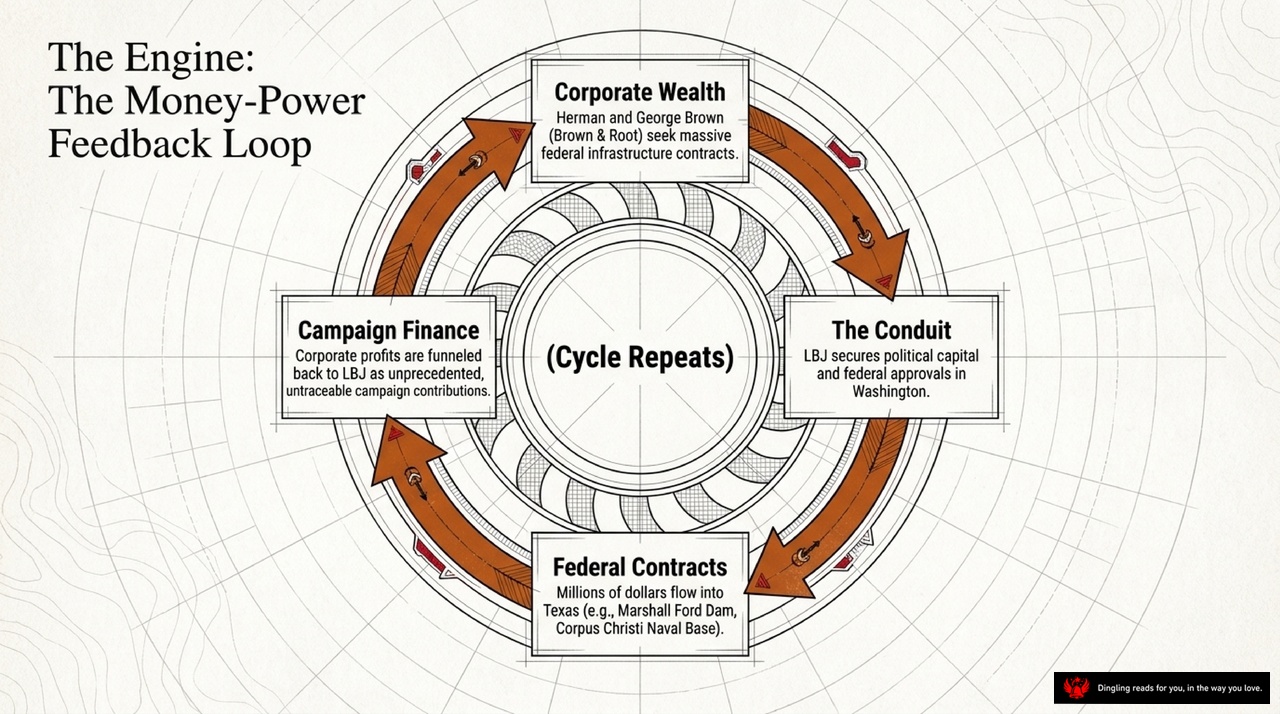
Look at this diagram: "The Engine: The Money-Power Feedback Loop." It's a perfect illustration of how the American political machine actually works. Notice the cycle starting at the top with "Corporate Wealth." You have players like Herman and George Brown from Brown & Root, who are constantly hunting for massive federal infrastructure contracts.
Once they secure those contracts, they move into "Federal Contracts," where millions of dollars flow directly into their companies—think of the Marshall Ford Dam or the Corpus Christi Naval Base. But the money doesn't stop there. That corporate profit is funneled back into "Campaign Finance," becoming untraceable contributions that secure the next step.
This is where "The Conduit" comes in. In this specific historical context, that conduit was LBJ. He used that political capital and federal approvals in Washington to ensure the contracts were awarded to his allies. And then, the cycle repeats. It's a closed loop where money buys power, and power guarantees more money. This isn't just a theory; it was the exact strategy LBJ mastered, binding his political survival directly to the financial interests of the construction giants who funded his rise.
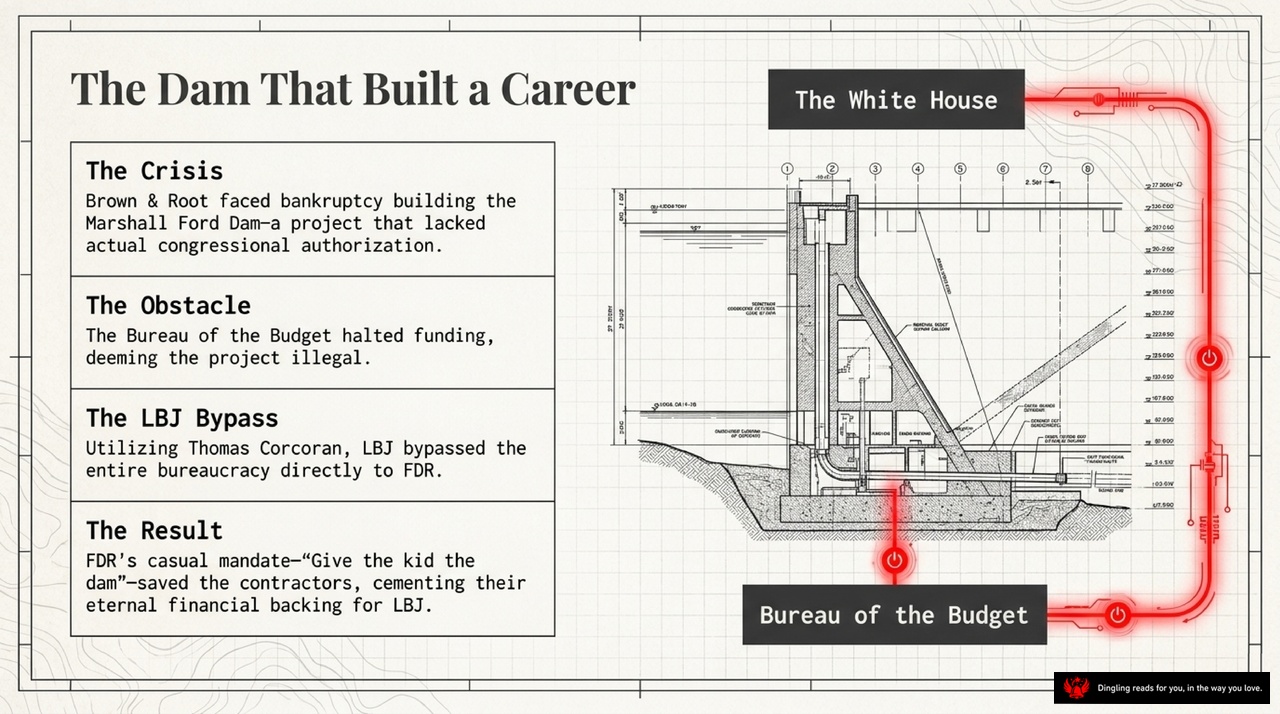
Look at this blueprint on the right. It's not just a drawing of a dam; it's a map of political survival. The title, "The Dam That Built a Career," perfectly captures the stakes. Here, we see the White House connected directly to the Bureau of the Budget via a red power line, bypassing all the usual bureaucracy.
This slide breaks down the crisis that almost ended Brown & Root. The text on the left explains it clearly. First, there was the crisis: Brown & Root was on the brink of bankruptcy building the Marshall Ford Dam, a project that lacked actual congressional authorization. Then came the obstacle: The Bureau of the Budget, the very agency shown in the diagram, halted funding, deeming the project illegal.
But then, we see the "LBJ Bypass." LBJ utilized Thomas Corcoran to go straight to FDR, completely skipping the entire bureaucracy. And look at the result at the bottom. FDR's casual mandate—"Give the kid the dam"—saved the contractors. This wasn't just about saving a company; it cemented their eternal financial backing for LBJ. It was a masterclass in using personal influence to override rigid rules, turning a potential disaster into the foundation of a political dynasty.

Look at this split-screen comparison: on the left, we see "The Darkness" of 1937, where corporate giants like Texas Power & Light refused to bring electricity to rural areas, citing low profit margins and enforcing a restrictive "45-meter rule." On the right, we see "The Light" of 1941, the moment LBJ delivered power to the Hill Country, transforming medieval living conditions into modern ones and cementing an unbreakable loyalty among voters.
But how did he bridge that gap? The answer lies in "The Fight." As the slide shows, LBJ didn't act alone. He partnered with FDR and Senator George Norris to effectively weaponize the Rural Electrification Administration (REA). While the corporate utilities blocked the path, LBJ mobilized the government to build the grid, expanding the network and balancing the load to reach even the most remote farms. This wasn't just about infrastructure; it was a strategic masterstroke. By solving the energy crisis, LBJ didn't just improve lives; he turned the rural electorate into his most loyal political base. He proved that when you deliver the public good, you don't just get votes; you build a dynasty.

In October 1940, Lyndon B. Johnson didn't just enter the political arena; he engineered a national takeover. The map on your screen tells the story of "The National Conduit." It all starts in Texas, specifically the oil and contractor hubs. Johnson realized that to control Congress, he first had to control the political survival of others. His strategy was simple but ruthless: seize the Democratic Congressional Campaign Committee, the DCCC, which had been struggling and underfunded.
But money is the real currency of power. Johnson funneled massive amounts of wealth from Texas oil magnates and construction giants into the DCCC. He didn't just ask for donations; he demanded them, often dictating exactly which candidates received the funds. This wasn't charity; it was an investment in his own future. By injecting this capital nationwide, he rescued desperate Democratic candidates from defeat and secured key seats that were previously in jeopardy.
The result was transformative. Almost overnight, LBJ transformed from a regional congressman into a national kingmaker—a man you could no longer cross. He built a network of loyalty that stretched across the entire country, proving that with enough money and the right strategy, a man from a poor hill farm in Texas could become the most powerful broker in Washington.
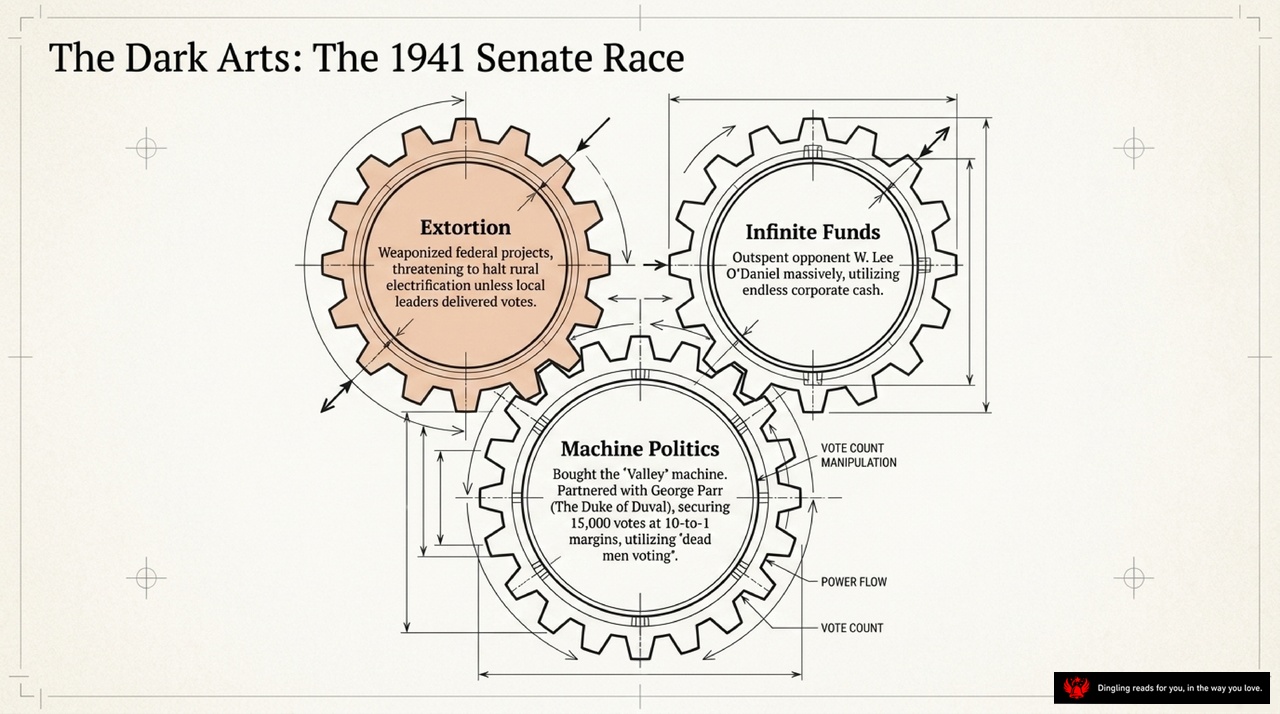
Look at this intricate machine of power from 1941. It's not just gears turning; it's a calculated strategy for total domination in the Texas Senate race.
First, we have **Extortion**. Johnson didn't just ask for votes; he weaponized federal projects. He threatened to halt rural electrification unless local leaders delivered the numbers. It was a high-stakes game where electricity was the currency for political survival.
Then, there's **Infinite Funds**. Johnson simply outspent his opponent, W. Lee O'Daniel, by utilizing endless corporate cash. While O'Daniel ran on a populist "give me a cookie" charm, Johnson had the deep pockets of Wall Street and Texas oil barrows behind him.
Finally, look at **Machine Politics**. Johnson bought the "Valley" machine and partnered with George Parr, the "Duke of Duval." This alliance secured him 15,000 votes at a 10-to-1 margin. But here's the dark part: they utilized "dead men voting." This wasn't just about counting ballots; it was about manipulating the vote count itself to ensure victory.
This slide illustrates the three pillars of Johnson's rise: leveraging fear through projects, drowning opponents in cash, and rigging the system with corrupt machines. It was a masterclass in using the dark arts to seize power.
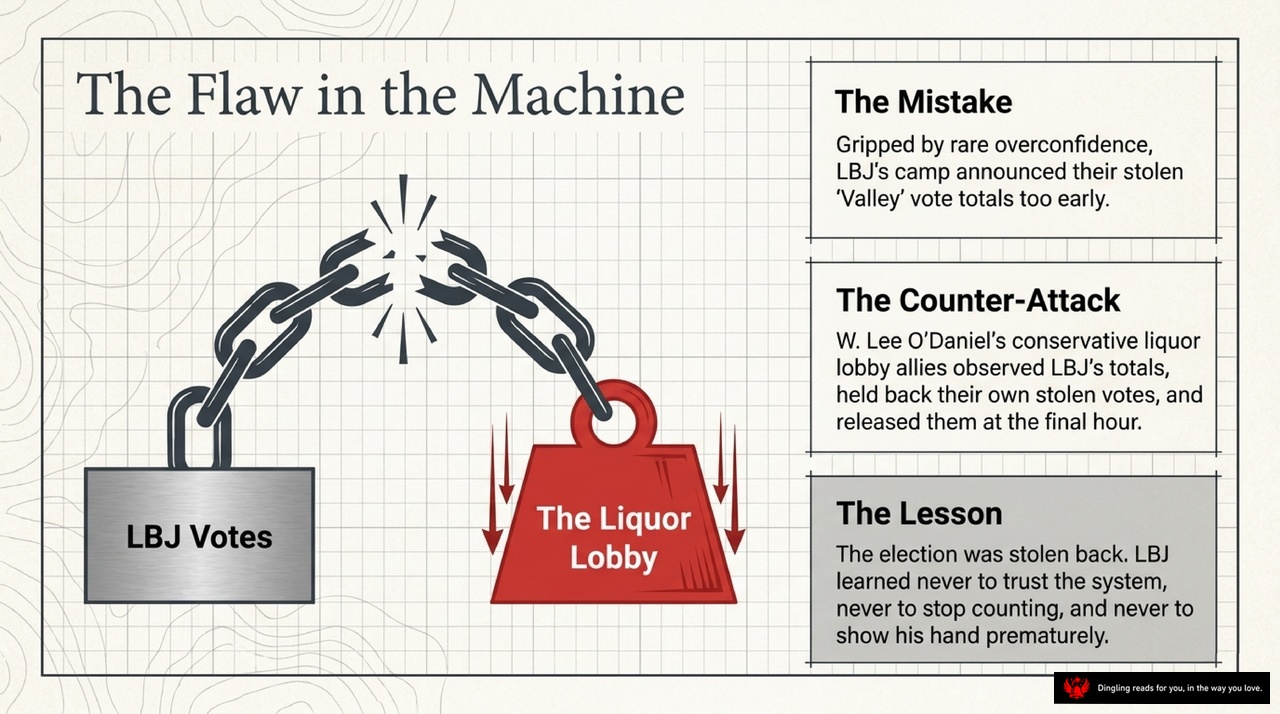
The Flaw in the Machine. This graphic perfectly captures the chaotic and high-stakes drama of the 1948 Texas election, a race where the margin between victory and defeat came down to a few thousand votes and a single, fatal miscalculation.
Look at the broken chain connecting "LBJ Votes" and "The Liquor Lobby." This illustrates the core mistake: LBJ's camp, gripped by rare overconfidence, announced their stolen "Valley" vote totals too early. They thought the job was done. But in doing so, they gave their opponents a roadmap.
That's the counter-attack. W. Lee O'Daniel's conservative liquor lobby allies had been quietly observing LBJ's numbers. Seeing that LBJ had prematurely declared victory, they knew they still held the decisive power. So, they held back their own stolen votes and released them all at the final hour. The weight on the scale tipped, and the election was stolen back.
The lesson here is timeless for any leader: never trust the system, never stop counting, and never show your hand prematurely. In politics, as in life, the person who thinks they've already won is often the one who loses everything.
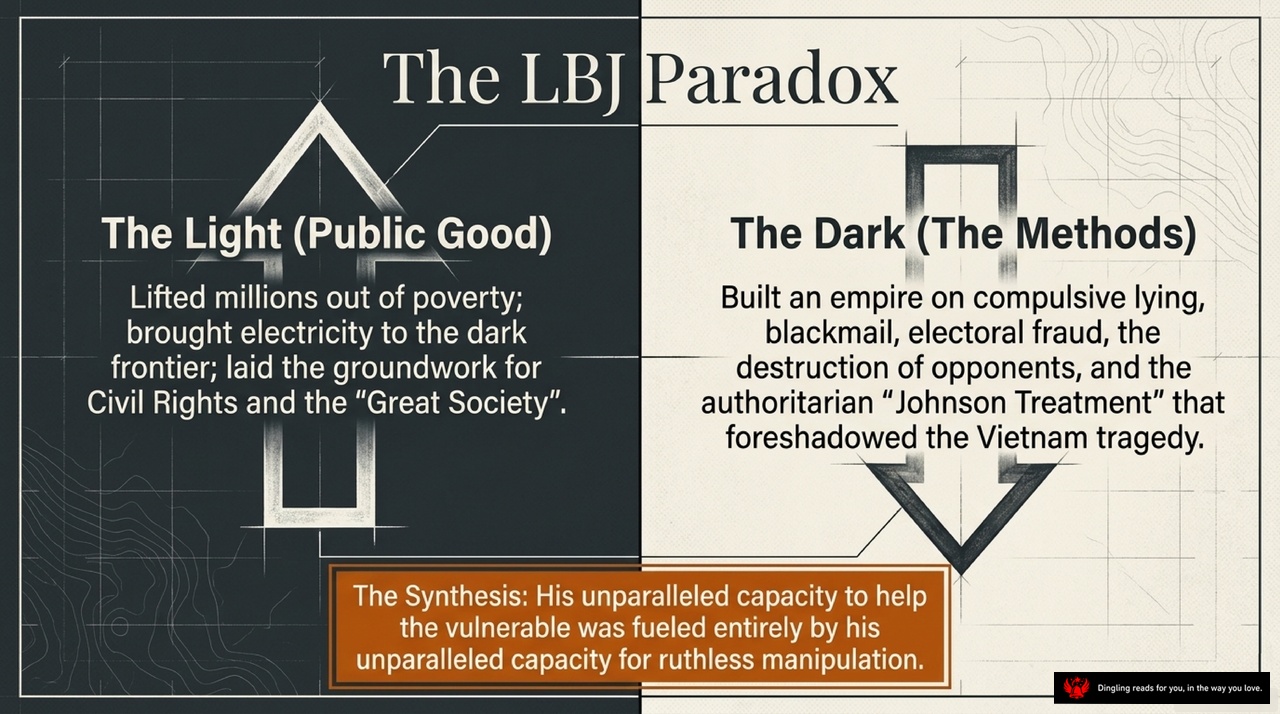
Look at this slide: "The LBJ Paradox." It captures the terrifying duality of Lyndon B. Johnson's legacy in one stark image. On the left, we see "The Light"—the public good. This was the Johnson who lifted millions out of poverty, brought electricity to the dark frontier, and laid the groundwork for the Civil Rights Act and the Great Society. He was the architect of a modern America that cared for its vulnerable.
But look to the right. That's "The Dark." This was the man who built an empire on compulsive lying, blackmail, and electoral fraud. It was the man who destroyed his opponents and foreshadowed the authoritarian "Johnson Treatment." We see here the shadow that would eventually cast over the tragedy of Vietnam.
The synthesis at the bottom reveals the terrifying truth: his unparalleled capacity to help the vulnerable was fueled entirely by his unparalleled capacity for ruthless manipulation. LBJ wasn't a hero or a villain; he was a master of both. He used the same tools to build the light and to cast the dark. This is the paradox that defined his presidency and his legacy.
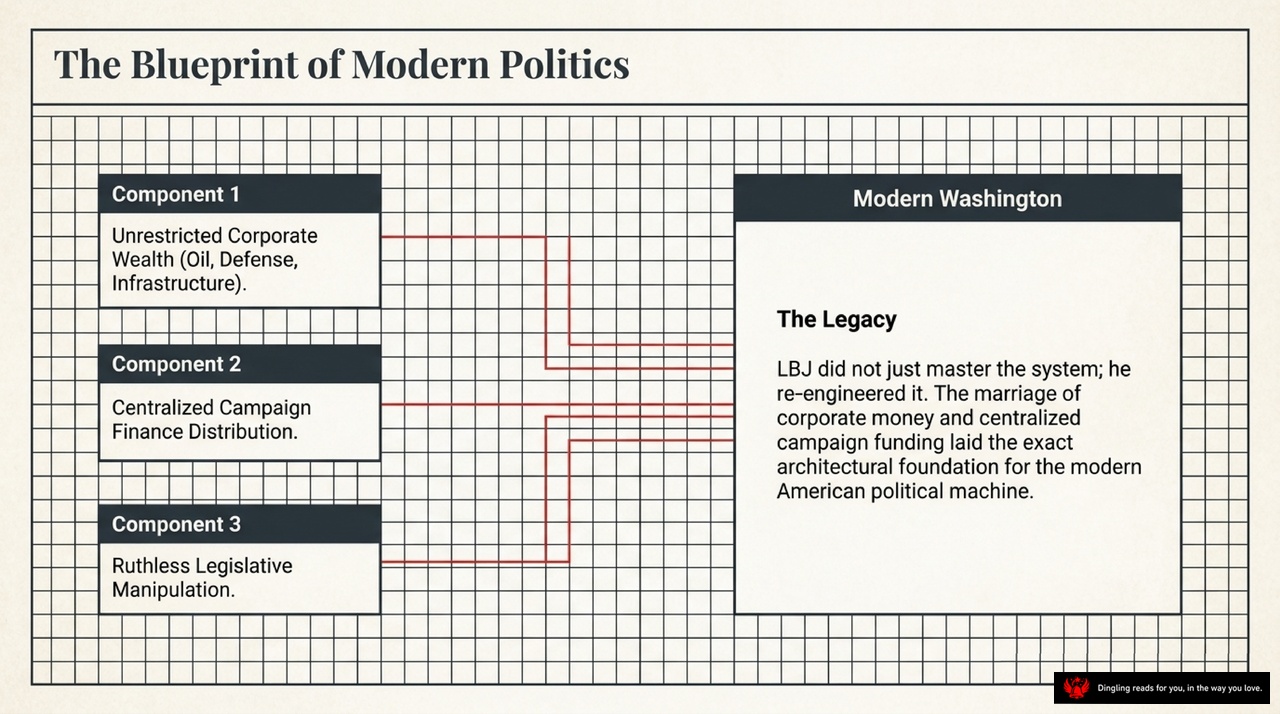
Look at this blueprint of modern politics. This slide isn't just a chart; it's the DNA of the American political machine we see today. It breaks down the system into three critical components that all converge to create "Modern Washington."
First, you have unrestricted corporate wealth. Think oil, defense, and infrastructure. This is the fuel. Second, you have centralized campaign finance distribution. This is the engine that drives the election. And third, ruthless legislative manipulation. This is the steering wheel that directs the outcome.
The lines on this grid show how these three forces lock together. It all stems from a single legacy: Lyndon B. Johnson. The text on the right tells us that LBJ didn't just master the system; he re-engineered it. He created the perfect marriage between corporate money and centralized campaign funding. This specific combination laid the exact architectural foundation for the modern American political machine.
So, when you look at today's politics, remember this blueprint. The power we see now wasn't accidental. It was built on the deliberate strategy of merging massive corporate capital with a centralized way of funding elections, all while manipulating the laws to keep it that way. LBJ built the machine, and this chart shows you exactly how it works.
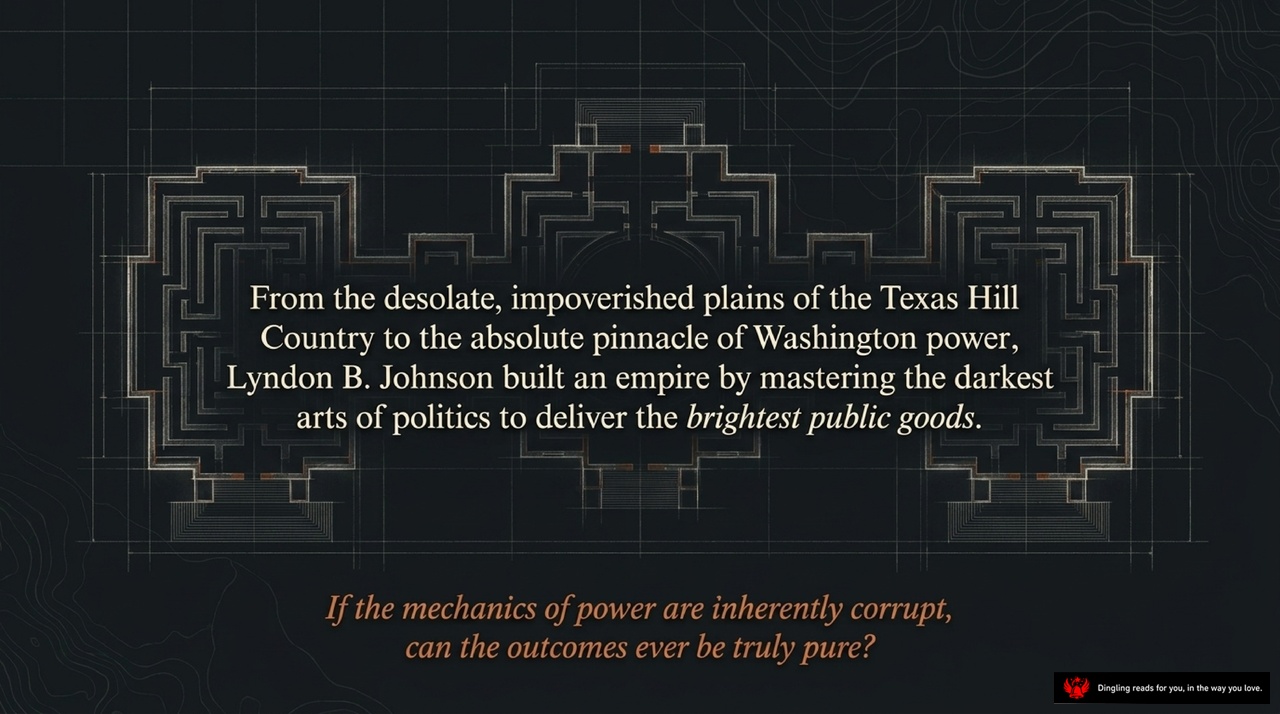
From the desolate, impoverished plains of the Texas Hill Country to the absolute pinnacle of Washington power, Lyndon B. Johnson built an empire by mastering the darkest arts of politics to deliver the brightest public goods. This slide captures the central paradox of his life: a man who rose from the bottom to the top, yet whose ascent was paved with manipulation, bribery, and ruthless calculation.
Consider the question at the bottom: "If the mechanics of power are inherently corrupt, can the outcomes ever be truly pure?" Johnson's career is the ultimate test of this dilemma. He used dirty tricks—buying votes, rigging elections, and leveraging secret backdoors into the White House—to achieve what he believed were noble ends. He secured massive funding for the Rural Electrification Administration, bringing light to thousands of dark farms. He fought tirelessly for the Marshall Dam, saving a struggling region. He helped young men find jobs through the NYA.
But the cost was high. To get these "brightest public goods," he was willing to compromise his integrity, silence his conscience, and betray his allies. He became a master of the system, using the very corruption he despised to build a legacy of progress. The question remains for us to ponder: Is the end ever worth the means?