
The Perils of Interpreting: Complete Chapter-by-Chapter Summary
Welcome to today's session on "The Perils of Interpreting," a story based on the groundbreaking work by Henrietta Harrison.
We are about to embark on a historical exploration of two remarkable translators who navigated the volatile collision between the Qing Dynasty and the British Empire. Their lives reveal a profound and often dangerous truth: that cross-cultural empathy can be the most dangerous asset of all.
As we begin, keep in mind the central theme of this slide: the perils of interpreting. In a world where empires clashed and languages divided, these translators did more than just convert words from one tongue to another. They became the bridge between two vastly different civilizations, and in doing so, they risked everything. From the bustling streets of Naples to the imperial courts of Beijing, their journey illustrates how understanding the other side can be both a powerful tool and a life-threatening vulnerability. Let's dive into their story.

In speech is history made, and nowhere is this more true than in the tangled web of the 1793 Macartney Embassy. This slide captures a pivotal dynamic: the gap between "The Rulers" and "The Voices." On the left, we see Emperor Qianlong and King George III—the leaders who decide the intent. On the right, we see "The Voices," or the interpreters, who ultimately shape the reality we perceive today.
The core message here is profound: Leaders decide the intent, but interpreters shape the reality. History is not just written by kings; it is translated by intermediaries. Consider the 1793 mission. It was not a meeting of two isolated, ignorant worlds. Instead, it was a deeply entangled early global exchange managed entirely by invisible bilingual intermediaries.
Take Li Zibiao, a Chinese interpreter who navigated the treacherous waters between Beijing and London. He was the bridge that allowed the Emperor's words to reach the King, and the King's demands to reach the court. His choices—what to translate, what to emphasize, what to soften—directly influenced the outcome of negotiations. Without him, the "intent" of the rulers would have remained lost in translation, and the "reality" of history would have been entirely different.
Similarly, Lord George Staunton, the British interpreter, played a crucial role in framing China for the British public. His writings, *An Authentic Account of an Embassy from the King of Great Britain to the Emperor of China*, became the primary lens through which the West viewed China for decades. He was the voice that defined the "other."
This slide reminds us that history is a construct of language. The rulers set the stage, but the voices—the translators, the diplomats, the scribes—write the script. They determine how power is perceived, how culture is understood, and how the past is remembered. In the grand theater of international relations, the power of the pen, and the power of the tongue, often outweighs the power of the sword.
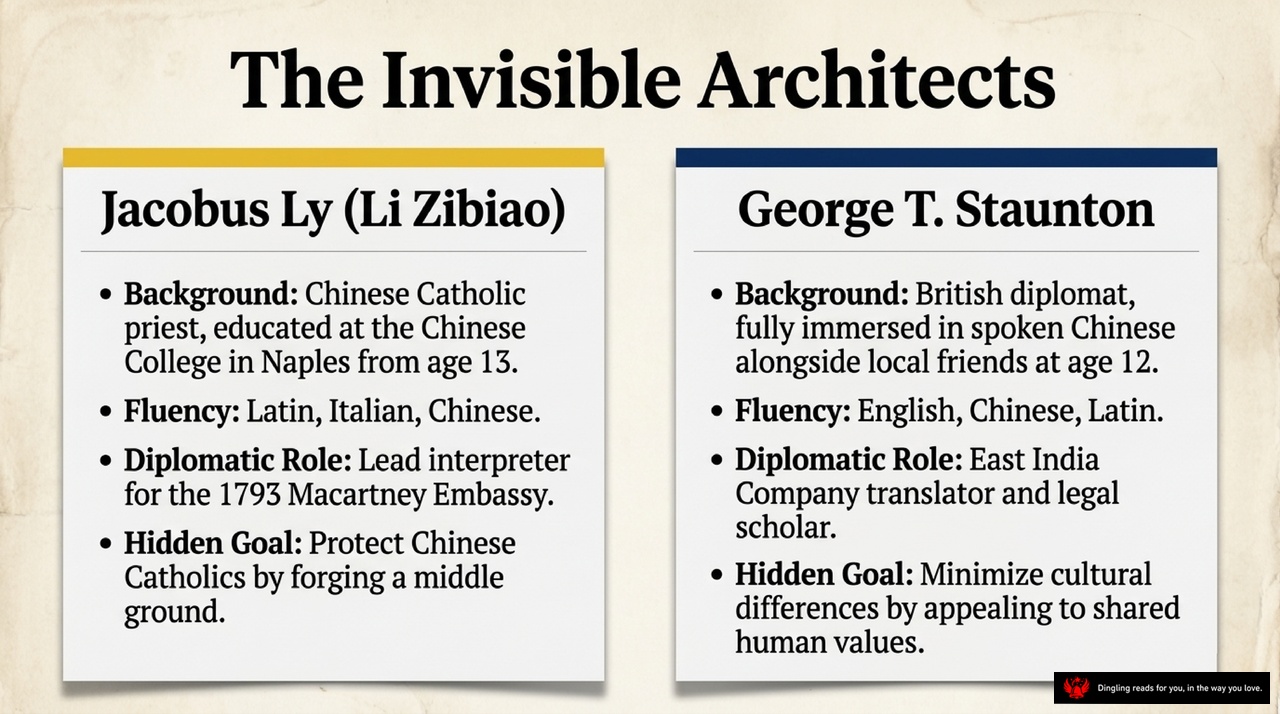
The Invisible Architects are Li Zhibiao and George T. Staunton. Li Zhibiao was a Chinese Catholic priest educated in Naples from age 13, fluent in Latin, Italian, and Chinese. He served as the lead interpreter for the 1793 Macartney Embassy with a hidden goal to protect Chinese Catholics by forging a middle ground. George T. Staunton, a British diplomat immersed in spoken Chinese at age 12, was fluent in English, Chinese, and Latin. As an East India Company translator and legal scholar, his hidden goal was to minimize cultural differences by appealing to shared human values. These two men, though from different worlds, became the unseen bridges between East and West during a time of great tension.

Translation as Negotiation: The art of diplomacy isn't just about speaking two languages; it's about mastering the space between them. Look at this diagram. It illustrates the crucial role of Li Zhaobiao during the Macartney Mission.
On the left, we see Macartney's blunt diplomatic demands—direct, perhaps even risky, for the Qing court. But these raw requests couldn't simply be spoken to Emperor Qianlong. They had to pass through "The Filter."
This filter was Li Zhaobiao himself. He wasn't a passive recording device; as the core insight states, he was a cultural broker. His methodology was active and deliberate. He assessed court etiquette, personal risk, and political reality. He altered tones, omitted friction points, and even inserted his own hidden agendas to protect his Christian community.
The result, shown on the right, was a softened, culturally acceptable request delivered to the Emperor. The ultimate goal was clear: ensure high-stakes diplomacy did not break down into immediate hostility. Li Zhaobiao didn't just translate words; he negotiated the relationship itself, saving the mission from disaster through his skillful mediation.
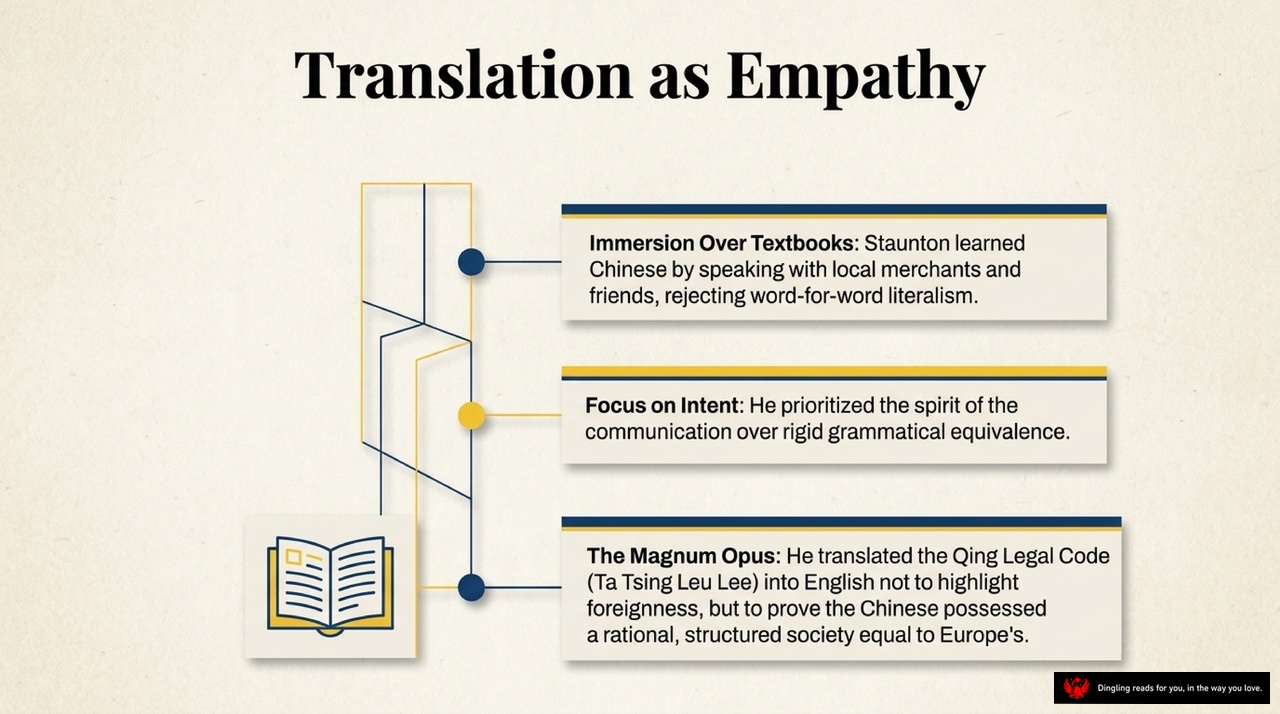
Translation as Empathy: The Art of Bridging Worlds
Look at this slide. It breaks down how translation is truly an act of empathy, using the story of John Stewart as our prime example. First, we see "Immersion Over Textbooks." Unlike his peers who relied on rigid grammar books, Stewart learned Chinese by living it. He spoke with local merchants and friends, rejecting word-for-word literalism in favor of real, spoken language.
Next, the slide highlights "Focus on Intent." Stewart prioritized the spirit of the communication over rigid grammatical equivalence. He understood that a message's core meaning mattered far more than a perfect, mechanical translation of every word.
Finally, we see "The Magnum Opus." Stewart translated the Qing Legal Code into English, but his goal wasn't to highlight foreignness. Instead, he aimed to prove that Chinese society possessed a rational, structured logic equal to Europe's. By translating with empathy, he didn't just convey words; he built a bridge of mutual understanding between two vastly different cultures.
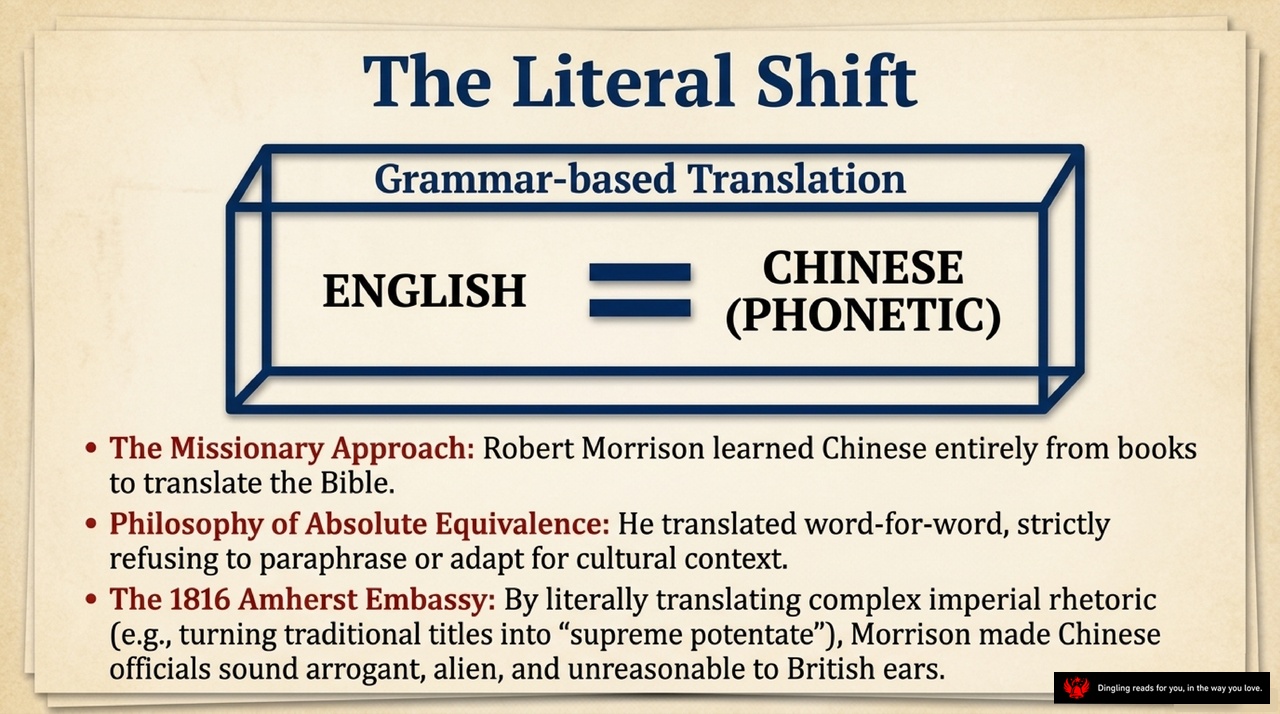
The slide we see here is titled "The Literal Shift," and it captures a pivotal moment in how the British Empire understood—and misunderstood—China. At the center is a diagram showing a rigid equation: English equals Chinese, phonetic for phonetic. This represents the "Grammar-based Translation" that dominated the early 19th century, a mindset that prioritized literal word-for-word matching over cultural nuance.
This approach wasn't just an academic choice; it was the strategy of the missionary Robert Morrison, who learned Chinese entirely from books and believed in a philosophy of "Absolute Equivalence." He refused to paraphrase or adapt for context, treating the two languages as perfect mirrors of each other. But as the 1816 Amherst Embassy proved, this rigid literalism backfired spectacularly. By translating complex imperial titles like "supreme potentate" directly, Morrison made Chinese officials sound arrogant and alien to British ears, creating a diplomatic crisis.
The irony, however, lies in the next generation. While the missionaries pushed for this stiff, literal translation, George Thomas Staunton—George's father—had learned the opposite lesson. Having grown up in a multilingual, multicultural environment and studied under the Jesuits, George realized that true communication required flexibility. He understood that translation wasn't about swapping words, but about bridging cultures. While the "Literal Shift" was creating barriers, George's later work would prove that the key to diplomacy lay not in rigid equivalence, but in finding a middle ground that respected both sides.

The slide reveals a stark reality: the method we use to learn a language doesn't just change our vocabulary; it dictates the geopolitical outcome of our interactions. Look at the table. Two men, Jacobus Ly and George T. Staunton, both used "Immersion." Their goal was finding common ground or proving equality, leading to "Sustaining Peace." But look at Robert Morrison. He relied on a "Textbook," aiming for "Absolute Equivalence." The result? "Fueling Conflict."
This isn't just about grammar; it's about power. Morrison's approach, treating translation as a rigid, word-for-word exercise, created a barrier. He sought a perfect mirror of the original text, ignoring the cultural context that makes communication work. In contrast, the immersive methods of Ly and Staunton allowed for nuance and adaptation, building bridges rather than walls. As we saw with the Macartney mission, when translation becomes a tool for absolute equivalence rather than mutual understanding, it often fuels the very conflicts it was meant to resolve. The lesson is clear: how we interpret the world determines how the world interprets us.
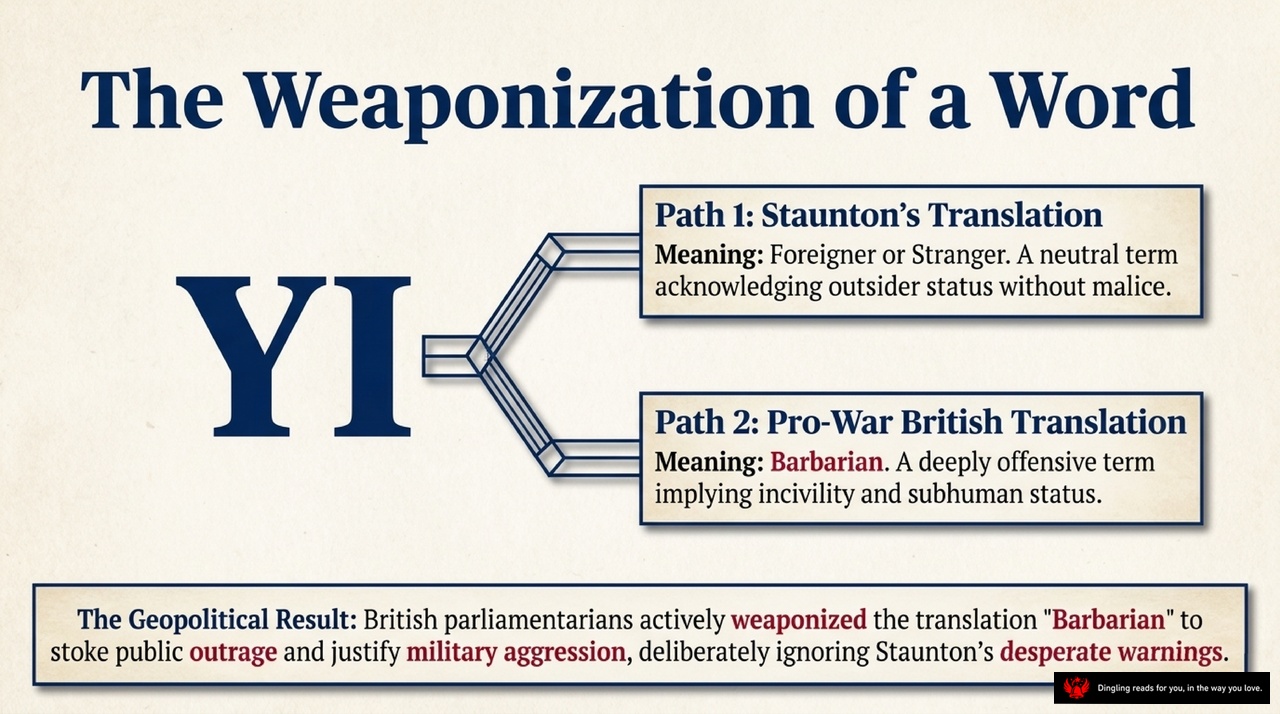
The Weaponization of a Word. Look closely at the diagram on your screen. It reveals a critical turning point in history: the deliberate distortion of a single character, "Yi."
We see two distinct paths. Path 1 represents Sir George Staunton's original translation, where "Yi" simply meant "foreigner" or "stranger"—a neutral term acknowledging outsider status without any inherent malice. It was a diplomatic bridge. But look at Path 2: the Pro-War British translation. Here, that same word was redefined as "Barbarian." This wasn't just a linguistic choice; it was a deeply offensive term implying incivility and subhuman status.
The geopolitical result was catastrophic. British parliamentarians actively weaponized this translation. By insisting on the term "Barbarian," they successfully stoked public outrage back home. This manufactured anger was then used to justify military aggression against China. They deliberately ignored Sir George's desperate warnings about the danger of this rhetoric, choosing instead to frame a peaceful diplomatic mission as a clash between civilization and savagery. This linguistic manipulation laid the ideological groundwork for the Opium Wars, turning a word into a weapon of war.
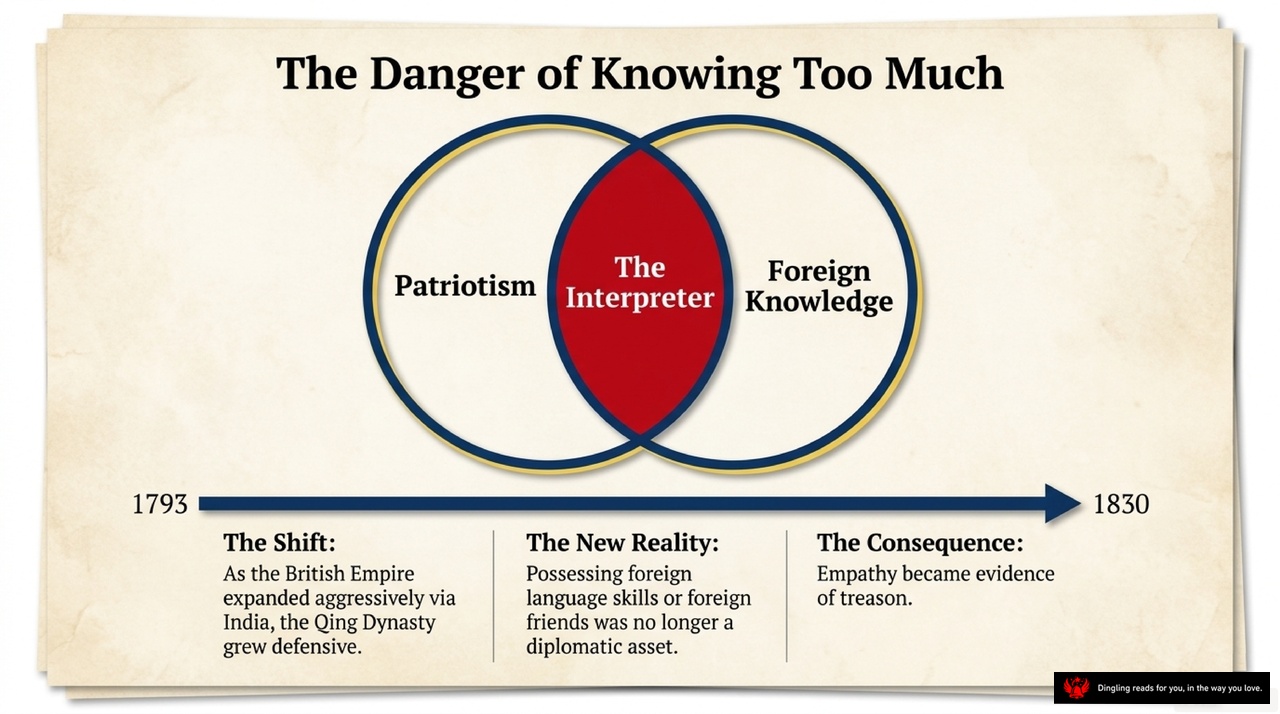
The danger of knowing too much. As the British Empire expanded aggressively through India, the Qing Dynasty grew defensive. Possessing foreign language skills or foreign friends was no longer a diplomatic asset. Instead, empathy became evidence of treason. This shift marked a turning point for interpreters like Li Zibiao and George Thomas Staunton. While Li Zibiao navigated the perilous waters of the Macartney Embassy, translating with a delicate balance of loyalty and survival, Staunton's son, George, rose to become the most knowledgeable Englishman on China, only to be rejected by his own society upon return. Their stories illustrate how, in a time of rising nationalism, understanding the other side could become a liability. The very knowledge that once served as a bridge now became a barrier, silencing the voices that could have prevented conflict.

The Strategic Retreat into Ignorance. This slide challenges a common myth: that the Qing Dynasty was completely blind to the outside world. The reality was far more complex and deliberate.
On the left, we see "Available Knowledge." Through global trade, maps, and diplomatic notes, the Qing court actually possessed significant information about the West. Elite scholars and merchants knew the West intimately. However, as the "Dark Truth" at the bottom reveals, sharing accurate intelligence became a literal death sentence in a hostile political climate. To survive, these elites chose silence.
This brings us to the central mechanism: "Political Survival." Faced with the threat of foreign powers, the ruling elite made a calculated decision. They didn't lack information; they actively filtered it out.
This process is shown by the valve in the center, representing the control of information flow. By turning this valve, they transformed "Available Knowledge" into "Manufactured Ignorance." The result, as stated on the right, was a strategic silence that fell over the empire. This wasn't an accident of ignorance; it was a strategic retreat designed to protect the regime, ultimately sealing China off from the modern world.
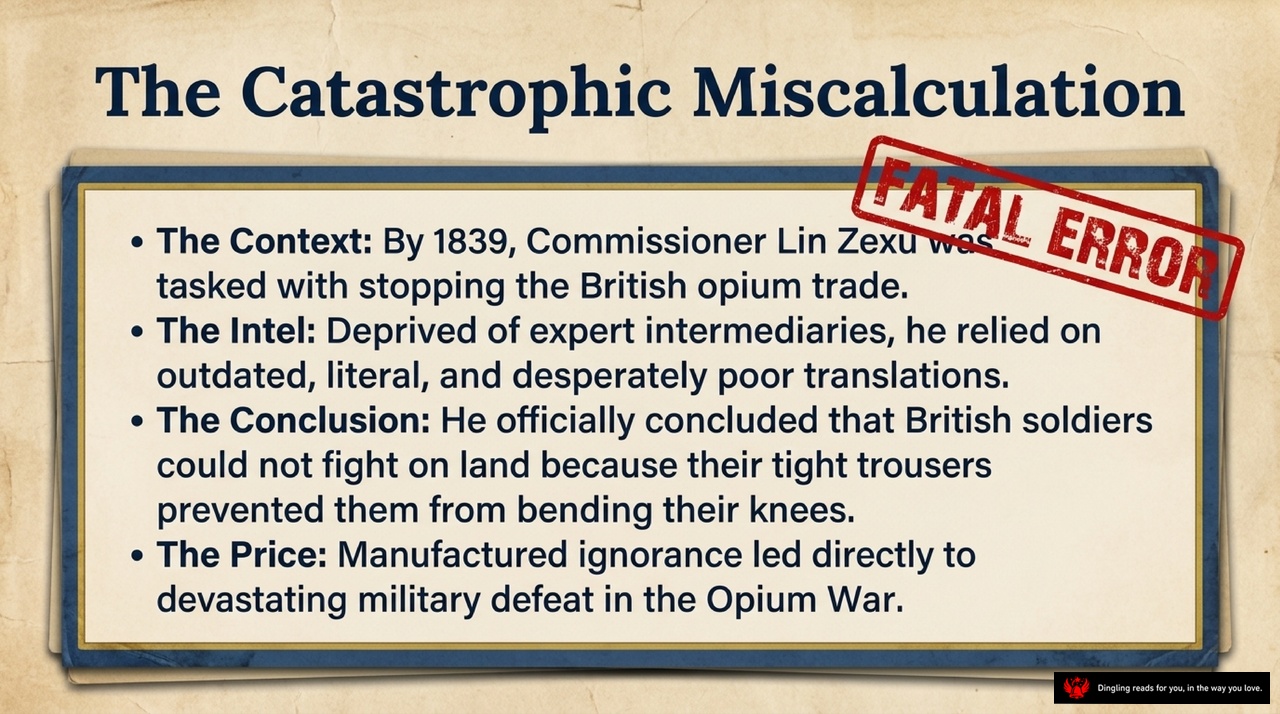
The catastrophic miscalculation of the Opium War began not with cannon fire, but with a fatal error in intelligence. By 1839, Commissioner Lin Zexu was tasked with stopping the British opium trade, yet he was utterly deprived of expert intermediaries. Desperate for information, he relied on outdated, literal, and desperately poor translations that distorted reality. This manufactured ignorance led to a terrifying conclusion: Lin Zexu officially declared that British soldiers could not fight on land because their tight trousers prevented them from bending their knees. This absurd belief, born from a lack of proper understanding, directly led to a devastating military defeat. As the slide starkly labels this "Fatal Error," it reminds us that the path to war was paved by a catastrophic miscalculation, where ignorance of the enemy's true capabilities cost China dearly.

The fate of the intermediaries is a sobering reminder of how personal vision can be crushed by imperial ambition. On this slide, we see the divergent paths of Jacobus Ly and George T. Staunton. Jacobus Ly, born Li Zibiao, spent his final decades hiding under the false name "Mr. Plum" in rural Shanxi villages. He was fleeing violent anti-Catholic purges, surviving only by blending into the very culture he served as a bridge. In stark contrast, George T. Staunton fled China under the threat of arrest, returning to the British Parliament where he spent his later years mocked by hardliners for his moderate, empathetic stance on China. Both survived, but their vision of mutual understanding was deliberately discarded by their respective empires. Ly was erased by the Qing crackdown, while Staunton was marginalized by British political polarization. Their stories prove that even when two cultures find a translator to speak their truths, the powerful often choose to silence the bridge between them.

The Geopolitical Cycle of Communication isn't just a theory; it's a historical blueprint that explains how empires collide. Look at this diagram: it starts with **Interconnection**, fueled by trade and early diplomacy. But as we saw in the stories of Li Zibiao and Lord Macartney, that bridge doesn't last forever. When economic interests clash or territorial disputes arise, **Rising Friction** sets in.
This friction breeds **Suspicion of Intermediaries**. In the Macartney mission, Li Zibiao was seen not as a bridge, but as a potential traitor. Empathy was viewed as treason, and translators became targets. This leads to a strategic **Information Blackout**, where nations retreat into ignorance and stop listening to each other. Finally, the cycle culminates in **Open Conflict**, a war based on miscalculation.
The breakdown of Sino-British relations wasn't an inevitable clash of alien cultures. It was a systematic destruction of the linguistic and human bridges that connected them. When we destroy our intermediaries and stop communicating, we don't just lose friends; we invite war.

Today, we often rely on machine translation to get the perfect, literal match—thinking that's all diplomacy needs. But history teaches us a different lesson. Look at this scale: on one side, we have "Linguistic Accuracy," representing the rigid, word-for-word approach of the past, much like what Robert Morrison tried to do. On the other side sits "Cultural Empathy." True success isn't found in just processing vocabulary; it requires the human courage to mediate intent, context, and shared humanity. As the history of the Macartney Embassy proves, a perfect translation without empathy can fail to bridge the gap between cultures. It's not about the words you speak, but the understanding you bring to the conversation.

Translators are the invisible architects of history. When empires collide, the ability to understand the 'other' is a powerful tool for peace, yet it inevitably makes the interpreter a target of profound suspicion. As we've seen through the stories of Li Zibiao and George Staunton, the descent into the Opium War was not caused by a lack of contact, but by the deliberate silencing of those who possessed cross-cultural empathy. Li Zibiao, a Chinese Catholic who served as a translator for the Macartney mission, risked his life to advocate for religious freedom, only to be erased from official records once the political winds shifted. Conversely, George Staunton, raised in a unique bilingual environment, used his fluency to navigate the complexities of Chinese law and culture, yet his very competence eventually became a liability when the narrative of conflict took hold.
If history is truly made in speech, what happens to our future when we view the effort to understand our adversaries not as an act of diplomacy, but as an act of betrayal? The tragedy of the 19th century was not just the clash of cannons, but the loss of the translators who could have bridged the gap. By silencing the voices of Li Zibiao and others, and by misinterpreting the intentions of the East, we paved the way for a century of conflict that could have been avoided. The lesson is clear: peace depends not on the strength of the sword, but on the fidelity of the word.