
The Pillow Book: Complete Chapter-by-Chapter Summary

Welcome to *The Pillow Book*, a timeless masterpiece by Sei Shōnagon. Imagine stepping into the quiet, elegant world of 11th-century Japan, where every season tells a story and even a single glance holds deep meaning. This book captures the exquisite aesthetics, sharp wit, and hidden court life of that era with unmatched grace. From the delicate beauty of cherry blossoms in spring to the cozy warmth of snow-covered mornings in winter, Shōnagon paints a vivid picture of life within the imperial palace. It's not just about grand events, but the tiny, delightful moments that make life extraordinary—a falling petal, a clever joke, or the simple joy of a shared laugh. Whether you're drawn to poetry, nature, or the intrigue of royal court life, this book offers a unique window into a world that still feels alive today.
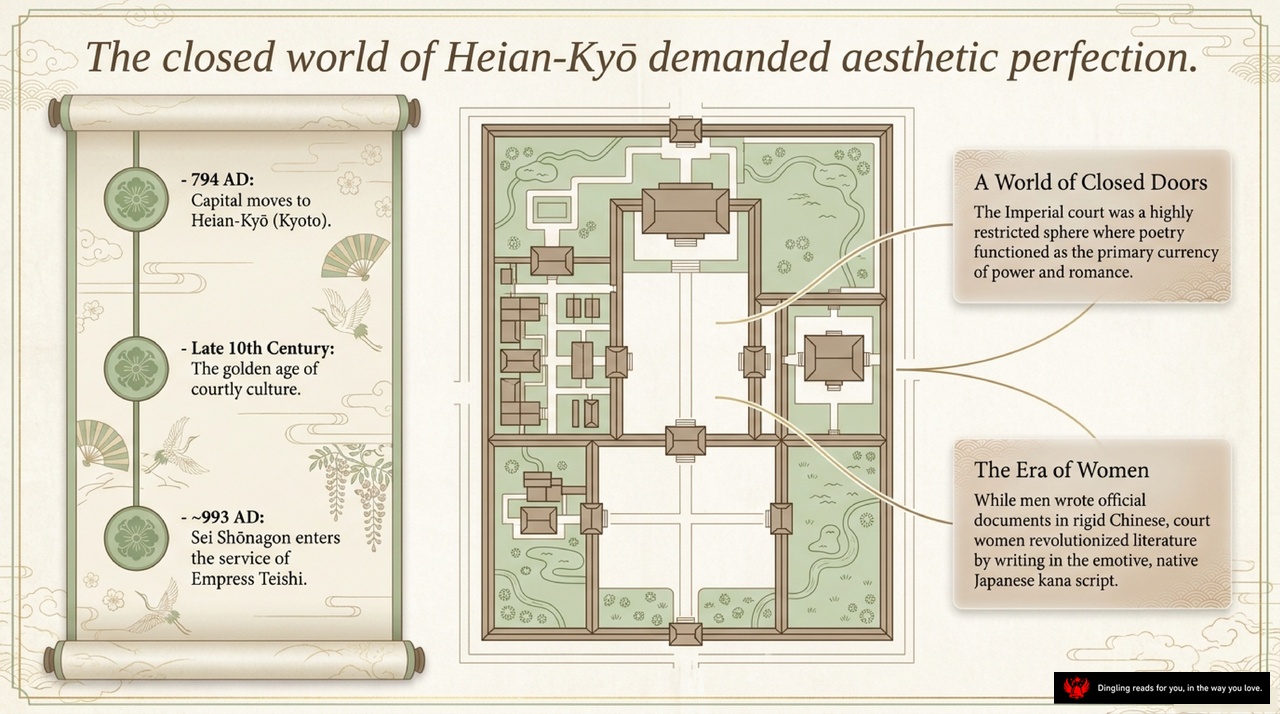
The closed world of Heian-Kyō demanded aesthetic perfection, turning the Imperial court into a highly restricted sphere where poetry functioned as the primary currency of power and romance. In this era of closed doors, men wrote official documents in rigid Chinese, while court women revolutionized literature by writing in the emotive, native Japanese kana script. This shift gave rise to what we call "The Era of Women," a time when female voices defined the cultural heartbeat of the capital.
Looking at the timeline on the left, we see that in 794 AD, the capital moved to Heian-Kyō, or Kyoto, setting the stage for this unique society. By the late 10th century, it had reached its golden age of courtly culture, a period where the capital was not just a political center, but a stage for refined living. It was here, around 993 AD, that Sei Shōnagon entered the service of Empress Teishi, becoming one of the most influential voices of her time.
The map in the center illustrates just how enclosed this world was. The intricate layout shows a palace filled with gardens and buildings, yet separated by walls and gates. This physical separation mirrored the social hierarchy. Inside these walls, life was a carefully choreographed performance. Every gesture, every flower arrangement, and every line of poetry had to be perfect. There was no room for error. A misplaced fan or a poorly written poem could ruin one's reputation. This intense focus on aesthetics created a culture where beauty was not just appreciated, but worshipped. It was a world where the outside chaos was kept at bay, and inside, everything was polished to a brilliant sheen. This is the world we are stepping into today.
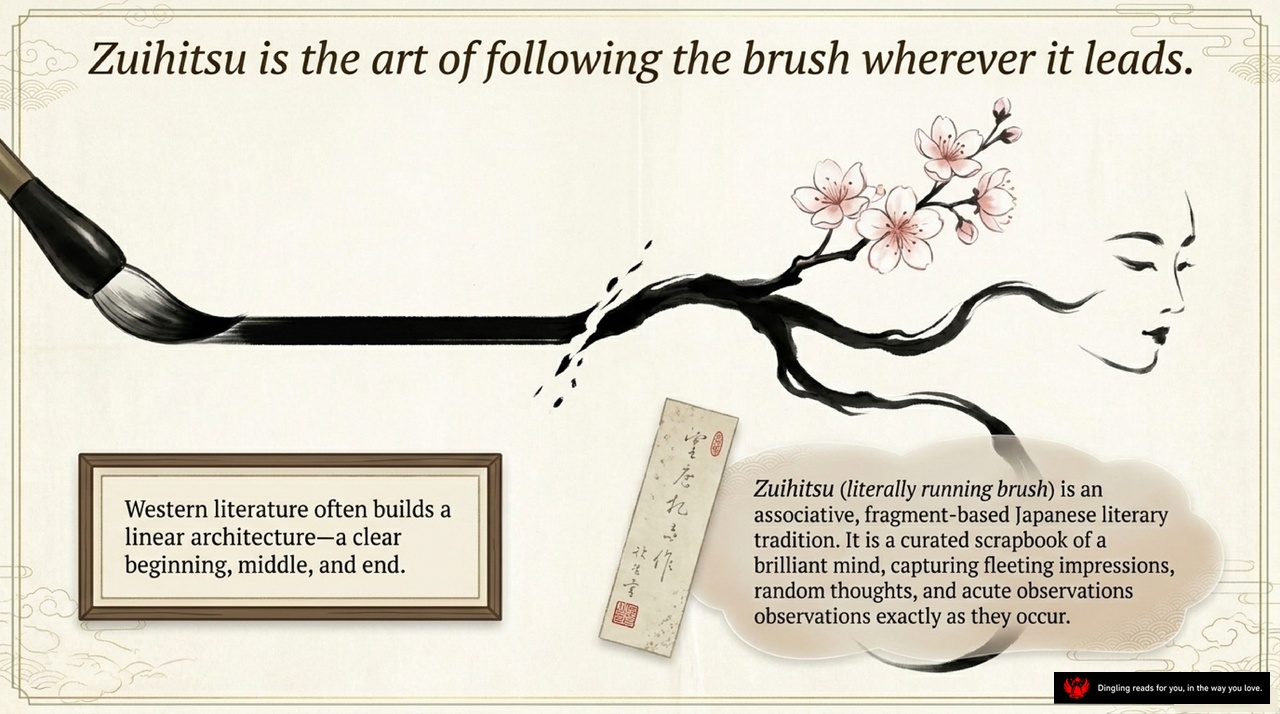
Today's slide captures the very soul of *Zuihitsu*, the art of following the brush wherever it leads. As you can see, the ink doesn't stop at a planned line; it flows into a branch of cherry blossoms and a serene face, perfectly illustrating how this Japanese literary tradition works. Unlike Western literature, which often builds a rigid, linear architecture with a clear beginning, middle, and end, *Zuihitsu* is completely different. Literally translating to "running brush," it is an associative, fragment-based tradition. Think of it as a curated scrapbook of a brilliant mind, capturing fleeting impressions, random thoughts, and acute observations exactly as they occur, without forcing them into a neat narrative box. It's not about a structured story; it's about the authentic, unfiltered flow of life, just like the ink in the image.
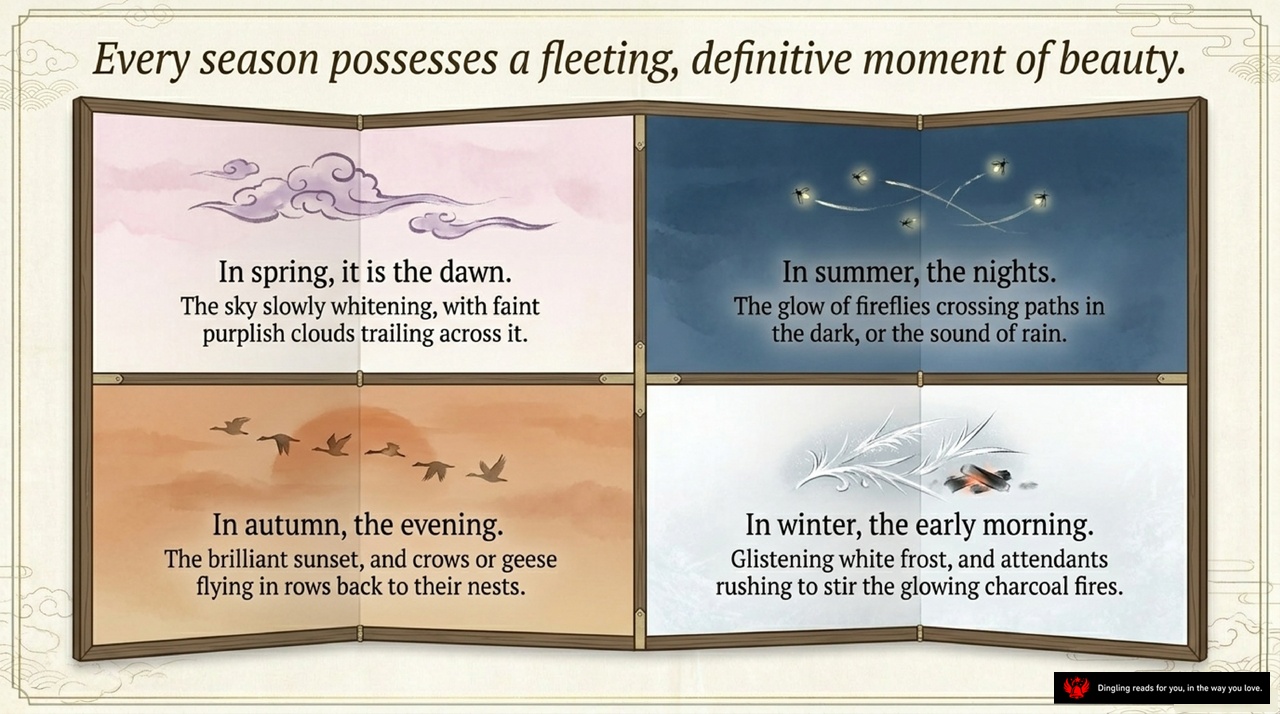
Every season holds a fleeting, definitive moment of beauty, a specific time that defines its character. Think about spring: it's not the full bloom, but the dawn, when the sky slowly whitens and faint purplish clouds trail across the horizon. Summer finds its magic in the nights, whether it's the glow of fireflies crossing paths in the dark or the comforting sound of rain. Then there is autumn, best experienced in the evening with a brilliant sunset and crows or geese flying in rows back to their nests. Finally, winter offers its charm in the early morning, with glistening white frost and attendants rushing to stir the glowing charcoal fires. These aren't just times of year; they are the perfect, quiet moments where nature and life align in their most elegant form.
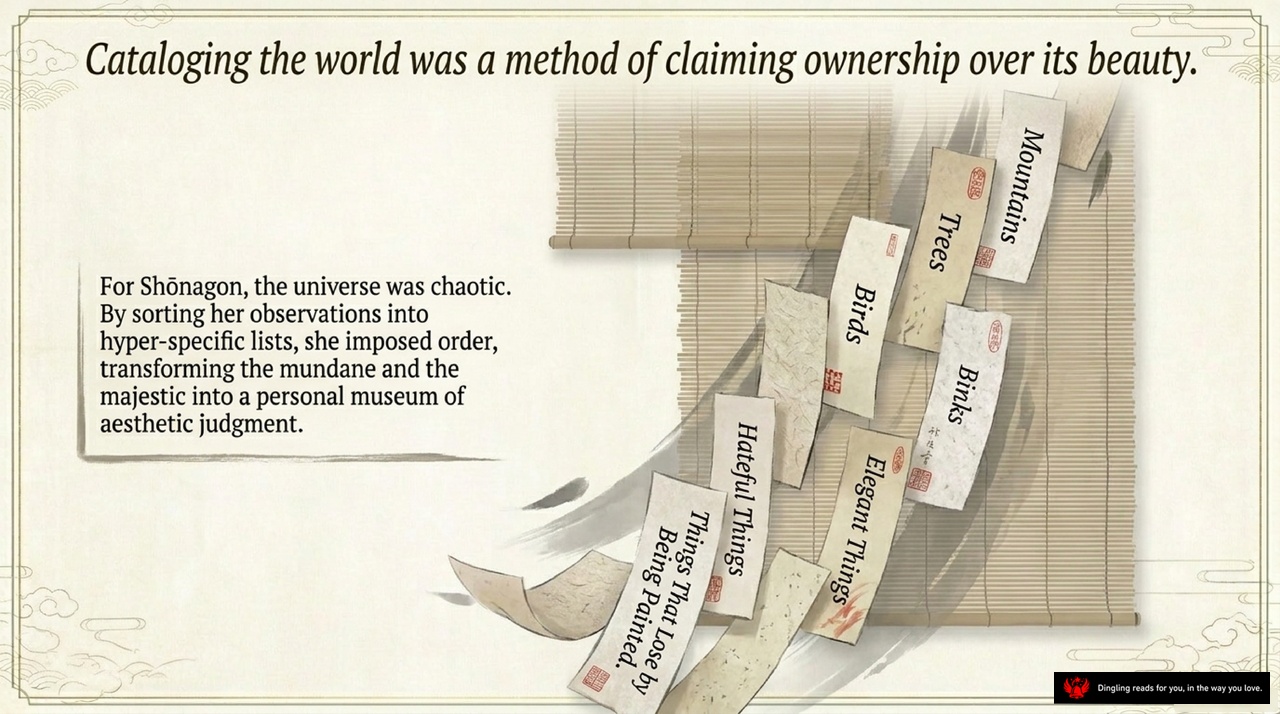
For Shōnagon, the universe was chaotic, a wild mix of beauty and disorder. To make sense of it all, she didn't just observe the world; she cataloged it. As the slide beautifully illustrates, she transformed her observations into hyper-specific lists—categories like "Mountains," "Trees," "Birds," and even "Things That Lose by Being Painted." By sorting the mundane and the majestic into these personal collections, she imposed order on the chaos, effectively turning her life into a private museum of aesthetic judgment. For her, cataloging wasn't just about record-keeping; it was a profound method of claiming ownership over the world's beauty. Every item listed, from the elegant to the hateful, became a piece of her own curated masterpiece, proving that even in a chaotic world, she held the power to define what was truly beautiful.

True elegance in the Heian court wasn't about loudness or excess; it was found in the quiet beauty of fragility, stark contrasts, and absolute refinement. Look at this display: fashion, cuisine, and nature, all united by this delicate aesthetic.
First, consider the fashion. We see pale purple robes layered over a crisp white inner garment. It's a classic look of the time, where soft, muted colors like lavender were paired with pure white to create a sense of ethereal grace. It's not about standing out aggressively, but about looking effortlessly refined.
Next, turn your eyes to the culinary art. Here, we have shaved ice mixed with sweet syrup, served in a gleaming new silver bowl. The contrast is key: the cold, fluffy white ice against the dark, polished metal of the bowl. It represents a moment of pure, refreshing delight, a treat that feels both luxurious and light.
Finally, look at nature. We see snow piled heavily upon delicate plum blossoms. This is the ultimate image of the era's taste. The harsh, cold white of the snow doesn't destroy the beauty of the flower; instead, it highlights it, creating a stark, breathtaking contrast. It captures a fleeting moment where winter's chill meets spring's promise.
Together, these three elements show us that true style is about balance. It's the courage to embrace fragility, the art of using contrast to make things pop, and the pursuit of a refinement that feels absolute yet soft.
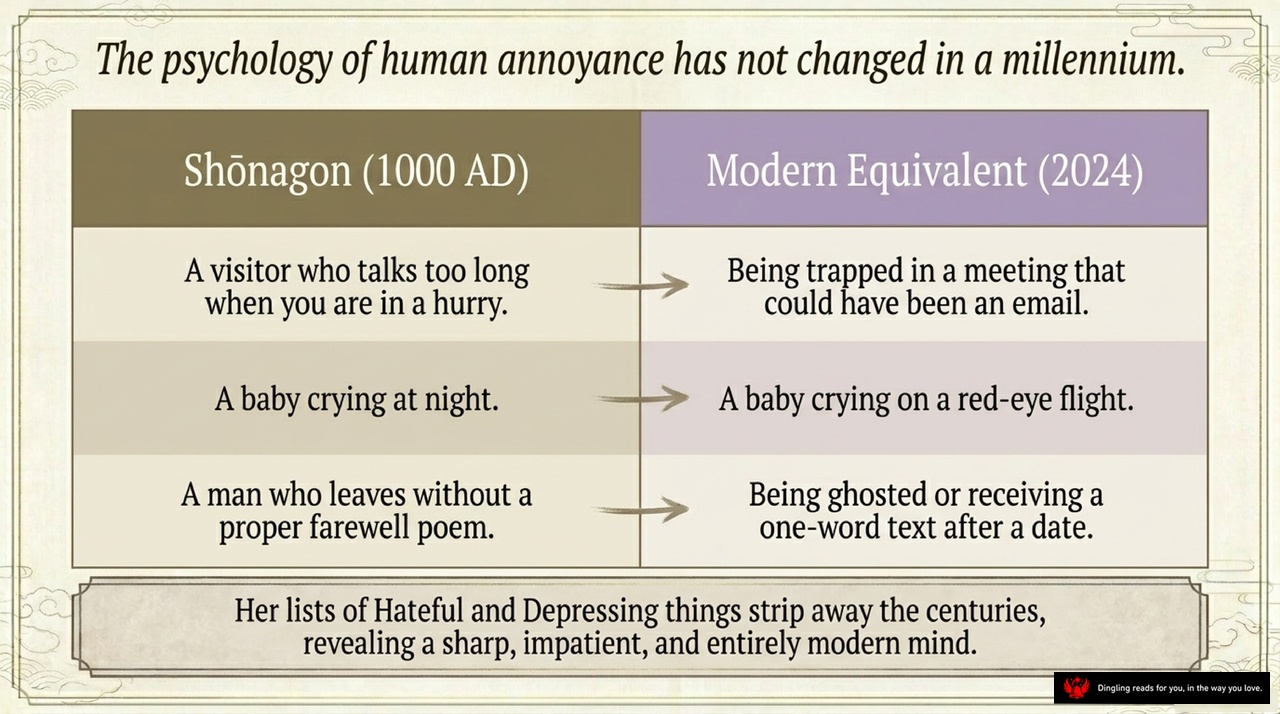
The psychology of human annoyance has not changed in a millennium. It's like time travel, but the bad vibes stay exactly the same.
Look at the first row: In 1000 AD, Shōnagon hated a visitor who talked too long when she was in a hurry. Fast forward to 2024, and that's just being trapped in a meeting that could have been a quick email. The frustration is identical.
Next, she complained about a baby crying at night. Today? That's a baby crying on a red-eye flight. The exhaustion and the noise are the same, just with more jet lag.
Finally, she was annoyed by a man who leaves without a proper farewell poem. Now, we're dealing with being ghosted or receiving a one-word text after a date. The sting of being ignored hasn't evolved at all.
Shōnagon's lists of hateful and depressing things strip away the centuries, revealing a sharp, impatient, and entirely modern mind. We haven't learned to be less annoyed; we've just upgraded our excuses for it.

Anticipation isn't about grand gestures; it's found in the sharp, vivid details of our senses. As the *Shōnagon* reveals, the thrill of waiting is mapped through the micro-sensations of preparation. Imagine the heartbeat quickening as you wash your hair and drape yourself in freshly perfumed robes, the scent filling the air before the visitor even arrives. Then, catch that glint of light—or lack thereof—on a fine bronze mirror, its surface slightly clouded, signaling a shift in time. Suddenly, the sound of footsteps on a rainy night pierces the silence, the distinct rhythm of a secret guest approaching. Finally, your fingers move with purpose, tying the intricate strings of a new incense pouch, the texture grounding you in the moment. These aren't just random acts; they are the pulse of romance itself, proving that excitement lives not in declarations, but in the quiet, electric details of getting ready.

Imagine a world where the most powerful voices were spoken from the shadows. In the Heian court, noblewomen didn't rule from the front; they ruled from behind bamboo blinds. This wasn't just a barrier; it was a superpower. Because they were physically confined and largely unseen by men, they gained immense psychological and literary freedom. They became the era's sharpest critics, observing everything without being seen themselves.
But how did they connect with the outside world? It was an art form. Communication happened through a secret interface: passing folded poems under the blinds or slipping perfectly color-coordinated sleeves out beneath the screen. Every gesture, every hidden message, was a dance of invisibility. While the men paraded in the light, these women mastered the art of the hidden observer, shaping culture from the quiet corners of silk and shadow.
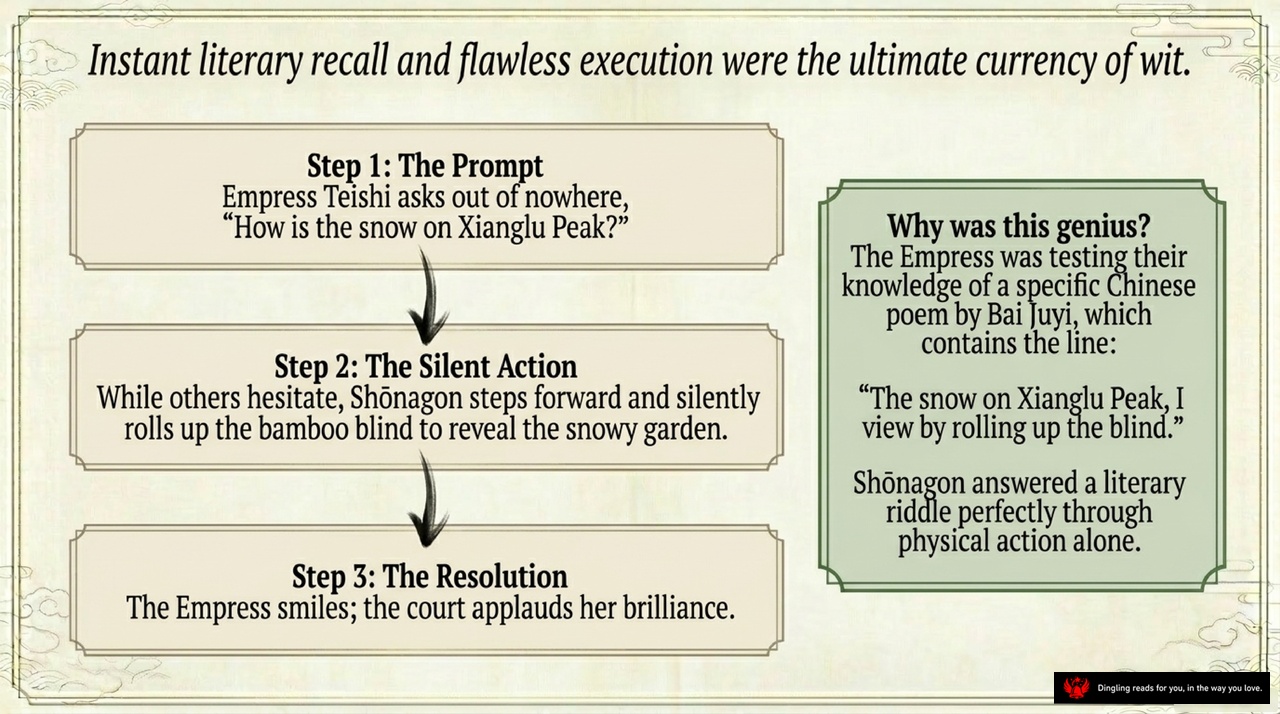
In the high-stakes world of the Heian court, wit wasn't just about clever words; it was about instant recall and flawless execution. The ultimate currency of intelligence was the ability to solve a riddle without saying a single word.
Consider this moment: Empress Teishi, known for her sharp mind, suddenly asks a question that seems random: "How is the snow on Xianglu Peak?" This was a test of knowledge regarding a specific line from a famous poem by Bai Juyi, which reads, "The snow on Xianglu Peak, I view by rolling up the blind." While other courtiers hesitated, struggling to find the poetic connection, Shōnagon stepped forward. Instead of reciting the poem, she silently rolled up the bamboo blind, revealing a snowy garden outside. She answered the literary riddle perfectly through physical action alone.
The resolution was immediate and satisfying. The Empress smiled, impressed by the ingenuity, and the entire court erupted in applause, celebrating her brilliance. This story reminds us that true genius often lies in the ability to connect the abstract with the tangible, turning a simple gesture into a masterpiece of intellect.
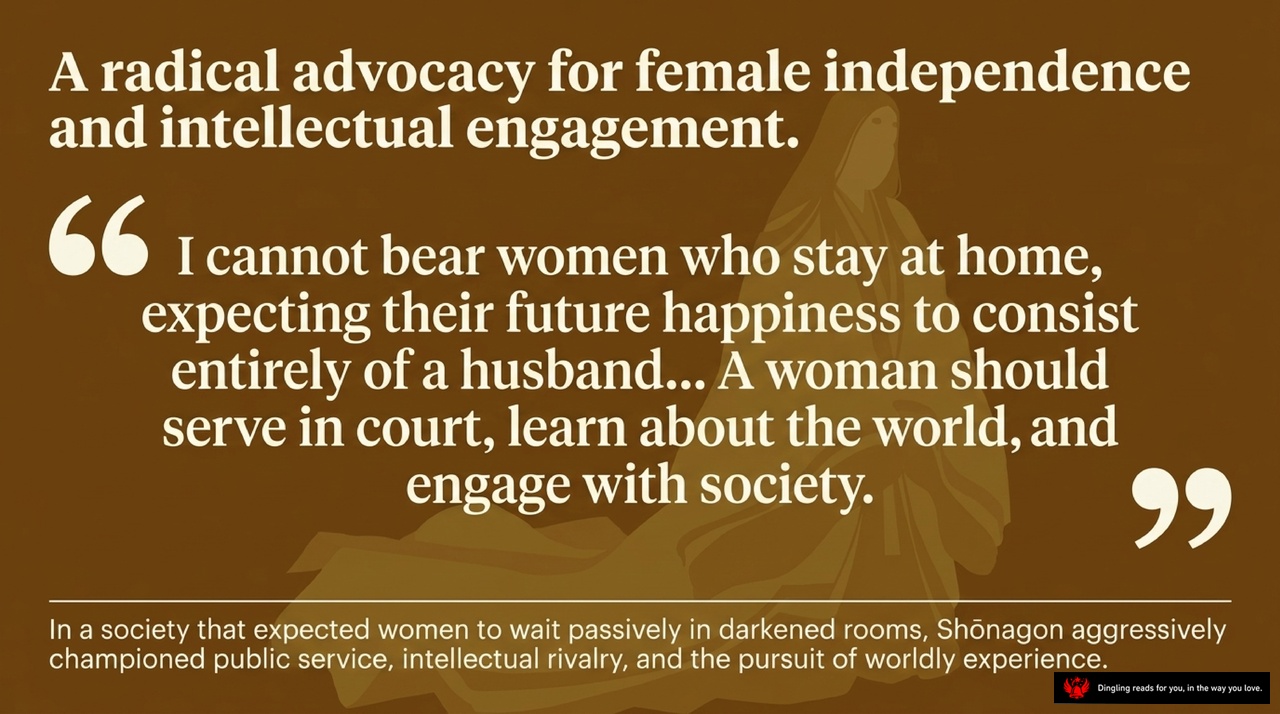
In a society that expected women to wait passively in darkened rooms, Shōnagon aggressively championed public service, intellectual rivalry, and the pursuit of worldly experience. This slide captures the very heart of her philosophy: a radical advocacy for female independence and intellectual engagement.
Look at this powerful quote: "I cannot bear women who stay at home, expecting their future happiness to consist entirely of a husband." Shōnagon was unapologetically direct. She believed that a woman's life should not be defined solely by domesticity or dependence on a spouse. Instead, she argued that a woman should serve in court, learn about the world, and actively engage with society.
This wasn't just about being busy; it was about being vital. Shōnagon saw the court not as a place of confinement, but as a dynamic arena for women to develop their minds, refine their social skills, and gain a perspective that a secluded life could never provide. She understood that exposure to the complexities of the world—whether through political maneuvering, literary debates, or simply observing the flow of daily life—was essential for a fulfilling existence.
By rejecting the passive role assigned to women of her time, Shōnagon laid the groundwork for a more empowered female identity. Her words remind us that true happiness and fulfillment come from active participation and intellectual curiosity, not from waiting for someone else to define our destiny.
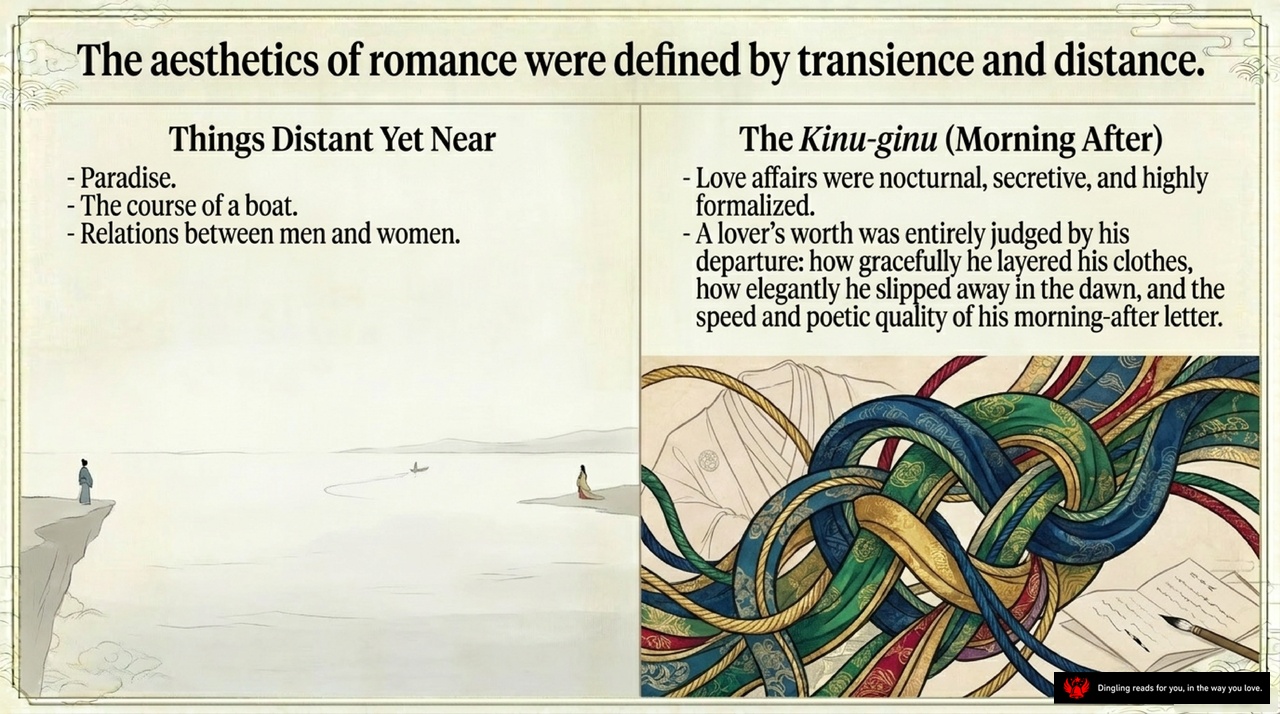
The aesthetics of romance were defined by transience and distance, a theme that runs deep through the court's daily life. On the left, we see "Things Distant Yet Near"—Paradise, the course of a boat, and relations between men and women. These aren't just abstract concepts; they are the heartbeat of the era. Love affairs were nocturnal, secretive, and highly formalized, much like the intricate knotwork shown on the right under "The Kinu-ginu (Morning After)."
In these fleeting moments, a lover's worth was entirely judged by his departure: how gracefully he layered his clothes, how elegantly he slipped away in the dawn, and the speed and poetic quality of his morning-after letter. The image captures this tension perfectly—a figure standing alone on a distant shore, separated from another by a vast expanse of water, mirroring the emotional distance that fueled the poetry of the time. Romance wasn't about staying close; it was about the beauty of what was just out of reach, the thrill of the boat's journey, and the grace of a graceful goodbye. It was in these transient, distant moments that the true art of love was revealed.

Today's slide beautifully contrasts two of Japan's most iconic literary pillars: *The Tale of Genji*, built on the melancholy of *mono no aware*, and Sei Shōnagon's *The Pillow Book*, championing the vibrant wit of *okashi*. While *Genji* focuses on tragedy and the shadows of life, *The Pillow Book* is all about sharp observation, aesthetic delight, and the brilliant light of the present moment.
Sei Shōnagon didn't just want to record her days; she wanted to capture the sheer joy of living them. She found magic in the unexpected. Think of the "sweeping of the dust" incident, where she watched a young man frantically searching for his fan and paper, stuffing them into his sleeve and fanning himself with a careless, almost frantic energy. To her, that wasn't just a mess; it was a performance of human nature, amusing and full of character.
She also loved the absurdity of court life. She once noted how a monk, exhausted from fighting demons elsewhere, would fall asleep and snore while chanting prayers to cure someone, his voice turning into a dull, sleepy drone. It was a hilarious reminder that even the most serious rituals could be undercut by simple, human exhaustion.
But perhaps her most famous moment of *okashi* was the "True Snow Mountain" incident. When the court decided to build a snow mountain in the courtyard for New Year's, she boldly predicted it would last until the fifteenth day of the first month. Everyone laughed at her overconfidence. Yet, she secretly prayed to the White Snow Mountain观音 to keep the snow from melting. And guess what? It actually held until the very end, only to be melted away by the empress herself on the twelfth night. Her prediction was right, but the twist—that the empress had secretly ordered the snow thrown away—turned a simple prediction into a story full of intrigue and humor.
For Sei Shōnagon, life wasn't about waiting for tragedy; it was about finding the witty, the bright, and the amusing in every fleeting moment.
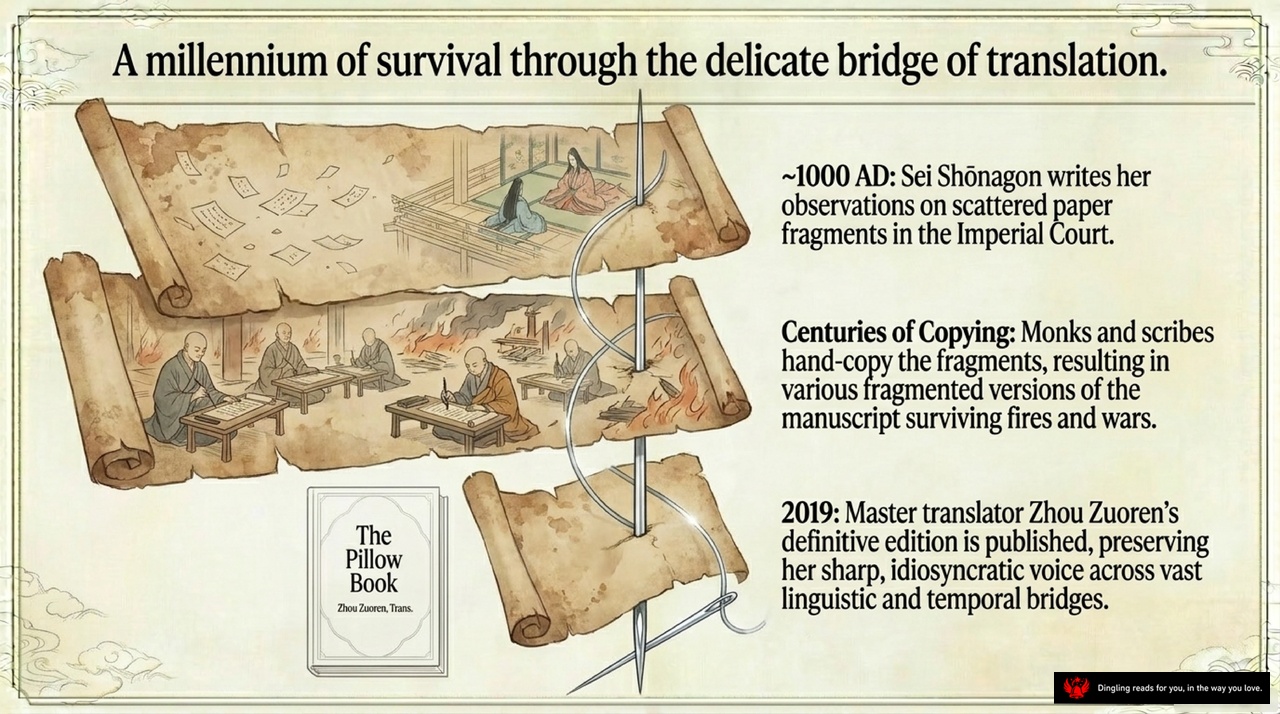
Today, we stand at the end of a journey that spans a thousand years. Look at this timeline: it all began around 1000 AD, when Sei Shōnagon was writing her sharp, observant notes on scattered paper fragments within the Imperial Court. For centuries after that, these fragile manuscripts were handed down by monks and scribes. They copied them by hand, ensuring that even through fires and wars, various fragments of her unique voice survived. It was a delicate bridge of translation and survival. Finally, in 2019, master translator Zhou Zuoren published the definitive edition of *The Pillow Book*. This edition successfully bridges vast linguistic and temporal gaps, preserving Shōnagon's idiosyncratic voice for a modern audience. From ancient court whispers to a contemporary classic, her legacy has truly endured.

Sei Shōnagon didn't just record history; she curated life. She cataloged the world not through grand battles or royal decrees, but through the fleeting beauty of the seasons, the sharp annoyances of daily life, and the quiet poetry hidden behind bamboo blinds.
Think about the delicate moments we often miss in our relentless pursuit of the future. What about the elegance of a falling cherry blossom petal beside an inkstone? Or the quiet satisfaction of a perfectly arranged tea set? In our busy lives, we are constantly chasing the next big thing, but we are failing to write down the small, exquisite details that actually make life beautiful.
So, let's pause for a moment. Instead of just moving forward, let's try to appreciate the present. Notice the light, the textures, and the subtle interactions around you. These are the moments that give life its true meaning, the quiet poetry that only Sei Shōnagon could truly see and capture.