
The Pinnacle of Data: Complete Chapter-by-Chapter Summary

Welcome to our book club session on "The Pinnacle of Data" by Tu Zipei. Today, we're diving into the very beginning of our story—the foundation of the modern world built on numbers.
Imagine a mountain made entirely of data points, rising above the rugged terrain of history. That is the image on our cover, and it perfectly captures the book's promise: a sweeping journey through how data constructed our present and will forge the societies of tomorrow.
This isn't just about big numbers; it's about the power of measurement. From the very start, humans realized that precise data could turn chaos into order. Whether it was ancient Chinese emperors tracking households for taxes or American founders using census counts to balance power between large and small states, data became the ultimate tool for fairness and governance.
As we turn the page, we'll see how these early efforts evolved from simple counts into complex systems that manage everything from war strategies to life values. Join me as we climb this mountain of data together.
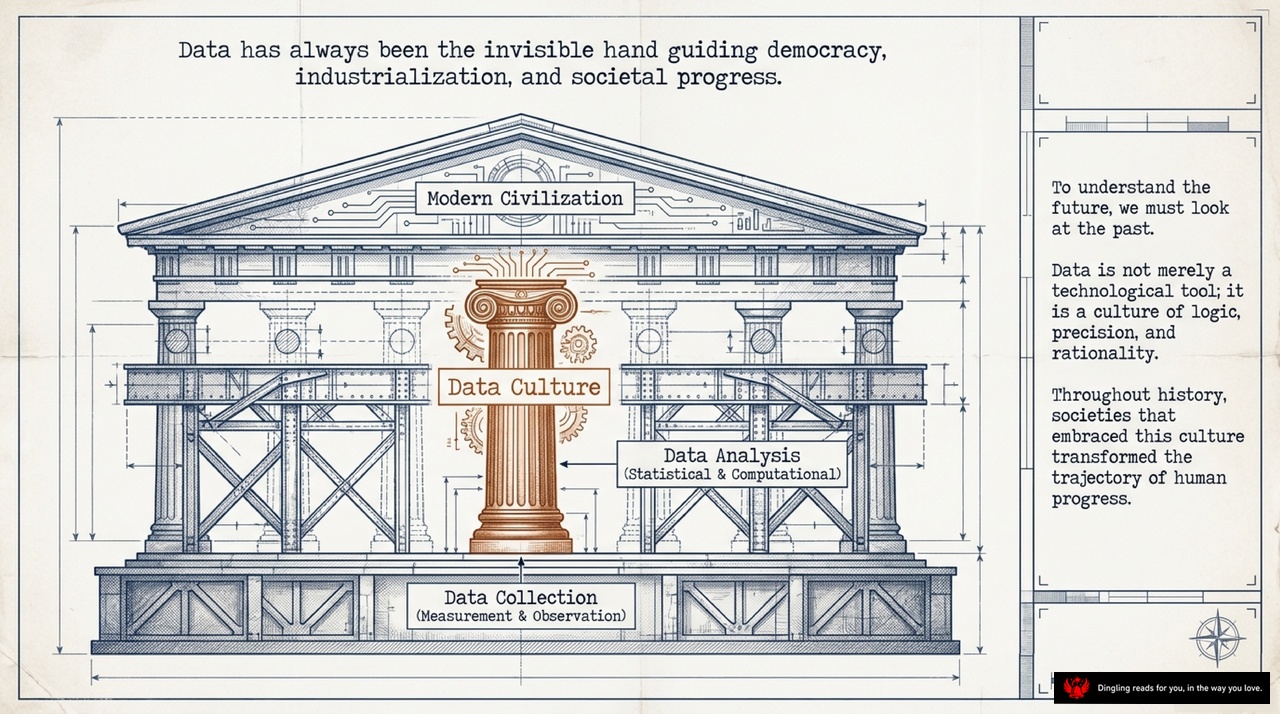
Data has always been the invisible hand guiding democracy, industrialization, and societal progress. Think of modern civilization not as a random collection of buildings, but as a grand architectural blueprint where every pillar is essential. At the very foundation lies Data Collection—measurement and observation. Without this raw input, nothing else can stand. Rising from this base is Data Analysis, the statistical and computational engine that turns raw numbers into actionable insights.
But the true heart of this structure is the central column: Data Culture. This isn't just about technology; it is a culture of logic, precision, and rationality. History shows us that societies which embraced this culture fundamentally transformed the trajectory of human progress. To understand the future, we must look at the past, because data has always been the invisible force that guided our journey.
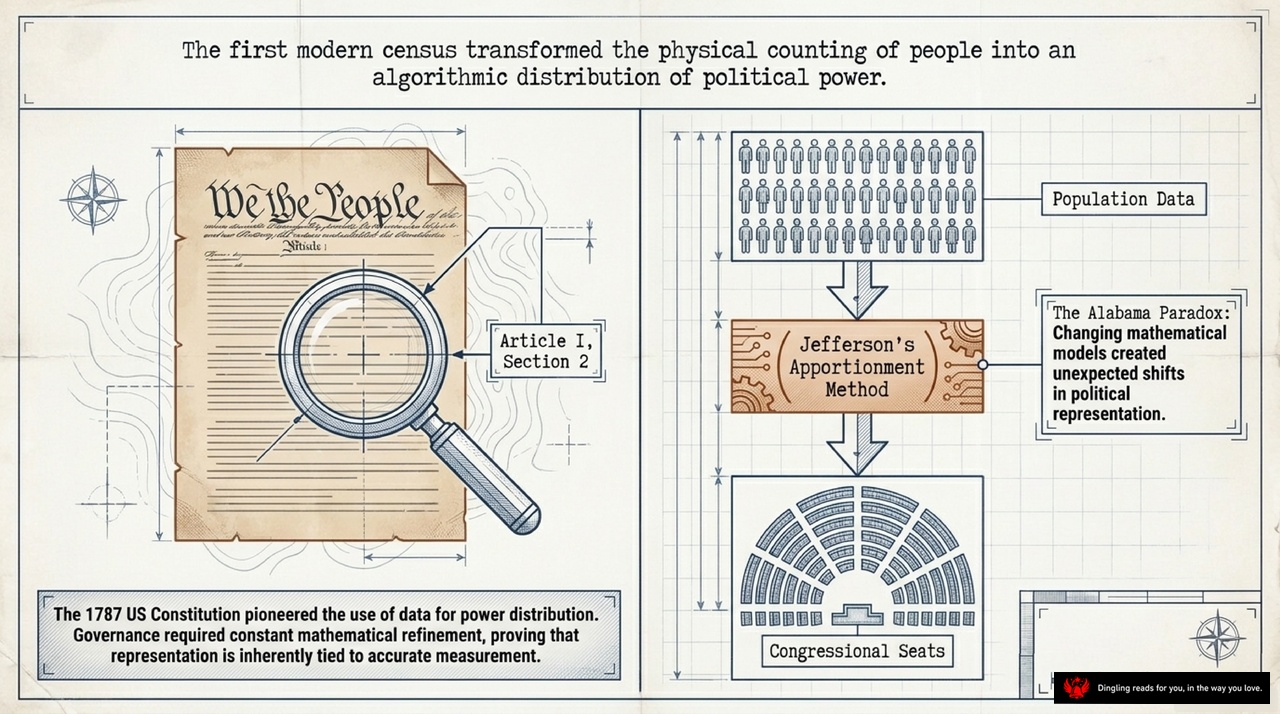
The first modern census transformed the physical counting of people into an algorithmic distribution of political power. Look at this flowchart: it starts with raw Population Data, moves through Jefferson's Apportionment Method, and finally determines the number of Congressional Seats. But here's the catch—changing the mathematical model can create unexpected shifts in representation, known as the Alabama Paradox.
This entire process traces back to Article I, Section 2 of the Constitution. In 1787, the founders realized that governance required constant mathematical refinement. They needed a way to balance the interests of large and small states without descending into chaos. The solution was simple but revolutionary: tie representation directly to accurate measurement. Every ten years, a census would count the population, and those numbers would dictate how many seats each state got in Congress.
It was a bold gamble. The 1787 US Constitution pioneered the use of data for power distribution, proving that representation is inherently tied to accurate measurement. By turning a headcount into a formula for political power, the founders created a system where the voice of the people could literally be counted and distributed. It was the birth of data-driven democracy, turning the abstract concept of "the people" into concrete, countable units that could shape the future of the nation.
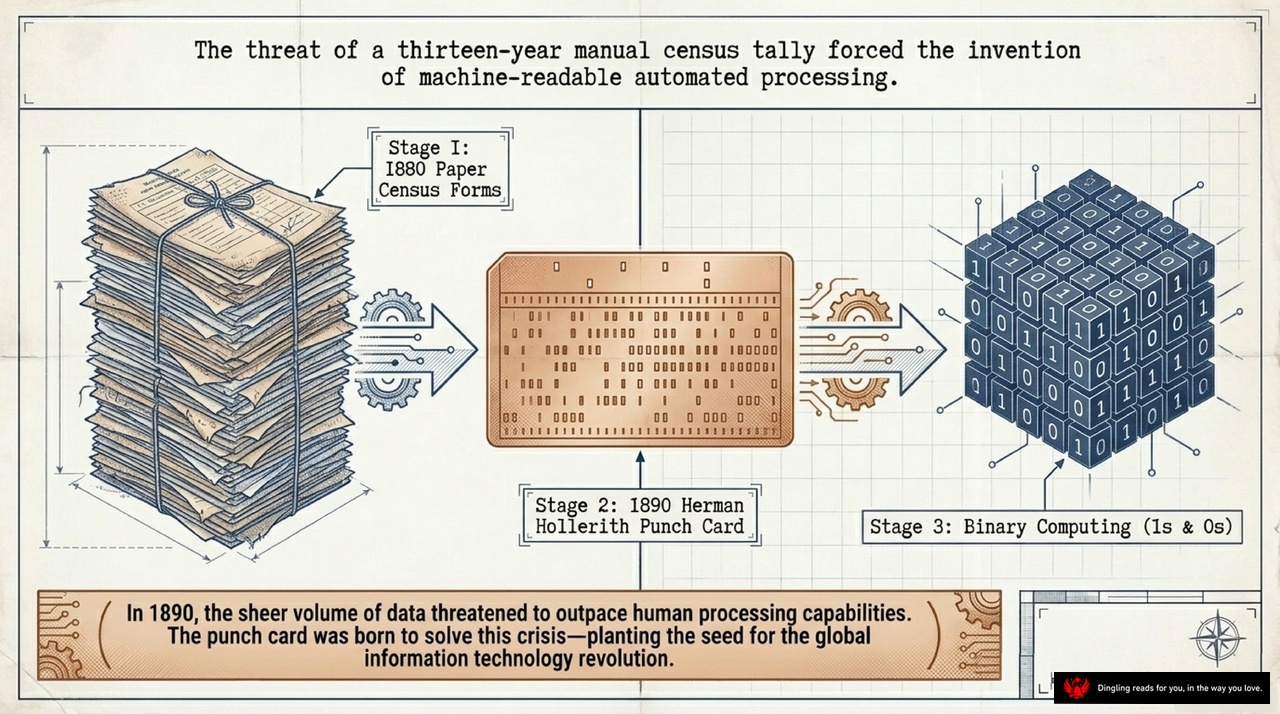
Look at this timeline. It tells the story of how we went from drowning in paper to thinking in binary.
Back in 1880, the U.S. Census was a logistical nightmare. Imagine stacks of paper forms, tied together, piled so high they threatened to collapse the room. Processing this data by hand would take thirteen years. It was simply too much for human beings to handle.
So, the system evolved. By 1890, Herman Hollerith introduced the punch card. Instead of reading text, machines could now read holes punched into cards. This was the moment data stopped being just words on a page and started becoming something a machine could actually crunch.
Fast forward to today, and that punch card has transformed into the digital cube you see on the right. We've moved from manual tallying to binary computing—ones and zeros. That shift is the foundation of everything we use now.
The lesson here is clear: when the volume of data outpaces human capability, innovation isn't just an option; it's a necessity. The crisis of the 1890 census didn't just solve a counting problem; it planted the seed for the entire global information technology revolution.

The Ford Pinto case serves as a chilling reminder of what happens when cold numbers override human life. In the late 1970s, Ford faced a crisis with the Pinto, a compact car notorious for exploding upon rear-end collision due to a poorly designed fuel tank. Internal documents revealed that Ford had conducted a brutal cost-benefit analysis. They calculated that the cost of adding a protective shield to the fuel tank was $137.5 million. In contrast, they estimated the benefit of preventing 180 deaths, 180 burn injuries, and 2,100 vehicle fires would only yield $49.5 million. The math was clear: the cost exceeded the benefit, so they decided not to fix the design.
This decision was grounded in a legal concept known as the Hand Formula, named after Judge Learned Hand. It suggests that negligence only exists if the cost of prevention is less than the probability of the accident multiplied by the potential injury. Ford argued they were being rational by adhering to this economic logic. However, the public and the courts saw it differently. The Pinto became known as a "moving fire trap," and the revelation that a corporation would sacrifice human lives for a few dollars sparked a massive public outcry.
This incident exposed a deep ethical dilemma in the era of data-driven decision-making. It showed that while quantifying risk and cost can help allocate resources efficiently, it can also lead to morally repugnant outcomes when human life is treated merely as a variable in an equation. The Pinto case forced society to confront the limits of cost-benefit analysis and the urgent need for ethical boundaries in how we use data to govern our lives and businesses.
In the modern era, data has evolved far beyond simple measurement. Today, our foundation rests on three pillars: measurement, which captures the physical world; record, which preserves our diverse experiences in text, images, and video; and computation, which transforms raw numbers into new insights. This shift is driving us into an age where data isn't just a number, but a powerful engine for innovation.
Consider the sheer scale of this transformation. The relentless progress of Moore's Law has made storage exponentially cheaper, while the rise of ubiquitous computing means sensors are everywhere—from optimizing garbage collection in Philadelphia to monitoring athletes' performance on the field. But the true explosion comes from social media. Platforms like Facebook and Twitter have turned every user into a data producer, generating billions of words daily. This deluge of unstructured information is the core of what we call Big Data.
The real magic happens when we apply social computing and data mining to these vast datasets. Look at a classic example: a newspaper investigation into police speeding. By analyzing millions of records, they uncovered a pattern of excessive speeding during rush hours. The result? Over 800 officers were disciplined, and speeding incidents dropped by 84%. This proves that data isn't just for corporations; it's a tool to hold power accountable and improve public safety.
This logic extends to manufacturing and logistics. Companies like Amazon use predictive algorithms to ship products before you even buy them, while others analyze sales patterns to discover unexpected connections, like the famous link between beer and diapers. We are also seeing the rise of "social manufacturing," where 3D printing and crowdsourcing allow consumers to co-design products, breaking the limits of traditional mass production.
From self-driving cars navigating complex roads to smart learning platforms personalizing education for millions, data is reshaping every industry. We are moving from a world of static records to a dynamic, intelligent society where computation drives progress. The future isn't just about having more data; it's about unlocking the hidden patterns within it to solve the world's most complex challenges.
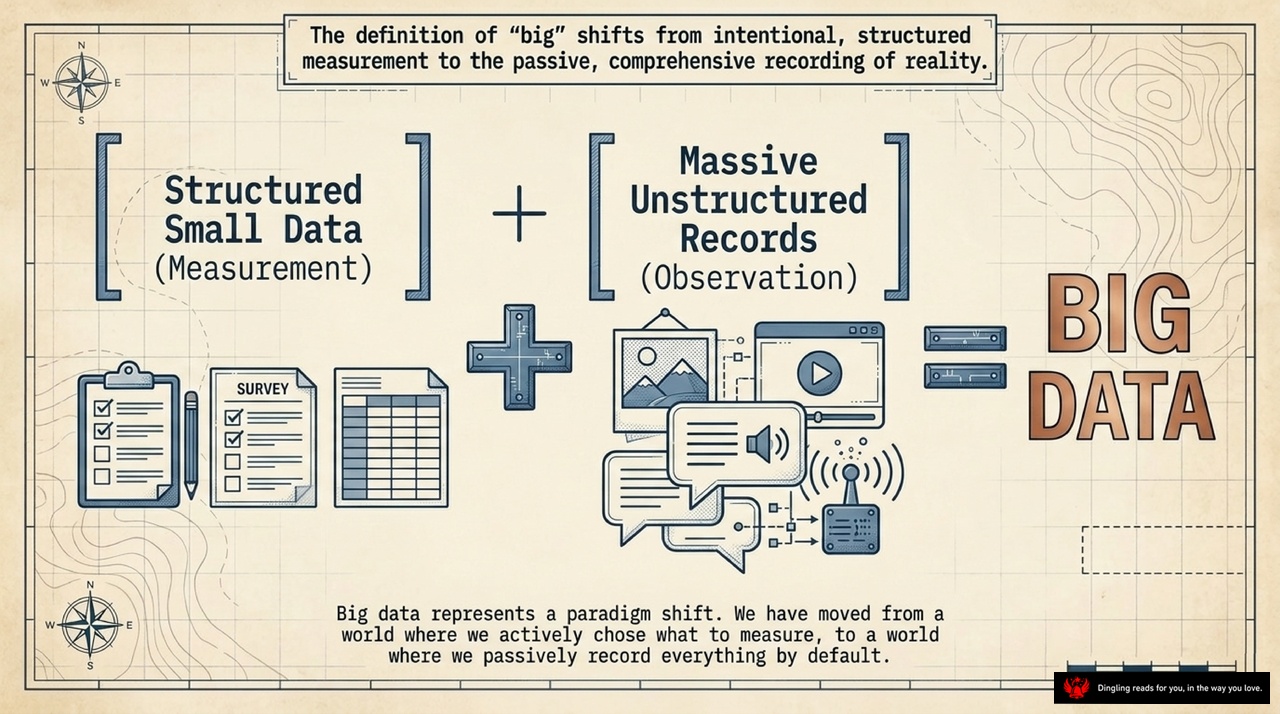
In the modern era, the very definition of "big" has undergone a profound transformation. We have shifted from an era of intentional, structured measurement to one of passive, comprehensive recording of reality. Think about it: in the past, data was something we actively chose to measure—like filling out a survey or recording a specific transaction. Today, our world is defined by massive unstructured records. We passively record everything by default, simply by living our lives.
Look at the visual breakdown here. On the left, you have "Structured Small Data," which represents traditional measurement—think checklists, surveys, and neat spreadsheets. On the right, we have "Massive Unstructured Records," which represents observation. This includes everything from photos and videos to social media posts, voice messages, and even the data generated by sensors in our trash cans or on our smartwatches.
When you combine these two forces, you get Big Data. This isn't just about volume; it's a paradigm shift. We have moved from a world where we actively chose what to measure, to a world where we passively record everything by default. This shift allows us to see patterns and trends that were previously invisible, turning the noise of our daily digital footprints into a powerful engine for knowledge, innovation, and understanding the world around us.

Look at this diagram: "The Structured Data Cloud." It's built on three pillars that have completely erased the boundaries of what we can record and store.
First, we have Moore's Law. You see that graph showing collapsing storage costs. For decades, the price of storing data has plummeted, making it almost free to keep digital records forever.
Second is Ubiquitous Computing. This pillar represents our IoT micro-sensor networks. From smart trash cans to fitness trackers, sensors are now embedded everywhere, automatically capturing the state of the physical world without us even lifting a finger.
And the third pillar is Social Media. This is where humans become real-time data generators. Every post, photo, and comment we make instantly adds to the global archive.
Put these three forces together, and the result is inevitable. The explosion of data isn't an accident. The cheap hardware, the constant sensor monitoring, and our daily digital lives have transformed every single action into a permanent digital record. We have effectively built a cloud that captures everything.
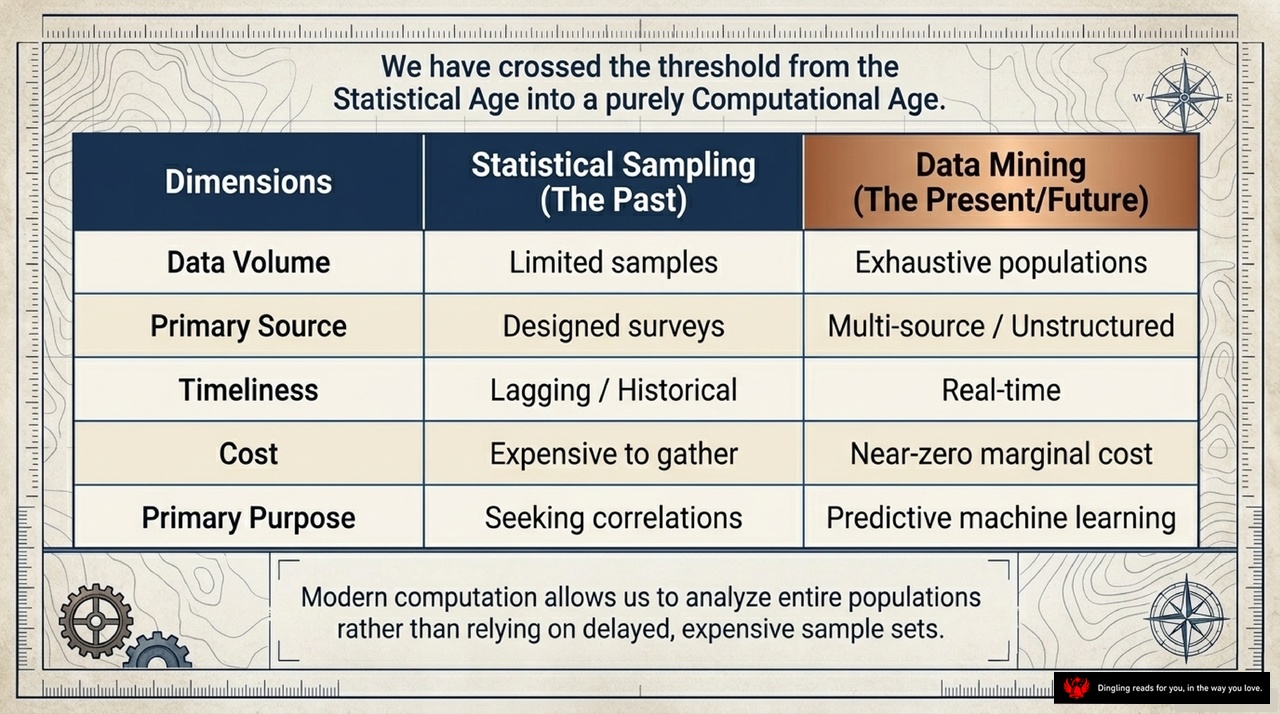
We've officially crossed a major threshold: we've moved from the Statistical Age into a purely Computational Age. Think about what that actually means for how we operate today.
Look at the comparison on your screen. In the past, we relied on Statistical Sampling. We took limited samples, designed specific surveys, and waited for lagging, historical data that cost a fortune to gather. Our main goal was just to find correlations.
But now? We are in the era of Data Mining. We have access to exhaustive populations, not just samples. We pull from multi-source, unstructured data in real-time. The marginal cost is nearly zero. And instead of just looking for patterns, we are using predictive machine learning to anticipate the future.
Modern computation allows us to analyze entire populations rather than relying on delayed, expensive sample sets. This shift isn't just about having more data; it's about having the power to act on the whole picture instantly, transforming how we make decisions in every aspect of life.
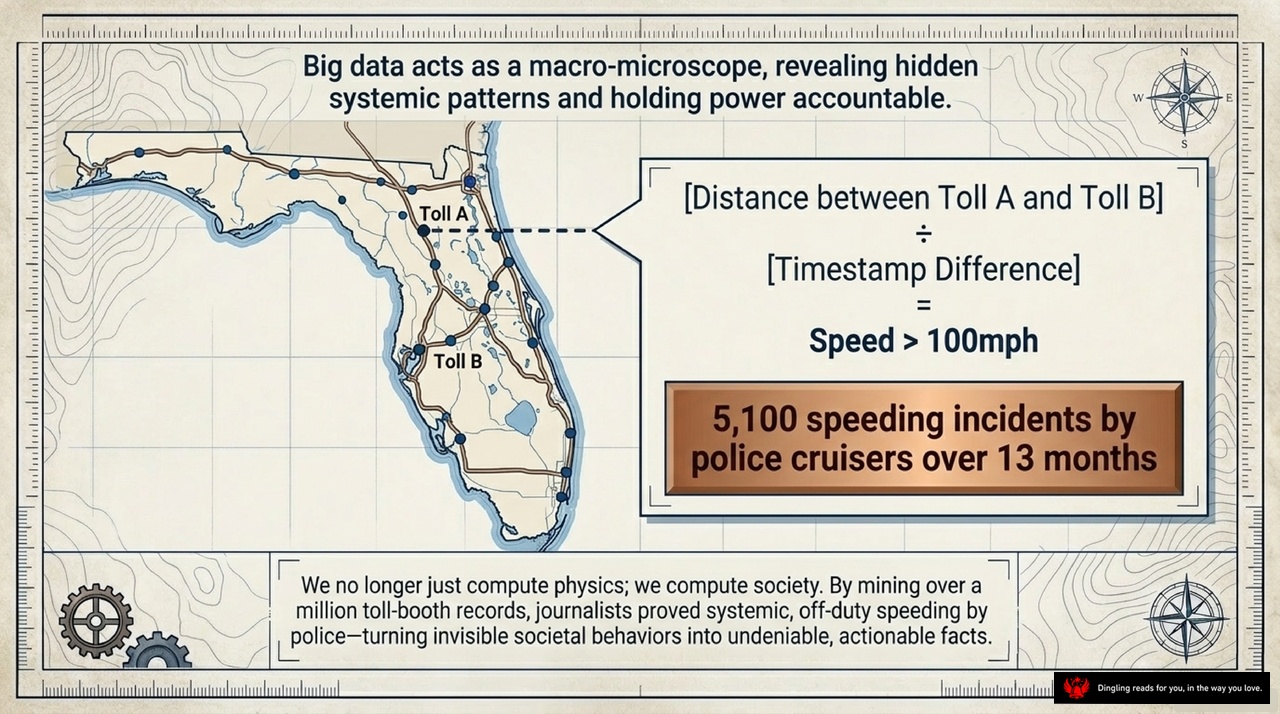
Big data isn't just about storing more information; it's about seeing the invisible patterns that shape our society. Think of it as a macro-microscope that reveals hidden systemic truths and holds power accountable.
Take the case of police cruisers in Florida. For 13 months, journalists mined over a million toll-booth records. By simply calculating the distance between two tolls and dividing it by the time it took to travel between them, they could instantly determine if a vehicle was speeding. The math was straightforward: if the speed exceeded 100 mph, an incident was flagged.
The result was undeniable. The data uncovered 5,100 speeding incidents by police officers while they were off-duty. This wasn't just a list of numbers; it was proof of a systemic behavior that had gone unnoticed. We no longer just compute physics; we compute society. By turning invisible actions into undeniable facts, big data transforms raw information into actionable insights, forcing institutions to confront their own conduct with the clarity that only hard data can provide.

A smart city isn't just about cool gadgets; it's about building a unified data platform that predicts needs, optimizes infrastructure, and allocates resources fairly. True urban intelligence requires breaking down data silos. By integrating layers of infrastructure into a single cloud platform, a city can proactively serve its population rather than reactively managing crises.
Think of this as a four-layer ecosystem. At the foundation is Layer 1: Physical Infrastructure, including roads and buildings. Above that sits Layer 2: the Sensor Network, where IoT devices and cameras collect real-time data from the street. This flows into Layer 3: the Cloud Platform, which handles unified integration and processing. Finally, at the top, we have Layer 4: the Citizen Interface, where mobile apps allow people to interact with the city.
This seamless connection transforms how we live. Instead of waiting for traffic jams or power outages to happen, the system anticipates them. It turns raw data into actionable insights, ensuring that resources go exactly where they are needed most. This is the future of urban living—efficient, responsive, and truly intelligent.
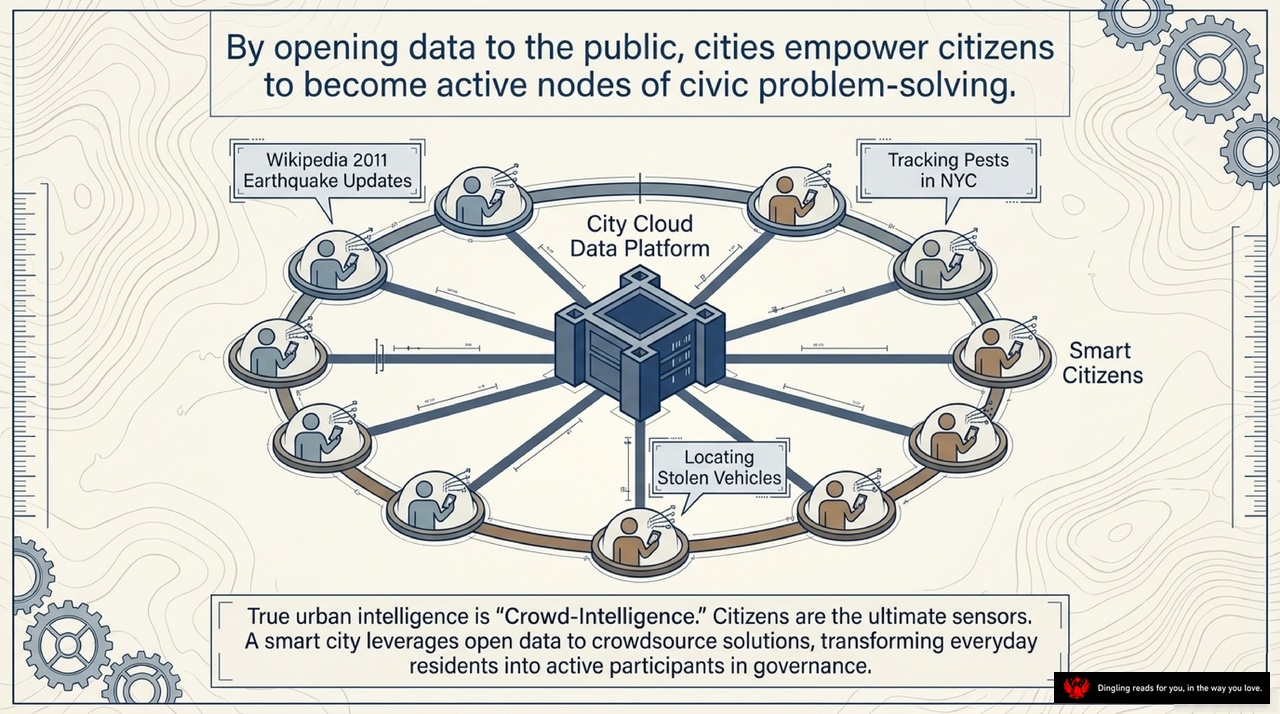
When we talk about smart cities, it's easy to get lost in the tech jargon, but the real magic happens when the city stops treating you like a statistic and starts treating you like a partner. As this slide illustrates, the core idea is simple yet revolutionary: by opening data to the public, cities empower citizens to become active nodes of civic problem-solving. Instead of waiting for city hall to fix things, you become part of the solution.
Think of the "City Cloud Data Platform" not as a cold server room, but as a shared brain connecting everyone. When you report a pothole, track pests in your neighborhood, or even help locate a stolen vehicle, you are essentially acting as a sensor for the city. This is what the diagram calls "Smart Citizens"—people who use their mobile devices to feed real-time information back into the system.
This brings us to a powerful concept: True urban intelligence is "Crowd-Intelligence." It's the realization that citizens are the ultimate sensors. A smart city leverages open data to crowdsource solutions, transforming everyday residents into active participants in governance. Whether it was volunteers tracking earthquake updates or neighbors helping each other out, the result is the same: a more responsive, agile, and connected community. The technology is just the bridge; the people are the engine.
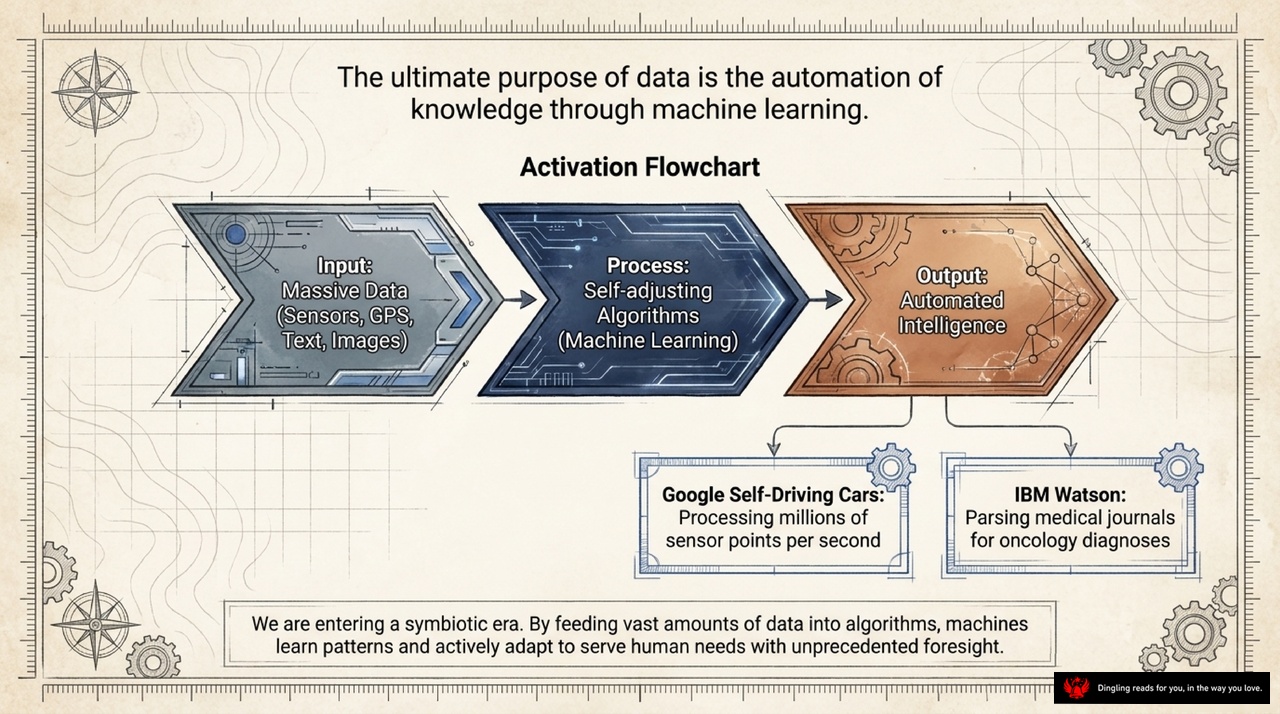
The ultimate purpose of data isn't just storage; it's the automation of knowledge through machine learning. Look at this activation flowchart: we start with massive input—think sensors, GPS, text, and images feeding into self-adjusting algorithms. These algorithms, powered by machine learning, don't just process; they learn patterns and actively adapt. The output? Automated intelligence.
We are entering a symbiotic era. By feeding vast amounts of data into these systems, machines gain unprecedented foresight to serve human needs. Consider the real-world impact: Google's self-driving cars are processing millions of sensor points every second, while IBM Watson parses medical journals to assist in oncology diagnoses. This shift marks the transition from static data to dynamic intelligence, where technology doesn't just record our world but begins to understand and optimize it for us.
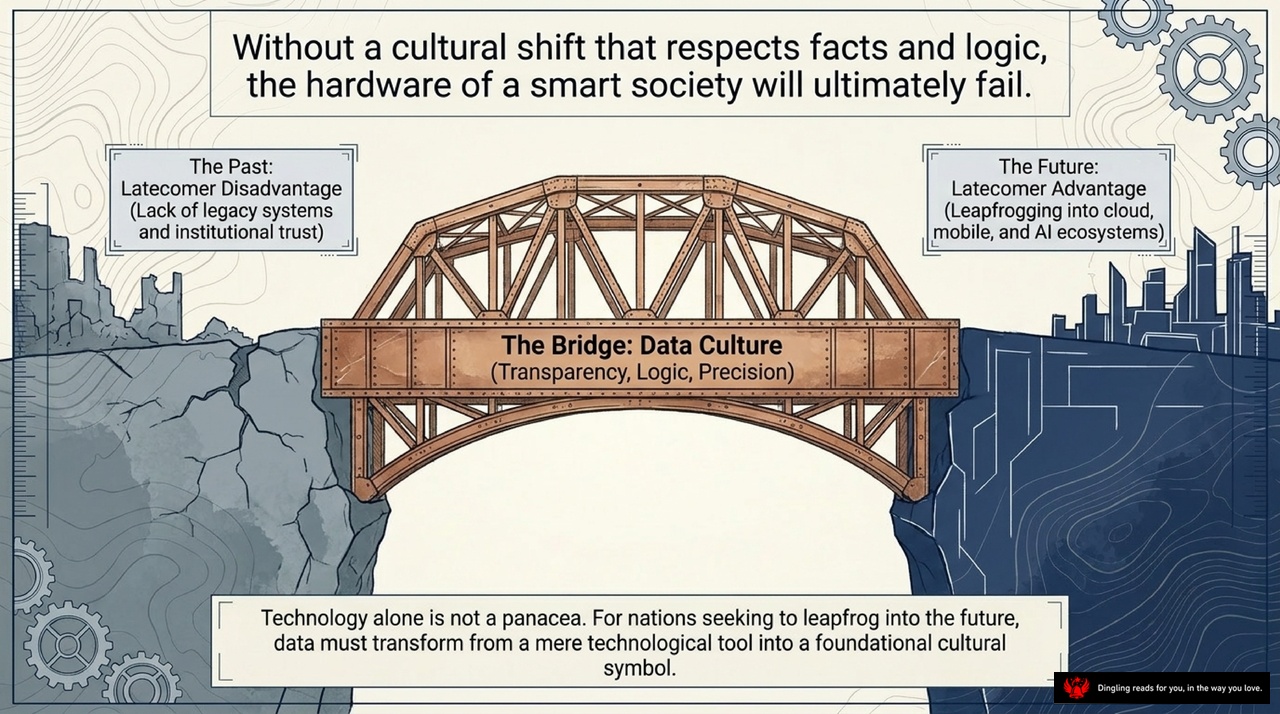
Without a cultural shift that respects facts and logic, the hardware of a smart society will ultimately fail. This slide illustrates a critical divide between the past and the future. On the left, we see the "Latecomer Disadvantage," defined by a lack of legacy systems and institutional trust. On the right lies the "Latecomer Advantage," where nations leapfrog into cloud, mobile, and AI ecosystems.
But what connects these two cliffs? The answer is the bridge in the center: Data Culture. It is built on three pillars—Transparency, Logic, and Precision. This is the crucial lesson we are learning today. Technology alone is not a panacea. For nations seeking to leapfrog into the future, data must transform from a mere technological tool into a foundational cultural symbol.
We have seen throughout history how data drives change. From the US Constitution's "Great Compromise" using census data to balance state power, to Lincoln using population statistics to win the Civil War, and to modern Japan leveraging statistical quality control to outcompete American automakers. These examples prove that data is more than just numbers; it is the fuel for rational decision-making and social progress.
However, relying on data without a corresponding cultural mindset leads to failure. We need a society where facts and logic are respected, where decisions are driven by evidence rather than intuition or ideology. Without this cultural bridge, even the most advanced technology will crumble. The future belongs not just to those who have the best hardware, but to those who have built the strongest data culture.
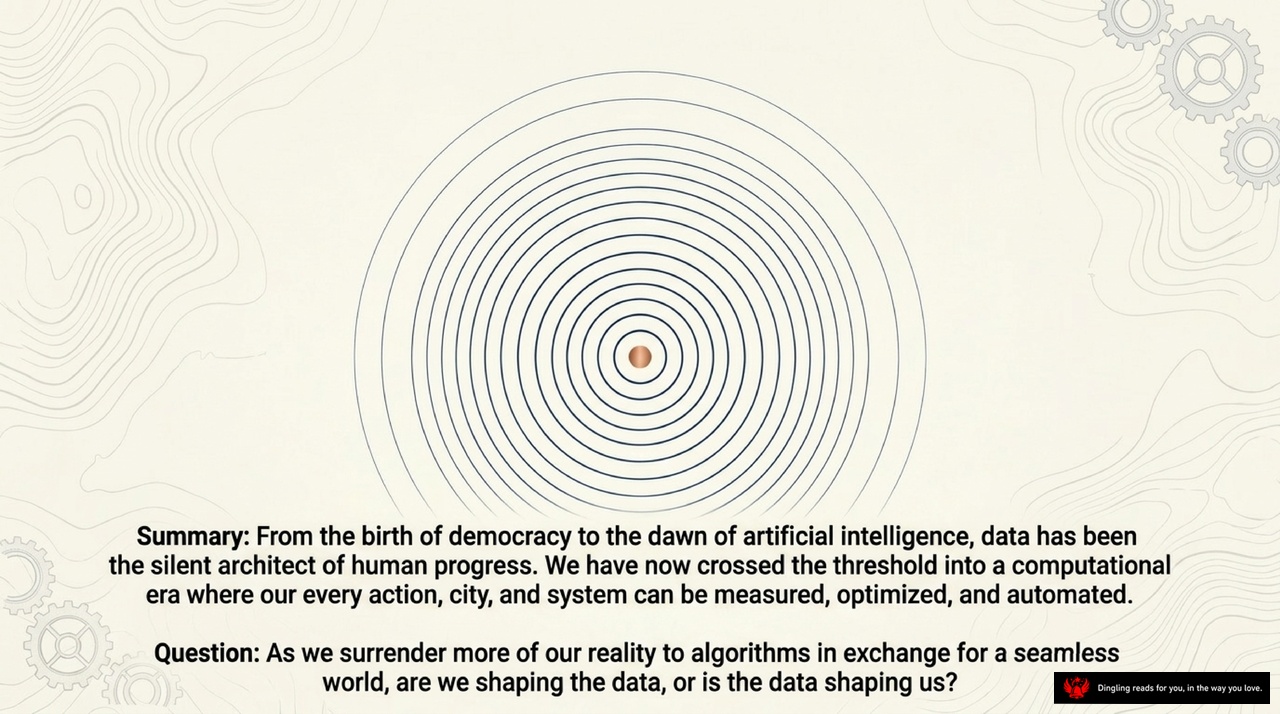
The image presents a powerful visual metaphor: concentric circles radiating from a central point, surrounded by gears and topographic lines. This graphic perfectly captures the book's core thesis—that data is the silent architect driving human progress, from the birth of democracy to the dawn of artificial intelligence.
The slide poses a critical question for our era: "As we surrender more of our reality to algorithms in exchange for a seamless world, are we shaping the data, or is the data shaping us?"
This tension echoes throughout history. In the early days of the United States, founders like Madison and Jefferson didn't just collect numbers; they used data as a tool for governance. The 1790 census wasn't merely a headcount; it was the mechanism that balanced power between large and small states, turning raw population figures into a rational framework for democracy. They believed that by grounding political representation in objective data, they could mitigate the dangers of mob rule.
Fast forward to the Civil War. Here, data became a weapon of liberation. Abraham Lincoln didn't rely on intuition; he relied on the 1860 census. He used precise numbers on land, crops, and troop locations to outmaneuver the Confederacy. He even used data to justify the Emancipation Proclamation, calculating that freeing the enslaved would shift the demographic balance and break the South's economic foundation. In this moment, data didn't just reflect reality; it actively shaped the outcome of history.
Later, in the 20th century, data evolved into a tool for quality and innovation. W. Edwards Deming took statistical sampling from the census office and brought it to the factory floor. His work didn't just measure defects; it redefined Japanese manufacturing culture, turning quality into a competitive advantage that eventually reshaped the global economy.
Today, we stand at the threshold of the computational era. The slide reminds us that we have crossed into a world where every action, city, and system can be measured, optimized, and automated. From the cost-benefit analysis that decided whether to build a dam to the algorithms that now curate our news feeds and drive our cars, data is everywhere.
The central image asks us to look at the relationship between the observer and the observed. Are we the ones designing these algorithms to solve our problems, or are we allowing these systems to define what is possible for us? As we surrender more of our reality to the machine, we must remain vigilant. The data can be a bridge to a smarter future, but only if we remember that the goal is not just efficiency, but human flourishing. The power to shape the data remains in our hands, but the challenge is to ensure we are the ones holding the steering wheel.