
The Practice of Management: Complete Chapter-by-Chapter Summary

Welcome to our deep dive into Peter Drucker's timeless classic, *The Practice of Management*. Today, we're exploring the very foundation of how modern society functions.
As the title on our slide suggests, management is not just an abstract concept or a set of tools; it is the defining organ of all modern institutions. Whether you're running a business, leading a hospital, or directing a university, effective management is what transforms raw resources into societal value and human achievement. Without it, even the most talented teams or the best ideas will fail to take shape.
Drucker argues that management must accomplish three equally vital tasks. First, it must realize the core mission of the institution—for a business, that means achieving real economic results, which is its fundamental reason for existing. Second, it must make work meaningful, giving employees a sense of achievement rather than treating them merely as cogs in a machine. And third, it must manage the institution's impact on society, ensuring that organizations take responsibility for their role in the world.
Think about how far we've come. In 1900, most social tasks were handled by families and small workshops. But as society evolved, these responsibilities shifted to large institutions, with businesses becoming the first mature example. This shift sparked a global management revolution, spreading from American manufacturing to Japan and developing nations alike. However, Drucker reminds us that management isn't just about techniques; it's deeply tied to culture and values. As we move forward, the challenges are even greater: how do we manage knowledge workers? How do we balance productivity with social responsibility? And how do we design organizations that are flexible enough for a rapidly changing world?
In the chapters ahead, we'll unpack exactly what an enterprise is, how to define its mission, and why the true measure of success isn't profit, but the creation of customers. We'll also look at how public service institutions can overcome bureaucratic traps and why the future of work depends on empowering employees, not just controlling them. Join us as we explore the practical wisdom that has guided leaders for decades and continue to shape the future of management.
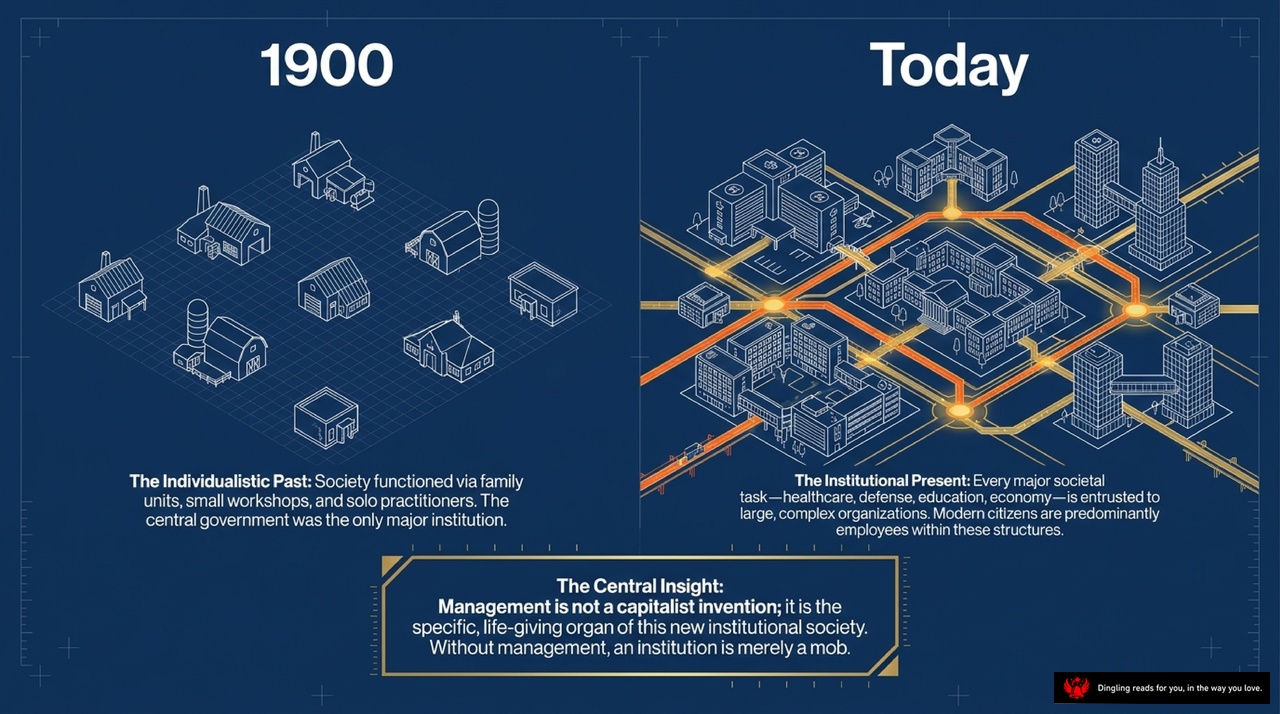
Look at this striking contrast between 1900 and today. On the left, we see the Individualistic Past: society ran on small family units, workshops, and solo practitioners, with the central government as the only major institution. Fast forward to the right, and we see the Institutional Present. Today, every major societal task—from healthcare and defense to education and the economy—is entrusted to large, complex organizations. Modern citizens are now predominantly employees within these structures.
This shift is the very reason management exists. As the slide emphasizes, management is not a capitalist invention; it is the specific, life-giving organ of this new institutional society. Without it, an institution is merely a mob. Think about it: in 1900, you could rely on a family or a small shop to handle your needs. But in our interconnected world, no single person can run a hospital, manage a defense system, or coordinate a global supply chain. These massive institutions require a specialized function to coordinate people, resources, and goals. That function is management. It transforms a collection of individuals into a cohesive, productive force capable of tackling the complex challenges of modern life.

Imagine your organization not as a simple business, but as a grand temple built upon three essential pillars. As we explore the core tasks of management, this visual framework becomes our compass.
The first pillar, highlighted in warm orange, represents **Economic Performance**. This is the foundation. Without fulfilling the specific mission of the institution—whether that's generating profit for a corporation or serving a community—the entire structure collapses. Economic success isn't just a bonus; it's the very reason the institution exists.
Supporting this is the second pillar, glowing in gold: **Productive Work & Worker Achievement**. Management isn't about treating people as mere cogs in a machine. True management makes the mechanics of work logical while ensuring the human worker feels effective and fulfilled. When we balance efficiency with human dignity, productivity naturally follows.
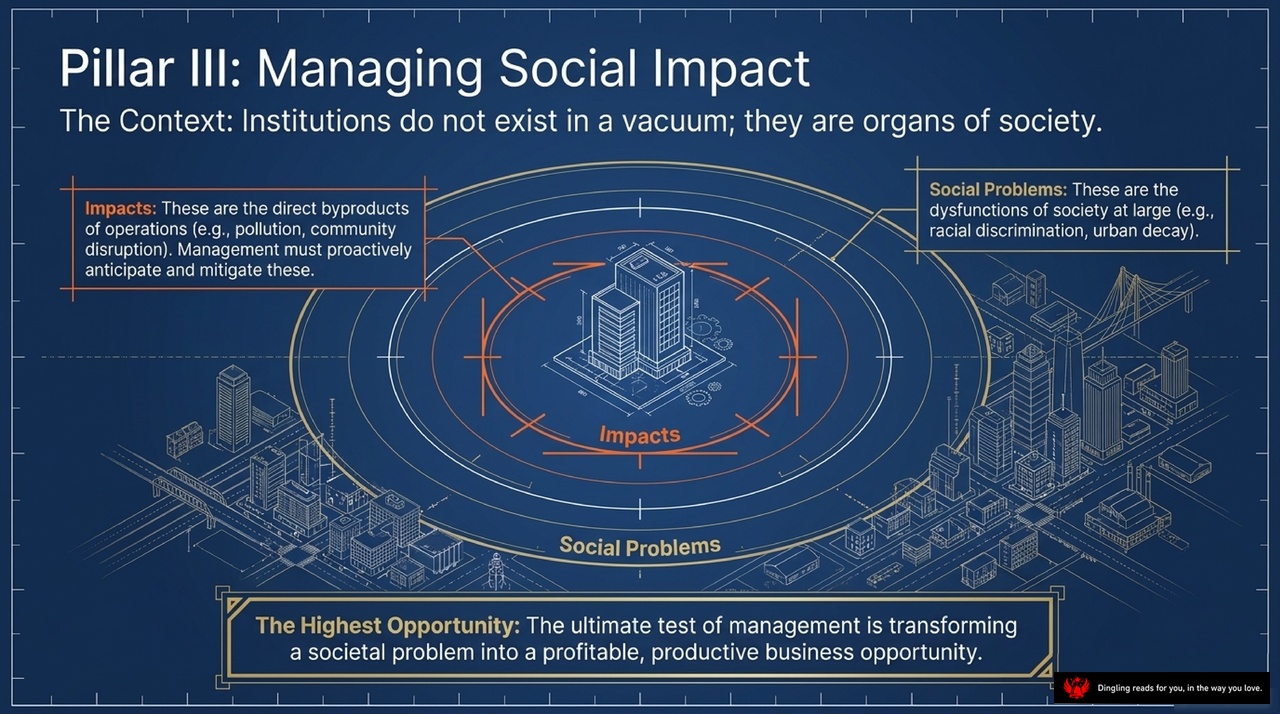
The third pillar, standing in cool blue, is **Social Impact**. This is about managing the organization's footprint on the community and anticipating our societal responsibilities. We cannot operate in a vacuum; we must be good neighbors and responsible citizens.
Crucially, notice how these three elements stand together. The text at the bottom reminds us of a vital truth: these tasks cannot be prioritized sequentially. You cannot solve economic problems before you care about your people or society. Every single managerial decision must balance all three simultaneously. If you neglect one, the stability of the whole institution is at risk. Great management is the art of holding these three inseparable tasks in perfect equilibrium.
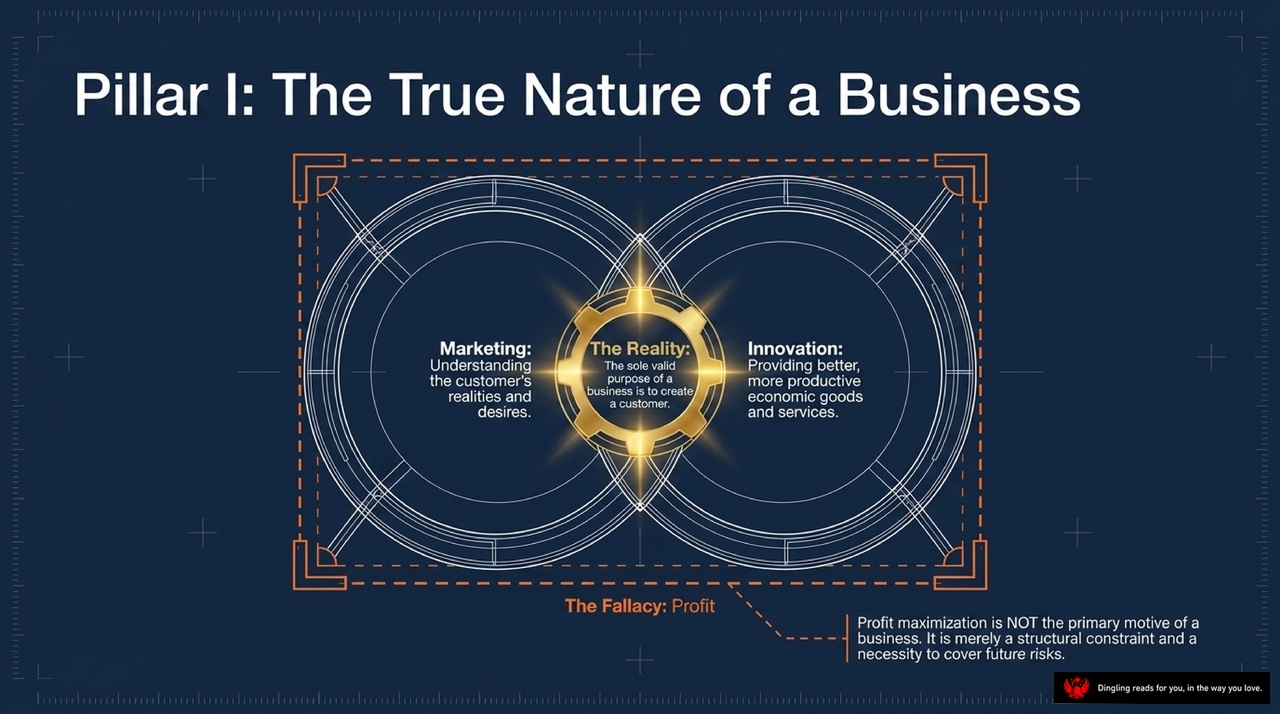
Pillar I: The True Nature of a Business. Look at this diagram. It reveals the fundamental truth that most companies get wrong. We often chase profit as our primary goal, but that is a fallacy. Profit is merely a structural constraint, a necessary outcome to cover future risks, not the engine that drives us.
The real engine lies in the center: creating a customer. That is the sole valid purpose of a business. To do this, you need two powerful pillars working in tandem. On the left, we have Marketing. This isn't just about selling; it's about deeply understanding the customer's realities and desires, even anticipating needs before they are voiced. On the right, we have Innovation. This goes beyond just technology; it includes creating better, more productive economic goods and services. Think of it as making the economy itself more efficient.
When you align deep customer understanding with genuine innovation, you naturally create value. And when you create real value, profit follows as a byproduct. It is the reward for taking on the risk of building something new for the future. If you flip this logic and try to maximize profit first, you end up chasing a mirage, often at the expense of the very customers you need to survive. True business success comes from focusing on the customer and the product, letting the numbers take care of themselves.

The core challenge facing public service institutions—hospitals, universities, and governments—is that they are trapped in a broken feedback loop. Unlike a business, which succeeds by satisfying a specific customer and gets paid directly for that result, these institutions face multiple, often conflicting constituencies. They are funded by a budget allocation rather than market results. This creates a perverse incentive: to please everyone and avoid alienating any single group, they end up maximizing their budget just to survive, rather than focusing on a clear, measurable objective.
The solution isn't to make these institutions act more like businesses. The real fix is accountability. They need clear objectives, concentrated resources, and rigorous performance testing. Without these, they will continue to drift, unable to deliver the results society actually needs.

The duality of work is the heartbeat of modern management. On one side, we have the mechanical and logical side—work itself. It's objective, governed by its own logic of analysis, synthesis, and process control. Think of it as a machine: gears turning, circuits running, efficiency measured in outputs. This is the realm of Taylorism, where we break tasks down to find the perfect, impersonal way to get things done.
But on the other side lies the human and dynamic side—working. This is where the real magic happens. "Working" isn't just about moving parts; it's deeply human. It encompasses our physiology, our psychology, our social connections, our economic needs, and the complex power dynamics at play. It's messy, emotional, and incredibly complex.
Here is the critical insight: managing a modern business requires perfectly aligning these two opposing forces. You must balance the cold, efficient logic of the work with the warm, chaotic reality of the people doing it. If you ignore the human side and treat employees like cogs in a machine, you lose their engagement and innovation. But if you ignore the mechanical side and rely solely on human goodwill without structure or process, you lose efficiency and consistency. Failing to balance both doesn't just lead to mediocre results; it results in systemic collapse. True leadership lies in synthesizing these two worlds.
So, let's talk about the very structure of the organization itself. For decades, managers have been obsessed with this, constantly reshaping and reorganizing their companies. But here is the hard truth: there is no single "best" structure. The old debates about whether to organize around functions or people, or hierarchies versus flat structures, are often pointless arguments that distract us from what really matters.
The core principle is simple: strategy dictates structure. You must first identify the activities that are truly critical to achieving your organizational goals. Once you know those, you design the structure to support them. Think about a company like Sears; their critical activities were procurement and inspection. Or consider Max Spence, where product development was key. The structure must place these high-impact activities in the right spots, whether they are central or decentralized.
We also need to move beyond the binary thinking of "job-centered" versus "person-centered" design. The best approach is a multi-axial system that combines both. The structure should be built around the work and the tasks that drive results, but the specific roles within that structure must be designed to fit the people doing the work. A rigid structure that ignores human capabilities will fail.
Remember, an organization is just a tool to achieve results. Don't get caught up in making the structure look symmetrical or beautiful on paper. The only metric that truly counts is whether the people within it are actually producing outstanding work. If the structure is hindering your team's ability to achieve the mission, it needs to change, regardless of how traditional it looks.
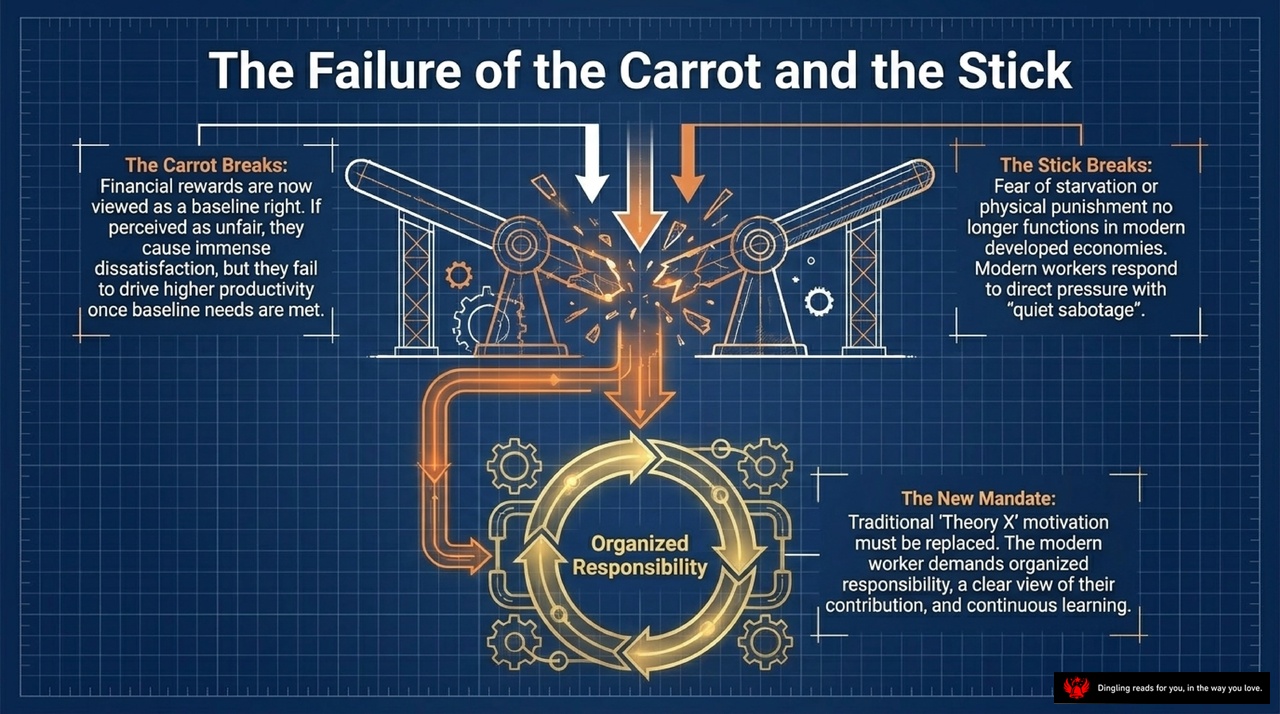
Let's talk about why the old playbook for managing people has completely fallen apart. We used to rely on the "Carrot and the Stick"—the promise of financial rewards or the threat of punishment. But as this slide clearly illustrates, both of these tools are broken.
On the left, you see "The Carrot Breaks." In today's economy, money is viewed as a baseline right, not a special reward. If bonuses feel unfair, they actually create resentment rather than motivation. Once a worker's basic needs are met, throwing more cash at them simply doesn't drive higher productivity anymore.
On the right, "The Stick Breaks." The fear of starvation or physical punishment no longer functions in developed economies. Modern workers don't just quit when pressured; they respond with "quiet sabotage," quietly slowing things down without ever getting caught.
So, what do we do when the old methods fail? The answer is right at the bottom of this slide: "Organized Responsibility." We need to replace the traditional "Theory X" mindset—which assumes people need to be controlled—with a new mandate. Modern workers don't want to be pushed or bought; they demand clarity. They need a clear view of their contribution, a sense of ownership, and continuous opportunities to learn. True motivation comes from giving employees the responsibility to organize their own work, not from controlling them.

Management by Objectives isn't just a buzzword; it's the antidote to the chaos that naturally pulls managers off course. As we see on this slide, traditional structures—hyper-specialization, rigid hierarchies, and flawed compensation systems—act as "misdirecting forces," dragging leaders away from what truly matters. The core philosophy here is simple yet powerful: a manager's goals must be defined entirely by their contribution to the success of the larger unit, not by their specialized craft. We need to shift from control from the outside to a stricter, more exacting control from the inside—self-control. This approach assumes that professionals inherently want to achieve and will discipline themselves if given clear objectives. When individual goals are perfectly aligned with organizational goals, the need for micromanagement disappears, and the organization becomes a cohesive, high-performing unit where everyone pulls in the same direction.
In today's global economy, the definition of corporate success has shifted dramatically. We no longer measure a company's worth simply by its size or the sheer number of products it sells. The real test of management is found in the delicate balance between concentration and diversification. A common mistake is assuming that doing more things automatically makes a company safer or more valuable. History shows us the opposite: the most enduring giants like IBM and Sony have thrived by staying intensely focused on a core market or technology, while companies that blindly diversified into unrelated areas often collapsed under their own complexity.
However, this doesn't mean diversification is dead. It just requires a strategic core. Take Sears, for instance. They sold everything from refrigerators to car insurance and home repair services. On the surface, this looks like a chaotic mix. But the secret was that all these businesses served the same customer: the American middle class. Similarly, Corning Glass used a single technology—glass manufacturing—to dominate everything from scientific lab equipment to everyday dinnerware. The key is that every new venture must either share a common market or rely on a shared technology. Without this logical thread, a company becomes a "holding company" of disconnected assets, managed through confusing reports rather than real operational insight.
When a company does expand, it faces a critical challenge: how to manage without losing its way. Many firms fall into the trap of "misfit," where a project is successful on its own but doesn't align with the company's core identity. General Motors learned this the hard way with tetraethyl lead. It was a profitable chemical, but it required a completely different sales network than their cars. Instead of forcing it into their existing structure, they partnered with a chemical company, keeping their core business clean and focused. True global leadership also requires a shift in mindset. The modern multinational corporation isn't just about exporting goods; it's about integrating the world. Research, production, and sales happen simultaneously across different countries, leveraging local advantages to serve global needs. Ultimately, whether a company stays small, grows medium, or becomes a global giant, its survival depends on one thing: ensuring that every new activity directly serves the company's mission and creates real value for society.
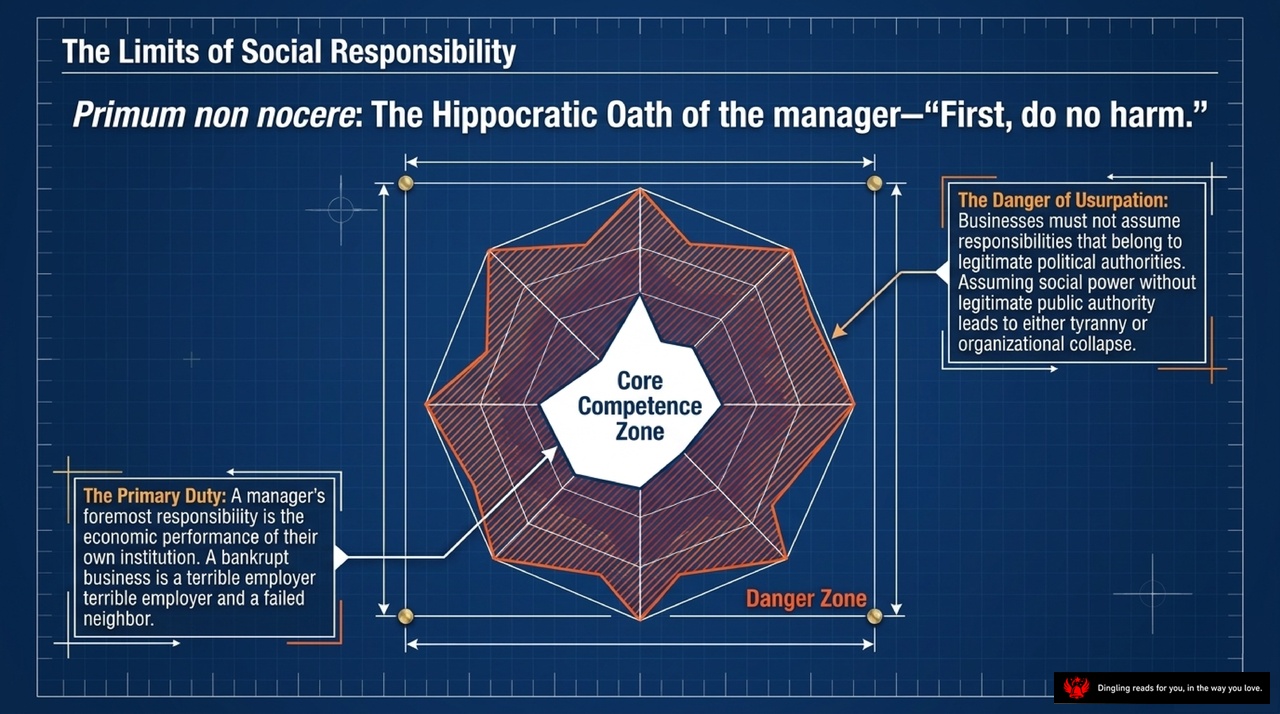
Today's slide cuts through the noise to reveal a hard truth about management: there is a limit to what social responsibility can do. We often hear that companies should fix everything, but the diagram here reminds us of a fundamental rule: *Primum non nocere*, or "First, do no harm." This is the Hippocratic Oath for managers, and it's the boundary we must never cross.
Look at the center of this chart: the "Core Competence Zone." This is where a manager's primary duty lies. As the text explains, a manager's foremost responsibility is the economic performance of their own institution. Why? Because a bankrupt business is a terrible employer and a failed neighbor. If you lose your economic footing, you lose the very foundation needed to help society. You cannot be a responsible neighbor if you don't have the resources to stand up.
Now, look at the outer ring labeled the "Danger Zone." This represents the "Danger of Usurption." This is where businesses go wrong by assuming responsibilities that belong to legitimate political authorities. When a company tries to solve social problems like poverty or inequality without the proper public authority, it leads to either tyranny or organizational collapse. It's a dangerous overreach.
The lesson is clear: social responsibility is not about taking over the government's job. It's about doing your core job so well that you don't cause harm in the process. Stay in your lane, master your economic mission, and avoid the trap of trying to be a savior when you're just a business. That is the only way to truly contribute without destroying yourself or the society you serve.
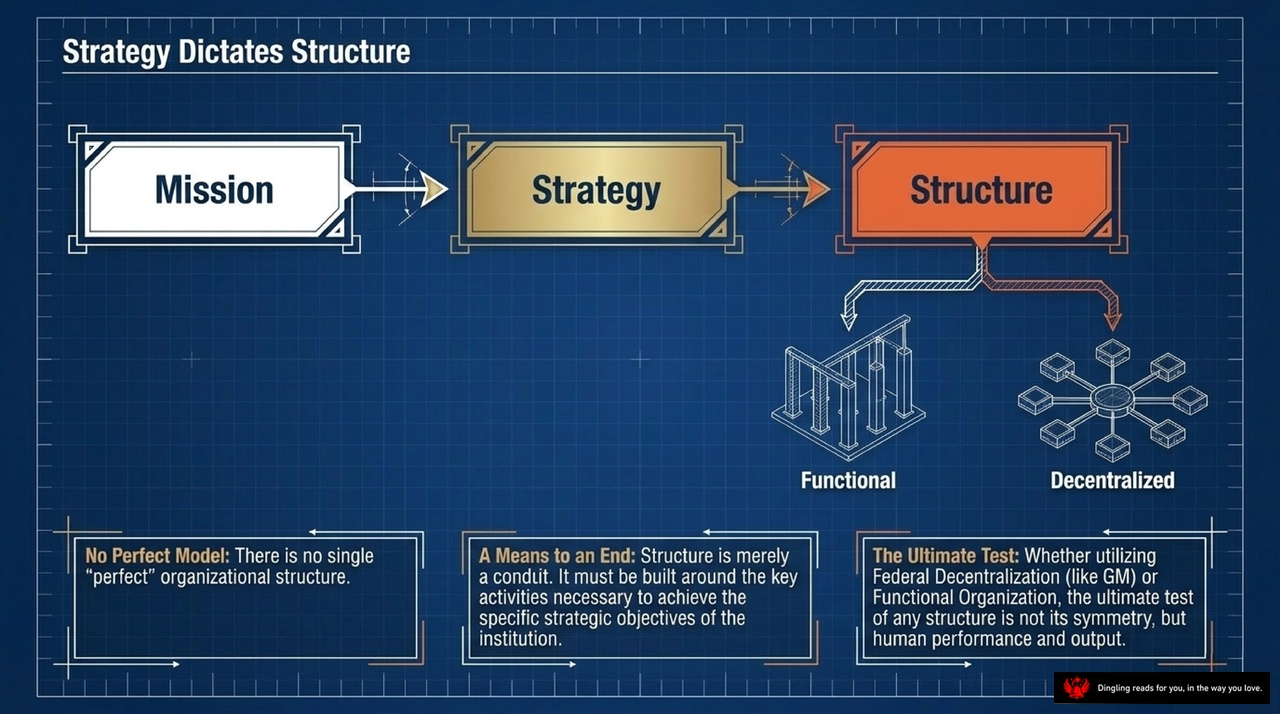
Strategy dictates structure, and that's the golden rule we need to keep in mind. As you can see here, the flow is clear: it all starts with the **Mission**. That's your North Star. Once you have a crystal-clear mission, you can finally craft a winning **Strategy**. And only when your strategy is locked in do you build the **Structure**.
Notice how the diagram splits from there into two paths: **Functional** and **Decentralized**. This visual perfectly captures the book's core argument that there is no single "perfect" organizational model. A structure isn't a rigid cage; it's merely a conduit. It must be built specifically around the key activities necessary to achieve your strategic objectives.
Think about it: if your mission is to innovate globally, a centralized, functional structure might choke you. But if your goal is standardized efficiency, that same structure becomes your strength. The ultimate test of any organization isn't how symmetrical or pretty its chart looks. It's not about the hierarchy itself. The real measure of success is whether your structure unleashes human performance and drives output. Don't let the structure dictate your strategy; let your strategy dictate the structure.

Top management isn't just a title; it's a distinct functional organ with a unique purpose. Think of the ship in our diagram. The bridge and command center represent top management, while the engine room below handles the day-to-day operations. While operational managers focus on the present and specific tasks, top management must look forward to the future and see the whole picture—navigating complex scales and multi-national cultures.
This role demands a cohesive team rather than a single "boss." The complexity of leading a global organization requires leaders with distinct temperaments working in orchestrated unison. It's about function, not status; it's about steering the ship toward a new horizon, not just maintaining the current course.

Today's slide breaks down the ethics of the professional manager into three non-negotiable pillars. First, we must embrace practice over science. Management isn't an exact science you can solve with formulas; it's a practice dealing fundamentally with people, values, and human judgment. Second, character is the non-negotiable prerequisite. While skills can be taught, integrity cannot. You cannot delegate character; it is the foundational prerequisite for leadership. Finally, look at the base of this structure: the source of authority. A manager's power doesn't come from ownership, wealth, or rank. It is based solely on objective contribution and an ethical responsibility to the public good. In a complex world, these aren't just buzzwords—they are the only things that sustain real leadership.

Management isn't just about balancing spreadsheets or maximizing profits; it is the very engine that drives modern society forward. Think of it as the central nervous system for everything from hospitals to universities and corporations. But what is its true purpose? It's not merely to keep the lights on. As we see in the image, responsible management is the ultimate alternative to tyranny. It must do more than just ensure economic performance; it must be dedicated to human achievement and the quality of life.
So, the critical question we face today is this: Are we managing our institutions merely to survive, or are we leading them to elevate the human condition? If we are truly committed to lifting people up, we must stop treating employees as cogs in a machine and start designing work that gives them a sense of accomplishment. We need to move beyond the old idea that management is just about controlling people, and instead focus on creating an environment where everyone can contribute meaningfully. This shift from simple survival to genuine elevation is the difference between a good organization and a great one.