
The Presentation of Self in Everyday Life: Complete Chapter-by-Chapter Summary

Welcome to our deep dive into Erving Goffman's groundbreaking work, *The Presentation of Self in Everyday Life*. Imagine society not as a static structure, but as a grand, continuous theater where every single interaction is a performance. Goffman introduces us to a powerful sociological framework that reveals how we constantly curate our identities, exploring human connection through the metaphor of theatrical performance.
In this iconic image, we see a lone figure standing under a bright spotlight against a dark background. This visual perfectly captures Goffman's central idea: in our daily lives, we are all performers on a stage, and the people around us are our audience. We are constantly managing the impression we leave behind, crafting a specific version of ourselves that fits the context. Whether it's a casual chat with a friend or a formal meeting at work, we are consciously or unconsciously adjusting our "expressive equipment"—our clothing, our tone, our gestures—to align with the expectations of the scene.
Goffman teaches us that there is no such thing as a completely private self when we interact. Our identity is constructed in real-time through these performances. We step into roles, adopt scripts, and use "stage props" like our appearance or the environment we inhabit to reinforce the reality we wish to project. As the text suggests, we are often "believers" who genuinely feel the role we are playing, or perhaps "cynics" who know it's a act but play it anyway. Either way, the performance is the social fact.
So, the next time you walk into a room or start a conversation, remember: you are not just being yourself; you are presenting yourself. You are directing a scene, inviting others to see the character you have chosen to be. This simple shift in perspective changes how we see the world, revealing the intricate, often invisible, drama that plays out in every moment of our lives.

We live by inference: The Information Game. Have you ever noticed how people trust what slips out accidentally far more than what they say on purpose? That's because we all play a subtle game of signals.
Look at this diagram. On the left, there's the person we're watching. They send out two types of messages. First, there are the "Expressions Given"—the bright, yellow beam. These are the controlled signals, the things the performer deliberately projects to define the situation. It's the script, the costume, the rehearsed smile. It's what they want you to see.
But then, there's the second beam, the fainter, blueish trail labeled "Expressions Given Off." These are the uncontrolled leaks. They're the tiny, involuntary slips—maybe a micro-expression, a nervous gesture, or a tone that doesn't quite match the words. These are the cracks in the mask.
Here is the crucial part: observers constantly check these two things against each other. We look at what is being "Given" and compare it to what is being "Given Off" to deduce the true intentions. We are trying to figure out if the performance is real or just an act.
But here is the twist that makes this game so fascinating: it is asymmetric. As the slide notes, the observer almost always trusts the "Given Off" parts—the accidental leaks—more than the deliberate "Given" messages. We think, "If they really believed it, they wouldn't have to tell me so hard." We trust the unconscious slip over the conscious script.
So, in our daily lives, we are all constantly analyzing these beams of light, trying to see through the performance to find the truth hidden in the mistakes.

In the beginning, the medical student wears a mask born of pure belief. They start with sincere, sacred ideals, fully invested in the performance, convinced that their mask *is* their true reality. This is the realm of the sincere performer, where the act of playing a role feels indistinguishable from living it.
But the journey doesn't stay there. As exhaustion sets in and the routine of the profession grinds on, that initial idealism often curdles into cynicism. The mask, once a tool of passion, transforms into a protective shield against the audience—against the patients, against the world. The performer stops believing in the act and starts using it purely for manipulation or self-preservation. This is the cynic, completely detached from the role they play.
The real tragedy, however, lies in the middle ground. As Robert Ezra Park noted, we come into the world as individuals, but over time we achieve character and inevitably become masks. Mastery and societal validation pull us back and forth, but often, we get stuck in the loop. We perform so long that the mask stops being something we wear and starts being the very face we see in the mirror. The distinction between the sincere and the cynical blurs until, as the diagram suggests, the mask becomes the face itself.

In the theater of everyday life, success isn't just about what you say, but how you look and where you stand. Think of the classic doctor's office: the sterile exam room, the crisp white coat, and the authoritative demeanor. These aren't random details; they are your standardized expressive equipment, the essential tools that tell the audience exactly who you are before you even speak a word.
Your performance relies on three synchronized elements. First, the setting provides the fixed backdrop—the furniture and decor that define the scene, like that examination room or a luxury club. Second, your appearance acts as a symbol of your social status, signaled by your clothing and ritual state. Finally, your manner dictates the interaction role you play, whether you are expected to be aggressive, meek, or authoritative.
Here is the crucial insight: audiences expect strict consistency across all three. If a high-status official suddenly acts overly apologetic in a formal setting, or if a judge wears casual street clothes, the illusion shatters. A misalignment between your setting, appearance, and manner destroys the very reality you are trying to construct. To maintain the front, these elements must align perfectly, creating a seamless experience that convinces the world of your role.

Look at this iceberg. The glowing yellow triangle at the top represents the "Official Performance"—the polished, idealized image we project to the world. But beneath that surface lies the "Concealed Reality," a chaotic tangle of gears and machinery. This is where the "Illusion of Idealization" truly lives.
Let's break down what's hidden underneath. On the left, you see "Invisible Costs." This is the exhausting rehearsal and preparation required just to appear spontaneous. It's the grueling work behind the scenes that makes the front look effortless. Below that is "Dirty Work"—the semi-illegal, cruel, or degrading tasks that are often outsourced to maintain a pure front. We hide the messy, unethical parts so the overall image remains pristine.
Now, look to the right. We have "Secret Errors"—the mistakes and compromises hidden before the audience even arrives. No one wants to see the cracks in the armor. And finally, "Profit Motives." These are the financial or selfish drivers that are masked by the appearance of noble service. We sell a story of altruism while the engine is running on self-interest.
In our daily lives, we all play this role. Whether you're a professional at work or a parent at home, we all curate a version of ourselves that fits social expectations. We hide our doubts, our fatigue, and our true motivations behind a facade of perfection. This slide reminds us that what we see is just the tip of the iceberg; the real story is often far more complex and less glamorous than it appears on the surface.
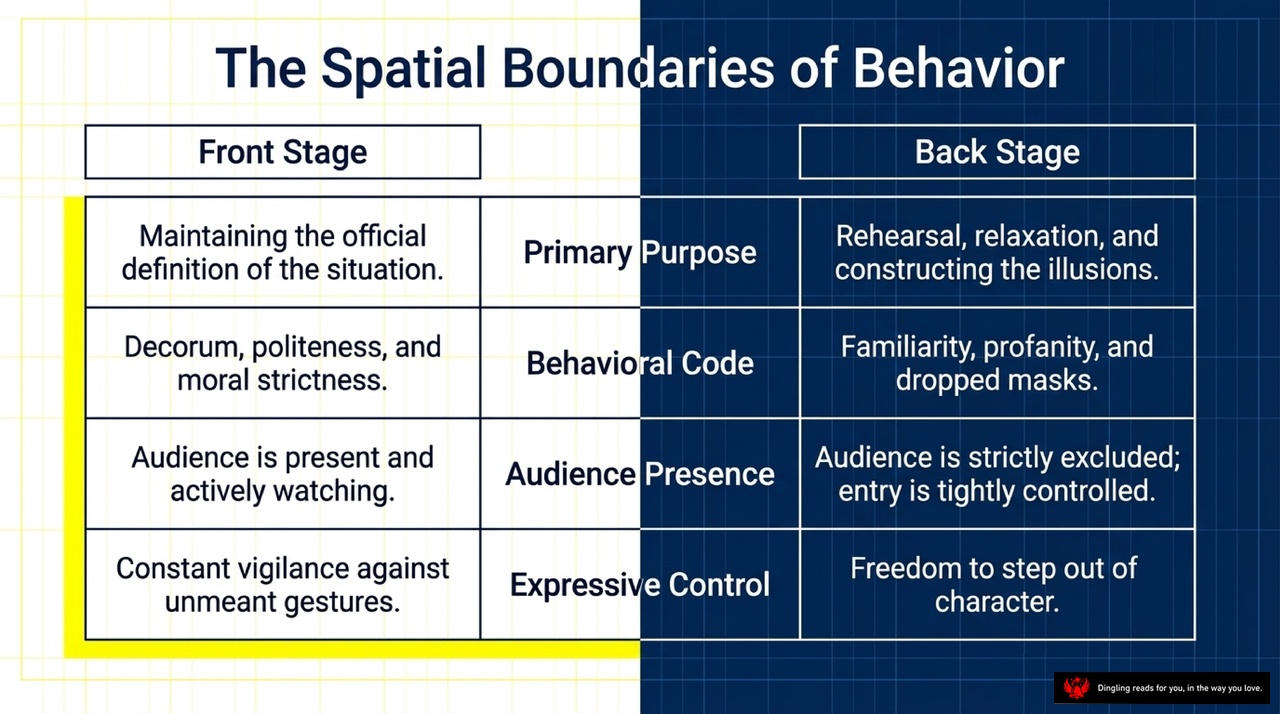
Welcome back. Today, we're diving into the hidden mechanics of social interaction, specifically looking at how performers manage their image when the audience isn't watching. We've established that the "Front Stage" is where we perform our ideal selves with strict decorum, but what happens behind the curtain?
Enter the "Back Stage." This is the performer's sanctuary—a space strictly excluded from the audience where they can finally relax, rehearse, and drop their masks. It's here that the behavioral codes we meticulously maintained on stage are discarded. In the kitchen of the Shetland Islands hotel, for instance, the staff and owners shed their middle-class pretenses. Instead of polished service, they engage in familiar banter, eat simple boiled fish with skins on, and even taste the pudding they serve. The back stage allows for a necessary release, a place to vent frustration and prepare for the next act without fear of judgment.
But this separation isn't just about comfort; it's about control. The back stage protects the secrets of the performance. If the audience were to see the messy reality behind the scenes—the unpolished food, the tired staff, the private arguments—the entire illusion of the front stage would collapse. Think about your own life: how many times have you felt the need to lower your voice or act differently the moment you step into a neighbor's house? That's the boundary of the back stage in action. We use walls, locks, and social norms to keep the "audience" out, ensuring that our private, unscripted selves remain hidden.
However, this separation is fragile. Sometimes, the boundary blurs. A waiter might accidentally let a customer hear a complaint about them in the kitchen, or a neighbor might overhear a private argument through a thin wall. When the back stage leaks into the front stage, the performance risks failure. The performer is forced to scramble, either by hiding the breach or by improvising a new script on the fly.
Ultimately, the back stage is essential for the front stage to exist. It provides the safety needed to be human, the space to recover from the exhausting vigilance of public life. Without this hidden area where we can step out of character, the performance would become impossible, and the social order we rely on would dissolve into chaos. We are constantly balancing these two worlds, walking the line between who we are and who we must pretend to be.

Imagine the entire social world as a grand theater where we are all constantly on stage. As we wrap up our exploration of Erving Goffman's dramaturgical theory, let's step back and look at the big picture. We've journeyed through the fragile reality of performance, the hidden teamwork of the "dramatic team," the strategic separation of front and back regions, and the unique roles of experts and friends who support us behind the scenes.
What emerges from these chapters is a powerful framework for understanding human interaction. It teaches us that our social scenes are built on a mutual dependence contract. Just like the actors on that stage in our diagram, who share a "sweet guilt of conspirators" and present a united front, we all rely on each other to maintain the illusion of order. If one person breaks character, the entire group's reality can crumble.
But here is the profound insight: this isn't just about pretending. Your personality isn't a fixed inner core waiting to be discovered; it is the very product of these performances. You become who you are through the roles you play and the audiences you face. Whether you are a professional navigating a client meeting or a friend hosting a dinner party, you are actively constructing your identity in real-time.
Ultimately, Goffman's theory offers us a liberating perspective. It shows that while we manage impressions, we are not trapped by them. We have the agency to choose which roles to emphasize, which backstage secrets to reveal to our confidants, and how to navigate the delicate balance between social expectation and our authentic selves. We are all skilled actors, and understanding the script allows us to perform with more confidence and authenticity in our own lives.

Imagine the curtain falls on a performance, and the audience scatters. In that fleeting moment between the applause and the next act, something fascinating happens behind the scenes. The rigid masks we wear for the world suddenly slip, revealing a very different reality. This slide, "Breaking Character: Communication Behind the Mask," captures the secret language of the theater troupe—what Goffman calls the "backstage."
Look at the top left quadrant: "Treatment of the Absent." This is where the true work of team morale happens. Once the audience leaves, the performers don't just relax; they engage in "backstage derogation." They mock the very people they just served with such polished courtesy. Why? Because this shared ridicule acts as a pressure valve, reinforcing the team's solidarity and reminding everyone that the polite front was just a job, not a reflection of their true feelings.
Move your eyes to the top right, labeled "Staging Talk." This is the rehearsal for the next show. Here, the troupe engages in post-mortems and gossip. They dissect past mistakes, analyze what went wrong, and, crucially, choreograph the next interaction. They discuss the "script" for the upcoming performance, ensuring everyone knows their lines and cues. It's a strategic planning session disguised as casual chat, keeping the team aligned and ready for the next spotlight.
Now, look at the bottom left: "Team Collusion." This is the invisible network of secret signals. Think of retail clerks using code words or subtle glances to communicate without alerting a customer. These hidden cues allow the team to coordinate—perhaps to avoid a difficult request or to signal that a colleague needs help—while maintaining the perfect illusion of independence and competence in front of the audience.
Finally, in the bottom right, we see "Realigning Actions." This is where boundaries are tested in the shadows. It's where team members might exchange veiled complaints or subtle acts of mutiny against the official rules, all while pretending to cooperate. It's a way of venting frustration or negotiating power dynamics without breaking the fragile contract with the audience.
Together, these four quadrants show us that social interaction isn't just a series of isolated performances. It's a complex, collaborative dance where the "backstage" is just as vital as the "front stage." It's where the real work of maintaining our social reality takes place, hidden in plain sight.

The secret behind every smooth social interaction lies in the invisible team working behind the scenes. We call this the "team," a group of people who collaborate to maintain a specific reality for the audience. Think about a hospital teaching session: two senior doctors might have spent the night analyzing a patient's case together, yet when they stand before an intern, they pretend to be working independently. They don't just act alone; they choreograph a performance where one asks and the other answers, creating a unified impression of expertise that neither could project alone.
This teamwork is essential because the performance's success depends on everyone staying in sync. If one member slips up—like a child speaking out of turn at a family dinner or an employee making a gaffe in a meeting—the entire illusion can collapse. To protect this fragile reality, teams develop secret signals. A salesperson might tap their foot to call for the "manager" to handle a difficult customer, or a mother might raise her voice to signal her daughter to clean up before guests arrive. These non-verbal cues allow the team to solve problems without breaking the show in front of the audience.
But there's another layer to this backstage coordination: the team's relationship with the audience. Once the audience leaves, the team often engages in "mocking the absent." They might imitate a customer's annoying habits or use derogatory nicknames that would be unthinkable in public. This isn't just malice; it's a way to release tension and reinforce their own solidarity. By venting about the audience behind their backs, team members recommit to their roles when the audience returns, ensuring the next performance is even stronger. It's a complex dance of public cooperation and private venting that keeps our social world running smoothly.

When we step onto the social stage, we quickly learn that reality is incredibly fragile. It doesn't survive on being "mostly good." Think of an interaction like a musical chord; if just a single note is out of tune, the entire composition is ruined. This is the danger of the "unmeant gesture"—a momentary slip of control, an awkward intrusion, or a social faux pas that shatters the carefully built illusion and brings the interaction to an embarrassing halt.
We often think of our social persona as an extension of who we really are, but that's a trap. Our performance is actually a delicate construction of symbols and behaviors designed to fit a specific context. A small mistake—a dropped fork, a wrong word, or a sudden burst of emotion—can expose the gap between our "front stage" performance and our "back stage" reality. Once that gap is visible, the audience sees through the act, and the trust we've built evaporates instantly.
This fragility is why we constantly work to maintain our "dramatic definition of the situation." We aren't just reacting naturally; we are carefully curating every gesture to ensure it aligns with the role we are playing. Whether it's a professional in a meeting or a friend at a dinner party, we are all actors trying to keep the spotlight on our best selves. And if we slip up, even for a second, the whole performance collapses. That is the true cost of social life: the constant, exhausting effort to keep the illusion intact.

Now, let's dive into the delicate art of impression management. Think of social interaction as a stage where we are all actors, and the success of our performance depends on a silent, unspoken agreement between the performer and the audience.
On one side of this balance, we have the actor's defenses. This is the hard work we do behind the scenes to keep the illusion intact. It requires loyalty to the role, discipline to suppress our true emotions, and circumspection to plan ahead and limit our audience. We are constantly guarding our secrets and controlling our expressions to ensure the performance remains believable.
On the other side, we have the audience's tact. This is perhaps the most crucial part of the equation. It is the audience's willingness to practice "willful ignorance." When an actor slips up, when the mask cracks, the audience often chooses to look away. They ignore the mistakes and pretend not to see the cracks in the facade. This tact is what allows the performance to survive.
The synthesis point here is profound: a performance only survives because both the actor and the audience actively conspire to protect the illusion. It is a shared secret. Without the audience's complicity in ignoring reality, the actor's defenses would crumble instantly. This dynamic explains why we can maintain professional personas, why we can hide our vulnerabilities, and why social interactions often feel so smooth despite the chaos underneath. We are all in this together, co-creating the reality we wish to see.

In the shadows of our social stage, a darker, more honest truth often emerges once the audience leaves. While we strive for perfection on the front stage, the back stage is where the real work of morale happens. When the curtain falls, the rigid masks we wear crumble, and we engage in what sociologists call "spoil the performance." This isn't about malice; it's about survival.
Think about your own life. When your boss leaves the office, do you still speak with that authoritative tone? Or do you immediately relax, using nicknames and inside jokes that would be disastrous in front of clients? This is the universal human experience of "denigration of absent audience." We mock the very people we just served to relieve the tension of the performance and bond with our own team.
This dynamic extends to our daily conversations. We speak in a specialized "jargon" that only insiders understand, creating a secret language that reinforces our group identity while excluding outsiders. We use subtle signals—a raised eyebrow, a specific hand gesture—to coordinate our next move without breaking character. We might even engage in "collusive mockery," laughing at the absurdity of the script we just had to follow, finding humor in the constraints we all agree to play by.
But there is a fine line between this necessary rebellion and crossing the boundary. If the secrets of the back stage leak out, the entire performance collapses. Trust is everything. That's why we are so quick to police our own group, ensuring that no one accidentally reveals the messy reality behind the polished facade. We protect the illusion not just for the audience, but for each other, because without that shared lie, the social order we rely on would simply fall apart.